For More Information
Visit RAND at www.rand.org
Explore the RAND Arroyo Center
View document details
Support RAND
Purchase this document Browse Reports & Bookstore Make a charitable contribution
Limited Electronic Distribution Rights
This document and trademark(s) contained herein are protected by law as indicated in a notice appearing later in this work. This electronic representation of RAND intellectual property is provided for non-commercial use only. Unauthorized posting of RAND electronic documents to a non-RAND website is prohibited. RAND electronic documents are protected under copyright law. Permission is required from RAND to reproduce, or reuse in another form, any of our research documents for commercial use. For information on reprint and linking permissions, please see RAND Permissions.
Skip all front matter: Jump to Page 1
6
The RAND Corporation is a nonprofit institution that helps improve policy and decisionmaking through research and analysis.
This electronic document was made available from www.rand.org as a public service of the RAND Corporation.
CHILDREN AND FAMILIES EDUCATION AND THE ARTS ENERGY AND ENVIRONMENT
HEALTH AND HEALTH CARE INFRASTRUCTURE AND
TRANSPORTATION INTERNATIONAL AFFAIRS
LAW AND BUSINESS NATIONAL SECURITY POPULATION AND AGING PUBLIC SAFETY SCIENCE AND TECHNOLOGY TERRORISM AND HOMELAND SECURITY
This product is part of the RAND Corporation technical report series. Reports may include research findings on a specific topic that is limited in scope; present discussions of the methodology employed in research; provide literature reviews, survey instru-ments, modeling exercises, guidelines for practitioners and research professionals, and supporting documentation; or deliver preliminary findings. All RAND reports un-dergo rigorous peer review to ensure that they meet high standards for research quality and objectivity.
ARROYO CENTER
The Effect of Military
Enlistment on Earnings
and Education
David S. Loughran, Paco Martorell, Trey Miller, Jacob Alex Klerman Prepared for the United States Army
The R AND Corporation is a nonprofit institution that helps improve policy and decisionmaking through research and analysis. RAND’s publications do not necessarily reflect the opinions of its research clients and sponsors.
R
®
is a registered trademark.© Copyright 2011 RAND Corporation
Permission is given to duplicate this document for personal use only, as long as it is unaltered and complete. Copies may not be duplicated for commercial purposes. Unauthorized posting of RAND documents to a non-RAND website is prohibited. RAND documents are protected under copyright law. For information on reprint and linking permissions, please visit the RAND permissions page (http://www.rand.org/publications/ permissions.html).
Published 2011 by the RAND Corporation
1776 Main Street, P.O. Box 2138, Santa Monica, CA 90407-2138 1200 South Hayes Street, Arlington, VA 22202-5050 4570 Fifth Avenue, Suite 600, Pittsburgh, PA 15213-2665
RAND URL: http://www.rand.org
To order RAND documents or to obtain additional information, contact Distribution Services: Telephone: (310) 451-7002;
Fax: (310) 451-6915; Email: [email protected]
The research described in this report was sponsored by the United States Army under Contract No. W74V8H-06-C-0001.
Library of Congress Cataloging-in-Publication Data
The effect of military enlistment on earnings and education / David S. Loughran ... [et al.]. p. cm.
Includes bibliographical references. ISBN 978-0-8330-5823-2 (pbk. : alk. paper)
1. Veterans—United States—Economic conditions. 2. Veterans—Education—United States—Statistics. 3. Educational attainment—United States—Statistics. 4. Income—United States—Statistics. I. Loughran, David S.,
1969-UB357.E37 2011 331.2'97308697—dc23
iii
Preface
Each year, more than 150,000 young men and women enlist in the active component of the U.S. military. The experience of these enlistees while serving their country will undoubtedly influence their long-run labor market outcomes, but just how is not well understood. The research described in this report seeks to estimate the causal effect of military enlistment on labor market earnings and educational attainment as many as 18 years following enlistment. The report will be of interest to policymakers and military manpower analysts interested in how early military experiences affect long-run labor market and educational outcomes.
This research was sponsored by the United States Army Accessions Command and con-ducted within RAND Arroyo Center’s Manpower and Training Program. RAND Arroyo Center, part of the RAND Corporation, is a federally funded research and development center sponsored by the United States Army.
The Project Unique Identification Code (PUIC) for the project that produced this docu-ment is RAND10469.
For more information on RAND Arroyo Center, contact the Director of Operations (telephone 310-393-0411, extension 6419; FAX 310-451-6952; email Marcy_Agmon@rand. org) or visit the Arroyo Center’s website at http://www.rand.org/ard/.
v
Contents
Preface . . . . iii Figures . . . .vii Tables . . . . ix Summary . . . . xi Acknowledgments . . . .xix Abbreviations . . . .xxi CHAPTER ONE Introduction . . . . 1 CHAPTER TWO Methods and Data . . . . 5Enlistment, Reenlistment, and Military Compensation . . . .5
Empirical Approach . . . .6
Data . . . 7
Limitations of Our Approach . . . .8
CHAPTER THREE The Effect of Army Enlistment on Labor Market Earnings . . . .13
Earnings Data . . . .13
Earnings Model Specification . . . .17
Results . . . .17
1989 Applicant Cohort . . . .17
Application Year . . . .19
Armed Forces Qualification Test . . . 22
Race/Ethnicity and Gender . . . 23
In-Service . . . 24
CHAPTER FOUR The Effect of Army Enlistment on Educational Attainment . . . .35
Education Data . . . .35
Education Model Specification . . . 38
Results . . . .39
College Enrollment . . . .39
College Degree Attainment . . . 42
vi The Effect of Military Enlistment on Earnings and Education
CHAPTER FIVE
Conclusion . . . .49 APPENDIX
The Effect of Enlistment on Labor Market Earnings: All Services . . . .51
vii
Figures
S.1. Estimated Effect of Army Enlistment on Annual Earnings, by Years
Since Application . . . .xiii
S.2. Estimated Percentage Effect of Army Enlistment on Annual Earnings, by Years
Since Application . . . .xiii
S.3. Estimated Percentage Effect of Army Enlistment on Annual Earnings, by Years
Since Application and AFQT Category . . . .xv
S.4. Estimated Effect of Army Enlistment on College Degree Attainment, by Years
Since Application . . . .xv
S.5. Estimated Effect of Enlistment on College Degree Attainment, by Years Since
Application: All Services Combined . . . .xvi
2.1. Fraction of Enlistees Serving in the Active Component, by Years Since Application . . . . .11
3.1. Estimated Effect of Army Enlistment on Annual Earnings, by Years Since
Application: 1989 Applicant Cohort . . . .18
3.2. Estimated Effect of Army Enlistment on Annual Earnings, by Years Since
Application: All Applicant Cohorts . . . .21
3.3. Estimated Percentage Effect of Army Enlistment on Annual Earnings, by Years
Since Application: All Applicant Cohorts . . . .21
3.4. Estimated Percentage Effect of Army Enlistment on Annual Earnings, by Years
Since Application and AFQT Category: All Applicant Cohorts . . . 22
3.5. Estimated Percentage Effect of Army Enlistment on Annual Earnings, by Years
Since Application and Race/Ethnicity . . . .25
3.6. Estimated Percentage Effect of Army Enlistment on Annual Earnings, by Years
Since Application and Gender: All Applicant Cohorts . . . 28
3.7. Estimated Effect of Army Enlistment on Annual Earnings, by Years Since Application, AFQT Category, and Whether Currently Serving in the Active
Component: All Applicant Cohorts . . . .31
4.1. Percentage of U.S. College Enrollment and Degrees Awarded Covered by
NSC Data, by Year . . . 36
4.2. Estimated Effect of Army Enlistment on Current College Enrollment, by Years
Since Application . . . 40
4.3. Estimated Effect of Army Enlistment on Cumulative College Enrollment, by Years Since Application . . . .41
4.4. Estimated Effect of Army Enlistment on Cumulative College Enrollment, by Years Since Application and AFQT Category . . . .41
4.5. Estimated Effect of Army Enlistment on College Degree Attainment, by Years
Since Application . . . 43
4.6. Estimated Effect of Army Enlistment on Two-Year College Degree Attainment,
viii The Effect of Military Enlistment on Earnings and Education
4.7. Estimated Effect of Army Enlistment on Four-Year College Degree Attainment,
by Years Since Application and AFQT Category . . . 44
4.8. Estimated Effect of Army Enlistment on Two-Year College Degree Attainment,
by Years Since Application and Race/Ethnicity . . . .45
4.9. Estimated Effect of Army Enlistment on Four-Year College Degree Attainment,
by Years Since Application and Race/Ethnicity . . . .45
4.10. Estimated Effect of Enlistment on College Degree Attainment, by Years Since
Application: All Services Combined . . . 46
4.11. Estimated Effect of Enlistment on Two-Year College Degree Attainment, by Years Since Application and AFQT Category: All Services Combined . . . .47
4.12. Estimated Effect of Enlistment on Four-Year College Degree Attainment, by Years Since Application and AFQT Category: All Services Combined . . . .47
ix
Tables
2.1. Mean and Standard Deviation of Applicant Characteristics: All Active-Component
Applicants . . . .9
2.2. Mean and Standard Deviation of Applicant Characteristics: Army Applicants . . . .10
3.1. Mean Annual Earnings, by Years Since Application and Year of Application: Army Enlistees . . . .15
3.2. Mean Annual Earnings, by Years Since Application and Year of Application: Army Non-Enlistees . . . .16
3.3. Estimated Effect of Army Enlistment on Annual Earnings, by Years Since Application and Year of Application . . . 20
3.4. Estimated Effect of Army Enlistment on Earnings, by Years Since Application and AFQT Category: All Applicant Cohorts . . . 23
3.5. Re-Weighted Estimated Effect of Army Enlistment on Annual Earnings, by Years Since Application and AFQT Category: All Applicant Cohorts . . . 24
3.6. Estimated Effect of Army Enlistment on Annual Earnings, by Years Since Application and Race/Ethnicity: All Applicant Cohorts. . . 26
3.7. Re-Weighted Estimated Effect of Army Enlistment on Annual Earnings, by Years Since Application and Race/Ethnicity: All Applicant Cohorts . . . 27
3.8. Estimated Effect of Army Enlistment on Annual Earnings, by Years Since Application and Gender: All Applicant Cohorts . . . .29
3.9. Re-Weighted Estimated Effect of Army Enlistment on Annual Earnings, by Years Since Application and Gender: All Applicant Cohorts . . . 30
3.10. Estimated Effect of Army Enlistment on Annual Earnings, by Years Since Application and AFQT Category Across All Applicant Cohorts: Currently Serving in the Active Component . . . .32
3.11. Estimated Effect of Army Enlistment on Annual Earnings, by Years Since Application and AFQT Category Average Across All Applicant Cohorts: Currently Separated from the Active Component . . . .33
4.1. Sample Sizes and Sampling Weights for Educational Analyses . . . .37
4.2. Mean Educational Outcomes, by Years Since Application: Army Enlistees . . . 38
4.3. Mean Educational Outcomes, by Years Since Application: Army Non-Enlistees . . . .39
4.4. Estimated Effect of Army Enlistment on Cumulative Two- and Four-Year College Enrollment, by Years Since Application and AFQT Category . . . 42
4.5. Estimated Effect of Army Enlistment on Cumulative Two- and Four-Year College Enrollment, by Years Since Application and Race/Ethnicity . . . 43
A.1. Estimated Effect of Enlistment on Earnings, by Years Since Application and Service: All Applicant Cohorts . . . .51
x The Effect of Military Enlistment on Earnings and Education
A.2. Estimated Effect of Enlistment on Earnings, by Years Since Application and Year of Application: All Services Combined. . . .52
A.3. Estimated Effect of Enlistment on Earnings, by Years Since Application and AFQT Category: All Services and Applicant Cohorts Combined . . . .53
xi
Summary
Military compensation is one of the Department of Defense’s most important means for attracting and retaining a force of young men and women qualified to meet the nation’s national security objectives. As such, it is natural to want to compare military compensa-tion with the compensacompensa-tion service members might receive were they to work in the civilian economy instead. Interpreting the difference in earnings between veterans and nonveterans, though, is complicated by the fact that individuals who do and do not serve in the military differ in ways that are likely to influence their earnings. The selective nature of military service makes it difficult to determine whether the observed difference in earnings is attributable to military service or to differences in the characteristics of these individuals.
In the research reported here, we refine comparisons between the earnings of enlist-ees and non-enlistenlist-ees employing an approach first implemented by Angrist (1998). The core assumption we make is that an enlistee drawn at random from the pool of military applicants will be more similar to a randomly selected applicant that did not enlist than to a randomly selected non-applicant. Thus, we assume that differences in the earnings of military applicants who do and do not ultimately enlist will provide a better estimate of the causal effect of enlist-ment than will differences in the earnings of enlistees and all non-enlistees combined (i.e., non-enlisted applicants and non-applicants). We further assume that the rich set of applicant characteristics recorded on the military application record, information that is not found in the typical survey, controls adequately for any remaining differences between applicants who do and do not enlist that are correlated with earnings. Although this assumption, which Angrist refers to as the assumption of “selection on observables,” is quite strong, it is perhaps not unreasonable in this particular context, in which the sample is restricted to individuals with a common propensity to apply for military service and the available control variables are those that the military uses to screen applicants for service.
Our analysis expands on the work of Angrist (1998) in several important ways. First, we employ data on more recent cohorts of military applicants (individuals applying for military service between 1989 and 2003). Second, we follow military applicants for as many as 18 years following application, allowing us to estimate longer-run effects of enlistment on earnings. Third, our estimates account for military allowances and bonuses, which constitute a signifi-cant portion of military earnings. Fourth, our estimates are conditioned on a broader range of observable differences between enlistees and non-enlistees, including earnings prior to applica-tion. Finally, our analyses consider not only how enlistment affects earnings, but also how it affects a critical determinant of earnings, college education.
xii The Effect of Military Enlistment on Earnings and Education
Data and Methods
We employ administrative data on military applicants applying for active-component enlisted service between 1989 and 2003. We restrict our sample to the typical qualified applicant: indi-viduals 17 and older with at most a high school diploma (excluding those with varying levels of postsecondary education) who meet the military’s minimum enlistment standards with respect to aptitude, health, and drug and alcohol use. We obtained longitudinal earnings data for each of these applicants from military pay files and the Social Security Administration. Our mea-sure of earnings captures virtually all cash compensation paid to these individuals from mili-tary and civilian sources. Data on college enrollment and degree attainment for a subsample of applicants were obtained from the National Student Clearinghouse, a nonprofit organization that contracts with institutions of higher education to verify college enrollment and degree receipt for student loan agencies. The earnings data span 1994 to 2007, and the college enroll-ment and degree attainenroll-ment data span 1991 to 2010.
With these individual-level longitudinal administrative data, we estimate the effect of enlistment on earnings and education by years since application, controlling for age, gender, year of application, service, race/ethnicity, educational attainment, and scores on the Armed Forces Qualification Test (AFQT). Our earnings model also controls for earnings prior to application.
Although we believe these data allow for better estimates of the effect of enlistment on earnings and education than are typically found in the literature, we acknowledge several limitations with our approach. First, it could be that we do not fully control for differences between enlistees and non-enlistees that are correlated with earnings and education. As such, our estimates could still be biased estimates of the true causal effect of enlistment on earnings and education. Second, we estimate the effect of ever having enlisted rather than the effect of a specific length of military service. Although we observe years of military service in our data, it is less plausible that the covariates available on the applicant record are sufficient to control for differences in enlistees who serve for different periods of time; therefore, comparing the educational attainment or earnings of such persons would confound the potential effects of individual differences on outcomes with those of military service. Third, we estimate the effect of enlistment on cash compensation rather than on total compensation, which would include the value of health, deferred, and in-kind benefits. While we know exactly what those benefits are in the military context, assigning a cash-equivalent value to them can be difficult. Further-more, while we can directly observe the cash compensation of applicants that do not enlist, we do not observe their noncash benefits. Making the necessary imputations for all of our 15 applicant cohorts is beyond the scope of this study.
Results
Figure S.1 graphs the average estimated effect of Army enlistment on annual earnings for indi-viduals applying for active-component service between 1989 and 2003. Figure S.2 graphs these effects as a percentage of non-enlistee earnings. In both figures, data points above the hori-zontal line at zero indicate a positive effect of enlistment on earnings, and points below that line indicate a negative effect of enlistment on earnings. The dashed lines denote the estimated 95 percent confidence interval surrounding these estimates.
Summary xiii
Figure S.1
Estimated Effect of Army Enlistment on Annual Earnings ($2005), by Years Since Application
NOTES: Sample restricted to Army applicants. Dashed lines denote 95 percent confidence intervals. RAND TR995-S.1 4,000 3,000 2,000 1,000 0 17 16 15 14 13 12 11 10 9 8 7 6 5 4 3 2 1 0 –1 –2 –3 18
Years since application
5,000
–1,000
Estimated ef
fect of Army enlistment on
annual ear
nings ($2005)
Figure S.2
Estimated Percentage Effect of Army Enlistment on Annual Earnings, by Years Since Application
NOTES: Sample restricted to Army applicants. Percentages are computed relative to the earnings of non-enlistees. RAND TR995-S.2 40 30 20 10 17 16 15 14 13 12 11 10 9 8 7 6 5 4 3 2 1 0 –1 –2 –3 18
Years since application
50
0
Estimated per
centage ef
fect of Army
enlistment on annual ear
xiv The Effect of Military Enlistment on Earnings and Education
Since we control for differences in pre-application earnings, applicants who do and do not enlist have nearly identical earnings prior to the year of application. In the first three to four years following application (years 0–3), the figures show a strong positive effect of Army enlistment on earnings. The positive estimated effect of enlistment peaks two years following application, at 42 percent, and then declines through the 10th year following application.
Differences in the timing of postsecondary education between enlistees and non-enlistees likely account for some of the pattern in earnings effects we observe. In the years immediately following application, enlistees are working full-time in an occupation that pays relatively well for someone with only a high school education. Had these individuals not enlisted, some fraction of them would have attended college instead and, as a result, would likely have been working less than full-time, consequently earning comparatively little. By three years following the year of application, however, a large fraction of enlistees will have separated from the active
component.1 Many of these individuals will attend college when they separate and
presum-ably work relatively little in those years. Meanwhile, had these individuals never enlisted, they would be further along in their schooling or their civilian careers at this juncture.
Differences in civilian employment and work experience are also likely to contribute to the pattern of estimated earnings effects. Military employment offers stable full-time work, whereas the civilian jobs individuals typically hold in the first few years after high school are characterized by high turnover. Between four and eight years following application, when enlistees are separating from the military in large numbers, those that do not go to college enter civilian jobs with less civilian work experience than they otherwise would have, which could lead to lower earnings, all else equal.
The estimates presented in Figures S.1 and S.2 indicate that the positive effect of Army enlistment on earnings persists in the longer run. By 14–18 years following application, our estimates imply that Army enlistment increases annual earnings, on average, by 11 percent.
Figure S.3 shows that these estimated earnings effects are considerably stronger for indi-viduals scoring between the 31st and 50th percentiles of the AFQT distribution (Category IIIB). We also find, conditional on AFQT, that enlistment increases the earnings of African Ameri-cans and Hispanics substantially more than it does for whites. We find little difference between men and women in the impact of Army enlistment on earnings.
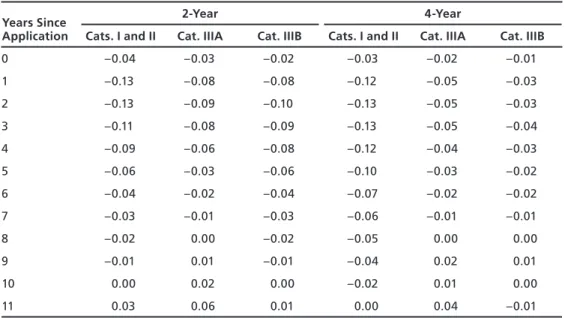
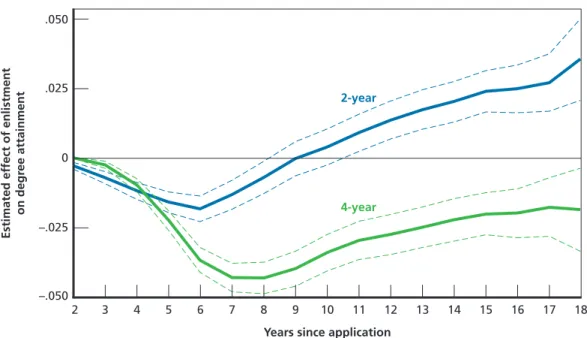
Our college enrollment and degree attainment estimates clearly indicate that Army enlist-ment delays college education, but our relatively small sample for the Army makes it impossible to draw firm conclusions about the longer-run effect of Army enlistment on educational attain-ment (see the wide confidence intervals surrounding the two- and four-year college degree attainment estimates in Figure S.4 in year 18). However, when we examine a larger sample covering all services combined (see Figure S.5), our estimates indicate a small positive longer-run effect of enlistment on two-year college degree attainment and a small negative effect of enlistment on four-year college degree attainment. The college degree attainment estimates for all services combined are statistically indistinguishable from those for the Army alone.
1 Year 3 after the application year corresponds to the fourth year of service in our analysis, since year 0 is the year of
Summary xv
Figure S.3
Estimated Percentage Effect of Army Enlistment on Annual Earnings, by Years Since Application and AFQT Category
NOTE: Sample restricted to Army applicants. RAND TR995-S.3 40 10 17 16 15 14 13 12 11 10 9 8 7 6 5 4 3 2 1 0 18
Years since application
50
0
Estimated ef
fect of Army enlistment on
annual ear nings ($2005) 30 20 Category IIIB Category I and II Category IIIA Figure S.4
Estimated Effect of Army Enlistment on College Degree Attainment, by Years Since Application
NOTES: Sample restricted to 1991–1994 Army applicant cohorts. Dashed lines denote 95 percent confidence intervals. RAND TR995-S.4 17 16 15 14 13 12 11 10 9 8 7 6 5 4 3 2 18
Years since application
.025
–.050
Estimated ef
fect of Army enlistment
on degr ee attainment –.025 0 2-year 4-year
xvi The Effect of Military Enlistment on Earnings and Education
Discussion
A strong, positive, short-run effect of enlistment on earnings is perhaps unsurprising, since the alternative to military service for many young men and women is college rather than full-time work. In addition, it could very well be that the military must offer a relatively high wage in order to induce individuals to choose enlistment and the risks and hardships it entails. That enlistment might convey longer-run benefits in the labor market is perhaps of greater signifi-cance for military manpower policy.
There are at least three potential explanations for these longer-run, positive earnings effects. First, it could be that enlistment induces enlistees to obtain more formal education than they otherwise would have obtained and that this greater educational attainment has returns in the labor market. We find, at best, weak evidence in support of this hypothesis. On the one hand, our estimates clearly indicate that enlistment causes enlistees to delay their col-lege education. All else equal, we might expect such a delay to depress longer-run labor market earnings. However, our estimates also indicate that enlistment increases the likelihood that enlistees will obtain a two-year college degree, although these estimates are statistically signifi-cant only when looking at all services combined. The increase in two-year degree attainment does not emerge until 16–18 years following enlistment, and the value of obtaining such a degree at that age might be much less than at some earlier age. Moreover, for AFQT Category I and II enlistees, the evidence suggests that the increase in two-year degree attainment comes at the expense of four-year degree attainment. The overall effect of enlistment on two-year col-lege degree attainment is small in both absolute and relative terms, suggesting that it is unlikely
Figure S.5
Estimated Effect of Enlistment on College Degree Attainment, by Years Since Application: All Services Combined
NOTES: Sample restricted to 1991–1994 applicant cohorts. Dashed lines denote 95 percent confidence intervals. RAND TR995-S.5 17 16 15 14 13 12 11 10 9 8 7 6 5 4 3 2 18
Years since application
.050 .025 –.050 Estimated ef fect of enlistment on degr ee attainment –.025 0 2-year 4-year
Summary xvii
that these education effects could account for the substantial longer-run earnings effects we estimate.
If enlistment does not have a strong effect on educational attainment, then what explains the longer-run earnings effects we observe? Two possibilities are that (1) military service devel-ops other skills that are valued in the labor market and (2) the military pays above-average wages in order to compensate individuals for their sacrifice and service (a “compensating wage differential”). We do not directly test these alternative hypotheses, but we do find that the positive effect of enlistment on longer-run earnings is concentrated among enlistees who are still serving in the military. The earnings of Category IIIA and IIIB Army enlistees still serv-ing in the military between 14 and 18 years followserv-ing enlistment are 125 and 155 percent higher, respectively, than the earnings of comparable non-enlistees. By contrast, Category IIIA and IIIB Army enlistees who have separated by 14–18 years following enlistment earn 3 and 6 percent more than comparable non-enlistees, respectively. Category I and II Army enlistees still serving at that juncture earn 84 percent more than comparable non-enlistees, but those enlistees who have separated earn 6 percent less.
The magnitude of the differences in earnings estimates between enlistees who do and do not continue to serve in later years suggests that some of the longer-run earnings effects are attributable to a compensating wage differential. For Category I and II enlistees, it seems likely that this differential explains all of the positive longer-run earnings gains observed for that group as a whole, since the correlation between enlistment and earnings of those who have separated from active-component service is actually negative and our estimates further suggest that enlistment could cause Category I and II enlistees to obtain less formal education than they otherwise would have. Category IIIA and IIIB enlistees, on the other hand, appear to ben-efit from enlistment even after they separate, although their earnings gains are fairly modest. This suggests that military service may, in fact, help at least some individuals develop skills that convey longer-run benefits in the civilian labor market.
In the All-Volunteer era, the overriding objective of compensation policy is to attract and retain the force necessary to meet the nation’s national security objectives. If individuals believe they will be well served by this experience, more might be willing to enlist. Further-more, from a societal perspective, the electorate might be more willing to support putting young men and women at risk for the sake of national defense if it believes these individuals will benefit financially. The estimates reported in this document suggest that, for the bulk of the enlisted force, military service provides tangible benefits in terms of longer-term earnings. On average, these individuals will earn more and obtain as much, or more, formal education as they otherwise would have. The evidence for the highest-aptitude youth is mixed. Clearly, in the short run, these individuals experience substantial earnings gains as a result of military service. However, those earnings gains erode over time and, for those who do not remain in the military, eventually turn slightly negative, perhaps because enlistment delays college and permanently lowers the likelihood they will obtain a four-year college degree.
xix
Acknowledgments
This research would not have been possible without the assistance of dedicated staff within the United States Army Accessions Command (USAAC), Office of the Secretary of Defense (OSD), Social Security Administration (SSA), and the National Student Clearinghouse (NSC). We are especially thankful to LTC Douglas Gilbert, LTC Gregory Lamm, and COL Jeffrey Schamburg working within USAAC for their guidance and support throughout the project. We are indebted to Michael Risha of SSA, Jeff Tanner and Diana Gillum of NSC, and Rich-ard Moreno, Kathleen Moreno, and Marisa Michaels of the Defense Manpower Data Center (DMDC) for assisting us with obtaining and interpreting the data employed in this research. We thank our RAND colleagues Bruce Orvis, Michael Hansen, and Paul Heaton and John Warner of Clemson University for their careful reviews of this document and many helpful suggestions. Finally, we thank Craig Martin and Alessandro Malchiodi of RAND for provid-ing excellent programmprovid-ing support.
xxi
Abbreviations
AFQT Armed Forces Qualification Test
ASVAB Armed Services Vocational Aptitude Battery
BAH Basic Allowance for Housing
BAS Basic Allowance for Subsistence
DMDC Defense Manpower Data Center
DoD U.S. Department of Defense
FICA Federal Insurance Contribution Act
FSA Family Separation Allowance
MEPCOM Military Entrance Processing Command
MEF Master Earnings File
NSC National Student Clearinghouse
OSD Office of the Secretary of Defense
SSA Social Security Administration
1
CHAPTER ONE
Introduction
In FY2009, 161,588 young men and women enlisted in the active component of the U.S. mili-tary (OUSD P&R, 2010, Table B-1). Based on historical statistics, about half of these enlistees will separate from the active component within four years and more than 80 percent will
sepa-rate within eight years.1 Upon leaving the active component, most enlistees will be entering the
civilian labor market in earnest for the first time, and it is an open question just how well their
military experience and training will serve them in their civilian careers.2
Military service is likely to benefit the labor market outcomes of enlistees in a variety of ways. For an enlistee just finishing high school, the military provides a steady, full-time job at
above average wages,3 facilitating the accumulation of work experience and vocational
train-ing that civilian employers value. In addition to fostertrain-ing the development of specific technical skills, the military environment is conducive to the development of certain “soft” skills, such
as discipline, punctuality, and self-confidence (Furstenberg, 2005).4 Many enlistees
accumu-late funding for postsecondary education through the Montgomery GI Bill, Army College Fund, and other programs that they can use to obtain additional vocational training or attend a two- or four-year college either while they serve or after they separate from the active com-ponent, which in turn could lead to improved labor market outcomes. These educational ben-efits could be particularly valuable to lower-aptitude youth who do not qualify for merit-based scholarships and cannot afford tuition and living expenses, even with need-based financial aid (Krueger, 2004).
While enlistees may, in fact, experience all of these benefits of military service, the cen-tral question we seek to address in the research reported in this document is whether enlistees ultimately have higher labor market earnings than they otherwise would have. That is, had an enlistee not enlisted, would he or she have developed fewer skills, obtained less education, and worked in a less stable, lower-paying job? Or, conversely, would entering school or beginning a civilian career upon graduating from high school have ultimately resulted in higher lifetime labor market earnings? Military work experience is not necessarily equivalent to civilian work experience. Grissmer (1992), for example, finds that only one-quarter to one-half of specific military occupations have direct counterparts in the civilian sector, suggesting that military
1 See Chapter Two for description of data used to generate these statistics.
2 This report addresses the effect of non-prior-service active-component military service on the enlisted force. We do not
consider officers or individuals whose initial military service was in the reserve components.
3 See, for example, Asch, Hosek, and Martin (2002) and OUSD P&R (2008).
4 More generally, see, for example, Kelty, Kleykamp, and Segal (2010) and Symonds, Schwartz, and Ferguson (2011) for
2 The Effect of Military Enlistment on Earnings and Education
experience may be a poor substitute for civilian experience in many cases.5 Moreover, enlistees
have lower civilian firm-specific tenure than they would have otherwise, which could further depress their civilian labor market earnings. Finally, while many enlistees obtain formal educa-tion while serving, it is likely that they will complete that educaeduca-tion later than they would have had they not enlisted, meaning that any labor market return to that educational attainment will be enjoyed for fewer years.
A long line of empirical research has sought to determine whether enlistment during the
All-Volunteer era (1973 and later) has a causal impact on labor market earnings.6 Much of that
literature employs survey data to compare the labor market earnings of enlisted veterans and nonveterans, controlling for standard demographic characteristics of survey respondents, such as age, gender, race/ethnicity, and educational attainment. This literature typically finds that enlistees earn more than non-enlistees (Bryant, Samaranayake, and Wilhite, 1993; Magnum and Ball, 1989; Phillips et al., 1992; Andrisani and Daymont, 1998; Stafford, 1991).
However, it is unclear whether these past studies adequately control for differences between individuals who do and do not enlist in the military that are themselves correlated
with labor market earnings (hereafter referred to as simply “earnings”).7 As such, these
esti-mates cannot necessarily be interpreted as the causal effect of enlistment on earnings (i.e., the effect of enlistment rather than the effect of the characteristics of enlistees). For example, even conditional on age, race/ethnicity, and education, the average enlistee might be healthier and otherwise more skilled than the average non-enlistee. Such differences could translate into ferences in earnings that, in the absence of appropriate controls, would be interpreted as dif-ferences attributable to enlistment. And even with rich survey data that allow one to control for such observable differences between enlistees and non-enlistees, there are likely to be other differences between enlistees and non-enlistees—for example, in attitudes toward risk and authority—for which the researcher cannot control.
In the research reported here, we refine comparisons between the earnings of enlistees and non-enlistees employing an approach first implemented by Angrist (1998). Angrist assumes that an enlistee drawn at random from the pool of military applicants will be more similar to a randomly selected applicant that did not enlist than to a randomly selected non-applicant. Thus, differences in the earnings of military applicants who do and do not ultimately enlist will provide a better estimate of the causal effect of enlistment than will differences in the earnings of enlistees and all enlistees combined (i.e., enlisted applicants and non-applicants). Angrist further assumes that the rich set of applicant characteristics recorded on the military application record—information that is not found in the typical survey—controls
5 Technological advances over the past two decades may have caused military and civilian occupations to become more
similar in their requirements than suggested by Grissmer (1992). Goldberg and Warner (1987) find that the association between military service and earnings is strongly related to military occupation.
6 A number of papers address the effect of involuntary military service on earnings. In a seminal paper, Angrist (1990)
estimates the effect of conscription during the Vietnam War on earnings by exploiting the nearly random variation in mili-tary enlistment induced by the draft lottery system in place at that time. Employing this method, Angrist (1990) finds that Vietnam-era veterans suffered large (15 percent) earnings losses. Angrist and Chen (2007), however, find that these earnings losses are close to zero 30 years following conscription. Angrist and Krueger (1994) find smaller negative effects of conscrip-tion on the earnings of veterans of World War II and the Korean War.
7 Hirsch and Mehay (2003) find that active-component service has no effect on the earnings of enlisted members of the
reserve components (Reserve and National Guard). By focusing on reservists, the study controls for selection into military service, but it is not clear whether the resulting estimates generalize to nonreservists.
Introduction 3
adequately for any remaining differences between applicants who do and do not enlist that are correlated with earnings. Although this assumption, which Angrist refers to as the assumption of “selection on observables,” is quite strong, it is perhaps not unreasonable in this particular context, in which the sample is restricted to individuals with a common propensity to apply for military service and the available control variables are those that the military uses to screen applicants for service.
Using data for individuals applying for military service between 1979 and 1982, Angrist (1998) reports that enlistment increases earnings substantially in the first three years following application. That earnings difference, however, diminishes and turns negative in subsequent years. By the end of his data, 12 years following application, the Angrist estimates show a modest (about 10 percent) positive effect of enlistment on the earnings of African American enlistees and no effect on the earnings of white enlistees.
Although we employ an empirical model similar to that of Angrist (1998), our overall approach differs in several important ways. First, our estimates apply to more recent cohorts of military applicants (individuals applying for military service between 1989 and 2003). Second, we follow military applicants for more years , as many as 18 years following application, allow-ing us to estimate longer-run effects of enlistment. Third, our estimates account for military allowances and bonuses, which constitute a significant portion of military earnings. Fourth, our estimates are conditioned on a broader range of observable differences between enlistees and non-enlistees, including earnings prior to application.
As we report below, our estimates imply that enlistment has a significant, positive effect on the long-run earnings of military enlistees. We explore one hypothesis for this effect by employing similar methods to estimate the effect of enlistment on educational attainment, the idea being that the effect of enlistment on earnings could be due in part to its intermedi-ate effect on educational attainment. Those analyses imply that enlistment increases two-year degree attainment among all enlistees, but lowers four-year degree attainment among the high-est-aptitude enlistees. However, the magnitude of these education effects is too small to fully explain the long-run earnings gains attributable to enlistment.
We note here that the focus of this research is on the overall effect of enlistment on earn-ings and educational attainment rather than the effect of particular characteristics of military service, such as years of service and military occupation. Although the effects of these char-acteristics on long-run labor market outcomes are of significant interest to policymakers, the empirical strategy we employ in this research is not tailored to estimating their causal effect. Which military occupation an enlistee chooses and how long that enlistee remains in service are likely correlated with a host of unobservable characteristics of the enlistee that are them-selves correlated with labor market outcomes and that are likely not controlled for by observ-able characteristics of the enlistee at the time of application.
The remainder of this report has the following structure. Chapter Two describes the basic empirical approach we employ to estimate the effect of enlistment on earnings and educational attainment, and discusses its limitations. Chapters Three and Four then report the estimated
effect of Army enlistment on earnings and educational attainment, respectively.8 These
chap-ters describe specific empirical models and the data employed to estimate those models. In both chapters, we report the average estimated effect of Army enlistment over all enlistees by
4 The Effect of Military Enlistment on Earnings and Education
years since enlistment and then according to a variety of applicant characteristics, including year of application, aptitude, race/ethnicity, and gender. Chapter Five concludes by summariz-ing the main empirical results of this research and discusssummariz-ing how they might inform military manpower policy.
5
CHAPTER TWO
Methods and Data
We seek to estimate the causal effect of enlistment on earnings and educational attainment. This chapter details our basic empirical model, beginning with a discussion of the institutional details that motivate our approach. We reserve discussion of modeling details specific to each outcome, including a description of data on earnings and educational attainment, for Chapters Three and Four.
Enlistment, Reenlistment, and Military Compensation
In this section, we briefly discuss a number of institutional details concerning military enlist-ment, compensation, and separation that motivate our empirical model and are necessary for interpreting our empirical estimates.
An individual interested in joining the military begins the formal application process by visiting a military entrance processing station. Applicants who satisfy aptitude, education, health, citizenship, criminal background, and other “moral” standards are offered the opportu-nity to enlist. This process is managed by goals for the fraction of recruits who are high school graduates and satisfy threshold scores on the Armed Forces Qualification Test (AFQT), and by a formal system of waivers for those not satisfying current enlistment standards (see Asch, Hosek, and Martin [2009] for a more detailed discussion of enlistment standards).
Qualified applicants receive an offer, consisting of initial rank, bonus, educational ben-efits, military occupation and training, and initial term of service, which varies with the appli-cant’s characteristics and military requirements at that point in time. The applicant can select one of the offered options or choose not to enlist. Those who choose one of the offered options sign a formal enlistment contract and enter the Future Soldier Training Program, also known as the Delayed Entry Program (DEP). Some enlistees begin military service within a short time of signing their contract. More typically, given personal circumstances, military needs, and the availability of specific training slots, others ship for basic training some months later. A small fraction of individuals drop from DEP and so never formally access into the military.
In this analysis, we limit our examination of military compensation to cash compensa-tion: a combination of basic pay, cash allowances for food and housing, other smaller and less common pays and allowances, and a tax advantage due to the exclusion of all allowances and some pays from federal (and often state) income taxes. Military compensation varies with rank, years of service, and family structure (marital status, presence of children). In 2011, the average
6 The Effect of Military Enlistment on Earnings and Education
enlistee with no dependents could expect to receive about $34,000 in cash compensation in his
or her fi rst year of service.1
Th e enlistment contract specifi es the period of initial service. Th at contract length varies
with service, over time, and across individuals. As we describe below, a large fraction of enlist-ees separate from the military at the end of their fi rst enlistment contract (generally three to six years in duration). At the end of the fi rst enlistment contract, individuals choose whether
to reenlist in the military or to separate and enter the civilian sector. Th is decision refl ects both
the service member’s preferences and the military’s decision concerning its need for the indi-vidual’s continued service and the indiindi-vidual’s suitability for continued service.
Th e military off ers generous retirement benefi ts, which generate strong fi nancial
incen-tives to remain in the military once service members have committed to more than one or two terms of service. Another important determinant of the likelihood of reenlisting is how suc-cessful service members have been in the military. A key marker of success in the military is the speed at which one has been promoted up the military ranks. Prior evidence (Hosek and Martorell, 2009) suggests that individuals who have been promoted quickly are much more likely to reenlist in the military.
Empirical Approach
For a given individual, the causal eff ect of enlistment on a particular outcome (e.g., earnings, educational attainment) can be expressed as
Rit=Yit E− Yit NE , (2.1) where Yit E
denotes the outcome of applicant i in the tthyear since applying for military service
if the applicant enlists, and Yit
NE
denotes the same outcome if the applicant never enlists. Since,
for any individual applicant, it is impossible to observe the diff erence Rit (i.e., an applicant
cannot both enlist and never enlist), we must estimate this diff erence using data on a popula-tion of individuals that enlists and a populapopula-tion of individuals that does not enlist.
Th e average eff ect of enlistment on a population of enlistees (generically referred to as the
eff ect of “treatment on the treated”) can be expressed as:
Rt E = E(Yit E |Di=1)−E(Yit NE |Di =1), (2.2)
where Di is an indicator variable for enlistment. We can generate an unbiased estimate of the
fi rst term on the right-hand side of Equation 2.2 using data on enlistees. It is likely, however, that using data on individuals who never enlist will result in biased estimates of the second term on the right-hand side of Equation 2.2, the mean outcome of enlistees had they never
enlisted (i.e., the counterfactual). Th is bias results from the fact that individuals choose to
enlist in the military and the military chooses which applicants can enlist, and these choices are likely conditional on characteristics of individuals correlated with the outcomes of inter-est. For example, enlistment might be relatively more common among individuals with a high
1 U.S. average for an E-1 based in the continental United States with one year of service and no dependents (see the Offi ce
Methods and Data 7
tolerance for risk, and the military requires enlistees to meet specifi c aptitude, health, drug and alcohol, and other requirements.
Comparisons of mean outcomes made conditional on the characteristics of individuals that determine enlisted status yield a causal estimate of the eff ect of enlistment on outcomes if the distribution of potential outcomes is unrelated to enlistment conditional on covariates
included in the model. Formally, if we assume the pair (Yit
E ,Yit
NE
) is independent from Dit|Xit
for some vector of covariates X, then
Rt E = E(Yit E |Di =1,Xit)−E(Yit NE |Di =0,Xit), (2.3)
which we can estimate directly from data on enlistees and non-enlistees, is an unbiased
esti-mate of the causal eff ect of enlistment on outcome Y. Sample size and data processing issues
lead to diff erent implementations of Equation 2.3 for our two outcomes, earnings and
educa-tional attainment. Th ese diff erences are explained in Chapters Th ree and Four.
Th e key assumption in Equation 2.3 is that the vector X contains all factors that co-vary
with enlistment and outcome X. We argue, as in Angrist (1998), that restricting our sample
to military applicants and employing the rich data on the applicant record make this assump-tion plausible for our purposes. It is reasonable to assume that enlistees will be more similar
to applicants who do not enlist than to individuals in the general population. Th is is likely to
be true in terms of both observable characteristics, such as age, gender, and education, and unobservable characteristics, such as attitudes toward risk and authority. By restricting our
sample to applicants, we implicitly control in X for diff erences in observable and unobservable
characteristics across applicants and non-applicants. Within the pool of applicants, there are likely to remain important diff erences between applicants who do and do not enlist, but we assume that we can control for these remaining diff erences by employing data available in the applicant record (see later in this chapter for more discussion of this particular assumption).
Th us, focusing our analysis on applicants allows us to control more completely for diff erences
between enlistees and non-enlistees in the population at large and therefore improve our esti-mate of the causal eff ect on enlistment on earnings and education in the general population.
Data
We obtained data on military applicants from DoD Military Entrance Processing Command
(MEPCOM) administrative records. Th ese data fi les contain electronic records for every
indi-vidual who submits a formal application for active-component military service. Th e extract we
employ covers the universe of individuals who applied for military service between FY1989 and FY2003. We restrict our analysis fi le to the typical qualifi ed applicant: individuals who were 17 and older at the time they applied for military service, had no prior military service, obtained a score of 31 or higher on the AFQT (very few individuals who score below this per-centile are admitted to the military), had at most a high school diploma (excluding those with varying levels of postsecondary education), and had no potentially disqualifying health
condi-tions or potentially disqualifying drug or alcohol use.2 Th ese sample restrictions leave us with
2 Approximately 23 percent of the applicant records are missing health and drug and alcohol information. Th ese records
8 The Effect of Military Enlistment on Earnings and Education
2,763,410 applicants, or about 184,227 applicants per fiscal year, representing 45 percent of the
total universe of individuals applying for military service in those years.3
For each applicant, the MEPCOM data include measures of the key factors the mili-tary uses to screen applicants at the time of application. In addition to the screening criteria mentioned in the previous paragraph, these measures include AFQT score (a powerful
predic-tor of labor market earnings—see, for example, Neal and Johnson [1996])4 and educational
attainment. The application record also contains standard demographic information, such as gender, race/ethnicity, date of application, and active-component service to which the individ-ual applied. Table 2.1 reports the mean of these applicant characteristics across all application years and all active-component services. (Table 2.2 reports the same statistics for the Army alone.)
We define an applicant as having enlisted if, according to MEPCOM records, that indi-vidual accesses following his or her application date. To “access” means that the military inducts the individual into military service. An enlistee, by this definition, could serve as little as a single day in the active component, although 92 percent of applicants in our data serve at least six months and 70 percent serve three or more years (see top line for all services in Figure 2.1). Thus, our estimates represent the average effect of serving in the active component, regardless of how long, on earnings and educational outcomes in a given year following application. It is also important to remember that a sizable fraction of active-component enlistees will continue to serve in the reserve components and so, separation from active-component service does not necessarily mean separation from military service altogether.
Limitations of Our Approach
Although our methods allow us to control for many of the factors that lead individuals to apply for military service and the military to admit those individuals, we acknowledge that differ-ences could remain. A qualified applicant who chooses to enlist could differ from a qualified applicant who does not enlist for reasons unrelated to their propensity to apply or differences in available covariates. For example, it is plausible that, even among applicants, individuals with a higher willingness to accept the regimentation, strenuous physical work, and danger that can be associated with military employment are more likely to enlist. If these characteristics are correlated with labor market earnings, then our estimates could be biased even after adjusting for the extensive set of controls we use here.
Two other such factors are the stochastic arrival of civilian job offers (or job losses) and school admissions. Given our extensive controls, we assume that applicants who do and do not enlist are equally well prepared for civilian jobs and postsecondary education, but there is nonetheless a random component to job offers and school admissions. Take two equally well-qualified applicants. One applicant randomly receives an attractive civilian job offer and
3 Approximately 10 percent of the sample has two or more application records indicating that their first application was
suspended. This could happen either because the applicant decided to withdraw his or her application or because the appli-cant did not meet enlistment criteria at that time. For individuals who decide to apply again at a later date, we apply sample restrictions and measure all covariates at the time of that individual’s last application record in the MEPCOM data.
4 AFQT scores are derived from selected scores on the eight-component Armed Services Vocational Aptitude Battery
Methods and Data 9
Table 2.1
Mean and Standard Deviation of Applicant Characteristics: All Active-Component Applicants
Characteristic All Non-Enlistees Enlistees
Enlisted 0.79 0.00 1.00
Education
Dropout or GED 0.06 0.06 0.06
In high school 0.38 0.44 0.36
High school graduate 0.56 0.49 0.58
Male 0.82 0.77 0.84 AFQT category Category I 0.04 0.04 0.04 Category II 0.37 0.36 0.37 Category IIIA 0.28 0.28 0.29 Category IIIB 0.31 0.33 0.30 Race White 0.66 0.65 0.66 Black 0.17 0.16 0.17 Hispanic 0.09 0.09 0.09 Other 0.08 0.10 0.08 Service Army 0.36 0.37 0.36 Air Force 0.17 0.14 0.18 Marine Corps 0.18 0.21 0.18 Navy 0.28 0.29 0.28 Age 17 0.27 0.29 0.26 18 0.27 0.26 0.27 19 0.17 0.14 0.17 20 0.10 0.09 0.10 21 0.06 0.06 0.07 22 0.04 0.04 0.04 23 0.03 0.03 0.03 24+ 0.07 0.08 0.06 Number of observations 2,763,410 2,192,220 571,190 NOTES: Applicant characteristics also include year of application, which is not shown here. GED = General Education Development certificate.
10 The Effect of Military Enlistment on Earnings and Education
the other does not. All else equal, it is reasonable to assume that the applicant receiving this job offer is less likely to enlist than the applicant who does not receive such an offer. The same might be true of school admissions. If this “good luck” has a lasting, beneficial effect on civilian labor market outcomes and postsecondary education, then Equation 2.3 will tend to underestimate the causal effect of military service on outcomes. By the same token, an individ-ual who loses his job during the application process might be more likely to join the military.
While theoretically plausible, there are two reasons why we might expect the stochas-tic arrival of job offers and school admissions to be pracstochas-tically unimportant in this context. First, our sample has already applied for military service, and so the job offer or offer of school admission must arrive between the time the individual goes through the application process
Table 2.2
Mean and Standard Deviation of Applicant Characteristics: Army Applicants
Characteristic All Non-Enlistees Enlistees
Enlisted 0.79 0.00 1.00
Education
Dropout or GED 0.09 0.10 0.09
In high school 0.34 0.40 0.33
High school graduate 0.57 0.50 0.59
Male 0.80 0.73 0.82 AFQT category Category I 0.04 0.04 0.04 Category II 0.34 0.33 0.35 Category IIIA 0.29 0.28 0.30 Category IIIB 0.32 0.34 0.32 Race White 0.64 0.64 0.64 Black 0.20 0.19 0.20 Hispanic 0.08 0.08 0.08 Other 0.08 0.08 0.08 Age 17 0.25 0.27 0.24 18 0.24 0.23 0.25 19 0.16 0.14 0.17 20 0.10 0.09 0.11 21 0.07 0.07 0.07 22 0.05 0.05 0.05 23 0.03 0.04 0.03 24+ 0.09 0.12 0.08 Number of observations 1,005,723 210,499 795,224 NOTES: Sample restricted to Army applicants. Applicant characteristics also include year of application, which is not shown here.
Methods and Data 11
(which entails visiting a military entrance processing station, taking the ASVAB, completing a physical exam, and undergoing drug testing and criminal background checks) and when that individual makes the decision whether to enlist. This window is typically relatively short; the median number of months between application and enlistment in our sample is six. Second, these stochastic events must have a lasting effect on labor market outcomes and educational attainment. That is, the effect of landing a good job following high school or being admitted to a good school by chance must persist and not be countered by equally probable “bad luck” in the future.
We conclude this chapter by acknowledging two related limitations inherent in our approach. First, we estimate the effect of ever having enlisted on outcomes rather than the effect of a specific length of military service on outcomes. Although we observe years of mili-tary service in our data, it is less plausible that the covariates available on the applicant record are sufficient to control for differences between enlistees who serve for different periods of time. Put another way, over time, the pool of enlistees still serving in the active component becomes increasingly select, both because those individuals are choosing to remain in service and because the military wants them to remain in service. Thus, while it is of considerable interest to understand how characteristics of military service, such as years of service or mili-tary occupational specialty, affect outcomes, estimating such effects requires isolating exog-enous variation in those characteristics, which is beyond the scope of this research.
Second, and related to the first point, we cannot isolate the effect of enlistment on the labor market outcomes of enlistees who separate from the active component. We might like to know whether civilian labor market outcomes of enlistees are affected by enlisting, but the decision to separate from the active component is endogenous, leading to potential bias for the reasons given above. We elaborate on this issue in Chapter Three.
Figure 2.1
Fraction of Enlistees Serving in the Active Component, by Years Since Application
NOTES: Sample restricted to enlistees applying for active-duty service between 1989 and 2003. The percentage remaining in-service does not fall monotonically because separation rates vary slightly across cohorts. RAND TR995-2.1 16 14 12 10 8 All services Army 6 4 2 0 18
Years since application
90 100
0
Per
cent enlisted serving in active component
10 20 30 80 70 60 50 40
13
CHAPTER THREE
The Effect of Army Enlistment on Labor Market Earnings
We begin this chapter by describing the earnings data employed in this research and explain-ing precisely how we estimate Equation 2.3 when the outcome in question is labor market earnings. We then report and discuss overall earnings estimates by years since application and by various applicant characteristics. In this chapter and in Chapter Four, we focus on Army enlistment. We present results for other active-component services in the appendix.
Earnings Data
Our measure of earnings includes all cash compensation received by enlistees and non-enlistees from virtually all military and civilian sources. Earnings data employed in this research come from two sources: the Social Security Administration (SSA) and the Defense Manpower Data Center (DMDC). SSA records in its Master Earnings File (MEF) earnings from all sources
subject to Medicare taxes, which covers almost all U.S. employers.1 These earnings records
have been used in many empirical studies, including several studies related to the military (for example, Angrist, 1990; Angrist, 1998; and Angrist and Krueger, 1994).
Not included in SSA earnings records are military allowances (e.g., Basic Allowance for Subsistence [BAS], Basic Allowance for Housing [BAH], Family Separation Allowance [FSA]) and bonuses, which are not subject to Medicare taxes. To account for these significant sources of military earnings, we add these quantities to SSA earnings using individual-level pay records contained in DMDC’s Active and Reserve Duty Pay Files. Data on military allowances and bonuses are first available starting in 1994. We then make further adjustments to account for the fact that military allowances and certain military pays (e.g., those received while serving in an officially designated combat zone) are not subject to federal income taxes. Our tax
impu-tations assume that enlisted individuals file as single with no dependents.2 Total earnings are
converted to 2005 dollars using the Consumer Price Index for All Urban Consumers (CPI-U).
1 The Code of Federal Regulations, Title 20, Part 404 (see Social Security Administration, 2011), lists employment
cat-egories that are exempt from Medicare taxes. Unlike Social Security earnings, Medicare earnings are not capped at the Social Security taxable limit.
2 The assumption that enlistees file as single with no dependents is clearly not valid. However, the impact of this
assump-tion on our tax imputaassump-tions is likely to be small, on average. On the one hand, assuming enlistees are unmarried means that spousal earnings do not affect the enlistees’ marginal tax bracket. All else equal, this assumption lowers estimated taxes. On the other hand, the assumption that enlistees have no dependents reduces the number of exemptions the enlistee can declare, which raises estimated taxes. Our imputations do not account for preferential tax treatment of military pays and allowances at the state level.
14 The Effect of Military Enlistment on Earnings and Education
We obtain these annual earnings data for 95 percent of the applicants in our baseline
applicant extract for the years 1986 to 2007.3 Thus, for individuals in our earliest applicant
cohort, 1989, we can estimate the effect of enlistment on annual earnings for up to 18 years following application. Tables 3.1 and 3.2 report average earnings of Army enlistees and non-enlistees by years since application and year of application.
Although these administrative earnings records are of very high quality, several limita-tions deserve mention. First, prior to 1994, earnings subject to Medicare taxes data were cen-sored above the taxable maximum level of income. In this particular application, this censor-ing is unlikely to pose a serious problem because the vast majority of military applicants have
earnings well below the earnings limit.4 A second issue with Medicare earnings data is that
they only have information on earnings reported to SSA. Since all military pay is reported to SSA, but not necessarily all civilian earnings (i.e., “under-the-table” earnings), any such mea-surement error in earnings is likely to be correlated with military service, leading to upward bias of the effects of military service.
We conclude this section by emphasizing that the focus of our analysis is on the effect of enlistment on cash compensation. An analysis of the effect of enlistment on total compensa-tion would include the value of health, deferred, and in-kind benefits. While we know exactly what those benefits are in the military context, assigning a cash-equivalent value to them is difficult. Furthermore, while we can directly observe the cash compensation of applicants that do not enlist, we do not observe their noncash benefits and so would need to impute their value using data on the availability and generosity of noncash benefits available in the civilian economy in general. Making such imputations for all of our 15 applicant cohorts is beyond the scope of this study.
We acknowledge, however, that an analysis of the effect of enlistment on total compensa-tion could come to different conclusions than an analysis of enlistment on cash compensacompensa-tion. It is argued, for example, that military health benefits are more generous than those available to the vast majority of civilian workers (Hosek et al., 2005). Under current policy, enlistees pay no premium, deductible, or co-payment; civilian health plans with such terms are virtually nonexistent. Nearly half of all enlistees live in on-base housing free of charge. Enlistees also benefit from retirement pay accruals, state and Federal Insurance Contribution Act (FICA) tax advantages, meals, commissary benefits, educational benefits, and other in-kind benefits and services. The Tenth Quadrennial Review of Military Compensation estimated the total annual value of health, retirement, and state and FICA tax advantages to be between $4,400 and $16,100 for enlisted personnel (the value grows with years of military service), which is considerably less than the imputed value of these benefits to comparably educated civilian workers (OUSD P&R, 2008). Thus, it is possible that estimates of the effect of enlistment on cash-compensation underestimate the effect of enlistment on total compensation, especially in the first few years following application, when the majority of enlistees are still serving in the active component.
3 Virtually all military applicants should appear in the SSA data. All enlistees should appear in the MEF since basic pay
is subject to Medicare tax, and almost all applicants will be employed in a covered job at some point in their lives. Match rates below 100 percent, therefore, are likely due to discrepancies in the names, Social Security Numbers, and dates of birth used to match the applicant and SSA records.
4 In 1992 and 1993, the Medicare taxable earnings maximum was about $125,000 (in nominal dollars). Between 1989
and 1991, the Medicare taxable maximum was about $50,000 and was equal to the maximum for Social Security taxes. In 1990, few covered male workers had earnings that were above the Social Security taxable limit. That outcome was even less common among the young men who applied for military service.