There is no such thing as a
free lounge
– a report on frequent flyer programmes
Swedish Competition Authority April 2003 ISSN No. 1401-8438
Ekonomi-Print AB, Stockholm 2004 Photo: Barrie Rokeach/Getty Images.
Preface
The Swedish Government has instructed the Swedish Competition Authority to review the effect on competition and on consumers of imposing restrictions on the use of bonus programmes (frequent flyer programmes, FFPs) in the Swedish domestic aviation market, and to present proposals for action. The mandate specifically calls on the Competition Authority to survey and analyse the range and application of frequent flyer programmes, to examine their impact on airlines and travellers, to describe legislation relating to their use, to analyse the consequences of introducing unilateral restrictions on such programmes in the domestic aviation market and to discuss ways in which Sweden might actively pursue, at international level, the question of limiting the use of FFPs in the air transport sector. The mandate is the subject of this report. Stockholm, March 2003
Table of contents
1 Introduction 6
1.1 The mission 7
1.2 Implementation and disposition 8
2 The Swedish domestic aviation market 11
2.1 The liberalisation of air travel 12
2.2 Competition in the domestic market 14
2.2.1 Competitive conditions 18
2.3 Development of domestic air travel 23
2.3.1 Passenger traffic trend 23
2.3.2 Ticket price trend 25
3 Supply of frequent flyer programmes 34 3.1 Loyalty programmes in civil aviation 35 3.2 Comparison between FFPs and other loyalty
programmes 36
3.3 FFPs in the Swedish market 40
3.3.1 EuroBonus 41
3.3.2 Braathen Wings 43
3.3.3 The Malmö Aviation Members Service 43
3.4 Comparisons with Europe and the US 45
3.5 Summary of conclusions 48
4 Legislation and practice 49
4.1 Legislation 49
4.1.1 Air services 50
4.1.2 Consumer affairs 56
4.1.3 Taxation 61
4.1.4 Competition 67
4.2 Decision of the Market Court in the EuroBonus case 73 5 Effects of frequent flyer programmes 77
5.1 Introduction 77
5.2 Incentive and competitive effects of FFPs 79 5.3 An empirical study of the Swedish domestic aviation
5.4 Summary of conclusions 92 6 International attitudes and efforts in relation to
frequent flyer programmes 96
6.1 Introduction 96
6.2 Work in the Nordic countries 98
6.2.1 Denmark 99
6.2.2 Finland 101
6.2.3 Norway 101
6.3 The Nordic Task Force on Airline Competition 105
6.4 The ECA Air Traffic Working Group 108
6.5 The European Commission 111
6.6 OECD 114
6.7 International organisations in the civil aviation field 116 6.7.1 Air transport policy organisations 116
6.7.2 Air carrier organisations 118
7 The consequences of unilateral restrictions
from a European viewpoint 120
7.1 The views of airlines and stakeholder organisations 121 7.2 Comparisons between domestic markets in the EU 124
7.3 Summary of conclusions 127
8 Summary and proposed measures 130
8.1 Summary 130
8.2 Proposed measures 137
8.2.1 Special legislation to supplement the
Competition Act? 137
8.2.2 Proposals 140
8.2.3 International means of pursuing FFP issues 142
References 144 Annex Econometric study of the consequences of
introducing and restricting FFPs on
1
Introduction
There are many reasons why competition in the Swedish domestic aviation market may be considered flawed. Among the principal reasons are the fact that the market is capital-intensive and sensitive to economic fluctuations, that it embodies concentrated ownership structures, that it is subject to complex regulations and national and international agreements, and that there is congestion both in airspace and at airports.
Besides the problems that are attributable to the presence of complicated regulations, the system for distributing departure and arrival times, ‘slots’, at strategically important airports also represents an obstacle to competition. In addition, the market activities of airline companies - particularly companies in a dominant position – may have an adverse effect on competition. The application of frequent flyer programmes (FFPs), also referred to as bonus programmes, is one such activity. FFPs can distort market incentives, especially if the person using a service is not the one who pays for it. An employee undertaking a business trip, for instance, may choose a more expensive travel alternative although such a choice is not justified by the difference in quality.
FFPs also generate switching costs, i.e. the cost to a traveller of switching from one air carrier to another, by giving travellers a stronger incentive to use the same carrier again. This means it costs the traveller more to switch airlines, which reduces the chances of competitors being able to attract customers away from a carrier. Switching costs can lead to substantial welfare losses in the form of lower production and consumption levels and higher prices. Such costs may also impede market entry and thus limit competition. On 27 February 2001, the Swedish Market Court
(Marknadsdomstolen) delivered a decision, based on the Swedish
Competition Act (Konkurrenslagen, 1993:20), on SAS’s use of its
EuroBonus programme.1 In all essentials, the decision represented
confirmation of the injunction imposed on the scheme earlier by the Competition Authority.
Under the Market Court decision, SAS is forbidden to apply its FFP in such a way that points or the equivalent for the redemption of bonus offers can be earned on domestic flights between destinations where SAS, or airlines cooperating in an alliance with SAS under the programme, are in competition. SAS, however, is still free to award points on other domestic routes. Other airlines are free to award points on all domestic flights, regardless of whether they are in competition or not.
The Market Court decision and the Competition Authority injunction are based on Section 19 of the Competition Act prohibiting abuse by any undertaking of a dominant market position.
1.1
The mission
The Government decided on 13 June 20022 to instruct the Swedish Competition Authority to review the effect on competition and on consumers of imposing restrictions on the use of bonus programmes (FFPs) in the Swedish domestic aviation market, and to present proposals for action. Under the mandate, the Competition Authority is specifically called upon to
! survey the range and application of FFPs in the Swedish domestic aviation market and to analyse their impact on airlines and travellers,
! detail legislation, etc, relevant to the presence and application of airline programmes for frequent flyers,
! review the existence and application of FFPs at international level, especially in the EU member states, and describe the outcome of any studies undertaken in this field,
2 N2002/5777/TP (2002-06-13).
• analyse the implications of introducing unilateral restrictions on FFPs in domestic aviation and to discuss ways in which Sweden might actively pursue, at
international level, and particularly in respect of the EU and its domestic markets, the question of limiting the use of FFPs in the aviation sector.
In accordance with the terms of the mandate, the investigative work was undertaken in consultation with the Swedish Civil Aviation Administration (Luftfartsverket) and the Swedish Consumer
Agency (Konsumentverket).
The Competition Authority conducted its study in the form of a project. The project group comprised investigators and advisers from the various agency departments, led by Erik Murray. The other group members were Ola Bergström, Mikael Ingemarsson and Jens Lehman.
1.2
Implementation and disposition
As a first step, the Competition Authority contacted airlines3 and stakeholder organisations to determine their views on frequent flyer programmes and to develop a general idea of the problems and measures that the stakeholders themselves feel should be addressed. A questionnaire4 was sent to airlines and stakeholder
organisations,5 and the replies were collated by the Competition Authority. In some cases, the written replies were followed up by means of meetings.6
As the report largely concerns the application of FFPs in the Swedish civil aviation market, we chose primarily to contact
3 The terms airline, airline company and carrier are used synonymously in the report. 4 See Annexes 1 and 2.
5 SAS, Skyways, Malmö Aviation, Nordic Airlink, Golden Air, Gotlandsflyg, City Airline, Värmlandsflyg, Walt Air, Ryanair, Goodjet, Finnair, Lufthansa, Svenskt Flyg, the Swedish Business Travel Association, the Association of Swedish Travel Agents and the Swedish Aviation Association.
Swedish stakeholders, airlines operating domestic air traffic in Sweden and stakeholder organisations. In addition, we considered it appropriate to contact both Swedish and international airlines that might become potential competitors in the Swedish aviation market. The Competition Authority also gathered and compiled information on FFPs by means of regular contact with sister organisations in both the Nordic area and the EU. Contact was maintained within the framework of the Nordic Task Force on Airline Competition
(Samnordisk flygarbetsgrupp), and is still being maintained within
the framework of the ECA Air Traffic Working Group.7
Under the terms of the mandate, the agency carried out its work in consultation with the Swedish CAA and the Swedish Consumer Agency by means of regular consultative meetings. Also, on its own initiative, the Competition Authority consulted with the National Tax Board (Riksskatteverket) as it was felt that tax issues
relating to FFPs also needed to be addressed.
The Competition Authority called upon Fredrik Carlsson (PhD) of the Department of Economics, School of Economics and
Commercial Law, Gothenburg University, to analyse the impact of FFPs on airline prices and number of departures, using an
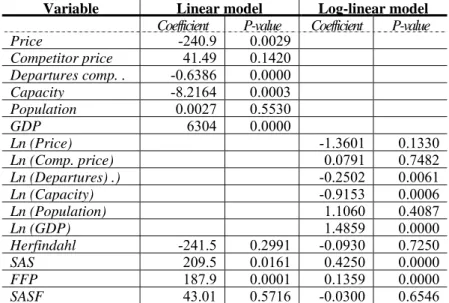
econometric model. Estimates were formed on the basis of
quarterly data for the period 1992 up until the third quarter of 2002. Switching costs, i.e. the cost to the traveller of switching from one airline to another, were calculated by means of a specific model. Supporting data for the analyses was largely obtained from the Swedish CAA and from the carriers themselves.
Under the terms of the mandate, the Competition Authority was to review the effect on competition and on consumers of imposing restrictions on the use of FFPs in the Swedish domestic aviation market. The travaux préparatoires of the Competition Act8 define
consumers not just in the normal sense of the word but also as end users in the aviation industry and buyers intending to sell the products to others. In the present report, therefore, the term
7 ECA (European Competition Authorities) 8 Govt bill 1992/93:56 p. 78
consumers encompasses both private travellers and undertakings whose employees travel on business.9
The report is structured as follows. Chapter 2 outlines the Swedish domestic aviation market and includes an initial background account of the liberalisation process. Much of this chapter focuses on competitive relations in the market and on passenger traffic and ticket price trends in the Swedish domestic aviation market. Chapter 3 describes various types of bonus and discount systems for frequent flyers, and the supply and use of such programmes in the domestic market. This chapter also describes the difference between FFPs and other bonus systems and discusses European and US frequent flyer programmes.
Chapter 4 examines current competition, consumer and tax legislation of relevance for FFPs, as well as case-law in this area. Chapter 5 discusses the incentive and competitive effects of such programmes and also describes the outcome of an empirical study of the domestic aviation market.
Chapter 6 describes international efforts in relation to FFPs and to their competitive impact. A significant part of the chapter is devoted to the work under way in this area in the Nordic countries. The work of the competition authorities in the EU/EEA, the European Commission10 and the OECD is also discussed. This chapter gives an indication of the ways in which Sweden might actively pursue, at international level, especially in respect of the EU and its domestic markets, the question of limiting the use of FFPs in the aviation sector.
Chapter 7 looks at the implications from a European viewpoint of introducing unilateral restrictions on FFPs in domestic aviation. This account is based to a great extent on the views expressed by airlines and stakeholder organisations. A summary of the report is provided in Chapter 8, which also contains proposals for action aimed at improving competition.
9 In the present report, the term traveller is used to describe the person making the journey, irrespective of whether this involves private or business travel, while the term customer is used to describe the individual or company paying for the journey.
2
The Swedish domestic aviation market
Structural conditions in the Swedish domestic aviation market are such that newcomers starting up scheduled air services can expect to encounter considerable difficulties, and competitive potential is
! Sweden is a large country in geographical terms but has relatively few inhabitants, most of whom live in the central or southern regions. This settlement pattern affects the structure of the domestic air transport market. • The market is characterised by a hub-and-spoke system
with Arlanda (Stockholm) as the only hub. SAS and Skyways are in a strong position at Arlanda. SAS owns a share in and cooperates extensively with Skyways. • Between them, SAS and Skyways have almost a 60 per
cent share of the start and departure times (slots) at Arlanda.
• Market concentration is high. SAS has had between 70 and 95 per cent of the market since liberalisation was introduced in 1992. SAS’s principal competitor in the domestic market is Malmö Aviation.
• Prices in the domestic market have increased considerably more than prices as a whole since liberalisaton was introduced in 1992.
• The air travel market is subject to complex regulations at both national and international level.
• Previous studies show that the potential exists for competition on up to 10 routes.
limited. Arlanda is the hub in a hub-and-spoke system11, which means that practically all flights in Sweden, both domestic and international, go via this airport. With Arlanda as the hub, SAS operates 14 domestic routes to various parts of the country and cooperates with Skyways and a number of other regional carriers. Thus SAS can offer customers an extensive domestic network of routes. Together with its partners, it is the only carrier with a nationwide network in Sweden. SAS also operates a considerable amount of international traffic, based, like its domestic services, on Arlanda.12
SAS’s principal competitor in the domestic market is Malmö Aviation, which has a network encompassing five destinations, largely from Bromma Airport. Skyways, which is the largest regional carrier in Sweden, operates flights to 20 destinations.
2.1
The liberalisation of air travel
13The EU began liberalising the air transport sector in Europe in 1979. The liberalisation process was undertaken in several stages, of which stage three, the ‘Third Package’, relating to market entry, pricing and the licensing of carriers entered into force on 1 January 1993.
The Third Package for the liberalisation of air transport gave carriers in the EU with valid operating licences14 the right to operate services on intra-Community routes. In April 1997, the EU
11 The major carriers’ service networks have increasingly developed into hub-and-spoke systems, i.e. the various routes meet at a junction that serves as a transit point for passengers. By directing passengers from the various spokes in the system via a hub, traffic density for each spoke leading from the hub is assumed to increase. A highly developed hub-and-spoke system is believed to generate benefits of scale, which increase when a number of such systems are combined.
12 The SAS annual report for 2003 shows that the company had an 80 per cent share of the Swedish domestic aviation market.
13 This chapter is based principally on material from a report by the Swedish CAA entitled ‘Market Potential in Domestic Aviation: Measures for Improving Competition’ (Luftfart och Samhälle Rapport 2001:6).
14 Licences for carriers established in the Community to engage, against payment, in the air transport of passengers, post and/or goods.
introduced a rule allowing licensed carriers from any member state to operate in the territory of any other member state, i.e. full cabotage.15 In addition, the Third Package enabled carriers to introduce free pricing while at the same protective measures were put in place to safeguard consumer and trade interests.16
In 1989, the Competition Commission17 made a special study of how regulated sectors of the Swedish economy, including the transport sector, might be exposed to competition via legislative changes. The Commission took the view that the domestic market would be ripe for such exposure in the early 1990s. The chief external reasons were the liberalisation process then under way in the EU, which would force Swedish airlines to adjust to
competition, and the sharp increase in the volume of Swedish domestic air travel, where the number of passengers grew by more than 250 per cent between 1980 and 1990. Also, liberalisation of domestic aviation in the US in 1978 had streamlined the market, resulting in a better general supply and lower prices. In principle, the Competition Commission argued, competition in the domestic market would lead to greater freedom of choice for consumers, greater freedom of market action for airlines, not least for charter companies and regional carriers, and greater cost efficiency in airline operations, resulting in lower prices to the consumer, and would also give the market free rein to adjust prices and supply to consumer demand.
In its 1992 Budget Bill18 the Government proposed the introduction of new guidelines for the licensing of carriers in the Swedish domestic market. These involved the liberalisation of domestic air travel to allow the market to decide price levels, supply and capacity. The principal purpose of liberalisation was to introduce free competition and thereby improve services and bring down prices.
15 In principle, this gave carriers free market access in the EU, Norway and Iceland under the EEA agreement.
16 Report of the Swedish CAA, ‘Market Potential in Domestic Aviation: Measures for Improving Competition’, pp. 104-106.
17 Report of the Competition Commission (SOU 1990:58) 18 Budget Bill for 1992 (1991/92:100)
The market for domestic air travel in Sweden was opened up to competition on 1 July 1992. At that time, SAS, which for many years had been able to build up its operation without any
appreciable competition, enjoyed a very strong position that could almost be described as a monopoly of the Swedish domestic aviation market.19 Liberalisation gave new players the opportunity to establish themselves in the market, and free pricing ensued.
2.2
Competition in the domestic market
When the market was exposed to competition, SAS and Linjeflyg together had a market share in excess of 95 per cent.20 Shortly after liberalisation was introduced in the domestic market in 1992, SAS
19 In 1944, the privately-owned company SILA, which at this time was SAS’s parent company, was given permission to operate scheduled air services, chiefly to foreign destinations. Prior to this, the state-owned AB Aerotransport (ABA) company had monopolised all scheduled services. In 1948, ABA and SILA merged their operations, while continuing to represent the Swedish state and Swedish private enterprise respectively as SAS parent companies. SAS was established in 1946 by ABA and the corresponding Danish and Norwegian companies, DDL and DNL. The consortial agreement between the parent companies was concluded in 1951.
Linjeflyg was founded in 1957 as an SAS subsidiary. Its main task was to serve the domestic market, except in the case of services from Bromma (and later Arlanda) to Göteborg, Malmö, Luleå and Kiruna. Linjeflyg was allocated the routes that held no interest for SAS, while regional carriers were left to operate on routes that neither Linjeflyg nor SAS wished to serve.
20 Prior to liberalisation, SAS had enjoyed a 38 per cent share of the domestic market and Linjeflyg 58 per cent. Liberalisation was aimed at encouraging competition between Linjeflyg and SAS. A few months before liberalisation was introduced, SAS acquired Linjeflyg, which meant that the two could not compete. The Swedish Antitrust Ombudsman concluded (NO 1992:177) that no buyer other than SAS could be found, and approved the purchase, although requiring SAS to fulfil nine conditions, the most important of which was that the airline release 100 of its 568 domestic slots per week during peak times of day. Under the nine conditions, SAS was to 1) release 100 of its 568 slots for domestic flights at peak times, 2) not use more than a quarter of the capacity at Bromma Airport over a period of 24 months, 3) guarantee the regional carriers access to SAS’s booking system on non-discriminatory terms over a 24-month period, 4) provide other airlines with airport services on commercial terms, 5) offer Swedish domestic carriers access to SAS’s bonus system so that domestic flights became competition neutral, 6) refrain from underpricing on domestic routes, 7) guarantee competitors the right to conclude interline agreements over a 24-month period, 8) agree not to resist proposals for free cabotage in Scandinavia, and 9) agree not to reach exclusive agreements with dominant ground transport undertakings anywhere in Sweden.
encountered competition from the Transwede airline. The two carriers mainly competed on ticket prices. Competition between them, however, was short-lived, and both suffered heavy losses. In 1996 and 1997, Transwede was purchased by Braathens, which took over the routes that Transwede had served.21
When liberalisation was introduced, Skyways was created by merging Salair and Avia. By acquiring Airborne, Highland Air, Air Express and Flying Enterprise, Skyways expanded dramatically and by 1997 enjoyed almost 10 per cent of the Swedish market. In the same year, SAS and Skyways began cooperating extensively in a programme that largely involved Skyways adapting its services to those of SAS. By 1998, the network had expanded and in that year Skyways operated on 25-odd routes in Sweden, although none of them in competition with SAS or Braathens. As of the spring of 1998, Skyways owns 25 per cent of SAS.22
Malmö Aviation began operations in 1981. Following deregulation, the company began flying the Malmö and Bromma-Göteborg routes. Braathens purchased Malmö Aviation in 1998 and merged it with Braathens Sweden. The new company was given the name of Braathens Malmö Aviation and was based in Malmö. At the end of 1998, operations were halved and the airline
concentrated its domestic flights to Bromma. In 2001, SAS purchased Braathens. Malmö Aviation, however, was excluded from the purchase and once again became a company in its own right.
In the autumn of 2001, another carrier, Nordic Airlink, engaged in limited competition with SAS on the Luleå-Stockholm route. In October 2002, SAS discontinued its domestic flights between Stockholm and Skellefteå and between Stockholm and Kristianstad. This created opportunities for new players. Nordic Airlink began competing with Skyways between Stockholm and Skellefteå, but
21 Bergman (2001) notes that SAS had an advantage in that it had many more departures per day on each route and a much more extensive network of services. In addition, the airline had managed, via a range of loyalty inducing agreements directed at travellers, employers and travel agents, to tie travellers to SAS. This proved more valuable than the relatively large cost advantage that Transwede/Braathens are said to have had.
22 State ownership in SAS amounts to 50 per cent, and due to SAS owning a quarter share of Skyways’ stock, the state has an indirect interest in Skyways as well.
discontinued the service after only a short period. Skyways, however, continues to operate there. On the Skellefteå-Stockholm route, supply has increased by 40 per cent in terms of seating capacity and the number of departures has doubled since SAS left the scene. On the Kristianstad-Stockholm route, too, supply has increased, by 55 per cent in terms of seats available and by 100 per cent in terms of departures.
In 2002, a new traffic agreement was concluded for Bromma Airport. It enabled Malmö Aviation to expand its network to include Bromma-Umeå and Bromma-Kristianstad. In March 2002, Malmö Aviation began competing with SAS on the Stockholm-Umeå route.
On 25 October 2002, air travel agents Goodjet began operating regular services in Sweden between Stockholm and Göteborg and between Stockholm and Malmö in competition with SAS and Malmö Aviation. Goodjet had previously been operating flights on a number of international routes to and from Göteborg and
Stockholm respectively.
A fully transferable return ticket (normal price) cost half as much as a ticket from Goodjet’s competitors, SAS and Malmö Aviation. Goodjet introduced annual season tickets and punch cards for business travellers in a bid to attract this profitable customer segment away from its competitors. Besides reducing prices substantially in the business travel segment, Goodjet also offered low airfares to private travellers on all domestic routes, from SEK 199 for a one-way flight, including airport charges.
Both SAS and Malmö Aviation chose to answer this price challenge from Goodjet, most notably in the private travel segment. SAS, for instance, allowed students to fly for the same price as under-18s and offered single travellers the same prices as those normally reserved for accompanying persons. Malmö Aviation introduced its own low-price fare for some flights at a cost of just SEK 100 more than Goodjet’s lowest price, applying this alternative on the Bromma-Säve and Bromma-Sturup routes.
Goodjet, however, ceased operating only six weeks after launching its services. A month later, the company filed for bankruptcy.
In January 2003, the low-price carrier Ryanair decided to relocate its Nordic traffic hub to Skavsta. From Skavsta, it plans to operate flights to six international destinations.23 Ryanair has also
announced plans to start domestic flights in Sweden and the company is negotiating with airports in Luleå, Umeå and elsewhere.24
Since early 2001, a number of new players have begun operating in the domestic air travel market. In addition, players already
established in the market have begun competing on some domestic routes where there was previously only one operator. By early 2003, over a dozen carriers were operating domestic flights in Sweden on some 70 routes. Compared to SAS, most of them were small operators in the domestic aviation market. On seven different domestic routes, air services were operating in competition.25 In mid-February 2003, Kullaflyg26 announced that it intended operating scheduled services in competition with SAS on the Ängelholm-Stockholm route.27 If this transpires, it would mean a total of eight domestic routes operating in competition.
As a result of factors such as increased competition from low-price carriers on international routes28 and the general economic
downturn, SAS has been forced to review costs. SAS has a complex structure and the company is trying to cope with increased
competitive pressures by breaking down its operations into
submarkets. Significant numbers of jobs have been shed and further adjustments can be expected.
23 Report in Svenska Dagbladet, 29 January 2003. Business supplement, p. 5. 24 Report in Flygrevyn Express, No. 304 (5 March 2003).
25 Report by the Swedish CAA: Luftfart och Samhälle, Destinationsutbud. 26 A company backed by Gotlandsflyg and local stakeholders.
27 Report in Aftonbladet, 12 February 2003.
28 The number of business travellers on SAS’s European routes has declined from 40 to 20 per cent – report in Svenska Dagbladet, 11 March 2003
2.2.1 Competitive conditions29
The presence of hub-and-spoke systems and SAS’s cooperation with regional carriers for the purpose of coordinating booking and ticket systems, as well as the through-checking of baggage to final destinations, all mean that passengers intending to continue on from Arlanda Airport, either to another domestic destination or to a destination abroad, usually choose to fly with SAS or one of its partners.30
About 20 per cent of passengers to Arlanda fly on to another destination.31 This gives SAS a considerable advantage in the battle to attract domestic travellers changing planes at the airport. This in turn means that a carrier flying in competition with SAS from a given location to Arlanda, or flying in the opposite direction, can only compete with SAS for the custom of about 80 per cent of the passengers.32
Bearing in mind that Sweden is a sparsely populated country and that many locations are not large enough to provide an adequate passenger base, competition in domestic aviation is necessarily flawed. In the case of larger population centres, too, it is often difficult for a carrier wishing to compete with SAS to attract a sufficient number of passengers, due partly to the fact that only SAS can offer customers an extensive network of services in the domestic air travel market and partly to the situation described above concerning the proportion of passengers whose final destination is not Arlanda.
29 See also Competition Authority report, ‘Competition in Sweden in 2002’, chapter 11. 30 By cooperating in alliances, airlines have been able to create global networks capable of offering customers a wide range of services throughout the world. As part of these alliance programmes, carriers can take advantage of one another’s hub-and-spoke systems and are thereby able to offer a considerably larger number of destinations. Further, alliances enable partner carriers to coordinate timetables and routes in order to shorten waiting times for transit passengers, and to provide travellers with joint services, e.g. check-in management and lounge access. Carriers can also merge their marketing and sales activities. Another feature of alliances is that partners often coordinate their frequent flyer programmes. 31 Bergman, Mats, ’Economic review of the Swedish domestic and international aviation markets’. Swedish Competition Authority, 28 August 2002.
Another important competitive factor is the extent to which a carrier can offer customers appropriate and attractive departure times.
One factor that works to the advantage of a dominant player and imposes constraints on newcomers to the air travel market is limited access to attractive departure and arrival times, ‘slots’.33 When liberalisation was introduced in 1992, SAS was allowed to keep its slots allocation at Arlanda. Given its large fleet and extensive access to slots, SAS would appear to be the only carrier in the Swedish market capable of adjusting to temporary fluctuations in demand by redistributing its aircraft and slots.
The system used in allocating slots at Arlanda and Bromma distorts competition due to the rule concerning ‘grandfather rights’, which favours those carriers that have previously utilised the slots
allocated to them. Under this rule, an airline that has used its slots at least 80 per cent of the time during the current season is entitled to the same slots the following season. This means that SAS, which enjoyed a 95 per cent share of the Swedish domestic aviation market and thus had a substantial number of attractive slots when liberalisation was introduced, has largely been able to retain its level of access to Arlanda under present regulations.
At Arlanda in 2002, SAS was allocated almost 45 per cent and Skyways about 15 per cent of the total number of slots. This means that between them the two airlines had about 60 per cent of all Arlanda slots. At peak traffic times,34 this share increases further. It is worth noting in this connection that in 2002 as many as 63 airline companies operated services to and from Arlanda, of which 56 operated exclusively on international routes, 4 on both international and domestic routes and 3 exclusively on domestic routes.
The domestic air travel market in Sweden is also affected by competition from high-speed trains and other substitutes. Regarding interchangeability with other forms of transport, trains and buses
33 Further information concerning the problem of allocating departure and arrival times is provided in the Swedish Competition Authority report, ‘Departure and Arrival Times in Air Travel’ (2001:7)
are the principal contenders. There are relatively few routes on which other transportation can compete with aircraft to any great extent. Rail transport may be an alternative to air transport under certain circumstances and on certain routes, primarily where passengers travel by the X2000 high-speed train. This applies in particular to the Stockholm-Göteborg route but also to the Stockholm-Malmö and Stockholm-Sundsvall routes. Over longer distances, air travel is in principle the only alternative.
Competition is also affected by other factors, such as FFPs.35 Such programmes can affect both prices and supply. Exactly how prices and number of departures are affected, however, is not altogether clear, due to such factors as the extent to which customers perceive the services offered by airlines to be interchangeable and how price-sensitive customers are.36
Competitive relations can be assessed on the basis of existing supply in the form of seating capacity, which provides a measure of the passenger base on a given route.
On the Stockholm-Göteborg and Stockholm-Malmö routes, the number of available seats per week in 2001 totalled at least 20,000. Air services on these routes were operated in competition. Capacity on the Stockholm-Luleå and Stockholm-Umeå routes, which lacked competition, was 10,000 seats per week. On the domestic routes placed six to ten in order of size – the services to Ängelholm, Östersund, Visby, Ronneby and Kalmar – some 5,000 seats per week were available and there was no competition on any of them. Meanwhile, Skyways and Gotlandsflyg are competing on the Stockholm-Visby route. There, however, the number of available seats is only 4,500 per week.
Even if the number of seats available at a given time can serve as a guide when assessing competitive relations, it should be
emphasised that such a criterion can be misleading.
35 FFPs in the Swedish market are dealt with in closer detail in Chapter 3.
36 In Section 5.2, we describe the incentive and competitive effects of FFPs. In Section 5.3, we describe an empirical study of the impact of FFPs on airline company prices, on the number of departures and on switching costs in the Swedish domestic aviation market.
On a route where only a single airline is operating services, seating capacity will correspond more closely with the actual number of travellers than in the case of a route operated by two or more airlines. This is even more pronounced in situations where entry barriers to the market are high and the incumbent carrier does not feel threatened by any potential competitors. Price cuts, resulting for instance from the market entry of a new carrier, will, all else equal, boost demand. Persons who have not travelled previously and persons who normally use other forms of transport will choose air travel. As a result of lower prices, ‘new’ travellers can be attracted to a given air route. In other words, there is a risk that an assessment based on historical data for seating capacity will be misleading. A number of studies have been carried out into competitive relations in Sweden.37 A report by the Swedish CAA, ‘Market Conditions in Domestic Aviation’,38 included a
comparison between routes showing that there appeared to be room for competition on at least four of the largest routes in Sweden and possibly on as many as ten.
At the beginning of 2003, there were seven competitive routes in the Swedish domestic aviation market.39 SAS was competing with Malmö Aviation on the routes from Stockholm to Göteborg, Malmö and Umeå respectively, while on the Stockholm-Luleå route SAS was competing with Nordic Airlink. On the smaller routes (in terms of passengers) from Stockholm to Kristianstad, Visby and
Trollhättan respectively, Skyways was competing with Malmö Aviation, Gotlandsflyg and Golden Air. Experience seems to show that an applicant carrier must deviate from the incumbent carrier if it is to succeed. This can be achieved in a number of different ways. One way is via geographical deviation, by avoiding the dominant carrier’s main hub. The newcomer can fly between other
destinations, if there is a large enough passenger base.
Alternatively, it can fly from another destination to Arlanda, as in the case of Malmö Aviation. Another course of action is to use
37 According to the decision of the Market Court, MD 2001:4, testimony showed that there was competitive potential in the domestic market at the time, at least on four or five routes. 38 Report from the Swedish CAA, ‘Market Conditions in Domestic Aviation’ (Inrikesflygets marknadsförutsättningar, Åtgärder för att förbättra konkurrensen , 2001), p. 82.
39 Report from the Swedish CAA, ’Range of Destinations’, (Luftfart och samhälle, Destinationsutbud 2002:9).
smaller aircraft on routes with a small passenger base. A further alternative is to deviate from the dominant carrier by offering lower prices with a lower standard of service.40
Low-price airlines41 are a relatively new phenomenon in the aviation industry, although in many respects they resemble
traditional charter companies. From an accountability viewpoint, it should be stressed that there is a difference between low-price airlines with licences to fly and low-price airlines that lack such licences but which act as organisers and agents for air travel. The niche of the low-price airline is specifically cost reduction aiming at lower prices. Such carriers reduce costs in many different way, for instance by using only one type of aircraft, resulting in lower maintenance costs, by having fewer departures per day, by flying between the cheaper secondary airports of major cities and by placing seats closer together. In addition, low-price airlines generally maintain a lower standard of service, both on board and on the ground, and tend to have lower marketing costs. Low-price airlines have an important edge on traditional airlines precisely because of their low cost levels. A strategic drawback in their fight to attract transit passengers, however, is that they generally lack a network system or have only a very limited one.
The most successful low-price airline in the US is Southwest Airlines. Since its arrival in 1967 it has grown to almost three times the size of SAS in terms of passenger volume. The European Commission estimated that the European low-price airlines
transported about 4 per cent of all air passengers in the EU in 1997. In Europe, the most successful airline of this type is Ryanair, which has grown to about half the size of SAS since it was launched in 1985. Ryanair’s profit margin was just over 20 per cent in 2000, while SAS’s margin was just over 7 per cent. Ryanair’s principal markets are the UK and Ireland, but the airline is growing rapidly in Germany, Scandinavia and other parts of Europe.
40 Report from the Swedish CAA, ‘Market Conditions in Domestic Aviation’ (Inrikesflygets marknadsförutsättningar, Åtgärder för att förbättra konkurrensen , 2001), p. 82ff.
41 Low-price airlines offer a limited range of services and in that sense could also be labelled low-service airlines. In the present report, the term low-price airline is used throughout.
Ryanair and Southwest Airlines use only Boeing 737s, which is the type of aircraft SAS generally uses for domestic air travel. On domestic routes in Sweden in 2002, SAS had a load factor, i.e. number of passengers as a proportion of total seating capacity, of 64 per cent. During the same period, Ryanair’s load factor was around 85 per cent, Southwest Airlines’ just over 70 per cent and EasyJet’s about 77 per cent.42
2.3
Development of domestic air travel
2.3.1 Passenger traffic trend
At the beginning of the 1970s, almost two million passengers flew on domestic flights in Sweden, while about twice as many flew on international flights. The volume of domestic passengers then increased rapidly. In the mid-1980s, the number of domestic passengers overtook the number of international passengers. When liberalisation came to the domestic aviation market in the summer of 1992, the Swedish economy was in deep recession. During that year, the number of domestic passengers at Swedish airports had declined considerably, due in part to the economic recession. In 1990, the number of domestic passengers totalled 8.7 million, while in 1991 it had fallen to 7.2 million.
Volume continued to decline over the next few years and it was not until 1997 that the negative trend was broken with an increase in passenger numbers, as shown in Figure 1 below. Passenger volume increased further during the following three years and in 2000 totalled just over 7.9 million flyers. Despite this increase, the number of passengers was still less than in the record year of 1990. Since 2000, the number of domestic passengers has declined by almost a million. The number of international passengers continued to increase in the 1990s and amounted to almost 16 million in 2000.
Figure 1 Number of domestic passengers 1992-2002 0 1 000 000 2 000 000 3 000 000 4 000 000 5 000 000 6 000 000 7 000 000 8 000 000 9 000 000 1992 1993 1994 1995 1996 1997 1998 1999 2000 2001 2002
Source: Swedish CAA
Almost all domestic passengers fly either to or from Stockholm or pass through it while travelling between two other points in
Sweden. According to statistics from the Swedish CAA, approx. 97 per cent of all domestic traffic, in terms of the number of
passengers, is found on routes to and from Stockholm. A limited number of horizontal routes have existed and still exist but they are small in terms of volume. Volume varies considerably between routes, from just over 1.3 million year passengers on the
Stockholm-Göteborg route to just over 6,000 on the route between Stockholm and Torsby/Hagfors. Figure 2 shows the distribution of passengers between Stockholm and airports with over 50,000 year passengers in 2001.
Figure 2 Number of passengers between Stockholm and airports with over 50,000 year passengers, 2001
0 200 000 400 000 600 000 800 000 1 000 000 1 200 000 1 400 000
Source: Swedish CAA
2.3.2 Ticket price trend
Air ticket categories
Following liberalisation, there was an increase in the price differential as a result of new air ticket categories being created. Airlines sought to take advantage of differing levels in customers’ willingness to pay, and applied what is termed yield management. On the Stockholm-Göteborg route, for instance, SAS had 22 different categories in June 2001, as shown in Figure 3 below. Besides these air ticket categories, various types of annual or six-month season tickets were available, enabling travellers to purchase an unlimited number of journeys and to pay prices scaled to the number of journeys undertaken. What distinguishes the various air ticket categories from one another are the terms of travel. In general, prices can be said to increase with the degree of flexibility a category offers the traveller, such as freedom to change
Figure 3 Air ticket price categories for SAS on the Stockholm-Göteborg route 2001
0 500 1000 1500 2000 2500 3000 3500 4000 Business Full Flex
SAS Business Flex 10 klipp dest 20 klipp dest SAS Business Saver SAS Business Low Idrottspris A Sas Pleasure Flex Idrottspris B Idrottspris C Privatpris +300 Privatpris +200 Seniorpris Charter/Ferry anslutningspris Privatpris +100 Studentpris Privatpris baspris Barnpris Bokningsbar ungdom Medföljande vuxen Ungdom Stand By Medföljande barn
Source: Swedish CAA
Figure 4 shows the distribution of SAS passengers in different air ticket categories in 2000. Among SAS travellers, the number flying on other tickets was slightly larger than those flying on business tickets such as ‘Business Full Flex’ or ‘Business Saver’. By comparison, 60 per cent of those who travelled with Skyways had business tickets. The combined share of sold business tickets among SAS and Skyways passengers was almost 50 per cent.
Figure 4 Distribution of SAS passengers by air ticket category, 2000. 0% 5% 10% 15% 20% 25% 30% 35% 40% 45% 50% Business travels Pleasure travels Senior citizens
Youths & Students
Std-by (youths)
Ca
teg
o
ry
Source: Swedish CAA
According to national studies of travel habits in Sweden,43 business travellers accounted for almost 57 per cent of the overall length of journeys undertaken in 1995. The corresponding figure for 2000 was 45 per cent. Thus a change in domestic travel habits could be said to have occurred in that business travellers are increasingly using tickets traditionally purchased by private travellers.44
Price trend
Changes in air ticket prices can be measured in many different ways. The price of a certain type of ticket on a given route can be studied over time, for instance. This can be misleading, for a number of reasons. Bergman (2002) has found that the number of price categories has successively increased, both in Sweden and abroad, due primarily to the introduction of new categories with lower air ticket prices. This increases the spread between high-price and low-price tickets respectively and means that an air ticket in a category offering a low price at a specific time may eventually rise in price.
43 Riks-RVU and RES.
44 The division of private and business travellers is based on ticket price levels and not on the purpose of journeys.
Statistics Sweden (SCB) has long been monitoring airfare price trend in the Swedish domestic aviation market.45 Air travel is included as a component in the Retail Price Index (RPI) showing general price trend in Sweden. As the RPI focuses on private consumption, the SCB originally monitored only price trend for domestic air travel among private passengers. Figure 5 shows the price trend for private domestic air travel between 1980 and 2002, and also shows the RPI.
Figure 5 Price trend for private domestic air fares, and RPI trend, 1980-2002 0,00 50,00 100,00 150,00 200,00 250,00 300,00 350,00 400,00 1980 1981 1982 1983 1984 1985 1986 1987 1988 1989 1990 1991 1992 1993 1994 1995 1996 1997 1998 1999 2000 2001 2002 In d ex: 1980= 100 ___ ___ Ticket price __________ RPI
45 Airlines supply details of ticket prices for private and business travel respectively on a monthly basis. In the case of private travel, the SCB measures the price for a basket of flights, weighting them differently for different routes and ticket categories on the basis of an assumed average purchasing pattern for private travellers. In the case of the business travel segment, factors such as commuter punch cards, bundled tickets and company tickets are taken into account. The studies are confined to the largest air routes in terms of turnover and ticket category. The weighted averages for airlines, air routes and ticket categories are updated annually and are based on current turnover data obtained from the airline companies.
Source: Swedish CAA
As Figure 5 shows, in nominal terms the price of an air ticket increased substantially in the 1980s. The inflation rate was high, however, and the price of private domestic air travel fell sharply in real terms. After 1992, the rate of increase was nominally lower than in the 1980s, but in real terms considerably higher.46 Since 1996, the SCB has also been measuring price trend for business air travel on domestic routes. Between December 1995 and December 2002, business air travel prices nominally increased by 25 per cent, according to the SCB. During the same period, prices for private air travel increased by just over 32 per cent. The corresponding increase in the RPI was 8 per cent, i.e. considerably lower. In other words, the price of domestic air travel has increased to a significantly greater extent than the general price level.
Analyses carried out by the Swedish CAA on the basis of the airlines’ official timetable publications and list prices show that since liberalisation was introduced, domestic air travel has become more expensive on most routes. Prices on different routes have shown different patterns. In general, price increases have been lower than the average on routes with a large number of passengers. This applies in particular to routes where competition has prevailed for an appreciable length of time.47 Prices on routes with relatively few passengers, meanwhile, have increased fairly substantially. Of the ten routes that have shown the greatest price increases, two are operated by SAS and most of the others by Skyways. The greatest price increases have occurred on routes previously served by SAS but subsequently operated by Skyways.48 The significant increase in prices on these routes began as early as 1993 when SAS was the operator.
46 When air travel became liable to VAT in 1991, the price rose by 25 per cent. The VAT rate has since been changed on several occasions. On 1 January 2001, it was reduced from 12 to 6 per cent.
47 E.g. Luleå and Umeå.
A further observation by the Swedish CAA is that pricing has become increasingly distance-related. This means that routes involving comparatively short distances have experienced the greatest price increases. There is a negative correlation between ticket prices and distance travelled – the shorter the distance, the higher the kilometre price.
Average prices
As noted above, there is now a considerable variety of air ticket categories. A general picture of the price trend situation can be obtained by studying the mean price, i.e. the weighted average price paid by the customer. On a one-off basis, the Swedish CAA has been given information by the airlines dating to 2000. Some information pertaining to certain routes and year is missing, largely due to the fact that the airlines previously operating on these routes no longer exist. SAS has provided the Swedish CAA with a
complete picture of the airline’s average price trend. Figure 6 shows how SAS prices have changed since 1992.
Figure 6 Real trend in SAS average price per passenger, 1992-2000 50 6 0 70 8 0 9 0 10 0 110 12 0 13 0 14 0 150 19 9 2 19 9 3 19 9 4 19 9 5 19 9 6 19 9 7 19 9 8 19 9 9 2 0 0 0 In d e x: 199 2= 1 0 0
Source: Swedish CAA
In the first year after liberalisation, prices fell as a result of the competition that SAS encountered, in particular from Transwede. The price war did not last long, however, and by 1994 the price
level had once again surpassed the 1992 level. Reduced prices in combination with lower demand due to the economic recession resulted in heavy losses for the company. These losses were followed by substantial price increases, especially in 1994 and 1995. Between 1998 and 2000, prices were comparatively
unchanged. For the period 1992-2000 as a whole, SAS raised its air ticket price by approx. 28 per cent, which works out at an average of 3.2 per cent/annum in real terms.
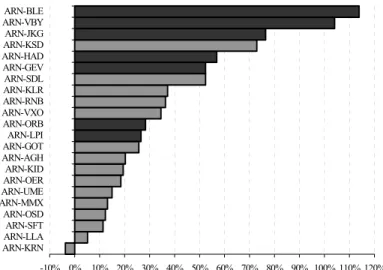
It has not been possible to obtain information about average price trend in the case of all domestic routes. The data to which Swedish CAA has had access is apparent from Figure 7 (SAS routes are shaded grey).
Figure 7 Real change in average prices for different air routes, 1992-2000 -10% 0% 10% 20% 30% 40% 50% 60% 70% 80% 90% 100% 110% 120% ARN-KRNARN-LLA ARN-SFT ARN-OSD ARN-MMXARN-UME ARN-OERARN-KID ARN-AGH ARN-GOTARN-LPI ARN-ORB ARN-VXO ARN-RNBARN-KLR ARN-SDL ARN-GEV ARN-HADARN-KSD ARN-JKG ARN-VBYARN-BLE
Source: Swedish CAA
The conclusions previously reached concerning which routes have experienced the largest and the smallest price increases are confirmed by the average price trend in the above. A common denominator for the five routes on which prices have increased most is that they were previously operated by SAS/Linjeflyg and are now operated by Skyways.
Price trend since 2001
As mentioned earlier, the Market Court delivered a ruling on 27 February 2001 concerning SAS’s use of its frequent flyer programme.49 Under the court ruling, SAS has been prohibited from applying its FFP in such a way that points or the equivalent for the redemption of bonus offers can be earned on domestic flights between destinations where SAS, or airlines cooperating in an alliance with SAS under the programme, are in competition. SAS, however, is still free to award points on other domestic routes. Other airlines are free to award points on all domestic routes, regardless of whether they are in competition or not. Figure 8 shows how relative prices for the private and business segments respectively have changed since 2001.50
Figure 8 Relative price trend since 2001 for private and business air travel in the domestic market, December 2000=100
Source: Statistics Sweden
49 MD 2001:4.
50 Relative prices have been calculated as nominal prices in relation to the Retail Price Index (RPI). 90,00 95,00 100,00 105,00 110,00 115,00 120,00 125,00 dec-0 0 ja n -0 1 fe b -0 1 ma r-0 1 a p r-0 1 maj -0 1 ju n -0 1 jul-0 1 au g-0 1 se p -0 1 ok t-0 1 nov-0 1 dec-0 1 ja n -0 2 fe b -0 2 ma r-0 2 a p r-0 2 maj -0 2 ju n -0 2 jul-0 2 au g-0 2 se p -0 2 ok t-0 2 nov-0 2 dec-0 2 Market Court Decision 11 september 2001 Decision in force --- Business travel ___________ Pleasure travel
Relative prices for the two segments were virtually unchanged from the beginning of 2001 up until the date when the Market Court injunction entered into force. Between the events of 11 September 2001 and the entry into force of the court decision, prices increased in both the private and public air travel segments. From the fourth quarter of 2001 onwards, there was a marked increased in relative prices for private travellers, but prices then fell in the first half of 2002.
From May 2002, relative prices for private travellers increased substantially, while prices in the business travel segment declined. During the summer and autumn, prices in the private travel segment increased further, although at a slightly slower pace, while prices in the business segment increased marginally and then stabilised. In sum, from the entry into force of the Market Court prohibition and up until the end of 2002, the relative price of tickets normally purchased by private travellers increased by almost 16 per cent. In the case of tickets normally purchased by business travellers, the relative price showed a 4 per cent fall during the corresponding period.
3
Supply of frequent flyer programmes
Most industries have bonus or discount programmes of some kind and the air travel industry is no exception. All such programmes are used for marketing purposes and represent instruments for
marketing a specific product or a service. One such instrument is a loyalty programme, the express purpose of which is to strengthen customer loyalty and develop strong customer relations. The aim of such programmes is generally to offer customers some kind of reward, often in the form of a price reduction or a higher membership level for travellers using a service frequently.
For a loyalty programme to work, the user must acquire information about the customer. Customers must first be identified and
described, especially the most important ones. A feature of many markets is that a relatively small proportion of customers account for a relatively large share of income. In the air travel field,
business travellers account for a significant share of airline turnover and profit. Frequent flyer programmes, FFPs, help to identify these travellers.
• Frequent flyer programmes (FFPs) are an important
competitive instrument that seek to induce loyalty.
• An airline with an extensive network and a wide range of
products can offer a more attractive bonus programme that strengthens loyalty to the company. Alliances and other forms of cooperation strengthen loyalty further.
• FFPs differ from other types of discount or bonus systems
in several respects.
• Bonus points normally accrue to the business traveller
personally despite the fact that the employer pays for the journey.
• In principle, FFPs display the same characteristics irrespective of whether they are Swedish, European or American.
Following identification, customers’ purchasing habits must be studied – how often they buy, what products they demand and what amounts of money different customer categories spend. By
gathering such information, companies can develop efficient marketing strategies targeting specific customer groups.51 Loyalty programmes represent powerful marketing instruments in the air travel industry. In the US, travellers in FFPs earn almost 50 per cent of their points from the purchase of products and services other than air flights, primarily via telephony, hotel
accommodation, car rental and financial services. Points can also be earned via credit card purchases.52
3.1
Loyalty programmes in civil aviation
The air travel industry offers a wide range of bonus or discount programmes. The present report is primarily concerned with the loyalty programmes in civil aviation commonly referred to as frequent flyer programmes or FFPs,53 under which participants are rewarded with free travel, service benefits and other perks. Airlines also offer more traditional types of bonus or discount programmes. One example is the use of travel passes, which award customers a price reduction for each journey when they buy several trips at once, or annual season tickets, which give customers a reduced price for each journey purchased over the next 12 months. Both involve initial investments, but the price reduction is
nevertheless relatively easy to calculate. In addition, there are company agreements under which undertakings sign volume agreements with carriers and are given a discount in return. FFPs were introduced in the US in the early 1980s. The first programme of all was launched by American Airlines in 1981 and was entitled the Aadvantage Travel Awards Programme. The
51 Mauri (2002)
52 ‘Fly me to the moon’, The Economist, 2 May 2002
53 The term frequent flyer programme or FFP is used throughout in this report to denote bonus or discount programmes in civil aviation that reward frequent flyers with free travel or other benefits of a similar nature.
company registered travellers who flew frequently and these customers were subsequently given baggage labels they could be recognised by, and also better meals on board from their own menu. After a while, travellers who flew frequently were given the
opportunity to earn points that could be redeemed against certain benefits such as free travel to a range of destinations and upgrades to a higher cabin class.
Other airlines in the US also began introducing FFPs and allowed participants to earn points on other purchases besides air trips, including car rental, hotel accommodation, telephone subscriptions and credit card purchases. In the mid-1980s, virtually all major US airlines ran some form of frequent flyer programme.
No such programmes existed in Europe in the 1980s. European airlines then began to realise that European travellers were
increasingly choosing US carriers for trans-Atlantic flights, and that they themselves were losing traffic to US airlines, especially business travel. Consequently, European airlines began entering into partnerships with US airlines.
In the early 1990s, the first FFPs were introduced in Europe and were followed by additional programmes in 1991 and 1992. The European programmes were considerably smaller in terms of membership than the US ones, and were initially more restrictive in their rules, but gradually came to resemble the American FFPs.
3.2
Comparison between FFPs and other loyalty
programmes
While FFPs resemble other loyalty programmes54 in many respects, they differ from them in some, for instance in the way they are formulated and in the rewards they offer. As in the case of other loyalty programmes, members are rewarded for using a particular product or service.
54 E.g. food chain stores’ customer cards, such as Coop MedMera and ICA Kundkort in Sweden, and petrol companies’ fuel or credit cards.
FFP content
The difference between frequent flyer programmes and other loyalty programmes lies primarily in the way they are designed. FFPs have a sophisticated points system. In addition, they include entry or threshold levels, time and membership limits and ‘blackout periods’, and the airlines also reserve the right to modify their programmes or terminate them.
Bonus points in an FFP have two different purposes and could be described as two different types of points. One type can be used to claim free travel, hotel accommodation, car rental, financial services or the like. In such cases, the points are valid for a lengthy period, from a few years up to lifetime duration. Points can never be redeemed against cash. Another points category, for service points, can be used to upgrade passengers’ service levels, often designated Gold, Silver or the like. These higher service levels entitle members to special privileges every time they fly, e.g. fast-track check-in, access to special lounges at airports, higher priority in the ticket reservation system, and seating and meal preferences on board. Service points are valid for a shorter period, usually 12 months. After that, members are required to accrue the same minimum number of points each year to keep their higher level of service.
Members can earn points for each flight. The points vary, depending on the destination and distance and in which class the person flies, which means that travellers earn more points on long-distance flights and flights in business class or first class than on flights over shorter distances and flights in tourist class. Some airlines do not award any points at all for certain kinds of travel. For the most part, entry levels or thresholds mean that members cannot redeem and make use of the points they have earned until they have accumulated a predetermined number. Members are guaranteed different kinds of benefits which increase the more they fly, but the benefits do not become available until the member has earned a given number of points. Consequently, members are less interested in flying with a rival airline even if that airline offers a lower price or a more suitable travel alternative.
Time and membership limits work in a similar way as ‘use by’ dates, partly because membership of the programme may be
terminated if the member earns no points over a fixed period, which means accrued points are forfeited, and partly because the points are only valid for a certain length of time.
The term blackout periods refers to periods during which the airline has decided that members cannot redeem points, e.g. the peak season or peak traffic times. Also, in their agreements with their members, airlines have to a great extent reserved the right to introduce programme changes, such as new levels for earning and redeeming points and the right to terminate the programmes.55
Membership
As in the case of most other loyalty programmes, membership of an FFP is personalised. Thus it is the individual traveller who belongs to the programme and who earns the points. As a rule, however, points can only be redeemed by the member and his/her family, or in certain cases by someone accompanying the member on the journey.
Frequent flyer programmes are open to all air travellers, including private travellers, but they specifically target business travellers.56 An important aspect of FFPs is that business travellers do not pay for their journeys themselves as they are flying on business. Thus points earned accrue to the business traveller personally despite the fact that it is the employer who pays for the travel. The private use of bonus points earned through business travel is taxed as earned income in many countries. In practice, however, it is difficult to tax this kind of benefit as the tax authorities do not have sufficient verification data at their disposal.57
Reward
In contrast to other loyalty programmes, reward in FFPs does not take the form of cash but of free services, and these do not
55 In practice, opportunities for airlines to make changes in their FFPs are probably more limited than the agreements suggest, due partly to statutory legislation and partly to the airlines’ desire to retain goodwill.
56 Business travellers are defined as those travelling on business. 57 This is discussed in greater detail in Section 4.1.3
necessarily fall into the same category as the service purchased, i.e. air travel. When threshold levels are also factored in, this use of non-monetary reward makes it difficult to calculate and evaluate the size of the reward in relation to the total purchase value. An
additional factor in evaluating reward is the considerable benefit to members of having access to a higher service level when a certain membership status has been achieved.
Another difference compared to most other loyalty programmes is in the size of the reward in relation to total purchase value. In FFPs, reward is often 5-15 per cent while in other programmes it tends to be only one or two per cent. Also, FFPs differ in that each
member’s total purchase value, especially in the business travel segment, is relatively high.58
Market dominance and network effects
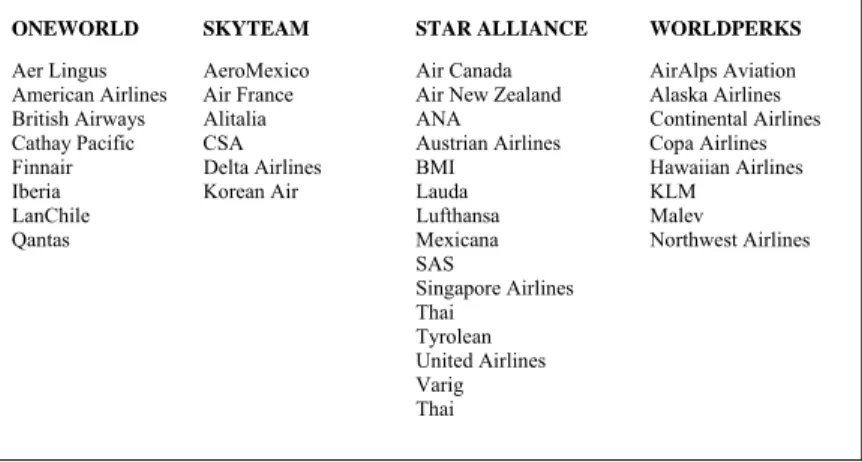
Most of the major airlines cooperate via voluntary bilateral or multilateral agreements, known as alliances. Such partnerships usually involve FFP cooperation, either through the introduction of a joint programme or through collaboration with other programmes in the alliance. As a rule, cooperation in FFP alliances means that travellers can use bonus points in a partner carrier’s programme. Figure 9 Alliances
ONEWORLD SKYTEAM STAR ALLIANCE WORLDPERKS
Aer Lingus AeroMexico Air Canada AirAlps Aviation American Airlines Air France Air New Zealand Alaska Airlines British Airways Alitalia ANA Continental Airlines Cathay Pacific CSA Austrian Airlines Copa Airlines Finnair Delta Airlines BMI Hawaiian Airlines
Iberia Korean Air Lauda KLM
LanChile Lufthansa Malev
Qantas Mexicana Northwest Airlines
SAS Singapore Airlines Thai Tyrolean United Airlines Varig Thai
Source: The airlines’ respective websites
58 Holm (2000), p.2ff.
Besides such alliances, there are other types of airline partnerships that may also involve cooperation on FFPs. Moreover, airlines sometimes collaborate with other types of undertakings, such as hotel enterprises, car rental firms or finance corporations, primarily credit card companies. As a result of alliances and other forms of cooperation, members of a frequent flyer programme can earn bonus points when travelling with any of the partner airlines. Also, they can accumulate points when using the services of other undertakings with which the airline collaborates.
Furthermore, in cases where an FFP is used by an airline that is dominant in a market, the programme may represent a barrier to market entry as a result of travellers tending to join a programme that offers the highest number of departures and the largest network of routes. In some markets, this may lead to an absence of suitable bonus alternatives for the traveller. Alliances and other forms of collaboration – with airlines and other types of undertakings – tend to reinforce this market dominance, which in turn strengthens the entry barriers that FFPs represent.
3.3
FFPs in the Swedish market
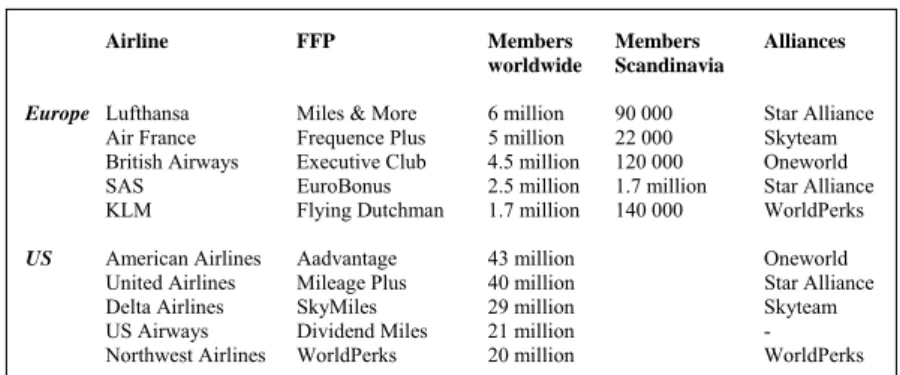
In 1992, SAS introduced its EuroBonus scheme, one of the first FFPs in Europe. The Star Alliance network founded in 1997 gave SAS’s EuroBonus members the opportunity to earn and use points throughout the alliance. In the same year, EuroBonus was also introduced in full in the domestic air travel market in Sweden. This SAS programme is totally dominant in the Scandinavian civil aviation market and also in the Swedish domestic market. EuroBonus has some 1.7 million members in Scandinavia and approx. 2.5 million altogether.
Other programmes, such as the British Airways Executive Club, KLM’s Flying Dutchman, Lufthansa’s Miles & More and Air France’s Fréquence Plus, have only a few hundred thousand members between them in Scandinavia. At the beginning of 2003, Malmö Aviation introduced its own FFP, the Malmö Aviation Member Service.