PhD Dissertation Proposal
Retrieval of 3D Models using
Partial Matching
by
Alfredo Manuel dos Santos Ferreira J´
unior
1 Introduction 1
2 Background and State-of-the-Art 3
2.1 The key players . . . 3
2.2 The most relevant events and journals . . . 6
2.3 Model databases . . . 8
2.4 From shapes to descriptors . . . 9
2.5 Shape descriptors . . . 10 2.5.1 Histogram-based descriptors . . . 11 2.5.2 Transform-based descriptors . . . 20 2.5.3 Graph-based descriptors . . . 26 2.5.4 Image-based descriptors . . . 30 2.5.5 Other methods . . . 36
2.5.6 Discussion on Shape Descriptors . . . 38
2.6 Query and Matching . . . 40
2.6.1 Query types . . . 40
2.6.2 Matching properties . . . 41
2.6.3 Similarity measuring . . . 42
2.7 Benchmarking 3D shape retrieval . . . 44
2.7.1 Shape benchmarks . . . 44
2.7.2 Comparative studies . . . 46
2.8 Content-based Retrieval of 3D models . . . 47
2.9 Retrieval using Partial Matching . . . 49
2.9.1 Partial matching at NIME . . . 50
2.9.2 Partial matching by structural descriptors . . . 51 i
2.9.5 Partial matching at Princeton . . . 56
3 Thesis Statement 58 3.1 The ultimate goal . . . 58
3.2 Problem statement . . . 59
3.3 Research hypothesis . . . 60
3.4 Research objectives . . . 61
4 Proposed Approach 61 4.1 Research focus . . . 62
4.2 The 3D test data set . . . 63
5 Work Plan 63 5.1 First year . . . 63 5.2 Second year . . . 64 5.3 Third year . . . 65 6 Preliminary Results 66 6.1 Prototype . . . 66 6.2 Shape Descriptors . . . 67 6.3 Model Database . . . 67 6.4 Evaluation results . . . 68 6.5 Next steps . . . 69 ii
5 2D examples space decomposition techniques . . . 15
6 Computing 3D shape contexts . . . 16
7 EGI descriptor versus VEGI descriptor . . . 17
8 3D object and corresponding shape index . . . 19
9 Cross sections of binary and inverse distance functions of 3D object . . . 21
10 Multi-resolution representation of the spherical extent function . . . 22
11 Computing feature maps . . . 23
12 Princeton methodology for computing spherical harmonics descriptor . . . 24
13 Symmetries relative to planes selected via PRST . . . 26
14 Reeb graph of a bi-torus . . . 27
15 Results of shape matching with MRG versus ARG . . . 28
16 Skeletal graphs for a pair of matching objects . . . 30
17 Building a spin image . . . 31
18 Spin-images for three oriented points on the surface of a model . . . 32
19 Silhouette images of an aeroplane model on the coordinate hyper-planes . . . . 33
20 Extraction of the depth buffer-based shape descriptor . . . 34
21 Computing elevation descriptor of a 3D model . . . 35
22 Computing spherical images from a 3D model . . . 37
23 The unit sphere under three most common Minkowsky distances . . . 43
24 Some models from National Design Repository . . . 45
25 Busts from Art-Models database and corresponding deformed models . . . 47
26 MIIRE search engine on PC and PDA . . . 49
27 Decomposition of a 3D model of a turtle . . . 51
28 Sub-part correspondence of two mechanical parts . . . 52
29 Scale-dependent corners and edges extracted from polygonal model . . . 54 iii
32 Selecting distinctive regions . . . 57
33 Example of partial matching . . . 59
34 Gantt chart representing PhD work plan. . . 64
35 Architecture of preliminary prototype. . . 66
36 Shape descriptors computed by preliminary prototype. . . 68
37 Precision-recall plots . . . 69
systems are able to find a model in a database from a sketched query or using query-by-example. However, results produced by such systems are far from the successful query results obtained by their textual counterparts.
A major handicap of most retrieval systems is the fact that they only support queries of the complete object. Even those who use local features to represent a model in a database usually do not allow matching of object subparts. In recent years, some researchers focused their investigation on 3D shape retrieval with partial matching. However, they rely on representing only some parts of the model, such as salient regions or distinctive features, and not the complete set of model subparts.
In this thesis proposal we will focus on 3D shape retrieval with partial matching. Unlike other approaches, we will represent complete models, in a way similar to text retrieval systems that classify all words from the entire document and not only some select words. We believe that through the use of a deterministic shape decomposition and a shape thesaurus with inverted indexes we will be able to describe and retrieve 3D models partially. This approach will allow us to take advantage of some well known techniques from text information retrieval, such as the term frequency and inverse document frequency to rank the relevance of every subpart in the database. We hope that, at the end, our research contribute to devising an effective solution for 3D shape retrieval with partial matching.
Keywords: Content-based retrieval, 3D shapes, partial matching.
number of 3D models both on the internet and in domain-specific databases. Three-dimensional models are used in a wide range of fields, such as engineering (CAD/CAM), virtual reality, medicine (CAT scans), molecular biology, geography (SIG) or not to men-tion the growing entertainment industry.
As a result, many collections of 3D models are now available for usage on a wide range of areas. Following the evolution of such collections, a considerable effort has been dedicated by researchers all over the world to analysis, classification and retrieval of three-dimensional models. Indeed, the problem of comparing 3D objects arises not only in one specific area or type of model but is a general issue, embracing a wide range of applications. For instance, besides the obvious applications in CAD model retrieval, similarity detection in organ deformation can help diagnosing diseases [72] and structural classification, a basic task in molecular biology, can be approached by 3D similarity search [9].
Thus, there is a growing necessity in classifying and retrieving 3D geometrical models using shape properties instead of (or combined with) text. To that end, several research groups focused their work on classification and retrieval algorithms that rely mainly on shape descriptors (feature vectors). Indeed, finding adequate descriptors that capture global or local shape characteristics while allowing computational viability of the repre-sentation has become a main investigation goal in this area. As a result of this research, there are several emerging solutions to search 3D objects based on their geometrical con-tent.
In this context, most current techniques to describe 3D models are based on computable geometrical attributes of the shape. However, these techniques do not use the structure and details of the desired objects to index. Moreover, existing approaches work mostly by comparing the complete models and do not allow partial queries to be formulated, which greatly hinders their usefulness. This is similar to a text-based system requiring detailed specifications of pages or complete documents to find a given document, in which only example documents would serve as query initiators instead of typing a few words to a search engine. This explains why 3D model retrieval systems enjoy limited usefulness and there is no equivalent of a GoogleTM or YahooR search engine for three-dimensional geometric shapes.
Nevertheless, in recent years a few 3D shape retrieval approaches with partial matching has been proposed. These approaches allow searching for a model supplying as a query only part of the desired model . However, such solutions rely on representing some sub-parts of the model and not the complete model. Indeed, considering only a small set of distinctive features of an object to classify it proved to be an efficient shortcut, but
some eventually relevant object information is discarded in this process. Informally, a 3D search engine using these approaches can be compared to a text retrieval system that uses automatically extracted keywords to classify document instead of the whole content.
Aiming an effective solution for 3D shape search, our investigation work will focus on object retrieval mechanisms to analyse and describe the content of models based on
techniques for structure-driven partial matching of 3D models. Indeed, we intend to
develop techniques that will provide some of the functionality necessary to build a retrieval system with effective support to partial matching but classifying complete models. To that end, we plan to investigate the viability of transposing matching and indexing approaches widely-used in text information retrieval to 3D shape searching.
We believe that through the combination of effective shape decomposition techniques with a shape thesaurus we will be able to describe and retrieve 3D models with partial queries. However, despite the success of word thesaurus in text documents, while words can be easily extracted from documents, shape identification in a three-dimensional object is a much harder task and the success of such approach is not guaranteed. Indeed, the difficulties of this task came not only from its computational complexity but also from the ambiguity of such identification.
Therefore, our research will focus on devising a technique for model segmentation suitable to be used in conjunction with a shape thesaurus. Moreover, we will investigate shape retrieval, indexing and matching methods that support the proposed thesaurus-based approach. Additionally, we will develop a framework for 3D shape classification and retrieval with partial matching based on the proposed approach.
On this proposal we will firstly present a brief overview of research context underneath the classification and retrieval of three dimensional shapes. To that end we identify the key players in this area and the most relevant events regarding our work. Additionally, we present a short list of existing model databases.
Next, we will focus on the theoretical background and state of the art in 3D shape re-trieval by analysing three distinct research areas: shape descriptors; content-based rere-trieval of 3D models and retrieval of 3D shapes using partial queries. Since shape descriptors are generally used to represent objects in retrieval systems, as referred above, algorithms and techniques to extract such information from models are considered to be among the most important topics in shape retrieval research. Thus, we give special attention to shape descriptor techniques by providing an extensive overview to existing approaches.
In the remaining of this document we will focus in the proposed research problem and present the thesis statement, defining the hypothesis. Next, we will describe the approach we will follow in our research work and present a three-year work plan for the proposed PhD thesis. Finally, we will present some preliminary results obtained in early stages of this work.
tionally, we will identify a small set of journals and conferences where our research topics are usually presented and published.
Besides presenting the current research context we focus on important topics in 3D shape retrieval. Regarding our work, these are the shape description, query and matching techniques and benchmarking methodologies. Due to the unquestionable importance of descriptor computation techniques on content-based retrieval system, we dedicate special attention to present later in this section a short but comprehensive survey on 3D shape descriptors. We will also briefly review some existing solutions for 3D shape retrieval. Obviously, this section could not be complete without presenting the state-of-the-art on partial matching of 3D shapes, with which we close this section.
2.1 The key players
Following the increasing importance of content-based retrieval of three-dimensional shapes, several research groups around the world focused their interests on this area, which we will present here. However, producing an exhaustive list with all of them is difficult, with the additional risk of excluding some important researchers. Therefore, we will only present a short list containing those we consider more relevant regarding our work.
The concise list of research groups working on analysis and retrieval of three-dimensional shapes, and corresponding researchers is presented in Table 1. As we mentioned before, the list of research groups referred in this section is far from exhaustive. Indeed, many relevant researchers were not included here since it will result in a quite extensive list of every people of every group working on analysis and retrieval of three-dimensional shapes. Thus, we will only refer the groups whose work had greater impact in our research until the present time and the most prominent researchers of these groups.
Princeton During the last six years, the Princeton Shape Retrieval and Analysis Group, leaded by Thomas Funkhouser, have been addressing key issues in shape-based retrieval and analysis of 3D models. Focusing on effective shape representations and query inter-faces, they have developed a search engine for 3D polygonal models and later released a classified set of 3D models that can be used by researchers in this area. The Princeton Shape Benchmark is now widely accepted as a major benchmarking tool within 3D shape retrieval and classification.
Research Group Institution People
Shape Retrieval and Analysis Group Princeton University Thomas Funkhouser
(USA) David Dobkin
Adam Finkelstein Szymon Rusinkiewicz Philip Shilane Josh Podolak 3D Model Similarity Search Project Konstanz University Daniel A. Keim
(Germany) Dietmar Saupe Benjamin Bustos Tobias Schreck Dejan Vrani´c
PRECISE Purdue University Karthik Ramani
(USA) Suyu Hou
Y. Kalyanaraman
Shape Modelling Group CNR IMATI-Ge Bianca Falcidieno
(Italy) Michela Spagnuolo
Silvia Biasotti Simone Marini Francesco Robbiano Multimedia and Geometry Group Utrecht University Remco Veltkamp
(The Netherlands) Frank Ter Haar Reinier Van Leuken
FOX-MIIRE group University of Lille Mohamed Daoudi
(France) Jean-Philippe Vandeborre Tarik Filali-Ansary Media Integration and Communication Center University of Florence Alberto del Bimbo
(Italy) Pietro Pala
J¨urgen Assfalg Image and Video Processing Group Boˇgazi¸ci University B¨ulent Sankur
(Turkey) Y¨ucel Yemez (Ko¸c University) Ceyhun Burak Akg¨ul
Helin Dutaˇgaci Table 1: Some key players on 3D shape retrieval research
Konstanz The Multimedia Signal Processing Group chaired by Dietmar Saupe and the Databases, Mining and Visualization Group leaded by Daniel Keim, both from Konstanz University, join their efforts in a research project focusing the retrieval of three-dimensional shapes. The 3D Model Similarity Search project is part of the strategic research initiative on Distributed Processing and Delivery of Digital Documents and aims at effective content based model retrieval and efficient indexing and accessing methods.
PRECISE In Purdue University, Karthik Ramani leads the Purdue Research and Edu-cation Center for Information Sciences in Engineering (PRECISE). Their research lies at the intersection of design, shape analysis, and information sciences. They focus on develop-ing representations for two and three-dimensional shapes for engineerdevelop-ing and proteomics. In the last few years, they developed interfaces for querying, interacting, orienteering, and navigating intelligently in 3D shape databases. Their 3D Sketch-Based System for Con-ceptual Design, also known as ShapeLab, aims on empower computer-aided design users to retrieve, modify and reuse 3D models through freehand sketches.
elling, producing some interesting work on shape retrieval. Moreover, Bianca Falcidieno is coordinator of the AIM@SHAPE network of excellence.
AIM@SHAPE The Advanced and Innovative Models And Tools for the development of Semantic-based systems for Handling, Acquiring, and Processing knowledge Embed-ded in multidimensional digital objects (AIM@SHAPE) is a sixth framework program project that fosters the development of new methodologies for modelling and processing the knowledge related to digital shapes. This project embraces a multi-disciplinary field, which integrates Computer Graphics and Vision with Knowledge Technologies and builds on using knowledge formalisation mechanisms for linking semantics to shape or shape parts.
Utrecht Also participating on AIM@SHAPE, Multimedia and Geometry group headed by Remco Veltkamp at the Center for Geometry, Imaging and Virtual Environments of Utrecht University has been working on multimedia information retrieval. Along with their research in areas such as music or image retrieval, they have developing some interesting work on 3D shape analysis and retrieval, namely on 3D facial models.
FOX-MIIRE In the Multimedia, Images, Indexation and Recognition (FOX-MIIRE) research group at the University of Sciences and Technologies of Lille, Jean-Philippe Van-deborre, Mohamed Daoudi and their teams are working on three-dimensional model in-dexing and topological analysis. The recently published FOX-MIIRE 3D-Models Search Engine based on adaptive views clustering algorithm is the first search engine that accepts 3D-Models retrieval from photos [46]. Additionally, they developed a 3D retrieval applica-tion for mobile devices, which were presented in the 2007 ACM Internaapplica-tional Conference on Image and Video Retrieval. The FOX-MIIRE group is a partner of DELOS Network of Excellence.
DELOS Partially funded by the European Commission in the frame of the Information Society Technologies Programme, DELOS is a Network of Excellence on Digital Libraries. The main goal behind DELOS is to provide global access to knowledge contained in the digital collections created by organisations and individuals around the world. To that end, DELOS is conducting a joint program of activities aimed at developing the next generation of Digital Library technologies, based on sound comprehensive theories and frameworks for
the life-cycle of Digital Library information. Within the large number of research topics covered by DELOS, the work leaded by Alberto del Bimbo from the University of Florence is of major relevance for our research.
Firenze At the Media Integration and Communication Center of the University of Flo-rence, researchers leaded by Alberto del Bimbo presented a prototype system for content based retrieval of 3D objects, briefly described in Section 2.8. Besides, they have been developing relevant research on curvature maps and spin images as descriptors for 3D shape retrieval.
Boˇgazi¸ci At the Image and Video Processing Group of Boˇgazi¸ci University, B¨ulent Sankur’s team is developing, together with people from the multimedia, vision and graph-ics laboratory at Ko¸c University relevant research on 3D shape retrieval. In the last two years, they focused their research on analysis and description of 3D shapes and on 3D face recognition, achieving remarking results.
2.2 The most relevant events and journals
In order to disseminate the results of our research and to allow an easier search of related work, we identified the most relevant events and journals that focus the 3D shape analysis
and retrieval area. When gathering this information we decided not to include some
major computer graphics publications and events, such as ACM Transaction on Graphics, since their importance is obvious. Instead, we list a short number of selected events and publications with high visibility where researchers on our field have been sharing their work.
SMI The IEEE International Conference on Shape Modeling and Applications, also
known as Shape Modelling International (SMI), was launched in 1997 with the goal to join a multi-disciplinary community concerned with computation techniques for modelling and processing digital representations of shapes and their properties. In 2001, SMI has merged with the Implict Surface Workshop and is now run as an annual event alternating between Asia, Europe and America. Today, SMI addresses all aspects of shape acquisition, processing, retrieval and understanding. Since 2006, it includes a related event of great importance for our work, the 3D Shape Retrieval Contest (SHREC).
SHREC Similarly to what happens in other information retrieval research areas, inves-tigators that work on 3D object retrieval established recently an international retrieval contest. Organised by the Network of Excellence AIM@SHAPE, the SHREC aims at evaluating the effectiveness of 3D-shape retrieval algorithms. In its initial version it was designed around the Princeton Shape Benchmark. The success of this contest provided
SGP The first Eurographics Symposium on Geometry Processing was held in 2003 to allow researchers of the geometry processing area to present and share their work. This emerging research field aims at designing efficient algorithms for acquisition, manipulation, animation and transmission of complex 3D models. The processing techniques are based on recent developments in applied mathematics, computer science, and engineering. Closely related to our work, shape analysis is one of the topics covered by this symposium, making it an interesting event for us. After the success of the first edition, this event are being organised on a yearly base. Papers presented in this event appear in the Eurographics Proceedings Series in cooperation with ACM SIGGRAPH.
MIR Initially launched as Workshop Multimedia Intelligent Storage and Retrieval Man-agement (MISRM) in 1999 and later renamed to ACM SIGMM International Workshop on Multimedia Information Retrieval (ACM MIR), this workshop has the purpose of bringing together researchers, developers, and practitioners from academia and industry, working on multimedia information retrieval. The workshop proceedings are printed by ACM and indexed in the ACM Digital Library, which makes it a good selection when choosing where to publish our work.
SPM Since its inception in 1991, the ACM Symposium on Solid and Physical Modeling
Symposium (SPM), then Symposium on Solid Modeling and Applications, has been the primary venue for disseminating research results in the design, representation, analysis, visualisation, and use of digital models. Within the topics of interest covered by this event are geometry processing and shape analysis, two important subjects in our research work. Moreover, the proceedings of this event are published by ACM Press and papers of outstanding quality are selected for publication in the following international journals: Computer Aided Geometric Design, Computer-Aided Design and IEEE Transactions on Automation Science and Engineering.
CAD Published by Elsevier, Computer-Aided Design is an established international
journal that provides engineers, designers and computer scientists with key papers on research and developments in the application of computers to the product design process. Although it focus mainly on engineering design, it covers a wide range of topics, such as the management of design databases, which includes the study of techniques for analysis and retrieval of 3D models.
CADG The international journal of Computer Aided Geometric Design, also published by Elsevier, is closely related with CAD journal referred before, but it main focus is on mathematical and computational methods for the description of geometric objects as they arise in areas ranging from CAD/CAM to robotics and scientific visualisation. Indeed, this journal does not have any topic focusing on retrieval of 3D shapes, but is an interesting place to find and publish work on shape description and simplification algorithms.
TOMCCAP The ACM Transactions on Multimedia Computing, Communications, and Applications (TOMCAP) is the flagship publication of the ACM Special Interest Group in Multimedia (SIGMM), published quarterly. It focuses on multimedia computing, mul-timedia communications and mulmul-timedia applications. Since our research field can be considered as part of multimedia information retrieval, this journal assumes major rele-vance both in our studies and in our dissemination goals.
IJDL The International Journal on Digital Libraries (IJDL), published by Springer, is a quarterly journal aimed at advancing the theory and practice of acquisition, definition, organization, management, and dissemination of digital information. Indeed, databases of 3D models are digital libraries, which justifies the importance of this publication for our work.
IJSM The International Journal of Shape Modeling is aimed at creating a suitable
environment for exchanging research results obtained in advanced theories and techniques devised for handling the shape of objects, pointing out main aspects of modeling. Besides the pure shape modeling, this journal also includes topics regarding shape classification, recognition and characterisation.
2.3 Model databases
Besides identifying the key players in three dimensional shape retrieval and the most relevant events for this research area, it is important to identify the existing sources of three dimensional models to which shape retrieval can be useful. Indeed, as a result of recent advances on modelling, digitising and visualising techniques, there are a large number of 3D model collections available for usage both on the internet and in domain-specific databases. Since it will be hard and out of scope of this work to exhaustively enumerate all of this databases, we will refer in the following paragraphs just a few of these databases offering public access.
The Protein Data Bank (PDB) [14, 15], an archival for macro molecular structures, is an early example of such collections now considered the single worldwide archive for biological macro molecules. The PDB stores atomic 3D coordinates and partial bond connectivity for around 29,000 protein molecules, as derived from crystallographic studies.
models and CAD files. Recently, Google released the Google 3D Warehouse [63], an online service that hosts 3D models of existing objects (mainly buildings) created in GoogleTMSketchUp [62]. These models can be downloaded into GoogleTMEarth [61] and placed in their actual location on earth.
Relevant for our work are the databases associated with shape benchmarks, very useful for evaluating retrieval algorithms. From these, the most important is Princeton Shape Database [50] which stores polygonal surface models for more than thirty thousand ob-jects crawled from the web. Additionally, the PRECISE group provides a fully classified database of mechanical parts [60]. This shape benchmark has special interest for people working on analysis and retrieval of CAD models. The objects in this database were col-lected from various sources including industrial partners of Purdue University and from the web.
2.4 From shapes to descriptors
The application diversity of three-dimensional models in a wide range of fields lead to sev-eral distinct forms of model representation [29]. However, these can always be converted or approximated to a more generic one, such as a polygonal mesh, which could be inter-preted by classification and retrieval algorithms. These algorithms usually rely on feature vectors to describe both models and queries and then perform the search over the feature vectors instead of comparing the objects directly. Indeed, the usage of feature vectors is the standard approach for multimedia retrieval [44]. A feature vector, also referred as de-scriptor, is a set of values extracted from a multimedia object that describe it numerically in a high dimensional space.
In 3D models, these values usually describe the shape or certain aspects of the object and form a feature vector of high dimensionality. Thus, a 3D shape descriptor can be considered as a representation of a three dimensional object in a high-dimensional vector space. However, an important goal of any shape description approach is to preserve the maximum shape information on a feature vector with the lower dimensionality possible. Indeed, finding such computational representation of a shape is considered as the primary challenge in building a shape based retrieval system [49]. Therefore, we will present in the next section a survey on most important shape description techniques.
Some relevant recent work had focused on the computation of the shape descriptor,
i.e., the extraction of global or local object characteristics. Indeed, several research groups are working in this field, developing mechanisms to support 3D shape retrieval from large
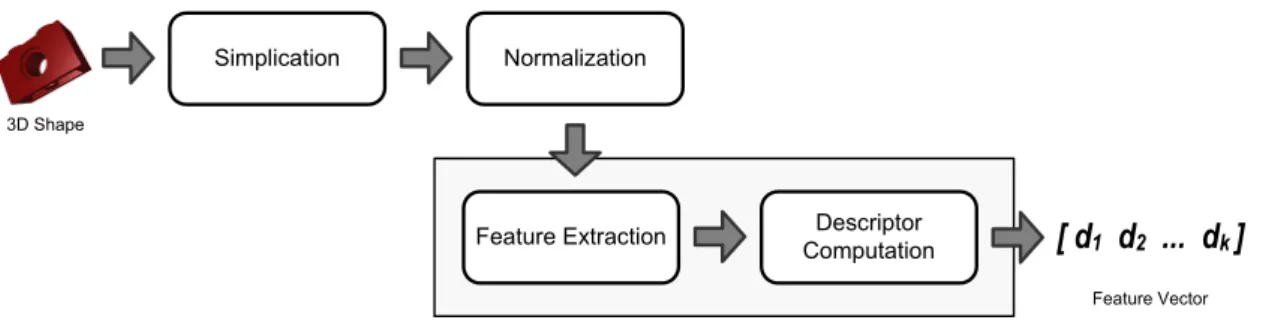
Simplication Normalization
3D Shape
Feature Vector
Feature Extraction ComputationDescriptor [ d1 d2 ... dk ]
Figure 1: Shape descriptor computation process.
collections using geometrical queries. One of the main goals of their research is to devise descriptors that represent efficiently the shape geometry and that allow computation of ill-defined properties, such as ”geometric similarity”. A wide variety of extraction algorithms have been proposed, ranging from basic approaches, which use properties of an object bounding box, to more complex ones, like the distribution of normal vectors or curvature, or the Fourier transform of some spherical functions that characterise objects. Depending on the method used, the feature vector describes particular characteristics of an object, capturing different features.
Despite the wide variety of approaches to 3D shape descriptor computation, this process generally follows the basic steps depicted in Figure 1. The first step is the ob-ject simplification. In this step is usually performed a noise removal algorithm, especially in digitised models. Additionally, irrelevant geometrical features are removed from the object. In the second step, the resulting shape is pre-processed for rotation, translation and/or scale invariance, when required by the algorithm, followed by pose normalisation. The third step starts by converting the resulting shape to an object abstraction accord-ing to descriptor needs. Thus, it is converted to surfaces, volumes or images, dependaccord-ing on the approach. Then, the object abstract representation is transformed into a numeri-cal representation using, for instance, histograms, spherinumeri-cal harmonics or discrete Fourier transform. The last step uses this numerical representation to generate a feature vector. Although this basic steps are similar in most approaches, different authors use different techniques, making descriptor computation a rapidly evolving field.
2.5 Shape descriptors
In this section we will briefly describe existing approaches to 3D shape description. Al-though we tried, in this document to produce a comprehensive survey, readers are en-couraged to consult recent publications entirely dedicated to this topic. Bustos et al.
extensively surveyed methods for 3D shape descriptor computation [27] and proposed a taxonomy for these methods. However, due to the variety of distinct approaches, there is no universally accepted taxonomy of 3D shape descriptors.
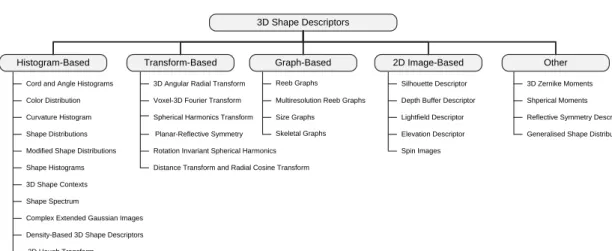
Complex Extended Gaussian Images
3D Hough Transform Shape Spectrum
Distance Transform and Radial Cosine Transform Rotation Invariant Spherical Harmonics
Density-Based 3D Shape Descriptors Shape Histograms
3D Shape Contexts
Modified Shape Distributions Spin Images
Figure 2: Taxonomy of 3D shape descriptors.
Nevertheless, I will follow a general classification scheme, very similar to the taxonomy proposed earlier by Bustos et al.. This scheme, depicted in Figure 2, emphasises the specific way to exploit the shape information contained in a 3D object and was suggested by Akg¨ul [4]. However, the research on 3D shape descriptors is a rapidly evolving field and, besides the recent work referred above, two other relevant surveys were published in recent years. A complete review on content based 3D shape retrieval methods was presented in 2004 by Tangelder and Veltkamp [115]. Additionally, in the following year, Iyeret al. published another state-of-the-art review [64] where they classify and compare several 3D shape searching techniques from a CAD/CAM perspective and suggest future trends.
2.5.1 Histogram-based descriptors
In statistics, a histogram is a summary graph showing a count of the data points falling within tabulated frequencies. Basically, it is the graphical version of a table which shows what proportion of cases fall into each of several or many specified categories. Widely used in computer graphics to represent the color distribution in an image, the color histogram
is computed by counting the number of pixels for each color. Adopted to 3D shape
description, an histogram is often referred as an accumulator that collects numerical values of certain features calculated from the shape to represent. Based on this loose definition, many 3D shape descriptors can be considered as histogram-based methods, although they are not based on histograms in the rigorous statistical sense of the term.
Cord and angle histograms The use of cord and angle histograms for 3D shape descriptors were presented by Paquet et al. in [90, 91]. The authors define a cord as a vector that goes from the centre of mass of an object to the centre of mass of a bounded
region on the surface of the object. They state that most often in 3-D applications the bounded region is a triangle, which is true due to broad use of triangular meshes. Even in other cases, the object can be transformed into a triangular mesh in the second step of shape descriptor computation process.
This 3D object descriptor are computed based on a collection of three histograms. The first histogram represents the distribution of the angles between the cords and the first reference axis. The second histogram represents the distribution of the angles between the cords and the second reference axis. The third histogram provides the distribution of the radius.
Despite its computational simplicity and efficiency, this approach simplifies triangles to their centres and does not consider the size and shape of the mesh triangles. Therefore, triangles of different sizes have equal weight in the final distribution and centres may not represent adequately the impact of the triangle on the shape distribution because of arbi-trary triangle orientations. Moreover, since only global features are used to characterise the overall shape of the objects this method is not very discriminating about objects de-tails, but their implementation is straightforward. It is often used in object retrieval as an active filter, after which more detailed comparisons can be made, or can be used in combination with other methods to improve shape descriptors.
Color distribution Paquet and Rioux [90] proposed, along with the cord and angle histograms, a peculiar color based descriptor for 3D shapes. In their approach, a voxelised representation of the 3D object, where each voxel has a color value associated with it. This value is computed using information from the texture map, material properties and vertex color extracted from the object representation.
Authors suggest three distinct approaches to compute the histogram that describes the object. If color location is relevant, it is only necessary to compute the color histogram of the object, based on the triplets (r, g, b) that represent the model colors. Alternatively, the dominant color is determined for each triplet and then the angle between the normal corre-sponding to that point and the first eigenvector is calculated. The statistical distribution of these angles is represented by a set of three histograms according to the dominant color. Otherwise, if color location is relevant, authors suggest using a wavelet approach based on a model with six dimensions: x, y, z, R, G, B. The six-dimensional wavelet transform is computed and then used to construct a histogram.
Curvature histogram Koenderink and van Doorn [73] defined the curvature index as a function of the two principal curvatures of the surface. This index gives the possibility to describe the shape of the object at a given point. However, it loses the information about the amplitude of the surface shape and is sensitive to noise. Later, Vandeborre et al. used this index to compute a curvature histogram of the shape [119], a local descriptor invariant to geometric transformations.
Figure 3: 3D shape and corresponding curvature histogram. (Figure taken from [119])
The surface curvatures are computed at a generic vertex v of a three-dimensional
polygonal mesh as expressed in Equation 1, with k1
v ≥ k2v, where k1v and k2v are the
principal curvatures associated with the pointv.
Iv = 2 πarctan k1v+k2v k1 v−k2v (1) In curvature histogram construction, the computation of principal curvatures is a key step. Estimating these curvatures can be achieved in several different ways. Authors suggest computing the curvature at each face of the mesh by fitting a quadric to the neighbourhood of this face (i.e. the centroid of this face and the centroids of its 1-adjacent faces) using the least-squares method1and then determine the principal curvatures k1
and k2 using the eigenvalues of a Weingarten endomorphism2. An alternative way to compute the curvature histogram descriptor is described in [24]. Figure 3 depicts the curvature histogram with 1024 intervals and the three-dimensional object from where it was extracted.
Shape distribution Osada et al. proposed a method for computing shape signatures for arbitrary 3D polygonal models [88]. They use a collection of shape functions computed with random sampling of the surface of the 3D object to describe. This shape function measures global geometric properties of the shape, based on distance, angle, area and volume measurements between random surface points.
Authors suggest five distinct one dimension functions to measure the object prop-erties, which are quick to compute, easy to understand, and produce distributions that are invariant to rigid motions (translations and rotations). The function to compute D1 shape distribution measures the distance of a surface point to the centre of mass of the model. Depicted in Figure 4, the D2 shape distribution is a function measuring the
dis-1Least squares is a method for linear regression that determines the values of unknown quantities in a statistical model by minimizing the sum of the residuals (difference between the predicted and observed values) squared. It is used to find or estimate numerical values of parameters to fit a function to a set of data and to characterise the statistical properties of estimates [1].
2
Principal curvatures are usually defined as the eigenvalues of the Weingarten mapW=I−1II, where
3D Model (Sphere) Shape Distribution 3D Model (Mug) Shape Distribution Figure 4: Two distinct objects and corresponding D2 shape distributions.
tance between two surface points. TheD3 shape function measures the square root of the area of the triangle defined by three surface points. The cube root of the volume of the tetrahedron defined by four surface points is measured by D4 shape function. Finally,A3 distribution function measures the angle formed by three random surface points.
The shape descriptors are constructed from the histograms of a set of the above men-tioned shape functions, controlling histogram accuracy through sampling density. The descriptor of shape distributions is fast, simple to implement, and useful for 3D shapes discrimination. However, the proposed shape functions are not adequate to fully describe the 3D shape effectively. Indeed, this approach distinguish models in broad categories very well, but perform poorly when used to discriminate between models with similar gross shape properties but vastly different detailed shape properties.
Modified shape distribution Ohbuchi et al. [87] extended the D2 shape functions proposed by Osadaet al., by devising a set of shape features that are tolerant to topological variations and geometrical degeneration. These are the modified shape D2 (mD2), the angle and distance histogram (AD) and the absolute angle and distance histogram (AAD). In the proposed technique, the mD2 is similar to original D2, but authors used a quasi-random number sequence3 to select points instead of the pseudo-number sequence4
suggested by Osada et al.. To compute AD, authors measure both distance between a
pair of points and angle formed by the surfaces the pair of points are located. Then, a 2D histogram is computed using the angle and distance as two independent variables. The
AAD is computed in an identical manner, but while the AD histogram respects the sign of the angle, the AAD feature takes the absolute value of the inner product in order to increase robustness against inconsistently orientated surface. Thus, these two descriptors
are not supposed to be used together. Indeed, the choice of using AD orAAD depends
only whether the surfaces are properly and consistently orientated.
3
The quasi random number sequence, also called low-discrepancy sequence, is not really random since a predictable sequence of numbers is generated. However, the numbers generated will provide uniform sampling with a suitable number of samples is required.
4
A pseudo random number sequence exhibits statistical randomness while being generated by an entirely deterministic causal process. Indeed, a pseudo random generator calculates a number in the range [0.0,1.0] given an initial seed which is updated each time a number is requested. With enough random numbers sampled, the distribution will be uniform. This, however, could be a large number of samples.
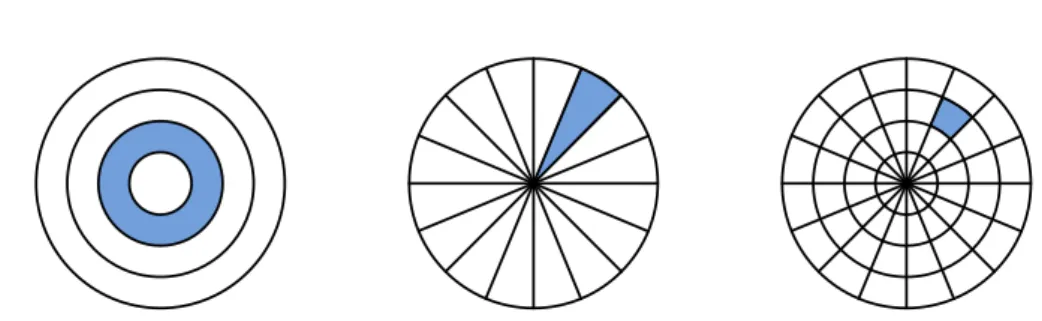
Figure 5: 2D examples of the space decomposition techniques proposed by Akerst et al.
in [9]. With a single bin marked, are depicted, from left to right, shell, sector and spider web model.
Shape histograms The shape histograms were proposed by Akerstet al. as an intuitive approach to describe 3D solid models [9]. In this approach the space where the object resides is partitioned using one of three space decomposition techniques: a shell model, a sector model and a spider web model (depicted in Figure 5). Shell model consists in decomposing the 3D space into concentric shells around the centre point. In the sector model the 3D is decomposed into sectors that emerge from the centre point. Finally, the spider web model (sometimes referred as combined model) is a simple combination of the two decomposition models described above. In any of these techniques, each cell of the decomposed 3D space correspond to a bin in the histogram. Then, the histogram can be constructed by accumulating the surface points in the bins.
The shape histograms method is an intuitive and discrete representation of complex spatial objects. However, authors illustrate the shortcomings of Euclidean distance to compare two shape histograms and make use of a Mahalanobis5 quadratic distance mea-sure taking into account the distances between histogram bins. On the other hand, this approach needs pose normalisation to be performed in the pre-processing stage. The pose normalisation is necessary because the sector model is only scaling invariant, while the shell model is only rotation invariant.
3D shape contexts The shape contexts was initially introduced by Belongieet al.[13] as a descriptor for computing similarity between 2D images. Using reference points, au-thors assign a shape context to each one, by capturing the distribution of the remaining points relative to it. K¨ortgen et al. extends the 2D shape contexts into a 3D shape de-scription and combines it with the shape histogram, thus proposing a set of descriptors called 3D shape contexts [74].
To compute the 3D shape contexts, N points are sampled from the shape boundaries, as in the shape distribution approach [88]. Then, the vectors originating from one sample point to all other points in the shape are computed, as depicted in Figure 6. Using the distribution over relative positions, is computed for this point a coarse histogram of the
Figure 6: From left to right: original 3D object; mesh with fifty samples; just the fifty samples; vectors originating from one sample point to all others (Figures taken from [74]).
relative coordinates of the remainingN −1 points. Indeed, this histogram is an adapted version of one of the Ankerst’s [9] shape histograms centred upon the sample point. This method is applied to allN sampled points, producing a 3D shape descriptor that is simply a set of N histograms.
Extended Gaussian images Defined by Horn in [59], the extended Gaussian im-ages (EGI) is a histogram-based technique to represent the shapes of surfaces that define a 3D object. Initially devised for recognition in machine vision systems, this approach was later adapted for pose determination and for computing 3D shape descriptors [68], by means of the complex extended Gaussian images (CEGI) representation.
Basically, the EGI of a 3D object is a histogram that records the variation of surface area with surface orientation. Each bin of this histogram is defined by a pair (θi ,φk) and
corresponds to some quantum of the spherical azimuth and elevation angles (θ,φ) in the range 0< θ <2π and 0< φ < π. These bins accumulate the count of the spherical angles of the face normal per surface, weighted by the scalar that represent the associated visible face area. The CEGI concept, presented by Kang and Ikeuchi, extended the EGI approach by adding the normal distance of each face to the origin. Thus, the weight associated with a particular normal in the CEGI is a complex number whose magnitude and phase are the corresponding visible face area and its signed distance to the origin, respectively. Thus, for a given point in the CEGI associated to normal~nk, the point weight wk can be estimated
through Equation 2:
wk=|A~nke
jdk|, (2)
where A~nk is the area of the corresponding face and dk is the distance of that face to
the origin. Concluding, the CEGI method combines the pose determination into shape descriptors and even into the shape matching process. It enables estimation of both the orientation and translation of a given object with respect to a stored model or prototype. More recently, Zhang et al. further extended the EGI representation to capture the volume distribution of an object without canonical alignment, while maintaining the trans-lation, scale and orientation invariance. The volumetric extended Gaussian image (VEGI) shape descriptor [133] is thus able to differentiate between convex and non-convex shapes
Convex shape Non-convex Shape
Figure 7: Two objects with the same EGI descriptor, but different volumes, thus different VEGI descriptors.
that share the same EGI, such as the objects depicted in Figure 7. Furthermore, VEGI directly extracts shape features avoiding pose normalization, since it does not depends on canonical alignment of shapes.
3D Hough transform Based on the 2D generalised Hough transform [12], Zaharia and Prˆetoux proposed in [132] the 3D Hough transform descriptor (3DHT) to represent a three-dimensional object. In their later work [131], developed canonical 3D Hough transform descriptor (C3DHT). These descriptors are constructed by accumulating points within a set of planes in 3D space, as described below.
Considering that a plane can be defined by a triplet (s, θ, φ), where s >0 denotes the distance from the origin of the coordinate system to plan and 0< θ <2πand−π
2 < φ <
π
2 respectively denote the azimuth and elevation associated with the spherical representation of the plane’s unit length normal vector. Then, each axis of the parameter space (s, θ, φ) can be uniformly sampled and a set of planes with orientation (θk, φj) passing through
thepis created. Considering a polygonal model,pstands for the centre of mass of a mesh faceg. Finally, for each plane, the quantized normal distance to the originsi is calculated.
If this value is positive, the bin corresponding to (si, θj , φk) is augmented by a weight
factor wpjk defined in Equation 3, where np denotes the unit length normal vector of face
g and njk denotes the normal of the plane defined by pair (θi, φk).
wpjk =Ap|hnp, njki| (3)
Indeed, 3DHT can be considered as a generalized version of EGI since, for a given si,
(θj, φk)-bins correspond to an EGI at distance si, except for the way the contributions of
the faces are assessed. In fact, Agk¨ulet al. have experimentally proven [6] that the 3DHT descriptor captures the shape information better than the EGI descriptor.
Shape spectrum The shape spectrum was introduced by Dorai and Jani [39] as a view-based representation of 3D free-form objects. In their work, authors focus on generation of a set of representative views of a 3D object suitable for efficient clustering and retrieval. Indeed, they apply this method to devise a general and powerful technique for organising multiple views of objects of complex shape and geometry into compact and homogeneous clusters. The shape spectrum characterises quantitatively the object shape by summarising the area on the surface of an object at each shape index value. This value is a quantitative measure of the shape of a 3D regular surface at a point p, denoted by Ip and defined
as expressed in Equation 4, where k1
p and kp2 are the principal curvatures of the surface
associated with point p, withk1p > k2p.
I(p) = 1 2 − 1 πarctan kp1+kp2 k1 p−kp2 (4)
Therefore, the shape index is a local geometrical attribute of a 3D surface, expressed as the angular coordinate of a polar representation of the principal curvature vector. It ranges in the interval [0,1] and is not defined for planar surfaces, since those have
k1 = k2 = 0 which will result in an indeterminate shape index6. Figure 8 illustrates the shape index of a free-form 3D object computed by this technique. The shape index provides a scale for representing salient elementary shapes and is invariant with respect to scale and Euclidean transforms. However, an important problem regarding the shape index, in fact all curvature-related quantities, is the estimation unreliability leading to a lack of robustness. Such shortcoming was alleviated by Zaharia and Prˆetoux in [131] by augmenting the shape index histogram by two additional attributes named planar surface and singular surface. Then, the proposed 3D shape spectrum descriptor (3D SSD) was applied to 3D retrieval within the MPEG-7 framework for multimedia content description. The 3D SSD of a 3D mesh is defined as the histogram of the shape index values, calculated over the entire mesh.
Therefore, the 3D SDD locally characterises free-form surfaces represented as discrete polygonal 3D meshes. One major advantage of this descriptor is its generality, since 3D meshes may include open surfaces that have not an associated volume. Furthermore, in-herited from the shape index properties, the 3D-SSD is invariant with respect to scale, translation, rotation and reflection transforms. On the other hand, this descriptor, as a simple local feature representation, is better to be combined with some global representa-tion schemes to effectively describe 3D object for shape retrieval purposes.
6For computational purposes, the shape index of a planar surface is represented by a symbolic label, usually a predefined shape index value to indicate surface planarity. In their implementation, Dorai and Jain [39] used a shape index value of 2.0.
Figure 8: View of a 3D object and corresponding shape index (Figure taken from [39] c
1997 IEEE).
Density-based shape descriptors A density-based descriptor of a 3D object is defined as the sampled probability density function7 (PDF) of some surface feature. The feature is local to the surface patch and treated as a random variable. This analytical framework was proposed by Akg¨ul and Sankur [6, 7] to extract 3D shape descriptors from local surface features characterising the object geometry. In [5], the authors suggest using as features the radial distance, the radial direction, the normal direction, the radial-normal alignment and the tangent-plane distance. Additionally, authors considered the shape index proposed in [73] as a second order feature that provides categorisation of the shape into primitive forms.
The density-based shape descriptor can be considered as a probability modeling prob-lem. As explained by Akgul et al. in [8], the local surface properties are first measured via various features, such as the referred above or a subset of the most discriminating of them. This feature information is then processed with the kernel methodology for density estimation [106, 41] and the PDF of the local feature is estimated at chosen target points. Then, the shape descriptor vector is then simply a sampled version of this probability density function.
As Akgul mentioned in [6], when performing on the Princeton Shape Benchmark, the density-based descriptor shown very good results when compared with other well-known 3D shape descriptors, such as cord and angle histogram, shape distribution, 3D Hough transform, extended Gaussian images, among others. However, this descriptor still suffers a problem that the features are neither scale- nor rotation-invariant and, since the method depends on them, pose normalisation must be accomplished during the prepossessing phase.
7
The probability density function [3], also called probability function or density function, is a function that represents a probability distribution in terms of integrals.
2.5.2 Transform-based descriptors
Instead of estimating the shape descriptor from the three dimensional space, some ap-proaches rely on mathematical transformations to switch from the spatial domain to a more suitable one and compute from there a shape descriptor. These new spaces are usually the frequency domain, although some recent approaches use different spaces.
Voxel-based 3D Fourier transform Vrani´c and Saupe suggest switching from the spatial domain to the frequency domain via a 3D Fourier transform [123] (3DFT). Au-thors start by performing pose normalisation, then voxelise the object using the so-called bounding cube8 (BC). This voxelisation is achieved by subdividing the BC intoN3 equal sized cubes (cells) and calculating the proportion of the total surface area of the object in-side each cell. Then, authors apply a 3D discrete Fourier transform to the voxelised model,
i.e. calculated values in cells, to compute the descriptor that represents the feature in the frequency domain.
Distance transform and radial cosine transform Following the initial ideas from Vrani´c and Saupe of applying Fourier transforms to feature extraction, Dutagaci et al.
proposed estimating a 3D discrete Fourier transform descriptor using two different voxel representations of 3D objects [42], namely, binary and continuous, as depicted in Figure 9. While in the first case the voxel values are simply set to 1 in the surface of the object and 0 elsewhere, in the continuous representation the space is filled with a function of distance transformation. This function, vd, is called inverse distance function and is calculated as
in Equation 5, whered(x) is the minimumL1 distance from pointxto the object surface. Thus, the function vd(x) has is maximum value of 1 on the object surface and decreases
when moving away from it.
vd(x) =
1
d(x) + 1 (5)
To compute a quasi rotation invariant descriptor, authors suggest a measure of the spectral energy in a sphere of radius r, because the spectral energy in a sphere centred at the origin of the frequency domain remains constant under rotation. Afterwards, they define the incremental spectral energy (ISE) as the difference of the spectral energies contained within concentric spheres, normalise ISE by r2 and take its square root to balance out large values accumulated in the low-pass shells. The normalised spectral energy(NSE), which has the property of rotation invariance, is used as the 3DFT-based descriptors of the object. However, slight deviation from rotation invariance can occur due to voxelisation distortion, together with the distance transform values at the corners of the bounding box, which decays rapidly to zero towards there, makes this representation not
8Vrani´c and Saupe consider the bounding cube of a 3D-model as the tightest cube in the canonical coordinate frame that encloses the model, with the centre in the origin and the edges parallel to the coordinate axes.
Figure 9: From left to right: voxelised 3D object; cross section of the binary function; cross section of the inverse distance function (Figures taken from [42] c 2005 IEEE). totally rotation invariant, but instead quasi rotation invariant. Furthermore, authors claim that this descriptor provide a multi-resolution representation because NSE descriptors values at small radii (low-pass region) carry information about the gross shape of the object, while shape details are encoded in the spectral shells at high-frequency radii.
Additionally, Dutagaciet al. suggest the use of 3D radial cosine transform (RCT) as an alternative to 3DFT [42]. The RCT coefficients constitute a set of rotation invariant shape descriptors. Such descriptor represents a 3D model with a small number of features, thus being easy and fast to be calculated. However, the retrieval results of RCT are generally worse than 3DFT or some other approaches. Therefore, it is always considered to be mainly suitable to be used together with other descriptors as an preliminary filter.
Spherical harmonics transform A 3D object can be characterized by a functionr on the sphereS2. To that end, rays are cast from the centre of mass the object and, for each ray defined by u ∈S2, is estimated the value equal to distance d from origin to the last point of intersection with the object surface. These values yield a sample of function r, called spherical extent function, for a shapeI. This function can be defined as
r: S2 →R
u7−→max{d≥0|du∈I ∪ {0}}
where 0 is the origin. In their initial approach, Saupe and Vrani´c [122] took a coarse number of samples ofr(u) to construct a feature vector. However, this simple technique is sensitive to small perturbations of the model. Therefore, to improve the robustness of this approach, they later proposed [97] extracting a dense sample of r(u) and then compute spherical harmonics for this function to describe the shape. Spherical harmonics form a Fourier basis on a sphere, like the sine and cosine do on a line or circle, and allow a spherical function to be decomposed into the sum of its harmonics. Thus, the function r
can be represented by the Fourier transform on the sphere defined in Equation 6, using the spherical harmonic functionYlm and the Fourier coefficient ˆr(l, m).
r(θ, φ) = ∞ X l=0 m=l X m=−l ˆ r(l, m)Ylm(θ, φ) (6)
Original k= 8 k= 16 k= 24
Figure 10: Multi-resolution representation of the function r(u) applied to the original model usingk2 spherical harmonic coefficients (Figures taken from [97]).
To efficiently compute the Fourier coefficient, authors apply a spherical FFT algorithm to N samples taken at points uij, where i, j = 0, ..., N. Thus, the descriptor accuracy
can be defined by changing the parameter that defines the sampling size, as well as the number of spherical harmonic coefficients to use. Figure 10 depicts the reconstruction of an object by using different number of coefficients. The shape descriptor is derived from these of coefficients, thus providing an embedded multi-resolution approach for 3D shape description.
Vrani´c and Saupe [123] improved the robustness of the proposed feature vector by taking samples of the spherical function r(u) at many points, but characterising the map by just a few coefficients in the spectral domain. In [124], they enhanced the spherical harmonics transform approach described above by taking in account the orientation of the surface, along with the extent vector. To that end, they proposed the use of a complex feature vector, in which the real component of the complex function is the extent of the object from the origin and the imaginary part is computed using the normal vector of the surface at sampled points. Thus, in this approach, the complex functionr(u) for a shape
I was defined as r: S2 →C u7−→x(u) +iy(u) x: S2 →[0,+∞[∈R u7−→max{x≥0|xu∈I∪ {0}} y: S2 →[0,1[∈R u7−→ ( 0, ifx(u) = 0 u·n(u), otherwise
where n(u) is the normal vector at the point ux(u). To compute the complex feature vector, authors apply the spherical Fourier transform to the function r(u), as they did in their previous work. Later, Vrani´c [120] proposed considering a set of concentric spheres with different radii, instead of a single one, thus using a collection of spherical functions to compute the descriptor.

![Figure 6: From left to right: original 3D object; mesh with fifty samples; just the fifty samples; vectors originating from one sample point to all others (Figures taken from [74]).](https://thumb-us.123doks.com/thumbv2/123dok_us/1964342.2791021/26.892.115.735.110.301/figure-original-object-samples-samples-vectors-originating-figures.webp)

![Figure 8: View of a 3D object and corresponding shape index (Figure taken from [39] c
1997 IEEE).](https://thumb-us.123doks.com/thumbv2/123dok_us/1964342.2791021/29.892.179.671.163.419/figure-view-object-corresponding-shape-index-figure-taken.webp)

![Figure 12: Princeton methodology for computing spherical harmonics shape descriptor (Figure taken from [50] c
2003 ACM).](https://thumb-us.123doks.com/thumbv2/123dok_us/1964342.2791021/34.892.114.730.171.317/figure-princeton-methodology-computing-spherical-harmonics-descriptor-figure.webp)