AN OPERATING SYSTEM ARCHITECTURE FOR
NETWORKED SERVER INFRASTRUCTURE
by
David E. Irwin
Department of Computer Science Duke University
Date:
Approved:
Dr. Jeffrey S. Chase, Supervisor
Dr. Landon P. Cox
Dr. Carla S. Ellis
Dr. Parthasarathy Ranganathan
Dissertation submitted in partial fulfillment of the requirements for the degree of Doctor of Philosophy
in the Department of Computer Science in the Graduate School of
Duke University 2008
ABSTRACT
AN OPERATING SYSTEM ARCHITECTURE FOR
NETWORKED SERVER INFRASTRUCTURE
by
David E. Irwin
Department of Computer Science Duke University
Date:
Approved:
Dr. Jeffrey S. Chase, Supervisor
Dr. Landon P. Cox
Dr. Carla S. Ellis
Dr. Parthasarathy Ranganathan
An abstract of a dissertation submitted in partial fulfillment of the requirements for the degree of Doctor of Philosophy
in the Department of Computer Science in the Graduate School of
Duke University 2008
Copyright c
2008 by David E. Irwin
All rights reserved
Abstract
Collections of hardware components are the foundation of computation and consist of interconnec-tions of different types of the same core elements: processors, disks, memory cards, I/O devices, and network links. Designing a system for managing collections of hardware is challenging because modern infrastructures (i) distribute resource control across multiple autonomous sites, (ii) operate diverse sets of hardware, and (iii) support a variety of programming models for developing and executing software services.
An operating system is a software layer that manages hardware by coordinating its interaction with software. This thesis defines and evaluates an architecture for a networked operating system that manages collections of hardware in infrastructures spread across networks, such as the Internet. The foundation of a networked operating system determines how software services share a common hardware platform. A fundamental property common to all forms of resource sharing is that software services, by definition, share hardware components and do not use them forever. A lease is a natural construct for restricting the use of a shared resource to a well-defined length of time.
Our architecture employs a general neutrality principle, which states that a networked operating system should be policy-neutral, since only users and site administrators, and not operating system developers, know how to manage their software and hardware. Experience building, deploying, and using a prototype has led us to view neutrality as a guiding design principle. Our hypothesis is that an operating system architecture for infrastructure resource management that focuses narrowly on leasing control of hardware provides a foundation for multi-lateral resource negotiation, arbitration, and fault tolerance. In evaluating our hypothesis we make the following contributions:
• Introduce a set of design principles for networked operating systems. The principles adapt and extend principles from node operating system design to a networked environment. We evaluate existing systems with respect to these principles, describe how they deviate from them, and explore how these deviations limit the capabilities of higher level software.
• Combine the idea of a reconfigurable data center with the Sharp framework for secure
re-source peering to demonstrate a prototype networked operating system capable of sharing aggregations of resources in infrastructures.
• Design, implement, and deploy the architecture using a single programming abstraction— the lease—and show how the lease abstraction embodies the design principles of a networked operating system.
• Show that leases are a foundational primitive for addressing arbitration in a networked op-erating system. Leasing currency defines a configurable tradeoff between proportional-share scheduling and a market economy, and also serves as a basis for implementing other forms of arbitration.
• Show how combining the use of leases for long-term resource management with state recovery mechanisms provides robustness to transient faults and failures in a loosely coupled distributed system that coordinates resource allocation.
• Evaluate the flexibility and performance of a prototype by managing aggregations of physical and virtual hardware present in modern data centers, and showing that the architecture could scale to manage thousands of machines.
• Present case studies of integrating multiple software services including the PlanetLab network testbed, the Plush distributed application manager, and the GridEngine batch scheduler, and leverage the architecture to prototype and evaluate Jaws, a new light-weight batch scheduler that instantiates one or more virtual machines per task.
Acknowledgements
First, I would like to thank my adviser Jeff Chase for his guidance throughout my graduate career. It is impossible to accurately convey how much I have learned from Jeff over the past six years. I would also like to thank my committee members Landon Cox, Carla Ellis, and Partha Ranganathan. I have enjoyed hearing Landon’s thoughts, criticisms, and ideas at the various seminars and colloquia at Duke over the past two years. Carla has always been supportive and encouraging of my research efforts since the beginning of my graduate career. I interned for Partha at HP Labs during my third year of graduate school, where his enthusiasm and drive in developing and implementing new ideas serves as a model example for any graduate student.
I would like to thank all of my collaborators over the past six years including David Becker, Laura Grit, Anda Iamnitchi, Varun Marupadi, Lavanya Ramakrishnan, Matthew Sayler, Piyush Shivam, Sara Sprenkle, Ken Yocum, and Aydan Yumerefendi. I would especially like to thank Aydan and Laura for their collective contributions to Shirako, and David Becker for his help in answering my numerous questions. I would also like to acknowledge my officemates and/or roommates during my graduate school tenure, including Allister Bernard, Andrew Danner, and Jaidev Patwardhan, and my friends in San Diego, especially Chip Killian, Dejan Kost´ıc, Priya Mahadevan, Barath Raghavan, Patrick Reynolds, and Kashi Vishwanath. I would also like to acknowledge and thank Diane Riggs for coordinating the graduate school bureaucracy on my behalf during my many absences from Duke.
Finally, I would like to thank my family, especially my parents, John and Sue, and my wife, Jeannie. My parents helped me in enumerable ways throughout my graduate career. Without Jeannie’s support throughout the majority of my graduate career, I am certain I would neither have started nor finished this dissertation—now that I am done we can look forward to starting a “normal” life that does not require apartments in both San Diego and Durham and bi-monthly cross-country flights.
Contents
Abstract . . . iv
Acknowledgements . . . vi
List of Tables . . . xii
List of Figures . . . xiv
1 Introduction . . . 1 1.1 Problem . . . 2 1.1.1 Infrastructure Complexity . . . 3 1.1.2 Impact of Virtualization . . . 4 1.2 Solution . . . 5 1.2.1 Focusing Questions . . . 5
1.2.2 The Neutrality Principle . . . 7
1.3 Hypothesis and Contributions . . . 9
1.4 Thesis Outline . . . 10
1.5 Acknowledgements . . . 11
2 The Extensible Operating System Approach . . . 14
2.1 Relationship to Node Operating Systems . . . 14
2.1.1 Lessons from Microkernels . . . 16
2.1.2 Exokernel . . . 17
2.2 An Extensible Networked Operating System . . . 20
2.2.1 Multiplex Collections of Networked Resources . . . 21
2.2.2 Allocate Resources across Multiple Sites . . . 22
2.2.3 Coarse-grained Resource Allocation . . . 24
3 Classical Resource Management . . . 27 3.1 Hardware Virtualization . . . 29 3.1.1 Machine Virtualization . . . 29 3.1.2 Storage Virtualization . . . 30 3.1.3 Network Virtualization . . . 31 3.2 Middleware . . . 31
3.2.1 Batch Job Scheduling . . . 32
3.2.2 Grid Computing . . . 33
3.3 Data Center Operating Systems . . . 34
3.3.1 PlanetLab . . . 37
3.3.2 Utility Computing . . . 37
3.4 Elements of Distributed Systems . . . 38
3.4.1 Resource Scheduling and Arbitration . . . 38
3.4.2 Leases and Fault Tolerance . . . 40
3.5 Summary . . . 41
4 A Networked Operating System Architecture . . . 42
4.1 Background . . . 42
4.1.1 Resource Leases . . . 43
4.1.2 Sharp Brokers . . . . 44
4.2 Shirako and Cluster-on-Demand . . . 45
4.3 Design Principles . . . 47
4.3.1 Guest/Resource Neutrality . . . 48
4.3.2 Visible Allocation, Modification, and Revocation . . . 51
4.3.3 An Abort Protocol . . . 55
4.4 Example: Allocating Virtual Clusters to Guests . . . 55
4.4.2 Support for Virtual Machines . . . 57
4.4.3 Defining Machine Properties . . . 57
4.5 Summary . . . 59
5 Exposing Names and Secure Bindings . . . 60
5.1 Example: Virtual Machines . . . 60
5.2 Overview . . . 61
5.3 Exposing Names . . . 63
5.3.1 Site-assigned Computons . . . 65
5.3.2 Broker-managed Hosts . . . 67
5.3.3 Broker-guided Colocation . . . 71
5.3.4 Broker-guided Colocation and Sliver Naming . . . 73
5.4 Secure Bindings . . . 80
5.4.1 Logical Unit Naming . . . 80
5.4.2 Delegating Hardware Management . . . 82
5.4.3 Virtual Machine Examples . . . 84
5.4.4 Delegation using Leases . . . 88
5.4.5 Guest Failure Handling . . . 89
5.5 Exposing Information . . . 89
5.6 Summary . . . 90
6 The Lease as an Arbitration Mechanism . . . 91
6.1 Overview . . . 92
6.2 Self-Recharging Virtual Currency . . . 94
6.2.1 Rationale . . . 95
6.2.2 The PDP-1 Market . . . 97
6.2.3 Generalizing the PDP-1 Market . . . 98
6.3.1 A Market-based Task Service . . . 101
6.3.2 Effect on Global Utility . . . 105
6.4 Summary . . . 110
7 Leases and Fault Tolerance . . . 112
7.1 Approach . . . 112
7.1.1 Overview . . . 113
7.1.2 Interacting State Machines . . . 114
7.2 Actor Disconnections . . . 116
7.2.1 Actor Stoppage and Network Partitions . . . 116
7.2.2 Local State Recovery . . . 117
7.3 Lease Synchronization . . . 118
7.3.1 Actor Recovery . . . 120
7.3.2 Guest/Resource Recovery . . . 120
7.4 Implementation . . . 125
7.4.1 Lease State Machine . . . 125
7.4.2 Persistence and Recovery . . . 126
7.4.3 Idempotent Handlers . . . 127
7.5 Summary . . . 129
8 Flexibility and Performance . . . 130
8.1 Goals . . . 130
8.2 Implementation . . . 131
8.3 Flexibility . . . 133
8.3.1 Physical Machines, Virtual Machines, and Slivers . . . 135
8.3.2 Amazon’s Elastic Compute Cloud . . . 139
8.4 Performance . . . 141
8.4.2 Scalability . . . 144
8.5 Summary . . . 147
9 Guest Case Studies . . . 148
9.1 GridEngine . . . 148 9.1.1 Integration . . . 150 9.1.2 Demonstration . . . 153 9.1.3 Lessons . . . 156 9.2 Plush . . . 158 9.2.1 Integration . . . 159 9.2.2 Lessons . . . 161 9.3 Planetlab . . . 161 9.3.1 Integration . . . 162 9.3.2 Discussion . . . 163 9.3.3 Lessons . . . 166 9.4 Jaws . . . 166
9.4.1 Design and Prototype . . . 167
9.4.2 Lessons . . . 169 9.5 Summary . . . 169 10 Final Thoughts. . . 172 10.1 Contributions . . . 172 10.2 Future Directions . . . 175 Bibliography . . . 178 Biography . . . 192
List of Tables
2.1 The principles underlying Exokernel and Shirako are similar. Both systems focus on hardware multiplexing, visible allocation/revocation, secure bindings, an abort protocol, and exposing names. . . 20 4.1 The lease abstraction for the service manager implements the guest handler interface.
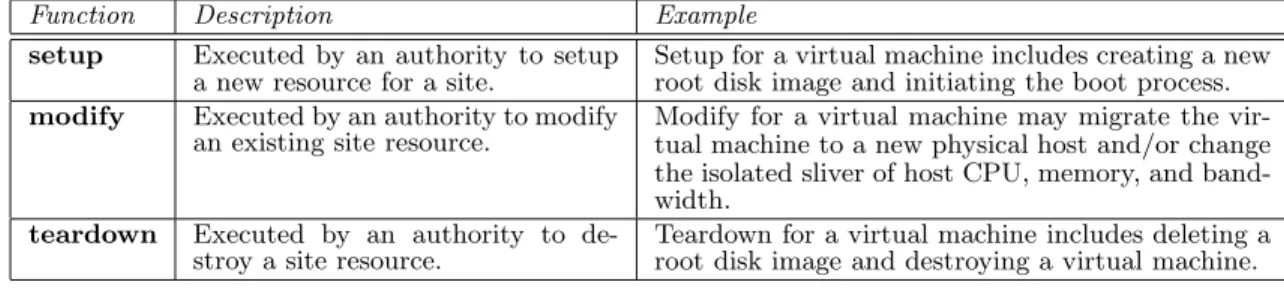
Service manager developers may add or modify guest handlers to support new types of guests. . . 49 4.2 The lease abstraction for the site authority implements the resource handler interface.
Site administrators add new resource handlers or update existing resource handlers to lease different types of resources. . . 49 4.3 The lease abstraction for the service manager implements the guest lease handler
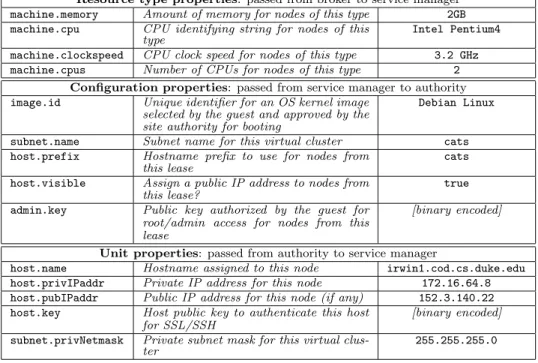
interface to give service managers an opportunity to modify leases when their state changes. . . 53 4.4 Selected properties used by Cluster-on-Demand, and sample values. . . 58 6.1 The bidding window is the number of auctionsBurstbids when it has queued tasks.
The bidding window from Figure 6.4 dictates the amount of currency bid for each auction. The table above shows the amount of currencyBurstbids for each bidding window. The large the window the lower the amount of currency bid, since its total currency holdings are split across more bids. . . 108 7.1 A table outlining the the effect of a single actor failure on a guest in a small network
of actors that includes a single service manager, broker, and site authority. . . 124 8.1 Lines of Java code for Shirako/COD. . . 132 8.2 A table outlining the different resource drivers currently supported by Shirako.
As-pects of the specific technology are hidden from the lease abstraction beneath the resource handler interface. . . 135 8.3 A table outlining the resource driver interface for a virtual machine. The authority
controls the binding of slivers to virtual machines, which are in italics. An authority may export control of the hardware management services in bold since their execution does not concern resource multiplexing or interfere with competing guests. . . 136 8.4 Parameter definitions for Section 8.4 . . . 144 8.5 The effect of increasing the cluster size onα as the number of active leases is held
constant at one lease for allN nodes in the cluster. As cluster size increases, the per-tick overheadαincreases, driving up the minimal lease termt′. . . 146 8.6 Impact of overhead from LDAP access. LDAP costs increase overheadα(ms/virtual
clock tick), driving down the maximum node flips per millisecondr′ and driving up
the minimum practical lease termt′. . . 146
9.1 A description of functions exposed by the Plush master via XML-RPC. External en-tities, such as a service manager, call Load, CreateResource, Run, AddResource, and RemoveResource to drive application execution. The Plush application de-scription registers two callbacks with the Plush service manager, NotifyExit and NotifyFailure, which the Plush master invokes when an applications completes or fails, respectively. . . 159
9.2 A summary of the different guests that we have integrated into Shirako as service managers. Integration enables a level of adaptation and resource control not available to each platform, itself. In addition to these guests, others have used the architecture to integrate the Rubis multi-tier web application [185] and Globus grids [138]. . . 169
List of Figures
2.1 Distributed computing environments, such as PlanetLab and Globus Grids, are built above hardware-level resource abstractions exported by resource owners. . . 15
2.2 An overview of Exokernel’s structure from [61]. The kernel acts as a secure multi-plexer of hardware, in the form of CPU quanta, disk blocks, and memory pages, for multiple guests. The kernel does not define programming abstractions such as file systems, processes, threads, or virtual memory that restrict guests’ use of the hard-ware. Guests are free to use the hardware directly to define their own programming abstractions, or link against library operating systems that provide a set of common programming abstractions. . . 18
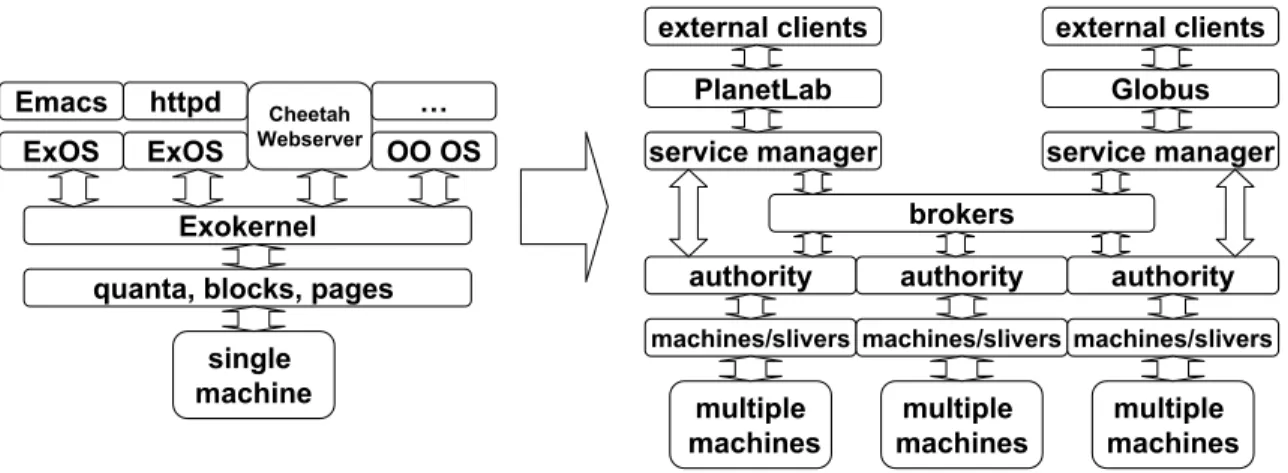
2.3 The figure compares the structure of Exokernel with a networked operating system. The primary design differences stem from a focus on multiplexing collections of re-sources from multiple sites at the coarser granularity of physical machines, virtual machines, and slivers. The focus motivates both a physical separation between the service manager, the authority, and the guests and resources they control, and a logical separation of policy between multiple authorities and brokers. . . 22
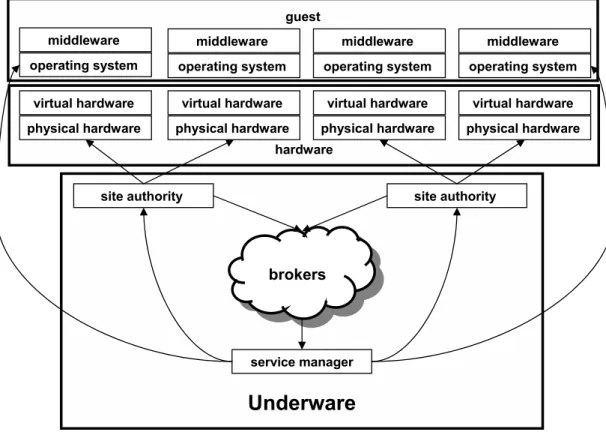
3.1 Physical and virtual hardware, node operating systems, and middleware are building blocks for a new underware layer that programmatically maps software onto hardware. Authorities control the binding of the resources they own to the service managers that request them. Service managers use network-accessible APIs exported by each authority to control the mapping of software (node operating systems, middleware, etc.) for their guests onto each site’s hardware. Brokers represent the cohesive entity that coalesces resources from multiple sites and offers them to service managers. . . 28
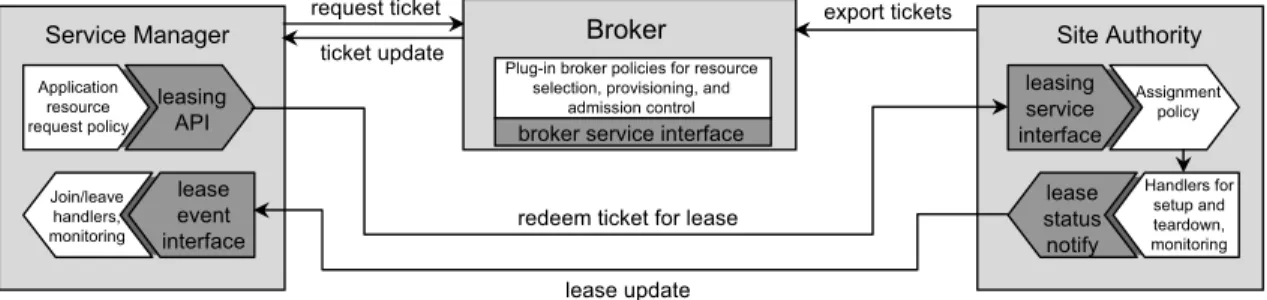
4.1 Summary of protocol interactions and extension points for the leasing system. A guest-specific service manager uses the lease API to request resources from aSharp
broker. The broker issues a ticket for a resource type, quantity, and site location that matches the request. The service manager requests a lease from the owning authority, which selects the resource units, configures them (setup), and returns a lease to the service manager. The arriving lease triggers ajoinevent for each resource unit joining the guest; the join handler installs the new resources into the guest. Plug-in modules forsetupandjoinevent handlers are applicable to different resource types and guests, respectively. . . 45
4.2 An example scenario that illustratesSharpand COD using a lease abstraction. The
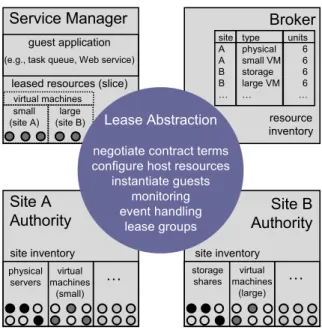
scenario depicts a guest acquiring machines from two sites through a broker. Each site maintains an authority server that controls its physical machines, and registers inventories of offered machines with the broker. A service manager interacts with a broker to lease machines from two different authorities on behalf of its guest. The lease abstraction is resource-independent, guest-independent, and policy-neutral, and masks all protocol interactions and lease state maintenance from the service manager controlling its guest, the authority controlling its resources, and the broker mediating between the two. . . 47
5.1 Sharptickets specify a resource type and resource unit count. COD associates each
resource unit with a single host. . . 64
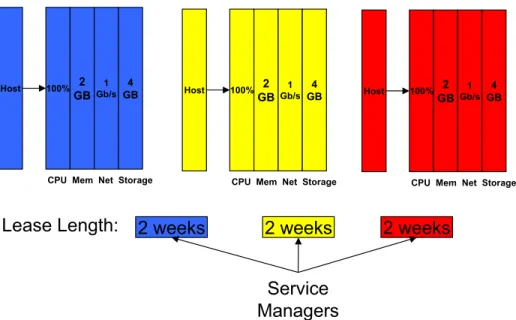
5.2 Each color represents a different lease. A computon is a predefined number of grains that comprise a sliver. To support logical unit colocation using computons, an au-thority associates a resource type with a computon and a resource unit count with a number of logical units. An authority assignment policy colocates multiple compu-tons and logical units on each host. . . 66
5.3 Authorities may permit brokers to determine the quantity of each grain that forms a sliver as long as each ticket includes information specifying the host. Sharp
accom-modates host specification if brokers specify a host by associating it with a resource type. . . 67
5.4 Brokers use vector addition to represent the two-dimensional packing of slivers onto hosts. The figure depicts a host with slivers that comprise 16 grains in two different dimensions. A broker carves tickets a, b, and c for slivers from the host. . . 68
5.5 Augmenting each ticket with a list of host names permits brokers to allocate multiple slivers within each ticket. Each color represents a different lease. . . 72
5.6 Naming individual slivers permits brokers to separate the different grains of a sliver into different leases, enabling a range of mechanisms that require sliver identification, including generalized victim selection, lease forking and merging, and host selection. 75
5.7 Naming logical units separately from slivers allows authorities to bind/unbind multi-ple slivers to a logical unit. These slivers may include remote slivers bound to different hosts, such as a remote storage server exporting a virtual machine root disk image. The scheme is general enough to also apply to logical resources, such as scarce public IP address space. . . 81
5.8 The figure depicts an authority that reserves control of the hardware management functions of each virtual machine. The service manager selects a root image from a template of options and the authority creates the virtual machine using thesetup
handler. The authority transfers control of the virtual machine to a service manager by configuring sshd, or an equivalent secure login server, with a public key, which the service manager transfers using a configuration property. . . 83
5.9 The figure depicts four service managers executing example hardware management functions for their leased virtual machines. Secure bindings permit service managers or authorities to access functions that control the hardware management services of a logical unit, such as a virtual machine. Delegating control of hardware management functions to service managers alleviates authorities from defining multiple software configurations and allows authorities to focus solely on hardware multiplexing and configuring access control for secure bindings. . . 84
6.1 Flow of credits and resources in a networked infrastructure. Leasing rights for re-sources flow from sites down through a broker network to consuming service managers. Brokers allocate resource rights using any policy or auction protocol: payments in credits flow up through the broker network. . . 95
6.2 Thecredit recharge rule returns credits to the buyers after a configurable recharge time r from when the currency is committed to a bid in an auction, or if a bidder loses an auction. . . 97
6.3 An example value function. The task earns a maximum value if it executes imme-diately and completes within its minimum run time. The value decays linearly with queuing delay. The value may decay to a negative number, indicating a penalty. The penalty may or may not be bounded. . . 103
6.4 Two market-based task services, calledBurstandSteady, bid for resources to satisfy their load. As the recharge time increases, the global utility increases until the point at which the task services’ static bidding strategies are too aggressive: they run out of currency before they finish executing their task load. The result is the global utility falls below that of a static partitioning of resources. The bidding window forBurst
(each line) is the expected length of time to complete aBurstof tasks, according to its static bidding strategy. As the bidding strategy becomes more conservative (i.e., lower numbers) relative to the recharge time the allocation achieves a higher global utility despite longer recharge times. . . 107
7.1 Interacting lease state machines across three actors. A lease progresses through an ordered sequence of states until it is active; delays imposed by policy modules or the latencies to configure resources may limit the state machine’s rate of progress. Failures lead to retries or to error states reported back to the service manager. Once the lease is active, the service manager may initiate transitions through a cycle of states to extend the lease. Termination involves a handshake similar to TCP connection shutdown. . . 115
8.1 Handler for configuring a virtual machine. Note that the handler is a simplification that does not show the details of each Ant target. . . 137
8.2 Handler for configuring a physical machine. Note that the handler is a simplification that does not show the details of each Ant target. . . 138
8.3 The progress ofsetupandjoinevents and CardioWave execution on leased machines. The slope of each line gives the rate of progress. Xen clusters (left) activate faster and more reliably, but run slower than leased physical nodes (right). The step line shows an GridEngine batch scheduler instantiated and subjected to a synthetic load. The fastest boot times are for virtual machines with flash-cloned iSCSI roots (far left). 141
8.4 Fidelity is the percentage of the lease term usable by the guest, excluding setup costs. Xen virtual machines are faster to setup than physical machines, yielding better fidelity. . . 143
8.5 The implementation overhead for an example scenario for a single emulated site with 240 machines. As lease term increases, the overhead factor α decreases as the actors spend more of their time polling lease status rather than more expen-sive setup/teardown operations. Overhead increases with the number of leases (l) requested per term. . . 145
9.1 Number of GridEngine tasks in each batch queue over time during a trace-driven execution. Note from the y-axis that the batch scheduler is experiencing intense constraint from the task load (2400 tasks at peak load) relative to the 71 machines that are available. . . 155
9.2 Number of machines in each of three virtual clusters over time during a trace-driven execution. Machines transfer to higher priority research groups as their task load increases. Strict priority arbitration results in machine reallocations to the highest priority research group whenever they have queued tasks. . . 156
9.3 Combined size of the Architecture running and pending task queues, and virtual cluster size over an eight-day period. . . 157
9.4 An example Plush application description that includes a request for resources from a Shirako broker/authority. . . 160
9.5 MyPLC and Jaws obtaining Xen virtual machines from the Shirako prototype. The prototype manages sharing of hardware resources between MyPLC and Jaws with a simple policy: MyPLC gets any resources not used by Jaws. . . 170
Chapter 1
Introduction
“The sum is more than the whole of its parts.” Aristotle
Collections of hardware components are the foundation of computation and consist of interconnec-tions of different types of the same core elements: processors, memory, disks, I/O devices, and network links. Since modern hardware components link to standard network interconnects it is possible to control and coordinate their management programmatically. An operating system is a software layer that manages hardware by coordinating its interaction with software: this the-sis defines and evaluates an operating system architecture for managing collections of hardware components spread across networks, such as the Internet.
To avoid confusion, we use the term networked operating systemto reference this category of operating system. We use the termnode operating systemto denote operating systems that centralize the management of hardware components for a single machine. Aphysical machineis a collection of
hardware components, which may include one or more processors, disks, memory cards, and network cards, connected over a bus. Examples of physical machines include routers, switches, sensors, and mobile phones. We also use the term node operating system to encompass distributed operating systems, which decentralize conventional techniques to manage multiple machines by presenting the view of a single machine.
A networked operating system controls and coordinates the mapping of distributed applications to networked collections of hardware in infrastructures. As with node operating systems, a networked operating system determines the method by which software executes on collections of hardware including what software executes, when it executes, where it executes, and for how long. Managing collections of hardware encompasses a range of actions, which include one or more of the following: installing software, uninstalling software, updating software [49], starting/stopping software services, altering software configurations, diagnosing software performance problems [7, 141], monitoring software execution [35], scheduling software execution [170], or assigning software to execute on
specific hardware [98, 119, 162].
While an operating system for networked resource management must address a wide variety of problems,its foundation ultimately rests on how applications share a common, networked hard-ware platform. This thesis focuses on defining an architecture that serves as the foundation for a networked operating system that is able to address all of the software management subproblems mentioned above. Section 1.1 makes a case for networked operating systems by examining current problems in modern infrastructure management. Section 1.2 presents a simple solution to solve these problems, asks a series of focusing questions that shape our vision of a networked operating system, and defines a single design principle for building a networked operating system. Section 1.3 presents the hypothesis and contributions of this thesis and Section 1.4 presents an outline for the remainder of the thesis.
1.1
Problem
A data center is a collection of hardware components under the control of a single sphere of au-thority located in the same room or building. Administrators have the responsibility of installing and maintaining software in data centers. These administrators continuously monitor and adjust multiple, active software environments on a set of physical machines using one or more management tools [1, 126]. Administrators not only keep critical management software operational, users also request them to configure and reconfigure hardware for new uses. Managing multiple software en-vironments on a diverse and growing computing infrastructure can exceed the abilities of even the most capable administrators.
We refer to any software environment, from a node operating system and its processes executing on a single machine to multiple node operating systems and their processes executing across multiple machines, as a guest of the hardware to emphasize the distinction between an infrastructure’s hardware platform and the software that runs on it. We also use the term guest to disambiguate general software from node operating systems, processes, and applications.
A process is a programming abstraction defined by many node operating systems. There is no accepted definition of application in the literature; however, in this thesis, we use the term application to describe software running on one or more hardware components that performs a
specific function. Distributed applications execute across multiple physical machines. For example, a distributed hash table or DHT is a distributed application spanning multiple machines, each executing a node operating system, that provides one specific function: key-based data insertion and retrieval [155]. The term guest may include one or more node operating systems and their processes, running on one or more hardware components, and executing one or more distributed applications.
1.1.1
Infrastructure Complexity
An article from the New York Times captures the state of data center infrastructures in 2007 [115]. The article speculates on the size of a data center recently constructed by Google on the bank of the Columbia river in Oregon: “...the two buildings here—and a third that Google has a permit to build—will probably house tens of thousands of inexpensive processors and disks...” The same article posits that Google’s current operation consists of “...at least 450,000 servers spread over at least 25 locations around the world.” Microsoft’s computing initiative is of similar scale; the infrastructure is “...based on 200,000 servers, and the company expects that number to grow to 800,000 by 2011 under its most aggressive forecast.” The scale of these numbers is expected to increase over time—managing millions of machines at multiple locations is on the horizon [173].
Computing infrastructures are not only growing in physical size. Google’s infrastracture, which is “...spread over at least 25 locations...,” exemplifies an increase in geographical diversity that extends beyond any single data center. We use the terminfrastructure to refer to a collection of hardware components under the control of multiple spheres of authority, such as 25 independently administered data centers, and the termsiteto refer to a collection of hardware components under the control of one sphere of authority, such as a single data center. The terms infrastructure and site are broad enough to refer to any collection of hardware. For instance, the network of independent autonomous systems that manage the core routers, switches, and network links that embody the Internet are a set of independent sites that comprise an infrastructure. Sensor networks composed of interconnected groups of sensors also follow the infrastructure-site paradigm. We use the description of Google’s infrastructure to exemplify characteristics—large size and geographic dispersion—that are common across all infrastructures.
1.1.2
Impact of Virtualization
As infrastructures grow to accommodate more users and sites, the number of different types of guests and hardware components that they must support increases. Infrastructures are beginning to ad-dress the problem using virtualization. Virtualization platforms, such as Xen [22] and VMware [168], enable each physical machine to host one or more virtual machines.
Virtual machines expand an infrastructure’s management options by decoupling the machine from the physical hardware. This decoupling makes hardware management more flexible and dy-namic by giving site administrators, or trusted software acting on their behalf, the power to create and destroy virtual machines, bind isolated slivers of hardware components to virtual machines, and offer a wide array ofhardware management services(see Section 2.2). However, virtualization’s power introduces a new set of management challenges that exacerbate existing problems manag-ing an infrastructure. For example, the virtual infrastructure can be an order of magnitude larger than the physical infrastructure since virtualization increases the number of manageable hardware instances. Furthermore, these instances may now be active or inactive (i.e., have their live, in-memory state stored on disk) or have persistent state spread across multiple disks.
Many organizations maintain large collections of physical and virtual machines: universities, financial institutions, small businesses, hospitals, governments, and even individuals increasingly operate and depend on sizable, complex computing infrastructures. A recent Forrester Research report states that 50% of global 2000 firms will have server virtualization deployed by mid-2007 [77]. The range of different hardware management services a site administrator can leverage for each virtual machine is substantial, and, while each one of these services is useful for managing an infrastructure, invoking them manually at the request of users does not scale.
Virtualization technology is also spreading beyond data centers—recent work extends hardware virtualization to mobile devices [48], remote sensors [110], and network routers [24]. While vir-tualization increases management complexity, it also provides an element of the solution: rich, programmatic interfaces to control slivering and hardware management services. Broad adoption of virtualization, and its complexity, motivates a networked operating system that simplifies infras-tructure resource management by leveraging these new capabilities.
1.2
Solution
One solution to decreasing infrastructure management’s complexity is to automate resource man-agement by giving guests enough control to obtain resources whenever and wherever they require them. Rather than requiring intervention by a site administrator to install, maintain, and protect guests, we envision a system where each guest, itself, continuously monitors its load, determines its resource requirements, requests and configures new resources, and incorporates those resources into its collective software environment. The infrastructure provides the means for guests and automated guest controllers to find, request, and control sets of resources programmatically.
Delegating resource management to guests permits flexible infrastructures that are able to scale to meet the diverse needs and requirements of many different guests. The solution not only unbur-dens site administrators, it also empowers guests. Guests benefit from the power to dynamically regulate their performance by requesting resources to react to changes in load, resource scarcity, or failures. Infrastructures benefit from increased efficiency through infrastructure-wide statistical multiplexing, if proper incentives exist to encourage guests to release resources when they do not require them.
1.2.1
Focusing Questions
While simply stated, the proposed solution raises a number of important questions that shape our vision of a networked operating system. The questions, and their answers, evolved from our experiences building and using multiple prototypes—they represent the basis for the set of networked operating system design principles we define and evaluate in this thesis.
How do we support a full range of guests? A networked operating system should support any guest capable of executing on its hardware, and should not limit the capabilities of the hardware by restricting support to a specific class of guests. For example, a guest of a data center may be a load-leveling batch scheduler [75, 113, 183], a network testbed [23, 142], a compute grid [69], a multi-tier web application [36], a single computational task, or a node operating system intended for general use.
How do we balance the resource needs of each site with the needs of each guest?
Designing a system around any weaker model does not directly support guests that require strict resource assurances to meet contractual obligations, which may promise clients a specific level of service (i.e., a Service-level Agreement or SLA). In a utility computing model (see Section 3.3.2) guests exchange money to rent resources from an infrastructure [74]: it is unlikely that a system without resource assurances can be viable in a model that forces customers to rent a resource despite being unsure of what they are getting, when they are getting it, and how long they can use it. Similarly, an infrastructure needs resource assurances to know how much resource it is allocating to each guest and for how long to make informed decisions about how to multiplex resources between guests over time. For example, an infrastructure that rents resources to external guests may periodically wish to reserve resources for internal use.
How does an infrastructure support guests that require resources from multiple sites? A networked operating system should coordinate the allocation of resources owned and controlled by different spheres of authority to support guests that require resources from multiple sites. Guests, such as Content Distribution Networks [71, 172] or overlay routing systems [12], require resources from geographically disparate sites for correct operation. Furthermore, as infrastructures expand in physical size they also spread out geographically, with local site administrators controlling each site’s resources. Both Google’s computing infrastructure, which is “spread over at least 25 locations” around the world, and federated computing platforms, formed from resources donated by many autonomous sites, represent examples of infrastructures that span sites operating under different spheres of authority. Studies suggest that statistical multiplexing between sites is important since individual data centers experience long periods of low server utilization [118]. As a result, an infrastructure must support the coordinated acquisition of resources from multiple sites to guests:
brokering services, proposed by Sharp [73], address multi-site resource sharing by aggregating
resource rights from many sites and coordinating their distribution to guests.
How do guests interact with an infrastructure to acquire and control resources?
Guests should interact with infrastructures and resources programmatically using network-accessible APIs. Each guest has a controlling server, which we callservice manager, that monitors, requests, and controls guest resources programmatically. Each site operates a server, which we call an author-ity, that exports a network-accessible API for guests to obtain and control resources. The authority
fulfills guest resource requests and isolates resources from co-hosted guests. Brokering services ex-port a network-accessible API to programmatically receive and respond to service manager resource requests on behalf of multiple sites. We collectively refer to service managers, authorities, and brokering services asactors in a networked operating system.
How does an infrastructure arbitrate resources between guests when there are not enough resources for everyone? Infrastructures require a method for deciding the priority of guest resource requests. Markets are an attractive basis for arbitration in a networked infrastructure composed of, potentially self-interested, sites and guests that define natural incentives for guests to coordinate resource usage by associating usage with a price. Price provides a feedback signal that enables guests to respond to price changes and self-regulate their resource usage. However, market-based resource allocation is still an active research area with many unsolved problems that continue to prevent its transition from research prototypes to usable systems [152]. A networked operating system must include a basis for defining the incentives and controls that support evolving market-based technologies as well as other, more conventional, forms of resource arbitration, such as proportional-share or priority-based arbitration.
How do we design a system that is robust to faults and failures? A networked operating system should be resilient to intermittent server or network failures. We advocate distributing control of infrastructure resources across multiple actors: the service manager controlling each guest’s software, the authority controlling each site’s hardware, and brokering services acting on behalf of, or coordinating between, each guest and site. These actors, or the network linking them, may fail at any time, independently of the resources they control. Service managers, authorities, and brokering services must retain sufficient state to recover from actor failures, and define protocols for synchronizing their state with the state of their peers to tolerate periodic disconnections due to actor or network failures. Failures of actors, resources, guests, or the network must not compromise forward progress in the collective system.
1.2.2
The Neutrality Principle
In this thesis we explore a software architecture that embodies the answers to the questions above. The architecture defines a type of operating system that mediates the interaction between guests and
networked collections of hardware. Historically, operating systems have served two functions: they multiplex resources to simultaneously execute multiple applications and they provide programming abstractions to ease application development. We explore how a networked operating system should address these two functions by examining the following questions.
• What is the right set of programming abstractions for a networked operating system?
• How does an infrastructure use these programming abstractions to multiplex resources?
The answers lead us to employ a general neutrality principle in our design. The neutrality principle states that an operating system for networked resource management should be policy-neutral, since only users and site administrators, and not operating system developers, know how to best manage resources. In this thesis, we focus on how programming abstractions define policy. The principle is a restatement of the end-to-end principle for networked operating system design [145].
Exokernel, discussed in Chapter 2, applied a similar neutrality principle to node operating system design to eliminate programming abstractions, after arguing that these programming abstractions represent subtle, but ill-advised, embeddings of resource management policy [61]. A contribution of this thesis is the recognition that problems arising in the design of node operating systems are similar to problems arising in the design of networked operating systems. As a result, studying and adapting structures and techniques for designing node operating systems are able to resolve existing problems in networked resource management. Extensive experience building and using a networked operating system has led us to view neutrality as a guiding design principle. The goal of this thesis is to define a minimal set of elements common to all networked operating systems that are independent of any specific set of resource management policies or programming abstractions.
We find that a fundamental property common to all forms of networked resource sharing which does not, directly or indirectly, embed resource management policy is that guests, by definition,
share resources and do not use them forever. We use the termresourceto refer to a reusable aspect of the hardware, and do not intend for the phrase “resource sharing” to include “file sharing,” and other similar forms of sharing, that describe higher-level constructs for using a resource. To address the time aspect inherent to resource sharing, we examine an operating system architecture for networked infrastructure based on a lease abstraction, which restricts guest resource use to well-defined, finite lengths of time.
A networked operating system that does not define resource management policy is capable of supporting any type of guest or resource. Chapter 2 argues that strict adherence to the neutrality principle requires that the lease abstraction be flexible enough to manage resources down to the level of the hardware components that comprise physical and virtual machines.
1.3
Hypothesis and Contributions
This thesis evaluates the following hypothesis: “An operating system architecture for infrastructure resource management that focuses narrowly on leasing control of hardware to guests is a foundation for multi-lateral resource negotiation, arbitration, and fault tolerance.” In evaluating our hypothesis, we make the following specific contributions.
1. Introduce a set of design principles for networked operating systems based on our experiences building and using multiple prototypes. The design principles stem from the same motivation as Exokernel, which states that a node operating system should eliminate programming ab-stractions and concentrate solely on resource multiplexing. We show how to adapt and extend Exokernel design principles to a networked operating system that multiplexes collections of resources owned by sites spread across networks, such as the Internet.
2. Combine the idea of a reconfigurable data center from Cluster-on-Demand [39] and others [5, 15, 17, 97, 99, 116, 144, 177] with the Sharp framework [73] for secure resource peering
to demonstrate a networked operating system architecture capable of sharing resources from multiple data center sites between multiple guests. We extend both models by developing the architectural elements required to adapt and control any type of guest using any type of resource.
3. Design, implement, and deploy Shirako, a prototype networked operating system, using a single programming abstraction: the lease. The lease abstraction embodies Exokernel design principles, including visible resource allocation/revocation, an abort protocol, exposing names, exposing information, and secure bindings, and applies them to a networked operating system that decentralizes control of resource allocation across multiple spheres of authority. We use
our experiences deploying the architecture to motivate extensions toSharp and
Cluster-on-Demand that expose the names of distinct physical machines, virtual machines, and slivers.
4. Show that leases are a foundational primitive for addressing arbitration in a networked op-erating system that supports a range of different arbitration policies, including market-based policies, which are of particular importance for a system composed of self-interested actors. Leasing currency defines a configurable tradeoff between proportional-share scheduling and a market economy.
5. Leases are a common tool for building highly available, fault-tolerant distributed systems, and have long been a basis for addressing network and server failures in distributed systems [107]. We show how combining the use of leases for long-term resource management with state recovery mechanisms provides robustness to transient faults and failures in a loosely coupled distributed system that coordinates resource allocation.
6. Evaluate the flexibility and performance of Shirako by sharing physical and virtual hardware present in modern data centers between multiple types of guests, and showing that the archi-tecture could scale to manage thousands of machines.
7. Present case studies of integrating multiple guests that manage networked resources to eval-uate our approach. Guests include the PlanetLab network testbed [23], the Plush distributed application manager [9], and the GridEngine batch scheduler [75]. We also leverage the archi-tecture to prototype and evaluate Jaws, a policy-free batch scheduler that instantiates one or more virtual machines per task.
1.4
Thesis Outline
Chapter 2 details the philosophy that underlies the neutrality principle by drawing parallels to pre-vious work on Exokernel [61]. Chapter 3 examines related work in classical resource management and its relationship to a networked operating system. In particular, we discuss: resource manage-ment at each layer of the software stack, networked managemanage-ment of multiple software stacks, and classical elements of distributed systems design. Chapter 4 presents a networked operating system architecture that employs the neutrality principle to define a general lease abstraction by combining
and extending the key design principles of Exokernel,Sharp, and Cluster-on-Demand. Chapter 5
uses our experiences deploying the architecture to motivate extensions to Sharp and
Cluster-on-Demand that expose the names of distinct physical machines, virtual machines, and slivers. Chapter 6 shows how leases are a basis for resource arbitration policies and Chapter 7 discusses the architec-ture’s use of leases for fault tolerance. Chapter 8 discusses the implementation of the architecture within Shirako, and quantifies its flexibility and performance. Chapter 9 presents case studies of integrating three existing guests and developing one new guest with Shirako’s architecture. Chapter 10 concludes.
1.5
Acknowledgements
The starting point for the architecture and Shirako derives from ideas originally present in Cluster-on-Demand [39], led by then graduate student Justin Moore, andSharp[73], led by then graduate
student Yun Fu. Shirako is a group effort that serves a broader range of research goals than discussed in this thesis. The development of Shirako is part of a larger project, calledOrca, that encompasses
the study of other elements that comprise a fully functional networked operating system.
As described in later chapters, Shirako includes an interface to plug in multiple types of resources and guests as well as extensible interfaces for implementing and experimenting with different poli-cies. Since Shirako’s development is a shared effort, multiple people have contributed over the years to the different guests, resources, and policies that fill out the architecture, and we acknowledge their contribution. Laura Grit led the development of broker provisioning/arbitration policy imple-mentations as well as a general substrate for developing new lease-based adaptation, assignment, and arbitration policies. Aydan Yumerefendi led the development of the first assignment policies that used themodifyresource handler, discussed in Section 4.3.2, to migrate virtual machines and alter resource shares. These policies and their interactions are outside the scope of this thesis.
Varun Marupadi led the transition from using an LDAP database for persistent storage to using a MySQL database, as well as completed the integration of NFS/ZFS as a usable Shirako storage device. Varun Marupadi also ported Jaws and GridEngine to use a new guest packaging format developed by Aydan Yumerefendi that permits the dynamic creation and linking of guest-specific service managers within the Automat web portal [185]. Piyush Shivam and Aydan Yumerefendi
led the integration and testing of a Rubis-aware service manager [185] and Lavanya Ramakrishnan spearheaded the integration of a Globus-aware service manager [138], both of which we mention, but do not detail, in this thesis. Aydan Yumerefendi led the development and/or redevelopment of multiple pieces of software including a node agent for easier integration of resources, a model-checker for finding code bugs and validating lease state transitions, and a sophisticated web portal for uploading and testing new management policies [185]. Aydan Yumerefendi has significantly augmented the persistence architecture to include persistence of state other than core slice, lease, and policy state to build the web portal for Automat [185].
The implementations of different guests, resources, and databases have been written and re-written multiple times over the years in order to incorporate updates in resource and guest tech-nologies, new constraints imposed by higher levels of the architecture, and more robust interfaces for improved logging and debugging. Since all of Shirako’s various pieces are interdependent a number of people have touched this code; however, Aydan Yumerefendi and I have led the development of these changes over the last 4 years. Matthew Sayler has recently taken Shirako’s ad hoc rules for event logging and formalized and rewritten the event logging subsystem to support work on better classification, diagnosis, and repair of failures. David Becker significantly aided in the un-derstanding of multiple data center administration technologies, most notably LDAP and Xen, and provided support in tracking down the root cause of many guest-specific and resource-specific bugs and failures.
The insights in this thesis stem from lessons I learned through my distinct experiences, begin-ning with the original Cluster-on-Demand prototype in the early fall of 2002 up to the present day, spearheading the implementation of the lease as a programming abstraction for managing guests, resources, and persistence in a deployed system; these experiences required exercising and stressing every aspect of the architecture, including integrating a multitude of specific guests and resources, developing new adaptation policies and monitoring engines tailored for each guest/resource com-bination, modifying and enhancing arbitration policies to perform guest-specific resource sharing, developing a persistence architecture for lease and policy state, writing resource assignment policies and developing resource-specific configuration directives (e.g., IP address allocation and domain naming), and incorporating new disk images and monitoring software to support guests and sites
beyond the realm of Duke’s Computer Science Department. The integrative process I engaged in spanned the entire architecture and allowed me to pursue my own distinct goal of gaining new in-sights into networked operating system design through the experience of supporting real users using real guests and real resources under multiple different management scenarios for a sustained period of time.
Chapter 2
The Extensible Operating System Approach
“Because the system must ultimately be comprehensive and able to adapt to unknown future requirements, its framework must be general, and capable of evolving over time.”Corbat´o and Vyssotsky on Multics, 1965
Node operating system researchers have long realized the benefits of a flexible kernel that application developers can extend to add new functionality: our approach to a networked operating system stems from the same motivation [4, 27, 61, 108, 160, 182].
In Section 2.1 we argue that a networked operating system should concern itself only with re-source multiplexing and not the definition of programming abstractions that ease guest development but restrict flexibility. Guests are similar to node operating system applications and represent soft-ware environments that execute on a hardsoft-ware platform. We draw parallels between our approach and previous work on microkernels, and outline the design principles of Exokernel, which explored the separation of resource multiplexing from programming abstractions in the design of a node op-erating system. Section 2.2 describes how the architecture in this thesis extends Exokernel’s design principles to a networked operating system.
2.1
Relationship to Node Operating Systems
The landscape of networked computing today is analogous to node operating systems in key ways. There are multiple existing platforms for resource sharing and distributed computing with large user communities. We are again searching for an evolutionary path that preserves and enhances existing programming environments, accommodates innovation in key system functions, and preserves the unity and coherence of a common hardware platform. Finding the elemental common abstractions or “narrow waist” of the architecture that supports all of its moving parts remains an elusive goal. Node operating systems serve two purposes: they multiplex resources among multiple guest applications and they provide programming abstractions that ease guest development. Program-ming abstractions represent functionality embedded into a node operating system that simplify
visible allocation and revocation
distributed hardware resources
resource virtualization control plane distributed computing environments Internet-scale services resource multiplexing hardware-level abstractions Pl an etL a b G lo b u s G r id O th e r E n v ir o n m e n ts
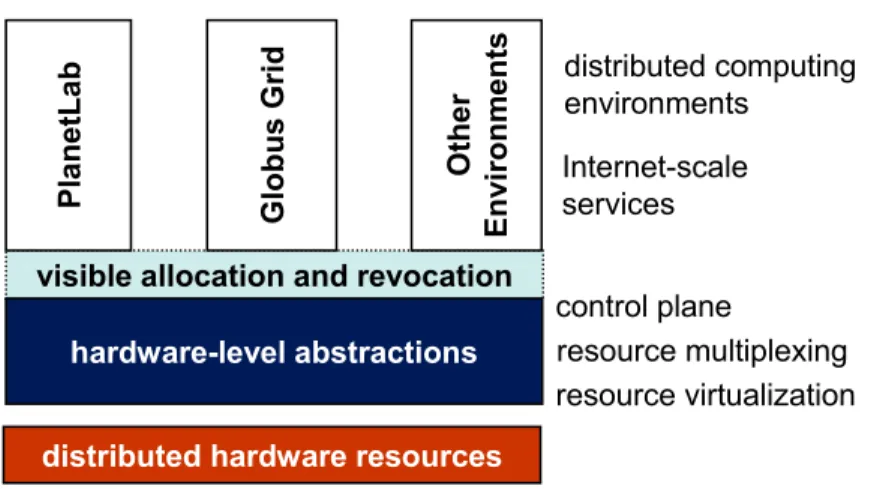
Figure 2.1: Distributed computing environments, such as PlanetLab and Globus Grids, are built above hardware-level resource abstractions exported by resource owners.
guests’ interaction with hardware. The implicit assumption is that it is appropriate to embed these programming abstractions since they are useful for the majority of guests.
To support a diverse range of guests, we advocate programming abstractions that focus on resource multiplexing and control. A narrow focus on resource multiplexing is able to accommodate a wide range of scenarios. For example, the GENI initiative proposes an international network testbed facility that multiplexes network resources—including data centers, mobile devices, sensors, storage, and network links—among experimental prototypes for a new generation of Internet applications and services [131]. These network services may eventually define a “new Internet” that is more flexible and open than today’s “best-effort” Internet. However, to support new network services, GENI must wrestle with core operating systems issues such as isolation, coordinated multiplexing of a range of hardware resources, and programming abstractions for distributed computing. The “future Internet” must provide a platform for planetary-scale applications not yet imagined, absorb technologies not yet invented, and sustain decades of growth and “disruptive innovation” without fracturing or collapsing under its own weight.
A stated motivation behind both PlanetLab and GENI (and Active Networks before them [174]) is overcoming the “ossification” of the existing Internet that prevents the adoption of new network services [129, 132]. The Internet is not a suitable platform for innovations in high-bandwidth, ultra-reliable, and ultra-secure technologies because it hides/abstracts details and control of resources in the network’s interior from the services that execute on the network’s edge resources. As a result,
a resource management layer that exposes control of resources is a cornerstone of any new type of Internet-scale operating system that seeks to satisfy the resource needs of all guests.
As depicted in Figure 2.1, we argue that a networked operating system must support multiple guests over collections of networked hardware in such a way that sites can redeploy hardware easily from one guest to another, rather than dedicating static islands of resources to each guest, as is common today. This “pluralist” approach has a familiar justification: given the wide diversity of needs among users, it is useless to wait for one system to “win” [52, 62]. Also, pluralism enables innovation and customization—we want to be able to experiment with multiple approaches to dis-tributed computing, not just one, and to provide a richer and wider set of experiences than any single platform can offer.
2.1.1
Lessons from Microkernels
The problems that researchers face designing an Internet-scale networked operating system, as proposed by GENI, also arise in a different context in the design of node operating systems. The motivation for microkernels and extensible kernels are similar to our motivation for a networked operating system: the “kernel” of the system should not restrict the range of guests it supports. In this section, we review lessons from research on microkernels and highlight the motivations, arguments, and principles behind the design of Exokernel, a variant of microkernel research, that espouses a clean separation of resource multiplexing from programming abstractions [60, 61, 96].
Microkernels are a node operating system structure that shifts some functionality outside of the kernel. Adopting a microkernel structure for a node operating system reduces the size of large monolithic kernels, that contain an array of device drivers, file systems, and other subsystems, to a small core that only coordinates hardware multiplexing and communication between privileged subsystems. The idea underlying microkernels is that shifting functionality outside of the kernel creates a more stable and reliable structure by extracting complex subsystems and executing them in user-space. As a result, subsystems that are known to be unreliable, such as device drivers, are unable to compromise correct system operation.
While early microkernel systems, such as Mach [4], extracted key subsystems from the kernel, the kernel retained control over resource management policy by preventing unprivileged guests from
modifying kernel subsystems. Exokernel is a variant of the microkernel structure that addresses this limitation by advocating a strict division between a node operating system’s kernel, which multiplexes resources, and its guests, which implement programming abstractions. The division is a logical extension of the key microkernel design principle that a “...concept is tolerated inside the microkernel only if moving it outside the kernel, i.e., permitting competing implementations, would prevent the implementation of the system’s required functionality [111].” The Exokernel structure views user-level kernel subsystems as privileged extensions of the kernel that prevent guests from modifying or replacing them, as depicted in Figure 2.2.
2.1.2
Exokernel
Exokernel, as well as other extensible operating systems [27], apply the neutrality principle to a node operating system by designing a kernel that does not impede the implementation and execution of a diverse range of guests by predefining a set of programming abstractions. We review the arguments behind the Exokernel architecture and the minimal set of design principles it defines. In Section 2.2, we relate how an extensible networked operating system applies and extends these arguments and design principles to a new context.
A summary of the argument for Exokernel, taken from the first paragraph of [61], is as follows.
“Operating systems define the interface between applications and physical resources. Un-fortunately, this interface can significantly limit the performance and implementation freedom of applications. Traditionally, operating systems hide information about ma-chine resources behind high-level abstractions such as processes, files, address spaces and interprocess communication. These abstractions define a virtual machine that applica-tions execute on; their implementation cannot be replaced or modified by untrusted appli-cations. Hardcoding the implementations of these abstractions is inappropriate for three main reasons: it denies applications the advantages of domain specific optimizations, it discourages changes to the implementations of existing abstractions, and it restricts the flexibility of application builders, since new abstractions can only be added by awkward emulation on top of existing ones (if they can be added at all).”
quanta, blocks, pages
Exokernel
ExOS
Emacs
ExOS
httpd
Cheetah WebserverOO OS
…
single
machine
Figure 2.2: An overview of Exokernel’s structure from [61]. The kernel acts as a secure multiplexer of hardware, in the form of CPU quanta, disk blocks, and memory pages, for multiple guests. The kernel does not define programming abstractions such as file systems, processes, threads, or virtual memory that restrict guests’ use of the hardware. Guests are free to use the hardware directly to define their own programming abstractions, or link against library operating systems that provide a set of common programming abstractions.
directly to implement their own programming abstractions, or link against libraries that implement node programming abstractions at application level. As with other microkernels, Engler et al. argue that the approach results in a more minimal, secure, and reliable kernel compared with monolithic kernels since it does not require implementing complex programming abstractions. The Exokernel philosophy is in keeping with Butler Lampson’s hints for computer systems design, as stated below [106].
“Dont hide power. ...When a low level of abstraction allows something to be done quickly, higher levels should not bury this power inside something more general. The purpose of abstractions is to conceal undesirable properties; desirable ones should not be hidden. Sometimes, of course, an abstraction is multiplexing a resource, and this necessarily has some cost. But it should be possible to deliver all or nearly all of it to a single client with only slight loss of performance. ...Leave it to the client. As long as it is cheap to pass control back and forth, an interface can combine simplicity, flexibility and high performance by solving only one problem and leaving the rest to the client.”
Exokernel asserts that guests “desire” control of the hardware, and that a node operating system should solve only the “one problem” of secure hardware multiplexing, thereby “leaving the rest” of a node operating system’s job to the guest. Research on Exokernel design distilled a minimal set of
design principles to separate programming abstractions from hardware multiplexing.
• Fine-grained Resource Allocation. Exokernel allocates resources at the finest granularity offered of the hardware, such as CPU quanta, memory pages, and disk blocks. The choice to offer access to raw partitions of the hardware is in keeping with a strict adherence to the neutrality principle: hiding hardware behind any type of higher-level abstraction hinders flexibility and prevents guest-specific performance optimizations.
• Visible Allocation and Revocation. An Exokernel explicitly notifies each guest when it allocates or revokes a resource, arguing that masking any type of resource allocation or revocation is a form of abstraction. Explicit notifications provide guests an opportunity to adapt their behavior in accordance with their resource allotment. For example, a guest that loses a memory page requires a notification of the page’s revocation to know that it must swap the page to disk [87].
• Secure Bindings. Exokernel uses secure bindings to associate each resource with a sin-gle guest and track ownership. Secure bindings prevent competing guests from accessing or modifying a resource by restricting resource access to the owning guest. They do not signif-icantly impact performance because bindings are set only at the time of resource allocation and revocation.
• An Abort Protocol. Exokernel uses an abort protocol to break a secure binding if a guest does not voluntarily relinquish control of a revoked resource. The abort protocol preserves the Exokernel’s right to revoke any resource at any time.
• Exposing Names and Information. Exokernel exposes physical names of hardware re-sources, such as disk blocks and memory pages, whenever possible to remove a layer of in-direction. A corollary to exposing physical names is exposing system-level information that guests cannot easily derive locally, but require to efficiently utilize the hardware, such as revealing the number of hardware network buffers [61].
Principle Exokernel Shirako
Hardware Multiplexing Exokernel allocates at the finest granularity of the hardware: CPU quanta, memory pages, and disk blocks.
Shirako allocates hardware at the granularity of physical and virtu-alized hardware devices.
Visible Allocation/Revocation Exokernel notifies guests when it allocates or revokes a CPU quanta, memory page, or disk block.
Shirako notifies guests when it allocates, revokes, or modifies a physical or virtual hardware de-vice.
Secure Bindings Exokernel binds guests to hard-ware and tracks ownership.
Shirako binds guests to physical or virtual hardware devices and tracks ownership.
Abort Protocol Exokernel uses an abort protocol
to break a secure binding. Shirako uses an abort protocolbased on leases, which define a natural termination point for re-source revocation.
Exposing Names/Information Exokernel exposes the names of hardware, such as memory pages and disk blocks.
Shirako exposes the names of sliv-ers, logical units (e.g., virtual ma-chines), and hosts.
Table 2.1: The principles underlying Exokernel and Shirako are similar. Both systems focus on hardware multiplexing, visible allocation/revocation, secure bindings, an abort protocol, and exposing names.
2.2
An Extensible Networked Operating System
As with node operating system kernels, a networked operating system involves two different but intertwined issues: resource multiplexing and programming abstractions. Existing systems for net-worked resource management, like conventional node operating systems, implement programming abstractions that violate the neutrality principle. For example, distributed operating systems, such as Amoeba [160], extend node operating system abstractions across a collection of machines. Like Exokernel, we argue that a networked operating system should strive to separate these abstractions from physical resource management.
The same principles that govern node operating system design also apply to managing networked hardware. We adapt Exokernel principles to a networked operating system to expose control of collections of resources to guests, giving them the power to manage a subset of resources in a multi-site infrastructure. The key design tenets of Exokernel are also found in our architecture. We explore how the same principles apply to the allocation of collections of physical and virtual machines. Table 2.1 summarizes the relationship between Exokernel design principles and the design principles of Shirako, our prototype networked operating system.
Guests require visible resource allocation and revocation to adapt the dynamics of their resource allotment, as described in Section 4.3.2, and sites require an abort protocol to break a guest’s binding