
Continuous Level Monte Carlo and Sample-Adaptive Model Hierarchies\ast
Gianluca Detommaso\dagger , Tim Dodwell\ddagger , and Rob Scheichl\S
Abstract. In this paper, we present a generalization of the multilevel Monte Carlo (MLMC) method to a setting
where the level parameter is a continuous variable. This continuous level Monte Carlo (CLMC) estimator provides a natural framework in PDE applications to adapt the model hierarchy to each sample. In addition, it can be made unbiased with respect to the expected value of the true quantity of interest provided the quantity of interest converges sufficiently fast. The practical implementation of the CLMC estimator is based on interpolating actual evaluations of the quantity of interest at a finite number of resolutions. As our new level parameter, we use the logarithm of a goal-oriented finite element error estimator for the accuracy of the quantity of interest. We prove the unbiasedness, as well as a complexity theorem that shows the same rate of complexity for CLMC as for MLMC. Finally, we provide some numerical evidence to support our theoretical results, by successfully testing CLMC on a standard PDE test problem. The numerical experiments demonstrate clear gains for samplewise adaptive refinement strategies over uniform refinements.
Key words. multilevel Monte Carlo, adaptivity, unbiased estimator, complexity theorem, heterogeneous elliptic
PDEs, CLMC
AMS subject classifications. 65CXX, 62PXX, 65N30
DOI. 10.1137/18M1172259
1. Introduction. No matter whether epistemic or aleatoric, known unknown or unknown unknown, uncertainty plays a fundamental role in any real life situation. Its quantification is becoming an object of interest for ever more complex problems, where accurate solutions require huge computational costs. A lot of methods have been proposed in the last decade that aim to reduce this cost without affecting the accuracy. Among others, multilevel techniques conquered the scene arising in a multitude of algorithms, all following the pioneering work
on multilevel Monte Carlo (MLMC) by Giles [10] and the earlier paper by Heinrich [14] (see
also [9, 4, 11] and references therein). In general, multilevel techniques aim to accelerate inference by exploiting a hierarchy of models with different levels of accuracy. By combining estimates from all the models in a telescoping sum, the computational cost is shifted towards the bottom (cheap and inaccurate) end of the hierarchy, while maintaining the accuracy of the top (expensive and high resolution) end.
\ast
Received by the editors February 22, 2018; accepted for publication (in revised form) October 8, 2018; published electronically January 15, 2019.
http://www.siam.org/journals/juq/7-1/M117225.html \dagger
Department of Mathematical Sciences, University of Bath, Bath, BA2 7AY, UK and The Alan Turing Institute, London, NW1 2DB, UK ([email protected]).
\ddagger
College of Engineering, Mathematics and Physical Sciences, University of Exeter, Exeter, EX4 4PY, UK and and The Alan Turing Institute, London, NW1 2DB, UK ([email protected]).
\S
Institute for Applied Mathematics, Heidelberg University, Im Neuenheimer Feld 205, 69120 Heidelberg and Department of Mathematical Sciences, University of Bath, Bath, BA2 7AY, UK ([email protected]).
93
Since the initial work on MLMC, several techniques have been employed to exploit model structures even further with considerable savings in computational cost. An important step forward was the introduction of adaptive MLMC (AMLMC) [15], where error estimates and adaptive refinement strategies are exploited to increase the accuracy only where needed (see also [9,8,16] in the context of PDEs). In contrast to the majority of the literature on MLMC, which is based on uniform refinements, AMLMC is able to deal with problems with very localized sample-dependent noise or quantities of interest, avoiding excessive computational cost by refining the models only where necessary and, in general, differently for each sample. A second important step forward was the introduction of an MLMC estimator that is unbiased with respect to the real quantity of interest [21] (see also [18, 19, 24]). In most problems of consideration, the quantity of interest is a functional of the solution of an inac-cessible, infinite-dimensional model. In such cases, standard MLMC is only able to provide an estimator that is unbiased with respect to an approximation of the real quantity of inter-est. Having an unbiased estimator for the real quantity of interest is often of great practical interest, especially if the estimator is used for further predictions. Furthermore, the bias error is typically harder to estimate than the sampling error, making it easier to avoid unnecessary computational effort with an unbiased estimator.
In this paper, we present a generalization of MLMC to a continuous framework that we denote continuous level Monte Carlo (CLMC), where the underlying hierarchical structure is considered to be continuous rather than a finite sequence of discrete instances. The level parameter\ell is assumed to be a real number rather than an integer, giving access to standard tools from calculus, such as the integral or the derivative with respect to the level. Although this might sound just like a conceptual generalization, we will in an interesting way see how the continuous framework also allows deeper understanding and different perspectives. As a first fact, it highlights a link with tools from probability theory, since the continuous sequence of approximations can now be interpreted as a continuous stochastic process over the level of resolution. In this framework, the classic telescoping sum of MLMC straightforwardly becomes a simplified version of Dynkin's formula [20], or more simply the fundamental theorem of calculus. As allowed in Dynkin's formula, the finest level L of resolution can be chosen as a stopping time random variable, which stops the refining procedure differently for each sample according to some probability distribution over L. We will see that there is a simple probability distribution overLcorresponding to the optimal decaying sequence of the number of samples in MLMC and the choice of this distribution is not very sensitive to an accurate estimation of the convergence rates and of the cost per sample.
The main result of the paper is a continuous version of the complexity theorem for MLMC. This provides two main contributions:
\bullet it introduces a CLMC estimator that, under standard assumptions, satisfies the same computational cost rate as the one in MLMC;
\bullet it proves that the CLMC estimator can potentially be unbiased, but the unbiased version has finite computational cost exclusively when the variance decays faster than the cost per sample grows.
Among potential applications, the continuous level framework finds its practical utility for sample-dependent hierarchical refinements: when the refinement levels depend on samples instead of being fixed, it is more natural to think of them in a continuous fashion, as the
resolution of a particular model can fall anywhere on the real line. This is a typical situation in AMLMC. Indeed, the resolution level is usually interpreted as the logarithm of the error of the numerical model, therefore intrinsically continuous. Moreover, the error is sample depen-dent, hence each sample will hit its own sequence of level refinements. As AMLMC involves taking sample averages of quantities of interest at some prescribed levels, approximations have to be made that may lead to slight inefficiencies especially when the improvement in the approximation error in each adaptation step varies strongly (see [16]).
Here, we develop practical CLMC algorithms that are easy to implement and do not require any such approximation. As we can arbitrarily choose the nature of the quantity of interest between the actual evaluations, to obtain a quantity of interest function that is continuous over the levels we simply interpolate the calculated values, whence we can work out a practical formula. Note that the practical formula can also be implemented for the unbiased version of the CLMC estimator. Finally, we provide some numerical experiments showing the CLMC algorithm in action for a standard two-dimensional model problem where the adaptivity and the sample-dependent hierarchies are shown to be leading to significant computational savings. The structure of the paper is as follows. In section2, we give a short background of Monte Carlo and MLMC; we present the main CLMC idea; we introduce the CLMC estimator and show the unbiasedness property; we state the CLMC complexity theorem; we provide a corol-lary showing when the estimator that provides the optimal cost is unbiased with respect to the real quantity of interest. In section3, we propose a practical CLMC algorithm for sample-based adaptive hierarchical refinement; we discuss the special case of uniform refinement and the similarities with MLMC and show the link between the distribution of the finest level and the sequence of number of samples; we finish the section with some proposals for other pos-sible implementations and approaches. Finally, section4 introduces the PDE model problem and the adaptive finite element hierarchy for them, as well as presenting and discussing the numerical experiments. We finish the paper with some conclusions and ideas for future work in section 5. The detailed proof of the complexity theorem, as well as some details about the goal-oriented error estimator are delegated to the appendices.
2. Continuous level Monte Carlo.
2.1. Background: Monte Carlo and MLMC. Suppose one is interested in estimating the expected value \BbbE [\scrQ ] of some (inaccessible) quantity of interest \scrQ , for simplicity assumed to
be scalar. In uncertainty quantification (UQ), \scrQ is typically a functional of the solution of some random PDE, where the randomness can lie anywhere, e.g., within the coefficients, the source, the boundary conditions, or the shape of the domain.
In general, the solution of a PDE cannot be calculated exactly and it has to be ap-proximated numerically, up to some desirable resolution level L. Let us call QL such an approximation and assume that QL \rightarrow \scrQ almost surely (a.s.) for L \rightarrow +\infty . Then, for any desired tolerance \varepsilon > 0, there exists a fine enough resolution L, such that | \BbbE [\scrQ - QL]| \leq \varepsilon , and we can focus on finding good algorithms to estimate\BbbE [QL] to the same accuracy. There
are two main issues here.
1. If the underlying probability distribution is continuous and high dimensional, which is common in UQ applications, it can be extremely expensive to approximate the expected value with standard quadrature methods.
2. If the resolution L required to compute the PDE solution with sufficient accuracy is high, then computing just one sample of QL will be expensive and the number of samples that can be computed on levelL in a reasonable time is limited.
A standard remedy for Issue 1 is the use of Monte Carlo (MC) methods [22]. Indeed, the rate of convergence of MC estimators is independent of the dimension of the integral and it is extremely easy to implement: given N independent samples \bigl( Q(k)L \bigr) Nk=1 of QL, distributed according to the underlying probability distribution, the expected value can be estimated as
(1) \BbbE [QL]\approx 1 N N \sum k=1 Q(k)L .
While the right-hand side in (1) is an unbiased estimator of\BbbE [QL], it unfortunately
con-verges very slowly: \scrO (\varepsilon - 2) samples are required for the root-mean-square error in the approx-imation in (1) to be less than some tolerance\varepsilon , which can quickly become very large for small tolerances. If in addition L is large, every single sample requires an expensive PDE solve, leading to an infeasibly high total computational cost.
An acceleration technique suggested for (1) is the MLMC method [14,10,11]. It exploits a hierarchy of approximationsQ0, Q1, . . . , QLof\scrQ at different resolutions, starting with a coarse and cheap approximation Q0, and going up to the fine and expensive approximation QL. In contrast to the standard MC estimator in (1), which directly estimates\BbbE [QL] by samplingQL, MLMC combines samples from the sequence of approximations (Q\ell )L\ell =0 to produce an overall cheaper estimator. To this purpose, the approximations are combined into the telescoping sum
(2) \BbbE [QL - Q0] = L
\sum
\ell =1
\BbbE [Q\ell - Q\ell - 1],
and then each term in the sum on the right-hand side is estimated with MC:
(3) \BbbE [Q\ell - Q\ell - 1]\approx 1 N\ell N\ell \sum k=1 \Bigl(
Q(k)\ell - Q(k)\ell - 1\Bigr) .
To obtain an estimator for \BbbE [QL] it suffices to add an MC estimator for \BbbE [Q0].
Crucially, the consecutive approximations Q(k)\ell - 1 and Q(k)\ell in the difference Q(k)\ell - Q(k)\ell - 1
come from the same sample k. This means that they are strongly positively correlated, and the variance of the difference is heavily reduced:
(4) \BbbV [Q\ell - Q\ell - 1] =\BbbV [Q\ell - 1] +\BbbV [Q\ell ] - 2Cov(Q\ell - 1, Q\ell )\ll \BbbV [Q\ell - 1] +\BbbV [Q\ell ].
As Q\ell \rightarrow \scrQ a.s. for \ell \rightarrow +\infty , we also have Q\ell - Q\ell - 1 \rightarrow 0, so that the covariance and, in turn, the variance reduction, increases as\ell \rightarrow +\infty . As a consequence, the required number of samplesN\ell at level\ell can be chosen to decrease monotonically with increasing \ell , so that only very few expensive samples on level Lare needed. The majority of samples and therefore the computational cost will be shifted to the coarser levels.
This reduction in computational complexity can be quantified rigorously, at least asymp-totically as the tolerance \varepsilon \rightarrow 0. The complexity theorems in [10, 4] show that the overall computational cost for the MLMC algorithm can be up to a factor \scrO (\varepsilon 2) smaller than the cost of the MC estimator in (1). We will return to this and give more details in section 2.4.
2.2. Continuous level Monte Carlo: The main idea. In this section, we introduce the CLMC idea. As we have seen above, MLMC exploits a discrete sequence of approximations
Q = (Q\ell )L\ell =0 of \scrQ . We now extend this to a continuous family of approximations (Q(\ell ))\ell \geq 0 of\scrQ . In other words, (Q(\ell ))\ell \geq 0 is a stochastic process of approximations over the continuous level of resolution \ell defined on a probability space (\Omega ,\scrF ,\BbbP ), with sample space \Omega , \sigma -algebra \scrF , and probability measure \BbbP .
LetLbe a random variable with finite expectation, independent of the stochastic process (Q(\ell ))\ell \geq 0, denoting the (random) finest level of resolution. Also, let L\mathrm{m}\mathrm{a}\mathrm{x} \in [0,\infty ] be a deterministic constant. Note that L\mathrm{m}\mathrm{a}\mathrm{x} can deliberately assume the value +\infty and this will allow us to write different results in a compact way. Assuming for each \ell \in (0, L\mathrm{m}\mathrm{a}\mathrm{x}) that
\BbbP (L > \ell )>0, we can write down the following formula:
(5) \BbbE [Q(L\wedge L\mathrm{m}\mathrm{a}\mathrm{x}) - Q(0)] =\BbbE
\biggl[ \int L\wedge L\mathrm{m}\mathrm{a}\mathrm{x}
0
dQ(\ell ) d\ell d\ell
\biggr]
,
where the expectation is taken with respect to the probability measure\BbbP . A sufficient condition
for the formula in (5) to be well posed, is to assume that \BbbE [| \mathrm{d}Q(\ell )\mathrm{d}\ell | ]\in L1(0, L\mathrm{m}\mathrm{a}\mathrm{x}). This also
ensures that we can exploit the Fubini--Tonelli theorem to exchange the order of the expected operator with respect to\BbbP with the integral over the level parameter. Note that for simplicity
we are choosing 0 as the coarsest level, but this can of course be generalized.
If we assume Lto be a deterministic variable, the expectation in (5) can be pulled inside the integral and the derivative, so that (5) reduces to the fundamental theorem of calculus, which guarantees the identity. However, more generally, (5) can be recovered as a particular case of Dynkin's formula [20], whereLis interpreted as a finite stopping time with respect to the\sigma -algebra \scrF .
2.3. The CLMC estimator. Let us assumeLto be a random variable independent of the whole stochastic process (Q(\ell ))\ell \geq 0. We can then define the CLMC estimator
(6) Q\widehat \mathrm{C}\mathrm{L}\mathrm{M}\mathrm{C}L \mathrm{m}\mathrm{a}\mathrm{x} := 1 N N \sum k=1 \int L\mathrm{m}\mathrm{a}\mathrm{x} 0 1 \BbbP (L\geq \ell ) \biggl( dQ d\ell \biggr) (k)
(\ell )1[0,L(k)](\ell ) d\ell ,
where the superscript (k) denotes thekth realization of the respective random variable andN
is the total number of samples. For simplicity of presentation, the estimatorQ\widehat \mathrm{C}\mathrm{L}\mathrm{M}\mathrm{C}L
\mathrm{m}\mathrm{a}\mathrm{x} is defined
as an estimator for \BbbE [Q(L\mathrm{m}\mathrm{a}\mathrm{x}) - Q(0)], as we see in Proposition2.1. As in standard MLMC, it suffices to add an unbiased estimator for\BbbE [Q(0)] to obtain an estimator for\BbbE [Q(L\mathrm{m}\mathrm{a}\mathrm{x})].
A reader familiar with the MLMC literature might be puzzled by the estimator in (6), where we use the same number of samples N for each level \ell . However, note that, for each sample k, the integrand in (6) will only be nonzero up to the random realization L(k) of L and, therefore, in practice we do not need to evaluate Q(\ell ) beyond level L(k).
We are now ready to show that the CLMC estimator is unbiased.
Proposition 2.1. The CLMC estimator (6) is an unbiased estimator for\BbbE [Q(L\mathrm{m}\mathrm{a}\mathrm{x}) - Q(0)],
i.e.,
\BbbE [Q\widehat \mathrm{C}\mathrm{L}\mathrm{M}\mathrm{C}L
\mathrm{m}\mathrm{a}\mathrm{x} ] =\BbbE [Q(L\mathrm{m}\mathrm{a}\mathrm{x}) - Q(0)].
Proof. By exploiting the independence of L from (Q(\ell ))\ell \geq 0 and the previous assumption that\BbbE \Bigl[ \bigm| \bigm| \bigm| \mathrm{d}Q(\ell ) \mathrm{d}\ell \bigm| \bigm| \bigm| \Bigr]
\in L1(0, L\mathrm{m}\mathrm{a}\mathrm{x}) which allows us to exchange the order of the integrals, we have
\BbbE \Bigl[ \widehat Q\mathrm{C}\mathrm{L}\mathrm{M}\mathrm{C}L\mathrm{m}\mathrm{a}\mathrm{x} \Bigr] =\BbbE \Biggl[ 1 N N \sum k=1 \int L\mathrm{m}\mathrm{a}\mathrm{x} 0 1 \BbbP (L\geq \ell ) \biggl( dQ(\ell ) d\ell \biggr) (k) 1[0,L(k)](\ell ) d\ell \Biggr] = \int L\mathrm{m}\mathrm{a}\mathrm{x} 0 1
\BbbP (L\geq \ell )\BbbE \biggl[
dQ(\ell ) d\ell
\biggr]
\BbbE \bigl[ 1[0,L](\ell )
\bigr] d\ell = \int L\mathrm{m}\mathrm{a}\mathrm{x} 0 1
\BbbP (L\geq \ell )\BbbE \biggl[
dQ
d\ell (\ell )
\biggr]
\BbbP (L\geq \ell ) d\ell
= \int L\mathrm{m}\mathrm{a}\mathrm{x} 0 \BbbE \biggl[ dQ(\ell ) d\ell \biggr] d\ell =\BbbE [Q(L\mathrm{m}\mathrm{a}\mathrm{x}) - Q(0)].
In particular, this implies the following important corollary. Corollary 2.2. If L\mathrm{m}\mathrm{a}\mathrm{x}= +\infty , then
\BbbE [Q\widehat \mathrm{C}\mathrm{L}\mathrm{M}\mathrm{C}\infty ] =\BbbE [\scrQ - Q(0)].
Corollary 2.2 results immediately from the fact that we can plug L\mathrm{m}\mathrm{a}\mathrm{x} = +\infty in the equation of Proposition 2.1. This shows that there is a version of the estimator (6) that is unbiased with respect to the expectation of the difference of the real quantity of interest \scrQ
and Q(0), and one can see the connection with the unbiased MLMC estimator introduced in [21].
In the next subsection, we will prove a complexity theorem for the CLMC estimator (6). We will pick L to be distributed as an exponential random variable to facilitate calculations and mimic the exponential decay in the assumptions on the convergence of the quantity of interest. Also, we will provide sufficient and necessary conditions for the Theorem to hold in the case L\mathrm{m}\mathrm{a}\mathrm{x}= +\infty , i.e., when the CLMC estimator is unbiased with respect to \scrQ - Q(0). A practical algorithm will then be described in section3.
2.4. Complexity theorem. The fundamental theoretical result about the MLMC method is the complexity theorem, first proved in [10] and generalized in [4]. In this section, we state an analogous complexity theorem for the CLMC estimator (6). A full proof is given in AppendixA.
First, let us define the mean-squared-error (MSE) of the CLMC estimator Q\widehat \mathrm{C}\mathrm{L}\mathrm{M}\mathrm{C}L
\mathrm{m}\mathrm{a}\mathrm{x} in (6) by (7) MSE :=\BbbE \Bigl[ \bigl( \widehat
Q\mathrm{C}\mathrm{L}\mathrm{M}\mathrm{C}L\mathrm{m}\mathrm{a}\mathrm{x} - \BbbE [\scrQ - Q(0)]\bigr) 2 \Bigr]
and denote by\scrC \mathrm{C}\mathrm{L}\mathrm{M}\mathrm{C}
L\mathrm{m}\mathrm{a}\mathrm{x} its expected computational cost. Then, we have the following result.
Theorem 2.3 (complexity theorem). Let\scrQ be some quantity of interest. Denote by(Q(\ell ))\ell \geq 0
a stochastic process defined on a probability space (\Omega ,\scrF ,\BbbP ) with \BbbE [| dQ(\ell )d\ell | ]\in L1(0,\infty ),
corre-sponding to a family of numerical approximations of \scrQ such that Q(\ell ) \rightarrow \scrQ a.s. as \ell \rightarrow \infty .
Furthermore, suppose that there are positive constants\alpha , \beta \leq 2\alpha , \gamma , c1, c2, c3 such that, for
any\ell >0, we have
(i) \bigm| \bigm| \bigm| \bigm| \BbbE \biggl[ dQ(\ell ) d\ell \biggr] \bigm| \bigm| \bigm| \bigm|
\leq c1e - \alpha \ell , (ii)\BbbV \biggl[
dQ(\ell )
d\ell
\biggr]
\leq c2e - \beta \ell , (iii) \scrC (\ell )\leq c3e\gamma \ell ,
where\scrC (\ell )is the cost to compute one sample ofQ(\ell ). Moreover, suppose thatL\sim Exponential(r)
with
r \in [min(\beta , \gamma ), max(\beta , \gamma )].
Then, for any \varepsilon \in (0, e - 1), there existL\mathrm{m}\mathrm{a}\mathrm{x}\in [0,+\infty ), N \in \BbbN , and C >0 such that
(8) MSE \leq \varepsilon 2 and \scrC L\mathrm{C}\mathrm{L}\mathrm{M}\mathrm{C}
\mathrm{m}\mathrm{a}\mathrm{x} \leq C \varepsilon
- 2 - \mathrm{m}\mathrm{a}\mathrm{x}(0,\gamma - \alpha \beta )(log\varepsilon )\delta r,\beta +\delta r,\gamma
with \delta denoting the Kronecker delta.
Note that the predicted computational cost in Theorem 2.3 is the same as in MLMC (asymptotically).
Corollary 2.4. Suppose that the assumptions of Theorem 2.3 hold and that L\mathrm{m}\mathrm{a}\mathrm{x} = +\infty ,
i.e., let us consider the unbiased CLMC estimator Q\widehat CLMC\infty .
(a) If \beta > \gamma , then for any \varepsilon \in (0, e - 1) and for any r \in (\gamma , \beta ), there exists an N \in \BbbN and
C >0 such that
MSE\leq \varepsilon 2 and \scrC \infty \mathrm{C}\mathrm{L}\mathrm{M}\mathrm{C}\leq C\varepsilon - 2.
(b) If \beta \leq \gamma and, in addition, there exist positive constants \eta \in [\beta , \gamma ], c\prime 2, andc\prime 3 such that
c\prime 2e - \eta \ell \leq \BbbV \biggl[
dQ(\ell )
d\ell
\biggr]
and c\prime 3e\eta \ell \leq \scrC (\ell ),
then MSE \times \scrC \mathrm{C}\mathrm{L}\mathrm{M}\mathrm{C}
\infty = +\infty for all r >0 and N \in \BbbN , i.e., the unbiased estimator has
infinite MSE or infinite cost.
Corollary 2.4 provides sufficient and necessary conditions for the CLMC estimator with
L\mathrm{m}\mathrm{a}\mathrm{x}= +\infty (which is unbiased with respect to\scrQ - Q(0)) to have a finite expected complexity
cost. Intuitively, since L\mathrm{m}\mathrm{a}\mathrm{x} = +\infty , the finest level at which computations are needed is maxk=1,...,NL(k)\rightarrow \infty a.s. asN \rightarrow \infty .1 Therefore, the estimator (6) will have finite expected cost only if the actual variance reduction rate is bigger than the actual cost growth rate. The rates\beta and \gamma in Theorem 2.3are only upper bounds. By analogy, we believe this constraint also applies to the unbiased estimator introduced by Rhee and Glynn [21]. However, the paper [21] is mainly concerned with time-stepping methods for SDEs, where the condition\gamma < \beta is usually satisfied. Our result is also relevent for [18], which provides a related construction of a multilevel unbiased estimator.
1
To see this rigorously, let\ell >0 be arbitrary and apply the Borel--Cantelli lemma to the sequence of events
En:=\{ max\{ L1, . . . , Ln\} > \ell \} ,n\in \BbbN .
Note that, if L\mathrm{m}\mathrm{a}\mathrm{x}= +\infty , even in the case \beta > \gamma , there is a nonzero probability that the finest levelL(k) for some sample (k) is drawn larger than the maximal refinement achievable on the particular machine that is used, but we can exactly quantify the probability for this to happen. Indeed, if \=L is the maximum refinement level achievable by the machine, the probability that at least one sample is greater than or equal to \=L is given by
N\BbbP (L\geq L\=) =Nexp( - rL\=).
We will see that for problems of interest this probability is very small. In the rare event that
L(k)>L\= for some samplek, one could simply approximateQ(k)(\ell ) =Q(k)( \=L) for\ell \in [ \=L, L(k)]. If \=L is sufficiently large, this would introduce a negligible bias error for any practical values of \varepsilon .
3. Practical implementation. In the previous section, we have seen that it is possible to extend MLMC to a continuous framework, where the approximations of the quantity of interest are functions over a continuous family of resolutions. This point of view comes naturally when the level parameter is not associated with some fixed hierarchy of approximations, but with an adaptively chosen hierarchy for each sample, e.g., in the context of adaptive finite element approximations of a PDE with random coefficients where the level parameter \ell is related to the accuracy of the approximation (see section4).
However, it still remains to show how this can be implemented in practice and how the practical implementation differs from MLMC. There are many possible ways to implement the estimator in (6). Let us first focus in some sense on the simplest one. We will comment on other approaches at the end of this section.
3.1. Sample-dependent level hierarchies and piecewise linear interpolation. Let us as-sume that we have estimates of the parameters\alpha , \beta , \gamma in Theorem2.3. In practice, these can be obtained (on the fly) from sample averages and sample variances of Q(\ell ) and dQ(\ell )/d\ell , as in standard MLMC. Then, given a desired tolerance \varepsilon >0, Theorem2.3 provides suitable choices for the number of samples N and for the rate r of the exponential distribution of L
to achieve the optimal complexity in (8).
In what follows, we will define families of continuous approximations (Q(k)(\ell ))
\ell \geq 0that will allow us to work out explicit formulas for the CLMC estimator (6). Importantly, note that there is some freedom in the choice of the continuous family (Q(k)(\ell ))\ell \geq 0, as long as it satisfies the assumptions in the complexity Theorem 2.3.
For any samplek, suppose that (Q(k)j )j\geq 1denotes a countable sequence of approximations of Q(k) at levels (\ell (k)j )j\geq 1. Then, to define a continuous familyQ(k)(\ell ) of Q(k), we use linear interpolation such that
\biggl( dQ d\ell \biggr) (k) (\ell ) := Q (k) j - Q (k) j - 1 \ell (k)j - \ell (k)j - 1
for\ell \in (\ell (k)j - 1, \ell (k)j ).
Also, for each sample k, let us define the index J(k) corresponding to the first value of \ell (k)j
that is bigger thanL(k)\wedge L\mathrm{m}\mathrm{a}\mathrm{x}, that is,
J(k):= min\{ j\geq 1 : \ell (k)j - (L(k)\wedge L\mathrm{m}\mathrm{a}\mathrm{x})\geq 0\} .
Hence, we can write down the CLMC estimator (6) as \widehat Q\mathrm{C}\mathrm{L}\mathrm{M}\mathrm{C}L\mathrm{m}\mathrm{a}\mathrm{x} = 1 N N \sum k=1
\int L(k)\wedge L\mathrm{m}\mathrm{a}\mathrm{x}
0 1 \BbbP (L\geq \ell ) \biggl( dQ d\ell \biggr) (k) (\ell ) d\ell = 1 N N \sum k=1 J(k) \sum j=1 wj(k) \Bigl( Q(k)j - Q(k)j - 1 \Bigr) , (9) where we define
(10) \ell \~(k)j :=\ell (k)j \wedge (L(k)\wedge L\mathrm{m}\mathrm{a}\mathrm{x}), and the integrals in the weights wj(k) can be computed explicitly as
(11) wj(k):= 1
\ell (k)j - \ell (k)j - 1
\int \ell \~(k)j
\ell (k)j - 1 1
P(L\geq \ell )d\ell =
exp\bigl( r\ell \~(k)j \bigr) - exp\bigl( r\ell (k)j - 1\bigr) r\bigl(
\ell (k)j - \ell (k)j - 1\bigr)
for all j = 1, . . . , J(k). Algorithm 1 provides the key instructions to implement the CLMC estimator in (9).
Algorithm 1:CLMC algorithm---key steps.
Input : \varepsilon : tolerance;
r: exponential rate;
N: total number of samples;
L\mathrm{m}\mathrm{a}\mathrm{x}: maximum reachable level---potentially infinite if \gamma < \beta .
Output: Q\widehat \mathrm{C}\mathrm{L}\mathrm{M}\mathrm{C}L
\mathrm{m}\mathrm{a}\mathrm{x} : CLMC estimator.
1: Initialize Q\widehat \mathrm{C}\mathrm{L}\mathrm{M}\mathrm{C}L
\mathrm{m}\mathrm{a}\mathrm{x} \leftarrow 0;
2: fork= 1,2, . . . , N do
3: SampleL(k) \sim Exponential(r);
4: Evaluate and store the column array\bfitQ \leftarrow [Q(k)0 , Q(k)1 , . . . , Q(k)J(k)]
T; 5: Calculate column array \bfitw of weights in (11);
6: UpdateQ\widehat \mathrm{C}\mathrm{L}\mathrm{M}\mathrm{C}L
\mathrm{m}\mathrm{a}\mathrm{x} \leftarrow Q\widehat
\mathrm{C}\mathrm{L}\mathrm{M}\mathrm{C} L\mathrm{m}\mathrm{a}\mathrm{x} +\bfitw
T \ast diff(\bfitQ ), where diff(\bfitQ ) is the array of the differences between consecutive elements of \bfitQ ;
7: end for
8: SetQ\widehat \mathrm{C}\mathrm{L}\mathrm{M}\mathrm{C}L
\mathrm{m}\mathrm{a}\mathrm{x} \leftarrow Q\widehat
\mathrm{C}\mathrm{L}\mathrm{M}\mathrm{C} L\mathrm{m}\mathrm{a}\mathrm{x} /N.
Note that it is easy to work out an unbiased estimator for the variance ofQ\widehat \mathrm{C}\mathrm{L}\mathrm{M}\mathrm{C}L
\mathrm{m}\mathrm{a}\mathrm{x} in (9),
which is needed to estimate the total number of samples N. Let us define
Y(k) := J(k) \sum j=1 wj(k) \Bigl( Q(k)j - Q(k)j - 1 \Bigr) .
Then (9) simply reduces to a standard MC estimator with independent and identically dis-tributed samples Y(k) and we can estimate
\BbbV \Bigl[
\widehat
Q\mathrm{C}\mathrm{L}\mathrm{M}\mathrm{C}L\mathrm{m}\mathrm{a}\mathrm{x} \Bigr] \approx 1
N(N - 1) N \sum k=1 \left( \Bigl( Y(k)\Bigr) 2 - \Biggl( 1 N N \sum i=1 Y(i) \Biggr) 2\right) .
3.2. Uniform refinements as a special case. It is interesting to see what happens in the case of uniform refinements, where all samples Q(k), for k = 1, . . . , N, are evaluated at the same deterministic points \ell (k)j = \ell j for j \geq 1, and then interpolated. Without loss of generality, we assume that \ell j =j, as in standard MLMC.
In this case, the set of possible levels reduces to integers. Therefore, although a continuous probability distribution for L is still a valid choice, it is more natural to pick a discrete distribution over the levels, where \BbbP (L \geq j) is constant over the interval (j - 1, j). In that
case, the practical CLMC estimator in (9) reduces to
\widehat Q\mathrm{C}\mathrm{L}\mathrm{M}\mathrm{C}L\mathrm{m}\mathrm{a}\mathrm{x} = 1 N N \sum k=1 J(k) \sum j=1 1 \BbbP (L\geq j) \Bigl( Q(k)j - Q(k)j - 1\Bigr) .
A natural choice would be a geometric distribution on L.
To see the relationship with the standard MLMC estimator more clearly, let us define
N(\ell ) :=N\BbbP (L\geq \ell ).
Then, (N(\ell ))\ell \geq 0 \subset [0,\infty ) corresponds to a continuous density of samples, analogous to the sequence of sample sizes at discrete levels in MLMC. Moreover, the probability that L is at least\ell corresponds to the normalized density of samples that gets at least to level\ell . Therefore, by plugging this relation in the equation above, we get
\widehat Q\mathrm{C}\mathrm{L}\mathrm{M}\mathrm{C}L\mathrm{m}\mathrm{a}\mathrm{x} = N \sum k=1 J(k) \sum j=1 1 N(j) \Bigl( Q(k)j - Q(k)j - 1\Bigr) ,
which exactly corresponds to the Rhee and Glynn estimator in [21].
3.3. Other implementations. Although the practical implementation discussed in sub-section 3.1 is a natural, practical implementation of the CLMC estimator, it is not the only possibility. One could think of exploiting the underlying continuous level structure in order to predict the global trend of the function Q(\ell ), thereby denoising the pointwise evaluations coming from the random samples. More concretely, imagine that each samplekprovides eval-uations (Q(k)j )J(k)
j=1, respectively, at levels (\ell (k) j )J
(k)
j=1. Instead of defining the functionQ(k)(\ell ) as the linear interpolant between the given points as in subsection 3.1, one could define Q(k)(\ell ) to be a particular polynomial interpolant or regression function. The resulting continuous function may not exactly interpolate the points but rather catch the global trend, avoiding overfitting sample-dependent noisy oscillations.
In general, for each sample k, define the polynomials \biggl( dQ d\ell \biggr) (k) (\ell ) := np - 1 \sum i=0
a(k)ij \ell i for\ell \in [\ell (k)j - 1, \ell (k)j ),
where the coefficient (a(k)ij )ni=0p - 1 come from some np-order polynomial regression procedure, for j = 1, . . . , J(k). As in standard MLMC, one needs to make sure that the consecutive increments cancel properly; therefore, the fit procedure must be such that the polynomials
Q(k)(\ell ) coincide at the interval extremes (\ell (k)j )j=2J(k) - 1, i.e., Q(k)(\ell ) is a continuous function. As in subsection 3.1, it can be shown that the resulting CLMC estimator is given by
(12) Q\widehat \mathrm{C}\mathrm{L}\mathrm{M}\mathrm{C}L \mathrm{m}\mathrm{a}\mathrm{x} = 1 N N \sum k=1 J(k) \sum j=1 np - 1 \sum i=0 a(k)ij i \sum m=0 ( - 1)m i m rm+1 \biggl( \bigl( \~
\ell (k)j \bigr) i - mer\ell \~ (k) j - \bigl( \ell (k) j - 1 \bigr) i - m er\ell (k) j - 1 \biggr) ,
where \~\ell (k)j is defined as in (10). Note that, when the the regression polynomial is a simple piecewise linear interpolation polynomial, the CLMC estimator (12) reduces to (9).
4. Application to AMLMC. The development of the continuous level framework was motivated by the challenge of integrating samplewise adaptive finite element solutions within a hierarchical framework. For a given sample, there are significant computational gains to be realized by using goal-oriented (towards the quantity of interest) schemes, particularly when the random field or quantity of interest is localized. The exciting conceptual idea here is in contrast to other AMLMC methods [8, 16] we do not use the refinement steps or some predefined error tolerances as the levels, but instead use a continuous measure of error in the quantity of interest as our level. This naturally fits within our CLMC framework.
4.1. Subsurface flow problem and constructing pathwise adaptive solutions. We con-sider a toy model describing steady state, single phase, incompressible flow in a permeable medium (e.g., rock), given by the linear, scalar elliptic PDE
(13) - \nabla \cdot k(x)\nabla u(x) =f(x) \forall x\in D\subset \BbbR d,
subject to suitable boundary conditions. Physically u(x) is the fluid pressure, f(x) the fluid source term, and k(x) the scalar permeability field. In practical applications (e.g., in oil reservoir simulation), the permeability field k(x) or the source term f(x) are not known everywhere, therefore, a typical approach is to model each as a random field. Let the sample space be denoted by \Omega , then the random permeability and source field k(x, \omega ) and f(x, \omega ) belong to D\times \Omega with a certain distribution (inferred from data). Therefore the solution to (13), the unknown pressure field, is also a random field, i.e.,u(x, \omega )\in D\times \Omega . For simplicity, we shall restrict ourselves to homogeneous Dirichlet conditions u(\omega ,\cdot ) \equiv 0 on the domain boundary\partial D. The particular random fieldkand source termf in section4.2guarantee that (13) is well posed.
For a fixed\omega \in \Omega we can recast (13) as a standard variational problem, i.e., findu(x, \omega )\in
V :=H1
0(D) =\{ v\in H1(D) :v= 0 on\partial D\} , such that (14)
\int
D
k(x, \omega )\nabla u(x, \omega )\cdot \nabla v(x)dx
\underbrace{} \underbrace{} =:a(\omega ;u,v) = \int D f(x, \omega )v(x)dx \underbrace{} \underbrace{} =:b(\omega ;v) \forall v\in V .
Here, Dis assumed to be a bounded Lipschitz domain and V =H01(D) is the usual Sobolev space of weakly differentiable functions on D. Then, a(\omega ;\cdot ,\cdot ) is a symmetric, bounded, and positive-definite bilinear form onV\times V, and as such defines an inner product and a norm onV, the so-called energy norm \| u\| a :=
\sqrt{}
a(u, u). If f is sufficiently smooth, then the functional
b(\omega ;\cdot ) is bounded on V (see [5,3]).
To approximate the pressure solutionu(x, \omega ), we construct a (samplewise adapted) finite element (FE) spaceVh(\omega )\subset V of piecewise linear Lagrange polynomials on a grid \scrT h(\omega ) that vanish on the boundary of D. The FE solutionuh(x, \omega )\in Vh(\omega ) satisfies
(15) a(\omega ;uh, vh) =b(\omega ;vh) \forall vh \in Vh(\omega ),
resulting in a (large) linear system of equations of dimension Mh(\omega ) := dim(Vh(\omega )). From this, we are interested in approximating statistics (e.g., the expected value) of a quantity of
interest\scrQ , defined to be (for simplicity) a linear functional ofuh(x, \omega ).
As motivated at the beginning of this section, we are going to build our approximate solutions, sample-by-sample, using adaptive FE methods. But instead of using the number of refinement steps as the level parameter and applying MLMC, we will use a samplewise error estimate as the level parameter and apply our new CLMC framework.
As in the previous sections, let us denote by the superscript (k) a particular realization
\omega k \in \Omega . For each k, starting with an initial grid \scrT (k)
0 := \scrT 0, chosen to be the same for each sample, we use anh-adaptive refinement strategy to construct a sequence of grids\bigl( \scrT j(k)\bigr) J
j=0. In our case, the adaptive procedure is driven by a local, sample-dependent,goal-orientederror indicator e(k)j,\tau for each \tau \in \scrT j(k). Denoting by (Q(k)j )Jj=0 the sequence of approximations of
\scrQ corresponding to the sequence \bigl( \scrT j(k))J
j=0, the error in the quantity of interest \scrQ can be bounded using the relative contributions from each element in the following way:
(16) | \scrQ - Q(k)j | \leq e(k)j := \Biggl( \sum \tau \in \scrT j(k) e(k)j,\tau \Biggr) 1/2 .
In addition to solving (15) (the so-called primal problem), goal-oriented error estimators typically also require an approximate FE solutionwh(\omega ,x) of the dual problem
(17) a(\omega ;vh, wh) =\scrQ (vh) \forall vh\in Vh.
There are many different choices of goal-oriented error estimators; see, for example, [12]. For one particular choice, described in detail in [12], the error estimator e(k)j,\tau in each element
\tau \in \scrT j(k)is computed by bounding the product of the energy norms of the errors in the primal and dual FE solutionsuh(\omega k,x) andwh(\omega k,x) of (15) and (17), respectively. Up to a sample-dependent constant, for each of the two problems, these bounds are simply the sum of the element residuals and of the jumps/discontinuities in interelement fluxes. Full details can be found in [12], but we will also provide some more details in AppendixB.
The FE grid\scrT j+1(k) is generated by refining the\theta j percent of elements of\scrT j(k)that contribute most to the bound on error in \scrQ defined in (16). In our numerical experiments below, we increase\theta j asj increases. To ensure that the FE spaceVj+1(k) is conforming, i.e., that there are no hanging nodes in \scrT j+1(k), this is followed by some additional refinements. We use a so-called
red/green refinement strategy (see [17] for more details).
Finally, we now define our samplewisecontinuous level at refinement stepj to be
(18) \ell (k)j := - log \Biggl( e(k)j e(k)0 \Biggr) .
The level gives a samplewise measure of the error inQ(k)j relative to the error on the coarsest grid. We note that with this choice, computations on \scrT 0 are naturally providing values Q(k)0 at level \ell (k)0 = 0. However, the main reason for using the relative error in (18) is due to the particular error estimator that we are using being only known up to an unknown sample-dependent constant.
4.2. Numerical experiments. All the numerical experiments are calculated using the high performance FE library DUNE [2] and its discretization moduledune-pdelab. Simulations are carried out on a computer consisting of four, 8-core Intel Xeon E5-4627v2 Ivybridge processors, each running at 1.2 GHz, giving a total of 32 available cores. The solutions for each sample are computed on a single processor and independent samples are equally distributed across all available cores. Individual solutions of the forward and dual problems are obtained using the sparse direct solver UMFPACK [6]. Each adaptive step uses the red/green refinement strategy, as implemented indune-grid [1], refining \theta j percent of elements from\scrT j(k) to\scrT
(k) j+1.
In our numerical test, we consider D := [0,1]2. The coarse grid \scrT 0 for all samples is taken as a uniform 32\times 32 triangular mesh on D. In our test we consider (13) with random permeability fieldkand random source termf. The permeability fieldk(x, \omega ) is characterized by a log-normal random field, where logk(x, \omega ) has a mean of zero and a two-point exponential covariance function
(19) C(x,y) := exp ( - 3\| x - y\| 1), x,y\in D,
with \| \cdot \| p denoting the \ell p-norm in \BbbR 2. This choice of covariance function implies that k is
homogeneous and it follows from Kolmogorov's theorem [5] that k(\cdot , \omega ) \in C0,\eta (\Omega ) a.s. with
\eta < 1/2. Together with the following definition of the source term f(\cdot , \omega ) \in C\infty (\Omega ), this ensures that (13) is well posed. The field is parameterized via a (truncated) Karhunen--Lo\`eve expansion (20) k(x, \omega ) = exp \Biggl( R \sum i=1 \surd
\mu i\phi i(x)\xi i
\Biggr)
,
Figure 1. Permeability fieldk, pressure solutionuh, and influence functionwhon the finest adaptive grid
(j= 6)for a particular realization \omega \in \Omega .
where\{ \mu i\} i\in \BbbN are the eigenvalues,\{ \phi i(x)\} i\in \BbbN the correspondingL2-normalized eigenfunctions of the covariance operator with kernel function C(x,y), and \xi i \sim \scrN (0,1). For more details on how this expansion is constructed see, for example, [4]. In the calculations which follow we take R= 36. For the random source term, we take
(21) f(x, \omega ) = 1000a exp\bigl( - 20\| x - yf\| 22\bigr)
,
whereaand the components of yf are all sampled from\scrU (0,1).
As the quantity of interest, we consider the average pressure near yQ := [0.25,0.25]T, defined by the linear functional
(22) \scrQ (u) :=C1 \int D exp \biggl( - \| x - yQ\| 2 2 \lambda Q \biggr) u(x, \omega )dx
with\lambda Q= 0.0005 andC1=
\bigl( \int Dexp( - \| x - yQ\| 2 2/\lambda Q)dx \bigr) - 1 \approx 0.00157.
We now test our CLMC algorithm (Algorithm 1) by comparing uniform refinements and adaptive refinements with a variable\theta j (percentage of elements refined per step). In particular, we choose
(23) \theta j = min(100\%, \delta j\theta 0)
as the percentage of elements refined in \scrT j(k) with \theta 0 = 1\% and \delta = 3. We note that this choice is heuristic, motivated by a series of test runs. For the problem at hand, the idea of starting with small\theta 0and increasing the percentage with the number of adaptive steps makes sense. Initially the error in \scrQ is dominated by the fact that the grid is not well adapted to the particular random sample \omega \in \Omega . This includes the random field, the location of the localized source, and the quantity of interest itself. Once the adaptive strategy has focused in on all those localized regions, the error in\scrQ is governed by the global lack of regularity in the coefficient [3,23] and thus distributed fairly uniformly across the whole domain. So from that point onwards, refining all elements uniformly leads to the most effective error reduction.
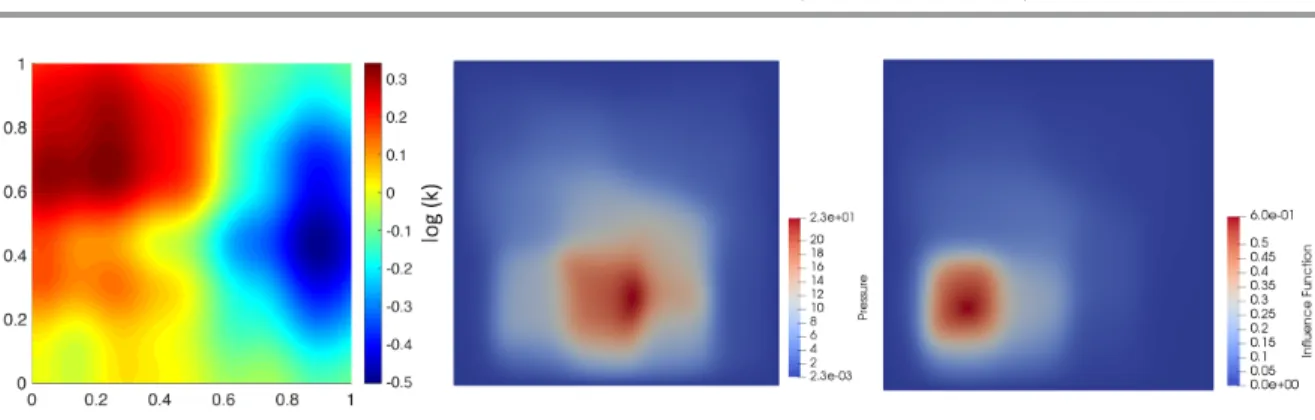
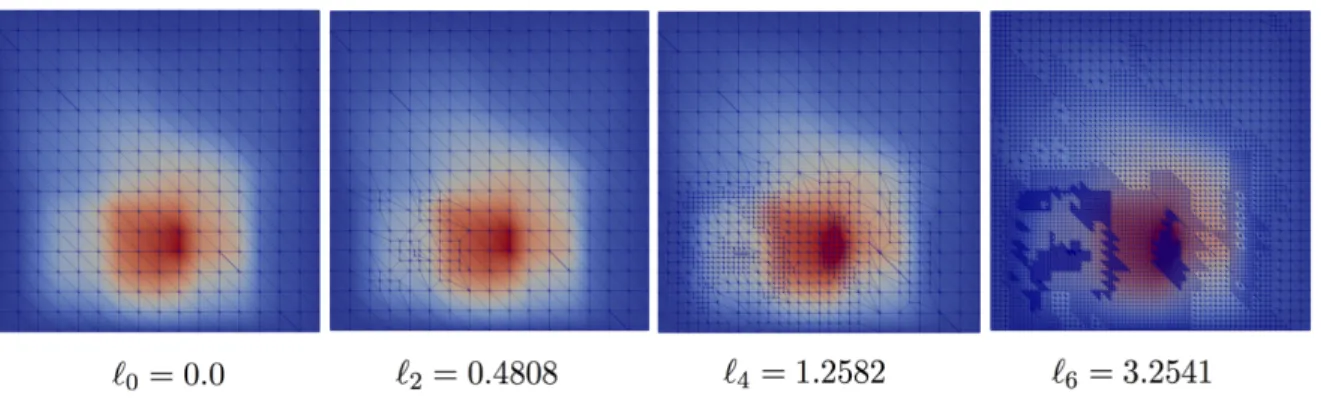
Before running a complete simulation we first consider a single sample \omega \in \Omega . Figure 1 shows the random permeability field k(x, \omega ), pressure solution uh(x, \omega ), and the influence
Figure 2. Sequence of adaptive grids built using a goal-oriented error estimator for random\omega k\in \Omega ; level
is defined by\ell (k)j given by (18).
functionwh(x, \omega ) (i.e., the solution of the dual problem (17)) for this sample after 6 adaptive steps. Snapshots of the grids, built using the goal-oriented error estimator, are shown in Figure2at steps 0, 2, 4, and 6. Visually, we see that the adaptive scheme is working correctly, refining near yQ = [0.25,0.25]T, the point around which the pressure is averaged in the functional \scrQ in (22), while also adapting around the localized source. At the latter levels the refinement also starts to pick up local variations in the permeability field in regions that influence the pressure at the point of interest.
For the uniform and adaptive strategy, we first run an initial batch of 6400 samples up
to L\mathrm{m}\mathrm{a}\mathrm{x} = 5, in order to estimate the parameters \beta and \gamma . In a real simulation, it would
not be necessary to estimate these parameters accurately and so significantly fewer samples could be used. With uniform refinements, our estimates are\beta u = 2.28 and \gamma u = 1.0, whereas for adaptive refinements we get \beta a = 2.22 and \gamma a = 0.78. Note that, in both cases, \beta > \gamma , therefore, by taking L\mathrm{m}\mathrm{a}\mathrm{x} = +\infty in the CLMC setting we obtain unbiased estimators with respect to \BbbE [\scrQ - Q(0)]. In these initial runs we can already see the expected computational
gains of adaptive grid refinement. We note that the rates \beta for\BbbV [dQ/d\ell ] are much the same
in each case, whilst \gamma , the rate of growth of the expected cost per sample, is clearly smaller for the adaptive strategy. Figure 3 gives a plot of the continuous level \ell , representing the estimate of the relative FE error, against the natural log of the cost for all samples, which shows the better rate for the adaptive scheme.
We then run the CLMC algorithm with a maximum ofN = 106 samples for each case. The exponential parameter rateris taken to be the same for each case, so that any computational gains can be attributed to the adaptive strategy, rather than a difference in r. The value is chosen so that r = 12(ru+ra) = 14(\beta u+\gamma u+\beta a+\gamma a) = 1.57, and we consider the unbiased estimator withL\mathrm{m}\mathrm{a}\mathrm{x}= +\infty .
The numerical results show that the CLMC algorithm is working as expected. In Figure4 (left), we observe as expected that the natural logarithm of \BbbE [dQ/d\ell ] decreases linearly with
\ell , i.e., \alpha \approx 1, in both the uniform and the adaptive case, since \ell is defined as the natural logarithm of an estimate of the relative bias error. Figure 4 (middle) shows the variance reduction for both uniform and adaptive refinement strategies. Both decay very similarly across the levels with rates of around \beta = 2. Finally, Figure 4 (right) shows the actual
0 1 2 3 4 5 6 level -2 -1 0 1 2 3 4 log e (Cost) adaptive . a = 0.78 uniform . u = 1.0
Figure 3. Level\ell againstlog(Cost)for6400uniform (red circles) and6400adaptive samples (blue squares).
0 1 2 3 4 level -8 -7 -6 -5 -4 -3 -2 -1 0 log e E[dQ/dl] , = 1.0 adaptive uniform 0 1 2 3 4 level -14 -12 -10 -8 -6 -4 -2 0 log e V[dQ/dl] adaptive - = 2 uniform -6.5 -6 -5.5 -5 -4.5 log e(rmse) 7 8 9 10 11 12 13 14 log e (Cost) adaptive uniform rate = 2
Figure 4. Results for the numerical test, in log-scale. Left and middle: Convergence plots of \BbbE [dQ/d\ell ]
and\BbbV [dQ/d\ell ]against\ell , respectively. Right: Total cost of uniform and adaptive algorithm (in seconds) against estimated sampling error (= root-mean-square error due to unbiasedness).
cost to compute the estimate for different choices of N. The cost (in seconds) is plotted against the root-mean-square error, which is equal to the sampling error, since the estimator is unbiased. As proved in Theorem 2.3, since\beta > \gamma for both strategies, we observe parallel straight lines with rate of \approx 2. Due to the reduced computational cost on the finer levels, the adaptive strategy wins over the uniform one across a range of tolerances. Especially for coarser tolerances the gains are significant and the sample-adaptive level hierarchy consistently reduces the cost by a factor of 4.
The actual gains that are possible with the new CLMC estimator and with sample-adaptive level hierarchies are very problem dependent. They also depend strongly on the error estimator and on the adaptive refinement strategy. The estimator and the strategy employed here are by no means optimal. It is known that the employed error estimator is not necessarily very effective in the context of strong coefficient variations. Finally, the gains also depend on
the cost of the linear solver. For a fair comparison, we used a sparse direct solver, which outperforms iterative solvers for the problem sizes encountered in our two-dimensional model problem. However, further experiments in three space dimensions will require iterative solvers and robust preconditioners that can cope both with the strong coefficient variations and with the locally refined FE meshes. The cost and the memory requirements of sparse direct solvers grow too rapidly in three dimensions (3D). Nevertheless, we expect the gains in 3D to be even more significant.
5. Conclusions and further work. In this paper, we introduce CLMC, a generalization of MLMC to a continuous framework where the level is a continuous variable rather than an integer. We propose a practical estimator and prove a complexity theorem, showing the same order of convergence as in MLMC. Furthermore, we provide a version of the estimator that is unbiased with respect to the true quantity of interest and extend the complexity theorem to this case, giving sufficient and necessary conditions for the unbiased estimator to have finite cost. We apply CLMC to adaptive refinement schemes, where the continuous framework is particularly well suited in order to capture sample-based level hierarchies. We demonstrate clear computational gains when adaptive refinement strategies are adopted rather than uniform ones.
The introduction of CLMC opens the door to several new research directions. We outline a few ideas for further work:
Extension of Multi-index MC (MIMC) [13]. MIMC is an extension of MLMC to
multidi-mensional level parameters and higher-order differences. In the same way, as CLMC general-izes MLMC by replacing the sum with an integral and the difference with a derivative in the case of a scalar level parameter, one could generalize MIMC by employing multidimensional integrals of partial derivatives. Indeed, consider (Q(\ell ))\ell to be a sequence of approximation functions of \scrQ , where \ell = (\ell 1, . . . , \ell m) is an m-dimensional vector of non-negative levels. To explain the idea, let us restrict our description to m = 2 and consider a two-dimensional positive random variable\bfitL = (L1, L2). Assuming sufficient regularity, we can write
(24) \BbbE \bigl[ Q(\bfitL ) - Q(0)\bigr] =\BbbE \biggl[ \int L1
0
\int L2
0
\partial 2Q(\ell )
\partial \ell 1\partial \ell 2
d\ell \biggr] + 2 \sum j=1 \BbbE \biggl[ \int Lj 0 \partial Q(\ell ) \partial \ell j d\ell j \biggr] .
Note that (24) is a two-dimensional extension of the formula in (5). It is outside the scope of this paper, but we argue that different choices for the probability distribution of the vector of finest levels \bfitL (with potentially correlated components) correspond to different choices of the grid of levels in MIMC. A natural choice would be again to pick independent Li \sim Exponential(ri) for i = 1, . . . , m with ri > 0. Classically, in MIMC, \bfitL is a fixed integer vector chosen to control the bias error, while the optimal strategy for the choice of samples avoids computation of samples for levels with\ell 1/L1+\ell 2/L2 >1. Here, the bias can again be completely eliminated (provided the variance decays fast enough w.r.t. the growth in cost), and the optimal strategy is a direct consequence of the choice of the exponential distributions
forL1 andL2, making the probability that both\ell 1 and\ell 2are simultaneously large practically
zero.
Extension of Multilevel Markov Chain Monte Carlo (MLMCMC) [7]. Multilevel tech-niques have been successfully applied to sampling algorithms like Markov chain MC (MCMC), drastically reducing their complexity cost. The extension of MLMCMC to continuous level MCMC is an object of future work, potentially leading to an estimator that is an unbiased with respect to the real quantity of interest, under the real target probability distribution. Such an unbiased estimator would be of great interest: unlike forward problems, where the bias can arise only from the approximation of the quantity of interest, inverse problems have the additional issue of an approximation of the target probability distribution. Unbiasedness guarantees that the estimator is in fact estimating the correct unknown, without expensive extra computational cost to estimate the bias error. In addition, continuous level adaptive re-finement strategies will significantly help to slim down MCMC's computational cost, allowing one to solve even more complex problems.
Appendix A. Proof of the complexity results. A.1. Proof of Theorem 2.3.
Proof. First, we want to bound the MSE by \varepsilon 2. By the bias-variance decomposition, this can be achieved by bounding both the squared bias and variance by\varepsilon 2/2.
By using assumption (i) and recalling thatL\sim Exponential(L), the bias term is bounded by \bigm| \bigm| \bigm| \bigm| \bigm| \BbbE \Bigl[ \widehat
Q\mathrm{C}\mathrm{L}\mathrm{M}\mathrm{C}L\mathrm{m}\mathrm{a}\mathrm{x} - (\scrQ - Q(0))\Bigr]
\bigm| \bigm| \bigm| \bigm| \bigm| = \bigm| \bigm| \bigm| \bigm| \bigm| \BbbE \biggl[ \int L L\wedge L\mathrm{m}\mathrm{a}\mathrm{x} 1 \BbbP (L\geq \ell ) dQ(\ell ) d\ell d\ell
\biggr] \bigm| \bigm| \bigm| \bigm| \bigm| \leq \BbbE \Biggl[ \int L L\wedge L\mathrm{m}\mathrm{a}\mathrm{x} 1 \BbbP (L\geq \ell ) \bigm| \bigm| \bigm| \bigm| \bigm| \BbbE \biggl[ dQ(\ell ) d\ell
\biggr] \bigm| \bigm| \bigm| \bigm| \bigm| d\ell \Biggr] \leq c1\BbbE \biggl[ \int L L\wedge L\mathrm{m}\mathrm{a}\mathrm{x} 1 \BbbP (L\geq \ell )e
- \alpha \ell d\ell
\biggr] = \Biggl\{ c 1 r - \alpha \BbbE \bigl[
e(r - \alpha )L - e(r - \alpha )L\wedge L\mathrm{m}\mathrm{a}\mathrm{x}\bigr] ifr\not =\alpha , c1\BbbE [L - L\wedge L\mathrm{m}\mathrm{a}\mathrm{x}] ifr=\alpha
(25)
= c1
\alpha e
- \alpha L\mathrm{m}\mathrm{a}\mathrm{x},
(26)
where we can explicitly compute the expected values in (25) using the distribution ofL. As we want to bound the squared bias by\varepsilon 2/2, this is equivalent to bounding the bias by
\varepsilon /\surd 2, which can be achieved by setting
(27) L\mathrm{m}\mathrm{a}\mathrm{x}\geq \Biggl\lceil 1 \alpha log \surd 2c1r\varepsilon - 1 \alpha \Biggr\rceil .
Then, let us provide an upper bound for the variance of the CLMC estimator (6). By the law of total variance, we have
(28) \BbbV [Q\widehat \mathrm{C}\mathrm{L}\mathrm{M}\mathrm{C}L \mathrm{m}\mathrm{a}\mathrm{x} ] =\BbbE \Bigl[ \BbbV [Q\widehat \mathrm{C}\mathrm{L}\mathrm{M}\mathrm{C}L \mathrm{m}\mathrm{a}\mathrm{x} | L] \Bigr] +\BbbV \Bigl[
\BbbE [Q\widehat \mathrm{C}\mathrm{L}\mathrm{M}\mathrm{C}L
\mathrm{m}\mathrm{a}\mathrm{x} | L]
\Bigr]
.
Let us start by bounding the first term on the right-hand side of (28). We will use the Cauchy--Schwarz inequality on the covariance, followed by assumption (ii). We have
\BbbE \Bigl[ \BbbV [Q\widehat \mathrm{C}\mathrm{L}\mathrm{M}\mathrm{C}L \mathrm{m}\mathrm{a}\mathrm{x} | L] \Bigr] =\BbbE \Bigl[ Cov \Bigl( \widehat
Q\mathrm{C}\mathrm{L}\mathrm{M}\mathrm{C}L\mathrm{m}\mathrm{a}\mathrm{x} ,Q\widehat \mathrm{C}\mathrm{L}\mathrm{M}\mathrm{C}L
\mathrm{m}\mathrm{a}\mathrm{x} \bigm| \bigm| L \Bigr) \Bigr] = 1 N\BbbE \Biggl[ \int [0,L\wedge L\mathrm{m}\mathrm{a}\mathrm{x}]2 1 \BbbP (L\geq \ell ) 1
\BbbP (L\geq \ell \prime )Cov \biggl( dQ(\ell ) d\ell , dQ(\ell \prime ) d\ell \prime \biggr)
d\ell d\ell \prime
\Biggr] = 1 N\BbbE \Biggl[ \int [0,L\wedge L\mathrm{m}\mathrm{a}\mathrm{x}]2 1 \BbbP (L\geq \ell ) 1
\BbbP (L\geq \ell \prime )\BbbV \biggl[ dQ(\ell ) d\ell \biggr] 12 \BbbV \biggl[ dQ(\ell \prime ) d\ell \prime \biggr] 12
d\ell d\ell \prime
\Biggr]
= 1
N\BbbE
\left[ \Biggl(
\int L\wedge L\mathrm{m}\mathrm{a}\mathrm{x}
0 1 \BbbP (L\geq \ell )\BbbV \biggl[ dQ(\ell ) d\ell \biggr] 12 d\ell \Biggr) 2\right] \leq 1 Nc 2 2\BbbE \Biggl[
\biggl( \int L\wedge L\mathrm{m}\mathrm{a}\mathrm{x}
0
1
\BbbP (L\geq \ell )e
- \beta 2\ell d\ell
\biggr) 2\Biggr] = \left\{ 1 N 4c2 2 (2r - \beta )2\BbbE \Bigl[ \bigl(
e(r - \beta 2)L\wedge L\mathrm{m}\mathrm{a}\mathrm{x} - 1\bigr) 2
\Bigr]
ifr\not =\beta /2,
1
Nc22\BbbE [(L\wedge L\mathrm{m}\mathrm{a}\mathrm{x})2] ifr=\beta /2
\leq \left\{ 1 N 4c2 2 (r - \beta )(2r - \beta )2 \bigl(
(2r - \beta )e(r - \beta )L\mathrm{m}\mathrm{a}\mathrm{x} - \beta \bigr) ifr \not =\beta /2, \beta ,
1 N
4c2 2
\beta 2(\beta L\mathrm{m}\mathrm{a}\mathrm{x}+ 1) ifr =\beta ,
1 N
8c2 2
\beta 2 ifr =\beta /2.
On the other hand, the second term on the right-hand side of (28) can be bounded as
\BbbV \Bigl[
\BbbE [Q\widehat \mathrm{C}\mathrm{L}\mathrm{M}\mathrm{C}L
\mathrm{m}\mathrm{a}\mathrm{x} | L]
\Bigr]
= 1
N\BbbV
\biggl[ \int L\wedge L\mathrm{m}\mathrm{a}\mathrm{x}
0
1
\BbbP (L\geq \ell )\BbbE \biggl[ dQ(\ell ) d\ell \biggr] d\ell \biggr] \leq 1 Nc 2 1\BbbV
\biggl[ \int L\wedge L\mathrm{m}\mathrm{a}\mathrm{x}
0
1
\BbbP (L\geq \ell )e
- \alpha \ell d\ell
\biggr] = \Biggl\{ 1 N c2 1 (r - \alpha )2\BbbV \bigl[
e(r - \alpha )L\wedge L\mathrm{m}\mathrm{a}\mathrm{x} - 1\bigr] ifr\not =\alpha ,
1
Nc21\BbbV [L\wedge L\mathrm{m}\mathrm{a}\mathrm{x}] ifr=\alpha
\leq \Biggl\{ 1 N c21 (r - \alpha )2\BbbE \bigl[
e2(r - \alpha )L\wedge L\mathrm{m}\mathrm{a}\mathrm{x}\bigr] ifr\not =\alpha ,
1 Nc 2 1\BbbV [L] ifr=\alpha = \left\{ 1 N c2 1 (r - 2\alpha )(r - \alpha )2 \bigl(
2(r - \alpha )e(r - 2\alpha )L\mathrm{m}\mathrm{a}\mathrm{x} - r\bigr) ifr \not =\alpha ,2\alpha ,
1 N
2c2 1
\alpha L\mathrm{m}\mathrm{a}\mathrm{x} ifr = 2\alpha , 1
N c2
1
\alpha 2 ifr =\alpha .
In both cases in the last step, we have again used our knowledge of the distribution ofL.
Note that asymptotically the bound for the first term on the right-hand side of (28) always dominates the bound of the second, since we have assumed that \beta \leq 2\alpha . Hence, adding together the two bounds and using (27), as well as the fact that \varepsilon < e - 1, we obtain the following asymptotic bound on the total variance:
\BbbV [Q\widehat \mathrm{C}\mathrm{L}\mathrm{M}\mathrm{C}L
\mathrm{m}\mathrm{a}\mathrm{x} ] \leq C\prime N
\left\{
\varepsilon \beta - \alpha r ifr > \beta ,
log\varepsilon ifr =\beta ,
1 ifr < \beta
for some constantC\prime >0 that is independent ofNand\varepsilon . Thus, to guarantee\BbbV [Q\widehat \mathrm{C}\mathrm{L}\mathrm{M}\mathrm{C}L
\mathrm{m}\mathrm{a}\mathrm{x} ]\leq \varepsilon
2/2
it suffices to choose
(29) N \geq 2C\prime \varepsilon - 2 - \mathrm{m}\mathrm{a}\mathrm{x}(0,r - \alpha \beta )(log\varepsilon )\delta r,\beta ,
where\delta denotes the Kronecker delta.
Finally, we can bound the expected overall cost:
\scrC L\mathrm{C}\mathrm{L}\mathrm{M}\mathrm{C}
\mathrm{m}\mathrm{a}\mathrm{x} =N\BbbE
\biggl[ \int L\wedge L\mathrm{m}\mathrm{a}\mathrm{x}
0 \scrC (\ell )d\ell \biggr] =N \int L\mathrm{m}\mathrm{a}\mathrm{x} 0
\scrC (\ell )\BbbP (L\geq \ell )d\ell \leq N c3
\int L\mathrm{m}\mathrm{a}\mathrm{x}
0
e\gamma \ell \BbbP (L\geq \ell )d\ell
=
\Biggl\{
N c3
\gamma - r
\bigl(
e(\gamma - r)L\mathrm{m}\mathrm{a}\mathrm{x} - 1\bigr) ifr\not =\gamma , N c3\gamma L\mathrm{m}\mathrm{a}\mathrm{x} ifr=\gamma . (30)
Hence, using (29) the overall cost can be bounded as (31) \scrC L\mathrm{C}\mathrm{L}\mathrm{M}\mathrm{C}\mathrm{m}\mathrm{a}\mathrm{x} \leq C \varepsilon - 2 - \mathrm{m}\mathrm{a}\mathrm{x}(0,r - \alpha \beta ) - \mathrm{m}\mathrm{a}\mathrm{x}(0,
\gamma - r
\alpha )(log\varepsilon )\delta r,\beta +\delta r,\gamma
for some constant C > 0, which is again independent of \varepsilon . This completes the proof since we had assumed that r \in [min(\beta , \gamma ),max(\beta , \gamma )] and so max(0,r - \beta \alpha ) + max(0,\gamma - r\alpha ) = max(0,\gamma - \beta \alpha ).
A.2. Proof of Corollary 2.4.
Proof. To prove (a), suppose L\mathrm{m}\mathrm{a}\mathrm{x}= +\infty . Then, the bias in (26) is zero due to Corollary 2.2, so that the MSE is equivalent to the variance of the CLMC estimator. Since r < \beta it follows as in the proof of Theorem 2.3in section A.1, that
\BbbV \Bigl[ \widehat Q\mathrm{C}\mathrm{L}\mathrm{M}\mathrm{C}\infty \Bigr] \leq C \prime N
for some constantC\prime >0. Analogously, sincer > \gamma , the expected overall cost can be bounded by
C\infty \mathrm{C}\mathrm{L}\mathrm{M}\mathrm{C}\leq C\prime \prime N
for some constant C\prime \prime >0. Therefore, we can bound the MSE with \varepsilon 2 by taking N \geq C\prime \varepsilon - 2
and the overall computational cost is C\mathrm{C}\mathrm{L}\mathrm{M}\mathrm{C} \infty =\scrO
\bigl(
\varepsilon - 2\bigr)
.
To prove (b), suppose that the additional assumptions in part (b) of Corollary 2.4 hold. Then, by tracking back the steps in the proof of Theorem 2.3 in section A.1, it can be seen fairly easily that for\beta \leq \eta \leq \gamma we have
\BbbE \Bigl[
\BbbV [Q\widehat \mathrm{C}\mathrm{L}\mathrm{M}\mathrm{C}\infty | L] \Bigr] \geq \left\{ 1 N 4c\prime 2 2
\eta (\eta - r) ifr < \eta , r\not =\eta /2, 1
N 8c\prime 2
2
\eta 2 ifr =\eta /2,
+\infty ifr \geq \eta ,
and \scrC \infty \mathrm{C}\mathrm{L}\mathrm{M}\mathrm{C}\geq \Biggl\{
N c
\prime
3
r - \eta ifr > \eta , +\infty ifr \leq \eta .
We see that MSE\times \scrC \mathrm{C}\mathrm{L}\mathrm{M}\mathrm{C}
\infty = +\infty for all choices ofr.
Appendix B. Goal-oriented error estimators. We use a classical goal-oriented error esti-mator to drive the samplewise adaptive scheme in our numerical experiments. The following description is taken from [12]. Let\omega \in \Omega be fixed, and recall thatu\in V denotes the solution of (14) while uh \in Vh \subset V is its FE approximation on a grid \scrT h. The error in a quantity of interest (defined by a linear functional2) is given by
(32) \scrQ (\epsilon h) =\scrQ (u - uh) =\scrQ (u) - Q(uh).
This functional can be interpreted as the ``source"" of the FE discretization error in the quantity of interest, and is a bounded linear functional on the dual space V\prime . The key idea of goal-oriented, a posteriori error estimators is to relate \scrQ (\epsilon h) to the solution residual ruh, i.e., we seek a function w\in V\prime \prime such that \scrQ (\epsilon h) =w(ruh). SinceV is a reflexive Hilbert space, there exists a w \in V such that\scrQ (\epsilon h) =ruh(w). The function w, termed the influence function, is the solution of the dual problem
(33) a(v, w) =\scrQ (v) \forall v\in V.
This dual solution can be approximate using the same FE approximation as uh, i.e., find
wh\in Vh \subset V s.t
a(vh, wh) =\scrQ (vh) \forall vh\in Vh.
Using the Galerkin orthogonality of u anduh, we can bound\scrQ (\epsilon h) as follows:
| \scrQ (\epsilon h)| =| \scrQ (u - uh)| =| a(u - uh, w)| =| a(u - uh, w)| +| a(u - uh, wh)| =| a(u - uh, w - wh)| \leq \sum \tau \in \scrT h \| u - uh\| a,\tau \| w - wh\| a,\tau . (34)
In the last step, we have used the Cauchy--Schwarz inequality elementwise. Hence, the product of energy norms\| u - uh\| a,\tau \| w - wh\| a,\tau provides an estimate for the elementwise contribution to the error inQ(uh). It is now used to define an appropriate adaptivity scheme.
To estimate the error of the solutions of the primal and dual problems in the energy norm on each element \tau , we use explicit error estimators. We only show the main ideas for
2
Similar error estimators can also be obtained for nonlinear functionals by first linearizing about\epsilon h.
estimating \| u - uh\| a,\tau using one of the most basic estimators. The bound for \| w - wh\| a,\tau can be derived analogously. On each element \tau , using integration by parts, the FE error can be represented as a(\epsilon h, v)| \tau = \int \tau f vdx - \int \tau
\nabla uh\cdot k(x)\nabla vdx = \int \tau \scrR uvdx+ \int \partial \tau \scrJ uvds \forall v\in V , (35)
where the residual error on the element is define by
(36) \scrR u(x) =\nabla \cdot k(x)\nabla uh(x) +f(x) \forall x\in \tau ,
and where\scrJ u defines, for allx\in \partial \tau (except at the vertices), the jump of the flux inuh across the element boundary by
(37) \scrJ u(x) =
\Biggl\{
k(x)
\Bigl[
n\tau (x)\cdot \nabla uh| \tau +n\tau \prime (\bfx )(x)\cdot \nabla uh| \tau \prime (\bfx ) \Bigr]
\forall x\not \in \partial D ,
n\tau (x)\cdot k(x)\nabla uh| \tau \forall x\in \partial D ,
where n\tau is the outward unit normal to the element boundary \partial \tau at x and \tau \prime (x) is the neighboring element of \tau at x. For simplicity, we assume that the boundary conditions are homogeneous Dirichlet conditions on all of\partial D.
Using again Galerkin orthogonality, we can introduce the global FE interpolant \scrI hv in (35), and thus using classical interpolation theory find that
a(\epsilon h, v)| \tau \leq \| \scrR u\| L2(\tau )\| v - \scrI hv\| L2(\tau )+\| \scrJ u\| L2(\partial \tau )\| v - \scrI hv\| L2(\partial \tau )
\leq c1
\Bigl(
h\tau \| \scrR u\| L2(\tau )+
\sqrt{}
h\tau \| \scrJ u\| L2(\partial \tau )
\Bigr)
\underbrace{} \underbrace{}
=:\eta \tau (uh)
\| v\| a,\omega \tau ,
where \omega \tau denotes the subdomain of elements sharing a common edge with \tau , and where c1 is a problem dependent constant independent of the mesh size h\tau . Substituting v =\epsilon h and summing over all elements, we can see that (up to a constant factor c2 depending on the geometry) this leads to the explicit global energy error estimator
(38) \| \epsilon h\| a\leq c1c2 \left( \sum \tau \in \scrT h \eta \tau 2(uh) \right) 1/2
for the primal solution on \scrT h.
The local error contribution \eta \tau (wh) to the dual solution wh on \tau in the energy norm can be estimated analogously, and it can be shown that together with (34) this leads to the goal-oriented error estimator
(39) | \scrQ (\epsilon h)| \leq c3
\sum
\tau \in \scrT (k)
\eta \tau (uh)\eta \tau (wh),
![Figure 4. Results for the numerical test, in log-scale. Left and middle: Convergence plots of \BbbE [dQ/d\ell ] and \BbbV [dQ/d\ell ] against \ell , respectively](https://thumb-us.123doks.com/thumbv2/123dok_us/10063442.2906057/16.918.150.738.492.672/figure-results-numerical-scale-left-middle-convergence-respectively.webp)
