1
Criminal
Domestic Violence
Case Processing
A Case Study of the Five Boroughs
of New York City
Submitted to
the New York State Division of Criminal Justice Services and the Office on Violence Against Women of the
U.S. Department of Justice
RESEARCH
A Public/Private Partnership with the New York State Unified Court System
Written by Chandra Gavin Nora K. Puffett 2005
This publication was supported by funding from the Office on Violence Against Women, US Department of Justice, under the Grants to Encourage Arrest Policies program, grant number 2000-WE-VX-0009. The opinions and recommendations expressed in this document are those of the authors and do not necessarily reflect the position of the Office on Violence Against Women or the Center for Court Innovation.
About the Authors
Chandra Gavin is a former Research Associate at the Center for Court Innovation. Nora K. Puffett is a Senior Research Associate at the Center for Court Innovation.
Acknowledgments
The authors thank the many judges, defense attorneys, prosecutors, resource coordinators, victim advocates, clerks and other court staff in the five boroughs who volunteered their time to participate in interviews and provide information for this project. We would also like to thank Deirdre Bialo-Padin, Andy Liu, Wanda
Lucibello, Jessica Marcus, Michelle Maroney, Audrey Moore, Terri Roman, and Yolanda Rudich for reviewing the final draft and providing essential corrections and thoughtful feedback. Any remaining errors are entirely the authors’ own. Finally, we offer our deepest gratitude to Michael Rempel and Liberty Aldrich at the Center for Court Innovation for their patience, support, and
continued faith that this document would, eventually, be completed.
TABLE OF CONTENTS
Executive Summary ... i
I. Introduction ... 1
II. Literature Review ... 3
III. Domestic Violence Criminal Case Processing in the Five Boroughs of New York City ... 9
a. Demographic context ... 9
b. Key elements of case processing ... 9
c. Bronx... 11
d. Brooklyn... 13
e. Manhattan... 15
f. Queens... 17
g. Staten Island ... 19
IV. Synthesis and Comparison of Domestic Violence Court Policies and Practices .. 21
a. Domestic Violence Court practices ... 22
b. District Attorney practices ... 24
V. Stakeholder Perceptions... 27
a. Goals and objectives ... 27
b. Court procedures... 29
c. Program mandates ... 32
d. Concerns... 34
e. Conclusions and future research... 37
VI. Bibliography... 39
Appendices a. Questions... 41
b. Key terms ... 49
EXECUTIVE SUMMARY
In the decade since the passage of the Violence Against Women Act in 1994, jurisdictions across the country have sought to redefine their response to domestic violence. In New York City, all five boroughs now consolidate their criminal (misdemeanor) domestic violence caseload in a dedicated, specialized domestic violence court that seeks to achieve offender accountability and victim safety through aggressive prosecution, close monitoring of defendants and provision of services and advocacy to victims. The current study sought to establish what the policies and practices of these courts are, to understand their underlying rationale, and to learn what stakeholders perceive as their strengths and weaknesses.
For this research, court observations and interviews with judges, attorneys, victim advocates, clerks and resource coordinators were conducted in the Bronx, Brooklyn, Manhattan, Queens and Staten Island in the spring and summer of 2002. Caseload statistics were collected for the same period from the New York State Office of Court Administration.1
PRACTICES ANDPOLICIES OFDOMESTICVIOLENCECOURTS ANDPROSECUTORS
While courts are structured similarly in all boroughs, the most notable cross-borough differences lie in court resources and prosecution policies. Queens and the Bronx have more staff (resource coordinator, defendant monitor, and, in the Bronx only, project director), than the other
boroughs, although Brooklyn has a resource coordinator. Additional funding obtained by the victim services agency Safe Horizon also allows for enhanced victim advocacy in Queens and the Bronx. The impact of these additional resources is evident in such areas as the court’s ability to research and maintain contact with community resources and programs for defendants.
PROSECUTORIALPRACTICES ANDPOLICIES
District Attorney policies varied greatly from borough to borough on a number of issues:
§ Queens is the only borough to narrow its definition of domestic violence to exclude not only non-intimate partner family violence (e.g., violence between siblings), but also violence between intimate partners who have never been married or lived together. This significantly decreases the number of cases eligible for the domestic violence court.
§ Queens is also unique in having prosecutors remain involved in cases during the post-sentence monitoring phase.
§ Manhattan, on the other hand, is the only borough that has not created a dedicated domestic violence bureau, instead assigning assistant district attorneys to domestic violence cases as to any other type of case, with extra support from a dedicated supervisor.
§ Queens and Manhattan both, however, conduct vertical prosecution (that is, assign a single prosecutor to a case from beginning to end); other boroughs attempt some degree of vertical prosecution, but not to the extent of these two.
§ Bronx is unique in having a first-party complaint policy that results in the District Attorney declining to prosecute those cases in which the victim does not sign a complaint. All
boroughs practice some degree of evidence-based prosecution—that is, prosecution based on material evidence, conducted without the cooperation of the victim—but are hesitant to identify precise criteria for deciding when to conduct such a prosecution and when to accede to the victim’s wishes to drop the case.
1
Please note that important changes have taken place in many boroughs’ practices since that time; where possible, those changes have been noted, but it should not be assumed that this document entirely reflects the current landscape.
Executive Summary ii It is difficult to assess the impact of these prosecutorial differences on case processing and outcomes. While vertical prosecution and dedicated domestic violence prosecutors might seem to be preferable from the standpoint of the complainant, there has been no attempt to directly assess complainant perceptions of different prosecution styles. Opinion is also divided on such issues as the narrow definition of domestic violence employed by the Queens District Attorney's Office: on the one hand, caseloads are large, and may impede the ability to prosecute and
adjudicate cases as effectively as possible, making reduction of the caseload desirable; on the other hand, it is possible that cases that would benefit from the domestic violence court model are being denied the opportunity.
DOMESTICVIOLENCECOURTPRACTICES ANDPOLICIES
Queens and Brooklyn are the only two boroughs that routinely accept conditional pleas—those in which the defendant pleads to a higher and lower charge, with the higher charge to be dropped if conditions, usually program mandates, are met. Proponents argue that such pleas give judges greater leverage over the defendant and increase the severity of potential sanctions if the
defendant fails to comply with court conditions. It is unclear why this practice is not used elsewhere; stakeholders in other boroughs did not identify it as a practice that they wished to introduce, or to which there had been opposition, but neither did they object to it.
In most other respects, the courts demonstrated considerable consistency: all imposed orders of protection throughout the case, usually full (‘stay-away’) orders; all provided advocacy to victims, whether through the District Attorney’s office, a community agency, or both; all made at least some use of program mandates (most boroughs made extensive use of these; Manhattan was unable to document how many cases were mandated); and all conduct regular, usually monthly, judicial monitoring of defendants mandated to programs, with some of the larger courts employing separate court parts for this purpose.
STAKEHOLDERPERCEPTIONS
Interviews with judges and judicial hearing officers, prosecutors and defense attorneys, and victim advocates addressed issues such as the goals of the domestic violence court; court
operations; and program mandates for defendants. Most stakeholders believed very strongly that domestic violence courts provide tangible benefits in the areas of victim safety and defendant accountability. Others cited practical benefits resulting from the structure of the courts.
The most significant benefit of domestic violence courts cited by stakeholders was the enhanced training of judges, attorneys and court staff, and the experience that comes from handling the same types of cases every day. Many felt that this level of expertise enhanced the consistency of the court’s response to domestic violence. Additionally, some stakeholders opined that a specialized court staff facilitates the sharing of information, in particular through the resource coordinator position and through the partners meetings convened by the court. GOALS OF THEDOMESTICVIOLENCECOURT
Perceptions of goals were generally consistent within each stakeholder role; differences emerged more often between roles than between boroughs. Judges and judicial hearing officers described their goals as being to uphold the law, protect the complainant, punish the defendant, and
rehabilitate the defendant; goals which sometimes seemed to be at odds. Prosecutors were concerned with prosecuting the defendant to the fullest extent of the law, and with finding the
best and safest outcome for the complainant. Defense attorneys, unsurprisingly, sought the least punitive court outcome for the defendant, whilevictim advocates primary concern was the safety of the victim.
While most stakeholders felt that the courts were doing a reasonable job of maintaining defendant accountability, they were less confident about victim safety. Nearly everyone
interviewed lamented the fact that a lack of information about violations, new arrests, and long-term outcomes makes it difficult to assess the court’s impact.
SPECIALIZEDPERSONNEL
Stakeholders cited the use of trained staff—including the presence of trained judges and
prosecutors—as a primary benefit of the domestic violence court model. Most stakeholders also agreed that the court model increases defendant accountability. In particular, those courts with resource coordinators reported that they were much better able to manage relationships with programs and obtain compliance reports, allowing them to more effectively monitor defendants’ compliance with orders and mandates.
CASEVOLUME ANDRESOURCES
Most parties interviewed cited the overwhelming court volume as a barrier to better and more efficient case processing, pointing to its negative effects on the ability to coordinate and share information between players, and particularly to its impact on assistant district attorneys. ADAs are perceived by many stakeholders to be frequently unprepared and ill-informed regarding their own cases, leading to unnecessary adjournments and additional appearances. Some
stakeholders—primarily members of the defense bar—pointed out that the court model actually increases case volume, as cases make more appearances and are dismissed later than they would otherwise be.
THEDEFENSEBAR
Stakeholders indicated that the defense bar, while an active participant in the court, remains opposed to its fundamental tenets, a view that defense attorneys themselves supported. Defense attorneys continue to harbor philosophical, practical and legal concerns about the domestic violence court model, decrying it as biased against defendants and paternalistic toward victims. PROGRAMMANDATES
While most courts rely primarily on mandates to batterer intervention programs (as opposed to treatment programs), all parties seemed dubious about the value of such programs. There were also concerns raised about the cost and quality of programs, and the availability of programs for female and homosexual batterers.
CONCLUSION
Specialized domestic violence courts are now established in all five New York City boroughs. While they continue to face challenges, they have been endorsed by the majority of stakeholders as a significant improvement in the criminal justice response to domestic violence crime. Most stakeholders asserted that the court substantively improved victim safety and defendant
accountability. In particular, stakeholders spoke positively of the increased training and information available to judges, court staff, and partners, which enable them to handle cases more consistently and monitor offender behavior more closely. At the same time, they identified
Executive Summary iv limited resources as a key challenge to the courts’ survival, and pointed to a need for increased communication between court partners. Stakeholders also expressed a desire for more
information regarding long-term outcomes for victims and defendants, underscoring the importance not only of conducting further research into these issues, but also of disseminating the results of that research to the widest possible audience.
I. INTRODUCTION
In the decade since the passage of the Violence Against Women Act in 1994, jurisdictions across the country have sought to redefine their response to domestic violence—few more so than New York State. The Act forced local legislatures to institute new measures such as mandatory arrest policies, and provided funding for new specialized prosecution and police units. In New York, district attorneys were encouraged to pursue cases even without victim cooperation—cases they might previously have declined—through the practice of an “evidence-based” prosecution that relied on physical evidence and 911 tapes rather than victim testimony.
In 1996, New York went a step further with the opening of an experimental, specialized felony domestic violence court in Brooklyn. The new court was intended to address those issues that so often go unaddressed by the justice system, yet pose serious risks to victim safety. It would monitor defendant behavior more closely—in part by requiring attendance of a batterer intervention program as a condition of bail or sentence—impose and enforce orders of
protection, coordinate conditions and orders with those issued by Family Court, and provide victims with resources such as advocacy and links to services. All of this would stand in stark contrast to traditional criminal domestic violence case processing, which was often reported to be characterized by high dismissal rates, inconsistent rulings, a dearth of consequences for
defendant noncompliance with orders, unusually lenient sentencing, and relative indifference to the concerns of victims.
To accomplish all this, the court featured a single presiding judge; a dedicated prosecution team; victim advocates to provide support and resources to complainants; and a resource
coordinator to monitor defendant compliance with orders of protection and mandates to batterer intervention programs. It was envisioned as one component of a larger community response to domestic violence, and the judge and court staff met regularly with prosecutors, defense attorneys, probation, victim advocates, batterer intervention providers and others to coordinate policies across institutions.
The success of the court was such that it was soon expanded to a second dedicated court part and judge, and plans were made to adapt the model for criminal (misdemeanor) courts. The state’s first misdemeanor domestic violence court opened in the Bronx, with other misdemeanor courts shortly following in the other four boroughs, as well as outside of the New York City metropolitan area.
In New York State, domestic violence courts were only the latest development in a larger movement toward problem-solving courts and alternative sentencing. However, domestic violence courts differed substantially from initiatives such as drug courts and community courts. The nature of domestic violence makes it unique among criminal behaviors, and accordingly difficult to prosecute: Complainants are often the only witnesses to crimes that have left no physical evidence; yet complainants—whether due to fear for their safety, concern for their children, pressure from the defendant, or a genuine disinclination to press charges—often decline to cooperate, thereby severely limiting the prosecution. In these cases, the prosecutor must decide whether to dismiss the case, try it on the strength of what little material evidence there may be, or subpoena the complainant as a hostile witness. (Many victim advocates have criticized the latter two tactics as disempowering for the complainant, and potentially
dangerous.) Thus, domestic violence courts have become laboratories for innovative prosecution strategies, as well as for victim safety and defendant accountability measures.
I. Introduction 2 seek to rehabilitate the defendant. The goals of New York State domestic violence courts are victim safety and offender accountability—not offender reform. The complainant is a central concern of the prosecution and the court, and interventions such as batterer intervention programs are used more for monitoring and punitive purposes than for rehabilitation.
Yet this creates ambivalence among stakeholders about the goals of the court. Would not rehabilitation of the defendant be the best guarantor of victim safety? Logically it might seem so, but is rehabilitation possible? One of the difficulties faced by court reformers is the relative paucity of available knowledge on domestic violence: its causes, the impact of criminal
sanctions, the nature of recidivism, and the potential for rehabilitation. The complexity of the issue, inconsistency in defining and measuring constructs, and difficulty in locating and interviewing victims have all severely limited research in this area, with the result that most criminal justice practitioners are basing policies and practices as much on their own philosophies and experience as on empirical knowledge.
The current research sought to establish what existing policies and practices are, to
understand their underlying rationale, and to learn what stakeholders perceive as their strengths and weaknesses. To do so, it drew on courtroom observations and individual interviews
conducted by one of the authors in the spring and summer of 2002. Courtroom observation focused on court processes, interactions between stakeholders, and other courtroom dynamics.
Interviews were conducted with primary stakeholders in criminal domestic violence courts in five boroughs: Bronx, Brooklyn, Manhattan, Queens, and Staten Island. Only one person
declined to be interviewed. Interview subjects included judges and court staff—clerks, resource coordinators, defendant monitors—permanently assigned to the domestic violence court parts, as well as assistant district attorneys associated with the District Attorney’s Domestic Violence Bureau, defense attorneys, and victim advocates. Defense attorneys were selected on the basis of the frequency with which they appeared in the court, or on the recommendation of judges and court staff; they included members of both local defense agencies and the Legal Aid Society. The victim advocates interviewed all worked for Safe Horizon and were heads of their respective county’s Criminal Court Division. Safe Horizon does not have dedicated domestic violence court advocates (except where noted as a result of special funding). Subjects were asked a standard set of questions based on role (see Appendix A), with key points of inquiry being case processing, philosophical differences, and challenges.
Additionally, quantitative data on borough demographics and domestic violence case
outcomes were collected from the United States Census and the New York State Office of Court Administration.
The report opens with a review of the literature on domestic violence courts; proceeds to a detailed description of the practices of each New York City borough; and then outlines the strengths, weaknesses and concerns raised by stakeholders—judges, prosecutors, advocates, the defense bar—in interviews. Appendices offer a review of legislative actions that have influenced the development of domestic violence courts and a glossary of criminal justice terminology.
II. LITERATURE REVIEW
The court system has long been deplored as inimical to justice and safety for battered women. Critics contend that the criminal justice system’s historic inability either to secure the safety of individual women or to reduce the incidence of domestic violence within the community can in large part be attributed to the courts, and a culture that fails to take domestic violence seriously (Tsai 2000) and focuses on “procedures and defendants at the expense of the victim” (Fritzler and Simon 2000, p. 28). “To be fair,” argue Mazur and Aldrich (2003) in their assessment of the historical record, “…no one knew what worked with these difficult cases.” But whatever the causes, the outcome was clear: “in all too many instances, either perpetrators were never brought to court or their cases were quickly dismissed (p. 5).”
The federal Violence Against Women Act of 1994 provided domestic violence activists an opportunity to address these criticisms and explore the possibilities of whatmight work with these cases. In collaboration with police, prosecutors, judges and probation, they have wrought substantial changes in nearly all aspects of domestic violence case handling, increasing
practitioner expertise and consistency (Helling 1998, Karan, Keilitz and Denaro 1999);
monitoring of defendant compliance with court orders (Helling 1998, Karan et al.1999); timely response of the court to defendant noncompliance (Epstein 1999, Frisch, Mackey, Hall and Warden 2001, Fritzler and Simon 2000, Helling 1998); and accountability for criminal justice professionals (Helling 1998, Karan et al.1999, Tsai 2000). Some jurisdictions set new goals for the court’s or prosecutor’s response to the complainant, such as increased information and access to court proceedings (Helling 1998; Mazur and Aldrich 2003); validation of the experience of the complainant (Frisch et al. 2001); provision of services and victim advocacy to the complainant (Mazur and Aldrich 2003; Newmark, Rempel, Diffily and Kane 2001; Sack 2002); and
documentation of the incident for non-criminal justice purposes, such as verification of the abuse to social workers, health care providers and employers (Frisch et al. 2001).
While these goals are lauded by most domestic violence advocates and many criminal justice professionals, they are certainly not yet universally embraced, particularly by the defense bar. And, coherent though they may be in theory, in practice they sometimes conflict (Fagan 1996). For example, prosecutors may perceive victim advocacy as a tool for securing the cooperation of complainants—a view not generally shared by advocates themselves (Peterson 2001).
Complainants’ own goals may in turn be inconsistent with those of the prosecution and the court, particularly if they include reconciliation with the abuser (Bennett, Goodman and Dutton 1999; Buzawa, Hotaling, Klein and Byrne 1999). Further aggravating these conflicts is the dearth of knowledge regarding best practices, which allows for differing interpretations of how common goals might be achieved: so, for instance, some assert that courts can advance victim safety only by closely monitoring defendant behavior, while others maintain that they can do so only by promoting offender rehabilitation.
This section reviews the major innovations in domestic violence case prosecution and adjudication of the last decade, and then describes their coordination within a specialized
domestic violence court model such as that implemented in the five boroughs of New York City. Special attention is given to what we know regarding the impact of these courts, and to the challenges and criticisms they face.
II. Literature Review 2
ELEMENTS OFDOMESTICVIOLENCEPROSECUTION ANDADJUDICATION
There are many components to prosecution and adjudication of any type of case; domestic violence cases, with their special needs and additional concerns, have more than most. The list below is not exhaustive, but rather includes those issues that are most fundamental, or that feature most prominently in the discussion of the five boroughs to follow. In particular, these include dedicated domestic violence prosecution bureaus; no-drop prosecution; victim advocacy; orders of protection; sentencing; program mandates; and judicial supervision.
1. DEDICATEDDOMESTICVIOLENCEPROSECUTIONBUREAUS
Following the passage of the Violence Against Women Act and local mandatory arrest legislation, many prosecutors drew on the national momentum—and the accompanying funding—to create dedicated domestic violence bureaus. These bureaus attempted to provide prosecutors with the training and resources to pursue more cases, more aggressively. Their rationale for doing so was twofold: to support and advance the impact of the mandatory arrest policies by ensuring that arrests were not an end in themselves, but led to further action on the part of the criminal justice system; and to address victims’ complaints regarding the historic failure of the system to respond to domestic violence as a serious crime.
2. NO-DROPPROSECUTION
Whether out of respect for victims’ wishes or due to a perception that “victimless” crimes could not be successfully prosecuted, most domestic violence bureaus initially deferred to
complainants’ desires not to proceed with prosecution. However, the resulting high dismissal rates contradicted these units’ professed goal of bringing offenders to justice, and left prosecutors frustrated (Ursel and Brickey 1996). As a result, many bureaus have since implemented a “no-drop” policy (Buzawa and Buzawa 1996; Cahn 1992; Epstein 1999). Under such a policy, the prosecutor decides whether or not the case has sufficient merit to prosecute and proceeds whether the complainant wishes it or not. If the complainant is uncooperative, the prosecutor will proceed on the evidence of the case (i.e., without her testimony).
Some studies have found that no-drop policies reduce recidivism, if only for a short time (Epstein 1999; Ford and Regoli 1993). No-drop policies may reduce dismissal rates (Davis, Smith and Davies 2002), or they may increase them (Ford 2003); regardless, many prosecutors continue to cite victim non-cooperation as the primary cause of dismissals (and, conversely, successful prosecution may be dependent on the amount of contact the prosecutor has with the victim) (Belknap, Graham, Hartman, Lippen, Allen and Sutherland 2000). Supporters argue that the policy serves an ideological purpose—that the state must be perceived as consistent and inflexible in its response to domestic violence if a culture of intolerance is to be created. Explains Ford (2003), “No-drop policies are justified to the public on grounds that prosecution protects victims, albeit not necessarily the victim who requested protection (p. 672).”
Some supporters of no-drop policies also claim that they actually help to ensure victim safety by making it clear that the defendant is being prosecuted by the state, not the complainant, thereby reducing the defendant’s incentive to intimidate or retaliate against her. Detractors, however, claim that this policy removes agency from the complainant, essentially revictimizing her; and may put her at risk from the defendant (Ford 2003; Hanna 1996; Hart 1998; Mills 1998; O’Connor 1999). One of the few studies of the impact of no-drop policies has found that victims who are empowered to make the prosecution decision are at lower risk of future violence—but only if their decision is to prosecute (Ford and Regoli 1993).
Victims’ reasons for opposing or opting out of prosecution are many and varied. They may have initiated contact with the criminal justice system only to stop an immediate act of violence, without any interest in further interventions (Bennett et al.1999). They may want offenders to “get help”—usually counseling or substance abuse treatment—rather than go to jail, particularly if the offender provides for them financially (Bennett et al.1999; Buzawa et al.1999). Or they may simply wish to reconcile with the offender (Plecas, Seggar and Marsland 2000). In the eyes of victims, prosecution may be unnecessary or even contradictory to these goals. Indeed, victims have been reported to perceive “a gap between their interests and those of the prosecutors
(Buzawa et al.1999, p. 13)” while prosecutors often fail to understand victims’ motives in making prosecution decisions (Ford 1983).
When asked to consider the issues theoretically, however, victims have demonstrated greater ambivalence about the balance of power between complainant and prosecutor. One survey of domestic violence victims found that the majority (69%) supported no-drop prosecution policies, and believed that they would be more likely to report future violence if they knew such policies were in place—but they then went on to say that those policies were more likely to benefit other victims than themselves (Smith 2001). In another study, a nearly equal proportion of victims (65%) believed that victimsshould be allowed to drop charges (Erez and Belknap 1998). 3. VICTIMADVOCACY
Because the term “advocacy” can encompass so many activities, undertaken at both systemic and individual levels, it is often unclear just what is meant by domestic violence victim advocacy (Bohmer, Bronson, Hartnett, Brandt and Kania 2000). Bell and Goodman (2001) tell us that, “At its best, advocacy for battered women in the justice system consists of four overlapping
components: (a) assistance in planning for safety, (b) provision of emotional support, (c) provision of information about and access to community resources, and (d) provision of information about and accompaniment through the legal process (p. 1381).” In particular, advocates help victims to assess the potential impact of the process on their safety, and make plans for their own protection (Davies, Lyon and Monti-Catania 1998).
Advocates may work for the District Attorney or for a community organization, and usually make contact with victims through referrals from the police, prosecutors or court staff; some also approach victims directly in police stations, complaint rooms and courthouses, where they may be stationed to provide immediate assistance with the arrest, complaint, and court processes (Bohmer et al. 2000). These latter are often “legal advocates” who primarily address victims’ legal needs, providing advice on subjects such as how to effectively petition for an order of protection (Bell and Goodman 2001).
Research indicates that most victims appreciate the support and assistance of advocates, particularly in helping them to navigate the court process (Smith 2001). It may also boost their opinion of the larger system, or at least their willingness to participate in it; in one study, three-quarters of domestic violence victims who had received advocacy indicated that it had increased the likelihood that they would report future violence (Smith 2001). Anecdotal evidence from New York City criminal court advocates indicates that victims with advocates are also more likely to cooperate with the prosecution on the current case. Notably, this evidence came from advocates who werenot associated with a prosecutor’s office, as might be expected.
While it is hoped that victims with advocates are more comfortable prosecuting because they feel safe and supported, there is always concern about the potential for victim confusion and coercion when advocates work for District Attorneys. In a study of the Quincy, Massachusetts
II. Literature Review 4 domestic violence court, victims reported high levels of satisfaction with advocates, yet expressed uncertainty regarding the advocates in this regard, wondering if the advocate’s role was really just to get information for the prosecution (Buzawa et al.1999).
There has not been extensive evaluation of the long-term impact of victim advocacy. One study found that at two years post-intervention, victims who had used advocates experienced less violence, depression, fear and anxiety than those who had not; other studies have found shelter-based advocates and legal advocates to have positive effects, particularly in supporting victims in leaving their batterers (Bell and Goodman 2001; Davis and Srinivasan 1995; Gondolf and Fisher 1988).
4. ORDERS OFPROTECTION
Most research on orders of protection has been conducted on civil orders, which are
substantively different from criminal orders: they must be actively sought by the victim, while criminal orders are imposed at the request of a prosecutor, often against the complainant’s wishes. It is difficult to know how effective an unwanted order of protection may be, or how likely victims are to disregard such orders. As with no-drop prosecution, many advocates argue that orders of protection issued against victims’ will are counterproductive and an infringement of victims’ autonomy (O’Connor 1999, Mills 1998). One survey of victims, however, found that 82% agreed with the policy of mandating no-contact orders in all domestic violence cases, regardless of the victim’s wishes—this in spite of the fact that many of the victims surveyed reported having experienced financial hardship as a result of the no-contact order, and having suffered offender violations of the order (Plecas et al. 2000).
At least in New York City, however, judges report that it is common for complainants to request that an order of protection be dropped or modified from full (stay-away) to limited. Judges vary in their policies on this subject, but most report that in making the decision they consider the nature and severity of the allegation, the defendant’s criminal history, the stage of the case, and extenuating factors such as children and finances.
5. SENTENCING
Even today, domestic violence cases continue to result in lower conviction and incarceration rates than comparable assaults (Peterson 2003). It is questionable, however, to what extent activists wish to make this the focus of criminal justice reform, for there is as yet no conclusive evidence that harsher sanctions reduce recidivism. Contradicting classic deterrence theories, the defendant’s demographic profile has proved to be a better indicator of future compliance than the length or severity of the punishment imposed on the instant case. Research does not support the hope that prosecution outcomes on domestic violence misdemeanor cases might influence future recidivism (Davis, Smith and Nickels 1998). Equally disturbing, there is evidence that the expectation of future sanctions has no impact on an individual’s likelihood of re-offending (Gondolf and Heckert 2000, Hanson and Wallace-Capretta 2000). (Fagan (1996) suggests that one possible explanation for these observations is that batterers’ ability to act rationally is impaired, making deterrence futile—deterrence assumes a rational actor. This view directly contradicts the feminist theory of domestic abuse as calculated and rational action.)
Other studies, however, have sought to qualify this apparent lack of a relationship between criminal justice sanctions and recidivism. At least one study has found that demographic factors such as length of employment, length of residence and neighborhood stability all influence defendants’ probability of being deterred by more punitive dispositions (Thistlethwaite,
Wooldredge and Gibbs 1998). Other research suggests that while recidivism may not be deterred by the sentenceper se, it may be affected by defendants’ cumulative experience of the criminal justice system. This study found that defendants who were arrested, prosecuted, sentenced to probation and mandated to an intervention program demonstrated less recidivism than defendants who exited the system at an earlier stage of the process—i.e., were arrested but not prosecuted, were prosecuted but not convicted, or were convicted but did not receive a meaningful sentence involving continued supervision (Murphy, Musser and Maton 1998). 6. PROGRAMMANDATES
Many courts mandate defendants to batterer intervention or other types of programs as a
condition of sentencing, usually a conditional discharge or probation sentence. However, many domestic violence advocates worry that programs may be used to divert cases from the criminal justice system, or that treatment programs and poorly structured batterer intervention programs may undermine the message of accountability that the court sends. The New York State Office for the Prevention of Domestic Violence advocates the use of an educational, not treatment, model for batterer intervention programs, and has posted a “Batterer program checklist” on its website to assist attorneys and court staff in evaluating programs for use. In particular, the Office stresses that the program should reinforce accountability through such practices as strict monitoring of absences and immediate response to excessive absences and noncompliance, including notification of the court.
7. JUDICIALSUPERVISION
Regular judicial monitoring is frequently cited as essential to any effort to maintain defendant accountability, and is considered a cornerstone of the domestic violence court model discussed below (Mazur and Aldrich 2003, Sack 2002). In misdemeanor courts, monitoring is conducted pre-disposition by scheduling frequent court dates, usually no fewer than one a month. After sentencing, defendants who have been mandated to programs may also be required to return to court on a regular basis, at which time the judge may review any program updates and
compliance with orders of protection. Courts with very large caseloads may designate a separate part and judge for this purpose; others may simply devote a subset of the domestic violence calendar to compliance monitoring.
Judicial monitoring is theorized to impress defendants with the realization that the court knows what they are doing at the program, is aware of any infractions or violations that they have committed, and will respond strongly to noncompliance. There is evidence to suggest that defendants are in fact less likely to be re-arrested while under supervision (San Diego Superior Court 2000, Taylor, Davis & Maxwell 2001).
THESPECIALIZEDDOMESTICVIOLENCECOURTMODEL
Any of the practices and policies described in the previous section may be applied in isolation or in combination with the others. However, in the hope of maximizing the effectiveness of any one of these practices, increasing numbers of U.S. jurisdictions—more than 300 at present—are choosing to consolidate most or all of them within a dedicated, specialized criminal domestic violence court (Keilitz 2000). Because there is no uniform definition of what a domestic
violence court is, or even what constitutes domestic violence, or family violence, each individual jurisdiction is free to create its own definitions, and goals (Karan et al. 1999). Nevertheless, commonalities have developed. Domestic violence courts are generally understood to include a
II. Literature Review 6 dedicated, trained judge and prosecutor, and dedicated, trained court staff to assist in case
coordination and transmittal of information between parties, attorneys, the judge and community and law enforcement agencies. Advocacy and services for victims are provided by the
prosecutor, the court, or community agencies; lethality assessments and safety planning are perceived as essential (Keilitz 2000). Close judicial oversight of defendant behavior is
maintained through frequent court appearances and regular information exchange with probation, programs, police and others (Healey, Smith and O’Sullivan 1998, Mazur and Aldrich 2003, Sack 2002, Steketee, Levey and Keilitz, 2000). The court may operate full-time, or may function more as a dedicated calendar heard at a fixed time on a regular schedule, usually once a week or once a month. By definition, such a court hears all domestic violence cases in the jurisdiction, with screening mechanisms established by the prosecutor or court clerks to identify all eligible cases (Mazur and Aldrich 2003, Sack 2002, Weber 2000).
All of the practices discussed above are time- and labor-intensive; domestic violence courts demand accordingly large quantities of resources. Judges, attorneys and staff must receive continuous training; close monitoring requires additional appearances, more frequent
appearances, and outreach by court staff to advocates, programs and others for information; and maintenance of system-wide consistency necessitates regular meetings between all stakeholders. Given these demands, one might reasonably ask, to what extent do the benefits of domestic violence courts outweigh their costs?
Advocates, defense attorneys, judges and other stakeholders have all expressed concerns about domestic violence courts: that they will divert offenders from prosecution to treatment; that they may jeopardize judicial neutrality; that they will have unintended consequences for victims, such as increasing the number of victims prosecuted for failure to protect their children from the violence (Keilitz 2000). More optimistically, they hope that the courts will result in greater consistency in prosecutors’ and judges’ treatment of cases; more advocacy and relief to victims; and increased compliance with court orders from defendants (Keilitz 2000).
There has not yet been extensive rigorous evaluation of domestic violence courts, but what little exists has been positive. Much more than conventional courts, domestic violence courts link victims to advocacy and services (Henning and Klesges 1999, Newmark et al. 2001) and are perceived by victims to do a good job of case handling, to produce fair outcomes, and to be generally more satisfactory than conventional courts (Eckberg and Podkopacz 2002, Gover, MacDonald and Alpert 2003, Hotaling and Buzawa 2003). The introduction of a domestic violence court has been found to result in significant reductions in dismissal rates (Davis, Smith & Rabbitt 2001, Henning and Klesges 1999, Newmark et al. 2001), to increase the pursuit of cases with lower charges, to increase the percentage of defendants mandated to batterer
intervention, and to increase the frequency and regularity of judicial monitoring (Newmark et al. 2001), as well as to increase the incidence of jail sentences (Ursel and Brickey 1996). A survey of domestic violence victims found overwhelming support for the idea of a dedicated court, with almost three-quarters of respondents saying that they believed such a court would benefit them, and that knowing of the existence of such a court would increase their chances of reporting future violence (Smith 2001).
The results of victims’ experience with specialized courts are more equivocal. At least two studies found that three-quarters of victims were satisfied with the handling of their case in a domestic violence court, but that satisfaction hinged not only on the outcome of the case but on a broad range of factors, including victims’ perception of having been treated fairly, their personal motivation to end the relationship, and even the criminal history of the offender (Henning and
Kesges 1999, Hotaling and Buzawa 2003). This implies that the court experience itself is only a small percentage of the victim’s total experience with the case.
Moreover, it is important to note that even as victims have in practice and theory approved the domestic violence court as an improvement over standard case processing, at least one study found that 40% of victims still found the court experience “embarrassing” and said they would not return to court if they experienced another incident of domestic violence (Hotaling and Buzawa 2003).
The impact of domestic violence courts on recidivism appears equivocal. One study found no effect on misdemeanor offenders’ re-arrest rates (Henning and Klesges 1999); another found no reductions in re-arrests among felony offenders, but suggested that this might have been partially attributable to the court and prosecutor’s increased knowledge of defendant behavior, which made it more likely that they would learn of re-offending (Newmark et al. 2001). Finally, three other studies (one of a program targeted to substance-abusing domestic violence offenders) found small to significant reductions in re-arrest rates among misdemeanor offenders
(Goldkamp, Weiland, Collins and White 1996, Gover et al. 2003, San Diego Superior Court 2000).
CHALLENGES OF THEMODEL
The domestic violence court model poses many operational challenges to court planners and administrators. The most obvious challenge is often volume—close monitoring requires that cases make more, and more frequent, appearances than usual; post-sentence monitoring may keep cases returning to court up to a year after they would normally be off the calendar. The size of the caseload and the nature of the cases may also affect judges and court staff, significantly increasing individual workloads and potentially leading to burnout (Helling 1998). Other common administrative challenges include linking and tracking cases and storing and accessing additional case information, such as victim advocate reports and order of protection history, while also protecting the parties’ privacy rights (Karan et al. 1999). Maintenance of courtroom security also becomes more complex in domestic violence courts, where it is critical to victim safety (Fritzler and Simon 2000).
Domestic violence courts must also negotiate relationships with other courts and outside agencies. The introduction of a domestic violence court impacts other courts—primarily Family Court—that handle similar cases or cases involving the same parties. All of the courts involved may need to identify their jurisdictional limitations in relation to each other (Epstein 1999, Helling 1998, Karan et al. 1999), and judges may need to be sensitive to the potential for conflict between courts, especially in regard to orders of protection and visitation.
Finally, domestic violence courts change the way that criminal justice professionals and other stakeholders interact with each other and with the parties, potentially leading to confusion as new roles are added and existing roles are redefined (Tsai 2000). In order to appropriately serve the parties, domestic violence courts must work to coordinate the courts’ operation with the
initiatives and resources of other agencies (Karan et al. 1999).
CRITICISMS OF THEMODEL, AND THENEED FORFURTHERRESEARCH
Many criminal justice professionals and even some victim advocates have criticized the very concept of a specialized domestic violence court, on the grounds that a criminal justice intervention is not always the appropriate response to domestic violence. Others, primarily defense attorneys, protest what they perceive as a bias against defendants (Helling 1998, Tsai
II. Literature Review 8 2000). A smaller group of critics worries that a concerted criminal justice response jeopardizes, rather than increases, victim safety, and decries the specialized courts as easier on defendants than traditional courts (primarily because of their use of alternative sentences such as batterer intervention programs rather than jail) (Tsai 2000). Many of these critics also condemn the expenditure of resources on services for batterers rather than victims (Tsai 2000). Other critics have focused on the possible negative impact on minority populations, including immigrants and African Americans (Epstein 1999).
In responding to these criticisms, proponents of domestic violence courts are hampered by the lack of conclusive research on the impact of key court components (Tsai 2000), including batterer intervention programs and enhanced defendant monitoring. What research exists is also rendered less effective by inconsistency across studies in defining terms (e.g., recidivism as re-arrest versus victim-reported re-offense) and follow-up periods, and by small sample sizes, particularly in longitudinal research with victims. This latter is due in large part to the difficulty and expense of making and maintaining contact with victims, who have little incentive to participate in research and may have compelling reasons for wishing to escape attention. But if victim safety is indeed a primary goal of domestic violence courts, than evaluation of long-term outcomes for victims and their children must be a priority of research.
III. DOMESTIC VIOLENCE CRIMINAL CASE PROCESSING IN THE FIVE BOROUGHS OF NEW YORK CITY
This section describes case processing in the criminal (misdemeanor) domestic violence court parts in all five counties of New York City. Although there are significant differences in case processing between boroughs, the criminal justice system and domestic violence court norms dictate that many elements are universal. The implications of specific practices and policies, as well as a cross-borough comparison, will follow in the next section.
DEMOGRAPHICCONTEXT
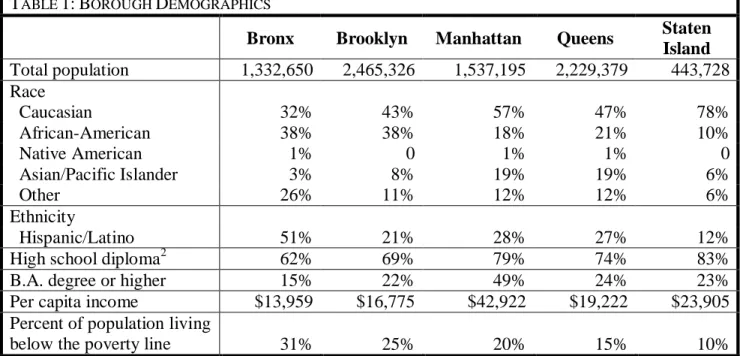
Table 1 describes the makeup of each borough’s population, and their relative wealth, as of 2000 (U.S. Census, 2000).
TABLE1: BOROUGHDEMOGRAPHICS
Bronx Brooklyn Manhattan Queens Staten Island Total population 1,332,650 2,465,326 1,537,195 2,229,379 443,728 Race Caucasian 32% 43% 57% 47% 78% African-American 38% 38% 18% 21% 10% Native American 1% 0 1% 1% 0 Asian/Pacific Islander 3% 8% 19% 19% 6% Other 26% 11% 12% 12% 6% Ethnicity Hispanic/Latino 51% 21% 28% 27% 12%
High school diploma2 62% 69% 79% 74% 83%
B.A. degree or higher 15% 22% 49% 24% 23%
Per capita income $13,959 $16,775 $42,922 $19,222 $23,905
Percent of population living
below the poverty line 31% 25% 20% 15% 10%
The gaps between the boroughs are evident, with the Bronx at one extreme and Manhattan at the other. Overall, the populations of Queens, Manhattan, and Staten Island are significantly more prosperous than Brooklyn and the Bronx. Incomes and poverty rates further confirm these differences; in Brooklyn and the Bronx over one-quarter of residents live below the poverty line, while poverty rates become much lower when moving to Manhattan, Queens and Staten Island.
KEYCOMPONENTS OFCASEPROCESSING
1. THEARREST ORCOMPLAINT
One of three things must happen for a domestic violence incident to become a crime: the police are called to the scene; the complainant goes to the police precinct and files a report; or the complainant appears in the District Attorney’s complaint room. In the first instance, police are required to notify the complainant of her available legal recourses, both criminal and civil; 2
III. DV Criminal Case Processing in the Five Boroughs of NYC 10 complete a Domestic Incident Report; direct the complainant to appropriate community resources; and arrest the alleged offender. Having made the arrest, the officer takes the defendant to the precinct for booking, then forwards the booking report and the Domestic Incident Report to the District Attorney’s Office. In the second instance, when the complainant goes to the precinct to file the report, the police fill out the Domestic Incident Report, take the complainant’s statement, inform her of the available legal remedies, and launch an investigation. In the third instance, complainants come to the District Attorney’s complaint room either to file an initial complaint or to corroborate the complaint filed by the police. Clerks, paralegals, and prosecutors staff the complaint rooms, and Safe Horizon victim advocates are available. With some exceptions (to be described in the borough sections), complaint rooms operate during regular business hours and are located in each county’s criminal court.
2. THEDECISION TOPROSECUTE
Most boroughs attempt to practice some degree of vertical prosecution—assigning a single prosecutor to follow the case from beginning to end. In all boroughs but Manhattan, new domestic violence cases are directed to the District Attorney’s Domestic Violence Bureau. An Assistant District Attorney (ADA) from the Bureau reviews the case and the evidence, and sometimes speaks with the complainant, before deciding whether there is sufficient evidence for prosecution. In Manhattan, the process is essentially the same, but the ADA’s caseload is not exclusively composed of domestic violence cases.
The cooperation of the complainant is usually the critical factor in deciding whether there is sufficient evidence to prosecute the case: by New York State law, if prosecution is based on the police report rather than complainant report, the complainant must corroborate the report within five days if the defendant is incarcerated, or 90 days if the defendant is released. At that time, the prosecution must either produce the corroborating statement or declare its readiness to continue with an evidence-based prosecution, without the assistance of the complainant. The frequency with which District Attorneys pursue the latter course varies; for example, the Brooklyn District Attorney’s Office is more likely to continue the case without the complainant than is the Bronx District Attorney’s Office (Peterson 2002).
3. INITIALCOURTPROCESSING
Domestic violence cases are usually arraigned in a regular court part, then adjourned to the domestic violence court. Every domestic violence case receives an order of protection at arraignment; the order is renewed at subsequent court appearances, and a final order is usually issued at disposition or sentencing. The ADA will generally request a full order of protection whether the complainant wishes it or not; the courts generally issue very few limited orders, particularly in the early stages of the case.
At the case’s first appearance in the domestic violence court, an ADA restates the charges against the defendant and, in most cases, offers a plea deal, under which the defendant would plead to a reduced charge and receive a specified sentence. The defendant then has the option of pleading guilty to the original charges, agreeing to the plea deal, or going to trial.
4. SENTENCING, PROGRAMS ANDCOMPLIANCEMONITORING
The most commonly imposed sentence in the criminal domestic violence courts is a one-year conditional discharge, usually with the condition of participation in an intervention or treatment program (most commonly a batterer intervention program), which may last anywhere from
twelve weeks to twelve months. Program mandates are complemented by compliance
monitoring, consisting of regular appearances before the judge or, in Queens, Brooklyn and the Bronx, before a dedicated judicial hearing officer (JHO). During monitoring appearances, the defendant monitor or resource coordinator will review program reports on the defendant, and the judge or JHO will address any infractions. Common responses to minor noncompliance include motivational talks, lectures, and an increase in the frequency of court appearances. Major infractions, such as alleged violations of the order of protection, a new arrest, or program failure must be addressed by the sentencing judge, who will assess the circumstances and determine whether or not the defendant has violated the conditions of his conditional discharge. If so, an alternative sentence (usually a jail sentence, the length of which may have been specified at the time of sentencing) is imposed. If the offense does not reach the level of a violation, the judge will return the case to the compliance part with a warning or other sanction.
BRONX3
Bronx County has a population of 1,332,650, divided almost into thirds between African-Americans, Caucasians and all other races. Half of Bronx residents are of Hispanic ethnicity. Sixty-two percent of the population has a high school diploma, while 15% has a bachelor’s degree or higher. Nearly a third of Bronx residents live below the poverty level.
In 2002, 5,491 domestic violence cases were arraigned in Bronx County, and 6,467 were disposed: 49% plead guilty or were convicted, 44% were dismissed, and 3% were adjourned in contemplation of dismissal; less than 1% were acquitted, and the remainder received other dispositions. Approximately 40% of convictions resulted in jail sentences; most others received conditional discharges.4
THEDOMESTICVIOLENCECOURT
The Bronx Misdemeanor Domestic Violence complex opened in 1999 with funding from a STOP grant from the Violence Against Women Office. It is staffed by specialized personnel, including a project director, resource coordinator and two defendant monitors, and consists of three court parts: one for trials, one for post-sentence compliance monitoring, and one for all other types of appearances. The all-purpose and trial parts hear cases five days a week, while the compliance part operates three days a week.
THEDEDICATEDDOMESTICVIOLENCEPROSECUTIONBUREAU
In the 1980s, the Bronx District Attorney created a single bureau for all cases involving sex crimes, child abuse, and domestic violence. In 2003, domestic violence cases were moved to their own dedicated Domestic Violence Bureau, currently staffed by 17 misdemeanor and six felony assistant district attorneys. The Bureau’s prosecution is nearly vertical: a single assigned ADA follows the case to disposition and appears at all court dates after arraignment.
Under its first-party complaint policy, the District Attorney’s Office usually declines to prosecute cases in which the victim will not sign a complaint. Should the victim sign a complaint and then later withdraw her cooperation, ADAs may choose to proceed with an
3
In November 2004 Bronx County underwent a court restructuring process that combined the criminal
(misdemeanor) and supreme (felony) courts into a single entity. This section reflects court and District Attorney practices prior to restructuring.
4
All 2002 case statistics for all boroughs provided by the Office of the Administrative Judge, Criminal Court of the City of New York.
III. DV Criminal Case Processing in the Five Boroughs of NYC 12 evidence-based prosecution. The decision to do so is based primarily on the strength of the evidence against the defendant, but also takes into consideration other factors, such as whether the complainant is seeking to resolve the matter in Family Court.
THECOMPLAINTROOM, CASEASSIGNMENT ANDPROSECUTION During regular business hours, the arresting police officer usually escorts the complainant directly to the complaint room. If the police officer does not believe the complainant to be in immediate danger, or if the arrest is made at night or on a weekend, the officer directs the complainant to appear in the District Attorney’s complaint room as soon as possible during business hours.
In the complaint room, an ADA from the Bronx District Attorney’s Domestic Violence Bureau asks the complainant to corroborate the arresting officer’s report, as well as to describe any history of abuse with the defendant. After the complaint is filed, an ADA is assigned to the case; this may or may not be the same person who met with the complainant in the complaint room, or who will represent the complainant at arraignment.5 ADAs are expected to make contact with the complainant when first assigned to the case, and before all court appearances thereafter. The number of contacts varies, depending not only on the length of the case but on the accuracy of the contact information obtained from the complainant, and on her interest in cooperating.6
ORDERS OFPROTECTION
The Domestic Violence Bureau requests a full order of protection in all assault cases, and usually considers a limited order appropriate only after an intervention that either demonstrates to the defendant the severity of the charges (jail) or provides him with tools to avoid future violence (a batterer intervention program).
The judge’s decision of whether to impose a full or limited order of protection is based on the defendant’s prior criminal history, past allegations of physical assault, and information about the particular case (such as whether there are children living in the home) gathered by the resource coordinator. Limited orders are rare and are generally issued only at or after sentencing, often after the defendant has demonstrated compliance with existing orders and any program
mandates.
PROGRAMS ANDCOMPLIANCE
The court often includes a program mandate with a sentence of conditional discharge. The judge draws on information provided by the resource coordinator, and possibly the defense attorney (usually if the defendant is already enrolled in a program), in choosing a program. The ADA may also provide input on what type of program the complainant believes will be most beneficial.
In most cases, the defendant is sentenced to a type of program rather than to a specific provider. When the defendant monitor meets with the defendant after sentencing, she assesses his needs (schedule, ability to pay, language facility, etc.) and recommends a particular program. 5
At the time of data collection, the Domestic Violence Bureau was in the process of restructuring the department in order to handle cases vertically. Other stakeholders reported that even the partial implementation (the coordinated effort to have the ADA come to Safe Horizon to interview the defendant) had made a significant difference. 6
Bureau ADAs report that the contact information given in the complaint room is often incorrect, or changes as a result of attempts to evade the defendant (or the prosecutor). In some cases, the complainant may not have a permanent address; in interviews, many different parties observed that the Bronx has a highly transient population. However, ADAs add that complainants who are interested in pursuing the case will make sure to stay in contact.
Representatives from the programs used most frequently by the court come to the courthouse to assess defendants. For all other programs, the defendant monitor schedules an intake
appointment for the defendant.
One month after sentencing, defendants mandated to a program return to the compliance part for monitoring by a judicial hearing officer. No attorneys are present, unless the defendant commits a major infraction and is forthwithed back to the sentencing judge. Compliance is monitored primarily via program reports faxed to the defendant monitors, but at least one agency sends a representative to court to report on compliance in person.
Most defendants are required to appear for monitoring once a month for approximately six months (the length of the typical batterer intervention program); however, defendants who miss program dates or are otherwise not in compliance with the program mandate may be monitored longer.
VICTIMADVOCATES
While victims of domestic violence felonies receive victim advocacy primarily from the District Attorney’s Crime Victims Assistance Unit, victims in misdemeanor domestic violence cases receive advocacy from an independent agency, Safe Horizon. Access to victim advocacy is provided regardless of whether the complainant decides to cooperate with the prosecution, and advocates do not have an active role in the prosecution. The information shared by victim advocates with the District Attorney’s Office is usually limited to the lethality assessment and the notification of a violation of an order of protection. Nonetheless, in interviews ADAs stressed their perception that victim advocacy plays a critical role in prosecuting domestic violence cases: “If she’s safe and secure and her needs are addressed, there is a direct correspondence to her willingness to continue with the prosecution,” said one prosecutor.
BROOKLYN
The borough of Brooklyn, or Kings County, occupies 71 square miles and has a population of 2,465,326. Forty-three percent of residents are Caucasian, 38% are African-American, eight percent are Asian/Pacific Islander, and 11% are of other races; 21% are of Hispanic ethnicity. Sixty-nine percent of the population has graduated from high school, and 22% has a bachelor’s degree or higher. One-quarter of the population lives below the poverty line.
In 2002, 6,976 domestic violence cases were arraigned in Brooklyn (almost 1,500 more than in the borough with the next largest caseload, the Bronx). That same year, 9,157 domestic violence cases were disposed: 18% plead guilty or were convicted, 51% were dismissed, and 30% were adjourned in contemplation of dismissal; the remaining 1% was acquitted or received other dispositions. Approximately 35% of sentences imposed included imprisonment, while 51% of sentences were conditional discharges only.
THEDOMESTICVIOLENCECOURT
The Brooklyn Misdemeanor Domestic Violence complex opened in 1997, and consists of two all-purpose parts and a compliance part. Each all-purpose part has a dedicated judge, is active five days a week, and handles misdemeanor cases through trial. A judicial hearing officer staffs the compliance part, which is active two days a week. In 2003 the court hired a resource
coordinator with funding from the Grants to Encourage Arrest Policies program of the Office on Violence Against Women.
III. DV Criminal Case Processing in the Five Boroughs of NYC 14 THEDEDICATEDDOMESTICVIOLENCEPROSECUTIONBUREAU
The Brooklyn District Attorney created a Domestic Violence Bureau in 1990, which is staffed by 14 trial attorneys; all but the newest ADAs to the Bureau prosecute both felony and
misdemeanor cases. Due to recent budget restrictions, the Bureau reviews all domestic violence cases but retains only the most serious for prosecution; the rest are returned to the general trial division.
The Domestic Violence Bureau does sometimes prosecute cases without the support of the complainant, estimating that just under twenty percent of trial cases proceed with the
complainant’s participation. These cases, which are converted primarily on the basis of statements from the police and excited utterances, generally involve serious allegations and severe injuries. The Bureau emphasizes that its priority is the complainant’s safety, which it believes may be advanced by prosecution. If the ADA judges that in a particular instance prosecution would instead jeopardize the safety of the complainant, she may choose to drop the case.
THECOMPLAINTROOM, CASEASSIGNMENT ANDPROSECUTION Complainants rarely come to the District Attorney’s Office after an arrest; instead, ADAs obtain their contact information from the arresting police officer and interview them over the phone. The interview includes a special battery of questions created by the Domestic Violence Bureau for domestic violence cases, relating to the history of abuse between the complainant and the defendant. The ADA will also conduct a risk assessment with the complainant; complainants identified as being in imminent danger may be immediately referred to a social worker.
The District Attorney’s Office stations a paralegal in arraignments to contact complainants immediately after their case is arraigned, alerting them to the existence of any orders of
protection, as well as to the bail status of the defendant. Once the case is transferred to the Domestic Violence Bureau after arraignment, the assigned ADA contacts the complainant to arrange an interview, at which they discuss both the case and any service needs of the complainant.
While the Bureau does assign a single ADA to a case from arraignment through disposition, the assigned ADA does not necessarily appear in court on the case. Instead, assistants are assigned to the two domestic violence court parts on a rotating basis; complainants may not necessarily be interacting with the same assistant every time they come to court.
ORDERS OFPROTECTION
The Domestic Violence Bureau does not categorically object to limited orders of protection; a limited order is appropriate if it is sufficient to protect the complainant. The Court routinely issues full orders of protection out of concern for the safety of the complainant, but grants of limited orders at the request of the victim are not infrequent.
CONDITIONALPLEAS
The Brooklyn Court does sometimes accept conditional pleas. In those cases, defendants plead guilty to a misdemeanor; sentencing is then deferred while they participate in a court-mandated program, such as batterer intervention. If they successfully complete the program, defendants’ charges are reduced to the level of a violation, or the case is Adjourned in Contemplation of Dismissal. In those cases where defendants fail to complete the program, the judge retains the discretion to sentence the defendant as appropriate for the misdemeanor charge.
PROGRAMS ANDCOMPLIANCE
As one element of a conditional discharge – or, less often, of an Adjournment in Contemplation of Dismissal – Brooklyn Domestic Violence Court may sentence defendants to batterer
intervention, or to a substance abuse or mental health treatment program. The court currently refers almost all defendants to a single batterer intervention program, Safe Horizon’s Domestic Violence Accountability Program; defendants are sent elsewhere only under exceptional circumstances, such as residence in another borough.
After being sentenced to a program, cases are adjourned to the compliance part for regular monitoring, usually on a monthly basis.
In December 2003, the court introduced a new program, the Youthful Offender Domestic Violence Court (YODVC), for all domestic violence defendants between the ages of 16 and 19. The YODVC calendar is held one afternoon a week, and as a condition of plea most offenders participate in a free 12-week intervention program offered by a local community organization, STEPS to End Family Violence. The program is intended to be a more interactive and
developmentally appropriate version of the traditional batterer intervention model. VICTIMADVOCATES
From the complaint room, complainants’ contact information is passed to Safe Horizon victim advocates, who attempt to reach the complainant as soon as possible. Safe Horizon provides victim advocacy for all complainants, and the District Attorney’s Office provides social workers for those complainants whose cases are identified as high-risk at intake. In addition, the
Domestic Violence Bureau has close relationships with community agencies and legal services organizations such as Droit Femmes, the City Bar Fund, the New York Asian Women’s Center, Sanctuary for Families, South Brooklyn Legal Services and the Urban Justice Center, to which complainants are referred as appropriate. The Bureau also has a number of grant-funded service programs for special populations – such as women with disabilities – for which all complainants are screened and, if eligible, referred at the time of intake with the victim advocate.
MANHATTAN
Manhattan, or New York County, encompasses 23 square miles, with a population of 1,537,195. Fifty-seven percent of residents are Caucasian, 19% are Asian/Pacific Islander, 18% are African-American, and the remaining 13% are of other races; 28% are of Hispanic ethnicity. Seventy-nine percent of the population graduated from high school, and 49% have a bachelor’s degree or higher. Twenty percent of the population lives below the poverty line.
In 2002, 4,063 domestic violence cases were arraigned in Manhattan, and 4,627 were
disposed: 34% plead guilty or were convicted, 48% were dismissed, and 13% were adjourned in contemplation of dismissal; less than 1% acquitted, and the remainder received other
dispositions. Approximately 35% of sentences imposed included imprisonment, while 47% of sentences were conditional discharges only.
THEDOMESTICVIOLENCECOURT
The Manhattan Misdemeanor Domestic Violence Court, known as Part D, opened in 1999. It operates five days a week,7 with one judge hearing all cases, including compliance. Cases are referred to other parts for trials. The court receives no outside funding, and has no additional staff or resources.
7