Hybrid MPI/OpenMP parallel support vector
machine training
Kristian Woodsend ∗ Jacek Gondzio †
School of Mathematics and Maxwell Institute for Mathematical Sciences, University of Edinburgh, James Clerk Maxwell Building,
The King’s Buildings, Edinburgh, EH9 3JZ, UK Technical Report ERGO 09-001, January 6, 2009
Abstract
Support Vector Machines are a powerful machine learning technol-ogy, but the training process involves a dense quadratic optimization problem and is computationally challenging. A parallel implementa-tion of Support Vector Machine training has been developed, using a combination of MPI and OpenMP. Using an interior point method for the optimization and a reformulation that avoids the dense Hessian ma-trix, the structure of the augmented system matrix is exploited to par-tition data and computations amongst parallel processors efficiently. The new implementation has been applied to solve problems from the PASCAL Challenge on Large Scale Learning. We show that our ap-proach is competitive, and is able to solve problems in the Challenge many times faster than other parallel approaches. We also demonstrate that the hybrid version performs more efficiently than the version using pure MPI.
1
Introduction
Support Vector Machines (SVMs) are powerful machine learning techniques for classification and regression. They were developed by Vapnik [1998], and are based on statistical learning theory. They have been applied to a wide range of applications, with excellent results, and so they have received significant interest.
∗
Email: [email protected]
†
Like many machine learning techniques, SVMs involve a training stage, where the machine learns a pattern in the data from a training data set, and a separate test or validation stage where the ability of the machine to correctly predict labels is evaluated using a previously unseentest data set. This process allows parameters to be adjusted towards optimal values, while guarding against overfitting.
The training stage for Support Vector Machines involves at its core a dense convex quadratic optimization problem (QP). Solving this optimiza-tion problem is computaoptimiza-tionally expensive, primarily due to the dense Hes-sian matrix. Solving the QP with a general-purpose QP solver would result in the time taken to scale cubically with the number of data points (O(n3)). Such a complexity result means that, in practise, the SVM training problem cannot be solved by general purpose optimization solvers.
Several schemes have been developed where a solution is built by solving a sequence of small-scale problems, where only a few data points (anactive set) are considered at a time. Examples include Decomposition [Osuna et al., 1997] and Sequential Minimal Optimization [Platt, 1999], and state-of-the-art software use these techniques. Active-set techniques work well when the data is clearly separable by a hyperplane, so that the separation into active and non-active variables is clear. With noisy data, however, finding a good separating hyperplane between the two classes is not so clear, and the performance of these algorithms deteriorates [Woodsend and Gondzio, 2007].
In addition, the active set techniques used by standard software are essentially sequential — they choose a small subset of variables to form the active set at each iteration, and this selection is based upon the results of the previous iteration. It is not clear how to efficiently implement such an algorithm in parallel, due to the dependencies between each iteration and the next.
Few approaches have been developed for training SVMs in parallel, yet multiple-core computers are becoming the norm, and data sets are becoming ever larger. It is notable that of the 44 submissions to compete in the PASCAL Challenge on Large Scale Learning [Sonnenburg et al., 2008], only 3 entries were parallel methods.
Parallelization schemes so far proposed have involved splitting the train-ing data to give smaller, separable optimization sub-problems which can be distributed amongst the processors. Dong et al. [2003] used a block-diagonal approximation of the kernel matrix to derive independent optimization prob-lems. The resulting SVMs were used to filter out samples that were likely not to be support vectors. A SVM was then trained on the remaining
sam-ples, using the standard serial algorithm. Collobert et al. [2002] proposed a mixture of multiple SVMs where single SVMs are trained on subsets of the training set and a neural network is used to assign samples to different subsets.
Another approach is to use a variation of the standard SVM algorithm that is better suited to a parallel architecture. Tveit and Engum [2003] developed an exact parallel implementation of the Proximal SVM, which modifies the standard SVM formulation to remove the single constraint in the dual and give an unconstrained QP. It is not clear how applicable this formulation is to real-world data sets.
There have only been a few parallel methods in the literature which train a standard SVM on the whole of the data set. We briefly survey the methods of Zanghirati and Zanni [2003], Graf et al. [2005], Durdanovic et al. [2007] and Chang et al. [2008].
The algorithm of Zanghirati and Zanni [2003] decomposes the SVM training problem into a sequence of smaller, though still dense, QP sub-problems. Zanghirati and Zanni implement the inner solver using a tech-nique called variable projection method, which is able to work efficiently on relatively large dense inner problems, and is suitable for implementing in parallel. The performance of the inner QP solver was improved in Zanni et al. [2006].
In the cascade algorithm introduced by Graf et al. [2005], the SVMs are layered. The support vectors given by the SVMs of one layer are combined to form the training sets of the next layer. The support vectors of the final layer are re-inserted into the training sets of the first layer at the next iteration, until the global KKT conditions are met. The authors show that this feedback loop corresponds to standard SVM training.
The algorithm of Durdanovic et al. [2007], implemented in the Milde software, is a parallel implementation of the sequential minimal optimiza-tion. The objective function of the dual form (see equation (3) below) is expressed in terms of partial gradients. Variables are selected to enter the working set, based on the steepest descent direction, and whether the vari-ables are free to move within their box constraints. A second working set method considers pairwise contributions. Very large data sets can be split across processors. When a variable zi enters the working set, the owner
processor broadcasts the corresponding data vector xi. All nodes calculate
kernel functions and update their portion of the gradient vector. Although many of the operations within an iteration are parallelizable, a very large number of sequential outer iterations are still required. The authors use a hybrid approach to parallelization similar to ours described below, involving
a multi-core BLAS library, but its use is limited to Layer 1 and 2 operations. Another family of approaches to QP optimization are based on Inte-rior Point Method (IPM) technology, which works by delaying the split between active and inactive variables for as long as possible. IPMs gener-ally work well on large-scale problems, largely because the number of itera-tions tends to grow very slowly with the problem dimension. Unfortunately each iteration requires the solving of a large system of linear equations. A straight-forward implementation of the standard SVM dual formulation has a per iteration complexity of O(n3), and be unusable for anything but the smallest problems. Several sequential implementations of IPMS for sup-port vector machines address this difficulty [Ferris and Munson, 2003, Fine and Scheinberg, 2002, Woodsend and Gondzio, 2007]. Returning to par-allel implementations, Chang et al. [2008] use parpar-allel IPM technology for the optimizer, and avoid the problem of inverting the dense Hessian matrix by generating a low-rank approximation of the kernel matrix using partial Cholesky decomposition with pivoting. The dense Hessian matrix can then be efficiently inverted implicitly using the low-rank approximation and the Sherman-Morrison-Woodbury (SMW) formula. Moreover, a large part of the calculations at each iteration can be distributed amongst the processors effectively. The SMW formula has been widely used in interior point meth-ods; however, sometimes it runs into numerical difficulties. Goldfarb and Scheinberg [2005] constructed data sets where an SMW-based algorithm re-quired many more iterations to terminate, and in some cases stalled before achieving an accurate solution. They also showed that this situation arises in real-world data sets.
Most of the previous approaches (Durdanovic et al. [2007] is the excep-tion) have considered the parallel computer system as a cluster of indepen-dent processors, communicating through a message passing scheme such as MPI [MPI-Forum, 1995]. Advances in technology have resulted in systems where several processing cores have access to a single memory space, and such symmetric multiprocessing (SMP) architectures are becoming preva-lent. OpenMP [OpenMP Architecture Review Board, 2008] has proven to work effectively on shared memory systems, while MPI can be used for mes-sage passing between nodes. It can also be used to communicate between processors within an SMP node, but it is not immediately clear that this is the most efficient technique.
Most high performance computing systems are now clusters of SMP nodes. On such hybrid systems, a combination of message passing between SMP nodes and shared memory techniques inside each node could poten-tially offer the best parallelization performance from the architecture,
al-though previous investigations have revealed mixed results [Smith and Bull, 2001, Rabenseifner and Wellein, 2003].
A standard approach to combining the two schemes involves OpenMP parallelization inside each MPI process, while communication between the MPI processes is made only outside of the OpenMP regions. Rabenseifner and Wellein [2003] refer to this style as “master-only”. In this paper, we propose a parallel SVM algorithm that adopts this hybrid approach to par-allelization. It trains the SVM using the full data set, using an interior point method to give efficient optimization, and Cholesky decomposition to give good numerical stability. MPI is used to communicate between clusters, while within clusters we take advantage of the availability of highly efficient OpenMP-based BLAS implementations. Data is distributed evenly amongst the processors. Our approach directly tackles the most computationally ex-pensive part of the optimization, namely the inversion of the dense Hessian matrix, through providing an efficient implicit inverse representation. By exploiting the structure of the problem, we show how this can be paral-lelized with excellent parallel efficiency. The resulting implementation is significantly faster at SVM training than active set methods, and it allows SVMs to be trained on data sets that would be impossible to fit within the memory of a single processor.
The structure of the rest of this paper is as follows. Section 2 gives an outline of interior point method for optimizing quadratic programs. Section 3 provides a short description of support vector machines and the formula-tion we use. Then in Secformula-tion 4 we describe our approach to training linear SVMs, exploiting the structure of the QP and accessing memory efficiently. Numerical performance results are given in Section 5. Section 6 contains some concluding remarks.
We now briefly describe the notation used in this paper. xi is the
at-tribute vector for theithdata point, and it consists of the observation values
directly. There are n observations in the training set, and m attributes in each vector xi. X is the m ×n matrix whose columns are the attribute
vectors xi associated with each point. The classification label for each data
point is denoted by yi ∈ {−1,1}. The variables w ∈ Rm and z ∈ Rn are used for the primal variables (“weights”) and dual variables (α in SVM lit-erature) respectively, and w0 ∈ R for the bias of the hyperplane. Scalars and column vectors are denoted using lower case letters, while upper case letters denote matrices. D, S, U, V, Y andZ are the diagonal matrices of the corresponding lower case vectors.
2
Interior point methods
Interior point methods represent state-of-the-art techniques for solving lin-ear, quadratic and non-linear optimization programmes. In this section the key issues of implementation for QPs are discussed very briefly; for more details, see Wright [1997].
For the purposes of this paper, we need a method to solve the box and equality-constrained convex quadratic problem
min z 1 2z TQz+cTz s.t. Az=b (1) 0≤z≤u,
whereuis a vector of upper bounds, and the constraint matrixAis assumed to have full row rank. Dual feasibility requires thatATλ+s−v−Qz=c, where λ is the Lagrange multiplier associated with the linear constraint
Az=band s, v >0 are the Lagrange multipliers associated with the lower and upper bounds ofz respectively.
At each iteration, an interior point method makes a damped Newton step towards satisfying the primal feasibility, dual feasibility and comple-mentarity product conditions,
ZSe=µe
(U−Z)V e=µe,
for a given µ > 0. We follow a common practice in interior point litera-ture and denote with a capital letter (Z, S, U, V) a diagonal matrix with elements of the corresponding vector (z, s, u, v) on the diagonal. The algo-rithm decreasesµbefore making another iteration, and continues until both infeasibilities and the duality gap (which is proportional to µ) fall below required tolerances.
The Newton system to be solved at each iteration can be transformed into theaugmented system equations:
−(Q+ Θ−1) AT A 0 ∆z ∆λ = rc rb , (2)
where ∆z,∆λ are components of the Newton direction in the primal and dual spaces respectively, Θ−1 ≡ Z−1S + (U −Z)−1V, and rc and rb are
efficient method to solve such a system is to form the Schur complement
C =A(Q+Θ−1)−1AT, solve the smaller systemC∆λ=rb+A(Q+Θ−1)−1rc
for ∆λ, and back-substitute into (1) to calculate ∆z. Unfortunately, as we shall see in the next section, for the case of SVM training the Hessian matrix
Q is a completely dense matrix.
3
Support vector machines
In this section we briefly outline the standard SVM binary classification primal and dual formulations, and summarise how they can be reformulated as a separable QP [for more details, see Woodsend and Gondzio, 2007].
A Support Vector Machine (SVM) is a classification learning machine that learns a mapping between the features and the target label of a set of data points known as the training set, and then uses a hyperplane wTx+
w0 = 0 to separate the data set and predict the class of further data points.
The labels are the binary values “yes” or “no”, which we represent us-ing the values +1 and −1. The objective is based on the Structural Risk Minimization (SRM) principle, which aims to minimize the risk functional with respect to both the empirical risk (the quality of the approximation to the given data, by minimising the misclassification error) and maximize the confidence interval (the complexity of the approximating function, by maximising the separation margin) [Vapnik, 1998].
For a linear kernel, the attributes in the vectorxi for theith data point
are the observation values directly, while for a non-linear kernel the obser-vation values are transformed by means of a (possibly infinite dimensional) non-linear mapping Φ.
Concentrating on the linear SVM classifier, and using a 2-norm for the hyperplane weights w and a 1-norm for the misclassification errors ξ ∈Rn,
the QP that forms the core of training the SVM takes the form: min w,w0,ξ 1 2w Tw+τ eTξ s.t. Y(XTw+w0e)≥e−ξ w, w0free, ξ ≥0 (3)
where eis the vector of all ones, and τ is a positive constant that parame-terizes the problem.
Due to the convex nature of the problem, a Lagrangian function asso-ciated with (2) can be formulated, and the solution will be at the saddle point. Partially differentiating the Lagrangian function gives relationships
between the primal variables (w,w0 and ξ) and the dual variables (z∈Rn) at optimality, and substituting these relationships back into the Lagrangian function gives the standard dual problem formulation
min z 1 2z TY XTXY z−eTz s.t. yTz= 0 0≤z≤τ e. (4)
However, using one of the optimality relationships, w = XY z, we can rewrite the quadratic objective in terms of w. Consequently, we can state the classification problem (3) as a separable QP:
min w,z 1 2w Tw−eTz s.t. w−XY z= 0 yTz= 0 wfree, 0≤z≤τ e. (5)
The Hessian is simplified to the diagonal matrixQ= diag
em
0n
where
em = (1,1, . . . ,1)∈Rm, while the constraint matrix becomes:
A= Im −XY 0 yT ∈R(m+1)×(m+n). (6)
As described in Section 2, the Schur complement,
C≡A(Q+ Θ−1)−1AT = Im+XYΘzY XT −XYΘzy −yTΘzY XT yTΘzy ∈R(m+1)×(m+1),
can be formed efficiently from such matrices and used to determine the Newton step. Building the matrix C is the most expensive operation, of orderO(n(m+ 1)2), while inverting the resulting matrix is an operation of orderO((m+1)3). The formulation (4) is the basis of our parallel algorithm.
4
Implementing the QP for parallel computation
To apply (4) to truly large-scale data sets, it is necessary to employ lin-ear algebra operations that exploit the block structure of the formulation
[Gondzio and Sarkissian, 2003, Gondzio and Grothey, 2007]. Between clus-ters, the emphasis is on partitioning the linear algebra operations to mini-mize interdependencies between processors. Within clusters, the emphasis is on accessing memory in the most efficient manner.
The approach described below was implemented using the OOPS inte-rior point solver [Gondzio and Grothey, 2007]. We should note here that, as the parallel track of the Challenge was focused on shared memory algo-rithms, our submission to the Challenge used only the techniques described in Section 4.2.
4.1 Linear algebra operations between nodes We use the augmented system matrixH =
−Q−Θ−1 AT
A 0
correspond-ing to system (4), whereQ= diag
em
0
, Θ was described in Section 2 and
A is given by equation (5). This results inH having a symmetric bordered block diagonal structure. We can break H into blocks:
H = H1 AT1 H2 AT2 . .. ... Hp ATp A1 A2 . . . Ap 0 ,
where Hi = −(Qi + Θ−i 1) are actually diagonal and Ai result from
par-titioning the data set evenly across the p processors. Due to the “arrow-head” structure of H, a block-based Cholesky decomposition of the matrix
H =LDLT will be guaranteed to have the structure:
H = L1 . .. Lp LA1 . . . LAp LC D1 . .. Dp DC LT1 LTA1 . .. ... LTp LTAp LTC
Exploiting this structure allows us to compute the blocks Li, Di and
LAi in parallel. Terms that form the Schur complement can be calculated
in parallel but must then be gathered, and the corresponding blocks LC
(m+ 1)×(m+ 1) between processors. Hi =LiDiLTi ⇒Di =−(Qi+ Θ−i 1), Li =I (7a) LAi =AiL−i TD −1 i =AiHi−1 (7b) C =− p X i=1 AiHi−1ATi (7c) =LCDCLTC (7d)
Matrix C is a dense matrix of relatively small size (m+ 1)×(m+ 1), and the Cholesky decomposition C=LCDCLTC is performed in the normal
way on a single processor.
Once the representation H = LDLT above is known, we can use it to compute the solution of the system H
∆z ∆λ = rc rb through back-substitution. ∆z0, ∆λ0 and ∆λ00 are vectors used for intermediate calcula-tions, with the same dimensions as ∆z and ∆λ.
∆λ00=L−C1(rb− p X i LAirci) (8a) ∆λ0=DC−1∆λ00 (8b) ∆λ=L−CT∆λ0 (8c) ∆z0i=Di−1rci (8d) ∆zi= ∆zi0−LTAi∆λ (8e)
For the formation ofLDLT, equations (4.1) and (4.1) can be calculated on each processor individually. Outer products (4.1) are then calculated, and the results gathered onto a single master processor to form C; this re-quires each processor to transfer approximately 12(m+ 1)2 elements. The master processor performs the Cholesky decomposition of C (4.1). Each processor needs to calculate LAirci, which again can be performed
with-out any inter-processor communication, and the results are gathered onto the master processor. The master processor then performs the calculations in equations (4.1), (4.1) and (4.1) of the back-substitution. Vector ∆λ is broadcast to all processors for them to calculate equations (4.1) and (4.1) locally.
4.2 Linear algebra operations within nodes
Within each node, the bulk of operations are due to the contribution of each processorAiHi−1ATi to the calculation of the Schur complement in (4.1), and
to a lesser extent the calculation ofLAi in (4.1).
The standard technology for dense linear algebra operations is the BLAS library. Much of the effort to produce highly efficient implementations of BLAS Layer 3 (matrix-matrix operations) have concentrated on the routine GEMM, for good reason: K˚agstr¨om et al. [1998] showed that it is possible to develop an entire BLAS Layer 3 implementation based on a highly op-timized GEMM routine and a small amount of BLAS Layer 1 and Layer 2 routines. Their approach focused on efficiently organizing the accessing of memory, both through structuring the data for locality and through order-ing operations within the algorithm. Matrices are partitioned into panels
(block rows or block columns) and further partitioned into blocks of a size that fits in the processor’s cache, where access times to the data are much shorter. Herrero [2006] has pursued these concepts further, showing that it is possible to develop an implementation offering competitive performance without the need for hand-optimized routines.
Goto and van de Geijn [2008] have shown that another limiting factor is the process of looking up mappings in the page table between virtual and physical addresses of memory. A more efficient approach ensures that the mappings for all the required data reside in the Translation Look-aside Buffer, effectively a cache for the page table. In practice, the best way of achieving this is to recast the matrix-matrix multiplications as a sum of panel-panel multiplications, repacking each panel into a contiguous buffer. This is the approach implemented in GotoBLAS, the library used in our implementation.
To perform GEMMC:=AB+C, the algorithm described in Goto and van de Geijn [2008] divides the matrices into panels and uses three optimized components.
1. Divide matrix B into block row panels. Each panel Bp contains all
the columns we need, but fewer rows than the original matrix B. As required, pack Bp into a contiguous buffer.
2. Divide matrix A into block column panels Ap, so that the inner di-mensions of Ap andBp match. Further divideA into blocks Aip. As
required, pack block Aip into a contiguous buffer, so that by the end
3. Considering each blockAip in turn, perform the multiplicationCi:=
AipBp+Ci, withBpbrought into the cache in column strips.
Additionally, it is possible in a multi-core system to coordinate the packing of Bp between the processors, avoiding redundancy and improving
perfor-mance.
Returning to the SVM training problem, by casting the main computa-tion of our algorithm in terms of matrix-matrix multiplicacomputa-tions, we can take advantage of the above improvements for a multi-threaded architecture:
1. Consider a subblock of the constraint matrixA, consisting of all rows and the number of columns around the same size as m+ 1. Call this
Ai.
2. Calculate LAi for this subblock, using (4.1). This involves Layer 1
operations, but these can be vectorized by the compiler.
3. Calculate C := C +LAiATi using the GEMM algorithm described
above.
The performance gain of this approach is investigated in the next section.
5
Performance
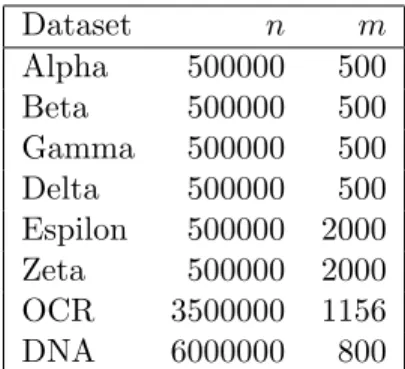
In this section we compare the hybrid OpenMP/MPI version of our software with one using only MPI, and also our implementation against three other parallel SVM solvers. Data sets are taken from the PASCAL Challenge on Large Scale Learning, and the sizes we used are shown in Table 1. Due to memory restrictions, we reduced the number of samples in the DNA dataset. Additionally, the DNA data set was modified from categories to binary features, increasingmby a factor of 4. The data sets were converted into a simple feature representation in svm-light format. The software was run on a cluster of quad-core 3GHz Intel Xeon processors, each with 2GB RAM. The GotoBLAS library was used for BLAS functions, with the number of OpenMP threads set to 4, to match the number of cores. We also used the LAM implementation of the MPI library.
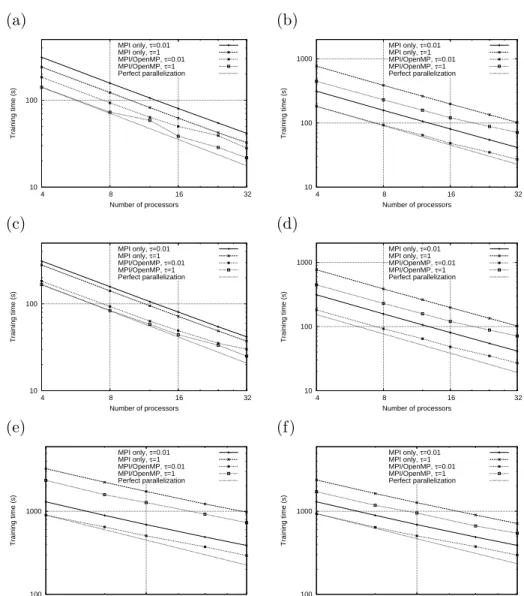
To compare the hybrid approach (using the techniques described in Sec-tions 4.1 and 4.2) with pure MPI (using Section 4.1 only), we used the data sets alpha to zeta. The results are shown in Figure 1. They consistently show that, although the pure MPI approach has better properties in terms of parallel efficiency, the hybrid approach is always computationally more efficient.
(a) (b) 10 100 4 8 16 32 Training time (s) Number of processors MPI only, τ=0.01 MPI only, τ=1 MPI/OpenMP, τ=0.01 MPI/OpenMP, τ=1 Perfect parallelization 10 100 1000 4 8 16 32 Training time (s) Number of processors MPI only, τ=0.01 MPI only, τ=1 MPI/OpenMP, τ=0.01 MPI/OpenMP, τ=1 Perfect parallelization (c) (d) 10 100 4 8 16 32 Training time (s) Number of processors MPI only, τ=0.01 MPI only, τ=1 MPI/OpenMP, τ=0.01 MPI/OpenMP, τ=1 Perfect parallelization 10 100 1000 4 8 16 32 Training time (s) Number of processors MPI only, τ=0.01 MPI only, τ=1 MPI/OpenMP, τ=0.01 MPI/OpenMP, τ=1 Perfect parallelization (e) (f) 100 1000 8 16 32 Training time (s) Number of processors MPI only, τ=0.01 MPI only, τ=1 MPI/OpenMP, τ=0.01 MPI/OpenMP, τ=1 Perfect parallelization 100 1000 8 16 32 Training time (s) Number of processors MPI only, τ=0.01 MPI only, τ=1 MPI/OpenMP, τ=0.01 MPI/OpenMP, τ=1 Perfect parallelization
Figure 1: SVM training time with respect to the number of processors, for the PASCAL data sets (a) alpha, (b) beta, (c) gamma, (d) delta, (e) epsilon and (f) zeta. For each dataset we trained using two values of τ. The results show that, although the pure MPI approach shows better parallel efficiency properties, the hybrid approach is always computationally more efficient.
Dataset n m Alpha 500000 500 Beta 500000 500 Gamma 500000 500 Delta 500000 500 Espilon 500000 2000 Zeta 500000 2000 OCR 3500000 1156 DNA 6000000 800
Table 1: PASCAL Challenge on Large Scale Learning data sets used in this paper.
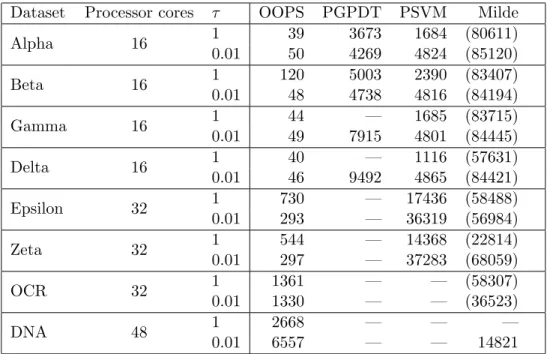
We made a comparison with other software PGPDT [Zanni et al., 2006], PSVM [Chang et al., 2008], and Milde [Durdanovic et al., 2007], all using a linear kernel, and the results are shown in Figure 2. With the exception of Milde (which has its own message passing implementation), the LAM implementation of the MPI library was used.
The presentation of the results is slightly unusual in that only times are presented, not accuracy against a test set. This is because full validation and test data sets have not been made publicly available. Performance statistics related to the precision recall curve were evaluated on the Challenge web-site; in general the precision of our method was consistent with the other linear SVM methods that participated. However, as all the methods in this comparison are linear SVMs, the training problems are equivalent, and we expect the real differences to be in the training times rather than precision. We required an objective value accuracy of = 0.01, and chose two values forτ within the range set in the Challenge, so we believe the training tasks are representative. In keeping with the evaluation method of the Challenge, the timings shown are for training and do not include time spent reading the data. The PSVM algorithm includes an additional partial Cholesky fac-torization procedure, which we also do not include in the training times. To make the training equivalent, the rank of the factorization was set to be the number of features m. The Milde software includes a number of termina-tion criteria but not one based on the objective. Using the default criteria of maximum gradient belowresulted in the software never terminating in all but one case within a 24 hour runtime limit. To be closer to the spirit of the Challenge, we show the time taken to be within 1% of the objective value at the end of 24 hours when the program was terminated prematurely,
Dataset Processor cores τ OOPS PGPDT PSVM Milde Alpha 16 1 39 3673 1684 (80611) 0.01 50 4269 4824 (85120) Beta 16 1 120 5003 2390 (83407) 0.01 48 4738 4816 (84194) Gamma 16 1 44 — 1685 (83715) 0.01 49 7915 4801 (84445) Delta 16 1 40 — 1116 (57631) 0.01 46 9492 4865 (84421) Epsilon 32 1 730 — 17436 (58488) 0.01 293 — 36319 (56984) Zeta 32 1 544 — 14368 (22814) 0.01 297 — 37283 (68059) OCR 32 1 1361 — — (58307) 0.01 1330 — — (36523) DNA 48 1 2668 — — — 0.01 6557 — — 14821
Table 2: Comparison of parallel SVM training software on PASCAL data sets. Times are in seconds. In all cases except the DNA dataset, the Milde software ran but did not terminate within 24 hours of runtime, so the num-bers in brackets show when it was within 1% of its final objective value; — indicates that the software failed to load the problem.
although in many cases the output indicated that the method was not yet converging.
The results show that our approach described in this paper and imple-mented in OOPS is typically one to two orders of magnitude faster than the other parallel SVM solvers, terminates reliably, and training times are reasonably consistent for different values of τ.
6
Conclusions
In this paper, we have shown how to develop a hybrid parallel implemen-tation of Support Vector Machine training. The approach allows the entire data set to be used, and consists of following the steps:
1. Reformulating the problem to remove the dense Hessian matrix. 2. Using interior point method to solve the optimization problem in a
predictable time, and Cholesky decomposition to give good numerical stability of implicit inverses.
3. Exploiting the block structure of the augmented system matrix, to partition the data and linear algebra computations amongst parallel processing nodes efficiently.
4. Within SMP nodes, casting the main computations as matrix-matrix multiplication where possible, partitioning the matrices to obtain bet-ter data locality, and utilizing highly efficient BLAS implementation for a multi-threaded architecture.
The above steps were implemented in OOPS. Our results show that, for all cases, the hybrid implementation was faster than one using purely MPI, even though the MPI version had better parallel efficiency. We used the hybrid implementation to solve very large problems from the PASCAL Challenge on Large Scale Learning, of up to a few million data samples. On these problems the approach described in this paper was highly competitive, and showed that even on data sets of this size, training times in the order of minutes are possible.
In this paper we have focused on linear kernels. It is possible to extend the technique to handle non-linear kernels, by first pre-processing using par-tial Cholesky factorization with pivoting, as described in Chang et al. [2008]. The method described above requires all sample data to be loaded into memory. It is possible to improve data handling and increase the storage capacity somewhat, for instance storing the data compactly and expanding sections into floating point numbers when needed by the BLAS routines [Durdanovic et al., 2007], but the scaling is still O(nm2). The direction of our further research is to develop methods that are able to safely ignore or remove data points from consideration as the algorithm progresses. In conjunction with exploiting the structure of the optimization problem as described in this paper, we believe this will offer further significant improve-ments to the overall training time.
Acknowledgements
The authors would like to thank the PASCAL organisers for permission to use the data sets, Professor Zanni for providing the PGPDT software, and Dr Durdanovic for assistance with the Milde software. This work has made use of the resources provided by the Edinburgh Compute and Data Facility
(ECDF, http://www.ecdf.ed.ac.uk/). The ECDF is partially supported by the eDIKT initiative (http://www.edikt.org.)
References
Edward Chang, Kaihua Zhu, Hao Wang, Hongjie Bai, Jian Li, Zhihuan Qiu, and Hang Cui. Parallelizing support vector machines on distributed computers. In J.C. Platt, D. Koller, Y. Singer, and S. Roweis, editors,
Advances in Neural Information Processing Systems 20, pages 257–264, Cambridge, MA, 2008. MIT Press.
Ronan Collobert, Samy Bengio, and Yoshua Bengio. A parallel mixture of SVMs for very large scale problems. Neural Computation, 14(5):1105– 1114, 2002.
Jian-xiong Dong, Adam Krzyzak, and Ching Suen. A fast parallel optimiza-tion for training support vector machine. In P. Perner and A. Rosenfeld, editors, Proceedings of 3rd International Conference on Machine Learn-ing and Data MinLearn-ing, pages 96–105, Leipzig, Germany, 2003. Springer Lecture Notes in Artificial Intelligence.
Igor Durdanovic, Eric Cosatto, and Hans-Peter Graf. Large scale parallel SVM implementation. In L´eon Bottou, Olivier Chapelle, Dennis DeCoste, and Jason Weston, editors,Large Scale Kernel Machines, chapter 5, pages 105–38. MIT Press, 2007.
Michael Ferris and Todd Munson. Interior point methods for massive sup-port vector machines. SIAM Journal on Optimization, 13(3):783–804, 2003.
Shai Fine and Katya Scheinberg. Efficient SVM training using low-rank kernel representations.Journal of Machine Learning Research, 2:243–264, 2002.
Donald Goldfarb and Katya Scheinberg. Solving structured convex quadratic programs by interior point methods with application to support vector machines and portfolio optimization. Submitted for publication, 2005. Jacek Gondzio and Andreas Grothey. Parallel interior point solver for
struc-tured quadratic programs: Application to financial planning problems.
Jacek Gondzio and Robert Sarkissian. Parallel interior point solver for struc-tured linear programs. Mathematical Programming, 96(3):561–584, 2003. Kazushige Goto and Robert A. van de Geijn. Anatomy of high-performance matrix multiplication. ACM Trans. Math. Softw., 34(3):1–25, 2008. ISSN 0098-3500. doi: http://doi.acm.org/10.1145/1356052.1356053.
Hans Peter Graf, Eric Cosatto, L´eon Bottou, Igor Dourdanovic, and Vladimir Vapnik. Parallel support vector machines: the Cascade SVM. In Lawrence Saul, Yair Weiss, and L´eon Bottou, editors,Advances in Neural Information Processing Systems. MIT Press, 2005. volume 17.
Jos´e R. Herrero. A Framework for Efficient Execution of Matrix Compu-tations. PhD thesis, Universitat Polit`ecnica de Catalunya (UPC), July 2006.
Bo K˚agstr¨om, Per Ling, and Charles van Loan. Gemm-based level 3 blas: high-performance model implementations and performance evalu-ation benchmark. ACM Trans. Math. Softw., 24(3):268–302, 1998. ISSN 0098-3500. doi: http://doi.acm.org/10.1145/292395.292412.
MPI-Forum. MPI: A Message-Passing Interface Standard. University of Tennessee, Knoxville, Tennessee, 1.1 edition, June 1995. URL http://www.mpi-forum.org.
OpenMP Architecture Review Board. OpenMP Application Program Inter-face, 3.0 edition, May 2008. URLhttp://www.openmp.org.
Edgar Osuna, Robert Freund, and Federico Girosi. An improved training algorithm for support vector machines. In J. Principe, L. Gile, N. Morgan, and E. Wilson, editors, Neural Networks for Signal Processing VII — Proceedings of the 1997 IEEE Workshop, pages 276–285. IEEE, 1997. John Platt. Fast training of support vector machines using sequential
mini-mal optimization. In Bernhard Scholkopf, Christopher. J. C. Burges, and Alexander. J. Smola, editors, Advances in Kernel Methods — Support Vector Learning, pages 185–208. MIT Press, 1999.
Rolf Rabenseifner and Gerhard Wellein. Comparison of parallel program-ming models on clusters of smp nodes. In Hans Georg Bock, Ekaterina Kostina, Hoang Xuan Phu, and Rolf Rannacher, editors,Modelling, Sim-ulation and Optimization of Complex Processes: Proceedings of the Inter-national Conference on High Performance Scientific Computing, March 10-14, 2003, Hanoi, Vietnam, pages 409–426, 2003.
Lorna Smith and Mark Bull. Development of mixed mode MPI / OpenMP applications. Scientific Programming, 2001.
Soeren Sonnenburg, Vojtech Franc, Elad Yom-Tov, and Michele Sebag. Pascal large scale learning challenge, 2008. URL http://largescale.first.fraunhofer.de/.
Amund Tveit and Havard Engum. Parallelization of the incremental prox-imal support vector machine classifier using a heap-based tree topology. Technical report, IDI, NTNU, Trondheim, 2003.
Vladimir Vapnik. Statistical Learning Theory. Wiley, 1998.
Kristian Woodsend and Jacek Gondzio. Exploiting separability in large-scale support vector machine training. Technical Re-port MS-07-002, School of Mathematics, University of Edin-burgh, August 2007. Submitted for publication. Available at
http://www.maths.ed.ac.uk/˜gondzio/reports/wgSVM.html.
Stephen J. Wright. Primal-dual interior-point methods. S.I.A.M., 1997. Gaetano Zanghirati and Luca Zanni. A parallel solver for large quadratic
programs in training support vector machines. Parallel Computing, 29(4): 535–551, 2003.
Luca Zanni, Thomas Serafini, and Gaetano Zanghirati. Parallel software for training large scale support vector machines on multiprocessor systems.