Code-Based Game-Playing Proofs
and the Security of Triple Encryption
∗Mihir Bellare† Phillip Rogaway ‡ February 27, 2006
(Draft 2.2)
Abstract
The game-playing technique is a powerful tool for analyzing cryptographic constructions. We illustrate this by using games as the central tool for proving security of three-key triple-encryption, a long-standing open problem. Our result, which is in the ideal-cipher model, demonstrates that for DES parameters (56-bit keys and 64-bit plaintexts) an adversary’s maxi-mal advantage is smaxi-mall until it asks about 278queries. Beyond this application, we develop the foundations for game playing, formalizing a general framework for game-playing proofs and dis-cussing techniques used within such proofs. To further exercise the game-playing framework we show how to use games to get simple proofs for the PRP/PRF Switching Lemma, the security of the basic CBC MAC, and the chosen-plaintext-attack security of OAEP.
Keywords: Cryptographic analysis techniques, games, provable security, triple encryption.
∗ Earlier versions of this paper were entitled “The Game-Playing Technique” and “The Game-Playing Technique and its Application to Triple Encryption.”
† Department of Computer Science & Engineering, University of California at San Diego, 9500 Gilman Drive, La Jolla, California 92093 USA. E-mail: [email protected] WWW: www.cse.ucsd.edu/users/mihir/
‡ Department of Computer Science, University of California at Davis, Davis, California, 95616, USA; and De-partment of Computer Science, Faculty of Science, Chiang Mai University, Chiang Mai 50200, Thailand. E-mail: [email protected] WWW: www.cs.ucdavis.edu/∼rogaway/
Contents
1 Introduction 3
2 The Game-Playing Framework 7
3 The Security of Three-Key Triple-Encryption 11
Acknowledgments 17
References 17
A The PRP/PRF Switching Lemma 19
B Fixing the PRP/PRF Switching Lemma Without Games 22
C An Example Programming Language for Games 23
D Game-Rewriting Techniques 26
D.1 Game chains . . . 26
D.2 Basic techniques . . . 26
D.3 Coin fixing . . . 28
D.4 Lazy sampling . . . 29
E Proofs for Triple-Encryption 31 E.1 Proof of Lemma 5 . . . 31
E.2 Proof of Lemma 6 . . . 35
E.3 Proof of Lemma 7 . . . 37
F Elementary Proof for the CBC MAC 37
1
Introduction
Foundations and applications. The game-playing technique has become a popular approach for doing proofs in cryptography. We will explain the method shortly. In this paper we take the initial steps in developing a theory of game-playing proofs. We believe that such a theory will prove beneficial for our field. Then we demonstrate the utility of game-playing by providing examples of the technique, the most striking of which is the first proof that triple-encryption (using three independent keys) is far more secure than single or double encryption. The result, which is in the ideal-cipher model, is the first to prove that the cascade of blockciphers can markedly improve security. Other examples that we work out with games include the PRP/PRF Switching Lemma, the PRF-security of the CBC MAC, and the chosen-plaintext-attack security for OAEP.
Why games? There are several reasons why we take a fresh look at the game-playing technique. First, the method is widely applicable, easily employed, and provides a unifying structure for diverse proofs. Games can be used in the standard model, the random-oracle model, the ideal-blockcipher model, and more; in the symmetric setting, the public-key setting, and further trust models; for simple schemes (eg, justifying the Carter-Wegman MAC) and complex protocols (eg, proving the correctness of a key-distribution protocol).
Second, the game-playing technique can lead to significant new results. We demonstrate this by developing a game-based proof for three-key triple encryption. Proving security for triple encryption is a well-known problem, but technical difficulties have always frustrated attempts at a solution.
Finally, we believe that the game-playing approach can lead to proofs that are less error-prone and more easily verifiable, even mechanically verifiable, than proofs grounded solely in more conventional probabilistic language. In our opinion, many proofs in cryptography have become essentially unverifiable. Our field may be approaching a crisis of rigor. While game-playing is not a panacea to this problem (which has at its core a significant cultural element), game-playing may play a role in the answer.
The cascade construction. The security of the cascade construction, where two or more independently keyed blockciphers are composed with one another, is a nearly 30-year-old prob-lem [19, 34]. Even and Goldreich refer to it as a “critical question” in cryptography [21, p. 109]. They showed that the cascade of ciphers is at least as strong as theweakest cipher in the chain [21], while Maurer and Massey showed that, in a weaker attack model, it is at least as strong as thefirst
cipher in the chain. We know that double encryption (the two-stage cascade) can’t strengthen secu-rity much, due to the classic meet-in-the-middle attack [19], although Aiello, Bellare, Di Creczenzo, and Venkatesan show that the “shape” of the security curve is slightly improved [3]. This means that triple encryption (the three-stage cascade) is the shortest potentially “good” cascade. And, indeed, triple DES is the cascade that is widely standardized and used [36].
Triple encryption “works.” In this paper we prove that triple-encryption vastly improves se-curity over single or double encryption. Given a blockcipherE: {0,1}k× {0,1}n→ {0,1}nwith in-verseDwe considerCascadeeeeE (K0K1K2, X) =EK2(EK1(EK0(X))) andCascadeedeE (K0K1K2, X) = EK2(DK1(EK0(X))). Our results are the same for both versions of triple encryption. Follow-ing [22, 30, 42], we model E as a family of random permutations, one for each key, and we provide the adversary with oracle access to the blockcipherE(·,·) and its inverseE−1(·,·) Given such
ora-cles, the adversary is asked to distinguish between (a) CascadeeeeE (K0K1K2, ·) and its inverse, for
a random key K0K1K2, and (b) a random permutation on n bits and its inverse. We show that
the adversary’s advantage in making this determination, Adveeek,n(q), remains small until it asks about q = 2k+0.5 min{k,n} queries (the actual expression is more complex). The bound we get is
0 0.2 0.4 0.6 0.8 1 10 20 30 40 50 60 70 80 90 100 110 120
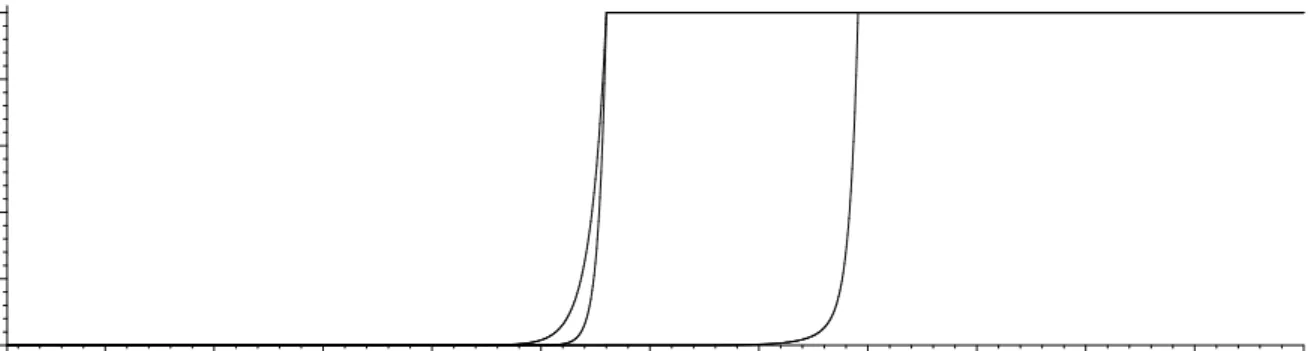
Figure 1: Upper bound on adversarial advantage (proven security) verses log2q(whereq=number of queries) for the cascade construction, assuming key lengthk= 56 and block lengthn= 64. Single encryption is the leftmost curve, double encryption is the middle curve [3], and triple encryption in the rightmost curve, as given by Theorem 3.
plotted as the rightmost curve of Figure 1 for DES parameters k = 56 and n = 64. In this case an adversary must ask more than 278.5 queries to get advantage 0.5. Also plotted are the security
curves for single and double encryption, where the adversary must ask 255 and 255.5 queries to get advantage 0.5. For a blockcipher with k =n= 64, the adversary must ask more than 289 queries to get advantage 0.5. As there are matching attacks and security bounds for single and double encryption, our result proves that, in the ideal-cipher model, triple encryption is more secure than single or double encryption.
Our proof for triple-encryption uses game-playing in an integral way, first to recast the ad-vantage we wish to bound to a simpler game, and later to analyze that game by investigating another one. Ultimately one is left with a game where conventional probabilistic reasoning (a special-purpose occupancy bound) can be applied. Game playing does not replace conventional probabilistic reasoning; it supplements it.
As for the cascade of ` ≥ 4 blockciphers, the maximal advantage in our attack model is no worse than it is for triple encryption, so our result proves that cascade “works” (provides improved security over single and double encryption) for all `≥3. It is an open question if security actually increases with increasing `.
What is the game-playing technique? One complication in any discussion about game-playing proofs is that the term means different things to different people. To some, a game-game-playing proof in cryptography is any proof where one conceptualizes the adversary’s interaction with its environment as a kind of game, the proof proceeding by stepwise refinement to that game. Viewed in this way, game-playing proofs have their origin in the earliest hybrid arguments, which began with Goldwasser and Micali [24] and Yao [48]. Bellare and Goldwasser provide an early example of an intricate proof of this flavor, demonstrating the security of a signature scheme that uses multiple cryptographic primitives [4]. In recent years Shoup has come to use such game-based proofs extensively [1, 16–18, 41, 43, 44, 46], as have other authors.
We believe that game-playing proofs can be most effectively studied and systematized by im-posing some discipline on the process and, in particular, regarding games as code. This viewpoint begins in 1994 with Kilian and Rogaway [30]. Code-based game-playing soon became the favored technique of Rogaway, who, along with coauthors, used it in many subsequent papers [6, 10, 12– 14, 26, 27, 38–40]. Code-based game-playing typically works like this. Suppose you wish to upper bound the advantage of an adversaryA in attacking some cryptographic construction. This is the difference between the probability that Aoutputs 1 in each of two different “worlds.” First, write some code—a game—that captures the behavior of world 0. The code initializes variables, inter-acts with the adversary, and then runs some more. Then write another piece of code—a second
game—that captures the behavior of world 1. Arrange that games 0 and 1 aresyntactically identical
apart from statements that follow the setting of a flag bad to true. Now invoke the “fundamental lemma of game playing” (which we formalize and prove in this paper) to say that, in this setup, the adversary’s advantage is upper-bounded by the probability that bad gets set (in either game). Next, choose one of the two games and slowly transform it, modifying it in ways that increase or leave unchanged the probability thatbad gets set, or decrease the probability that bad gets set by a bounded amount. In this way you produce a chain of games, ending at some terminal game. Bound the probability thatbad gets set in the terminal game using conventional (not game-based) techniques.
Formalizing the foundations. In our treatment games are code and not abstract environments; as we develop it, game-playing centers around making disciplined transformations to code. The code can be written in pseudocode or a formalized programming language L. We will describe a sample programming language for writing games, using it (apart from some “syntactic sugar”) in our examples.
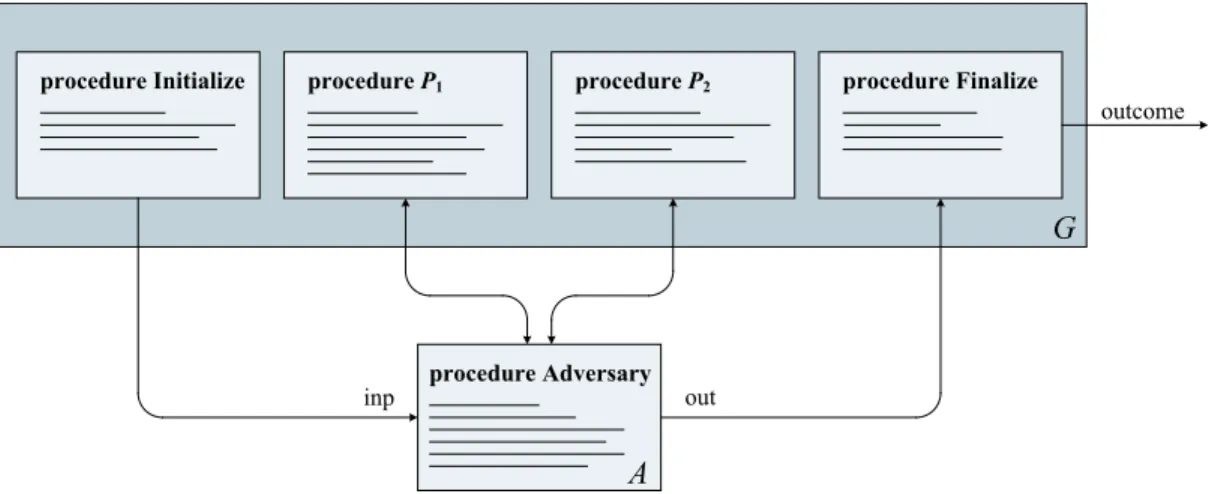
Under our framework, a game Gis a program that is run with an adversary A, which is also a program (look ahead to Figure 2). The adversary calls out to procedures, called oracles, specified by the game. We define what it means for two games to be identical-until-bad, where bad is a boolean variable in the game. This is a syntactical condition. We prove that if two games are identical-until-bad then the difference in the probabilities of a given outcome is bounded by the probability thatbad gets set (in either game). This result, thefundamental lemma of game-playing, is the central tool justifying the technique.
We go on to give describe some general lemmas and techniques for analyzing the probability thatbad gets set. Principle among these is a lemma that lets you change anything you want after the flag bad gets set. Other techniques speak to eliminating adaptivity, de-randomization, making “lazy” probabilistic choices, resampling, using “poisoned” points, and so forth.
Further applications. We illustrate the applicability of games in a wide variety of settings, providing results in the standard model, the random-oracle model [9], and the ideal-cipher model, and in both the symmetric and asymmetric settings.
We begin with a motivating observation, due to Tadayoshi Kohno, that the standard proof of the PRP/PRF Switching Lemma [5, 28] contains an error in reasoning about conditional probabilities. (The lemma says that an adversary that asks q queries can distinguish with advantage at most
q2/2n+1 a random permutation onn-bits from a random function of n-bits to n-bits.) We regard this as evidence that reasoning about cryptographic constructions via conditional probabilities can be subtle and error-prone even in the simplest of settings. This motivates our use of games as an alternative. We re-prove the Switching Lemma with a simple game-based proof.
Next we look at the CBC MAC. Let Advcbcn,m(q) denote the maximum advantage that an ad-versary restricted to making at most q oracle queries can obtain in distinguishing between (1) the
m-block CBC MAC, keyed by a random permutation on n bits, and (2) a random function from
mn-bits to n-bits. A result of Bellare, Kilian, and Rogaway [5] says thatAdvcbcn,m(q)≤2m2q2/2n. But the proof [5] is very complex and does not directly capture the intuition behind the security of the scheme. Here we use games to give an elementary proof for an m2q2/2n bound, the proof directly capturing, in our view, the underlying intuition.
Finally, we give an example of using games in the public-key, random-oracle setting by proving that OAEP [8] with any trapdoor permutation is an IND-CPA secure encryption scheme. The original proof of this result [8] was hard to follow or verify; the new proof is simpler and clearer, and illustrates the use of games in a computational rather than information-theoretic setting.
Further related work. The best-known attack on three-key triple-encryption is due to Lucks [31]. He does not work out an explicit lower bound forAdveeek,n(q) but in the case of triple-DES the ad-vantage becomes large by q = 290 queries. We prove security to about 278 queries, so there is no
contradiction.
The DESX construction has been proven secure up to about 2k+n−lgm blockcipher queries for key lengthk, block lengthn, andmqueries to the construction [30]. This is stronger than our bound for triple encryption when the adversary can obtain few points encrypted by the construction, a weaker bound otherwise.
Double encryption and two-key triple encryption were analyzed Aiello, Bellare, Di Crescenzo, and Venkatesan [3], where it is shown that the meet-in-the-middle attack is optimal (in the ideal-cipher model). Their result is the first to show that the cascade construction buys you something
(half a bit of security for advantage 0.5), but what it buys is inherently limited, because of the meet-in-the-middle attack. We comment that games provide an avenue to a much simpler proof of their result.
With motivation similar to our own, Maurer develops a framework for the analysis of cryp-tographic constructions and applies it to the CBC MAC and other examples [32]. Vaudenay has likewise developed a framework for the analysis of blockciphers and blockcipher-based constructions, and has applied it to the encrypted CBC MAC [47]. Neither Maurer’s nor Vaudenay’s approach is geared towards making stepwise, code-directed refinements for computing a probability.
A more limited and less formal version of the Fundamental Lemma appears in [6, Lemma 7.1]. A lemma by Shoup [43, Lemma 1] functions in a similar way for games that are not necessarily code-based.
Shoup has independently and contemporaneously prepared a manuscript on game playing [45]. It is more pedagogically-oriented than this paper. Shoup does not try to develop a theory for game playing beyond [43, Lemma 1]. As with us, one of Shoup’s examples is the PRP/PRF Switching Lemma.
In response to a web distribution of this paper, Bernstein offers his own proof for the CBC MAC [11], re-obtaining the conventional bound. Bernstein sees no reason for games, and offers his own ex-planation for why cryptographic proofs are often complex and hard to verify: author incompetence with probability.
In work derivative of an earlier version of this paper, Bellare, Pietrzak, and Rogaway [7] improve the boundAdvcbcn,m(q) ≤m2q2/2n of [5, 32] to aboutmq2/2n, and consider generalizations to this claim as well. The proof of [7] springs from games, refining the game used here for the CBC MAC and then analyzing it using techniques derivative of [20].
Following the web distribution of this paper, Halevi argues for the creation of an automated tool to help write and verify game-based proofs [25]. We agree. The possibility for such tools has always been one of our motivations, and one of the reasons why we focused on code-based games.
Why should game-playing work? It is fair to ask if anything is actually “going on” when using games—couldn’t you recast everything into more conventional probabilistic language and drop all that ugly code? Our experience is that it does not work to do so. The kind of probabilistic statements and thought encouraged by the game-playing paradigm seems to be a better fit, for many cryptographic problems, than that which is encouraged by (just) defining random-variables, writing conventional probability expressions, conditioning, and the like. Part of the power of the approach stems from the fact that pseudocode is the most precise and easy-to-understand language we know for describing the sort of probabilistic, reactive environments encountered in cryptography, and by remaining in that domain to do ones reasoning you are better able to see what is happening, manipulate what is happening, and validate the changes.
procedure Adversary
procedure Initialize procedure P1 procedure P2 procedure Finalize
out
outcome
inp
G
A
Figure 2: Running a gameGwith an adversaryA. The game is the code at the top, the adversary is the code at the bottom. The adversary interacts with the game by calling the oracles provided (two of which are shown).
2
The Game-Playing Framework
Programming language. A game is a program, viewed as a collection of procedures, and the adversary is likewise a program, but one consisting of a single procedure. We will, for the moment, regard games and adversaries as being written in pseudocode. Below we outline some elements of our pseudocode. We find that a pseudocode-based descriptive language is adequate to make game-playing unambiguous and productive. To make a truly rigorous theory one should, in fact, fully specify the underlying programming language. In Appendix C we provide an example language Lsuitable for describing games and adversaries (we specify the syntax but dispense with the operational semantics, which should be clear). The games of this paper conform to the syntax of Lapart from some minor matters.
Our programming language is strongly typed, with the type of each variable apparent from its usage (we dispense with explicit declarations). We will have variables of type integer, boolean, string, set, and array. A set is a finite set of strings and an array is an associative array, one taking on values of strings. The semantics of a boolean variable, which we will also call aflag, is that once true it stays true.
We allow conventional statements like if statements, for statements, and assignment state-ments. There is also a random-assignment statement, which is the only source of randomness in programs. Such a statement has the forms←$ S whereS is a finite set. The result is to uniformly select a random element from the set S and assign it to s. If S =∅ orS =undefined (we regard
undefined as a possible value for a variable) then the result of the random-assignment statement is to setsto undefined. A comma or newline serves as a statement separator and indentation is used to indicate grouping.
A game has three kinds of procedures: an initialization procedure (Initialize), a finalization procedure (Finalize), and named oracles (each one a procedures). The adversary can make calls to the oracles, passing in values from some finite domain associated to each oracle. The initialization or finalization procedures may be absent, and often are, and there may be any number of oracles, including none. All variables in a game are global variables and are not visible to the adversary’s code. All variables in adversary code are local.
Running a game. We can run a game G with an adversary A. To begin, variables are given initial values. Integer variables are initialized to 0; boolean variables are initialized to false; string
variables are initialized to the empty string ε; set variables are initialized to the empty set ∅; and array variables hold the value undefined at every point. These conventions facilitate omitting explicit initialization code in many cases.
The Initialize procedure is the first to execute, possibly producing an output inp. This is provided as input to the procedure Adversary, denoted A, which now runs. The adversary code can make oracle queries via statements of the form y ← P(· · ·) for any oracle P that has been defined in the game. The result is to assign to y the value returned by the procedure call. We assume that the game and adversary match syntactically, meaning that all the oracle calls made by the adversary are to oracles specified in the game, and with arguments that match in type or quantity. The semantics of a call is call-by-value; the only way for an oracle to return a value to the adversary is via a return statement. When adversary A halts, possibly with some output out, we call the Finalize procedure, providing it any output produced byA. The Finalize procedure returns a string that is the outcome of the game. If we omit specifying Initialize or Finalize it means that these procedures do nothing: they compute the identity function.
Termination and finite randomness. We assume that an underlying execution model provides a notion for the number of steps (the running time) of a program. We require that both the adversary and the game always terminate in finite time. By this we mean that, for any adversaryA
there must exist an integer T such that A always halts within T steps (regardless of the random choices A makes and the answers it receives to its oracle queries). Similarly, for any gameGthere must exist an integerT such thatG always halts withinT steps (regardless of the random choices made, Initialize halts withinT steps, and, regardless of the inputs they are provided, Finalize and the oracles halt within T steps). The finite-termination requirement is guaranteed automatically by our sample programming languageL.
Since the adversary and game terminate in finite time, there must be an integer T such that they each execute at mostT random-assignment statements, and there must be an integer B such that the size of the set S in any random-assignment statement s←$ S executed by the adversary or the game is at most B. Taken together, this means that the execution of G withA uses finite randomness, meaning G and A are underlain by a finite sample space Ω. Thus probabilities are well-defined and henceforth we can talk about the probabilities of various events in the execution.
Adversary and game outputs. We associate two outputs to the process of running a game with an adversary. The first, called the adversary output, is the value out returned by A after it has completed its interaction with the oracles provided by the game. The second, called the game output, is the value outcome returned by the Finalize procedure. Often the two outputs are the same, because the Finalize procedure is not specified (whence we define it to do nothing but pass on its input as its output).
The adversary and game outputs can be regarded as random variables. We write Pr[AG⇒1] for the probability that the adversary output is 1 when we run game G with adversary A, and Pr[GA⇒1] for the probability that the game output is 1 when we run game Gwith adversaryA.
Advantages. If Gand H are games andA is an adversary, let
Adv(AG, AH) = Pr[AG⇒1]−Pr[AH⇒1] and Adv(GA, HA) = Pr[GA⇒1]−Pr[HA⇒1].
These represent the advantage of the adversary in distinguishing the games, the first measured via adversary output and the second via game output. We refer to the first as theadversarial advantage
and the second as the game advantage. We say that G, H areadversarially indistinguishable if for any adversaryA it is the case thatAdv(AG, AH) = 0, and equivalent if, for any adversary A it is
the case thatAdv(GA, HA) = 0. We will often use the fact that
Adv(AG, AI) = Adv(AG, AH) +Adv(AH, AI) (1)
Adv(GA, IA) = Adv(GA, HA) +Adv(HA, IA) (2) for any games G, H, I and any adversary A. These will be referred to as the triangle equalities.
We will usually be interested in adversarial advantage (eg, this is the case in the game-playing proof of the PRP/PRF Switching Lemma). Game advantage is useful when we are interested in how the adversary’s output relates to some game variable such as a hidden bit chosen by the game (this happens in our proof of the security of OAEP).
Identical-until-bad games. We are interested in programs that are syntactically identical except for statements that follow the setting of a flag bad to true. Somewhat more precisely, let Gand H
be programs and let bad be a flag that occurs in both of them. Then we say that G and H
are identical-until-bad if their code is the same except that there might be places where G has a statementbad ←true, S while gameHhas a corresponding statement bad ←true, T for someT
that is different fromS. As an example, in the gamesS0 andS1 from Figure 6, the former has the
empty statement following bad ← true while in S1 we have Y
$
←image(π) following bad ← true. Since this is the only difference in the programs, the games are identical-until-bad. One could also say thatGandH are are identical-until-bad if one has the statement ifbad thenSwhere the other has the empty statement, for this can be rewritten in the form above.
A fully formal definition of identical-until-bad requires one to pin down the programming lan-guage and talk about the parse trees of programs in the lanlan-guage. We establish the needed lanlan-guage in Appendix C but, in fact, such formality isn’t needed in applications: for any two games one writes down, whether or not they are identical-until-bad is obvious. We emphasize that identical-until-bad
is a purely “syntactic” requirement.
We write Pr[AG sets bad] or Pr[GA sets bad] to refer to the probability that the flagbad istrue
at the end of the execution of the adversaryAwith game G, namely at the point when the Finalize procedure terminates. It is easy to see that, for any flag bad, identical-until-bad is an equivalence relation on games. When we say that a sequence of games G1, G2, . . . are identical-until-bad, we
mean that each pair of games in the sequence are identical-until-bad.
The fundamental lemma. The fundamental lemma says that the advantage that an adversary can obtain in distinguishing a pair of identical-until-bad games is at most the probability that its execution setsbad in one of the games (either game will do).
Lemma 1 [Fundamental lemma of game-playing] Let G and H be identical-until-bad games and let A be an adversary. Then
Adv(AG, AH) ≤ Pr[AG sets bad] and (3)
Adv(GA, HA) ≤ Pr[GA sets bad]. (4)
More generally, let G, H, I be identical-until-bad games. Then
Adv(AG, AH)
≤ Pr[AI sets bad] and (5)
Adv(GA, HA)
≤ Pr[IA sets bad]. (6)
Proof: Statement (3) follows from (4) by applying the latter to gamesG0, H0 formed by replacing the Finalize procedure of games G, H, respectively, with the trivial one that simply returns the
adversary output. Similarly, (5) follows from (6). We will now prove (4) and then derive (6) from it.
We have required that the adversary and game always terminate in finite time, and also that there is an integer that bounds the size of any setS in any random-assignment statements←$ S executed by the adversary or game. This means that there exists an integer b such that the execution of
GwithA and the execution ofH withA perform no more thanbrandom-assignment statements, each of these sampling from a set of size at most b. Let C = Coins(A, G, H) = [1.. b!]b be the set of b-tuples of numbers, each number between 1 and b!. We call C the coins for (A, G, H). For
c= (c1, . . . , cb)∈C, the execution of Gwith A on coins cis defined as follows: on theith random-assignment statement, call itX ←$ S, ifS={a0, . . . , am−1}is nonempty anda0< a1 <· · ·< am−1
in lexicographic order then let X take on the value acimodm. If S = ∅ then let X take on the
valueundefined. This way to perform random-assignment statements is done regardless of whether it is A or one of the procedures from G that is is performing the random-assignment statement. Notice thatmwill divide b! and so ifcis chosen at random fromC then the mechanism above will return a pointX drawn uniformly from S, and also the return values for each random-assignment statement are independent. For c ∈ C we let GA(c) denote the output of G when G is executed withA on coins c. We define the execution ofH withA on coinsc∈C, and HA(c), similarly. LetCGone={c∈C: GA(c)⇒1} be the set of coins c∈C such thatG outputs 1 when executed
withAon coinsc. PartitionCGoneintoCGonebadandCGonegood, whereCGonebad is the set of allc∈CGone
such that the execution ofG withA on coins csets bad and CGonegood =CGone\CGbadone. Similarly
define CHone, CHonebad and CHonegood. Observe that because games G and H are identical-until-bad,
an element c∈C is inCGonegood iff it is in CHonegood. Thus these sets are equal and in particular have the same size. Now we have
Pr[GA⇒1]−Pr[AH ⇒1] = |CGone| |C| −
|CHone|
|C| =
|CGonebad|+|CGonegood| − |CHonegood| − |CHonebad| |C|
= |CG
bad
one| − |CHonebad|
|C| ≤ |CGonebad| |C| ≤ |CGbad| |C| = Pr[G A sets bad].
This completes the proof of (4). Now, if G, H are identical-until-bad then (4) tells us that
Adv(GA, HA) ≤ Pr[GA setsbad] and Adv(HA, GA) ≤ Pr[HA sets bad].
However, ifG, H, I are all identical-until-bad, then Proposition 2 says that Pr[GA sets bad] = Pr[HA sets bad] = Pr[IAsets bad].
Thus we have established (6).
We have used finite randomness in our proof of the Fundamental Lemma, but we comment that this is more for simplicity than necessity: probabilities over the execution of Gwith A can be defined quite generally, even when the underlying sample space is infinite, and the Fundamental Lemma can still be proved. But we have never encountered any situation where such an extension is useful.
After bad is set, nothing matters. One of the most common manipulations of games along a game chain is to change what happens afterbad gets set to true. Often one expunges code that follows the setting ofbad, as we did in the PRP/PRF Switching Lemma,but it is also fine to insert alternative code. Any modification following the setting ofbad leaves unchanged the probability of setting bad, as the following result shows.
Proposition 2 [After bad is set, nothing matters] Let G and H be identical-until-bad games. Let A be an adversary. Then Pr[GA sets bad] = Pr[HA sets bad].
Proof: Using the definition from the proof of Lemma 1, fix coins C = Coins(A, G, H) and ex-ecute GA and HA in the manner we described using these coins. Let CGbad ⊆ C be the coins that result in bad getting set to true when we run GA, and let CHbad ⊆ C be the coins that
result in bad getting set to true when we run HA. Since G and H are identical-until-bad, each
c ∈ C causes bad to be set to true in GA iff it causes bad to be set to true in HA. Thus
CGbad = CHbad and hence |CGbad| = |CHbad| and |CGbad|/|C| = CHbad|/|C|, which is to say that Pr[GA sets bad] = Pr[HA sets bad].
Besides the lemma above, many other ways to manipulate games are illustrated by our examples and our discussion in Section D.
Game inputs. The setting discussed above can be extended to allow a game to take an input parameter: the Initialize procedure would take an optional input that is a string parameter input. The adversary and game outputs will now be denoted Pr[AG(input)⇒1] and Pr[GA(input)⇒1] respectively. Similarly, the advantages become Adv(AG(input), AH(input)) and Adv(GA(input), HA(input)), these being defined in the obvious ways. The definition of identical-until-bad obviously extends to games with inputs, as does the Fundamental Lemma.
We can imagine that it might be convenient for games to have inputs, for example in the asymptotic setting whereinput might be the security parameter, but our experience has been that it is not really necessary. Rather than giving a game an input input, we can usually imagine a family of games, one for each value ofinput, and reason about these; since the games are involved only in the analysis, this usually suffices. Accordingly our treatment of games omits explicit game inputs.
3
The Security of Three-Key Triple-Encryption
Triple encryption goes back to the early attempts to strengthen DES against key-search attacks [19]. We now show that the method increases security, in the ideal-cipher model, resolving a long-standing open problem.
Definitions. Let E: {0,1}k× {0,1}n → {0,1}n be a blockcipher with key length k and block length n. For K ∈ {0,1}k and X ∈ {0,1}n letEK(X) =E(K, X). Let E−1: {0,1}k× {0,1}n → {0,1}n be the blockcipher that is the inverse ofE. We also denote it byD. We associate toE two blockciphers formed by composition. DenotedCascadeeeeE ,CascadeedeE : {0,1}3k× {0,1}n→ {0,1}n, they are defined as
CascadeeeeE (K0K1K2, X) = EK2(EK1(EK0(X))) and
CascadeedeE (K0K1K2, X) = EK2(DK1(EK0(X)))
for all K0, K1, K2 ∈ {0,1}k and X ∈ {0,1}n. These blockciphers have key length 3k and block
length n and are sometimes referred to as the three-key forms of triple encryption. We will call the two methods EEE and EDE, respectively. There is also atwo-key variant of triple encryption, obtained by settingK0 =K2, but we do not investigate it since the method admits comparatively
efficient attacks [34].
We will be working in the ideal-blockcipher model, as in works like [3, 22, 30]. Let Bloc(k, n) be the set of all blockciphers E: {0,1}k× {0,1}n → {0,1}n. Thus E←$ Bloc(k, n) means that
EK: {0,1}n → {0,1}n is a random permutation on n-bit strings for each K ∈ {0,1}k. We con-sider an adversary A that can make four types of oracle queries: T(X), T−1(Y), E(K, X), and
E−1(K, Y), where X, Y ∈ {0,1}n and K ∈ {0,1}k. (As for our syntax, T, T−1, E, E−1 are for-mal symbols, not specific functions.) Theadvantage of Aagainst EEE and themaximal advantage against EEE obtainable using q queries are defined as
Adveeek,n(A) = Adv(AC0, AR0) and Adveeek,n(q) = max A
Adveeek,n(A)
where the games C0, R0 are shown in Figure 3 and the maximum is over all adversaries A that
make at most q oracle queries (that is, a total of q across all oracles). The advantage of A mea-sures its ability to tell whether T(·) is a random permutation or is Cascadeeee
E (K0K1K2, ·) for K0K1K2
$
← {0,1}3k, whenE realizes a random blockcipher E←$ Bloc(k, n) and T−1,E−1 realize inverses ofT,E, respectively.
Define the query threshold QTheee1/2(k, n) as the largest integer q for which Adveeek,n(q) ≤ 1/2. We will speak of EEE being secure up to QTheee1/2(k, n) queries. Let Advk,nede(A),Advedek,n(q), and
QThede1/2(k, n) be defined in the analogous way.
Results. The main result of this section is the following:
Theorem 3 [Security of triple-encryption] Let k, n≥2. Letα = max(2e2k−n,2n+k). Then
Adveeek,n(q) ≤ 4α q 2 23k + 10.7 q 2k+n/2 2/3 +12 2k . 2 (7)
We display the result graphically in Figure 1 for DES parametersk = 56 and n= 64. Our bound implies that QTheee1/2(k, n) is, very roughly, about 2k+min(k,n)/2, meaning that EEE is secure up to this many queries. We remark that Lucks [31] provides a key-recovery attack on EEE that succeeds in about 2k+n/2 queries, indicating that our threshold value is reasonably tight forn≤k.
For EDE the result is the same, meaning that Advedek,n(q) is also bounded by the quantity on the right-hand-side of (7). This can be shown by mostly-notational modifications to the proof of Theorem 3.
Conventions. The rest of this section, as well as Appendix E, is for proving Theorem 3. We begin with some conventions. Recall that an adversaryA against EEE or EDE can make oracle queries
T(X), T−1(Y),E(K, X), or E−1(K, Y) for any X, Y ∈ {0,1}n and K ∈ {0,1}k. We will assume that any adversary against EEE or EDE is deterministic and never makes a redundant query. A query is redundant if it has been made before; a query T−1(Y) is redundant if A has previously received Y in answer to a queryT(X); a query T(X) is redundant ifA has previously received X
in answer to a query T−1(Y); a query E−1(K, Y) is redundant if A has previously received Y in answer to a query E(K, X); a query E(K, X) is redundant if A has previously received X in
answer to a query E−1(K, Y). AssumingA to be deterministic and not to ask redundant queries is without loss of generality in the sense that for any A that asksq queries there is an A0 asking
at mostq queries that satisfies these assumptions and achieves the same advantage as A. Finally, recall that our general conventions imply thatA never asks a query with arguments outside of the intended domain, meaning {0,1}k for keys and{0,1}n for messages. We say that an adversary is
simplified if it does not makeT(·),T−1(·) queries (that is, it makes onlyE(·,·),E−1(·,·) queries).
Simplifying the adversary. The first step in our proof is to reduce the problem of bounding the advantage of an adversary against EEE to the problem of bounding advantage for a simplified adversary that aims to distinguish between a new pair of games (obviously not the original pair of games since an adversary can get no advantage in distinguishing R0 and C0 if it makes no T(·)
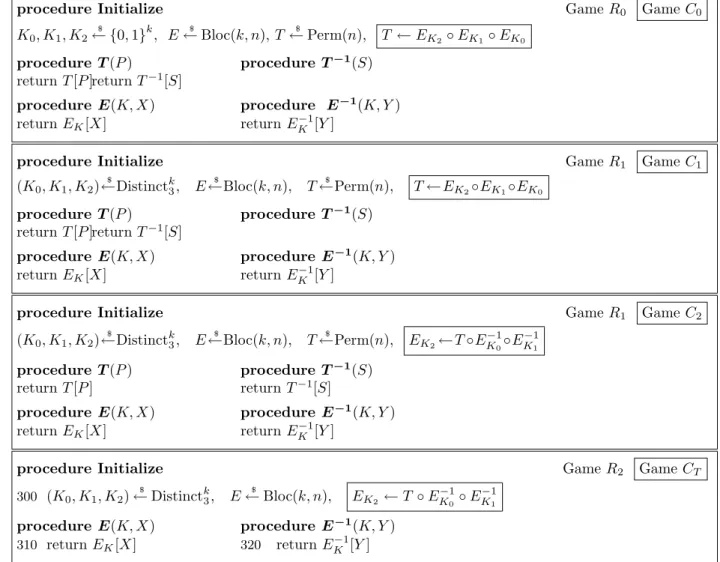
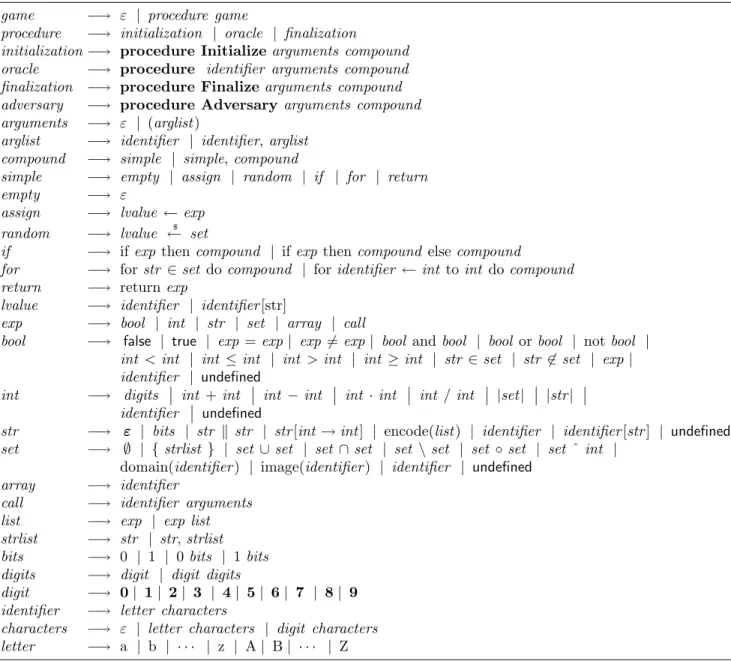
or T−1(·) queries). Consider the games in Figure 3. The R-games (where R stands for random) omit the boxed assignment statements while theC-games (whereCstands for construction) include them. Distinctk3 denotes the set of all triples (K0, K1, K2) ∈ ({0,1}k)3 such that K0 6= K1 and
procedure Initialize GameR0 Game C0 K0, K1, K2 $ ← {0,1}k, E←$ Bloc(k, n),T←$ Perm(n), T ←EK2◦EK1◦EK0 procedure T(P) procedure T−1(S) returnT[P]returnT−1 [S] procedure E(K, X) procedure E−1(K, Y) returnEK[X] returnE− 1 K [Y]
procedure Initialize GameR1 Game C1
(K0, K1, K2) $ ←Distinctk 3, E $ ←Bloc(k, n), T←Perm($ n), T←EK2◦EK1◦EK0 procedure T(P) procedure T−1(S) returnT[P]returnT−1[S] procedure E(K, X) procedure E−1(K, Y) returnEK[X] returnEK−1[Y]
procedure Initialize GameR1 Game C2
(K0, K1, K2) $ ←Distinctk 3, E $ ←Bloc(k, n), T←Perm($ n), EK2←T◦E −1 K0◦E −1 K1 procedure T(P) procedure T−1(S) returnT[P] returnT−1[S] procedure E(K, X) procedure E−1(K, Y) returnEK[X] returnEK−1[Y]
procedure Initialize GameR2 GameCT
300 (K0, K1, K2) $ ←Distinctk3, E $ ←Bloc(k, n), EK2 ←T◦E −1 K0◦E −1 K1 procedure E(K, X) procedure E−1(K, Y) 310 returnEK[X] 320 returnE− 1 K [Y]
Figure 3: Games used for triple encryption. TheCi games include the boxed statements, theRi games do
not.
K1 6=K2 and K0 6=K2. Game CT is parameterized by a permutationT ∈Perm(n), meaning we are effectively defining one such game for every T. Now we claim the following:
Lemma 4 Let A1 be an adversary that makes at mostq oracle queries. Then there is a simplified adversary B and a permutation S∈Perm(n) such that
Adveeek,n(A1) ≤ Adv(BCS, BR2) +
6 2k .
Furthermore, B also makes at most q oracle queries.
Proof: The only change between games R0 and R1 is to draw the keysK0, K1, K2 from Distinctk3
rather than from ({0,1}k)3, and similarly for games C0 andC1. So Adv(AC01 , AC11 )≤ 3 2k and Adv(A R1 1 , AR01 )≤ 3 2k .
triangle equality (1) and the above we have
Adveeek,n(A1) = Adv(AC01 , AR01 ) = Adv(AC01 , AC11 ) +Adv(AC11 , A1R1) +Adv(AR11 , AR01 )
≤ Adv(AC1 1 , AR 1 1 ) + 6 2k . (8)
Game C2 is obtained from game C1 as follows: instead of definingT as E2 ◦E1◦E0 for random E0, E1, E2, we defineE2asT◦EK0−1◦EK1 for randomT, EK0, EK1. These two processes are identical, and so
Adv(AC11 , AR11 ) = Adv(AC21 , AR11 ). (9) GameCT is parameterized by a permutationT ∈Perm(n). For any suchT we consider an adversary
AT that has T hardwired in its code and is simplified, meaning can make queries E(K, X) and
E−1(K, Y) only. This adversary runsA
1, answering the latter’s E(K, X) andE−1(K, Y) queries
via its own oracles, and answering T(X) and T−1(Y) queries using T. Note that AT makes at most q oracle queries. Choose S∈Perm(n) such that
Adv(ACS S , A R2 S ) = T∈maxPerm(n) n Adv(ACT T , A R2 T ) o
and letB =AS. Then, with the expectation taken over T $ ←Perm(n) we have Adv(AC21 , AR11 ) = EhAdv(ACT T , AR2T ) i ≤ Adv(ACS S , AR2S ) = Adv(BCS, BR 2 ). (10) This concludes the proof.
Pseudorandomness of three correlated permutations. Towards bounding the advantage of a simplified adversary in distinguishing between games C3 and R3 we posit a new problem.
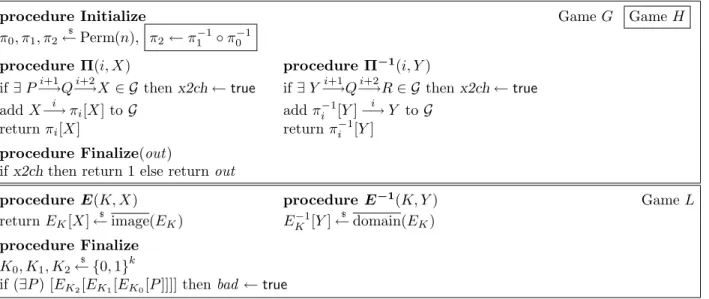
Consider gamesGandHdefined in Figure 4. An adversary may make queriesΠ(i, X) orΠ−1(i, Y) where i∈ {0,1,2} and X, Y ∈ {0,1}n. The oracles realize three permutations and their inverses, the function realized byΠ−1(i,·) being the inverse of the one realizing Π(i,·) for all i∈ {0,1,2}. In both games permutations π0, π1 underlying Π(0,·) and Π(1,·) are random and independent
permutations. In gameG, the permutationπ2 underlyingΠ(2,·) is also random and independent
of π0 and π1, but in gameH it is equal to π−11◦π0−1.
Notice that it is easy for an adversary to distinguish between games G and H by making queries that form a “chain” of length three: for anyP ∈ {0,1}n, let the adversary ask and be given
Q← π0(P), thenR ← π1(Q), then P0 ← π2(R), and then have the adversary output 1 if P =P0
(a “triangle” has been found) or 0 if P 6=P0 (the “three-chain” is not in fact a triangle). What we will establish is that, apart from such behavior—extending a known “2-chain”—the adversary is not able to gain much advantage. To capture this, as the adversary A makes its queries and gets replies, the games form an edge-labeled directed graph G. The graph, whose vertex set is {0,1}n, is initially without edges (we omit explicit initialization for the graph G). An arc X−→i Y
is created when a query Π(i, X) returns the value Y or a query Π−1(i, Y) returns the value X. The boolean flag x2ch is set in the games if the adversary “extends a 2-chain,” meaning that a path P−→i+1Q−→i+2R exists in the graph and the adversary asks either Π(i, R) or Π−1(i, P), where the indicated addition is modulo 3. We will be interested in the game outputs rather than the adversary outputs. If the flagx2chgets set to true then the adversary effectively loses: the game’s output is defined as a constant (rather than the adversary’s output) and the adversary will gain no advantage form this run. We comment that we have described gamesG and H as working with a graph, which is not actually a type in our formal programming language L, but it is easy to recast the games to use a set instead of a graph, it is simply that the code may be slightly less readable. We show, again using a game-based proof, that:
procedure Initialize GameG Game H π0, π1, π2 $ ←Perm(n), π2←π1−1◦π −1 0 procedure Π(i, X) procedure Π−1(i, Y)
if∃P−→i+1Q−→i+2X ∈ G thenx2ch←true if∃Y−→i+1Q−→i+2R∈ G thenx2ch←true
add X−→i πi[X] toG addπ−i 1[Y]−→i Y to G
returnπi[X] returnπ−1i [Y]
procedure Finalize(out)
ifx2chthen return 1 else returnout
procedure E(K, X) procedure E−1(K, Y) GameL
returnEK[X] $ ←image(EK) EK−1[Y] $ ←domain(EK) procedure Finalize K0, K1, K2 $ ← {0,1}k
if (∃P) [EK2[EK1[EK0[P]]]] thenbad ←true
Figure 4: Games used in the analysis of triple encryption. GameH includes the boxed statement, gameG
does not. GameLcaptures improbability of making three chains. Lemma 5 If Pr
BG makes ≥h oracle queries
≤δ then Adv(HB, GB) ≤ 2.5h2/2n+δ.
The proof is in Section E.1. We remark that the lemma makes no (explicit) assumption about the probability that BH makes h or more oracle queries.
The improbability of three-chains. Consider an adversary B that can make E(K, X) or E−1(K, Y) queries. Game L of Figure 4 implements the oracles as a random blockcipher and its inverse, respectively, but samples these lazily, defining points as they are needed. Write X−→K Y to mean that thatB has made queryE(K, X) and obtained Y as a result, or made queryE−1(K, Y) and obtainedX as a result, for K ∈ {0,1}k and X, Y ∈ {0,1}n. The Finalize procedure picks keys
K0, K1, K2 at random, and setsbad if the adversary’s queries have formed a three chain, meaning
that there exist pointsP, Q, R, S ∈ {0,1}nsuch thatP−→K0 Q−→K1R−→K2S. The conditional at line 111 means that, for some P, EK0[P] is defined and EK1[EK0[P]] is defined and EK2[EK1[EK0[P]]] is defined. Our next lemma bounds the probability of this happening. The proof is in Section E.2.
Lemma 6 Letk, n≥1. LetB be an adversary that asks at mostqqueries. Letα= max(2e2k−n,2n+
k). Then Pr[BL sets bad]<2α q2/23k.
Reducing to three correlated permutations. Let B be a simplified adversary and S ∈ Perm(n) a permutation. We associate to B, S a pair of adversaries BS,1 and BS,2 that make Π(i, X) or Π−1(i, Y) queries, where i ∈ {0,1,2} and X, Y ∈ {0,1}n, as follows. For b ∈ {1,2}, adversaryBS,bpicks (K0, K1, K2) at random from Distinctk3 and picksEat random from Bloc(k, n).
It then runs B, replying to its oracle queries as follows. If B makes a query E(K, X), adversary BS,b returns E[K, X] if K 6∈ {K0, K1, K2}; returns Π(i, X) if K =Ki for i∈ {0,1}; and returns
S◦Π(3, X) ifi= 3. Similarly, ifB makes a query E−1(K, Y), adversary B
S,b returns E−1[K, Y] if K 6∈ {K0, K1, K2}; returnsΠ−1(i, Y) if K =Ki for i∈ {0,1}; and returnsΠ−1(3, Y)◦S−1 if
i= 3. AdversariesBS,1, BS,2 differ only in their output, the first always returning 0 and the second
procedure Initialize GameR3 500 (K0, K1, K2) $ ←Distinctk 3,E $ ←Bloc(k, n), EK2←S◦E −1 K0◦E −1 K1 GameDS procedure E(K, X)
510 if∃i∈ {0,1,2}such thatK=Ki then
511 Q←E−1 Ki+2[X], P ←E −1 Ki+1[Q] 512 ifP−→i+1Q−→i+2X thenx2ch←true 513 Add arcX−→i EK[X] 514 returnEK[X] procedure E−1(K, Y)
520 if∃i∈ {0,1,2}such thatK=Ki then
521 Q←EKi+1[Y], R←EKi+2[Q]
522 ifY−→i+1Q−→i+2R thenx2ch←true
523 Add arcE−1K [Y]−→i Y
524 returnEK−1[Y] procedure Finalize
530 ifx2chthen return 1 else returnout
Figure 5: Games used in the triple-encryption analysis. GameDS includes the boxed statement, gameR3 does not.
Lemma 7 Let B be a simplified adversary that makes at most q oracle queries, and let S ∈ Perm(n). Let BS,1, BS,2 be defined based on B, S as above. Let K = 2k. Then for b ∈ {1,2} and every real number c >0,
PrhBS,bG makes ≥3cq/K oracle queriesi ≤ 1
c .
The proof is in Appendix E.3.
Proof of Theorem 3: We now show how to prove Theorem 3 given the above lemmas. LetAbe an adversary against EEE that makes at most q oracle queries. Let B be the simplified adversary, andS the permutation, given by Lemma 4, and letBS,1, BS,2 be the adversaries associated to it as
described above. Consider the gamesR3, DS of Figure 5 and note that Pr[DSB sets x2ch] = Pr[HBS,1⇒1] and Pr[RB
3 sets x2ch] = Pr[GBS,1 ⇒1]
Pr[DB
S ⇒1] = Pr[HBS,2⇒1] and Pr[RB3 ⇒1] = Pr[GBS,2 ⇒1].
Letα= max(2e2k−n,2n+k). Then for any c >0 we have the following:
Adveeek,n(A)
≤ Adv(BCS, BR2) + 6
2k (12)
= Adv(CSB, DSB) +Adv(DSB, RB3) +Adv(RB3, RB2) + 6
2k (13) ≤ Pr DBS sets x2ch + Pr RB3 setsx2ch +Adv(DSB, R3B) + 6 2k (14) = 2·Pr RB3 sets x2ch + Pr DBS setsx2ch −Pr RB3 sets x2ch +Adv(DBS, RB3) + 6 2k = 2·Pr RB3 sets x2ch +Adv(HBS,1 , GBS,1 ) +Adv(HBS,2 , GBS,2 ) + 6 2k (15) ≤ 2· 3 2k + Pr[B L sets bad] +Adv(HBS,1, GBS,1) +Adv(HBS,2, GBS,2) + 6 2k (16) ≤ 2 3 2k + 2α q2 23k + 5 2n 3cq 2k 2 +2 c + 6 2k (17)
Above, (12) is by Lemma 4, and (13) is by triangle equality (2). To justify (14) we note that gameCS can be easily transformed into an equivalent game such that this game and gameDS are identical-until-bad, and, similarly, gameR2 can be easily transformed into an equivalent game such
that this game and game R3 are identical-until-bad, and thus (14) follows from the Fundamental
Lemma. To justify (15) we use (11). To justify (16) we note that the probability that R3B extends a 2-chain is at most the probability thatLBforms a 3-chain. The extra term is becauseLpicks the keysK0, K1, K2 independently at random whileR3 picks them from Distinctk3. To get (17) we first
applied Lemma 6 and then, for each b ∈ {1,2}, applied Lemma 5 in conjunction with Lemma 7. Now, since the above is true for any c >0, we pick a particular one that minimizes the function
f(c) = 45c2q22−n−2k+ 2c−1. The derivative is f0(c) = 90cq22−n−2k−2c−2, and the only real root of the equation f0(c) = 0 is c = (2n+2k/45q2)1/3, for which we have f(c) = 3(45q2/2n+2k)1/3. Plugging this into the above yields (7) and concludes the proof of Theorem 3.
Acknowledgments
We thank Tadayoshi Kohno for permission to use his observations about the standard proof of the PRP/PRF Switching Lemma noted in Section A and Appendix B.
Mihir Bellare was supported by NSF 0098123, ANR-0129617, NSF 0208842, and an IBM Faculty Partnership Development Award. Phil Rogaway was supported by NSF 0208842 and a gift from Intel Corp. Much of the work on this paper was carried out while Phil was hosted by Chiang Mai University, Thailand.
References
[1] M. Abe, R. Gennaro, K. Kurosawa and V. Shoup. Tag-KEM/DEM: A new framework for hybrid encryption and a new analysis of Kurosawa-Desmedt KEM.Eurocrypt ’05.
[2] L. Adleman. Two theorems on random polynomial time. FOCS 78.
[3] W. Aiello, M. Bellare, G. Di Crescenzo, and R. Venkatesan. Security amplification by compo-sition: the case of doubly-iterated, ideal ciphers.Crypto ’98.
[4] M. Bellare and S. Goldwasser. New paradigms for digital signatures and message authentica-tion based on non-interactive zero knowledge proofs. Crypto 89, pp. 194–211, 1989.
[5] M. Bellare, J. Kilian, and P. Rogaway. The security of the cipher block chaining message authentication code.Journal of Computer and System Sciences (JCSS), vol. 61, no. 3, pp. 362– 399, 2000. Earlier version inCrypto ’94.
[6] M. Bellare, T. Krovetz, and P. Rogaway. Luby-Rackoff backwards: increasing security by making block ciphers non-invertible.Eurocrypt ’98.
[7] M. Bellare, K. Pietrzak, and P. Rogaway. Improved security analyses for CBC MACs. Crypto 05.
[8] M. Bellare and P. Rogaway. Optimal asymmetric encryption. Eurocrypt ’94.
[9] M. Bellare and P. Rogaway. Random oracles are practical: a paradigm for designing efficient protocols. ACM CCS ’93.
[10] M. Bellare, P. Rogaway, and D. Wagner. The EAX mode of operation (a two-pass authenti-cated encryption scheme).FSE ’04
[11] D. Bernstein. A short proof of the unpredictability of cipher block chaining. Manuscript, January 2005. Available on Bernstein’s web page.
[12] J. Black and P. Rogaway. CBC MACs for arbitrary-length messages: the three-key construc-tions.Crypto ’00.
[13] J. Black and P. Rogaway. A block-cipher mode of operation for parallelizable message authen-tication.Eurocrypt ’02.
[14] J. Black, P. Rogaway, and T. Shrimpton. Encryption-scheme security in the presence of key-dependent messages. SAC 2002.
[15] D. Boneh. Simplified OAEP for the RSA and Rabin functions. Crypto ’01.
[16] J. Camenisch and V. Shoup. Practical verifiable encryption and decryption of discrete logs. Crypto ’03.
[17] R. Cramer and V. Shoup. Design and analysis of practical public-key encryption schemes secure against adaptive chosen ciphertext attack. SIAM J. of Computing, vol. 33, pp. 167– 226, 2003.
[18] R. Cramer and V. Shoup. Universal hash proofs and a paradigm for adaptive chosen ciphertext secure public key encryption.Eurocrypt ’02.
[19] W. Diffie and M. Hellman. Exhaustive cryptanalysis of the data encryption standard. Com-puter, vol. 10, pp. 74–84, 1977.
[20] Y. Dodis, R. Gennaro, J. H˚astad, H. Krawczyk, and T. Rabin. Randomness extraction and key derivation using the CBC, Cascade, and HMAC modes.Crypto ’04.
[21] S. Even and O. Goldreich. On the power of cascade ciphers. ACM Transactions on Computer Systems, vol. 3, no. 2, pp. 108–116, 1985.
[22] S. Even and Y. Mansour. A construction of a cipher from a single pseudorandom permutation. Asiacrypt ’91. LNCS 739, Springer-Verlag, pp. 210–224, 1992.
[23] E. Fujisaki, T. Okamoto, D. Pointcheval, and J. Stern. RSA-OAEP is secure under the RSA assumption.J. of Cryptology, vol. 17, no. 2, pp. 81–104, 2004.
[24] S. Goldwasser and S. Micali. Probabilistic encryption. J. Comput. Syst. Sci., vol. 28, no. 2, pp. 270–299, 1984. Earlier version inSTOC ’82.
[25] S. Halevi. A plausible approach to computer-aided cryptographic proofs. Cryptology ePrint archive report 2005/181, 2005.
[26] S. Halevi and P. Rogaway. A parallelizable enciphering mode. CT-RSA ’04.
[27] S. Halevi and P. Rogaway. A tweakable enciphering mode. Crypto ’03. LNCS 2729, pp. 482– 499, 2004.
Wagner’s web page. Earlier version inCrypto ’98.
[29] E. Jaulmes, A. Joux, and F. Valette. On the security of randomized CBC-MAC beyond the birthday paradox limit: a new construction.FSE ’02. LNCS 2365, pp. 237–251, 2002.
[30] J. Kilian and P. Rogaway. How to protect DES against exhaustive key search (an analysis of DESX).J. of Cryptology, vol. 14, no. 1, pp. 17–35, 2001. Earlier version inCrypto ’96. [31] S. Lucks. Attacking triple encryption. FSE ’98. LNCS 1372, pp. 239–253, 1998.
[32] U. Maurer. Indistinguishability of random systems. Eurocrypt ’02. LNCS 2332, Springer-Verlag, pp. 110–132, 2002.
[33] U. Maurer and J. Massey. Cascade ciphers: the importance of being first. J. of Cryptology, vol. 6, no. 1, pp. 55–61, 1993.
[34] R. Merkle and M. Hellman. On the security of multiple encryption. Communications of the ACM, vol. 24, pp. 465–467, 1981.
[35] R. Motwani and P. Raghavan. Randomized Algorithms. Cambridge University Press, 1995. [36] National Institute of Standards and Technology. FIPS PUB 46-3, Data Encryption Standard
(DES), 1999. Also ANSI X9.52, Triple Data Encryption Algorithm modes of operation, 1998, and other standards.
[37] E. Petrank and C. Rackoff. CBC MAC for real-time data sources. J. of Cryptology, vol. 13, no. 3, pp. 315–338, 2000.
[38] P. Rogaway. Authenticated-encryption with associated-data. ACM CCS ’02.
[39] P. Rogaway. Efficient instantiations of tweakable blockciphers and refinements to modes OCB and PMAC.Asiacrypt ’04.
[40] P. Rogaway, M. Bellare, and J. Black. OCB: A block-cipher mode of operation for efficient authenticated encryption. ACM Transactions on Information and System Security, vol. 6, no. 3, pp. 365–403, 2003. Earlier version inACM CCS ’01.
[41] T. Schweinberger and V. Shoup. ACE: the advanced cryptographic engine. Cryptology ePrint report 2000/022, 2000.
[42] C. Shannon. Communication theory of secrecy systems. Bell Systems Technical Journal, vol. 28, no. 4, pp. 656–715, 1949.
[43] V. Shoup. OAEP reconsidered. J. of Cryptology, vol. 15, no. 4, pp. 223–249, 2002. Earlier version inCrypto ’01.
[44] V. Shoup. A proposal for an ISO standard for public key encryption. Cryptology ePrint report 2001/112, 2001.
[45] V. Shoup. Sequences of games: a tool for taming complexity in security proofs. Cryptology ePrint report 2004/332, November 30, 2004.
[46] V. Shoup. Using hash function as a hedge against chosen ciphertext attack. Eurocrypt ’00. [47] S. Vaudenay. Decorrelation over infinite domains: the encrypted CBC-MAC case.
Communi-cations in Information and Systems (CIS), vol. 1, pp. 75–85, 2001.
[48] A. Yao. Theory and applications of trapdoor functions. FOCS 1982, pp. 80–91, 1982.
A
The PRP/PRF Switching Lemma
The lemma. The natural and conventional assumption to make about a blockcipher is that it behaves as a pseudorandom permutation (PRP). However, it usually turns out to be easier to analyze the security of a blockcipher-based construction assuming the blockcipher is secure as a pseudorandom function (PRF). The gap is then bridged (meaning, a result about the security of the construct assuming the blockcipher is a PRP is obtained) using the following lemma. In what follows, we denote by AP ⇒1 the event that adversary A, equipped with an oracle P, outputs
the bit 1. Let Perm(n) be the set of all permutations on {0,1}n and let Func(n) be the set of all functions from {0,1}n to {0,1}n. We assume below thatπ is randomly sampled from Perm(n) and ρ is randomly sampled from Func(n).
Lemma 8 [PRP/PRF Switching Lemma] Let n ≥ 1 be an integer. Let A be an adversary that asks at most q oracle queries. Then
|Pr [Aπ⇒1 ]−Pr [Aρ⇒1 ]| ≤ q(q−1) 2n+1 .
In this section we point to some subtleties in the “standard” proof of this widely used result, as given for example in [5, 28], showing in particular that one of the claims made in these proofs is incorrect. We then show how to prove the lemma in a simple and correct way using games. This example provides a gentle introduction to the game-playing technique and a warning about perils of following ones intuition when dealing with conditional probability in provable-security cryptography.
The standard proof. The standard analysis proceeds as follows. LetColl(“collision”) be the event that A, interacting with oracleρ←$ Func(n), asks distinct queries X and X0 that return the same answer. Let Dist(“distinct”) be the complementary event. Now
Pr[Aπ⇒1] = Pr[Aρ⇒1|Dist] (18)
since a random permutation is the same as a random function in which everything one obtains from distinct queries is distinct. Lettingx be this common value and y= Pr[Aρ⇒1|Coll] we have
|Pr[Aπ⇒1]−Pr[Aρ⇒1]| = |x−xPr[Dist]−yPr[Coll]| = |x(1−Pr[Dist])−yPr[Coll]| = |xPr[Coll]−yPr[Coll]| = |(x−y) Pr[Coll]| ≤ Pr[Coll] where the final inequality follows because x, y ∈ [0,1]. One next argues that Pr[Coll] ≤ q(q− 1)/2n+1 and so the Switching Lemma follows.
Where is the error in the simple proof above? It’s at equation (18): it needn’t be the case that Pr[Aπ⇒1] = Pr[Aρ⇒1|Dist], and the sentence we gave by way of justification was mathematically meaningless. Here is a simple example to demonstrate that Pr[Aπ ⇒ 1] can be different from Pr[Aρ⇒1|Dist]. Letn= 1 and consider the following adversaryAwith oracleP: {0,1} → {0,1}:
procedure Adversary A
ifP(0) = 0 then return 1
else if P(1) = 1 then return 1 else return 0 We claim that
Pr[Aπ⇒1] = 1/2 and Pr[Aρ⇒1|Dist] = 2/3.
The first equation is true because there are two possibilities for (π(0), π(1)), namely (0,1),(1,0), and A returns 1 for one of them, namely (0,1). On the other hand, there are four possibilities for (ρ(0), ρ(1)), namely (0,0),(0,1),(1,0),(1,1). The event Aρ⇒1∧Distis true for two of them, namely (0,0),(0,1), while the eventDistis true for three of them, namely (0,0),(0,1),(1,0). Thus Pr[Aρ⇒1∧Dist]/Pr[Dist] = 2/3.
Notice that the number of oracle queries made by the adversary of this counterexample varies, being either one or two, depending on the reply it receives to its first query. This turns out to be crucial in making equation (18) fail, in that if A always makes exactlyq oracle queries (regardless of A’s coins and the answers returned to its queries) then equation (18) is true. (This was pointed out by Kohno, and his argument is re-produced in Appendix B.) Since one can always first modify
procedure P(X) GameS0
100 Y ← {$ 0,1}n Game S1
101 ifY ∈image(π) thenbad ←true, Y ←$ image(π)
102 returnπ[X]←Y
Figure 6: Games used in the proof of the Switching Lemma. GameS1includes the boxed statement andS0 doesn’t.
A to make exactlyq queries without altering Pr[Aρ ⇒1] or Pr[Aπ⇒1], we would be loath to say that the proofs in [5, 28] are incorrect. But the authors make claim (18), and view it as “obvious,” without restricting the adversary to exactly q queries, masking a subtlety that is not apparent at a first (or even second) glance.
The fact that one can write something like (18) and people assume this to be correct, and even obvious, suggests to us that the language of conditional probability may often be unsuitable for thinking about and dealing with the kind of probabilistic scenarios that arise in cryptography. Games may more directly capture the desired intuition. Let us use them to give a correct proof.
Game-based proof. Assume without loss of generality (since A’s oracle is deterministic) thatA
never asks an oracle query twice. We imagine answering A’s queries by running one of two games. Instead of thinking ofAas interacting with a random permutation oracle π←$ Perm(n), think of it as interacting with the GameS1 shown in Figure 6. Instead of thinking ofA as interacting with a
random function oracleρ←$ Func(n), think ofAas interacting with the gameS0shown in the same
figure. GameS0is gameS1 without the boxed statement. By convention, the boolean variablebad
is initialized to false while the arrayπ begins everywhere undefined. The games make available to
A an oracle which has a formal name, in this case P. Adversary A can query this oracle with a string X ∈ {0,1}n, in which case the code following the procedure P(X) line is executed and the value in the return statement is provided to A as the response to its oracle query. As the game runs, we fill-in values of π[X] with n-bit strings. At any point in time, we let image(π) be the set of alln-bit stringsY such thatπ[X] =Y for some X. Let image(π) be the complement of this set relative to {0,1}n. Let AS⇒1 denote the event that Aoutputs 1 in game S∈ {S
0, S1}.
Notice that the adversary never sees the flagbad. The flag will play a central part in our analysis, but it is not something that the adversary can observe. It’s only there for our bookkeeping. What
does adversaryA see as it plays gameS0? Whatever queryX it asks, the game returns a random n-bit string Y. So game S0 perfectly simulates a random function ρ
$
←Func(n) (remember that the adversary isn’t allowed to repeat a query) and Pr[Aρ⇒1] = Pr[AS0 ⇒1]. Similarly, if we’re in gameS1, then what the adversary gets in response to each queryX is a random pointY that has not
already been returned toA. The behavior of a random permutation oracle is exactly this, too. (This is guaranteed by what we will call the “principle of lazy sampling.”) So Pr[Aπ⇒1] = Pr[AS1⇒1]. We complete the proof via the following chain of inequalities, the first of which we have just justified:
|Pr[Aπ ⇒1]−Pr[Aρ⇒1]| = |Pr[AS1
⇒1]−Pr[AS0 ⇒1]|
≤ Pr[AS0 sets bad] (19)
≤ q(q−1)/2n+1 . (20)
Above, “AS0 sets bad” refers to the event that the flagbad is set totruein the execution ofAwith gameS0. We justify (19) by appealing to the fundamental lemma of game playing (Lemma 1), which
immediately follow the setting of bad, the difference in the probabilities that A outputs 1 in the two games is bounded by the probability thatbad is set in either game. (It actually says something a bit more general, as we will see.) We justify (20) by observing that, by the union bound, the probability that a Y will ever be in image(π) at line 101 is at most (1 + 2 +· · ·+ (q−1))/2n =
q(q−1)/2n+1. This completes the proof.
Counter-example revisited. It is instructive to see how the adversaryAof the counter-example above fares in the game-playing proof. A computation shows that
Pr[AS0⇒1] = 3/4, Pr[AS1 ⇒1] = 1/2, and Pr[AS0 sets bad] = 1/4.
So none of the equalities or inequalities that arose in the game-playing proof are violated. Another interesting thing to note is that
Pr
AS0 ⇒1 | AS0 does not set bad
= 1 = Pr[AS1 ⇒1],
This tells us that the event thatbad is not set totruein the game-playing proof doesnot correspond to the event Dist in the standard proof, although it appears to capture similar intuition. In the game-playing proof we are considering two experiments with a single underlying probability space, while equation (18) equates probabilities taken in two different spaces, something that is harder to do accurately.
B
Fixing the PRP/PRF Switching Lemma Without Games
Let adversary A and other notation be as in Section A,where we showed by example that if the number of oracle queries made by A depends on the answers it receives in response to previous queries, then (18) may not hold. Here we show that if the number of oracle queries made by A
is always exactly q—meaning the number of queries is this value regardless of A’s coins and the answers to the oracle queries—then (18) is true.
Note that given any adversaryA1making at mostqqueries, it is easy to modify it to anA2 that
has the same advantage asA1 but makes exactlyq oracle queries. (Adversary A2 will runA1 until
it halts, counting the number of oracle queries the latter makes. Calling this number q1, it now
makes someq−q1 oracle queries, whose answers it ignores, outputting exactly what A1 outputs.)
In other words, if an adversary is assumed to make at most q queries, one can assume wlog that the number of queries is exactly q. This means that one can in fact obtain a correct proof of the PRP/PRF Switching Lemma based on (18). The bug we highlighted in Section Athus amounts to having claimed (18) for allAmaking at mostq queries rather than those making exactly q queries. Let us now show that if the number of oracle queries made by A is always exactly q then (18) is true. Since A is computationally unbounded, we may assume wlog thatA is deterministic. We also assume it never repeats an oracle query. Let V = ({0,1}n)q and for a q-vector a ∈ V
let a[i] ∈ {0,1}n denote the i-th coordinate of a, 1 ≤ i ≤ q. We can regard A as a function
f: V → {0,1} that given a q-vector a of replies to its oracle queries returns a bit f(a). Let a
denote the random variable that takes value the q-vector of replies returned by the oracle to the queries made byA. Also let
dist = {a∈V : a[1], . . . , a[n] are distinct} one = {a∈V : f(a) = 1}.
Let Prrand[·] denote the probability in the experiment where ρ
$
←Func(n). Then Pr [Aρ⇒1|Dist] = Prrand[f(a) = 1|a∈dist ] =
Prrand[f(a) = 1∧a∈dist ]
Prrand[a∈dist ]
=
P
a∈dist∩onePrrand[a=a] P a∈distPrrand[a=a] = P a∈dist∩one2−nq P a∈dist2−nq = |dist∩one| |dist| . On the other hand let Prperm[·] denote the probability in the experiment where π
$ ←Perm(n). Then Pr [Aπ ⇒1 ] = Prperm[f(a) = 1 ] = X a∈dist∩one Prperm[a=a] = X a∈dist∩one q−1 Y i=0 1 2n−i = X a∈dist∩one 1 |dist| = |dist∩one| |dist| .
C
An Example Programming Language for Games
Formalizing the underlying programming language. Games, as well as adversaries, are programs written in some programming language. In this section we describe a suitable program-ming language for specifying games, denotedL. See Figure 7 for the context-free grammarG forL. As usual, not every program generated by this grammar is valid (eg, identifiers mustn’t be keywords, two procedures can’t have the same name, and so forth). The start symbol for a game is game
and that for an adversary is adversary. We regard a game (and an adversary) as being specified by its parse tree and therefore ignore the fact that G is ambiguous. If one wants to regard games as textual strings instead of parse trees then ambiguity can easily be dealt with by bracketing if
and for statements, adding parenthesis to expressions, and making extra productions to account for precedence and grouping rules.
Structure ofL. Our programming language is intentionally simple. Games employ only static, global variables. A game consists of a sequence of procedures (the order of which is irrelevant). There are three kinds of procedures in games: an initialization procedure, a finalization procedure, and oracle procedures. The first two are distinguished by the keyword Initialize or Finalize, which is used as though it were the procedure name. The adversary is a single procedure, one which uses the keyword Adversary as though it were the procedure name.
The language L is strongly typed. The types of expressions are integer, boolean, string, set, and array. Binteger: A value of this type is a point in the setZ ={· · · ,−2,−1,0,1,2,· · · }, or else
undefined. Bboolean: A value of this type is eithertrueorfalse, or elseundefined. Bstring: A value
of this type is a finite string over the binary alphabet Σ ={0,1}, or else undefined. Bset: A value
of this type is a finite set of strings, or elseundefined. Barray: A value of this type is an associative
array from and to strings; formally, an array A is a map A: {0,1}∗ → {0,1}∗∪ {undefined}. At any given time, there will be a finite number of strings X for which A[X] 6=undefined. An array can alternatively be regarded as a partial function from strings to strings. An array cannot have the value of undefined, but can be everywhere undefined: A[X] =undefined for allX ∈ {0,1}∗. We assert that A[undefined] =undefined.
We do not bother to declare variables, but each variable and each expression must have a well-defined type, this type inferable from the program. Demanding that each variable has a statically-inferable type rules out programs with statements like x←x orx← undefined wherex