University of Kentucky University of Kentucky
UKnowledge
UKnowledge
Theses and Dissertations--Electrical and
Computer Engineering Electrical and Computer Engineering
2016
Information-Theoretic Secure Outsourced Computation in
Information-Theoretic Secure Outsourced Computation in
Distributed Systems
Distributed Systems
Zhaohong WangUniversity of Kentucky, [email protected]
Digital Object Identifier: http://dx.doi.org/10.13023/ETD.2016.235
Right click to open a feedback form in a new tab to let us know how this document benefits you. Right click to open a feedback form in a new tab to let us know how this document benefits you.
Recommended Citation Recommended Citation
Wang, Zhaohong, "Information-Theoretic Secure Outsourced Computation in Distributed Systems" (2016). Theses and Dissertations--Electrical and Computer Engineering. 88.
https://uknowledge.uky.edu/ece_etds/88
This Doctoral Dissertation is brought to you for free and open access by the Electrical and Computer Engineering at UKnowledge. It has been accepted for inclusion in Theses and Dissertations--Electrical and Computer Engineering by an authorized administrator of UKnowledge. For more information, please contact [email protected].
STUDENT AGREEMENT: STUDENT AGREEMENT:
I represent that my thesis or dissertation and abstract are my original work. Proper attribution has been given to all outside sources. I understand that I am solely responsible for obtaining any needed copyright permissions. I have obtained needed written permission statement(s) from the owner(s) of each third-party copyrighted matter to be included in my work, allowing electronic distribution (if such use is not permitted by the fair use doctrine) which will be submitted to UKnowledge as Additional File.
I hereby grant to The University of Kentucky and its agents the irrevocable, non-exclusive, and royalty-free license to archive and make accessible my work in whole or in part in all forms of media, now or hereafter known. I agree that the document mentioned above may be made available immediately for worldwide access unless an embargo applies.
I retain all other ownership rights to the copyright of my work. I also retain the right to use in future works (such as articles or books) all or part of my work. I understand that I am free to register the copyright to my work.
REVIEW, APPROVAL AND ACCEPTANCE REVIEW, APPROVAL AND ACCEPTANCE
The document mentioned above has been reviewed and accepted by the student’s advisor, on behalf of the advisory committee, and by the Director of Graduate Studies (DGS), on behalf of the program; we verify that this is the final, approved version of the student’s thesis including all changes required by the advisory committee. The undersigned agree to abide by the statements above.
Zhaohong Wang, Student Dr. Sen-Ching S. Cheung, Major Professor Dr. Caicheng Lu, Director of Graduate Studies
INFORMATION-THEORETIC SECURE OUTSOURCED COMPUTATION IN DISTRIBUTED SYSTEMS
DISSERTATION
A dissertation submitted in partial fulfillment of the requirements for the degree of Doctor of Philosophy in the College of Engineering at the
University of Kentucky By
Zhaohong Wang Lexington, Kentucky
Director: Dr. Sen-Ching S. Cheung, Professor of Electrical and Computer Engineering
Lexington, Kentucky
2016
ABSTRACT OF DISSERTATION
INFORMATION-THEORETIC SECURE OUTSOURCED COMPUTATION IN DISTRIBUTED SYSTEMS
Secure multi-party computation (secure MPC) has been established as the de facto paradigm for protecting privacy in distributed computation. One of the earliest se-cure MPC primitives is the Shamir’s secret sharing (SSS) scheme. SSS has many advantages over other popular secure MPC primitives like garbled circuits (GC) – it provides information-theoretic security guarantee, requires no complex long-integer operations, and often leads to more efficient protocols. Nonetheless, SSS receives less attention in the signal processing community because SSS requires a larger number of honest participants, making it prone to collusion attacks. In this dissertation, I pro-pose an agent-based computing framework using SSS to protect privacy in distributed signal processing. There are three main contributions to this dissertation. First, the proposed computing framework is shown to be significantly more efficient than GC. Second, a novel game-theoretical framework is proposed to analyze different types of collusion attacks. Third, using the proposed game-theoretical framework, specific mechanism designs are developed to deter collusion attacks in a fully distributed man-ner. Specifically, for a collusion attack with known detectors, I analyze it as games between secret owners and show that the attack can be effectively deterred by an explicit retaliation mechanism. For a general attack without detectors, I expand the scope of the game to include the computing agents and provide deterrence through deceptive collusion requests. The correctness and privacy of the protocols are proved under a covert adversarial model. Our experimental results demonstrate the efficiency of SSS-based protocols and the validity of our mechanism design.
KEYWORDS: outsourced computation, multi-party computation, collusion, mecha-nism design
Author’s signature: Zhaohong Wang
INFORMATION-THEORETIC SECURE OUTSOURCED COMPUTATION IN DISTRIBUTED SYSTEMS
By
Zhaohong Wang
Director of Dissertation: Sen-Ching S. Cheung
Director of Graduate Studies: Cai-Cheng Lu
ACKNOWLEDGMENTS
I would like to express my deepest appreciations to my advisor Dr. Sen-Ching Samson Cheung. This work would not have been possible without his countless hours of mentoring, discussion, reviewing, and editing. I am grateful for his excellent guidance and encouragement boosting my confidence to explore and develop new ideas. I would also like to express the gratitude for my PhD advisory committee members, Dr. Henry Dietz, Dr. Kevin Donohue, and Dr. Andrew Klapper, for providing valuable insights and provoking suggestions.
I would like to thank the Department of Electrical and Computer Engineering at the University of Kentucky, for the financial support and research experience during my graduate study. I am also grateful for the teaching experience in the Department. Thanks also go to the faculty, staff and fellow graduate students who continually offered support, advice, and assistance.
Finally, I am indebted to my parents for their endless love and encouragement, and my wife for her support and great help.
TABLE OF CONTENTS
Acknowledgments . . . iii
Table of Contents . . . iv
List of Figures . . . vi
List of Tables . . . vii
Chapter 1 Introduction . . . 1
1.1 Application Scenario and Privacy Concerns . . . 3
1.2 Provable Security Approaches . . . 4
Differential Privacy . . . 5
Secure Multi-Party Computation . . . 7
1.3 Contributions . . . 11
1.4 Dissertation Organization . . . 12
Chapter 2 Related Work . . . 13
2.1 Secure MPC Review . . . 13
2.2 Adversarial Model and Collusion Attacks in ITS-MPC Protocols . . . 15
2.3 Game-Theoretic Analysis for Secure MPC . . . 17
2.4 Secret Sharing Schemes . . . 18
Chapter 3 Encrypted Domain Signal Processing . . . 20
3.1 Shamir’s Secret Sharing . . . 21
3.2 Signal Processing on Random Shares . . . 23
Bit Decomposition . . . 24 Truncation . . . 25 Equality Test . . . 25 Interval Test . . . 26 Exponentiation . . . 27 Comparison . . . 27
3.3 Privacy-Protected Image Denoising . . . 30
Discrete Wavelet Transform (DWT) . . . 31
Wavelet shrinkage . . . 32
3.4 System Implementation and Experiments . . . 33
3.5 Summary . . . 34
Chapter 4 Collusion Attacks in the Outsourced Computing . . . 36
4.1 Background . . . 36
Outsource Computation . . . 36
Game Theory . . . 40
4.2 Collusion Attack Models . . . 44
A1: Side-channels among agents for collusion . . . 44
A2: Collusion between agents and U or V . . . 45
A3: Collusion attack by computing agents . . . 46
Chapter 5 Anti-collusion for Customers . . . 48
5.1 User-Vendor Game . . . 48
Symmetric Games . . . 51
Proofs of Theorems 5.1.1, 5.1.2, and 5.1.3 . . . 55
Preference order (5.1) . . . 55
Preference order (5.2) . . . 55
Preference order (5.3) . . . 56
5.2 User-Vendor Bayesian Games . . . 57
Proofs of User-Vendor Bayesian Games . . . 58
U has typeΘU =x . . . 59
U has typeΘU =y . . . 61
U has typeΘU =z . . . 62
Chapter 6 Collusion Deterrence Mechanisms for Computing Agents . . . 65
6.1 Customer-Agent Game . . . 65
6.2 Censorship . . . 66
Correctness . . . 68
Security . . . 68
Chapter 7 Experiments . . . 71
7.1 Computational Efficiency of CD-SSS versus GC . . . 71
7.2 Simulations of Strategic Behaviors . . . 73
Chapter 8 Conclusion and Future Directions . . . 80
8.1 Message Routing Mechanism . . . 80
Proxy . . . 81 Relay . . . 83 Coalition Game . . . 85 8.2 Conclusion . . . 87 Bibliography . . . 89 Vita . . . 105
LIST OF FIGURES
1.1 Outsourced Computing Scenario . . . 3
1.2 Two-party Secure Computation Scenario . . . 8
3.1 Two implementations of DWT: (a) via a dyadic tree, (b) the flattened version of (a) . 32 4.1 Outsourced Computation Framework . . . 37
7.1 Emergent Behavior in User-Vendor Game One when q < p3 . . . 75
7.2 Emergent Behavior in User-Vendor Game One when q > p3 . . . 76
7.3 Emergent Behavior in User-Vendor Game Two when q < p3 . . . 76
7.4 Emergent Behavior in User-Vendor Game Two when p1> p2p3andp3=q . . . 76
7.5 Emergent Behavior in User-Vendor Game Two when eitherqp2> p1orp1> p2p3 andq > p3 . . . 77
7.6 Emergent Behavior in User-Vendor Game Three whenq < p2 . . . 77
7.7 Emergent Behavior in User-Vendor Game Three whenp1> p2p3 andp2=q . . . 77
7.8 Emergent Behavior in User-Vendor Game Three when eitherqp3> p1orp1> p2p3and q > p2 . . . 78
7.9 Emergent Behavior in Bayesian Game Three when p3> q . . . 78
7.10 Emergent Behavior in the User-Agent game whenp1>1−λ . . . 78
7.11 Emergent Behavior in the User-Agent game whenp1<1−λ . . . 79
8.1 Network topology for the Proxy scheme in the operation of renormalization: S1,2send shares to P1 whileS3 sends toP2; then P1,2distribute new shares back to all agents. 82 8.2 Network topology for the operation of output . . . 84
LIST OF TABLES
3.1 Time measurements of different protocols . . . 34
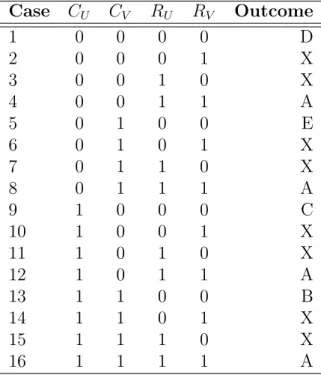
5.1 Different Outcomes in User-Vendor Games . . . 49
5.2 Normalized Utility of Different Outcomes in User-Vendor Games . . . 52
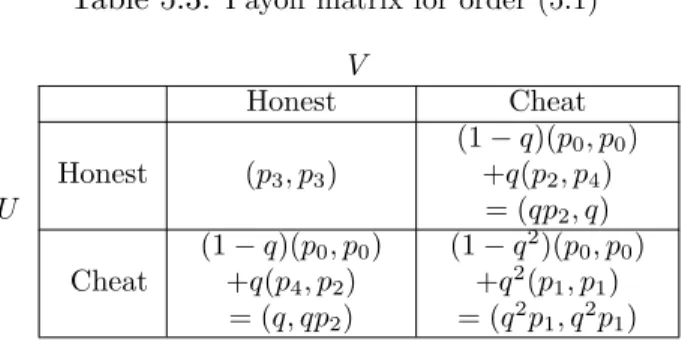
5.3 Payoff matrix for order (5.1) . . . 55
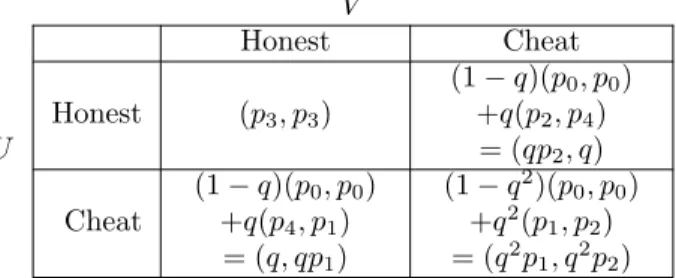
5.4 Payoff matrix for order (5.2) . . . 56
5.5 Payoff matrix for order (5.3) . . . 56
5.6 Bayesian Game forΘU =xagainstΘV =x . . . 59
5.7 Bayesian Game forΘU =xagainstΘV =y . . . 59
5.8 Bayesian Game forΘU =xagainstΘV =z . . . 60
5.9 Utilities in Bayesian Games of ΘU =x . . . 60
5.10 Ideal Solutions for Bayesian Games for All PossibleΘU . . . 61
5.11 Bayesian Game forΘU =y againstΘV =x . . . 61
5.12 Bayesian Game forΘU =y againstΘV =y . . . 62
5.13 Bayesian Game forΘU =y againstΘV =z . . . 62
5.14 Utilities in Bayesian Game, ΘU =y . . . 62
5.15 Bayesian Game forΘU =z againstΘV =x . . . 63
5.16 Bayesian Game forΘU =z againstΘV =y . . . 63
5.17 Bayesian Game forΘU =z againstΘV =z . . . 63
5.18 Utilities in Bayesian Game, ΘU =z . . . 63
6.1 Customer-Agent Game . . . 65
7.1 Deterlab Experiment . . . 72
7.2 Amazon EC2 Experiment . . . 73
8.1 Coalition Game in Proxy . . . 85
8.2 Coalition Game in Output of Relay . . . 86
Chapter 1 Introduction
While not explicitly stated in the U.S. Constitution, the rights of privacy for many aspects of our lives including religious beliefs, personal possession, and personal in-formation are protected under the Bill of Rights. Nonetheless, news about different forms of privacy invasion has become a daily affair. From sale of personal informa-tion to identity theft, from Google and YouTube surrendering user data to the mining of phone metadata by the National Security Agency, the number of ways that our privacy can be invaded seems to increase at an alarming rate.
One of the reasons for such erosion is the significant advancement in computing technologies for collecting, storing, and sharing personal information among individ-uals, private sectors, and government agencies. Anyone can now carry thousands of songs, hundreds of pictures and hours of videos in a small smart phone, ready to be exchanged, sometimes unknowingly, with anyone in the world. The focus of privacy protection often falls on medical or financial records, but it is the multimedia sig-nals – audio, images, and videos – that are driving the entire market of distributed computing while their privacy implications remain poorly understood.
The threats, however, are real. The advance in pattern recognition algorithms such as searchable surveillance or automatic speech recognition systems have turned the once labor-intensive processes into powerful automated systems. They can easily recognize objects of interest like faces, voice, and other biometric signals with high fi-delity. Correlating such information with location data such as geo-tags or RFID and other information on social networks allows hackers to easily track activities and asso-ciations of any individuals. The matter is further complicated by the unprecedented effort of the government in monitoring activities of private citizens to fight terrorism. It is thus imperative to develop a comprehensive privacy protection framework for
personal multimedia data without jeopardizing our homeland security.
While new legislature and policy changes are essential elements of such a frame-work, technologies are playing an equally pivotal role in safeguarding private informa-tion. There are two main technical challenges in protecting multimedia data. First, as signal capturing devices and wireless networks become ubiquitous, diverse applica-tions from multimedia emails and blogging to large-scale surveillance networks begin to demand some forms of privacy protection. A comprehensive framework is needed to identify appropriate sensitive information in different applications, and to provide different levels of protection depending on the role of each user in the system.
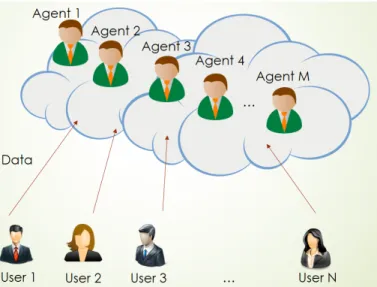
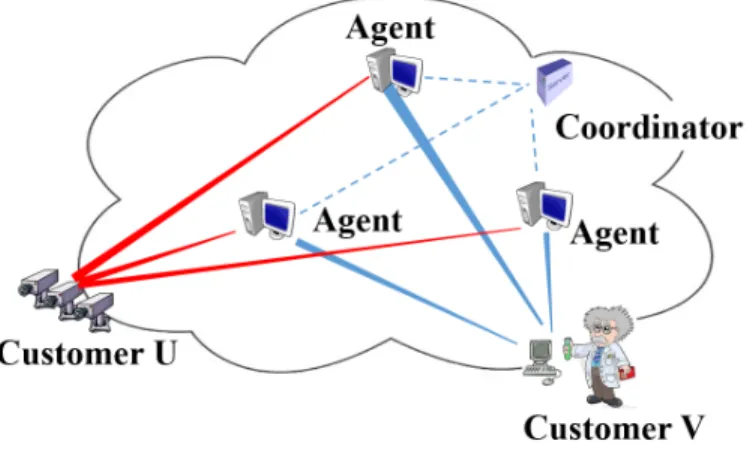
Second, from simple enhancement to sophisticated pattern recognition, multime-dia data requires various signal-processing operations to become useful. The current cloud and peer-to-peer (P2P) computing platforms have provided ubiquitous data storage for multimedia data. The computation by third parties like those cloud and P2P platforms is called the outsourced computing. Cloud and P2P computing plat-forms can process large-scale of data from multiple sources in a distributed manner. The promise of these computing platforms is grounded on its predicted pervasiveness: Internet customers will contribute their individual data and get useful services from the computing platforms. Figure 1.1 illustrates the situation of customers utilizing third parties to process their data, where customers are denoted as User 1,2, .., N
and the computing agents are operated in either cloud or P2P platforms.
There are a myriad of applications of outsourced computing. Examples include cloud storage and back up services, like Amazon Simple Storage Service (Amazon S3) [4], Dropbox [45], MEGA [90], and Carbonite [25]. In the United States of Amer-ica, the Affordable Care Act (ACA) leverages cloud-based solutions heavily [85]. Due to the fact that human DNA sequences are very large data sets, computing personally tailored drugs and personalized medical treatments according to an individual’s DNA sequence requires huge computing resources which are obtainable from the cloud
plat-Figure 1.1: Outsourced Computing Scenario
form. A mobile application was presented for the electronic healthcare data storage, update and retrieval using Cloud Computing [44]. GraphLab, a framework for ma-chine learning and data mining in the cloud, was proposed and implemented [86]. To achieve a high quality of service (QoS) provisioning for multimedia service, a media-edge cloud (MEC) architecture was proposed [140].
1.1 Application Scenario and Privacy Concerns
In the future, software developers will undoubtedly take advantage of the enormous power of various distributed computing platforms in offering various types of software services to process data. We consider a distributed computing task to have at least two participants: a user with a private input requires a service from a vendor with a proprietary software algorithm. It is easy to see why privacy is needed in any distributed multimedia processing service platform – the user may want to enhance or process a video taken using a smart phone but lacks the required capability and algorithms. The multimedia software vendor offers proprietary software for the job and charges the user based on the duration of the video needed to be processed. For simplicity, we assume that the vendor’s secrets are the key parameters used in an
otherwise well-known algorithm. For example, the parameters could be the tap values of a sophisticated filter or thresholds and weights in a neural network. The privacy objective is as follows: the user and the vendor do not trust each other and would like to prevent each other from knowing anything about their own secret information. The two parties come to the cloud server and take advantage of its enormous power and storage. The user clearly wants to protect any private information in his/her video while the software vendor needs to prevent theft of its proprietary algorithm.
Outsourced computing can fulfill its promise only if it provides a wide range of computation tasks while guaranteeing security and privacy for customers’ input data. The key challenge is to design an appropriate privacy protection scheme so that it will not compromise any legitimate processing of the data.
Current privacy violation in the outsourced computing is serious. From time to time, there are reports of cloud platforms being hacked and customers’ sensitive data compromised. Cloudminr.io, a Bitcoin Cloud Mining service, has been hacked. Its whole database of users is on sale for 1 Bitcoin [98]. In June 2015, LastPass, the cloud-based password manager, announced that its network was hacked and sensitive user information was stolen [121]. The concerns of patient privacy and information security of the ACA remain high [49]. It will be a disastrous result when the ACA medical records stored in the cloud are breached. If people’s private medical records are exposed, victims with some types of diseases may be denied jobs.
1.2 Provable Security Approaches
To overcome the concerns of privacy while utilizing powerful computing resources from third party platforms, there are two mainstream approaches for distributed computations on sensitive data with provable security and privacy. They are the differential privacy framework and the secure multi-party computation (secure MPC) framework [46, 34]. In the sequel, we provide a brief review of each framework and
evaluate their appropriateness as an outsourcing platform for multimedia data.
Differential Privacy
There is a strong need to quantify privacy in the outsourced scenario. Contributors of data to third-party platforms face several threats to their privacy [114]. Take a person participating in a large-scale health care study for example. First, the patient’s data may be recorded and exposed by a malicious application as part of the study. The malicious application could stealthily write the stolen data into a file and put it on the Internet. Then the file could be indexed by a search engine and thus further exposed to the public. Second, even if all computations are done correctly and securely, the final result itself, such as those common statistics computed in the study, may leak sensitive information about the patient’s personal medical record. To address the aforementioned concerns, traditional approaches to data privacy are to sanitize the data by syntactic anonymization, in which personally identifiable information such as names, ages, and Social Security numbers are removed. Unfortunately, the approach of anonymization does not provide provable privacy guarantees. For example, public releases of anonymized individual datasets, including AOL search logs [1] and the movie rating records of Netflix subscribers [95], eventually reveal customers’ private information. They are evidence that na¨ıve anonymization was easy to reverse in many cases. These incidents motivate a new approach called diferential privacy to protecting data privacy quantitatively [114].
Differential privacy was proposed for the purpose of enabling systems to draw inferences from datasets while preserving the privacy and security of the data and individual identities. Suppose there are nrecords in a datasetD = (x1, ...,xn), where
eachxi is a vector in Rd and represents the data collected from an individual i. The
number of elements, d, in xi can be understood as the d features of an individual.
Definition 1.2.1. An algorithmApriv(·) taking values in a setT provides-differential
privacy if
P(Apriv(D)∈ S)≤e·P(Apriv(D
0
)∈ S) (1.1)
for all measurable S ⊆ T and all datasets D and D0 differing in a single entry. The algorithm Apriv(·) provides (, δ)-differential privacy if
P(Apriv(D)∈ S)≤e·P(Apriv(D
0
)∈ S) +δ (1.2)
for all measurable S ⊆ T and all datasets D and D0 differing in a single entry.
Privacy parameters areandδ. The smallerandδare , the more privacyApriv(·)
would ensure [47, 135]. The computation under the differential privacy framework is in the interactive query model. There are two roles in the computation, one is the user and the other is the curator of the databaseD. The user submits queries to the curator and the latter replies approximate answers.
For the application of the differential privacy framework in signal processing prob-lems, there has been some progress recently. Rastogi and Nath proposed the first differential private data aggregation algorithm for distributed time-series data that offers good practical utility without relying on any trusted server [110]. To ensure differential privacy while overcoming the poor performance for time-series data by standard differential privacy techniques, they proposed the Fourier Perturbation Al-gorithm. FAST, an adaptive system to release real-time aggregate statistics under the differential privacy framework, was proposed using Kalman filter to improve the accuracy of data release per time stamp [51].
However, there are some open problems in the area of differential privacy that makes it inappropriate for the application scenario described in Section 1.1. First, the differential privacy framework provides approximate results [118], which is not satisfactory in many signal processing tasks. Second, the choice of the privacy pa-rameters and δ has little consensus. While there is heuristics on choosing , the
problem of choosingδ for the (, δ) differential privacy defined in 1.2 is poorly under-stood [48, 54]. Third, there are no differential privacy systems developed for the joint computation carried out by distrusted parties using their respective private inputs. Despite the fact that Proserpio et al. proposed distributed algorithms for publication for graph topologies [108], and McSherry and Mahajan considered the network trace problem [89], research on the networked information systems in differential privacy is still at its early stage. Thus, the general scenario in Section 1.1 is not yet ready to be deployed in the differential privacy framework.
Our focus is on two or more data owners computing jointly to obtain precise answers. While the differential privacy framework lacks mature joint computation solutions and provides only approximate results to computing tasks, the secure MPC framework provides exact outputs. Hence, we are most interested in the approach of secure MPC.
Secure Multi-Party Computation
Privacy protection in distributed computing enables distrusting parties to participate in joint computation without revealing their secret data. For example, a small com-pany can process its confidential customer data using a proprietary software from a vendor. The standard approach to protect the secrecy of data from all parties in a joint computation is to use secure multiparty computation or secure MPC protocols. The goal of secure MPC is to enable multiple distrusted parties, in the absence of any trusted third parties, to jointly compute a pre-agreed functionality based on each party’s private input. Many protocols for secure MPC have been proposed since 1982 [13]. There has been work on various secure MPC protocols for image denoising [115], joint computation among social network members [58], linear pro-gramming [127], auction [22], etc.
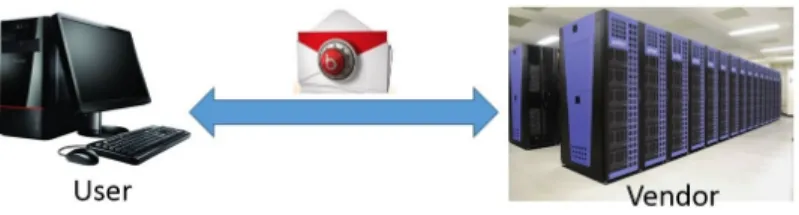
in Figure 1.2. The model has two participants, User and Vendor, each has his/her secret input. They encrypt their respective input using some secure MPC technique, with the most commonly-used one being the homomorphic encryption (HE) [103] and the garbled circuits (GC) [138]. Hence, the information exchanged between the two parties does not disclose any information about the secrets. This is the model used in encrypted-domain techniques. Data processing operations are to be performed directly on encrypted signals.
Figure 1.2: Two-party Secure Computation Scenario
Nevertheless, despite being actively researched for more than 30 years, and signif-icant advancement in the last few years [83, 123, 77], secure MPC protocols are still rarely used in practical systems since its invention by Yao [138]. The only reported large-scale application of secure MPC is the Danish sugar beet auction in January 2008 where over 1200 farmers and three servers participated [22]. The execution of the secure MPC ensured that each bid from a farmer submitted to the auction was kept secret from the time it left the bidder’s computer. The goal of the secure MPC system is to efficiently compute the price at which contracts should be traded without direct access to the actual bidding prices.
One key reason of the lack of practical secure MPC systems is the high compu-tational costs secure MPC protocols required, especially among those that rely on encrypted-domain processing. These protocols, classified as computationally secure multi-party computation (CS-MPC) protocols, achieve their security against any adversary limited to polynomial computing time. The encrypted-domain algorithms compute the desired output using only the encrypted input signals. Such techniques
have garnered much attention in recent years due to their potentials in various secu-rity and privacy applications such as biometric matching and privacy-preserving data mining [106, 82].
The key challenge facing most encrypted-domain DSP systems is the significant increase in the computational complexity. For example, Yao’s garbled circuits [138] with its variants is one of the most popular approaches for encrypted-domain DSP. The best result to-date on the performance of garbled circuit is about 1.6µs per garble gate or 625000 gates per second [83]. This is minuscule compared to most modern micro-processors, where even the slowest ones can easily execute billions of instructions per second.
There are two reasons for the enormous gap between computation in plaintext and in ciphertext: first, the protection of ciphertext relies on the computational hardness of certain mathematical problems. To ensure even a short-term protection against adversaries, a large security parameter needs to be used which results in a hundred to a thousand-fold increase in the data size. Second, the particular choice of cryptographic primitives used in the system strongly affects the implementation complexity of various basic operations. While the performance of certain operations can be optimized, most other basic operations require more complex procedures and interaction with secret owners.
An alternative is to use information-theoretic secure MPC (ITS-MPC) protocols. In these protocols, information exchanged between different parties are statistically independent of the secret data. As ITS-MPC protocols do not depend on the hardness of specific computational problems, they often admit faster implementations using a smaller prime field for data representations [134, 116, 42]. Typical baseline proto-cols for ITS-MPC include linear secret sharing [84], additive secret sharing [21], and Shamir’s secret sharing (SSS) [119]. Secret sharing schemes are schemes that decom-pose a secret number into multiple shares distributed to different parties. Individual
shares should not reveal any information about the secret but can be combined to recreate it.
SSS is among the earliest and most commonly-used ITS-MPC primitives. In SSS, secret information is first decomposed into multiple random shares using a polynomial secret sharing scheme. Similar to garbled circuits and homomorphic encryption, SSS is also homomorphic - computation with respect to addition and multiplication on se-cret numbers can be carried out through manipulation of the shares. Compared with encrypted-domain approaches, SSS does not require long keys and its implementa-tions of basic arithmetic operaimplementa-tions are usually much simpler. Unlike those encrypted-domain approaches, protocols based on SSS can achieve information-theoretic security – they guarantee security against an adversary with infinite computing power. Di-rect computation on shares is ideally suitable for privacy and security enhancement of high data-rate applications such as multimedia processing and data mining. It has been applied in many areas from typical privacy-enhanced applications such as auction [22] and private information retrieval [42], to signal-processing applications including medical data visualization [91], image processing [116] and video surveil-lance [126].
A drawback of SSS is the need to maintain a fraction of the computational parties non-colluding [16]. Specifically for SSS, computation is only feasible with at least three non-colluding semi-honest shareholders. Researchers have long pointed out the danger of collusion attacks in outsourced computation [40]. In fact, these attacks are significant real-life problems and occur in many networked applications. In online Poker and P2P file sharing, cheaters collude to have advantage over other honest players [59, 80]. PokerStars, one of the the largest online poker cardrooms in the world, recruits special security personnel to manually investigate special play patterns to uncover collusion patterns [59], and prohibits players from the same country to be in the same game [5]. Colluding communication usually exists in two different forms:
it can occur in side-channels external to the protocols, or as hidden data within, otherwise known as subliminal communication [2]. Algorithmically, it is impossible to design protocols to curtail communications over unknown side-channels. Existing anti-collusion techniques focus on eliminating subliminal communication by relying on either a semi-honest/trusted centralized server [2, 3] or a specially-designed ballot box [73]. These require heavy computation at a fortified centralized server, which defeats the efficiency goal of using SSS based ITS-MPC techniques.
1.3 Contributions
In this dissertation, our main contribution is the collusion deterrence for the ITS-MPC framework. We propose a collusion-deterred outsourced computing platform using SSS as a building block. This platform consists of a set of computing agents that provide computing services for secret-data owners to collaborate on joint com-putation using secret shares. Collusion, modeled as a covert adversarial behavior, can occur between one of the data owners and a portion of computing agents, or among the computing agents themselves. Unlike existing approaches, we model collusion as games and propose various mechanism designs that lead to honesty as stable strate-gies. The advantage of our approach is that no centralized server or computationally-intensive protocols are needed, making our solutions ideal for high-throughput signal processing applications. Our treatment is also comprehensive because the proposed models can handle different types of collusion attacks including those that may not be detected at all by the participants. In this dissertation, we further apply Bayesian games to better model the uncertainty in data owners’ privacy preference, propose a new censorship scheme to thwart collusion among computing agents, and provide additional experimental results to show the efficiency of SSS-based algorithms over other state-of-the-arts CS-MPC protocols.
1.4 Dissertation Organization
This dissertation is structured as follows. In Chapter 2 we present the information of related work for secure MPC, collusion deterrence, and secret sharing. In Chapter 3, we summarize general operations of signal processing in the secret sharing domain, specifically, using the Shamir’s secret sharing (SSS). We also describe the secure MPC based on SSS in terms of its security model, its classification according to the com-putational power of the adversary, and the comcom-putational techniques for building arithmetic operations. To demonstrate the usefulness of secret sharing domain signal processing, we propose an application of image denoising through wavelets trans-form. In Chapter 4 we discuss the collusion attacks under our proposed framework. In Chapter 5 we propose and analyze our game-theoretic mechanism designs for the collusion deterrence between customers. In Chapter 6 we describe analyze further mechanism designs as well as a censorship scheme for the collusion deterrence for computing agents. Experimental results are presented in Chapter 7. Finally, Chap-ter 8 concludes this dissertation and points out future directions.
Chapter 2 Related Work
In this chapter, we provide a review for the area of secure MPC. We survey existing tools for both computational secure MPC (CS-MPC) and information-theoretic secure MPC (ITS-MPC). After that, we summarize previous efforts on counter-measuring collusion attacks in secure MPC protocols. Then we provide an overview of existing game-theoretic perspectives on secure MPC, which are relevant but different from our approach. Finally, we finish our review with a discussion of secret sharing schemes.
2.1 Secure MPC Review
The study of secure multiparty computation started in the 1980s [138]. There are four main types of secure MPC primitives: Garbled Circuits (GC) [138], Homomorphic Encryption (HE) [111, 57], GMW protocol [61], and BGW protocol [12]. GC is one of the most well-developed secure MPC protocols. It provides a generic two-party implementation of any binary function by having one party prepare an encrypted Boolean circuit, and another party evaluate the circuit using the public-key based oblivious transfer protocol [75]. In recent years, there have been significant advances in optimizing the basic GC protocols [70, 77, 123], and in developing novel efficient hybrid circuits [83, 97].
Homomorphic encryption is a special kind of public-key encryption where some al-gebraic manipulations on plaintext numbers can be realized in the encrypted domain. Earlier homomorphic encryption such as RSA [112], ElGamal [50], and Paillier [104] are only partially homomorphic. Fully homomorphic encryption or FHE was proposed in [57] but remained highly complex and impractical for realistic computations [92]. Nevertheless, recent work [39, 23] has demonstrated efficient implementations of small circuits using the so-called somewhat homomorphic encryption (SHE).
Compared with the original plaintext computation circuit, the reliance on public-key protocols like oblivious transfer and homomorphic encryption significantly in-creases the size of the encrypted circuit. Instead of public-key based representations, the protocol proposed by O. Goldreich, S. Micali, and A. Wigderson, or the GMW protocol [62], and the protocol by M. Ben-Or, S. Goldwasser, and A. Wigderson, oe the BGW protocol [12], use secret sharing schemes such as Shamir’s Secret Sharing (SSS) scheme [119] to protect the secrecy of the operands. While GMW still re-quires oblivious transfer to protect against malicious adversaries, the BGW protocol is free of any expensive public-key operations and can use any prime field to achieve information-theoretic security (ITS). The efficiency of the BGW protocol makes it the basis of some ITS-MPC platforms including FairplayMP [11] and Sharemind [21], the latter being used by the Estonian Government in studying the linkage of tax and education records [20]. The focus of this dissertation is on building the application framework for the BGW protocol, specifically with the SSS building block, for signal processing.
The use of secure MPC in signal processing has a late start due to the sub-stantial challenges in adapting the complex protocols to handle the high data rate and real-time response demanded by typical signal processing applications. One of the earliest projects, SPED (Signal Processing in the Encrypted Domain) and its follow-on research were products of joint efforts between the applied cryptography and signal processing communities, resulting in a number of homomorphic encryp-tion based implementaencryp-tions of fundamental algorithms such as Fourier Transform and filtering [41, 107, 18, 19]. Since then, there have been many other privacy en-hanced applications from audio processing to biometric matching developed using both GC and HE. Interested readers should consult survey papers in this area such as [87, 52, 105]. Recently, efficient SSS-based protocols started to emerge in dif-ferent signal-processing applications including medical data visualization [91], image
denoising [116], video surveillance [126], and outsourced image enhancement [78].
2.2 Adversarial Model and Collusion Attacks in ITS-MPC Protocols
A key weakness of the BGW protocol is its susceptibility to collusion attacks. In SSS, the secret can be reconstructed using shares from a subset of the computational par-ties. The smallest size of such a subset is called the threshold of the SSS scheme and it has been shown that the threshold cannot be smaller than half of the total number of parties [12]. A collusion attack occurs when an adversary with malicious intent controls the threshold or more parties in a joint computation. In the most general case, when parties are connected by pairwise communication channels, collusion-free protocols for computing non-trivial functions are impossible [3]. For our target ap-plication of outsourced computation, we provide a detailed analysis of different col-lusion attack scenarios in Section 4.2. Typical cryptographic approaches to counter collusion include the use of centralized trusted mediators [2, 3] and complex crypto-graphical constructions [12, 73]. These computationally intensive constructions are incompatible with our efficiency goal in applying secure MPC techniques for high-rate distributed signal processing applications.
Our focus on solving collusion attacks in outsourced computation stems from its significant differences from other types of adversarial attacks. General consideration of attacks on secure MPC protocols include two different aspects: 1) how parties are identified and corrupted by an adversary, and 2) how corrupt parties behave under the control of an adversary. For the first aspect, existing classifications typically focus on whether an honest party becomes corrupted during the course of the computation [67]. For collusion attacks, this question is less important than how an honest party is corrupted by an adversary to collude in stealing a secret - is it due to information received in-band as part of the defined protocol or out-of-band through side channels? The first kind is termed a local adversary attack as it is based on local information
anticipated by the protocol. The local adversarial model has been used to model collusion attacks before [24] and will be assumed in our protocol design.
As for the second question, adversarial behaviors are typically classified into semi-honest and malicious. Semi-semi-honest refers to behaviors that do not deviate from the protocols but attempts to extract useful information from received data. The SSS protocols described in Section 4.1 are secure under a honest model. The semi-honest model is quite limited in practice - it certainly cannot capture an attempt of a corrupted party to persuade others to collude. The other end of the spectrum is the malicious model which puts no restriction on the behaviors of a corrupted party, which can disrupt and terminate the protocol at any time. Classical feasibility results have already demonstrated that IT security can be achieved by an addition of a broadcast channel and the use of verifiable secret sharing [109]. These additions, however, significantly limit their applications due to a much higher computation complexity.
More importantly, the malicious model does not model colluding activities ad-equately. First, in the presence of side channels, collusion can occur entirely out-of-band and it is impossible to counter using only protocol design. Second, it does not address the dynamic nature of collusion in which an honest participant agrees or refuses to collude. Assuming that there is a rational being behind each participant, there must be an external reason behind this decision such as a higher reward or a non-negligible probability of getting caught. Such behaviors can be modeled with a covert adversarial model in which a malicious attack can be deterred if the adversary can be caught with high probability [8]. Many work have used this security notion to design protocols that are more practical and efficient than those based on the no-tion of malicious adversary. They achieve computano-tional security using the building blocks of oblivious transfer and homomorphic encryption [96, 7]. In [37], the authors showed a general procedure to compile a protocol robust against the passive adver-sary into a protocol against the covert adveradver-sary with cheating behavior being caught
at a probability of 1
4 or higher. Their benchmark on an AES cipher demonstrated a significant performance enhancement over the baseline protocol that is secure against the malicious adversary [38].
2.3 Game-Theoretic Analysis for Secure MPC
More fundamental to the protocol design is to address the rationality behind adversar-ial behaviors. The use of game theory nicely captures the rationality of adversaries in many commercial, political, and social settings: weighing the gain of cheating against the risk and loss of being caught [66, 120]. The seminal work on rational secret sharing and secure MPC by Halpern and Teague first took into account the rational decision making process of the participants [65]. Since then, there has been several work focus-ing on various aspects of rational secure MPC includfocus-ing mixed-behavior models [88], rational ITS-MPC over broadcast channels [76], and computationally efficient rational secret sharing [53]. Other work attempts to recast the secure MPC problem from a game-theoretic perspective. In [6], the authors investigated two-party computation in the context of a fail-stop game and extended the notions of privacy, correctness, and fairness through equilibrium definitions from game theory. Recently, rational secret sharing has also been extended to incorporate perfect Bayesian equilibrium to model imperfect designs [131].
However, the problem addressed by the work[6, 131] is different from ours. They provide solutions on how to encourage all agents to honestly carry out the computa-tion so that the agents themselves can benefit from knowing the final answers. Such formulation is not suitable for the computation outsourcing scenarios that we are addressing. For outsourcing, the computational agents have no stake on the actual secrets as they are simply carrying out a pre-defined computation in exchange for some kind of reward. Also, the active involvement of an agent in a collusion at-tack does not necessarily disrupt the computational process and the customers can
still obtain the correct final results. As a result, our work primarily focuses on the mechanism designed to cope with the heterogeneous nature of the games involving both customers and computational agents as well as imperfect knowledge behind their utility functions.
2.4 Secret Sharing Schemes
A secret sharing scheme serves as a procedure that involves two types of roles: the secret owner and the share holding parties. The secret owner acts as a dealer to dis-tribute shares to parties so that only authorized subsets of parties can reconstruct the secret. Secret sharing schemes are important building blocks in cryptography and they are used in many secure protocols. They have found a broad range of important ap-plications. For example, general protocol for multi-party computation [14], Byzantine agreement [109], threshold cryptography [56, 74], access control [93], attribute-based encryption [63], and generalized oblivious transfer [71, 124].
Here we briefly review some of the most interesting constructions of secret sharing schemes that are linear, that is, the distribution scheme is a linear mapping. We are most interested in Shamir’s Secret Sharing (SSS), which is the building block for the system proposed in this dissertation. It enjoys the property of homomorphism – that addition and multiplication can be carried out directly on the shares [16]. SSS belongs to the category of threshold secret sharing schemes, where the authorized sets, or the access structure, are all sets whose size is bigger than some threshold. A (t, n) SSS has the threshold beingt and there are a total ofn parties. Bothtandn are integers and 1≤t ≤n. The access structure can be defined as At={B ⊆ {p1, ..., pn}:|B| ≥ t},
where pi, i ∈ {1, ..., n} is the i−th party. The secret is hidden as the constant term
of a polynomial with random coefficients chosen by the secret owner. The shares are evaluated at different points of the polynomial. A detailed review and discussion of SSS can be found in Section 3.1. Benaloh and Rudich constructed a secret-sharing
scheme that has its access structure corresponding to edges of a complete undirected graph with m vertices v1, ..., vm. A secret bit k is shared into (m −2) bits. Each
of the (m −2) parties will have a bit calculated based on the generated bits [10]. Ito et al. defined secret sharing schemes for general access structures. They showed the construction of such schemes for every monotone access structure. Let A be any monotone access structure. The secret owner shares the secret independently for each authorized setB ∈ A[72]. Generalizing the construction of [72], Benaloh and Leichter proposed a construction of secret-sharing schemes for any monotone formulae access structure. The length of the shares becomes exponential in the number of parties [15]. There is another category of secret sharing used for visual cryptography. It allows secret visual information to be embedded and encrypted in a cover image such that a well defined subset of the shared cover image could be overlapped to reconstruct the secret visual information [30].
Chapter 3 Encrypted Domain Signal Processing
In this chapter, we extend the basic homomorphic properties of Shamir’s sharing scheme to handle common signal processing operations such as filtering and thresh-olding. Based on these building blocks, we design an information-theoretically secure protocol for distributed wavelet denoising. The operational setting of the protocol described in Section 1.1 is repeated here as follows: a user U has an image which he/she wants to keep private but requires denoising. A software provider called V
the Vendor holds a proprietary wavelet filter and a denoising threshold. After de-composing their secret data into random shares, the shares are transmitted to three computing parties in a network which provides point-to-point secure communication. We assume that all three parties do not collude on their shares, and we will demon-strate that the received data contain no information about the image nor the filter. Once the computation is complete, the resulting shares are transmitted back to the user to reassemble the denoised image. The key contributions of our work include the development of information-theoretic secure signal processing building blocks with secret shares and the demonstration of a realistic image processing algorithm using the proposed framework. The organization of the Chapter is as follows: Section 3.1 reviews the Shamir’s secret sharing scheme and defines notations used in the rest of the chapter. Section 3.2 shows how fundamental operations for signal processing can be implemented with secret sharing. Section 3.3 describes our secure image de-noising protocol and analyzes its complexity. We provide implementation details and experimental results in Section 3.4, and conclude the chapter in Section 3.5.
3.1 Shamir’s Secret Sharing
Let x be a number in a prime field Fm with m prime. Let n be the number of
parties and t, called the threshold, be a positive integer between 1 and n. A (t, n) secret-sharing scheme of a secret numberx producesnshares [x]t
i, i= 1,2, . . . , nsuch
that any group of t or more shares can be used to reconstruct x. Any group of less than t shares, however, provides no information about x. Shamir’s secret sharing scheme hides the secret as the constant term of a random degree (t−1) polynomial. The polynomial coefficientsαj’s are uniformly random numbers selected by the secret
owner. The secret owner generates the ith share by evaluating the polynomial at a
public constant ki which usually is agreed to be the identity number of theith party:
[x]ti ,
t−1 X
j=1
αjkij+xmodm. (3.1)
The fact that αj’s are uniformly random in a prime field implies that the shares must
also be uniformly random, thereby providing no information about x. Given at least
t shares, the secret number x can be reconstructed with Lagrange interpolation
x=X
i∈K
γi[x]ti modm (3.2)
where γi ,Qj∈K,j6=i −kj
ki−kj and K is any subset of {1, . . . , n} with at least t elements.
Let x, y ∈ Fm be secret numbers and a, b ∈ Fm be constants. The following
properties of Shamir’s scheme are well known [16]:
(P1) [x+amodm]t i = [x]ti +a modm (P2) [axmodm]ti =a[x]ti modm (P3) [x+ymodm]max(i s,t) = [x]s i + [y]ti modm (P4) [xymodm]i(s+t)−1 = [x]s i[y]ti modm
(P5) Assume x, y ∈ {0,1}and ⊕denotes xor. [x⊕y]i(s+t)−1 = [x]s i + [y]ti−2[x]si[y]ti modm (P6) [x]ti =Pn j=1γj[[x] (s+t)−1 j ]ti modm
P1 through P5 form the foundation of computation in secret shares – they show that performing certain operations on each share of secret numbers is equivalent to applying those operations first on the secret numbers and then creating the shares. These operations include addition and multiplication with constants, with other se-cret numbers, and exclusive-or on sese-cret bits. These operations are universal in the sense that any computation on a digital computer can be composed by successive applications of these fundamental operations. Since the original shares do not reveal any information about the secret numbers, no successive operations on the shares can gain further knowledge. At the end of the operations, the secret owner can collect enough shares to reveal the result.
There are however hidden communication cost associated with some of these op-erations. Multiplication and exclusive-or operations (P4 and P5) produce results in a sharing scheme with a higher threshold (s+t)−2, where s and t are the original thresholds of the two secret operands. Repeated applications of such operations will eventually arrive at a threshold larger than the number of partiesnand the final result cannot be reconstructed even if all the shares are available. We can solve this prob-lem by renormalizing the threshold using P6: each party further breaks his/her share into separate shares and sends a share to its corresponding party. The final share at each party is computed by a weighted summation of these newly received shares from other parties. Since each party receives only one share from any other party, no secret information is leaked. This threshold reduction requires n(n−1) logm bits to be exchanged among the n parties. Denote computing parties as Pk for k = 1, ..., n.
To highlight the communication between two computing parties Pi and Pj, we use
(P6’) Pj : [[expr(x)]qj]ti −→Pi : [x]ti for i6=j
The expr(·) operator in P6’ can include a composition of different operations which increase the threshold to beq > tthat may result in one or more steps of renormaliza-tion. After those steps of renormalization, the new share will again has the threshold to bet.
An obvious omission from the above properties is division between two secret numbers. To compute xy−1 modm, y−1 must exist in F
m. We denote the inverse
operation as follows:
(P7) INVERSE ([y]t
i alli)−→Pi : ([y−1]ti)
INVERSE can be implemented by repeated multiplications according to the Carmichael’s theorem [113]: y−1 = yλ(m)−1 modm, where λ(m) is the (reduced) totient function. Notice that with this equation, the inverse of 0 is defined and is equal to 0. For prime
m, λ(m) = m−1. For large λ(m)−1, the inverse operation is expensive as every multiplication requires a renormalization step. To reduce the number of multiplica-tions, we can first expressλ(m)−1 as a sum of powers of two, sayλ(m)−1 = 1011 base 2 which implies yλ(m)−1 = y4y2y. We can then recursively compute [y2]ti and [y4]ti before multiplying them together to get the final answer. The communication complexity will beO(logλ(m)) rather thanO(λ(m)) in the sequential multiplication.
3.2 Signal Processing on Random Shares
Armed with the basic properties, many commonly used signal processing operations can be implemented. For example, in a linear convolution operation, two parties holding a secret signal x(t) and a filter h(t) can create n shares independently and distribute them ton parties to perform a privacy-protected linear filtering:
" X τ x(t−τ)h(τ) #2t−1 i =X τ [x(t−τ)]it[h(τ)]ti (3.3)
In this section, we survey a set of state-of-art arithmetic operations implemented in the secret sharing domain. These protocols can form the toolbox for privacy protecting signal processing tasks. These protocols are designed for integer and fixed point numbers. They achieve perfect privacy or statistical privacy.
With the domain and range in a prime field Zm, a function can be represented in the form of an arithmetic circuit or in the form of a Boolean circuit. While the basic addition and multiplication of shares can be computed in an arithmetic circuit, non-linear operations such as equality test and comparison are more easily done in the Boolean circuit. Thus a first step to process shares will be to decompose them into bit representations. To simplify our notation for a share, we drop the subscripts
iand twhich stand for theith party and the threshold. Suppose a secretxhas l bits.
The share ofxis denoted by [x]. The bitwise sharing ofxis denoted as [x]B. The goal
is to get [xl−1], ...,[x0] which satisfies x= Pl−1
i=02
ix
i, i.e. [x]B = [xl−1], ...,[x0]. Denote a random number from Zm as r. We use several primitive protocols to simplify our descriptions. They are Rand(Zm) which generates a random element from the
prime field Zm, Output([x]) which reveals the number x from its shares [x], and
[x < y?1 : 0]←Bitlt([x]B,[y]B) which carries out bit-wise comparison ofx and yin
shares and outputs 1 if x < y, otherwise 0 [36].
Bit Decomposition
Damg˚ard et al. proposed bit decomposition with unconditional security with con-stant rounds [36]. Nishide and Ohta improved upon Damg˚ard’s work to achieve less complexity [99]. Their bit decomposition protocol is summarized in Protocol 1.
Require: [x]
Ensure: [x]B
1. [r]B ←Rand(Zm)
2. [r]←[r]B
3. [c] = [x]−[r]
4. c←Output([c]). If c= 0 done, because [r]B = [x]B by a coincidence.
5. If c6= 0, compute [q] = [m≤r+c]←1−Bitlt([r]B,[m−c]B)
6. Computedi fori= 0, ..., l−1 that satisfies 2l+c−m=
Pl−1
i=02
id
i, and compute
fi for i= 0, ..., l−1 that satisfiesc=Pl −1
i=02
if i.
7. Compute [gi] = (di−fi)[q] +fi for i= 0, ..., l−1, i.e. [g]B.
8. Compute [h]B = [r]B+ [g]B.
9. Discard [hl] from [h]B to obtain [x]B.
Protocol 1: DECOMPOSITION [x]→[x]B
Truncation
The truncation operation is a core component in the fixed-point arithmetic. Denote signed integers asZhki ={x¯∈Z| −2k−1 ≤x¯≤2k−1−1}. Signed integers are encoded
in the prime field Zm by x=x mod m, m >2k where m is a prime. The truncation
protocol computes ¯d = bx/¯ 2s+uc, where ¯x ∈
Zhki and s ∈ [1, ..., k −1]. The bit u
depends on the rounding method. Catrina and Hoogh proposed a truncation protocol that achieves statistical privacy [27]. Their protocol is summarized in Protocol 2.
Equality Test
Given two secret numbers x, y ∈ Zm, the equality test protocol computes [(x ==
y?1 : 0)]. The problem of deciding whether x=y is equivalent to whether x−y= 0. Leta =x−y, and c=a+r where r is a random number. Note that c=r if a = 0. Nishide and Ohta proposed an equality test protocol without decomposing the secret
Require: [x], k, s Ensure: [d] 1. [r00]←Rand(Zhki), [r0]←Rand(Zhki) 2. [r0]B ←Decomposition([r0]) 3. c←Output(2k−1+ [x] + 2s[r00] + [r0]) 4. c0 ←cmod 2s 5. [d]←([x]−c0+ [r0])(2−s modm)
Protocol 2: TRUNCATION [d]←Trunc([x], k, s)
d into bits. Their protocol is summarized in Protocol 3.
Require: [x],[y] Ensure: [w] = [(x==y)?1 : 0] 1. [r]B ←Rand(Zm) 2. [r]←[r]B 3. [a] = [x−y], [c] = [a] + [r] 4. c←Output([c])
5. Represent cbitwise ascl−1, ..., c0, and denote new variable [c0i] fori= 0, ..., l−1.
Ifci = 1, [c0i] = [ri].
Else ifci = 0, [c0i] = 1−[ri]. Note that c0i = 1 iff ci =ri.
6. [w] =Vl−1
i=0[c
0 i].
Protocol 3: EQUALITY-TEST [w]←EqualityTest([x],[y])
Interval Test
The interval test protocol is to decide whether a secret element x∈Zm is within the interval [c1, c2] or not, where public constants c1, c2 ∈ Zm and c1 < c2. Nishide and Ohta proposed an interval testing protocol without decomposing the secret x into bits. Their protocol is summarized in Protocol 4.
Require: [x], c1, c2 Ensure: [d] = [([c1 < x < c2])?1 : 0] 1. [r]B ←Rand(Zm) 2. [r]←[r]B 3. [c] = [a] + [r] 4. c←Output([c]) 5. If c1 < c < c2 is not true, Ifc2 ≤c, [d1] =Bitlt([c−c2]B,[r]B), [d2] =Bitlt([c−c1]B,[r]B), [d] = [d1]×[d2]. Ifc≤c1, [d1] =Bitlt([c+m−c2]B,[r]B), [d2] =Bitlt([c+m−c1]B,[r]B), [d] = [d1]×[d2]. 6. If c1 < c < c2 is not true, [d1] =Bitlt([c−c1−1]B,[r]B), [d2] =Bitlt([c+m−c2+ 1]B,[r]B), [d3] = [d1]×[d2], [d] = 1−[d3].
Protocol 4: INTERVAL-TEST [d]←IntervalTest([x], c1, c2)
Exponentiation
Given a public constant a ∈ Zm and the secret x ∈ Z, the secure MPC protocol of exponentiation calculates xa modm ∈ Zm. Damg˚ard et al. proposed a private
exponentiation protocol with perfect privacy summarized as follows in Protocol 5 [36].
Comparison
Comparison is central to non-linear signal processing. To implement comparison, we first need to clarify its semantics in the prime field Fm. We allow negative secret
Require: [x], a
Ensure: [xa]
1. [r]←Rand(Zm), compute [ra].
2. Compute [xr], and reveal xr←Output([xr]). 3. Compute y= (xr)a=xara.
4. [xa] =y[r−a] =y[(ra)−1].
Protocol 5: EXPONENTIATION Exp([x], a)
number −x to be represented by m − x in Fm. Thus, a comparison of x > 0 is
equivalent to xmodm < dm/2e. Second, we need to select m to be at least twice as big as the dynamic range of any intermediate and final values in the target signal processing algorithm. This is necessary to ensure that we can represent both xmax−
xminandxmin−xmaxinFm wherexmaxandxminare the largest and smallest numbers.
To handle the non-linear nature of comparison, we rely on the radix-2 representations of the numbers. Let us start with a simpler version of comparison that compares two secret numbers v and w in plaintext stored at two different parties. To simplify the description of the protocol, we assume a three-party computation, i.e. n = 3 and
t= 2. The notation of this comparison protocol is as follows:
(P8) COMPARE2 (v atP1,w at P2)−→Pi : [v > w]2i
where the binary predicate v > w is 1 if true and 0 if false. Notice the binary output is represented inF5, which is the smallest prime field one can use to represent a secret among three parties. We use such a small prime field to minimize the communication overhead. The details of the protocol are given in Protocol 6 [117].
Correctness: Steps 1 and 2 create shares for each bit in v and w. Step 3 computes the expression (v0 −w0+ 1), which is 2 if v0 > w0, 0 if v0 < w0, and 1 otherwise. For the subsequent bits, bj at step 4 is 1 until the corresponding bits from v and w
Require: v atP1,w at P2, and [b0]2i ,[1]2i
Ensure: [c]2i at party Pi fori= 1,2,3 where c,(v > w).
1. P1,2 :v ,v0. . . vl−1 base 2,w,w0. . . wl−1 base 2 2. P1,2 : [vj]2i,[wj]2i −→Pi for j = 0, . . . , l−1. 3. Pi : [c]2i ,[v0−w0+ 1]2i 4. for k= 1 to 3 and j = 1 to l−1 Pk : [[bj−1(1−vj−1⊕wj−1)]3k] 2 i −→Pi : [bj] 2 i Pk : [[c(vj −wj + 2−bj)]3k]2i −→Pi : [c]2i 5. Pk : [[c4]k] 2 i −→Pi : [c] 2 i Protocol 6: COMPARE2(v, w)
the bits start to differ – it will be 0 if v < w and 2 if w > v. This leads to c = 0 if v < w. The subsequent steps inside the loop will not produce another 0 because
bj = 0 and vj−wj + 2−bj can only be 1 or 3. As such, cis 0 if and only if v < w.
At step 5, we invoke the Carmichael’s theorem to ensure that the output can only be 0 or 1. Security & Complexity: Communications occur at steps 2, 4, and 5. Step 2 is the initial distribution of shares and the rest are all renormalization steps. As such, none of them provide any additional information. The protocol is thus secure. The communication complexity of COMPARE2 is (20l−6) log 5 bits.
COMPARE2 requires the plaintext of the secret numbers while a proper COM-PARE function should assume that each party has access to only a share of the secret numbers. We will take the difference between the two secret numbers as [x]t
i and
develop the COMPARE function to determine if x <dm/2e as follows:
(P9) COMPARE ([x]2
i alli)−→Pi : [x <dm/2e]ti
Correctness: Steps 1 through 4 creates plaintext numbers v and w at party 2 and 3 to represent x using (3.2) such that
Require: [x]2i at party Pi for i= 1,2,3 Ensure: [d]2
i at party Pi for i= 1,2,3 whered,(x <dm/2e).
1. P1 : a random r−→P2. 2. P1 :u,γ1[x]21−r−→P3. 3. P2 :v ,γ2[x]22+r 4. P3 :w,γ3[x]23+u 5. COMPARE2(m−v,bm/2c+w)−→[a]2 i 6. COMPARE2(v, m−w)−→[b]2 i 7. COMPARE2(m+dm/2e −v, w)−→[c]2i 8. Pk : [[a⊕(bc)]k] 2 i −→Pi : [d]2i
Protocol 7: COMPARE [x]ti fori= 1,2,3
If x <dm/2e, then one of the following two statements must hold:
v modm+wmodm < dm/2e (3.4)
m ≤ v modm+wmodm < m+dm/2e (3.5)
Step 5 checks the inequality in (3.4), and steps 6 and 7 check (3.5). Since the two steps cannot both return 1, the output can be computed using an exclusive-or as in step 8. Security & Complexity: Since r is random, party 2 and 3 cannot gain any knowledge about the original share of party 1. The security of the rest of the protocol is guaranteed by that of COMPARE2. The communication complexity of COMPARE is 2l+ (60l−6) log 5 bits.
3.3 Privacy-Protected Image Denoising
This section describes the adaptation of wavelet denoising into secret shares. As described in Section 1.1, two customers, User U and a software provider Vendor
V come to a third party computing platform for a joint task. U owns a secret image and V owns the filters and the denoising parameters. All secret data will be
decomposed into random shares which are distributed to three non-colluding semi-honest computational parties to execute the algorithm.
Discrete Wavelet Transform (DWT)
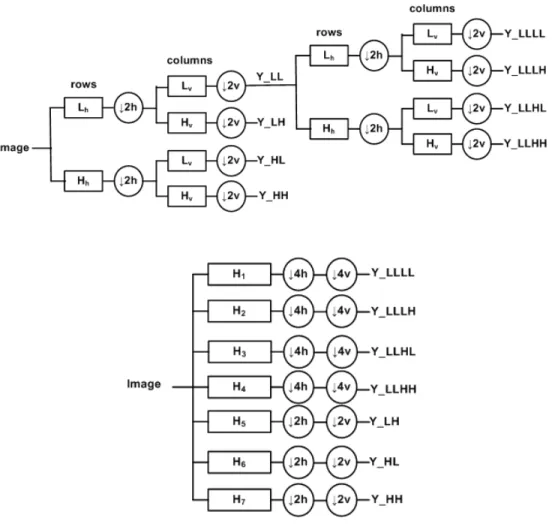
DWT is the first step of many important image processing functions including de-noising, compression, and enhancement. The most common implementation of DWT is via a dyadic tree, shown in Figure 3.1 (a). Such an implementation involves the repeated application of linear filtering. In order to preserve the homomorphism, a renormalization step needs to be applied after each level of filtering. Let’s consider the communication complexity of implementing a 2-level 2D-DWT. Suppose the size of the initial secret share is l bits per pixel for the image. We ignore the contribu-tions from the filters which are small compared with the image. Initial dissemination creates 3l bits per pixel. After horizontal filtering, the first renormalization gener-ates an additional 6l bits per pixel. As the second level of DWT applies only to the lowest frequency subband, it generates an addition 6· l
4 = 3l
2 bits per pixel for each of the vertical and horizontal filtering. The overall communication overhead is thus 3l+ 6l + 3l = 12l bits per pixel. Alternatively, we can flatten the dyadic tree into a filter bank of seven subband filters as shown in Figure 3.1 (b). The filter bank itself can be computed by passing a single impulse as an input signal to the dyadic DWT. As the input has only 1 pixel, the communication overhead is negligible. The subsequent processing on the random shares of the image does not need any commu-nication beyond the initial distribution of the shares, which amount to only 3l bits per pixel or 14 of that required by a dyadic tree implementation. The computation complexity increases slightly due to the use of 2-D filters.
Figure 3.1: Two implementations of DWT: (a) via a dyadic tree, (b) the flattened version of (a)
Wavelet shrinkage
In this section, we describe our implementation of a popular wavelet shrinkage denois-ing technique called BayesShrink [29]. While keepdenois-ing the wavelet coefficients from the lowest frequency subbandyL intact, coefficients from the high frequency subbandsyH
are shrunk by a thresholdλ if their absolute values are bigger thanλ or set to zero if smaller. In the share domain, this shrinkage function can be implemented with the COMPARE protocol from Section 3.2:
δλ(yH(i)) , COMPARE(yH(i), λ)(yH(i)−λ) +
There are many different approaches to determine λ and we use λ = σ2
y/σw, where
σy is the estimated noise variance of the image:
σy =
PN
i=1|yHH(i)|
0.6745N (3.7)
withyHHdenoting the highest diagonal frequency subband andNits size. σw estimate
the noise variance of the particular subband to be denoised:
σw = " max 1 Nw Nw X i=1 yw(i)2−σy2,0 !#1/2 (3.8)
withyw denoting the subband andNw denoting the number of coefficients inyw. This
implementation is a slight variation of that described in [29].
While it is possible to implement these equations entirely in the secret share domain, the protocol will reveal the threshold calculation process – a key step which the software provider may want to keep as a secret. To keep this step proprietary, we compute subband statistics including P
i|yHH(i)| and
P
iyw(i)
2 in shares but reconstruct the final statistics into plaintext for the software provider to determineλ. Such statistics reveal little information about the details of the image but enable the software provider the flexibility in determining the threshold in private. Finally, the provider will create 3 shares of λand send them back to the computational agents to complete the shrinkage from Equation (3.6). A final remark about the calculations of the two subband statistics: to prevent possible overflow, we use multiple words to keep track of overflow digits. For example, if we want to hold the running sum in two words S0 and S1, we will first compute the carry bit C = COMPARE(S0, Rmax−x)
whereRmax is the range for one word and x < Rmax is the next number to be added.
Then, we store the results in two words: S1 ,S1+C and S0 ,S0−CRmax+x.
3.4 System Implementation and Experiments
We implement our protocols in MATLAB on five different machines on the same LAN. Machines representing the user and the filter owner carry out the simple tasks
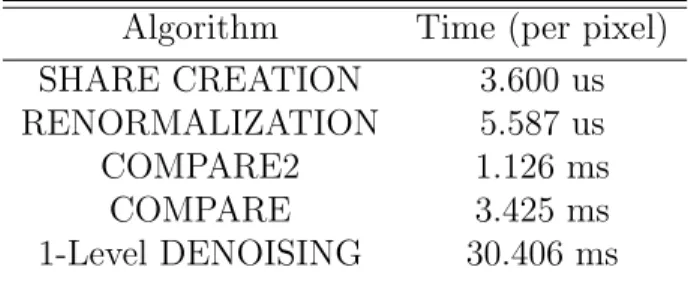
generating shares and assembling the final results. The bulk of the computation are done at the three machines corresponding to the computational agents. They all run windows 7 with 4 GB RAM on Intel Core 2 Quad CPU Q9650 @ 3 GHz. For the wavelet filters, we use the rationalized version of the 9/7 biorthogonal pair of Co-hen, Daubechies, and Feauveau [125]. We chose the modulus m to be the prime just greater than 231 and evaluate the shares at ki = 1,2,and 3. Table 3.1 provides time
measurements including data transmission time of the proposed algorithms using a 9/7 wavelet filter on a 128×128 image. RENORMALIZATION is essentially the
Table 3.1: Time measurements of different protocols
Algorithm Time (per pixel)
SHARE CREATION 3.600 us
RENORMALIZATION 5.587 us
COMPARE2 1.126 ms
COMPARE 3.425 ms
1-Level DENOISING 30.406 ms
same as SHARE CREATION plus network time in distributing shares. Their differ-ence highlights the fact that a significant portion of time is devoted for networking. COMPARE2 represents a significant increase in complexity compared with the more elementary functions. Even though we execute each step of our protocol over the entire image so that we can accumulate enough information for better network uti-lization, the repeated usage of renormalization in COMPARE2 significantly increases the time spent on data transmission. For a 1-level denoising scheme, roughly 10 COMPARE operations are used per pixel – two are for shrinkage while the remaining eight are for statistics computation.
3.5 Summary
In this chapter, we have presented information-theoretic secure protocols for privacy-protected signal processing. Using the classical Shamir’s secret sharing scheme, we
have developed algorithms to handle various fundamental signal processing opera-tions. These operations are used to build a realistic wavelet denoising system over three non-colluding computing agents and performance numbers are measured. Other signal processing applications on secret shares and network protocols to deter collu-sion in a distributed environment will be described in details in the remaining of this dissertation.