Animating Sand as a Fluid
Yongning Zhu∗University of British Columbia
Robert Bridson∗ University of British Columbia
Figure 1: The Stanford bunny is simulated as water and as sand.
Abstract
We present a physics-based simulation method for animating sand. To allow for efficiently scaling up to large volumes of sand, we abstract away the individual grains and think of the sand as a con-tinuum. In particular we show that an existing water simulator can be turned into a sand simulator with only a few small additions to account for inter-grain and boundary friction.
We also propose an alternative method for simulating fluids. Our core representation is a cloud of particles, which allows for accurate and flexible surface tracking and advection, but we use an auxiliary grid to efficiently enforce boundary conditions and incompressibil-ity. We further address the issue of reconstructing a surface from particle data to render each frame.
CR Categories: I.3.5 [Computer Graphics]: Computational
Ge-ometry and Object Modeling—Physically based modeling
Keywords: sand, water, animation, physical simulation
1
Introduction
The motion of sand—how it flows and also how it stabilizes—has transfixed countless children at the beach or playground. More gen-erally, granular materials such as sand, gravel, grains, soil, rubble, flour, sugar, and many more play an important role in the world, thus we are interested in animating them.
∗email:{yzhu, rbridson}@cs.ubc.ca
For small numbers of grains (say up to a few thousand) it is possible to simulate each one as an individual rigid body, but scaling this up to just a handful of sand is clearly infeasible; a sand dune containing trillions of grains is out of the question. Thus we take a continuum approach, in essence squinting our eyes and pretending there are no separate grains but rather the sand is a continuous material. The question is then what the constitutive laws of this continuum should be: how should it respond to force?
The dynamics of granular materials have been studied extensively in the field of soil mechanics, but for the purposes of plausible ani-mation we are willing to simplify their models drastically to allow efficient implementation. In section 3 we detail this simplification, arriving at a model which may be implemented by adding just a little code to an existing water simulation.
We also present a new fluid simulation method in section 4. As previous papers on simulating fluids have noted, grids and particles have complementary strengths and weaknesses. Here we combine the two approaches, using particles for our basic representation and for advection, but auxiliary grids to compute all the spatial interac-tions (e.g. boundary condiinterac-tions, incompressibility, and in the case of sand, friction forces).
Our simulations only output particles that indicate where the fluid is. To actually render the result, we need to reconstruct a smooth surface that wraps around these particles. Section 5 explains our work in this direction, and some of the advantages this framework has over existing approaches.
2
Related Work
We briefly review relevant papers, primarily in graphics, that pro-vide a context for our research. In later sections we will refer to those that explicitly guided our work.
Several authors have worked on sand animation, beginning with Miller and Pearce[1989] who demonstrated a simple particle sys-tem model with short-range interaction forces which could be tuned to achieve (amongst other things) powder-like behavior. Later Lu-ciani et al.[1995] developed a similar particle system model specif-ically for granular materials using damped nonlinear springs at a coarse length scale and a faster linear model at a fine length scale. Li and Moshell[1993] presented a dynamic height-field simulation of soil based on the standard engineering Mohr-Coulomb constitu-tive model of granular materials. Sumner et al.[1998] took a similar heightfield approach with simple displacement and erosion rules to model footprints, tracks, etc. Onoue and Nishita[2003] recently extended this to multi-valued heightfields, allowing for some 3D effects.
As we mentioned above, one approach to granular materials is directly simulating the grains as interacting rigid bodies. Milenkovic[1996] demonstrated a simulation of 1000 rigid spheres falling through an hour-glass using optimization methods for re-solving contact. Milenkovic and Schmidl[2001] improved the capa-bility of this algorithm, and Guendelman et al.[2003] further accel-erated rigid body simulation, showing 500 nonconvex rigid bodies falling through a funnel.
Particles have been a popular technique in graphics for water simu-lation. Desbrun and Cani[1996] introduced Smooth Particle Hydro-dynamics (see Monaghan[1992] for the standard review of SPH) to the animation literature, demonstrating a viscous fluid flow simula-tion using particles alone. M¨uller et al.[2003] developed SPH fur-ther for water simulation, achieving impressive interactive results. Premoze et al.[2003] used a variation on SPH with an approximate projection solve for their water simulations, but generated the final rendering geometry with a grid-based level set. Particles were also used by Takeshita et al.[2003] for fire.
There has been more work on animating water with grids, how-ever. Foster and Metaxas[1996] developed the first grid-based fully 3D water simulation in graphics. Stam[1999] provided the semi-Lagrangian advection method for faster simulation, but whose ex-cessive numerical dissipation was later mitigated by Fedkiw et al.[2001] with higher order interpolation and vorticity confinement. Foster and Fedkiw[2001] incorporated this into a water solver, and added a level set—augmented by marker particles to counter mass loss—for high quality surface tracking. To this model G´enevaux et al.[2003] added two-way fluid-solid interaction forces. Carlson et al.[2002] added variable viscosity to a water solver, providing beautiful simulations of wet sand dripping (achieved simply by in-creased viscosity). Enright et al.[2002b] extended the Foster and Fedkiw approach with particles on both sides of the interface and velocity extrapolation into the air. Losasso et al.[2004] extended this to dynamically adapted octree grids, providing much enhanced resolution, and Rasmussen et al.[2004] improved the boundary con-ditions and velocity extrapolation while adding several other fea-tures important for visual effects production. Carlson et al.[2004] added better coupling between fluid and rigid body simulations— which we parenthetically note had its origins in scientific work on simulating flow with sand grains. Hong and Kim[2003] and Taka-hashi et al.[2003] introduced volume-of-fluid algorithms for ani-mating multi-phase flow (water and air, as opposed to just the water of the free-surface flows animated above).
For more general plastic flow, most of the graphics work has dealt with meshes. Terzopoulos and Fleischer[1988] first introduced plasticity to physics-based animation, with a simple 1D model ap-plied to their springs. O’Brien et al.[2002] added plasticity to a fracture-capable tetrahedral-mesh finite element simulation to sup-port ductile fracture. Irving et al.[2004] introduced a more sophis-ticated plasticity model along with their invertible finite elements,
also for tetrahedral meshes. Real-time elastic simulation includ-ing plasticity has been the focus of several papers (e.g. [M¨uller and Gross 2004]). Closest in spirit to the current paper, Goktekin et al.[2004] added elastic forces and associated plastic flow to a wa-ter solver, enabling animation of a wide variety of non-Newtonian fluids.
For a scientific description of the physics of granular materials, we refer the reader to Jaeger et al.[1996]. In the soil mechanics literature there is a long history of numerically simulating granu-lar materials using a elasto-plastic finite element formulation, with Mohr-Coulomb or Drucker-Prager yield conditions and various non-associated plastic flow rules. We highlight the standard work of Nayak and Zienkiewicz[1972], and the book by Smith and Grif-fiths[1998] which contains code and detailed comments on FEM simulation of granular materials. Landslides and avalanches are two granular phenomena of particular interest, and generally have been studied using depth-averaged 2D equations introduced by Savage and Hutter[1989]. For alternatives that simulate the material at the level of individual grains, Herrmann and Luding’s review[1998] is a good place to start.
Our new fluid code traces its history back to the early particle-in-cell (PIC) work of Harlow[1963] for compressible flow. Shortly thereafter Harlow and Welch[1965] invented the marker-and-cell method for incompressible flow, with its characteristic staggered grid discretization and marker particles for tracking a free surface— the other fundamental elements of our algorithm. PIC suf-fered from excessive numerical dissipation, which was cured by the Fluid-Implicit-Particle (FLIP) method[Brackbill and Ruppel 1986]; Kothe and Brackbill[1992] later worked on adapting FLIP to incompressible flow. Compressible FLIP was also extended to a elasto-plastic finite element formulation, the Material Point Method[Sulsky et al. 1995], which has been used to model gran-ular materials at the level of individual grains[Bardenhagen et al. 2000] amongst other things. MPM was used by Konagai and Jo-hansson[2001] for simulating large-scale (continuum) granular ma-terials, though only in 2D and at considerable computational ex-pense.
3
Sand Modeling
3.1 Frictional Plasticity
The standard approach to defining the continuum behavior of sand and other granular (or “frictional”) materials is in terms of plastic yielding. Suppose the stress tensorσhas mean stressσm=tr(σ)/3 and Von Mises equivalent shear stress ¯σ=|σ−σmδ|F/
√ 2 (where | · |F is the Frobenius norm). The Mohr-Coulomb1 law says the material will not yield as long as
√
3 ¯σ<sinφσm (1)
whereφ is the friction angle. Heuristically, this is just the clas-sic Coulomb static friction law generalized to tensors: the shear stressσ−σmδ that tries to force particles to slide against one an-other is annulled by friction if the pressureσmforcing the particles against each other is proportionally strong enough. The coefficient of frictionµcommonly used in Coulomb friction is replaced here by sinφ.
1Technically Mohr-Coulomb uses the Tresca definition of equivalent shear stress, but since it is not smooth and poses numerical difficulties, most people use Von Mises.
If the yield condition is met and the sand can start to flow, a flow rule is required. The simplest reasonable flow direction isσ−σmδ. Heuristically this means the sand is allowed to slide against itself in the direction that the shearing force is pushing. Note that this is nonassociated, i.e. not equal to the gradient of the yield condi-tion. While associated flow rules are simpler and are usually as-sumed for plastic materials (and have been used exclusively be-fore in graphics[O’Brien et al. 2002; Goktekin et al. 2004; Irving et al. 2004]), they are impossible here. The Mohr-Coulomb law compares the shear part of the stress to the dilatational part, unlike normal plastic materials which ignore the dilation part. Thus an as-sociated flow rule would allow the material to shear if and only if it dilates proportionally—the more the sand flows, the more it ex-pands. Technically sand does dilate a little when it begins to flow— the particles need some elbow room to move past each other—but this dilation stops as soon as the sand is freely flowing. This is a fairly subtle effect that is very difficult to observe with the eye, so we confidently ignore it for animation.
Once plasticity has been defined, the standard soil mechanics ap-proach to simulation would be to add a simple elasticity relation, and use a finite element solver to simulate the sand. However, we would prefer to avoid the additional complexity and expense of FEM (which would require numerical quadrature, an implicit solver to avoid stiff time step restrictions due to elasticity, return mapping for plasticity, etc.). For the purposes of plausible animation we will make some further simplifying assumptions so we can retrofit sand modeling into an existing water solver.
3.2 A Simplified Model
We first ignore the nearly imperceptible elastic deformation regime (due to rock grains deforming) and the tiny volume changes that sand undergoes as it starts and stops flowing. Thus our domain can be decomposed into regions which are rigidly moving (where the Mohr-Coulomb yield condition has not been met) and the rest where we have an incompressible shearing flow.
We then further assume that the pressure required to make the en-tire velocity field incompressible will be similar to the true pressure in the sand. This is certainly false: for example, it is well known that a column of sand in a silo has a maximum pressure indepen-dent of the height of the column2 whereas in a column of water the pressure increases linearly with height. However, we can only think of one case where this might be implausible in animation: the pressure limit means sand in an hour glass flows at a constant rate independent of the amount of sand remaining (which is the reason hour glasses work). We suggest our inaccurate results will still be plausible in most other cases.
Since we are neglecting elastic effects, we assume that where the sand is flowing the frictional stress is simply
σf=−sinφp
D p
1/3|D|F
(2)
where D= (∇u+∇uT)/2 is the strain rate. That is, the frictional stress is the point on the yield surface that most directly resists the sliding.
We finally need a way of determining the yield condition (when the sand should be rigid) without tracking elastic stress and strain. 2This is due to the force that resists the weight of the sand above being transferred to the walls of the silo by friction—sometimes causing silos to unexpectedly collapse as a result.
Consider one grid cell, of side length∆x. The relative sliding ve-locities between opposite faces in the cell are Vr=∆xD. The mass of the cell is M=ρ∆x3. Ignoring other cells, the forces required
to stop all sliding motion in a time step∆t are F=−VrM/∆t=
−(∆xD)(ρ∆x3)/∆t, derived from integrating Newton’s law to get the update formula V new=V+∆tF/M. Dividing F by the cross-sectional area∆x2to get the stress gives:
σrigid=−ρD∆x
2
∆t (3)
We can check if this satisfies our yield inequality: if it does (i.e. if the sand can resist forces and inertia trying to make it slide), then the material in that cell should be rigid at the end of the time step. This gives us the following algorithm. Every time step, after advec-tion, we do the usual water solver steps of adding gravity, applying boundary conditions, solving for pressure to enforce incompress-ibility, and subtracting∆t/ρ∇p from the intermediate velocity field
to make it incompressible. Then we evaluate the strain rate tensor D in each grid cell with standard central differences. If the result-ingσrigid from equation 3 satisfies the yield condition (using the pressure we computed for incompressibility) we mark the grid cell as rigid and storeσrigid at that cell. Otherwise, we store the slid-ing frictional stressσffrom equation 2. We then find all connected groups of rigid cells, and project the velocity field in each separate group to the space of rigid body motions (i.e. find a translational and rotational velocity which preserve the total linear and angular momentum of the group). The remaining velocity values we up-date with the frictional stress, using standard central differences for u+ =∆t/ρ∇·σf.
3.3 Frictional Boundary Conditions
So far we have covered the friction within the sand, but there is also the friction between the sand and other objects (e.g. the solid wall boundaries) to worry about. Our simple solution is to use the friction formula of Bridson et al.[2002] when we enforce the u· n≥0 boundary condition on the grid. When we project out the normal component of velocity, we reduce the tangential component of velocity proportionately, clamping it to zero for the case of static friction: uT=max 0,1−µ|u·n| |uT| uT (4)
whereµis the Coulomb friction coefficient between the sand and the wall.
This is a crucial addition to a fluid solver, since the boundary con-ditions previously discussed in the animation literature either don’t permit any kind of sliding (u=0) which means sand sticks even to vertical surfaces, or always allow sliding (u·n≥0, possibly with a viscous reduction of tangential velocity) which means sand piles will never be stable. Compare figure 2, which includes friction, to figure 1 which doesn’t.
3.4 Cohesion
A common enhancement to the basic Mohr-Coulomb condition is the addition of cohesion:
√
3 ¯σ<sinφσm+c (5)
where c>0 is the cohesion coefficient. This is appropriate for soils or other slightly sticky materials that can support some tension before yielding.
Figure 2: The sand bunny with a boundary friction coefficientµ=0.6: compare to figure 1 where zero boundary friction was used. We have found that including a very small amount of cohesion
im-proves our results for supposedly cohesion-less materials like sand. In what should be a stable sand pile, small numerical errors can al-low some slippage; a tiny amount of cohesion counters this error and makes the sand stable again, without visibly effecting the flow when the sand should be moving.
However, for modeling soils with their true cohesion coefficient, our method is too stable: obviously unstable structures are implau-sibly held rigid. We will investigate this issue in the future.
4
Fluid Simulation Revisited
4.1 Grids and Particles
There are currently two main approaches to simulating fully three-dimensional water in computer graphics: Eulerian grids and La-grangian particles. Grid-based methods (recent papers include [Carlson et al. 2004; Goktekin et al. 2004; Losasso et al. 2004]) store velocity, pressure, some sort of indicator of where the fluid is or isn’t, and any additional variables on a fixed grid. Usually a staggered “MAC” grid is used, allowing simple and stable pressure solves. Particle-based methods, exemplified by Smoothed Particle Hydrodynamics (see [Monaghan 1992; M¨uller et al. 2003; Premoze et al. 2003] for example), dispense with grids except perhaps for ac-celerating geometric searches. Instead fluid variables are stored on particles which represent actual chunks of fluid, and the motion of the fluid is achieved simply by moving the particles themselves. The Lagrangian form of the Navier-Stokes equations (sometimes using a compressible formulation with a fictitious equation of state) is used to calculate the interaction forces on the particles.
The primary strength of the grid-based methods is the simplicity of the discretization and solution of the incompressibility condition, which forms the core of the fluid solver. Unfortunately, grid-based methods have difficulties with the advection part of the equations. The currently favored approach in graphics, semi-Lagrangian ad-vection, suffers from excessive numerical dissipation due to accu-mulated interpolation errors. To counter this nonphysical effect, a nonphysical term such as vorticity confinement must be added (at the expense of conserving angular or even linear momentum). While high resolution methods from scientific computing can ac-curately solve for the advection of a well-resolved velocity field through the fluid, their implementation isn’t entirely straightfor-ward: their wide stencils make life difficult on coarse animation grids that routinely represent features only one or two grid cells thick. Moreover, even fifth-order accurate methods fail to accu-rately advect level sets[Enright et al. 2002a] as are commonly used
to represent the water surface, quickly rounding off any small fea-tures. The most attractive alternative to level sets is volume-of-fluid (VOF), which conserves water up to floating-point precision: how-ever it has difficulties maintaining an accurate but sharply-defined surface. Coupling level sets with VOF is possible[Sussman 2003] but at a significant implementation and computational cost. On the other hand, particles trivially handle advection with excel-lent accuracy—simply by letting them flow through the velocity field using ODE solvers—but have difficulties with pressure and the incompressibility condition, often necessitating smaller than de-sired time steps for stability. SPH methods in particular can’t tol-erate nonuniform particle spacing, which can be difficult to enforce throughout the entire length of a simulation.
Realizing the strengths and weaknesses of the two approaches com-plement each other Foster and Fedkiw[2001] and later Enright et al.[2002b] augmented a grid-based method with marker particles to correct the errors in the grid-based level set advection. This particle-level set method, most recently implemented on an adap-tive octree[Losasso et al. 2004], has produced the highest fidelity water animations in the field. However, we believe particles can be exploited even further, simplifying and accelerating the implemen-tation, and affording some new benefits in flexibility.
4.2 Particle-in-Cell Methods
Continuing the graphics tradition of recalling early computational fluid dynamics research, we return to the Particle-in-Cell (PIC) method of Harlow[1963]. This was an early approach to simulating compressible flow that handled advection with particles, but every-thing else on a grid. At each time step, the fluid variables at a grid point were initialized as a weighted average of nearby particle val-ues, then updated on the grid with the non-advection part of the equations. The new particle values were then interpolated from the updated grid values, and finally the particles moved according to the grid velocity field.
The major problem with PIC was the excessive numerical diffu-sion caused by repeatedly averaging and interpolating the fluid variables. Brackbill and Ruppel[1986] cured this with the Fluid-Implicit-Particle (FLIP) method, which achieved “an almost total absence of numerical dissipation and the ability to represent large variations in data.” The crucial change was to make the particles the fundamental representation of the fluid, and use the auxiliary grid simply to increment the particle variables according to the change computed on the grid.
We have adapted PIC and FLIP to incompressible flow3 as fol-lows:
• Initialize particle positions and velocities • For each time step:
• At each staggered MAC grid node, compute a weighted av-erage of the nearby particle velocities
• For FLIP: Save the grid velocities.
• Do all the non-advection steps of a standard water simulator on the grid.
• For FLIP: Subtract the new grid velocities from the saved velocities, then add the interpolated difference to each par-ticle.
• For PIC: Interpolate the new grid velocity to the particles. • Move particles through the grid velocity field with an ODE
solver, making sure to push them outside of solid wall boundaries.
• Write the particle positions to output.
Observe there is no longer any need to implement grid-based ad-vection, or the matching schemes such as vorticity confinement and particle-level set to counter numerical dissipation.
4.2.1 Initializing Particles
We have found a reasonable effective practice is to create 8 particles in every grid cell, randomly jittered from their 2×2×2 subgrid positions to avoid aliasing when the flow is underresolved at the simulation resolution. With less particles per grid cell, we tend to run into occasional “gaps” in the flow, and more particles allow for too much noise. To help with surface reconstruction later (section 5) we reposition particles that lie near the initial water surface (say within one grid cell width) to be exactly half a grid cell away from the surface.
4.2.2 Transferring to the Grid
Each grid point takes a weighted average of the nearby particles. We define “near” as being contained in the cube of twice the grid cell width centered on the grid point. (Note that on a staggered MAC grid, the different components of velocity will have offset neighborhoods.) The weight of a particle in this cube is the stan-dard trilinear weighting. We also mark the grid cells that contain at least one particle. In future work we will investigate using a more accurate indicator, e.g. reconstructing a signed distance field on the grid from distance values stored on the particles. This would allow us to easily implement a second-order accurate free surface bound-ary condition[Enright et al. 2003] which significantly reduces grid artifacts.
We also note that the grid in our simulation is purely an auxiliary structure to the fundamental particle representation. In particular, we are not required to use the same grid every time step. An obvi-ous optimization which we have not yet implemented—rendering is currently our bottleneck—is to define the grid according to the bounding box of the particles every time step. This also means we have no a priori limits on the simulation domain. We plan in the future to detect when clusters of particles have separated and use separate bounding grids for them, for significantly improved effi-ciency.
3The one precedent for this that we could find is a reference to an un-published manuscript[Kothe and Brackbill 1992].
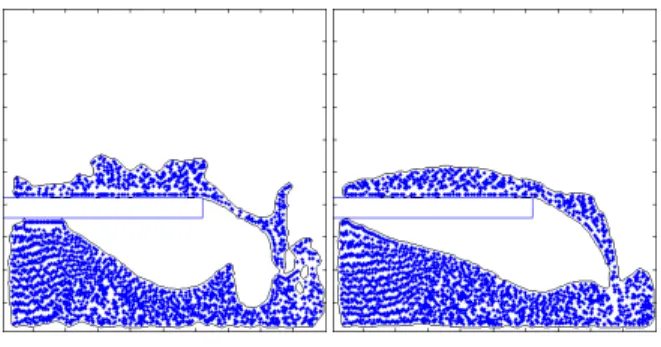
Figure 3: FLIP vs. PIC velocity update for the same simulation. Notice the small-scale velocities preserved by FLIP but smoothed away by PIC.
4.2.3 Solving on the Grid
We first add the acceleration due to gravity to the grid velocities. We then construct a distance fieldφ(x)in the unmarked (non-fluid) part of the grid using fast sweeping[Zhao 2005] and use that to ex-tend the velocity field outside the fluid with the PDE∇u·∇φ=0 (also solved with fast sweeping). We enforce boundary conditions and incompressibility as in Enright et al.[2002b], then extend the new velocity field again using fast sweeping (as we found it to be marginally faster and simpler to implement than fast march-ing[Adalsteinsson and Sethian 1999]).
4.2.4 Updating Particle Velocities
At each particle, we trilinearly interpolate either the velocity (PIC) or the change in velocity (FLIP) recorded at the surrounding eight grid points. For viscous flows, such as sand, the additional numer-ical viscosity of PIC is beneficial; for inviscid flows, such as water, FLIP is preferable. See figure 3 for a 2D view of the differences between PIC and FLIP. A weighted average of the two can be used to tune just how much numerical viscosity is desired (of course, a viscosity step on the grid in concert with PIC would be required for highly viscous fluids).
4.2.5 Moving Particles
Once we have a velocity field defined on the grid (extrapolated to exist everywhere) we can move the particles around in it. We use a simple RK2 ODE solver with five substeps each of which is limited by the CFL condition (so that a particle moves less than one grid cell in each substep), similar to Enright et al.[2002b]. We additionally detect when particles penetrate solid wall boundaries due simply to truncation error in RK2 and the grid-based velocity field, and move them in the normal direction back to just outside the solid, to avoid the occasional stuck-particle artifact this would otherwise cause.
5
Surface Reconstruction from Particles
Our simulations output the positions of the particles that define the location of the fluid. For high quality rendering we need to recon-struct a surface that wraps around the particles. Of course we can give up on direct reconstruction, e.g. running a level set simulation guided by the particles[Premoze et al. 2003]. While this is an effec-tive solution, we believe a fully particle-based reconstruction can have significant advantages.
Figure 4: Comparison of our implicit function and blobbies for matching a perfect circle defined by the points inside. The blobby is the outer curve, ours is the inner curve.
Naturally the first approach that comes to mind is blobbies[Blinn 1982]. For irregularly shaped blobs containing only a few particles, this works beautifully. Unfortunately, it seems unable to match a surface such as a flat plane, a cone, or a large sphere from a large quantity of irregularly spaced particles—as we might well see in at least the initial conditions of a simulation. Bumps relating to the particle distribution are always visible. A small improvement to this was suggested in [M¨uller et al. 2003], where the contribution from a particle was divided by the SPH estimate of density. This overcomes some scaling issues but does not significantly reduce the bumps on what should be flat surfaces.
We thus take a different approach, guided by the principle that we should exactly reconstruct the signed distance field of an isolated particle: for a single particle x0with radius r0, our implicit function
must be:
φ(x) =|x−x0| −r0 (6)
To generalize this, we use the same formula with x0replaced by a
weighted average of the nearby particle positions and r0replaced a
weighted average of their radii:
φ(x) = |x−x¯| −¯r (7) ¯ x =
∑
i wixi (8) ¯r =∑
i wiri (9) wi = k(|x−xi|/R) ∑jk(|x−xj|/R) (10) where k is a suitable kernel function that smoothly drops to zero— we used k(s) =max(0,(1−s2)3)since it avoids the need for squareroots and is reasonably well-shaped—and where R is the radius of the neighborhood we consider around x. Typically we choose R to be twice the average particle spacing. As long as the particle radii are bounded away from zero (say at least 1/2 the particle spacing) we have found this formula gives excellent agreement with flat or smooth surfaces. See figure 4 for a comparison with blobbies using the same kernel function.
The most significant problem with this definition is artifacts in con-cave regions: spurious blobs of surface can appear, since ¯x may er-roneously end up outside the surface in concavities. However, since these artifacts are significantly smaller than the particle radii we can easily remove them without destroying true features by sampling φ(x)on a higher resolution grid and then doing a simple smoothing pass.
A secondary problem is that we require the radii to be accurate es-timates of distance to the surface. This is nontrivial after the first
frame; in the absence of a fast method of computing these to the de-sired precision, we currently fix all the particle radii to the constant average particle spacing and simply adjust our initial partial posi-tions so that the surface particles are exactly this distance from the surface. A small amount of additional grid smoothing, restricted to decreasingφto avoid destroying features, reduces bump artifacts at later frames.
On the other hand, we do enjoy significant advantages over recon-struction methods that are tied to level set simulations. The cost per frame is quite low—even in our unoptimized version which calcu-lates and writes out a full 2503grid, we average 40–50 seconds a frame on a 2GHz G5, with the bulk of the time spent on I/O. More-over, every frame is independent, so this is easily farmed out to multiple CPU’s and machines running in parallel.
If we can eliminate the need for grid-based smoothing in the future, perhaps adapting an MLS approach such as in Shen et al.[2004], we could do the surface reconstruction on the fly during rendering. Apart from speed, the biggest advantage this would bring would be accurate motion blur for fluids. The current technique for gen-erating intermediate surfaces between frames (for a Monte Carlo motion blur solution) is to simply interpolate between level set grid values[Enright et al. 2002b]. However, this approach destroys small features that move further than their width in one frame: the inter-polated values may all be positive. Unfortunately it’s exactly these small and fast-moving features that most demand motion blur. With particle-based surface reconstruction, the positions of the particles can be interpolated instead, so that features are preserved at inter-mediate times.
6
Examples
We usedpbrt[Pharr and Humphreys 2004] for rendering. For the textured sand shading, we blended together a volumetric texture advected around by the simulation particles, similar to the approach of Lamorlette[2001] for fireballs.
The bunny example in figures 1 and 2 were simulated with 269,322 particles on a 1003grid, taking approximately 6 seconds per frame on a 2Ghz G5 workstation. We believe optimizing the particle transfer code and using BLAS routines for the linear solve would substantially improve this performance. Unoptimized smoothing and text I/O cause the surface reconstruction on a 2503grid to take 40–50 seconds per frame.
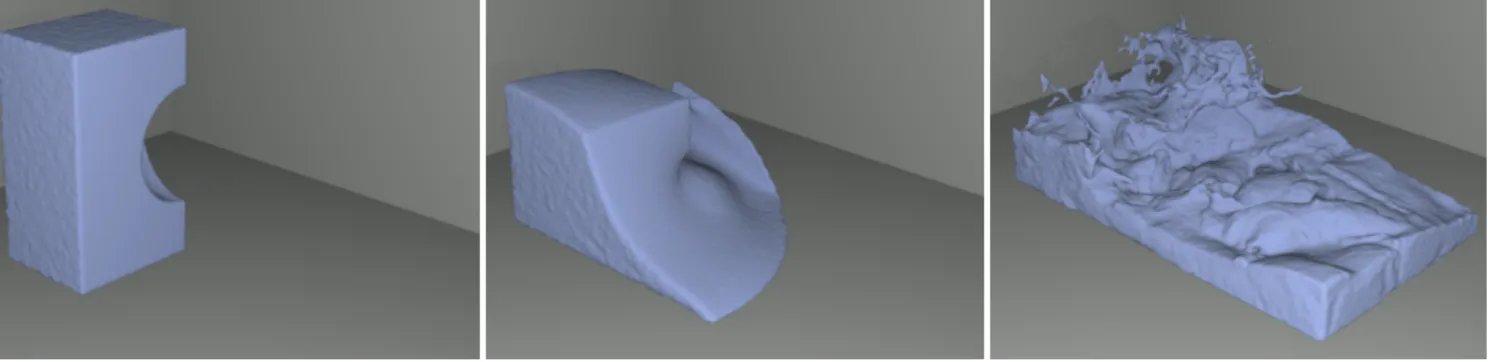
The column test in figures 5 and 6 was simulated with 433,479 par-ticles on a 100×60×60 grid, taking approximately 12 seconds per frame. Our cost is essentially linearly proportional to the number of particles (or equivalently, occupied grid cells).
7
Conclusion
We have presented a method for converting an existing fluid solver into one capable of plausibly animating granular materials such as sand. In addition, we developed a new fluid solver that combines the strengths of both particles and grids, offering enhanced flex-ibility and efficiency. We offered a new method for reconstruct-ing implicit surfaces from particles. Lookreconstruct-ing toward the future, we plan to more aggressively exploit the optimizations available with PIC/FLIP (e.g. using multiple bounding grids), increase the accu-racy of our boundary conditions, and implement motion blur of the reconstructed surface.
Figure 5: A column of regular liquid is released.
Figure 6: A column of granular material is released.
8
Acknowledgements
This work was in part supported by a grant from the Natural Sci-ences and Engineering Research Council of Canada. We would like to thank Dr. Dawn Shuttle for her help with granular constitutive models.
References
ADALSTEINSSON, D., AND SETHIAN, J. 1999. The fast
con-struction of extension velocities in level set methods. J. Comput. Phys. 148, 2–22.
BARDENHAGEN, S. G., BRACKBILL, J. U., ANDSULSKY, D.
2000. The material-point method for granular materials. Com-put. Methods Appl. Mech. Engrg. 187, 529–541.
BLINN, J. 1982. A generalization of algebraic surface drawing. ACM Trans. Graph. 1, 3, 235–256.
BRACKBILL, J. U.,ANDRUPPEL, H. M. 1986. FLIP: a method for adaptively zoned, particle-in-cell calculuations of fluid flows in two dimensions. J. Comp. Phys. 65, 314–343.
BRIDSON, R., FEDKIW, R.,ANDANDERSON, J. 2002. Robust treatment of collisions, contact and friction for cloth animation. ACM Trans. Graph. (Proc. SIGGRAPH) 21, 594–603.
CARLSON, M., MUCHA, P., VAN HORN III, R., AND TURK, G. 2002. Melting and flowing. In Proc. ACM SIG-GRAPH/Eurographics Symp. Comp. Anim., 167–174.
CARLSON, M., MUCHA, P. J.,ANDTURK, G. 2004. Rigid fluid: animating the interplay between rigid bodies and fluid. ACM Trans. Graph. (Proc. SIGGRAPH) 23, 377–384.
DESBRUN, M.,ANDCANI, M.-P. 1996. Smoothed particles: A new paradigm for animating highly deformable bodies. In Com-put. Anim. and Sim. ’96 (Proc. of EG Workshop on Anim. and Sim.), Springer-Verlag, R. Boulic and G. Hegron, Eds., 61–76. Published under the name Marie-Paule Gascuel.
ENRIGHT, D., FEDKIW, R., FERZIGER, J., ANDMITCHELL, I. 2002. A hybrid particle level set method for improved interface capturing. J. Comp. Phys. 183, 83–116.
ENRIGHT, D., MARSCHNER, S., ANDFEDKIW, R. 2002. Ani-mation and rendering of complex water surfaces. ACM Trans. Graph. (Proc. SIGGRAPH) 21, 3, 736–744.
ENRIGHT, D., NGUYEN, D., GIBOU, F.,ANDFEDKIW, R. 2003. Using the particle level set method and a second order accurate pressure boundary condition for free surface flows. In Proc. 4th ASME-JSME Joint Fluids Eng. Conf., no. FEDSM2003–45144, ASME.
FEDKIW, R., STAM, J.,ANDJENSEN, H. 2001. Visual simulation of smoke. In Proc. SIGGRAPH, 15–22.
FOSTER, N.,ANDFEDKIW, R. 2001. Practical animation of liq-uids. In Proc. SIGGRAPH, 23–30.
FOSTER, N.,ANDMETAXAS, D. 1996. Realistic animation of liquids. Graph. Models and Image Processing 58, 471–483. G ´ENEVAUX, O., HABIBI, A.,ANDDISCHLER, J.-M. 2003.
Sim-ulating fluid-solid interaction. In Graphics Interface, 31–38. GOKTEKIN, T. G., BARGTEIL, A. W.,ANDO’BRIEN, J. F. 2004.
A method for animating viscoelastic fluids. ACM Trans. Graph. (Proc. SIGGRAPH) 23, 463–468.
GUENDELMAN, E., BRIDSON, R.,ANDFEDKIW, R. 2003. Non-convex rigid bodies with stacking. ACM Trans. Graph. (Proc. SIGGRAPH) 22, 3, 871–878.
HARLOW, F., AND WELCH, J. 1965. Numerical Calculation
of Time-Dependent Viscous Incompressible Flow of Fluid with Free Surface. Phys. Fluids 8, 2182–2189.
HARLOW, F. H. 1963. The particle-in-cell method for numerical solution of problems in fluid dynamics. In Experimental arith-metic, high-speed computations and mathematics.
HERRMANN, H. J.,ANDLUDING, S. 1998. Modeling granular media on the computer. Continuum Mech. Therm. 10, 189–231. HONG, J.-M.,ANDKIM, C.-H. 2003. Animation of bubbles in liquid. Comp. Graph. Forum (Eurographics Proc.) 22, 3, 253– 262.
IRVING, G., TERAN, J.,ANDFEDKIW, R. 2004. Invertible finite elements for robust simulation of large deformation. In Proc. ACM SIGGRAPH/Eurographics Symp. Comp. Anim., 131–140. JAEGER, H. M., NAGEL, S. R., ANDBEHRINGER, R. P. 1996.
Granular solids, liquids, and gases. Rev. Mod. Phys. 68, 4, 1259– 1273.
KONAGAI, K., AND JOHANSSON, J. 2001. Two dimensional
Lagrangian particle finite-difference method for modeling large soil deformations. Structural Eng./Earthquake Eng., JSCE 18, 2, 105s–110s.
KOTHE, D. B., AND BRACKBILL, J. U. 1992. FLIP-INC: a particle-in-cell method for incompressible flows. Unpublished manuscript.
LAMORLETTE, A. 2001. Shrek effects—flames and dragon fire-balls. SIGGRAPH Course Notes, Course 19, 55–66.
LI, X., AND MOSHELL, J. M. 1993. Modeling soil: Realtime dynamic models for soil slippage and manipulation. In Proc. SIGGRAPH, 361–368.
LOSASSO, F., GIBOU, F.,ANDFEDKIW, R. 2004. Simulating wa-ter and smoke with an octree data structure. ACM Trans. Graph. (Proc. SIGGRAPH) 23, 457–462.
LUCIANI, A., HABIBI, A.,ANDMANZOTTI, E. 1995. A multi-scale physical model of granular materials. In Graphics Inter-face, 136–146.
MILENKOVIC, V. J., ANDSCHMIDL, H. 2001.
Optimization-based animation. In Proc. SIGGRAPH, 37–46.
MILENKOVIC, V. J. 1996. Position-based physics: simulating the motion of many highly interacting spheres and polyhedra. In Proc. SIGGRAPH, 129–136.
MILLER, G.,ANDPEARCE, A. 1989. Globular dynamics: a con-nected particle system for animating viscous fluids. In Comput. & Graphics, vol. 13, 305–309.
MONAGHAN, J. J. 1992. Smoothed particle hydrodynamics. Annu. Rev. Astron. Astrophys. 30, 543–574.
M ¨ULLER, M.,ANDGROSS, M. 2004. Interactive virtual materials. In Graphics Interface.
M ¨ULLER, M., CHARYPAR, D.,ANDGROSS, M. 2003. Particle-based fluid simulation for interactive applications. In Proc. ACM SIGGRAPH/Eurographics Symp. Comp. Anim., 154–159.
NAYAK, G. C.,ANDZIENKIEWICZ, O. C. 1972. Elasto-plastic stress analysis. A generalization for various constitutive relations including strain softening. Int. J. Num. Meth. Eng. 5, 113–135. O’BRIEN, J., BARGTEIL, A.,ANDHODGINS, J. 2002. Graphical
modeling of ductile fracture. ACM Trans. Graph. (Proc. SIG-GRAPH) 21, 291–294.
ONOUE, K.,ANDNISHITA, T. 2003. Virtual sandbox. In Pacific Graphics, 252–262.
PHARR, M.,ANDHUMPHREYS, G. 2004. Physically Based Ren-dering: From Theory to Implementation. Morgan Kaufmann. PREMOZE, S., TASDIZEN, T., BIGLER, J., LEFOHN, A., AND
WHITAKER, R. 2003. Particle–based simulation of fluids. In Comp. Graph. Forum (Eurographics Proc.), vol. 22, 401–410. RASMUSSEN, N., ENRIGHT, D., NGUYEN, D., MARINO, S.,
SUMNER, N., GEIGER, W., HOON, S., AND FEDKIW, R. 2004. Directible photorealistic liquids. In Proc. ACM SIG-GRAPH/Eurographics Symp. Comp. Anim., 193–202.
SAVAGE, S. B.,ANDHUTTER, K. 1989. The motion of a finite mass of granular material down a rough incline. J. Flui Mech. 199, 177–215.
SHEN, C., O’BRIEN, J. F.,ANDSHEWCHUK, J. R. 2004. Inter-polating and approximating implicit surfaces from polygon soup. ACM Trans. Graph. (Proc. SIGGRAPH) 23, 896–904.
SMITH, I. M., ANDGRIFFITHS, D. V. 1998. Programming the Finite Element Method. J. Wiley & Sons.
STAM, J. 1999. Stable fluids. In Proc. SIGGRAPH, 121–128. SULSKY, D., ZHOU, S.-J.,ANDSCHREYER, H. L. 1995.
Ap-plication of particle-in-cell method to solid mechanics. Comp. Phys. Comm. 87, 236–252.
SUMNER, R. W., O’BRIEN, J. F.,ANDHODGINS, J. K. 1998. Animating sand, mud, and snow. In Graphics Interface, 125– 132.
SUSSMAN, M. 2003. A second order coupled level set and volume-of-fluid method for computing growth and collapse of vapor bub-bles. J. Comp. Phys. 187, 110–136.
TAKAHASHI, T., FUJII, H., KUNIMATSU, A., HIWADA, K., SAITO, T., TANAKA, K., ANDUEKI, H. 2003. Realistic an-imation of fluid with splash and foam. Comp. Graph. Forum (Eurographics Proc.) 22, 3, 391–400.
TAKESHITA, D., OTA, S., TAMURA, M., FUJIMOTO, T., AND
CHIBA, N. 2003. Visual simulation of explosive flames. In Pacific Graphics, 482–486.
TERZOPOULOS, D., ANDFLEISCHER, K. 1988. Modeling
in-elastic deformation: viscoin-elasticity, plasticity, fracture. Proc. SIGGRAPH, 269–278.
ZHAO, H. 2005. A fast sweeping method for Eikonal equations. Math. Comp. 74, 603–627.