A BRANCH-DIRECTED DATA CACHE PREFETCHING
TECHNIQUE FOR INORDER PROCESSORS
A Thesis by
REENA PANDA
Submitted to the Office of Graduate Studies of Texas A&M University
in partial fulfillment of the requirements for the degree of MASTER OF SCIENCE
December 2011
A BRANCH-DIRECTED DATA CACHE PREFETCHING
TECHNIQUE FOR INORDER PROCESSORS
A Thesis by
REENA PANDA
Submitted to the Office of Graduate Studies of Texas A&M University
in partial fulfillment of the requirements for the degree of MASTER OF SCIENCE
Approved by:
Co-Chairs of Committee, Paul V. Gratz Jiang Hu Committee Members, Eun Jung Kim
Deepa Kundur
Head of Department, Costas N. Georghiades
December 2011
ABSTRACT
A Branch-directed Data Cache Prefetching Technique for Inorder Processors. (December 2011)
Reena Panda, B.Tech, NIT Rourkela, India Co-Chairs of Advisory Committee: Dr. Paul V. Gratz
Dr. Jiang Hu
The increasing gap between processor and main memory speeds has become a serious bottleneck towards further improvement in system performance. Data prefetching techniques have been proposed to hide the performance impact of such long memory latencies, but most of the currently proposed data prefetchers predict future memory accesses based on current memory misses. This limits the opportunity that can be exploited to guide prefetching.
In this thesis, I propose a branch-directed data prefetcher that uses the high prediction accuracies of current-generation branch predictors to predict a future basic block trace that the program will execute, and issues prefetches for all the identified memory instructions contained therein. I also propose a novel technique to generate prefetch addresses by exploiting the correlation between the addresses generated by memory instructions and the values of the corresponding source registers at prior branch instances. I evaluate the impact of the prefetcher by using a cycle-accurate simulation of an inorder processor on the M5 simulator. The results of the evaluation show that the branch-directed prefetcher improves the performance on a set of 18 SPEC CPU2006 benchmarks by an average of 38.789% over a no-prefetching implementation and 2.148% over a system that employs a Spatial Memory Streaming prefetcher.
ACKNOWLEDGEMENTS
I am extremely thankful to my advisor, Dr. Paul V. Gratz, for giving me an opportunity to work under him. His constant guidance and support always helped me move in the right direction in my research. I am grateful to him for making my research experience a memorable one, and my respect goes to him.
I would like to express my gratitude to my committee members Dr. Deepa Kundur, Dr. Eun Jung Kim and Dr. Jiang Hu for agreeing to be on my thesis committee and providing me valuable feedback.
I would also like to express my sincere thanks to Dr. Daniel Jimenez, for taking keen interest and giving his invaluable advice and suggestions during the course of this work. Special thanks to Ehsan Fatehi for his help with the M5 simulator and other members of my research community for their support, advice and suggestions over the past one year. My time at Texas A&M was made enjoyable in large part due to many friends that became a part of my life. I am grateful for the time spent with roommates and friends.
I would also like to thank my family for their love, support and encouragement all through my life. Lastly, I would like to thank god for blessing me with this opportunity and giving me the strength to reach this point.
TABLE OF CONTENTS
Page ABSTRACT ... iii DEDICATION ... iv ACKNOWLEDGEMENTS ... v TABLE OF CONTENTS ... viLIST OF FIGURES ... viii
LIST OF TABLES... ... x
CHAPTER I INTRODUCTION ... 1
I.1 Thesis Statement ... 2
I.2 Thesis Contributions ... 3
I.3 Thesis Organization ... 5
II BACKGROUND AND MOTIVATION ... 6
II.1 Background ... 6
II.2 Motivation ... 11
III PRIOR WORK ... 13
III.1 Data Prefetching Techniques ... 13
III.1.1 Sequential Prefetching ... 13
III.1.2 Stride Prefetching ... 14
III.1.3 Pointer-based Prefetching Techniques ... 14
III.1.4 Runahead Mechanisms ... 15
III.1.5 Region Based Prefetching Techniques ... 16
III.1.6 Branch-directed Data Prefetching ... 17
III.2 Confidence Estimation Techniques ... 21
CHAPTER Page
IV.1 Overall System Architecture ... 24
IV.2 System Components ... 28
IV.2.1 Branch Trace Cache ... 28
IV.2.2 Path Confidence Estimator ... 32
IV.2.3 Branch-Register Table ... 36
IV.2.4 Prefetch-filtering Mechanisms ... 48
IV.2 Working Example ... 53
V EVALUATION ... 61
V.1 Methodology ... 61
V.2 Results and Analysis ... 63
V.2.1 Impact on IPC ... 63
V.2.2 Prefetch Effectiveness ... 65
V.2.3 Bus Traffic ... 67
V.2.4 Impact of Predictor Table Size ... 68
V.2.5 Hybrid SMS and Branch-directed Prefetcher ... 69
V.2.6 Inorder versus Out-of-Order: Impact on IPC ... 70
V.3 Hardware Cost ... 72
VI LESSONS LEARNED ... 74
VI.1 Hybrid Prefetcher Implementation ... 74
VI.2 Modified Branch-register Table Implementation (The Min-Max Scheme) ... 75
VI.3 Indirect Branch Handling ... 78
VI.4 LRU Insertion Policy for Prefetched Blocks ... 80
VII CONCLUSION AND FUTURE WORK ... 82
REFERENCES ... 84
LIST OF FIGURES
FIGURE Page II.1 An example illustrating dependence between branch instructions and
data access patterns ... 6
II.2 Flow chart showing the Branch-Directed Prefetching Algorithm... 8
II.3 Graphs showing the degree of correlation between generated data addresses & corresponding source register values at a prior branch ... 9
II.4 Code fragment from Leslie3D benchmark (SPEC CPU2006) ... 11
IV.1 Overall system architecture ... 25
IV.2 Single Branch Trace Cache entry ... 30
IV.3 Figure showing: (a) A program sequence; (b) Control Flow Graph of the program sequence in (a); (c) Branch Trace Cache filled state ... 31
IV.4 Composite Branch Confidence estimator ... 33
IV.5 Graphs showing the variability in branch misprediction rates across the 37 confidence buckets for a set of SPEC CPU2006 benchmarks ... 34
IV.6 Single Branch-Register Table entry (Basic implementation)... 36
IV.7 Snapshot of the trained Branch-Register Table ... 37
IV.8 Single Branch-Register Table entry (Offset implementation) ... 40
IV.9 Flow Chart depicting (a) Process to use offset-field for prefetching; (b) Process to update the offset-field ... 41
IV.10 Single Branch-Register Table entry (Loop implementation) ... 42
IV.11 Flowchart describing the process to generate prefetch addresses in the loop-mode ... 45
FIGURE Page
IV.13 Example of the working of Prefetch-Queue based filtering... 53
IV.14 Working example showing update of Branch Trace Cache and creation of Branch-Register links ... 54
IV.15 Trained State of prediction tables, corresponding to the program sequence given in Figure IV.3 (a) ... 55
IV.16 Working example showing the prefetch address generation process ... 56
IV.17 Snapshot of the predictor tables at the end of a lookahead phase ... 57
IV.18 Working example showing Branch-Register Table learning process ... 58
IV.19 Working example showing steps followed when prefetch is issued for an already-prefetched block ... 59
V.1 IPC improvement over Baseline (No-prefetching) ... 63
V.2 IPC improvement over SMS prefetcher ... 64
V.3 Effectiveness of issued prefetches ... 66
V.4 Increase in number of L2 Cache accesses ... 68
V.5 Performance impact of hybrid SMS and Branch-Directed prefetcher ... 70
V.6 Performance comparision of Inorder (with prefetching support) and out-of-order implementations ... 71
VI.1 Single Branch-Register table entry (Min-Max Implementation) ... 76
LIST OF TABLES
TABLE Page III.1 Hardware overhead and performance benefits of prior branch-directed
prefetchers ... 19 V.1 Target microarchitecture parameters ... 62
CHAPTER I
INTRODUCTION
Owing to significant micro-architectural advancements as well as technology scaling, the performance of microprocessors has improved at a tremendous pace over the past couple of decades. However while the processing speed has increased significantly, the memory access speed has not scaled accordingly. So, the memory access latency is becoming a serious bottleneck towards further increase in system performance.
Many memory latency hiding techniques have been proposed in the literature so far in order to reduce this growing gap between memory and processor speeds. One such technique is the use of “caches” [1]. A cache is a smaller and faster memory that resides between the CPU and the main memory and thereby, allows faster access to data that resides in it. It basically exploits two important characteristics of programs, namely, spatial and temporal locality. It does so by storing, the recently used/demanded data (thereby, exploiting the temporal locality) and the data that resides closer to other demand-fetched data in the memory (thereby exploiting spatial locality). The idea is that such data have a greater chance to be accessed by the CPU than others. As long as these characteristics hold true, complete memory accesses can mostly be avoided, thereby providing performance benefits. Several enhancements have also been proposed to the cache implementation and handling, like lock-up free caches [2], better insertion and replacement algorithms etc. However, even with all these advancements, a single cache miss through all levels still causes a loss of more than hundreds of processor cycles and is thus, detrimental to system performance.
____________
Another technique that has been widely adopted to hide long memory latencies and also to exploit instruction level parallelism is out-of-order execution. Among its other benefits, out of order execution allows instructions, following a long latency missing instruction, to execute, being constrained only by the true data dependences or the size of the instruction window. Thus with out-of-order support, it becomes possible to overlap memory accesses with actual execution, thus hiding some of the penalties of a complete memory access. But as the technology is gradually moving into the submicron realm, superscalar processors (which are capable of supporting out of order execution) are becoming increasingly expensive to implement. This is because such processors employ several complex hardware units like the Reorder buffers, issue and wake up logic, multi-entry buffers etc., which are very power hungry and also have higher area requirements. These concerns have therefore, started diverting the attention back to the simple inorder processors, which have lesser power and area requirements.
A third technique that allows hiding memory access latency is prefetching. Prefetching predicts the data that will be used by the processor in future and generates requests to bring them closer to the processor before an actual request is sent out for them. So, if the prediction turns out to be correct, the demand request gets satisfied in the cache and the need to fetch the data from main memory is eliminated. But, like any other speculative technique, prefetching is not perfect and hence, it is likely that many prefetched blocks may be either useless or ineffective. However, such prefetched data may still evict more useful data from the cache and hence, can cause cache pollution. Additionally, a large number of prefetch requests sent to the main memory may impact the limited available bandwidth and hence, can cause delay in servicing other demand requests.
I.1 Thesis Statement
This thesis proposes a data prefetching mechanism as a means to reduce the impact of long memory latencies on system performance. This proposed scheme takes advantage
of the high prediction accuracies of current-generation branch predictors to accurately generate a future basic-block trace of the program and then, issues prefetches for all the identified memory instructions in these basic blocks. In addition, this thesis describes a novel technique to capture the data access behavior by observing the runtime modifications to the register values that used for memory address computation. The goal of this thesis is thus, to demonstrate that: a) the behavior of control instructions can be efficiently exploited to enable timely and effective prefetching and b) data addresses can be accurately predicted by monitoring the runtime updates to the address-generating register values.
I.2 Thesis Contributions
In this thesis, we propose a data prefetching technique so as to bridge the growing gap between processor and memory speeds and thereby, leading to performance benefits. While most of the existing prefetchers predict future accesses based on current memory misses, our prefetcher leverages the high prediction accuracies of current-generation branch predictors to accurately generate the future basic block trace that the program will follow and initiates data prefetching much before the actual execution of the instructions in the corresponding basic blocks begins. Our proposal is based on the idea that branch instructions determine the execution path of any program, i.e., which basic block of instructions gets executed and in what sequence is determined by the direction of the branch instructions contained in the path. Different basic blocks tend to operate on same/different data and contain instructions to operate on data in a particular pattern. So, given that branch instructions determine which basic blocks would get executed in any instance of the program run, the access pattern of data that is manipulated in those basic blocks can also be linked to the prior branch instructions.
We build our system based on the observation that the address values generated by the memory instructions in a basic block are quite predictable even at an earlier branch
instruction. We establish this correlation in hardware, by associating the source register indices being used for address computation by the memory instructions in any basic block to their preceding branch instruction (the entry point of the block). By making use of the actual register values at that execution instance and not data access history, we can prefetch even those instructions that do not exhibit regular strided access patterns, but still generate predictable address values starting from the dynamic register values.
In this thesis, we propose a practical hardware design of our data prefetcher for an inorder processor implementation. Due to their lower power and area requirements as compared to their superscalar counterparts, inorder processors have been receiving a lot of attention lately. They are thus making their way into mainstream multiprocessor and multi-core based designs. Many modern processors like Intel's Atom processor [3], Sun’s UltraSPARC T1 “Niagara” [4] have preferred to incorporate a number of smaller inorder cores over larger superscalar cores, thereby saving power and area. However, inorder processors have reduced single-threaded performance. The reason is partly because they allow very limited execution around the data cache misses. So, techniques like prefetching become more important for such architectures, as a means to bridge the growing gap between processor and memory speed. It is however important to note that, this prefetcher design is not architecture-specific and can be implemented with any processor architecture.
Finally in this thesis,
• We demonstrate that data addresses generated by memory instructions are predictable at prior branch locations by exploiting the runtime values of those registers that are used for memory address computation.
• We propose a practical hardware implementation of a prefetcher for the L1 Data Cache that allows look ahead across basic blocks and exploits the above-mentioned correlation to initiate prefetching.
• Branch directed prefetcher provides a mean speedup of 38.789% over a baseline system with no prefetching. While the Spatial Memory Streaming (SMS) [5], [6], one of the best performing practical prefetcher, provides a mean speedup of 35.87% over the baseline. Our final implementation also provides an IPC improvement of 2.14 % over SMS.
• We also discuss several enhancements to the base prefetcher design to improve the performance and accuracy of the prefetcher.
I.3 Thesis Organization
This document is organized as follows. Chapter II gives an overview of the proposed approach and discusses the motivation behind the same. In Chapter III, we provide an overview of the prior work in the areas important to this thesis. Chapter IV presents a detailed description of the system architecture. In chapter V, we discuss our simulation methodology and evaluate the results. In Chapter VI, we discuss few observations that were made, while implementing the different design alternatives. Finally, Chapter VII concludes this thesis and discusses future work.
CHAPTER II
BACKGROUND AND MOTIVATION
This chapter provides a general overview of the branch-directed prefetching system and also discusses the motivation behind the proposed approach.
II.1 Background
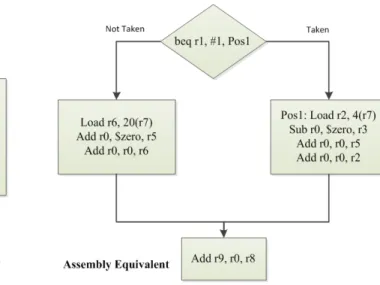
The direction taken by the control instructions determines the execution path of any program. In other words, which basic block of instructions gets executed and in what sequence is determined by the direction of execution of the control instructions encountered along the path. In this thesis, it is claimed that since branch instructions control the execution path, the data access patterns of subsequent basic blocks could also be dependent on/linked to the previous branch behavior. For example, consider a “C” code fragment comprised of an if-else code block (see Figure II.1).
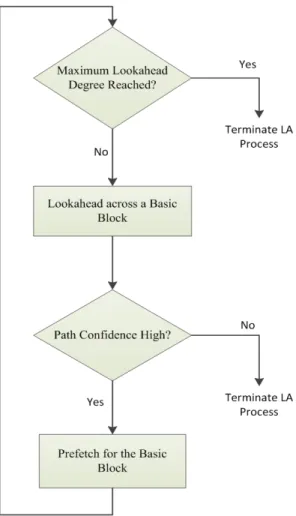
The block of code (if-block or else-block) which gets executed following the control instruction depends on the direction taken by it. So, the data that is going to get requested in the future execution phase and its access pattern is also dependent on the branch instructions encountered along the path and their direction of execution. Given that such correlation can be established, it implies that data prefetching can be initiated at the decode time of the branches, without waiting for the corresponding memory instructions to start executing. Additonally, data prefetching can be initiated even earlier by employing a reasonably accurate fast forwarding scheme that can predict the future execution path following a branch instruction. This implies that while one branch instruction is being executed, the future path of execution can be predicted therefrom and then, prefetches can be issued for those memory references that are linked to the future branch instructions contained in the path. Also, if the path prediction accuracy is not very high, then a confidence estimator can be employed to prevent speculating too deep along a wrong path (if at all) instead of allowing the lookahead to continue as long as possible. The process adopted to enable branch-directed prefetching is shown schematically in Figure II.2.
This thesis proposes a data prefetcher that establishes correlation between the memory instructions used in a basic block and their prior branch instructions. Later, it employs a lookahead scheme to predict the future path of execution and exposes the memory instructions identified along the path. Unlike prior works in this area, which mostly find correlation among the actual data addresses used by the instructions at consecutive execution instances, we propose to associate register indices being operated by the memory instructions (as source registers to generate data address) to their preceding branch instructions (the entry points of the basic block) and use this correlation to guide prefetching. This idea is based on the premise that register values at the time of data address generation would not be very different from their corresponding values at a time when the preceding branch instruction was executed. By exploiting such register-based correlation, the branch-directed prefetcher can not only predict data addresses which
display a regular strided-access pattern, but also can take advantage of the dynamic values of the registers at run-time to predict irregular and isolated data accesses.
Figure II.2 Flow chart showing the Branch-Directed Prefetching Algorithm
In order to determine if such correspondence exists, we conducted an experiment to demonstrate the degree of correlation between the data addresses generated by memory references and the corresponding register values at prior branch instructions. Before describing the details of the experiment, the meaning of certain terms are clarified first, which have been used throughout this thesis. A “spatial region” is defined as a coarser unit of memory, consisting of multiple consecutive cache blocks [5], [7]. Based on the above definition of the spatial region, two address values are said to be “correlated” if they fall into the same spatial region.
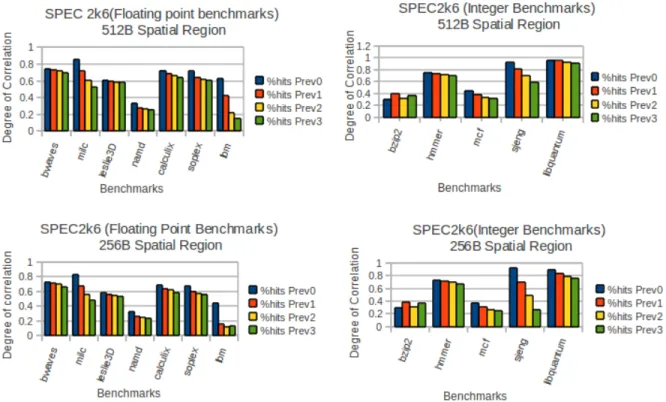
The experiment was conducted using application traces (corresponding to first 300 million committed instructions) collected from a subset of SPEC CPU2006 benchmarks. The traces consisted of: a) a dump of the architectural register file at each branch location, b) the effective addresses generated by each subsequent memory instruction, c) the corresponding source register indices used for address computation by the memory instructions. An offline analysis was then, performed on these traces to find out the degree by which the register values at prior branch instructions are correlated to the actual effective addresses generated by the instructions in those basic blocks. Finally, the percentage of memory instructions which demonstrated this correlation (where correlation implies falling into the same spatial region) with their preceding branch instructions was recorded. Also, the impact of the assumed region size on the degree of correlation was monitored. Results of this experiment for two different region sizes (512 Bytes and 256 Bytes) are shown in Figure II.3.
Figure II.3 Graphs showing the degree of correlation between generated data addresses & corresponding source register values at a prior branch
Corresponding to the figure, Prev 0 implies the case when the memory instructions were compared with their immediately preceding branch instruction, Prev 1 corresponds to the case where memory instructions were compared with the branch preceding their immediately preceding branch instruction and so on.
From the figure, we can observe that most of the benchmarks exhibit significant degree of correlation between the data addresses generated by memory instructions and corresponding register values at previous branch instructions. Also, as expected, the correspondence is stronger with respect to the immediately preceding branch instruction and it gradually reduces as the correlation is tested with older branches in program order. This is because greater is the distance between a memory instruction and the branch instruction in question, higher is the chance that other register-defining instructions would modify the value of the register in between. Also, another important point to note is that percentage of correlation reduces with the size of the recorded spatial region. Results of this experiment motivate the idea of prefetching all the cache blocks contained in the spatial region that holds the address given by the register value at a previous instance. Also, a region size of 512 bytes is chosen for use in all our experiments (applicable only in non-loop mode of operation, refer Subsection IV.1) in this thesis. The evaluation and analysis of the impact of varying region sizes on the performance of the prefetcher is left for future work.
It is obvious that greater is the correlation of memory addresses to prior branch instructions, better is the opportunity to look ahead across deeper basic blocks and be able to issue useful prefetches. But on the whole, this experiment demonstrates that prefetches can be issued with a certain degree of accuracy, for memory instructions at prior branch instructions by only using the values of the corresponding source registers at that instance. It is however to note that more correlation can be exploited, than
demonstrated in this experiment if the difference (offset) between the two compared values can be estimated or predicted.
II.2 Motivation
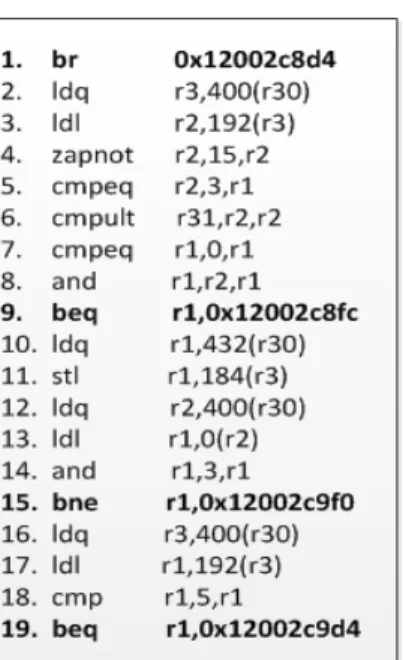
In this section, we will summarize the motivation behind the adopted approach (as also discussed in the previous section) with a theoretical example. Figure II.4 is a code snippet from the leslie3D benchmark from the SPEC CPU 2006 benchmark suite. The dynamic program sequence consists of 3 basic blocks. In the first basic block, there are 2 memory instructions, sequence number (SeqNum) 2 and 3. Since no other register-defining instructions exist between SeqNum 2,3 and the branch instruction at SeqNum 1, that can change the values of registers R30 and R3, the address going to be generated at SeqNum 2 and 3 is predictable at instruction 1, if the register values R3 and R30 are known.
Figure II.4 Code fragment from Leslie3D benchmark (SPEC CPU2006)
Similarly, in the second basic block, there are 4 memory instructions: SeqNum 10, 11, 12 and 13. SeqNums 10 and 12 use R30, SeqNum 11 uses R3 and SeqNum 13 uses R2
as their source registers for address generation respectively. It can be seen that none of the instructions contained in Basic Block 1 define the value of R30, which implies that the data addresses generated at SeqNum 10 and 12 in basic block 2 are quite predictable at SeqNum 1. However, the two memory reference instructions, SeqNum 2 and 3 define R2 and R3 respectively in basic block 1. Hence, the value of R2 and R3 at SeqNum 1 is more likely to be different from the addresses generated at SeqNum 11 and 13 respectively. But it is note that the address values are still predictable at the branch instruction corresponding to SeqNum 9. Note that, in our scheme a significant fraction of this variability can be captured by prefetching the entire spatial region around the runtime register values.
Another factor that motivates exploiting branch-directed correlation to guide prefetching is that any typical program will have less number of control instructions as compared to the number of memory instructions. So, this approach should theoretically, need much smaller predictor table sizes than most of the prior prefetchers that establish memory instruction-based correlation to capture the same information.
CHAPTER III
PRIOR WORK
This chapter reviews some related concepts before embarking on the specifics of the thesis. Subsection III.1 discusses the different data prefetching techniques that have been proposed in literature and compares our proposed solution against a few. As discussed in the previous chapter, our prefetcher employs a confidence estimator that estimates the likelihood that our execution path prediction is correct in order to limit prefetches along a wrong path of execution. Subsection III.2 reviews the importance of such confidence estimation techniques in general and also, discusses few branch confidence estimation techniques that have been previously proposed in literature.
III.1 Data Prefetching Techniques
Data Prefetching techniques have been explored extensively as a means to tolerate the growing gap between processor and memory access speeds. Broadly, the proposed solutions in this area can be classified as hardware-driven or software-directed techniques. Software prefetching [8], [9], [10] schemes perform static compile-time analysis of the likely memory accesses to learn patterns and predict future prefetch candidates. Hardware prefetching schemes, on the other hand use dynamic runtime information and thereby, issue prefetches far in advance so as to mask the off-chip latencies. This section illustrates few hardware-directed prefetching schemes that have been proposed in literature so far.
III.1.1 Sequential Prefetching
Sequential Prefetching [11] is one of the simplest hardware prefetching schemes. It proposes prefetching the successive cache blocks that follow a currently
accessed/demanded block. Several variations have been proposed to this basic scheme, which includes what type of accesses to a block initiate a prefetch (giving rise to the Prefetch-on-hit or Prefetch-on-miss schemes) and the number of blocks that are prefetched per access to a cache block (basically, the degree of prefetching). Tagged prefetching is another variation of this approach, where prefetching is initiated both on a cache miss as well as on a prefetch hit.
III.1.2 Stride Prefetching
Stride Prefetching [12] involves monitoring the patterns of memory accesses generated successively by memory instructions, with an objective of identifying constant-stride references which are typical of loop-based behavior. In order to achieve this, the stride prefetchers maintain a table structure that gets indexed with the memory instruction PC and contains the last address referenced by that instruction, the established stride, and a finite state machine that guides the prefetching scheme. This scheme is very effective for applications which are loop-based and demonstrate a very regular access pattern. However, for the general class of applications, which do not always exhibit regular strided memory access patterns, this scheme cannot provide much performance benefit. II.1.3 Pointer-based Prefetching Techniques
Content-directed prefetching (CDP) technique was proposed by Cooksey et al. as an effective prefetcher for the pointer-intensive applications [13]. It basically examines each address-sized word of the fetched or subsequently prefetched data in order to find likely pointer addresses and then, it initiates prefetch requests for those data that are identified as potential addresses. As a result of its aggressive policy, CDP has the potential to run many instances ahead of the current execution sequence and prefetch data, pointed by likely pointer addresses, into the cache. Its other advantages are that it does not require any state information and also does not require any training. However, because of its
aggressive nature, it tends to generate a lot of useless prefetches.
In an attempt to minimize such useless prefetches, Mutlu et al. proposed an enhancement to the basic CDP implementation, by adopting a combined hardware/software approach [14]. In this modified scheme, the compiler provides hints to inform the hardware about which pointer addresses would be useful over others. They also proposed a hybrid prefetcher implementation where the CDP is used in conjunction with a stream prefetcher and then, runtime feedback information is used to manage the interference between these two classes of prefetchers.
III.1.4 Runahead Mechanisms
Runahead-based prefetching schemes are based on the idea of pre-executing a set of instructions speculatively following a long latency operation, like an L2 cache miss and then, using the results obtained during that process to initiate prefetching. In the subsequent paragraphs, few such techniques are reviewed.
One of the earliest works on runahead prefetching was proposed by Dundas and Mudge [15]. In the paper, the authors proposed a data prefetching mechanism that generates addresses based on the results of pre-executing future instructions under a cache miss. Two approaches are proposed to realize the prefetcher: - a) a conservative approach in which instructions are not executed speculatively beyond branch instructions while in the runahead mode and b) an aggressive approach, in which branches and jumps are assumed to be correctly resolved during runahead. This scheme requires an extra check-pointing register file to save the architectural state before entering the runahead mode and makes use of the idle execution unit to facilitate runahead during the long latency data miss. But this method adds to the miss latency overhead by requiring to checkpoint the main register file during every data miss and restoring the checkpoint on the completion of the miss.
Mutlu et al. proposed an implementation to support runahead execution in out-of-order processors [16]. Their system is also based on entering a runahead mode post a long latency memory miss, when the future instructions get speculatively pre-executed and the corresponding results are used to initiate prefetching. Though this system is quite effective in the event of L2 misses, it suffers from a few drawbacks. Firstly, there is a large overhead in restarting normal execution after restoring the checkpoint, when the miss returns. Also, because of this overhead, the effectiveness of this mechanism to handle shorter latencies like the L1 cache miss latencies is reduced. Additionally, since the same hardware is used for runahead mode execution, computation cannot be overlapped with an L2 miss.
Finally in most of the runahead proposals, in an attempt to minimize hardware overhead, the prefetching opportunity gets confined to finding idle execution slots or idle context in a multithreaded environment.
In our current proposal, we also attempt to prefetch ahead of the currently executing basic blocks. But instead of relying on pre-executing the instructions following a long latency event, we make use of modest hardware to establish and exploit the dependence between memory references and their prior branch instructions. Additionally, the runahead mechanism relies on misses to initiate prefetching, but our approach tries to avoid the first misses as well. Moreover, unlike runahead mechanism, our approach is completely transparent (non - intrusive) to the execution in the main pipeline and does not add any additional overhead to the miss-handling latency.
III.1.5 Region Based Prefetching Techniques
Another technique that has been explored to improve prefetching performance is exploiting spatial locality over larger areas in memory, bigger than a single cache line. These approaches see a coarser view of memory, generally made of a few contiguous
cache blocks (called a spatial region) and try to find correlation or access patterns with respect to this coarser view. Few such techniques that exploit region-based correlation to enable prefetching are described in the following paragraphs.
Spatial Memory Streaming (SMS) is a spatial-region based prefetching proposition by Somyogi et al. [5]. It is one of the best-performing prefetchers proposed in literature currently. SMS makes use of code-based correlation to take advantage of spatial locality over larger regions of memory (called spatial regions) in the applications. As an application runs, SMS records access patterns over spatial regions in the form of bit vectors, over a period of time called the spatial region generation (defined as the time from when the first block of this region was brought into the cache till when an accessed block gets evicted). At the end of a spatial generation, these recorded bit patterns are transferred to a pattern history table (PHT). In their work, the authors show that an indexing mechanism that combines the PC and the initial missing offset into the region gives better results over other indexing schemes. But one potential issue with SMS is that it cannot predict the first misses into a region. To overcome this disadvantage, Somyogi et al. proposed an extension to SMS called Spatio-Temporal Memory Streaming (STEMS) [17]. STEMS exploits temporal access characteristics over the larger spatial regions and finer access patterns within each spatial region to re-create a temporally ordered sequence of misses and prefetches for the same. By employing both temporal and spatial characteristics, it improves the performance by 3% over the SMS scheme. However, this performance benefit is achieved at the expense of a huge hardware overhead (in the order of several megabytes), which makes this design slightly impractical to implement currently.
III.1.6 Branch-directed Data Prefetching
This is another class of prefetching that exploits the relationship between branch instructions and subsequently following memory instructions to identify prefetch
candidates. Although branch-based correlation has mostly been explored in the instruction-prefetching domain, there has been some work [18], [19] that applies the same to solve data prefetching issues. The branch-directed data prefetchers are based on the idea that since branch instructions control the execution path through a program, data accesses in the subsequently following instructions are also dependent on their behavior and hence, can be linked to them. However, in most of the proposed approaches, memory reference instructions are directly correlated with prior branch instructions and then, some variant of stride-directed scheme is used to guide prefetching. This section discusses some major work in this area.
The earliest work on branch-based data prefetching [18] associated the history of data references to the previous branch instructions in the Branch Target Buffer (BTB). Each BTB entry is extended to contain the last accessed data address field, a stride field and a 2-bit counter to handle the finite state machine to enable stride prefetching, corresponding to each memory instruction. Equipped with all this state, the BTB is then used to issue prefetches for load instructions following the branch instruction in the program flow. Thus, when a branch instruction gets decoded, the corresponding BTB entry is looked up to find the possibility of a potential prefetch. In case such an opportunity exists, a prefetch address is generated by adding the currently accessed data address to the estimated stride, in advance of the actual issuing of the loads.
Pinter and Yoaz proposed another branch-directed prefetching data scheme called the
Tango prefetcher for superscalar implementations [19]. The authors propose their solution again, as an enhancement over the stride-based reference prediction table approach suggested by Chen and Baer [20]. To issue prefetches fast enough to benefit a superscalar implementation, a lookahead scheme is employed that allows jumping from one branch instruction to another in a single clock cycle. Prefetches are then, issued for the memory instructions linked to the looked-ahead branch instruction using a modified version of the stride prediction table. In order to limit the impact of prefetching on
demand cache access behavior, Tango issues prefetch requests only during idle time slots and hence, it does not overload the cache ports. However, this system has certain limitations. Firstly, Tango is based on a modified stride prediction algorithm. Hence, the opportunity to prefetch is confined to those data structures that have uniform strided access patterns and hence, the general class of applications cannot be benefited from the same. Secondly, in Tango, once the lookahead process starts, it is allowed to proceed till a misprediction is detected in the main execution pipeline. Hence, owing to the imperfect branch prediction accuracies, the lookahead scheme is very likely to go deeper along a wrong path of execution and thereby, issue many useless prefetches.
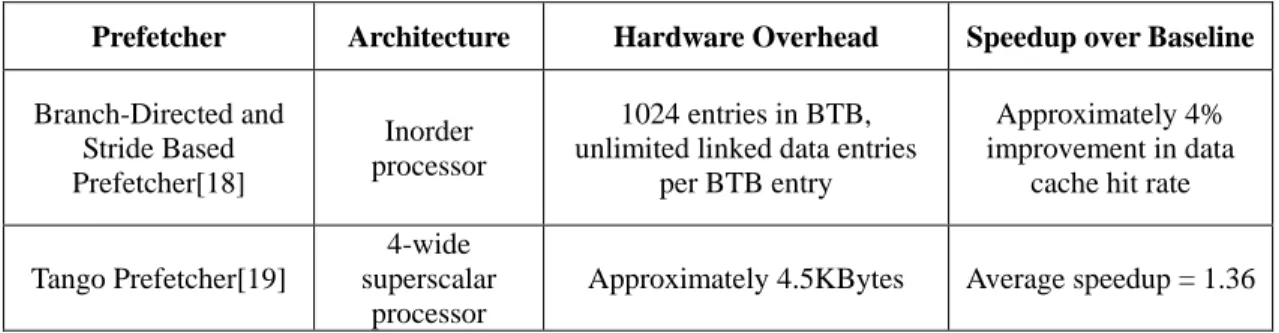
Table III.1 shows the hardware overhead and performance benefits of previous branch-directed prefetcher implementations.
Table III.1 Hardware overhead and performance benefits of prior branch-directed prefetchers
Prefetcher Architecture Hardware Overhead Speedup over Baseline Branch-Directed and Stride Based Prefetcher[18] Inorder processor 1024 entries in BTB, unlimited linked data entries
per BTB entry
Approximately 4% improvement in data
cache hit rate
Tango Prefetcher[19]
4-wide superscalar
processor
Approximately 4.5KBytes Average speedup = 1.36
In this thesis, we also employ a lookahead scheme to generate timely prefetches similar to that adopted in Tango. However, our system has certain advantages over the previously proposed branch-directed schemes including Tango. Our scheme enables prefetching by exploiting the correlation between the values of the source registers (that are used for memory address computation in basic blocks) at prior branch instructions and actual addresses generated by the corresponding memory instructions. This approach has many benefits over exploiting only memory instruction-based correlation. One such
benefit can be realized by examining the following code fragment.
This program sequence is taken from the Leslie3d benchmark from the SPEC CPU 2k6 benchmark suite. Since this is a loop-based code fragment, both the stride-based techniques (like Tango) and our current implementation can accurately prefetch for the same. But it is interesting to note that both instructions 1 and 2 manipulate the same register (r2) for their address computation, even if they are different instructions. In such a case, a stride-based prefetching scheme needs to save two separate entries for these two instructions (1 & 2) to accurately prefetch for them. But our register-index based prefetching scheme can save the same amount of information using a single entry corresponding to register index r2 (linked to the branch instruction, 5). Another advantage of our technique is that by exploiting branch-register correlating links, the dynamic runtime values of the registers can be used to enable prefetching for even those data that show irregular memory access patterns. But the previous methods can only take advantage of strided memory access patterns.
Having discussed the previously proposed data prefetching strategies, we next provide some background about confidence estimation mechanisms. Such techniques help to estimate the confidence of a certain prediction and hence, are used to limit the degree of speculation. We also employ a similar technique in our current scheme to enhance the accuracy of our prefetcher by limiting prefetches along an incorrectly predicted path of execution.
III.2 Confidence Estimation Techniques
Confidence estimation is a micro-architectural technique that allows control over speculation by predicting whether the speculation will be correct or not, before the actual outcome is established / known. Such techniques can be applied in areas like branch prediction, prefetching etc. For example, in the context of branch predictions, a confidence estimator can be used to classify the dynamic predictions made by a branch predictor into high confidence or low confidence categories.
In our current work, we are more concerned about estimating the “execution path confidence”. Unlike branch confidence, a path confidence estimate measures the confidence that a predicted execution path will be actually followed. Such a path may span multiple basic blocks and hence, can be used to limit lookahead from proceeding deeper along a wrong path of execution. Many path confidence estimators have been proposed in the past. But mostly all such approaches are based on the idea that since the control flow instructions determine the execution path, branch confidence estimators can themselves, be used to derive the path confidence estimate fairly accurately. In this subsection, a few branch-based and path-based confidence estimators are reviewed, that have been proposed in literature.
Jacobsen et al. proposed an accurate confidence estimation mechanism (called the JRS confidence estimator), aimed at controlling the branch-prediction based speculation [21]. It is based on the idea that a very small subset of static branches causes a majority of dynamic mis-predictions and that most mis-predictions occur in clusters. Hence, in their approach, it is attempted to identify those branches that were mis-predicted in the recent past and hence are likely to mis-predict again. To identify such branches, a table of 4-bit saturating counters called the miss distance calculating (MDC) table is used, whose index is derived by xoring the branch PC with the global branch history. Each time, a branch is correctly predicted the corresponding MDC entry gets incremented and
the counter is reset to zero in the event of a misprediction. So, the table entry essentially stores the number of times a particular branch was correctly predicted consecutively in the past. Higher this counter value, greater is the probability that the prediction would be correct another time. Grunwald et al. proposed an enhancement over the JRS predictor, wherein the global history that is used to index into the MDC table also includes the prediction for the current branch in question [22]. This predictor was also shown to be better than the original JRS proposal.
Jimenez proposed a composite scheme to make better confidence estimates in relation to branch predictions [23]. For a tournament-based predictor, the author proposed to use a combination of the outputs of different confidence estimators, like the JRS, up/down and the branch predictor’s self-counters to estimate a composite confidence output. Finally, whether a prediction is deemed to be of high confidence or not depends on whether the aggregate confidence estimate is above a pre-determined threshold. A variation of this technique is used for branch confidence estimation in this thesis work.
Among the efforts towards path confidence estimation, the approach adopted in many proposals is based on the idea that the higher the number of low-confidence branches along a path, higher is the likelihood of the path being incorrect. Along the same lines, the path confidence estimator records the count of the number of high-confidence and low-confidence branches encountered in a path and when the total number of low confidence branches increases beyond a certain threshold, the path is considered to be low-confident. However, this technique assumes that all low-confidence branches have the same misprediction rate and that all low confidence branches have lesser likelihood of being correct than all high-confidence ones, which may not be always true.
In contrary to the above assumption, we observed that because the branch confidence estimators are themselves imperfect, the misprediction rates observed over the different confidence categories does not correlate with the confidence value exactly. This
observation is in line with the observation made by Malik et al. in [24]. In [24], the authors do not use the value of each branch confidence category as an estimate of its correctness. Instead, they estimate the confidence value of each category based on the dynamically observed misprediction rates of the branches that fall into the same. The path confidence estimate is then, calculated by multiplying the confidence estimates of all the branches included in that path. In the same work, the authors have also presented a hardware implementation that measures path confidence using only integer addition and subtraction.
CHAPTER IV
DESIGN AND IMPLEMENTATION
This chapter presents the complete design and implementation of our branch directed prefetcher. First, a general overview of the overall system architecture is provided in Subsection IV.1, which is followed by a detailed description of the individual system components in Subsection IV.2. Finally, the chapter concludes with a working example (in Subsection IV.3) explaining how the different components work together.
IV.1 Overall System Architecture
This subsection presents an overview of the modified system architecture and discusses how the different components are tied to each other.
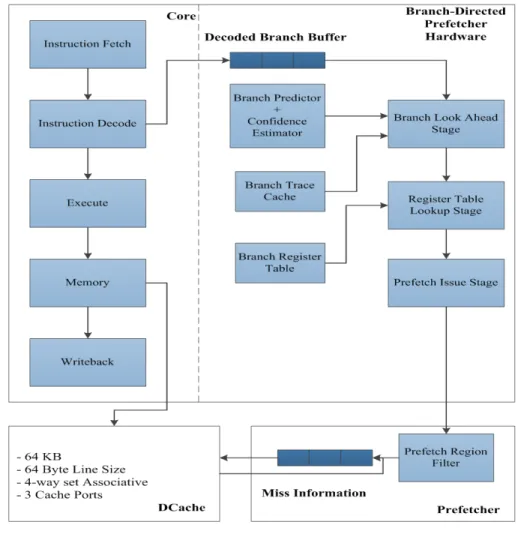
Figure IV.1 depicts the detailed architecture of a modified inorder core, showing the main execution pipeline as well as the additional hardware entities to realize the branch-directed data prefetcher. The additional components are as follows:
• Branch Trace Cache (BrTc) Table: It captures the dynamic control flow sequence of a program. It caches pairs of branch instruction PCs, where the second branch follows the first branch along a specific direction of execution of the first branch. This structure allows jumping from one basic block (defined by the entry branch instruction and its direction of execution) to the next in a single clock cycle. It thus, is used to implement the lookahead mechanism which plays a key role in making this prefetcher effective and timely.
Figure IV.1 Overall system architecture
• Path Confidence Estimator: This component allows controlling the degree of lookahead across basic blocks, by keeping track of the confidence of the predicted execution path. As the prefetcher tries to lookahead across multiple basic blocks so as to issue prefetches for them, this unit runs in parallel and estimates the confidence that the predicted execution path will be actually followed in the main execution pipeline. Whenever the computed confidence falls below a certain threshold value, indicating greater likelihood of lookahead being along a wrong path, the lookahead process is terminated. Thus, this helps to avoid prefetching useless data, by preventing lookahead along a wrong path of execution. It is to note that this kind of control mechanism has not been explored
in any similar prior work. Note also that most of the latest branch predictors come with a built-in confidence prediction mechanism and hence, it makes the use of an additional confidence estimator unnecessary.
• Branch-Register Table (BrReg Table): This is one of the most important structures towards the realization of this prefetcher. It captures the information that is used to generate prefetch addresses for future basic blocks. It links the memory instructions in any basic block to its immediately preceding branch instruction, by linking the source register indices of the memory instructions to their preceding branch instruction.
• Prefetch-Filtering Mechanism: Given its aggressive nature, this prefetcher tends to issue a large number of prefetches, which may not all be useful to the processor, thereby causing cache pollution. Additionally, this might also lead to increased demand on the limited bandwidth, thereby affecting performance. Hence, certain filtering techniques are in place to control the number of useless prefetches issued by the prefetcher.
As can be seen from the figure, the prefetching component is implemented as a separate pipeline referred to as the Auxiliary pipeline (A.P), parallel to the main execution pipeline. It monitors certain events of interest in the main pipeline for its functioning, but otherwise is completely non-intrusive to the actual program execution. Currently, A.P is implemented as a 3-stage pipeline where: a) the first stage is the “Basic-Block
Look-Ahead” stage that allows to jump from one basic block to the next and to achieve the lookahead component of the prefetching algorithm b) the second stage is the “Branch-Register Table Lookup” stage that allows to expose memory instructions in each looked-ahead basic block & generates prefetch candidate addresses and c) the third stage is the “Prefetch Issue” stage that issues identified prefetch addresses to the prefetch queue.
As shown in the figure, the A.P is connected to the main pipeline through a 3-entry
Decoded Branch Buffer (DBB). As branches get decoded in the main execution pipeline, they get inserted into the DBB (which operates in a FIFO fashion). A.P then, fetches these branch instruction PCs from the DBB and runs its lookahead algorithm to construct the future basic block trace, starting from the currently decoded branch. This is done by invoking the branch predictor and the BrTc structure repeatedly in the Basic-Block Look-ahead stage. Additionally, the path confidence estimator ensures that prefetching is allowed only along a path that can be confidently predicted starting from the current branch instruction. As the lookahead process continues, the BrReg Table structure is then invoked to identify addresses for prefetch in each looked-ahead basic block by making use of the established branch-register links. This is done in the Branch-Register Table Lookup stage of the auxiliary pipeline. The predicted addresses are passed then, through a prefetch filter to differentiate between the useful and the useless prefetches. Finally, the addresses, which are predicted to be useful, are queued up in the prefetch queue, so that they can be issued to the cache whenever there is available bandwidth and no demand requests are pending. In the current implementation, we support two modes of operation:
a. Non-Loop Mode: In this mode, when a prefetch address is generated, all the blocks in the spatial region containing the predicted address are issued to the prefetch queue. This is done to ensure that the variability in the address values from the past architectural register values, as a result of prefetching significantly ahead of actual execution, is taken care of. This technique also allows exploiting spatial locality in the code, if any.
b. Loop Mode: This mode is entered upon determination that a loop-based code is being executed in the main pipeline. In this mode, while being at one dynamic instance/iteration of a basic block, prefetches are issued for data that would be needed in a future iteration of the loop. In this mode, an entire spatial region around the predicted data is not prefetched.
By employing the lookahead mechanism, branch-directed prefetching aims to identify and eliminate as many misses as possible. But even after incorporating this prefetcher, if cache misses are encountered, then it implies that a prefetch was either not issued in a timely manner or was not accurate enough (owing to the chance of variability) or no prefetch was issued in the first place due to insufficient training of the structures. So, in such a case, the next cache line (the next-line prefetching approach [11]) following the miss block address is prefetched. The main benefit of using this combined approach is that the two techniques are complementary to each other and hence each scheme can compensate for the other's weakness, while taking advantage of the other's strengths. Next-line prefetching takes advantage of spatial locality in the application in the event of a miss. The branch-directed method can take advantage of spatial locality as long as it can predict the region of operation accurately. Additionally, branch-directed prefetching can take advantage of loop-based behavior and irregular accesses as well. So, theoretically, these two categories of prefetchers should work well together.
Finally, it is important to note that the branch-directed prefetching approach does not require any extra ports on the cache. It also gives greater preference to demand requests over prefetch requests. Details about the operation of each individual component are discussed in next section.
IV.2 System Components
This subsection describes in detail, the implementation and working of each system component, that were touched upon in the previous section.
IV.2.1 Branch Trace Cache
The first hardware component to realize this prefetcher is the Branch Trace-Cache (BrTc). As discussed before, this structure helps to capture a trace of the control flow
sequence between basic blocks by capturing the dynamic sequence of execution of branch instructions and their direction of execution. This structure allows us to look ahead across multiple basic blocks, starting from one branch instruction. It is called Branch Trace Cache because its each entry stores a trace of the executed control flow sequence.
The BrTc is implemented as a table that caches pairs of branch instructions, where the second branch follows the first branch along a particular direction of execution. The idea is that since a branch instruction and its direction of execution determines which basic block will get executed next in the program sequence, by exploiting the branch-trace cache hit information and the corresponding branch predictions, it becomes possible to jump from one basic block to another by skipping all the non-control-flow changing instructions in between. Branch Trace-Cache based lookahead approach relies on two typical program characteristics. Firstly, most instructions exhibit temporal locality. It implies that the dynamic sequences of instructions are very likely to repeat in future and hence, if they are cached, they can be used later to realize the lookahead mechanism. Secondly, branches are mostly biased towards one direction or the other. So, it is very likely that certain execution paths will be followed more frequently than others. Hence, maintaining a limited number of such paths should enable re-creation of entire program sequence (given by the combination of basic blocks) at a later point in time.
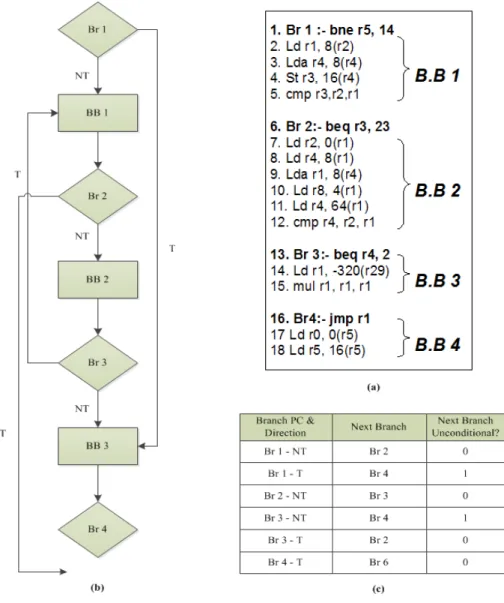
The BrTc is indexed using the current branch PC together with its predicted direction of execution, and its entries cache the next branch tag field (corresponding to the branch instruction that would be encountered if the predicted path is followed, starting from the current branch PC) and a 1-bit field to indicate if the next branch is conditional or not. A typical entry of the BrTc is shown in Figure IV.2. A branch trace cache hit requires that (1) the current branch PC matches the saved PC tag and (2) the corresponding branch prediction matches the stored direction. In case of a hit, the next basic block of execution gets exposed, which can now be used to further the lookahead process.
Figure IV.2 Single Branch Trace Cache entry
To enable filling the BrTc entries, two extra entities are needed, called the LastCommittedBranchInstruction (LCBI) register, which holds onto the last committed branch instruction in the main execution pipeline and the LastCommittedBranchDirection (LCBD) register, which holds onto the direction taken by the last committed branch instruction. As branch instructions commit in program order, they get linked to the branch tag saved in the LCBI register (along with the direction given by the LCBD register). To give an example of how the BrTc entries are filled and what they correspond to, consider the program sequence given in Figure IV.3 (a). The corresponding control flow graph is depicted in Figure IV.3 (b). In this directed graph, each bubble corresponds to one basic-block of instructions (that have exactly one entry point and one exit point) and the diamonds correspond to the branch instructions which lead into the basic blocks. The relevant filled entries of the branch trace cache for this program sequence is shown in Figure IV.3 (c).
The different design choices available for the BrTc's implementation are as follows: a. Table Update Policy - BrTc entries can be trained as branch instructions get
decoded speculatively or they can be filled as branch instructions retire in program order. Although the table learning time will be shorter in the first case, we choose the commit-time update mechanism in our current implementation to avoid pollution of the table by mispredicted and wrong path branches.
b. Organization – BrTc can be organized as a direct-mapped or a set-associative structure. Support can also be included for path associativity, which would allow simultaneous caching of multiple paths emanating from the same branch PC. Enabling support for path associativity would reduce thrashing between those
branch-pairs that start at the same address, but proceed in different directions. In our current proposal, we have implemented a direct-mapped BrTc structure, with support included for path associativity.
Figure IV.3. Figure showing: (a) A program sequence; (b) Control Flow Graph of the program sequence in (a); (c) Branch Trace Cache filled state
Finally, it is to note that even if BrTc was discussed as a standalone table so far, but given its similarity to a Branch Target Buffer (BTB) structure, BrTc can be implemented
as an extension to the BTB. This will save the extra tag space to save the indexing branch instruction PC, used by the current implementation. Also, instead of saving the next branch instruction tag completely, a pointer to the next branch's position in the table [19] can be saved. These optimizations could be attempted to reduce the hardware overhead of the BrTc Table.
IV.2.2 Path Confidence Estimator
As discussed before, our lookahead logic combines the branch prediction information together with the hit information from the Branch Trace-Cache to determine a likely path of execution. But after a lookahead is initiated, some mechanism is needed to ensure that lookahead keeps proceeding along the correct path. Such a terminating condition for the lookahead process can be realized in two ways: a) the first scheme allows lookahead to proceed as deep as possible and terminates it only when a misprediction is detected in the main execution pipeline. However if the branch prediction accuracy is not very high, then it is quite likely that lookahead would proceed deeper along a wrong path fairly often. If this is not limited, a lot of data may be prefetched along a wrong path, which may lead to cache pollution and unnecessary bus bandwidth consumption. b) The second scheme employs a confidence estimation technique that limits looking ahead along low-confidence paths. This approach is conservative in nature and hence may limit prefetching opportunity in some cases, but it would control the cache pollution resulting from wrong path prefetching. Hence in this thesis work, the second approach is adopted i.e., prefetching is allowed only along those paths that can be confidently predicted starting from the current execution instance.
To estimate the confidence in the prediction of the execution path, we make use of the fact that any program contains some non-control-flow changing (ALU or memory or IO etc.) instructions and some control-flow changing instructions and that, the path followed by the program at any time depends on the direction of execution of the
constituent control-flow instructions. Therefore, to estimate the confidence of any path, it is reasonable enough to consider the confidence estimates of the constituent branch predictions alone.
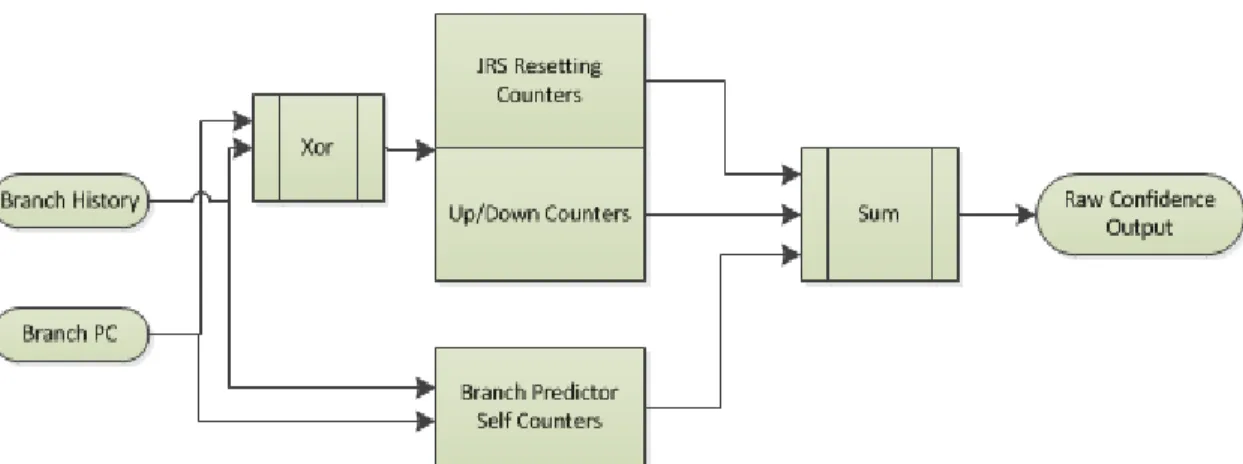
Figure IV.4 Composite Branch Confidence Estimator
To estimate branch confidence, a composite confidence estimator is employed (as suggested in [23]) that combines the JRS, up-down and self-counter based confidence estimators. This is shown schematically in Figure IV.4. The JRS and up-down estimators are arranged as a table of saturating counters that get indexed with the hash of the branch PC and the global branch history buffer. The corresponding saturating counters are incremented when a branch prediction turns out to be correct and decremented in the event of a misprediction. Therefore, to estimate the confidence of a branch prediction at any point in time, these tables is looked up using a hash of the branch PC and the global branch history buffer and the counter values are recorded. The total raw confidence value is calculated as the sum of the JRS counter value, the up-down counter and the self-counter value. We term each such raw confidence output as a “confidence bucket”, because these values help to segregate different branch instructions into different buckets according to their predictability. In order to convert this raw confidence output into a confidence estimate, there are two possible options:
One possibility is to use a static pre-determined value for each confidence bucket. This is based on the assumption that all low-confidence branches (having low bucket values) have the same misprediction rates while, all the high-confidence ones (those having higher bucket values) are more likely to be correct. However, during our experiments, we observed that the misprediction rate of each confidence bucket does not
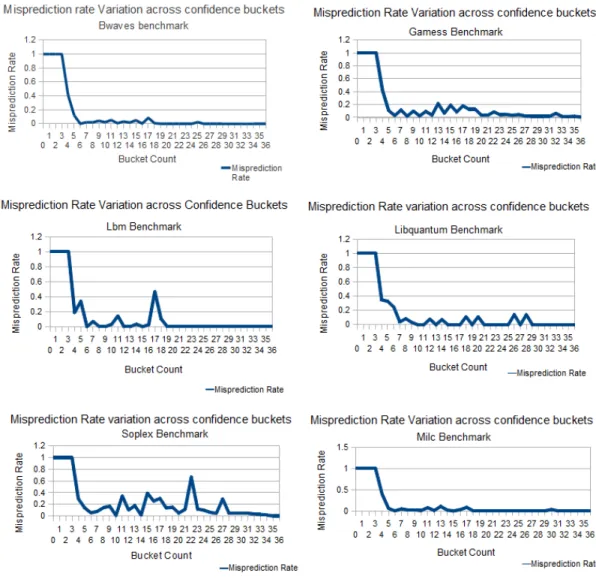
Figure IV.5. Graphs showing the variability in branch misprediction rates across the 37 confidence buckets for a set of SPEC CPU2006 benchmarks
correlate to its bucket value directly and that this trend varies with program phase as well as the application. The situation is depicted more clearly in Figure IV.5. These graphs show the misprediction rates observed across the 37 confidence buckets (JRS + Up/Down + Saturating) over a 300-million instruction run for a set of SPEC2k6 benchmarks. Misprediction rate of each bucket is calculated as the number of mispredicted branches that were predicted with that confidence value divided by the total number of branches predicted with that confidence value. We can see from the graph that many confidence buckets, which have a lower bucket number, have a better misprediction rate than many others with a higher bucket number. Similar observation was also recorded in [24].
This observation essentially, rules out the possibility of selecting a common threshold for each bucket that will hold well across all the applications and during each program phase. Hence, to take into account the variability observed across the confidence buckets, the associated confidence values are determined dynamically in our work, by monitoring the misprediction rate of each bucket. This approach is similar to that suggested in [24] except that a more fine-grained stratifier is used to filter out greater number of mispredicting branches. In this approach, counters are maintained per bucket to count the number of committed and squashed branches belonging to that category. Again, unlike [24], the confidence value of each bucket is maintained using a running estimate. Basically, the program run is divided into phases, where each phase consists of about 1/2 million branch predictions. In any program phase, the misprediction rate of each bucket is computed as the number of mispredictions falling into that category over the total number of predictions from that category. Finally, at the end of the program phase, the confidence value of each bucket is re-calculated as:
ConfidenceValue = ½ * (ConfidenceValAtTheBeginningOfInterval + ConfidenceValDuringInterval)
This running estimate (calculated as described above) gives more weightage to the misprediction rates in the latest interval, but allows for gradual changes by taking into
account the older estimates as well. Finally, the path confidence estimate is calculated as the gross product of the component branch confidence estimates.
Path Confidence = Π (Individual Branch Confidence values)
It is to note that the impact of incorporating more simplified confidence estimators has not been explored in this work. Given the other pollution controlling measures adopted in this thesis (like prefetch filtering), we think that more simplifying assumptions may be taken here without impacting performance much. Additionally, modern branch predictors come with their own self-confidence estimators and hence, do not require this separate entity to realize the branch-directed data prefetcher.
IV.2.3 Branch-Register Table
The third hardware component to realize this prefetcher is the Branch-Register (BrReg) table. This table is used to establish the links between the register indices that are used for memory address computation (source registers of memory instructions) in a basic block and their preceding branch instruction. This helps to generate data addresses for prefetching.
The BrReg Table is indexed using the Branch PC tag and the individual entries contain the registers that are linked to the corresponding branch PC and certain other fields, which are used for generating prefetch addresses. In its simplest form, a typical BrReg Entry looks as shown in Figure IV.6:
where,
• Branch Tag field contains the Branch PC tag.
• RegIdx – This multi entry field holds the register indices, which appear as source registers for address generation in the basic block following the branch PC (given by Branch Tag field).
• RegVal – It holds the most recent value of the register, based on which a prefetch was generated during the last lookahead cycle.
• PF Bit - This is a 1-bit field and is used to distinguish between the prefetched and the non-prefetched entries. This field also helps to prevent prefetching for those basic blocks, which have already been prefetched for.
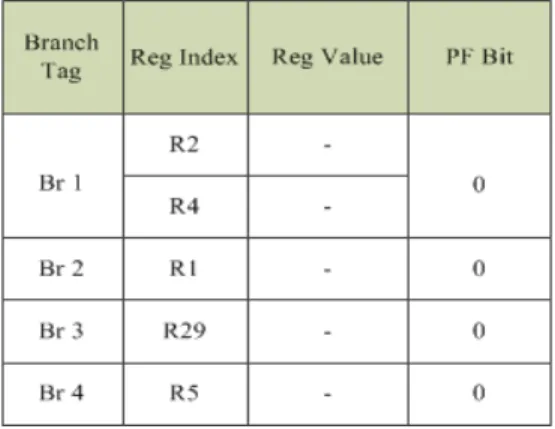
The link between memory and branch instructions gets created as the different control and memory instructions commit in program order. To establish such a link, a register called the LastCommittedBranchInstruction (LCBI) is used, which holds the last committed branch instruction in the main execution pipeline. As control instructions commit, they overwrite the existing content of the LCBI with their own PC. Hence, when memory instructions commit, they get associated with the Branch, whose PC is indicated by the LCBI register. Such links are cached in the BrReg Table. For example, for the code fragment given in Figure IV.3 (a), the corresponding learned state of the BrReg Table is given in Figure IV.7.