for agent programming. PhD thesis, University of
Nottingham.
Access from the University of Nottingham repository: http://eprints.nottingham.ac.uk/29286/1/luan-van.pdf Copyright and reuse:
The Nottingham ePrints service makes this work by researchers of the University of Nottingham available open access under the following conditions.
· Copyright and all moral rights to the version of the paper presented here belong to the individual author(s) and/or other copyright owners.
· To the extent reasonable and practicable the material made available in Nottingham ePrints has been checked for eligibility before being made available.
· Copies of full items can be used for personal research or study, educational, or not-for-profit purposes without prior permission or charge provided that the authors, title and full bibliographic details are credited, a hyperlink and/or URL is given for the original metadata page and the content is not changed in any way.
· Quotations or similar reproductions must be sufficiently acknowledged. Please see our full end user licence at:
http://eprints.nottingham.ac.uk/end_user_agreement.pdf A note on versions:
The version presented here may differ from the published version or from the version of record. If you wish to cite this item you are advised to consult the publisher’s version. Please see the repository url above for details on accessing the published version and note that access may require a subscription.
A general language
for agent programming
by Thu Trang Doan, MSc
Thesis submitted to The University of Nottingham
for the degree of Doctor of Philosophy, December 2013
A key advantage of BDI-based agent programming is that agents can deliberate about which course of action to adopt to achieve a goal or respond to an event. However while state-of-the-art BDI-based agent programming languages provide flexible support for ex-pressing plans, they are typically limited to a single, hard-coded, deliberation strategy (perhaps with some parameterisation) for all task environments. In this thesis, we de-scribe a novel agent programming language,meta-APL, that allows both agent programs and the agent’s deliberation strategy to be encoded in the same programming language. Key steps in the execution cycle ofmeta-APL are reflected in the state of the agent and can be queried and updated bymeta-APLrules, allowing a wide range of BDI delibera-tion strategies to be programmed. We give the syntax and the operadelibera-tional semantics of meta-APL, focussing on the connections between the agent’s state and its implementation. Finally, to illustrate the flexibility ofmeta-APL, we show how Jason and 3APL programs and deliberation strategy can be translated intometa-APLto give equivalent behaviour under weak bisimulation equivalence.
Above all, I am extremely grateful to Dr. Brian Logan, my principal supervisor as well as my primary resource for my study, for his scientific advice and knowledge, and insightful discussion and suggestion. This thesis would not exist at all if it were not for his tireless help and encouragement. I would also like to express my heartfelt gratitude to Dr. Natasha Alechina for not only encouraging and constructive feedback, thoughtful and detailed comments but also her constant support in my study as well as my life. She is someone everybody will instantly love and never forget once they meet her.
I would like to send my thanks to Dr. Henrik Nilsson and Dr. John-Jules Ch. Meyer for their valuable comments and suggestions on my thesis.
I would also like to thank the University of Nottingham and the School of Computer Science for giving me the opportunity to carry out my research, for their financial support and for providing a warm and inviting place to study.
Special thanks to my colleagues in Agent Lab, my wonderful friends in Nottingham and Swansea, for your invaluable help and support during my last five years.
Last but not least, I would like to thank my family, especially Hoàng Ngà Nguyen, my best friend, my soul-mate, my husband, for your unconditional and endless love, genuine care and deep sympathy at any time and anywhere I need. Without you, I am just a dust in the wind!
Abstract 1
Acknowledgements 2
List of Figures 6
1 Introduction 7
1.1 Motivation . . . 7
1.2 Research objectives and contributions . . . 12
1.3 Overview and structure of Thesis . . . 13
2 Background: Agents and programming agents 15 2.1 Intelligent agents . . . 15
2.2 BDI architecture . . . 17
2.3 Agent programming languages . . . 19
2.3.1 Logic-based languages . . . 20
2.3.2 Imperative languages . . . 24
2.3.3 Hybrid languages . . . 26
2.3.4 Discussion . . . 33
2.4 Programming deliberation strategies . . . 35
2.4.1 Programming selection of intentions for adoption . . . 35
2.4.2 Programming selection of intentions for execution . . . 36
2.5 Procedural reflection . . . 38 1
2.6 Simulating agent programs . . . 41
2.7 Summary . . . 42
3 The agent programming language meta-APL 44 3.1 Introduction . . . 44
3.2 Syntax . . . 48
3.2.1 Terms and atoms . . . 48
3.2.2 Primitive operations on atom instances . . . 50
3.2.3 Plans . . . 51
3.2.4 Primitive operations on plan instances . . . 52
3.2.5 User-defined queries and meta actions . . . 55
3.2.6 Object-level rules . . . 57
3.2.7 Meta rules . . . 58
3.2.8 Meta-APL program . . . 58
3.3 Core deliberation cycle . . . 59
3.4 Example Deliberation Cycles . . . 60
3.5 Example of ameta-APLagent program . . . 61
3.6 Summary . . . 65
4 Operational semantics of meta-APL 67 4.1 Agent configuration . . . 67
4.1.1 Atom and plan instances . . . 67
4.1.2 Configurations . . . 72
4.2 Semantics of queries and meta actions . . . 74
4.2.1 Answering queries . . . 74
4.2.2 Determining justifications . . . 76
4.3.1 TheSensephase . . . 81
4.3.2 TheApplyphase . . . 82
4.3.3 TheExecphase . . . 84
4.3.4 Semantics of agents . . . 87
4.4 Summary . . . 88
5 Cycle-based Bisimulation 89 5.1 Bisimulation . . . 90
5.1.1 Labelled transition system . . . 90
5.1.2 Strong bisimulation . . . 90 5.1.3 Weak bisimulation . . . 91 5.2 Cycle-based bisimulation . . . 93 5.3 Summary . . . 100 6 Simulating Jason 101 6.1 Jason . . . 101 6.1.1 Syntax . . . 102 6.1.2 Operational semantics . . . 104
6.1.3 Selections in a deliberation cycle . . . 112
6.2 Translation . . . 114
6.2.1 Outline of the translation . . . 114
6.2.2 The static part of the translation . . . 117
6.2.3 Component translation functions . . . 121
6.2.4 Simulating selections . . . 125
6.3 Equivalence oftrJason. . . 126
6.3.1 Observations . . . 126
7 Simulating 3APL 139
7.1 3APL . . . 139
7.1.1 3APL Syntax . . . 140
7.1.2 3APL Operational semantics . . . 144
7.1.3 Selections in a 3APL deliberation cycle . . . 151
7.2 Translation . . . 152
7.2.1 Outline of the translation . . . 153
7.2.2 The static part of the translation . . . 155
7.2.3 Component translation functions . . . 158
7.2.4 The translation functiontr3APL . . . 161
7.3 Simulating selections . . . 162
7.4 Equivalence bytr3APL . . . 163
7.4.1 Observations . . . 164
7.4.2 Equivalence theorem . . . 165
7.5 Summary . . . 174
8 Conclusion and future work 175 8.1 Evaluation ofmeta-APL. . . 175
8.2 Summary of Contributions . . . 178
8.3 Future work . . . 180
Bibliography 182 A Reference of meta-APL 188 B A computation run of the clean robot 192 B.1 First cycle . . . 193
2.1 An abstract view of intelligent agents. . . 16
2.2 Features of hybrid agent programming languages. . . 35
2.3 A computational view for procedural reflection. . . 39
3.1 The service robot example. . . 62
4.1 Example of the subgoal and justification relations. . . 73
4.2 Phases inmeta-APLdeliberation cycle. . . 80
5.1 Conditions of Theorem 5.2.6. . . 96
5.2 There are more than one transitions fromt. . . 98
6.1 The deliberation cycle of Jason. . . 105
6.2 The correspondence between Jason’s andmeta-APL’s deliberation cycles. . 115
6.3 The translation functiontrJason. . . 116
6.4 The simulation of Jason transitions in the translation. . . 124
7.1 The implemented deliberation cycle in 3APL platform [Dastani et al., 2005]. 140 7.2 The deliberation cycle of 3APL platform. . . 146
7.3 The correspondence between 3APL’s andmeta-APL’s deliberation cycles. . 153
7.4 The translation functiontr3APL. . . 155
7.5 The simulation of 3APL transitions in the translation. . . 162
Introduction
1.1
Motivation
Agent technology offers a promising approach to the development of large systems con-sisting of distributed, intelligent agents who interact via message passing and/or by per-forming actions in a shared environment. The Belief-Desire-Intention (BDI) approach to designing, programming and verifying such systems has been very successful, and is per-haps now the dominant paradigm in the field of multi-agent systems. In this architecture, states of agents are comprised of mental attitudes such as beliefs, desires and intentions where beliefs are the agents’ description about the world, desires specify states of affairs about which the agents want to bring and intentions are some of the desires to which the agents are committed. Agents use these mental attitudes to deliberate and decide which actions to perform.
In agent programming languages based on the BDI approach, agents select plans in response to changes in their environment or to achieve goals. In most of these languages, plan selection follows four steps. First the set of relevant plans is determined. A plan is relevant if its triggering condition matches a goal to be achieved or a change in the agent’s beliefs the agent should respond to. Second, the set of applicable plans is determined. A
plan is applicable if its belief context evaluates to true, given the agent’s current beliefs. Third, the agent commits to (intends) one or more of its relevant, applicable plans. Finally, from this updated set of intentions, the agent then selects one or more intentions, and executes one (or more) steps of the plan for that intention. This deliberation process then repeats at the next cycle of agent execution.
Current BDI-based agent programming languages such as AgentSpeak(L) [Rao, 1996], 3APL [Hindriks et al., 1999; Dastani et al., 2003b], GOAL [Hindriks et al., 2000; de Boer et al., 2007], Dribble [van Riemsdijk et al., 2003], Jason [Bordini et al., 2007], and 2APL [Das-tani, 2008] provide considerable support for steps one and two (determining relevant, ap-plicable plans). A programmer can write rule-based expressions in these languages which include triggering conditions and belief contexts. For example, aplanin AgentSpeak(L) contains a triggering event used to determine if the plan is relevant and a context query used to determine if the plan is applicable.
However, with the exception of some flags for plan in Jason, the third and fourth steps (adopting intentions and selecting one or more intentions for execution) cannot be pro-grammed in the agent programming language itself. For example, in Jason, a plan can be accompanied with flags such as the flagatomicmeaning that if an intention generated by the plan is selected for execution, the intention will be selected for execution in the sub-sequent deliberation cycles until completed. In other words, a Jason agent will not select another intention for execution if the intention which was selected to be executed in the last cycle is accompanied with the flag atomic has not been executed completely. No sin-gle deliberation strategy is clearly “best” for all agent task environments. For example, in a deliberation strategy, intentions can be executed in an interleaving or non-interleaving fashion. Interleaving can improve the performance of agents as they can achieve more than one goals in parallel. However, it might also give rise to the contention of resource so that no intentions were executed unsuccessfully [Thangarajah et al., 2003]. For example, an agent has two intentions for two goals about being at two different locations which are
in opposite directions. Then, interleaving the execution of these two intentions will make the agent to go around a position between the two locations. It is therefore important that the agent developer has the freedom to adopt the strategy which is most appropriate to a particular problem.
Some languages allow the programmer to override the default deliberation cycle be-haviour by redefining “selection functions”. For example, in Jason, there are three selec-tion funcselec-tions for selecting an event to react to, an applicable plan to generate intenselec-tions and an intention for execution. However, the redefinition of these selection functions can-not be done in the agent programming languages since they do can-not provide any support to do so. Therefore, the redefinitions of these selection functions must be done in the host language (i.e., the language in which the interpreters of these languages are themselves implemented). A different approach to modify the default deliberation cycle is to spec-ify the deliberation strategy in a different language such as [Dastani et al., 2003a]. This language provides primitive meta-statements such as for selecting a goal planning rule and for generating a plan from a selected rule. Then, a deliberation cycle is defined by combining these meta-statements using sequential, conditional and iterative constructs.
Clearly, both redefining selection functions in host languages and specifying deliber-ation strategies in a different language are less than ideal. If often requires considerable knowledge of how the deliberation cycle is implemented in the host language, for exam-ple. Moreover, without reading additional code (usually written in a different language), an agent developer cannot tell how a program will be executed. Therefore, it would be better to be able to program steps three and four in the agent programming language it-self. In other words, this agent programming language must provide facilities to query and manipulate its first class objects (where intentions are obviously first class objects) so that strategies of adopting new intentions and selection existing intentions for execution can be encoded in the language.
re-flection. A reflective programming language [des Rivières and Smith, 1984] incorporates a model of (aspects of) the language’s implementation and state of program execution in the language itself, and provides facilities to manipulate this representation. Critically, changes in the underlying implementation are reflected in the model, and manipulation of the representation by a program results in changes in the underlying implementation and execution of the program. Perhaps the best known reflective programming language is 3-Lisp [Smith, 1984]. However, many agent programming languages also provide some degree of support for procedural reflection. For example, the Procedural Reasoning Sys-tem (PRS) [Georgeff and Lansky, 1987] incorporated a meta-level, including reflection of some aspects of the state of the execution of the agent such as the set of applicable plans, allowing a developer to program deliberation about the choice of plans in the language itself. Similarly, many agent programming languages (such as Jason) provide facilities to manipulate the set of intentions. However, the support for procedural reflection in current state-of-the-art agent programming languages is always partial, in the sense that it is dif-ficult to express the deliberation strategy of the agent directly in the agent programming language.
In this thesis, we show how procedural reflection can be applied in a BDI-based agent programming language to allow a straightforward implementation of steps three and four in the deliberation cycle of a BDI agent. By exploiting procedural reflection an agent pro-grammer can customise the deliberation cycle to control which relevant applicable plan(s) to intend, and which intention(s) to execute. We argue this brings the advantages of the BDI approach to the problem of selecting an appropriate deliberation strategy given the agent’s state, and moreover, facilitates a modular, incremental approach to the develop-ment of deliberation strategies.
We describe a novel agent programming language,meta-APL, that allows both agent programs and the agent’s deliberation strategy to be encoded in the same programming language. This is achieved by adding the ability to query the agent’s plan state and actions
which manipulate the plan state to the language. Currently, no interpreter has been im-plemented formeta-APL. There are three key goals underlying the design ofmeta-APL:
• it should be possible to specify a wide range of deliberation cycles, including the deliberation cycles of current, state-of-the art agent programming languages; • programs of other agent programming languages should be translatable into
meta-APLin a modular fashion, namely the program of an agent programming language should be translated to an “object program” ofmeta-APLand the same specification of the agent programming language’s deliberation cycle should be used with all such translations (resulting in a bisimilar execution); and
• programming at the object level in this language should be at least as simple and easy as in state-of-the-art BDI agent programming languages; however, agent pro-grammers can take advantage of specifying alternative deliberation strategies in this language.
In order to show that programs of other agent programming languages can be translated intometa-APL, we choose to simulate agent programs in Jason and 3APL. Although both Jason and 3APL are based on the BDI approach, they support different features. For ex-ample, agents in Jason generate intentions to react to events and do not repair intentions, whereas agents in 3APL generate intentions to achieve declarative goals. 3APL agents are also capable of repairing intentions. These differences exhibit different challenges when translating their agent programs intometa-APL. Finally, both Jason and 3APL agents are provided with formal semantics as transition systems. Therefore, the equivalence be-tween these transition systems can be identified using the concept of weak bisimulation.
We believe the ability to express deliberation strategies (and other language features) in a clear, transparent and modular way provides a flexible tool for agent design. By expressing a deliberation strategy inmeta-APL, we provide a precise, declarative opera-tional semantics for the strategy which does not rely on user-specified functions. Key steps
in the execution cycle ofmeta-APLare reflected in the state of the agent and can be queried and updated bymeta-APLrules, allowing a wide range of BDI deliberation strategies to be programmed. Furthermore, even low level implementation details of a strategy, such as the order in which rules are fired, or intentions executed can be expressed if necessary.
1.2
Research objectives and contributions
The main research objectives of this thesis are:• To design an agent programming language (meta-APL) with facilities that enable the encoding of both agent programs and agent deliberation strategies;
• To define the operational semantics ofmeta-APL;
• To show howmeta-APLencodes typical deliberation strategies;
• To illustrate the flexibility of meta-APL by simulating state-of-the-art BDI-based agent programming languages;
• A theory to support the correctness proof of simulating inmeta-APLunder weak bisimulation equivalence;
• The correctness proofs of these simulations under weak bisimulation equivalence. The main contributions of this thesis are:
• A brief survey of existing agent programming languages; the limitations of these languages with respect to implementing deliberation strategies are also discussed; • An overview of procedural reflection as an approach to enable programming
delib-eration strategies in agent programming languages;
• An agent programming language, namelymeta-APL, with formal operational se-mantics which supports procedural reflection so that different deliberations strate-gies can be implemented; the encoding of typical deliberation stratestrate-gies in meta-APLis also discussed;
• Identifying a general theory for establishing a weak bisimulation between two agent programs through the strong bisimulation of their deliberation cycles;
• Developing the simulation of two state-of-the-art agent programming languages Ja-son and 3APL inmeta-APL; the equivalence result for each simulation is proved.
1.3
Overview and structure of Thesis
The rest of this thesis is organised as follows:Chapter 2 is a review of the background literature. Here, we recall the notion of intelli-gent aintelli-gents, the BDI approach to designing, specifying and programming aintelli-gents, BDI-based agent programming languages and the concept of procedural reflection in programming languages.
Chapter 3 defines the syntax ofmeta-APL.Meta-APLincludes constructs for mental at-titudes such as beliefs, goals, plans, intentions, facilities for enabling procedural reflection such as querying and manipulating mental attitudes.
Chapter 4 defines the operational semantics of meta-APL. Here, we give the definition of agent configurations inmeta-APL, how agents run by transiting from one con-figuration to another via transition rules. We also define semantics of the facilities which enable procedural reflection inmeta-APL.
Chapter 5 develops a theory for proving the correctness of simulating other agent pro-gramming languages inmeta-APL. Here, the correctness is based on weak
bisimu-lations which can be identified by showing the equivalence of operations between deliberation cycles only.
Chapter 6 presents the simulation of Jason inmeta-APL. We define a translation function to convert a Jason agent program into ameta-APLagent program. Then, we show that these two agents operate equivalently under weak bisimulation.
Chapter 7 presents the simulation of 3APL inmeta-APL. 3APL supports several features not found in Jason such as declarative goals and plan revision. Here we also define a translation function to convert each 3APL agent program into ameta-APLagent program and show the equivalence between these two programs.
Chapter 8 gives a brief conclusion about the work and results of this thesis. It also pro-vides directions for future work.
Background: Agents and
programming agents
The notion of an intelligent agent is the central to this thesis. In this chapter, we attempt to answer a number of questions regarding agents including what intelligent agents are, how to specify them, and how to build them by drawing on the multi-agent systems literature. In particular, we review the definition of intelligent agents, the BDI architecture and give a short overview of agent programming languages. At the end of this chapter, we present a brief review of work related to procedural reflection.
2.1
Intelligent agents
In order to develop an agent programming language, it is important to understand the concept of intelligent agents. Here, we follow Woodridge and Jenning’s definition of in-telligent agents [Wooldridge and Jennings, 1995; Wooldridge, 2002]:
An agent is a computer system that is situated in some environment, and that is capable of autonomous action in this environment in order to meet its design objectives.
This definition provides an abstract view of an intelligent agent, as illustrated in Fig-ure 2.1, where the agent is situated in an environment and autonomously runs in order to achieve its goals. Being situated in an environment means that the agent can receive sen-sory information provided by equipment. For example, a mobile agent is equipped with a camera in order to detect if there is an obstacle in front of the agent. The agent is also provided with a repertoire of certain external actions which are used to change the state of the environment. For example, a mobile agent may have effectors such as motorised wheels which allows the agent to move forward; as the agent moves to a different place, the state of the environment changes. In many environments, external actions may fail.
Agent
Environment
Sensory Information External actions
Figure 2.1: An abstract view of intelligent agents.
Therefore, we assume that the execution of an external action may fail to have its desired effect.
Additionally, agents are also argued to have further properties [Wooldridge and Jen-nings, 1995]:
Autonomy: Intelligent agents have the ability to operate autonomously. Here, autonomy means that an intelligent agent determines which action to perform and the freedom to decide how to satisfy its design objectives.
Pro-activeness: Intelligent agents are capable of exhibiting goal-directed behaviours. This means that if an agent has an intention to achieve a goal, the agent will try to exploit any opportunity to complete that intention.
Reactivity: Intelligent agents are capable of reacting to changes in the state of their envi-ronment which are recognised by perception. Reactivity requires the agents to react to these changes in a timely fashion.
Social ability: Intelligent agents are provided with communication languages so that they can communicate with each other (and possibly their owners). Social ability allows the agents to exchange information, to negotiate and to cooperate.
A key challenge confronting researchers in the field of multi-agent systems is to en-gineer intelligent agents that can achieve their design objectives. In the following sec-tions, we briefly review some of the approaches in building and implementing intelligent agents.
2.2
BDI architecture
One of most common approaches to designing intelligent agents is to use the Belief-Desire-Intention (BDI) architecture. In this architecture, states of agents consist of mental attitudes including beliefs, desires and intentions. An agent uses these mental attitudes when deliberating and deciding which actions to perform. Intuitively, beliefs are the infor-mation which agents have about the world. These beliefs may be incomplete or incorrect. In contrast to beliefs, the desires of an agent are descriptions of states of affairs that the agent wants to bring about. In general, it may not be possible to achieve all agent’s desires since desires may be in conflict and the agent might not have enough resources to achieve all desires. Intentions are the particular desires which an agent is committed to achieving. Agents can apply different strategies to commit to intentions. There are three com-monly used commitment strategies in the literature [Rao and Georgeff, 1991]:
• Blind commitment: agents with blind commitment are those who, once committed to an intention, will maintain this intention as long as the agents believe that the intention is not achieved;
• Single minded commitment: agents with single minded commitment are those who, once committed to an intention, will maintain this intention as long as the agents believe that the intention is not achieved and it is possible to achieve the intention; and
• Open minded commitment: agents with open minded commitment are those who, once committed to an intention for achieving a goal, will maintain this intention as long as the agents believe that the intention is not achieved and the intention is still one of agent’s goals.
Among the above commitment strategies, blind commitment is the most conservative: agents with this strategy will keep an intention as long as the intention is not achieved, i.e., if the intention is never achieved, it will be kept forever. Single mined commitment relaxes this condition by allowing intention can be dropped as soon as the agent knows that it is not possible to achieve the intention. Open mined commitment relaxes the condition to keep intentions further, by allowing an agent to drop an intention as soon as the intention is not a goal.
The BDI architecture has been used as a basis for defining logical formalisms which al-low the design of intelligent agents and systems of multiple agents to be specified. These logics are usually combinations of epistemic logics and dynamic logics or temporal logics where different modalities are used to describe mental attitudes of agents such as beliefs, goals (for desires) and intentions and possible worlds are used to define semantics of for-mulas. For example, Cohen and Levesque’s logic, [1990], is a combination of epistemic and dynamic logics. In this logic, beliefs and goals are specified by modal operators BEL and GOAL, respectively. However, intentions are described by dynamic formulas contain-ing action expressions and formulas about beliefs and goals. Another example is Rao and Georgeff’s logic, [1991], which adopts an alternative approach to possible world semantics where epistemic logics are combined with computation tree logic (CTL∗). Furthermore, intentions are treated as first-class citizens apart from beliefs and goals; i.e., there is an
operator, namely INTEND, which is used to specify intentions of agents.
The BDI architecture has also been used as a basis for defining agent programming lan-guages that allow intelligent agents and systems of multiple agents to be implemented. These languages provide data structures to encode beliefs, goals and intentions. Examples of agent programming languages based on the BDI architecture include: PRS [Georgeff and Lansky, 1987], AgentSpeak(L) [Rao, 1996], 3APL [Hindriks et al., 1999; Dastani et al., 2003b], GOAL [Hindriks et al., 2000; de Boer et al., 2007], Dribble [van Riemsdijk et al., 2003], Jason [Bordini et al., 2007], and 2APL [Dastani, 2008]. Interpreters of these lan-guages are generally implemented as loops which include activities such as receiving percepts from the environment, generating new intentions, selecting an intention and exe-cuting it, and dropping intentions. Generating new intentions may include two steps: first to select some desires to be achieved, then to generate intentions in order to achieve these selected desires. The selection of intentions for execution can be implemented using two common strategies: interleaving (which allows existing intentions to be executed in par-allel in an interleaving fashion) and non-interleaving (which keeps selecting an intention until it is completed or dropped). Then, the selection of intentions to be dropped are im-plemented according to some commitment strategy such as blinded commitment, single minded commitment or open minded commitment). Such a loop is called a deliberation cycle which is an idealisation of components, namely generating intentions, deliberating, executing and handling intentions, in practical reasoning [Bratman, 1999].
2.3
Agent programming languages
In this section, we present a brief survey of BDI-based languages. Our aim is to illustrate the broad spectrum of such languages and the design ideas which underlie them. Here, agent programming languages are listed according to categories, namely logic-based lan-guages, imperative languages and hybrid lanlan-guages, as presented in [Bordini et al., 2006].
2.3.1 Logic-based languages
Logic-based agent programming languages allow the direct specifications of intelligent agents and systems of multiple agents to be described in a logic language. Typical ex-amples of these languages include METATEM [Gabbay, 1987; Barringer et al., 1989, 1995; Fisher, 2005], Golog [Levesque et al., 1997], MINERVA [Leite et al., 2001], EVOLP [Alferes et al., 2002], and FLUX [Thielscher, 2005]. The specification of an intelligent agent in such a language is executed by means of its interpreter, which attempts to construct a formal model of the specification. In the remainder of this section, we review two well-known logic-based languages: METATEM and Golog.
METATEM
Agent programs in METATEM [Gabbay, 1987; Barringer et al., 1989, 1995; Fisher, 2005] are specifications which consist of declarative statements. These statements specify the behaviour that agents are expected to exhibit. Each statement is a Linear Temporal Logic (LTL) [Pnueli, 1977] formula where Linear temporal logic LTL is an extension of the propo-sitional logic with temporal operators including:
• thenextoperator: ◯ϕmeans thatϕis satisfied at the next moment in time;
• thesomeoperator: ♢ϕmeans thatϕis satisfied at some future moment in time;
• thealloperator: ◻ϕmeans thatϕis satisfied at all future moments in time; and
• theuntiloperator: ϕU ψmeans thatϕis satisfied at all future moments in time until ψis satisfied.
LTL allows properties of an individual agent to be expressed concisely. For example, the formularequest→replyU ackdescribes an agent which will reply continuously to another one whenever it receives a request from that agent until it obtains an acknowledgement message.
A METATEM agent is executed by means of iteratively constructing a temporal model for the agent’s specification. This is equivalent to proving that the specification is satis-fiable. The process of constructing temporal models of the specification is facilitated by translating the statements comprising the specification into equivalent statements in Sep-arate Normal Form. In this form, temporal statements are conjunctions of formulas of three forms:
• initial rules which specify initial states of the agent, for example start⇒ (sad∨optimistic)
states that at the beginning, eithersadoroptimisticis true. Intuitively, this means the agent is either sad or optimistic at the beginning.
• step rules which specify the relation between consecutive states of the agent, for example
sad∧ ¬optimistic⇒ ◯(sad)
states that from a state where the agent is sad and not optimistic, in the next state the agent must remain sad.
• sometime rules which specify constraints to be satisfied by executions, for example optimistic⇒ ♢(¬sad)
states that from any state where the agent is optimistic, any execution of the agent will eventually lead to a state where the agent is not sad.
Golog
Golog [Levesque et al., 1997] is a logic programming language based on Situation Cal-culus. The program of a Golog agent consists of a number of axioms specifying the pre-conditions and the effects (post-pre-conditions) of actions, and a strategy for executing the agent.
In general, a run of a Golog agent starts in an initial situation and moves to another situation which is produced by applying an applicable (primitive) action at the previous situation. The state of the world is described by fluents whose truth values may vary from situation to situation (hence, a fluent has an argument for situations) together with other predicates whose truth values do not depend on situations. The applicability of an action is provided by a precondition axiom. For example, an action to move north is possible at a situationsif and only if there is no obstacle in the north direction in this situation. This can be expressed in the following First Order Logic (FOL) formula:
P oss(move(north), s) ≡
∀cl, nl(location(cl, s) ∧next(cl, north, nl) → ¬obstacle(nl, s))
Recall that each fluent in the above FOL formula has an situation arguments. When all situation arguments of fluents in a FOL formulaφare suppressed,φis called a pseudo-fluent logical formula andϕ(s)denotes the formula obtained fromφby adding a situation argumentsto every fluent inφ.
The axioms for the effects of actions show how actions change the truth values of flu-ents. For each fluent, programmers provide an axiom to indicate in which situations it is true or false and by which actions it becomes true or false. For example, the truth value of the fluentlocationcan be defined as follows:
P oss(a, s) ⊃ [location(l, do(a, s))≡
(∃cl, d.location(cl, s)∧a=move(d)∧next(cl, d, l))∨
(¬∃d.a=move(d)∧location(l, s))]
The set of programmer-defined axioms together with the foundational ones including a set of axioms for unique names and a set of axioms from situation calculus is called Axioms.
The strategy in a Golog agent program is defined inductively from primitive actions as follows:
• ifφis a pseudo-fluent logical formula , then the test actionφ?is a complex action;
• ifδ,δ1 andδ2are complex actions, so is the sequence of actionsδ1;δ2;
• ifδ,δ1andδ2are complex actions, so is the non-deterministic choice of actionsδ1∣δ2; • ifδ(x)is a complex action, so is the non-deterministic choice of action arguments
(πx)δ(x); and
• ifδ,δ1andδ2are complex actions, so is the non-deterministic iteration of actionsδ∗.
The meaning of a strategy is defined inductively through a macroDoas follows:
• Do(a, s, t) ≡P oss(a, s) ∧t=do(a, s) • Do(φ?, s, t)≡φ(s) ∧s=t • Do(δ1;δ2, s, t)≡∃s′.Do(δ1, s, s′) ∧Do(δ2, s′, t) • Do(δ1∣δ2, s, t)≡Do(δ1, s, t) ∨Do(δ2, s′, t) • Do((πx)δ(x), s, t)≡∃x.Do(δ(x), s, t) • Do(δ∗, s, t)≡∀P.{(∀s1.P(s1, s1))∧(∀s1, s2, s3.P(s1, s2)∧Do(δ, s2, s3)⊃P(s1, s3))}⊃ P(s, t)
The last equivalence defines the semantics of a non-deterministic iteration in whichtis reached fromsby performing the complex actionδzero or more times.
Running an agent which is defined byAxiomsand a strategyδfrom an initial situation S0is to use a theorem prover to perform the following task:
2.3.2 Imperative languages
Agents can also be implemented using conventional (imperative) programming languages, such as Pascal, Java and C++. In such a language, a programmer must perform tasks in-cluding defining data structures to represent agent’s beliefs, goals and intentions as well as functions to decide which action to execute. Therefore, several extensions of imperative programming languages have been proposed such as JAL [Winikoff, 2005], JADE [Bel-lifemine et al., 2005] and Jadex [Pokahr et al., 2005] which facilitate the development of agents and multi-agent systems. As Jadex is an extension of JADE, we only review JAL and JADE in the following.
JAL
JAL [Winikoff, 2005] extends Java with a number of language constructs to allow agent programmers to define a range of notions including:
• Beliefset: beliefs in JAL are stored in a small relational database which is a set of beliefsets. Each beliefset, or relation, stores beliefs of the formname(data1,data2, ...)
which have the same name and different values for data fields. • View: virtual beliefsets that are generated from other beliefsets.
• Event: events which indicate some changes, such as the receipt of messages, the adoption of a new goal, the receipt of perception from from the environment. • Plan: a plan includes indications of which event it handles, which events it
gen-erates, a context to determine in which situations it can be used, and a body that contains Java code.
A JAL agent consists of beliefsets that the agent has, events that it handles and posts, and plans that it has to deal with events. A plan has a method, namelyrelevant, which takes an event as argument and returns true if the plan is relevant to deal with the event.
The relevant method can only access data contained in the event. A plan also has another method, namelycontext, which returns true if the plan is applicable. Finally, we define a body of the plan which includes only Java code.
A JAL agent runs by repeatedly handling events. The process of handling events is as follows:
1. Event posted;
2. Find plans that handle it; 3. Determine the relevant plans; 4. Determine the applicable plans; 5. Select a plan and run its body; 6. If plan fails, go to step 4.
As JAL is based heavily on Java, it has no formal semantics.
JADE
JADE [Bellifemine et al., 2005] is also based on the programming language Java. However, rather than an agent programming language, JADE is a framework for building multi-agent systems. JADE defines a set of Java classes for defining an multi-agent such as Agent and Behaviour. Realising an agent involves constructing a class extending the Agent class. The internal data of agents built in JADE such as beliefs and goals are defined as variables of the class and behaviours of the agents are inner classes which inherit from the Behaviour class defined in JADE. Implementing a behaviour for an agent involves defining an ac-tionmethod and optionally anotherdonemethod to indicate whether the behaviour has completed its execution. Like JAL, JADE also has no formal semantics.
2.3.3 Hybrid languages
Hybrid languages are combinations of logical languages and imperative ones. For most of the languages in this category, mental notions such as beliefs and goals are represented and queried by means of logical languages, while intentions are expressed in impera-tive languages by using conventional programming constructs including sequential state-ments, conditional statements and iteration statements. In this section, we review some popular hybrid agent programming languages including PRS, SPARK, AgentSpeak(L), Jason, 3APL, GOAL and Gwendolen.
PRS
A PRS [Georgeff and Lansky, 1987] agent contains a database for storing its beliefs, a set of goals, an ACT library and a set of intentions.
Given a set of predicate symbols, a set of function symbols and a set of variables, the database is a set of logical formulasP which have the following syntax:
P ∶∶= (p t∗) ∣ (NOTP) ∣ (ANDP+)
t ∶∶= x∣ (f t∗)
wherepis an element of the set of predicate symbols,f is an element of the set of function symbols, andxis a variable from the set of variable. PRS has procedures to maintain the consistency of sets of ground literals.
A goal describes a desired behaviour that an agent intends to perform. It can be one of the following forms:
• ACHIEVEC, to obtainC;
• ACHIEVE-BYC (A1, . . . , An), to obtainCby some procedureA1, . . . , Anfrom the ACT library (see below);
• USE-RESOURCERto allocate a resourceRwhich is either a name or a variable;
• WAIT-UNTILC, to wait untilCbecomes true;
• REQUIRE-UNTILG C, to check that a goalGis always true untilCbecomes true;
• CONCLUDEP, to addP into the database;
• RETRACTP, to deleteP from the database;
whereCis a well formed formula which has the following syntax:
C ∶∶= P ∣ (ORC+)
The ACT library is a set of procedure specifications, calledKnowledge Area(KA), which show how to accomplish a goal or to respond to a particular situation. Each KA consists of a body (describing the steps to be performed of the KA), and aninvocation condition (specifying when it is suitable to use the KA). The body (also called the plot) of a KA is described by a graph containing an initial node and one or more end nodes. Each node on the graph is labelled with a subgoal to be archived while carrying out the KA. The formalism for KAs supports complicated control constructs such as conditional choice, loops and recursion.
SPARK
SPARK[Morley and Myers, 2004] is a successor of PRS. It is a framework for building systems of agents supporting scalability and clean semantics. Compared to PRS, the lan-guage has made a number of simplifications and improvements. A SPARK agent’s knowl-edge base is a set of ground literals rather than a set of restricted FOL formulas as in the database in PRS and the plot of a KA is extended with syntactical constructs for compound task expressions. A task can be a composition of other tasks in sequence or parallel, or can be constructed using familiar constructs from conventional imperative programming
languages such asif −then−else,try−catch, andwhile−do. SPARK also provides opera-tional semantics for each construct so that programmers can understand the meaning of compound tasks.
AgentSpeak(L)
AgentSpeak(L) [Rao, 1996] is a simplified version of PRS. An AgentSpeak(L) agent consists of a belief base, an event base, a plan library (or the plan base) and an intention base. The belief base consists of ground literals. The event base consists of events that occur during the execution of the agent. Events specify changes in mental states of agents such as the addition and deletion of beliefs and goals. There are two types of goals: achievement goals and test goals. An achievement goal specifies a state of affairs that the agent would like to bring about whereas a test goal simply is for checking whether a predicate is true with respect to the current belief base of the agent. The plan library consists of plans used to generate intentions. Each plan is comprised of a triggering event, a context query and a body as a sequence of external actions, belief update actions, and subgoal actions (achievement goal or test goal). Finally, the intention base consists of intentions that the agent is committed to.
AgentSpeak(L) is provided with a formal operational semantics which is defined by a set of transition rules. For example, there is a transition rule describing the application of a plan when its triggering event matches an event in the event base and its query evaluates to true with respect to the belief base. The result of applying the plan is that its body is inserted into the intention base. In AgentSpeak(L), when an intention is created, the agent will not drop the intention until it completes. There are also transition rules for executing actions of intentions in the intention base. Here, executing an external action means to perform the action on the environment. Executing a belief update action is to add or delete beliefs to/from the belief base. Executing an achievement goal means to generate an internal event into the event base. Executing a test goal means to evaluate it
against the belief base.
Jason
Jason [Bordini et al., 2007] is an extension of AgentSpeak(L). Details about AgentSpeak(L) and Jason are described in detail in Chapter 6 where we show how to simulate Jason agents inmeta-APL.
3APL
3APL was first proposed by [Hindriks et al., 1999]. A 3APL agent consists of beliefs and procedural goals (i.e., intentions) which describe what to do. In later work, 3APL was ex-tended in [Dastani et al., 2003b] to incorporate the separation between procedural goals and declarative goals (where a declarative goal describes what to achieve) and the ability to revise intentions. In this extended language, a 3APL agent program consists of a belief base, similar to a Prolog program, consisting of facts and Horn clauses, a goal base con-sisting of goals as conjunctions of literals, and a rule base concon-sisting of goal planning rules for generating new intentions and plan revision rules for revising existing intentions.
The execution of 3APL agents is defined by the 3APL operational semantics comprised of transition rules. These transition rules define how to apply goal planning rules and plan revision rules, and how to execute intentions. 3APL is also provided with an interpreter, namely the 3APL Platform [Dastani et al., 2005]. 3APL is described in detail in Chapter 7 where we also show how to simulate 3APL agents inmeta-APL.
GOAL
GOAL was proposed in [Hindriks et al., 2000] to support declarative goals which were missing in AgentSpeak(L) [Rao, 1996] and the first version of 3APL [Hindriks et al., 1999]. A GOAL agent consists of a set of actions, an initial belief base and an initial goal base. It reasons about beliefs and goals based on Propositional Logic (P L). In the following, we
useP Lto denote the set of all formulas of P Land⊧to denote the logical consequence relation inP L.
Given a set of propositional variablesP rop, a beliefφor goalψin GOAL is a formula ofP Land has the following syntax:
φ, ψ∶∶=p∣ ¬φ∣φ1∧φ2 wherep∈P rop.
In GOAL, queries are defined as follows: ϕ∶∶=Bφ∣Gψ∣ ¬ϕ∣ϕ1∧ϕ2
A GOAL agent is equipped with a set of basic actions, namelyBcap, which are used to update the agent’s beliefs. Basic actions inBcapare specified by a functionT ∶Bcap×
℘(P L)→℘(P L)where℘(P L)is the set of all subsets ofP L, i.e.,℘(P L)={Σ∣Σ⊆P L}. Then, given a basic actiona ∈ Bcapand a set of formulasΣ ⊆P Lwhich represents the agent’s beliefs,T(a,Σ)is the resulting set of the agent’s beliefs after executing the basic actiona.
Furthermore, a GOAL agent can also perform two special basic actionsadopt(ψ)and drop(ψ)which are used to add and to delete goals, respectively.
An actionbin GOAL is defined by a query (specifying when the action is enabled) and a basic action (specifying the effect of the action). The syntax ofais as follows:
b∶∶=ϕ→do(a)
where a ∈ Bcap∪ {adopt(ψ), drop(ψ) ∣ ψ ∈ P L}. Here,adopt(ψ)and drop(ψ)are two predefined basic actions in GOAL where the semantics is to add to the agent’s goals a new goalψand to delete from the agent’s goals a goalψ, respectively.
Then, a GOAL agent is a triple (Π,Σ0,Γ0)where Π is a finite set of actions,Σ0 is a finite set of beliefs and Γ0 is a finite set ofgoals such that for all ψ ∈ Γ0, Σ0 ⊧/ ψ. The conditionΣ0⊧/ ψon the goal setΓ0means that goals in GOAL agents are declarative; i.e.,
the agents do not maintain goals that have been achieved (those which are consequences of the agent’s beliefs). During execution, this condition will be checked whenever there are changes in the agent’s beliefs and goals and maintained by removing any goal that violates the condition.
A configuration of a GOAL agent is a pair(Σ,Γ)of the belief baseΣand the goal base
Γ. A queryϕis evaluated against the configuration(Σ,Γ)is defined as follows: • (Σ,Γ) ⊢BφiffΣ⊧φ;
• (Σ,Γ) ⊢Gψiff∃ψ′∈Γ∶ψ′⊧ψ; • (Σ,Γ) ⊢ ¬ϕiff(Σ,Γ) /⊢ϕ;
• (Σ,Γ) ⊢ϕ1∧ϕ2iff(Σ,Γ) ⊢ϕ1and(Σ,Γ) ⊢ϕ2;
The GOAL operational semantics implements the blind commitment strategy, i.e., a GOAL agent drops a goal iff it achieves the goal. From a configuration(Σ,Γ), an action b= ϕ→do(a) ∈π can be performed if the conditionϕevaluates to true, i.e.,(Σ,Γ) ⊢ϕ. Then, the transition of an actionbis defined as follows:
• Ifa∈Bcap, the transition bybis defined as(Σ,Γ)Ð→b (Σ′,Γ′)whereΣ′=T(a,Σ)and
Γ′=Γ∖ {φ∣Σ′⊧φ}.
• Ifa= adopt(ψ), the transition bybis defined as(Σ,Γ) Ð→b (Σ,Γ∪ {ψ})ifΣ⊧/ ψor
(Σ,Γ)Ð→b (Σ,Γ)otherwise. This means thatadopt(ψ)only adds the goalψintoΓif ψis not already achieved; i.e., is not a consequence ofΣ.
• Ifa=drop(ψ), the transition bybis defined as(Σ,Γ)Ð→b (Σ,Γ∖ {ψ′∣ψ⊧ψ′}). Note thatdrop(f alse)does not drop any goal whiledrop(true)removes all goals. Gwendolen
Gwendolen [Dennis and Farwer, 2008] is a BDI-based agent programming language which shares many features with both AgentSpeak(L) and GOAL. An agent in Gwendolen
con-sists of:
• a belief base which is a finite set of literals;
• a goal base which is also a finite set of literals; and
• a plan base which is a finite set of plans for generating new intentions and repairing existing intentions.
Given an agent in Gwendolen, its deliberation cycles are defined by the operational semantics of Gwendolen which consists of two selection functions:
• Sintto select an intention to be executed at each deliberation cycle,
• Splanto select a plan to apply at each deliberation cycle,
and transition rules which determine transitions in a deliberation cycle. These two func-tionsSintandSplanare not implemented in Gwendolen but in the host language in which
the Gwendolen interpreter is implemented. Each Gwendolen deliberation cycle is organ-ised in six consecutive stages:
Stage A: which is responsible for selecting an intention to execute at the current cycle; Stage B: which is responsible for generating applicable plans from the plan base with
respect to existing beliefs, goals, and intentions;
Stage C: which is responsible for selecting an applicable plan to generate a new intention or repairing an existing intention;
Stage D: which is responsible for executing the top action of the selected intention in this cycle;
Stage E: which is responsible for updating the belief base and the goal base according to perception received from the environment;
2.3.4 Discussion
In this section, we briefly summarise the agent programming languages that have been presented so far. We will concentrate on the similarities as well as the differences between these agent programming languages in order to highlight common characteristics of BDI agent programming languages.
The main purpose of an agent programming language is to create a practical tool for expressing concepts in agent theories (such as the BDI-architecture). This characteristic is shared by most of agent programming languages that we have reviewed. For example, beliefs and desires are represented in METATEM in Propositional Logic. Similarly, Golog expresses these notions by using fluents in the situation calculus. The obvious advan-tage of using logical languages is that it facilitates representation of and reasoning with beliefs and desires by inheriting the decision procedure from the corresponding logical language. In contrast, agent programming languages such as JAL and JADE, that follow the imperative approach, do not use logic, and beliefs and desires must be expressed in an ad-hoc fashion. For example, JAL uses a small relational database to store beliefs of the formname(data1, data2, . . .)which are only equivalent to atoms in logics. However, imperative agent programming languages have their own advantages. In particular, it allows one to reuse legacy code implemented in imperative programming languages.
Furthermore, logic-based agent programming languages suffer from several significa-tion drawbacks [Mascardi et al., 2003] such as low in efficiency, poor in scalability and lack of modularity. Furthermore, while these languages provide a highly expressive tool, they are not convenient and straightforward as implementation languages [Hindriks, 2001]; therefore, they are not likely to be used in mass production of multi-agent systems. Never-theless, logic-based agent programming languages are suitable to build small and simple prototypes which are verifiable by rigorous methods such as model checking and theorem proving.
stream of agent programming language design that strives to combine the advantages of both logic-based and imperative agent programming languages. In particular, hy-brid agent programming languages share the common characteristic that mental attitudes such as beliefs, events and goals are expressed in logical languages, while intentions are specified in an imperative manner. The connection between mental attitudes and inten-tions are usually object rules which specify when to adopt certain inteninten-tions. Here, the “when” conditions of these rules are determined through reasoning in the logics which are used to express the mental attitudes. Even when intentions are generated, they are linked to the mental information (such as events or goals) to justify the existence and pur-pose of the behaviours. For example, in Jason, the event that triggers a plan to generate an intention is kept as part of the intention (see Section 6 for details). Similarly, in 3APL, the declarative goal that is used to generate an intention is added as a part of the intention. This part is then used to justify the existence of the intention (see Section 7 for details). In particular, if the goal is achieved, the intention is deleted (even if it has not been executed completely).
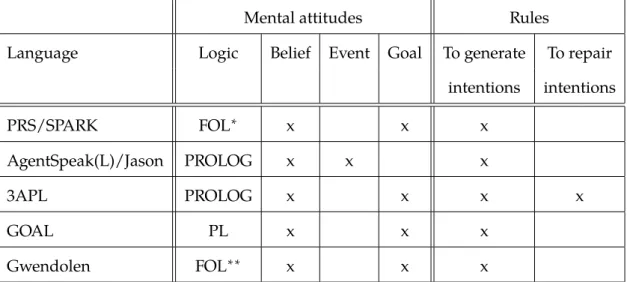
Even though hybrid agent programming languages share the characteristics listed above, they differ greatly in terms of the mental attitudes that they support, the logi-cal languages that are used, and the rules that generate and repair intentions. Figure 2.2 summarises these differences, where FOL∗means a fragment of First Order Logic where only negation and conjunction operators are allowed; PL means propositional logic; and FOL∗∗means a fragment of First Order Logic where only literals are allowed.
Furthermore, hybrid agent programming languages also differ in the support they provide for defining deliberation strategies to select intentions to adopt and execute. In the next section, we shall discuss these differences in more detail.
Mental attitudes Rules
Language Logic Belief Event Goal To generate To repair intentions intentions PRS/SPARK FOL∗ x x x AgentSpeak(L)/Jason PROLOG x x x 3APL PROLOG x x x x GOAL PL x x x Gwendolen FOL∗∗ x x x
Figure 2.2: Features of hybrid agent programming languages.
2.4
Programming deliberation strategies
In this section, we discuss the level of support that existing agent programming languages have for specifying a deliberation strategy for selecting intentions for adoption and exe-cution.
2.4.1 Programming selection of intentions for adoption
In most hybrid agent programming languages, the programmer can specify which plan to select for adoption by means of rule-based constructs which include a condition to de-termine when they are applicable. For example, in PRS, the programmer uses KAs where the body of a KA specifies the plan and the invocation condition of the KA determines when it is suitable to use the plan in the KA. “Plans” in AgentSpeak(L) also allow the programmer to specify sequences of actions to adopt where the triggering event of a plan determines when it is relevant to consider the plan, and the context query of the plan determines when it is applicable to use the plan with respect to the beliefs of the agent. Goal planning rules in 3APL and actions in GOAL have a similar purpose.
pro-vide direct support for programming a strategy to select among multiple applicable plans in the languages. Instead, such a strategy is specified by means of selection functions which do not belong to the syntax of these agent programming languages and are de-fined the host languages which are used to implements their interpreters. For example, the selection function to select an applicable plan in Jason is implemented in Java, the host language which implement the Jason interpreter. The only way to alter this selection function is to reprogram it in Java and recompile the Jason interpreter.
PRS is an exception as it allows the programmer to define strategies to select multiple applicable KAs. Here, the programmer can use so-calledmetalevelbeliefs for storing meta information about object-level KAs such as their estimated costs in time and money, their priorities, and their success rate to realise a goal. Furthermore, she can definemetalevel KAs for reasoning about the level of importance and utility of object-level KAs so that the “best” KA can be determined and selected.
2.4.2 Programming selection of intentions for execution
Agent programming languages provide even less support for programming strategies to select intentions for execution. The interpreters of these languages usually implement a default strategy for selecting a plan to execute. For example, Jason by default imple-ments a selection strategy [Bordini et al., 2007] based on a “round-robin” scheduler. A different strategy can be implemented by over-riding this default selection function and recompiling the Jason interpreter. Additionally, the programmer can only change the de-fault selection for execution slightly by setting theatomicflag for plans. For an intention generated by a plan declared with theatomicflag, once it is selected for execution, it will be selected for execution in subsequent cycles until completed. However, this feature of Jason only leaves the agent programmer with a little space to change the default selection strategy.
define a meta language for programming deliberation strategies. In such a language, the programmer is provided with terms to define information about plans such as costs and statements for selecting plans, applying plans and executing a plan. This meta-statements then can be combined using sequential, conditional and iterative constructs to define a deliberation program. The language defined in [Hindriks et al., 1998] was used to program deliberation cycles of AgentSpeak(L) and 3APL [Hindriks et al., 1999]. The language defined in [Dastani et al., 2003a] was used to program deliberation cycles of 3APL [Hindriks et al., 1999]. Obviously, this approach requires a language (in addition to agent programming languages) to define deliberation strategies.
No single deliberation strategy is clearly “best” for all agent task environments. For example, in a deliberation strategy, intentions can be executed in an interleaving or non-interleaving fashion. Interleaving can improve the performance of agents as they can achieve more than one goals in parallel. However, it can also give rise to contention for resources so that no intentions are executed successfully [Thangarajah et al., 2003]. For ex-ample, an agent has two intentions that achieve two goals to be at two different locations which are in opposite directions. Then, interleaving the execution of these two inten-tions makes the agent to go around a position between the two locainten-tions. It is therefore important that the agent developer has the freedom to adopt the strategy which is most appropriate to a particular problem. To this end, it is worth looking back at the discus-sion in [Hayes, 1977] about designing languages to program knowledge reasoners Hayes argues it is a good engineering practice that the language to represent knowledge and the language to specify strategies to reason about knowledge are the same. Similarly, agents can use their own knowledge (beliefs, goals, plans, intentions, etc.) to reason about which new plan to adopt, which existing intention to execute during deliberation. Therefore, it is also a good engineering practice if the language to program an agent and the language to specify the deliberation strategy for this agent are the same. One way to achieve this is to use procedural reflection.
2.5
Procedural reflection
In this section, we briefly review the notion of procedural reflection [des Rivières and Smith, 1984] in programming languages. A reflective programming language incorpo-rates a model of (aspects of) the language’s implementation and state of program exe-cution in the language itself, and provides facilities to manipulate this representation. Critically, changes in the underlying implementation are reflected in the model, and ma-nipulation of the representation by a program results in changes in the underlying imple-mentation and execution of the program. Perhaps the best known reflective programming language is 3-Lisp [Smith, 1984].
2.5.1 A computational view
One way to understand procedural reflection is to view computation as relations on syn-tactical objects and runtime objects of programming languages. Here, synsyn-tactical objects of a programming language appear in the source code of programs which are written in the programming language. For example, the source code of a Jason program contains the textual representations of beliefs, events and plans which are the syntactical objects of Jason. When the source code of a program is parsed by an interpreter, syntactical objects in the source code are converted into internal representations which are called runtime objects. Runtime objects are created by using suitable data structures (defined in another programming language which implements the interpreter). For example, in the Java im-plementation of the Jason interpreter, there is a classP lanfor storing Jason plans; when the interpreter parses a Jason agent program, each plan (a syntactical object) gives rise to a Java object (a runtime object) of the classP lan.
In this computational view, there are two types of relations on syntactical objects and runtime objects. First, relations from syntactical objects to runtime objects are called in-ternalisations. This is a mapping which converts textual representations from programs of a language into runtime objects as internal representations within an interpreter as
pro-grams are parsed. Second, relations from runtime objects to runtime objects are called normalisations. This is a mapping which evaluates internal representations into their sim-plestform. For example, the evaluation of query, the application of plans, and the execu-tion of an acexecu-tion in Jason. In particular, the context query of a plan in Jason is evaluated into a simplest value of truth – either true or false – in order to determine if the plan can be applied to generate an intention or not. The application of a plan results in a new in-tention for the agent which is a sequence of actions. Then, the execution of an action of an intention results either changes to the environment (in case of an external action) or to states of an agent (in case of belief update actions and subgoal actions).
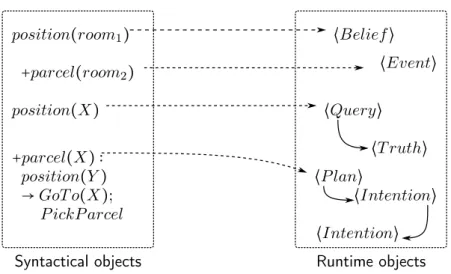
position(room1) +parcel(room2) position(X) +parcel(X) ∶ →GoT o(X); ⟨Belief⟩ ⟨Event⟩ ⟨Query⟩ ⟨T ruth⟩ ⟨P lan⟩ ⟨Intention⟩ ⟨Intention⟩ position(Y) P ickP arcel
Syntactical objects Runtime objects
Figure 2.3: A computational view for procedural reflection.
Figure 2.3 illustrates the above computational view of agent programs in Jason. In the left hand side box are examples of syntactical objects while examples of runtime objects are grouped in the right hand side box. The notation ⟨T⟩ denotes a runtime object of the Java class T defined in the implementation of the interpreter Jason. Furthermore, internalisations from syntactical objects are drawn as dashed arrows while normalisations are drawn in solid arrows.
2.5.2 Reflection in programming languages
Implementing an interpreter for a programming language can be considered as imple-menting internalisations and normalisations in this language. Then, adding procedural reflection to the programming language involves proving facilities to influence these inter-nalisations and normalisations. To this end, des Rivières and Smith defined two levels of reflection in a programming language, namelystructural reflectionandprocedural reflection Structural reflection: a language has structural reflection if it is provided with means to query and modify runtime objects. For example, one can define in a Lisp program a function which can modify the definition of other functions. When this function is applied to another function, it changes the internal representation of the other function. Thus, this allows one to influence internalisations.
Procedural reflection: a language has procedural reflection if it has structural reflection and additionally is provided with means to access the execution context of a pro-gram. Thus, this allows one to influence normalisations.
Many agent programming languages also provide support for procedural reflection. For example, PRS [Georgeff and Lansky, 1987] incorporated a meta-level, including re-flection of some aspects of the state of the execution of the agent such as the set of appli-cable plans, allowing a developer to program deliberation about the choice of plans in the language itself. Similarly, languages such as Jason provide facilities to manipulate sets of beliefs and intentions such as belief update actions for adding and removing beliefs. However, these languages do not provide facilities to program steps in a deliberation cy-cle such as different strategies to select applicable plans for generating new intentions or to select intentions for execution. Therefore, the support for procedural reflection in cur-rent state-of-the-art agent programming languages is often up to the level of structural reflection only.
2.6
Simulating agent programs
In this last section, we present a brief review of the notion of bisimulation [Milner, 1989] used to compare expressive power of languages. Influenced by the work of Hindriks in [2001] where weak bisimulation is used to show the correctness of the translation, we will use bisimulation in order to underpin the translation of other agent programming languages intometa-APL.
When simulating an agent programming language (called the source language) in an-other agent programming language (called the target language), agent programs (called the source programs) of the source language are translated into agent programs (called the target programs) of the target language such that the source programs and the target programs behave equivalently with respect to a weak bisimulation [Milner, 1989]. The most recent and significant work related to simulating agent programs up to now is done by Hindriks in [2001] and by Dennis et al. in [2008]
Simulation in 3APL
In [2001], Hindriks developed an approach to simulate a source language in a target lan-guage by identifying atranslation bisimulationwhich is a function translating programs and configurations of the source language into programs and configurations of the target language. Hindriks [2001] showed that such a translation bisimulation produces a weak bisimulation between the configurations of the source language and the configurations of the target language. Hence, for each run of a source program, there is an equivalent run of the target program and vice versa. Therefore, the target agent behaves equivalently to its source agent.
This approach is applied to the simulation of AgentSpeak(L) and Golog in the first version of 3APL [Hindriks et al., 1999] where the operational semantics of 3APL does not include a deliberation cycle. Therefore, it is not clear whether it is still straightforward to apply the same approach for simulating source languages whose operational