Full text document (pdf)
Copyright & reuse
Content in the Kent Academic Repository is made available for research purposes. Unless otherwise stated all content is protected by copyright and in the absence of an open licence (eg Creative Commons), permissions for further reuse of content should be sought from the publisher, author or other copyright holder.
Versions of research
The version in the Kent Academic Repository may differ from the final published version.
Users are advised to check http://kar.kent.ac.uk for the status of the paper. Users should always cite the published version of record.
Enquiries
For any further enquiries regarding the licence status of this document, please contact: [email protected]
If you believe this document infringes copyright then please contact the KAR admin team with the take-down information provided at http://kar.kent.ac.uk/contact.html
Citation for published version
Lammers, Joris and Burgmer, Pascal (2017) Power increases anchoring effects on judgment. Social Cognition, 35 (1). pp. 40-53. ISSN 0278-016X.
DOI
https://doi.org/10.1521/soco.2017.35.1.40
Link to record in KAR
https://kar.kent.ac.uk/71352/
Document Version
Header: POWER INCREASES ANCHORING
accepted version before copy-editing
Power Increases Anchoring Effects on Judgment
Joris Lammers Pascal Burgmer University of Cologne Research Report Words: 3991 Abstract: 149
Address correspondence to: Joris Lammers, University of Cologne, Department of Psychology, Sozialpsychologie I, Richard-Strauss-Str. 2, 50931, Kšln, Germany [email protected]
Lammers, J., & Burgmer, P. (2017). Power increases anchoring effects on judgment. Social Cognition, 35, 40-53. doi:10.1521/soco.2017.35.1.40
Abstract
Four experiments test the impact of power (versus powerlessness) on anchoring effects. Anchoring refers to the tendency to assimilate oneÕs judgment to a previously considered numeric standard. Based on the notion that power facilitates the activation of and reliance on accessible information, we hypothesized that power increases numeric anchoring effects on judgment, compared to powerlessness. Across studies, we found consistent support for this idea, when testing estimations of factual values (Experiments 1 and 2), subjective evaluations (Experiment 3), and negotiation behavior (Experiment 4). The findings of Studies 2 to 4 qualify the dominant idea in power literature that power reduces conformity to othersÕ opinion. Power increases
conformity to othersÕ opinion, if such opinion is presented as an anchor and therefore processed more automatically. These findings also have important methodological implications for power research. They show that differences in stimulus presentation can steer observed effects of power in opposite directions.
Power Increases Anchoring Effects on Judgment
When people try to estimate a numeric value, then often they assimilate their estimate to any numeric value that they encounter before, even if it is irrelevant (Chapman & Johnson, 2002; Epley, 2004; Mussweiler, Englich, & Strack, 2004; Mussweiler & Strack, 1999a). In the classic demonstration of this anchoring effect, Tversky and Kahneman (1974) asked participants to estimate what percentage of nations in the United Nations were African. Crucially, participants first estimated whether that percentage was more or less than 65% (high anchor) or more or less than 10% (low anchor). This had a marked effect on the subsequently provided estimates. Participants who were presented with the high anchor estimated the percentage of African nations to be close to 45%, while those who received the low anchor estimated 25%. Such anchoring effects have been observed in a broad array of judgmental domains, ranging from real estate prizing (Yukl, 1974), to negotiation (Galinsky & Mussweiler, 2001), to legal decision making (Englich, Mussweiler, & Strack, 2006), and even to estimates of the likelihood of nuclear war (Plous, 1989). Power Increases Anchoring
In the current manuscript, we hypothesize that incidental feelings of power increase the strength of anchoring effects, compared to feelings of powerlessness. This idea is derived from the notion that anchoring effects are considered to be driven by the selective activation of information that is consistent with the anchor value and subsequent application of that highly accessibly information in forming oneÕs
judgment (Chapman & Johnson, 1999; Mussweiler & Strack, 1999b; 2000; Strack & Mussweiler, 1997). In other words, anchoring to a high value occurs, because when people receive a high anchor, then they selectively activate information that is
consistent with that high value and subsequently apply that information in their judgment.
We hypothesize that feelings of power increase anchoring, compared to feelings of powerlessness, because power affects both steps in this process, increasing both the activation of anchor-consistent information and the degree to which people rely on it. We explain both effects below:
Power Increases Information Activation. First, people who feel powerful are more likely to activate information that is consistent with salient information. People who feel dependent are instead motivated to engage in controlled processing, whereby they try to be as accurate as possible in their judgment by looking for inconsistent information (Erber & Fiske, 1984; Neuberg & Fiske, 1987). In contrast, people who experience a sense of power instead follow a more automatic process, where they are unlikely to test their core assumptions and instead allow their thoughts to be influenced by whatever information is available (De Dreu & Van Kleef, 2004; Fischer, Fischer, Englich, Aydin, & Frey, 2011; Fiske, 1993; Fiske & DŽpret, 1996; Goodwin, Gubin, Fiske, & Yzerbyt, 2000; Keltner, Gruenfeld, & Anderson, 2003). Therefore, people who experience a sense of power should be more likely to activate information about the target-judgment that is consistent with the anchor.
Power Increases Information Application. Second, people who feel powerful should also be more likely (than those who feel powerless) to apply that information in their judgment. Various findings have shown that the powerful are more influenced by information that is temporarily more accessible, such as primed goals or situational cues (DeMarree, Loersch, Bri–ol, Petty, Payne, & Rucker, 2012; Galinsky, Gruenfeld, & Magee, 2003; Guinote, 2008; Guinote, Weick, & Cai, 2012). Anchors similarly function as temporarily accessible information that has the
potential to automatically guide judgment (Mussweiler & Englich, 2005). Therefore, people who experience power should not only be more likely to activate anchor-consistent information about the target of their judgment, but they should also be more likely to rely on that accessible information in reaching their judgment, compared to those who feel powerless.
Summary and Overview of Studies
In summary, there is ample reason to hypothesize that power increases anchoring (compared to powerlessness), because power increases both critical components that produce anchoring effects: information activation and application. We test this prediction in four studies, in which we orthogonally manipulate power (high versus low) and the value of an anchor (high versus low). In all studies, we predict an interaction effect, such that the difference in estimates between low- and high-anchor conditions should be amplified for high-power (compared to low-power) participants. We test this in a broad range of settings, to maximize generalizability.
Methodological Notes. In all studies, participants were recruited on AmazonÕs Mechanical Turk. We set sample size to 200 participants throughout all studies, based on the recommendation to have at least 50 respondents per cell
(Simmons, Nelson, & Simonsohn, 2013). This provides us with enough power (1Ðβ= 0.80) to detect a small-to-medium effect of f = .20. Throughout these studies, we
mention whether we exclude any data, and why. Additionally, we report all manipulations and we report all measures. We include a meta-analysis that also includes studies with non-significant effects to avoid a file-drawer effect.
Experiment 1 Ð Eiffel Tower Method
Participants and design.In return for $0.30, 200 U.S. American respondents (81 men, 119 women, mean age 34.6 years) participated in this research. Respondents were randomly assigned to one of four experimental conditions of a 2 (power: high vs. low) × 2 (anchor: high vs. low) between-subjects design.
Procedure. After signing informed consent forms, participants first completed an imagined hierarchical power role manipulation (Dubois, Rucker, & Galinsky, 2010). Participants imagined that they had an important, powerful position or a low-power, subordinate position. After spending a few moments thinking about that, they wrote about how this would be and make them feel, providing at least 200 characters. Next, participants estimated the height of the Paris Eiffel Tower (actual height: 1,063 feet / 324 meters), measured from the base to the top of the broadcast aerial. Before doing so, participants first answered whether the Eiffel Tower was higher or lower than 2,500 feet (high anchor) or higher or lower than 100 feet (low anchor). These values represent the 5th and 95th percentiles, respectively (rounded), in a pilot study (N
= 100, 46% female, mean age 38.0 years), in which participants freely estimated the towerÕs height. After indicating whether they agreed or disagreed with the anchor, participants provided their own estimation in feet in an open response box.
Participants were instructed not to look up the correct number. Results
Given that participants used an open response box (allowing extreme
responses), we a priori excluded any response that overestimated the actual height by a factor of 10 or more (i.e., more than 10,630 feet), as a likely typo. Two participants who estimated the tower to be 100,000 and 12,000 feet (30.4 km and 3.6 km, both > 8
SDs from mean) were deleted as extreme outliers. One participant provided the correct answer. We retained that response as it may have been simply a good guess and deletion did not affect results in any meaningful manner.
A 2 (power: high vs. low) × 2 (anchor: high vs. low) ANOVA on participantsÕ estimation showed the predicted interaction effect of power and anchor, F(1, 194) = 4.54, p = .034, η2p = .02, in addition to a main effect of anchor, F(1, 194) = 62.00, p
< .001, η2p = .24, and a main effect of power, F(1, 194) = 6.49, p = .012, η2p = .03.
We interpreted this interaction effect by running two planned t-tests, within the high- and low-power conditions. This showed that the anchoring effect
(operationalized as the difference in means between the high- and low-anchor conditions) was 74.1% stronger in the high-power conditions, ΔM = 1303.83 feet, SE
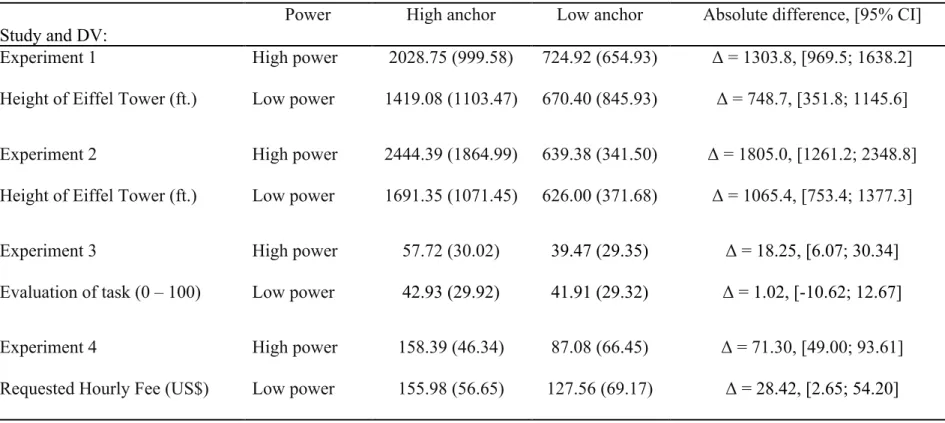
= 168.51, t(99) = 7.74, p < .0001, CohenÕs d = 1.55, 95% CI = [969.46; 1638.19], than in the low-power conditions, ΔM = 748.69 feet, SE = 199.93, t(95) = 3.74, p
< .001, CohenÕs d = 0.76, 95% CI = [351.77; 1145.61]. See Table 1 for means. Experiment 2 Ð Eiffel Tower II
Experiment 1 showed that power increases anchoring effects on participantsÕ judgment of the height of the Eiffel Tower. To increase generalizability, Experiment 2 seeks to replicate this but changes the procedure. Rather than presenting the anchor as an item that is part of the materials, we now present the anchor as advice that was supposedly provided by an earlier participant.
Method
Participants and design.In return for $0.30, 199 U.S. American respondents (103 men, 96 women, mean age 35.1 years) participated in this research. Respondents were randomly assigned to one of four experimental conditions of a 2 (power: high vs. low) × 2 (anchor: high vs. low) between-subjects design.1
Procedure. The procedure was the same as in Experiment 1, except that the anchor was now presented as advice that was allegedly provided by an earlier
participant. In reality, the value of that advice served as our anchor manipulation and was either 2,500 feet (high anchor) or 400 feet (low anchor)2.
Results
We followed the same data treatment procedure as in Experiment 1; one participant who estimated the tower to be 30,000 feet (9.1 km, > 11 SDs from mean) was deleted as an extreme outlier. No participant provided the correct height.
A 2 (power: high vs. low) × 2 (anchor: high vs. low) ANOVA on the mean estimated height of the Eiffel Tower showed the predicted interaction effect of power and anchor, F(1, 194) = 5.76, p = .017, η2p = .03, in addition to a main effect of
anchor, F(1, 194) = 86.67, p < .001, η2p = .31, and a main effect of power, F(1, 194) =
6.18, p = .014, η2p = .03.
We interpreted this interaction effect by running two planned t-tests. This showed that the anchoring effect (operationalized as in Experiment 1) was 69.4% stronger in the high-power conditions, ΔM = 1805.0 feet, SE = 273.80, t(92) = 6.59, d
= 1.35, p < .001, 95% CI = [1261.23; 2348.80], than in the low-power conditions, ΔM
= 1065.35 feet, SE = 157.27, t(102) = 6.77, d = 1.33, p < .001, 95% CI = [753.40; 1377.29]. See Table 1.
Experiment 3 Ð Subjective Evaluation
Experiments 1 and 2 show that power increases anchoring effects on
judgments of factual values. To further generalize our findings, Experiment 3 focuses on subjective judgments, by asking participants for their evaluation of the study. Given that people can be expected to have a stronger opinion on that, than on the height of the Eiffel Tower, this serves as a stronger test of our hypothesis.
Method
Participants and design.In return for $0.30, 201 U.S. American respondents participated in this research (103 men, 98 women, mean age 34.7 years). Respondents were randomly assigned to one of four experimental conditions of a 2 (power: high vs. low) × 2 (anchor: high vs. low) between-subjects design.
Procedure. After completing the same power manipulation as before,
participants were asked for their evaluation of the study, in particular the writing-task, between 0 (very boring) and 100 (very interesting). Before doing so, they were first provided with a bogus evaluation, allegedly provided by an earlier participant. This served as the anchor manipulation. Depending on condition, this evaluation was either very positive (97) or very negative (3). Next, participants provided their own
judgment on the same 100-point scale, using a slider measure that was preset to a neutral (50) starting position.
Results
A 2 (power: high vs. low) × 2 (anchor: high vs. low) ANOVA on participantsÕ own judgment of the task showed the predicted interaction effect of power and anchor,
F(1, 197) = 4.12, p = .044, η2p = .02, as well as a significant main effect of anchor, F(1, 197) = 5.15, p = .024, η2p = .03. The main effect of power was not significant, F(1, 197) = 2.11, p = .148.
We interpreted this interaction with two planned t-tests. This showed that the anchoring effect (operationalized as before) was 18 times stronger in the high-power,
ΔM = 18.25, SE = 6.13, t(95) = 2.98, p = .004, d = 0.61, 95% CI [6.07; 30.34], than in
the low-power conditions, where the effect was no longer significant, ΔM = 1.02, SE =
Experiment 4 Ð Simulated Negotiation Behavior
The previous studies showed the anchoring-amplifying effect of power on factual and subjective judgments. In Experiment 4 we test whether it also affects behavioral outcomes in a negotiation simulation.
Method
Participants and design.In return for $0.30, 202 U.S. American respondents participated in this research (73 men, 121 women, mean age 32.2 years). Respondents were randomly assigned to one of four experimental conditions of a 2 (power: high vs. low) × 2 (anchor: high vs. low) between-subjects design.
Procedure. After completing the same power manipulation as in prior studies, participants played a business simulation. They were hired as freelance external consultants and were told to negotiate their hourly consultancy fee. They read that an experienced colleague offered to recommend an appropriate opening bid. Depending on condition, participants either received the recommendation to open the negotiation with a $185 bid (high anchor) or a $15 bid (low anchor). After judging whether they thought the recommendation was too low or too high, participants entered their opening bid, between $0 and $200, using a slider measure that was preset to a $100 starting position.
Results
A 2 (power: high vs. low) × 2 (anchor: high vs. low) ANOVA on participantsÕ own opening bid showed the predicted interaction effect of power and anchor, F(1, 198) = 6.30, p = .013, η2p = .03, as well as a significant main effect of anchor, F(1,
198) = 34.07, p < .0001, η2p = .15, and a significant main effect of power, F(1, 198) =
Again using two planned t-test, we found that the anchoring effect
(operationalized as in prior studies) was 150.9% times stronger in the high-power conditions, ΔM = 71.30, SE = 11.25, t(106) = 6.34, p < .0001, d = 1.24, 95% CI
[49.00; 93.61], than in the low-power conditions, ΔM = 28.42, SE = 12.98, t(92) =
2.19, p = .031, d = 0.45, 95% CI [2.65; 54.20]. See Table 1. Meta-Analysis
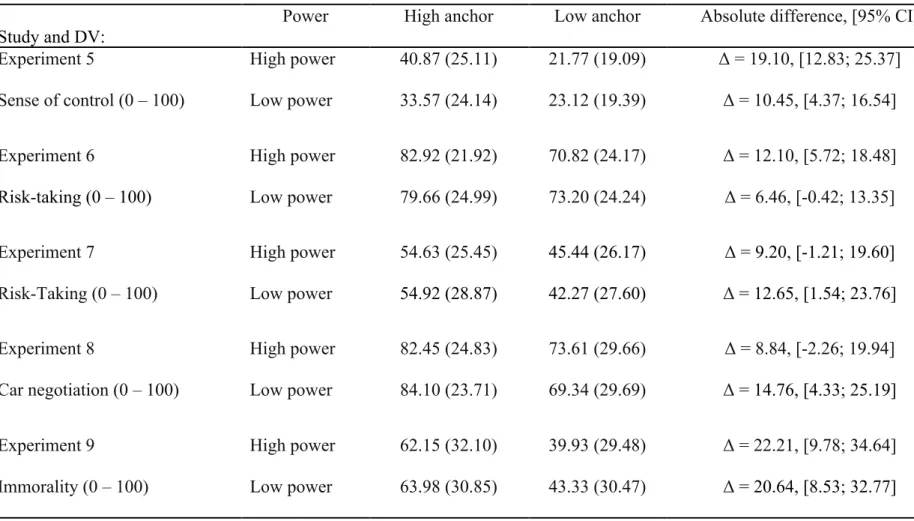
We performed a meta-analysis to check for a file-drawer effect (Cumming, 2014) by combining these four reported studies and five additional unreported studies (total N = 2202, 984 men, 1217 women, mean age 35.1 years). Combining all data is preferred over a traditional meta-analysis approach if the number of studies is small, the studies are similar, and the actual data are available (Steinberg et al., 1997). The unreported studies were similar in design, including similarly valued anchors (3 and 97 on a 100-point scale), but differed in their dependent variable. Specifically, Experiment 5 tested the sense of control (Fast, Gruenfeld, Sivanathan, & Galinsky, 2009), critical interaction: F(1, 396) = 3.81, p = .052, η2p = .01; Experiment 6 tested
risk-taking when engaging in unprotected sex (Anderson & Galinsky, 2006), critical interaction: F(1, 398) = 1.41, p = .236, η2p = .004; and Experiment 7 also tested
sexual risk-taking, critical interaction: F(1, 196) = 0.20, p = .654, η2p = .001;
Experiment 8 tested assertiveness in negotiating the prize when buying a new car (Magee, Galinsky, & Gruenfeld, 2007), critical interaction: F(1, 197) = 0.60, p = .441,
η2p = .003; and Experiment 9 tested immorality (speeding; Lammers, Stapel, &
Galinsky, 2010), critical interaction: F(1, 197) = 0.03, p = .858, η2p = .000.
We performed a 2 (power: high vs. low) × 2 (anchor: high vs. low) ANOVA on participantsÕ within-study-standardized responses, across all studies, controlling for study number (1 - 9). This showed a significant interaction effect of power and
anchor, F(1, 2202) = 11.85, p < .001, η2p = .005, as well as a significant main effect of
anchor, F(1, 2202) = 211.46, p < .0001, η2p = .089, and a significant main effect of
power, F(1, 2202) = 4.50, p = .03, η2p = .002. The interaction effect was not qualified
by an interaction with study, F(1, 2202) = 1.46, p = .17, suggesting it is similar across the different studies (and associated dependent variables). We found a medium- to large-sized anchoring effect in the high-power conditions, ΔM = 0.73, SE = 0.73, t(1087) = 12.72, p < .0001, d = 0.77, 95% CI [0.62; 0.85], and a small- to medium-sized anchoring effect in the low-power conditions, ΔM = 0.45, SE = 0.57, t(1112) =
7.83, p < .0001, d = 0.47, 95% CI [0.33; 0.56]. In other words, the anchoring effect was on average about 65% larger in the high-power than in the low-power conditions.
General Discussion
We predicted that because feelings of power facilitate the activation and application of situationally available information, power would increase anchoring effects. Four studies showed support for this idea, both on factual judgments (the height of the Eiffel Tower), subjective judgments (own evaluations), or behavioral outcomes (in a negotiation simulation). A meta-analysis across all studies conducted in this line of research shows that the effect remains significant after including non-significant studies. Compared to low-power conditions, participants in the high-power conditions reported an anchoring effect that was on average 65% larger.
Power and Conformity
These results are important because they qualify a dominant theme in existing power literature, which has repeatedly demonstrated that power reduces the degree to which people conform to other peopleÕs opinions. For example, using a design that is quite similar to that of Experiment 3 (minus the numeric anchor), Galinsky and colleagues demonstrated that power reduces the degree to which participants follow
bogus evaluations, ostensibly provided by earlier participants (Galinsky, Magee, Gruenfeld, Whitson, & Liljenquist, 2008). Other research demonstrates that power reduces the degree to which participants use advice provided by other people (See, Morrison, Rothman, & Soll, 2011; Tost, Gino, & Larrick, 2012). In our studies, we instead found that power increases the degree to which people respond to information provided by the experimenter (Experiment 1), allegedly provided by other participants (Experiments 2 and 3), or a colleague in a simulation (Experiment 4).
This difference in outcomes between earlier and current research can be explained by differences in methodology. Earlier research focused on judgments where participants have formed and established strong opinions Ð for example, on an unambiguously boring study (Galinsky et al., 2008) Ð and then received information that runs against their own established opinion. In such cases, feelings of power help people to defend their own views and resist pressure to conform to others (Anderson & Galinsky, 2006; Fast, Sivanathan, Mayer, & Galinsky, 2012; Magee et al., 2007; Van Kleef, De Dreu, Pietroni, & Manstead, 2006; Van Kleef, Oveis, Van der Lšwe, LuoKogan, Goetz, & Keltner, 2008). In contrast, numeric anchors provide a subtle and implicit source of influence that bypasses such motivated processes by Òflying below the radarÓ and affecting judgments more automatically (Mussweiler & Englich, 2005). For reasons that we explained in the Theoretical Introduction, feelings of power amplify such automatic processes and thus strengthen anchoring effects. Paradoxically, the powerful are less influenced in their judgment by strong pressures, but more influenced by weak pressures, compared to the powerless.
Limitations
One limitation to our research is that (due to the lack of a control condition) it is unclear whether these effects are more due to power increasing anchoring effects or to powerlessness decreasing anchoring effects. This adds to a prevalent problem in power research, that many findings do not include a baseline or control condition, given that it is often difficult to do so (Magee & Smith, 2013). The few findings in the literature that are relevant to our research and that also include a control or baseline condition, offer an inconsistent picture. Some findings support the idea that a positive effect of power drives these effects. Feelings of power have been shown to increase the activation of stereotypical information (Guinote, Willis, & Martellotta, 2010) and the degree to which people apply their ideas (Galinsky et al., 2008)ÐÐboth compared to feelings of powerlessness and baseline (with no difference between the two). These two effects suggest that power increases (but powerlessness does not decrease) the activation and application of anchoring information, respectively. Other findings, however, support the idea that a negative effect of powerlessness on anchoring drives these effects. For example, being in a dependent or subordinate position increases peopleÕs tendency to process information that is inconsistent with expectations (Erber & Fiske, 1984; Guinote & Philips, 2010), suggesting that powerlessness may also hinder both the activation and application of information. Most likely, the effects observed here are driven by a simultaneous positive effect of power and a negative effect of powerlessness on anchoring (see also: Guinote & Lammers, 2016).
Another limitation is that we did not manipulate the extremity of anchors. A priori, there is no reason to expect that the current effects would depend on extremity. Earlier research has shown that anchoring effects occur for weak, moderate, and extreme anchors (Grau & Bohner, 2014; Strack & Mussweiler, 1997). For example,
Strack and Musssweiler even found anchoring effects when participants were asked whether Leonardo DaVinci was born before or after 1952 (actual value: 1452) or whether the Elbe is longer or shorter than 25 kilometers (actual value: 1165). Our values were less extreme. In any case, it would be interesting to test the interaction between power and extremity of anchors.
A final limitation is that we did not manipulate personal relevance. Across all studies, participantsÕ estimates were relatively irrelevantÑthey were not incentivized for making a correct estimate, for example. It could be that when judgments are highly personally relevant, the effect of power on anchoring reverses, because the powerful are known to be able to switch more effectively from peripheral to central processing, whenever the situation requires more careful processing of relevant information (Guinote, 2007). On the other hand, anchoring effects have also been demonstrated for decisions that are highly personally relevant and therefore likely to invite central processingÑsuch as real-estate agentsÕ pricing decisions of real estate properties (Northcraft & Neale, 1987). This issue waits for further testing.
Methodological Implications
These findings may also have important methodological implications. Anchoring effects may occur unexpectedly and unplanned, due to differences in the measurement of the dependent variable. For example, scale end-points or certain elements in the formulation of the dependent variable may work as numeric anchors. As the current results show, feelings of power may increase the effects of such aspects of measurement and thus potentially obscure the true effects of power.
One example of this occurred in the low-anchor condition of Experiment 4, where we found that high-power participants showed lessassertiveness than did low-power participants. This is a clear example where anchoring obscures the true effect
of power, given that earlier research has repeatedly found that power increases negotiation assertiveness (Anderson & Galinsky, 2006; Magee et al., 2007). In other words, if researchers do not control for these effects, it is possible that any observed effect of power is actually due to an amplification of the anchoring effect of numeric information, rather than reflecting a true effect of power. One way to avoid this is to present differently worded versions of the dependent variable and show that the manipulation produces parallel effects on each (Fiedler, 2011).
Applied Implications
The current findings suggest that powerful peopleÕs judgments are more strongly affected by numeric anchors than those of others. One setting where this may be particularly likely is in judicial decision-making. Judges have considerable power over defendants and are exposed to anchors, for example in the prosecutorÕs
sentencing demand. It is possible that judges are more influenced by such effects. Indeed, research has demonstrated that anchors can affect sentencing decisions, even among judges and other legal experts (Englich, Mussweiler, & Strack, 2006).
Conclusion
People who feel powerful rely more strongly on numeric anchors in their subsequent judgment than do people who feel less powerful. This finding qualifies the dominant view that feelings of power reduce the degree to which people are affected by othersÕ opinion.
References
Anderson, C., & Galinsky, A. D. (2006). Power, optimism, and risk-taking. European Journal of Social Psychology, 36, 511Ð536. doi: 10.1002/ejsp.324
Chapman, G.B., & Johnson, E.J. (1999). Anchoring, activation, and the construction of values. Organizational Behavior and Human Decision Processes, 79, 1Ð39. doi: 10.1006/obhd.1999.2841
Chapman, G. B., & Johnson, E. J. (2002). Incorporating the irrelevant: Anchors in judgments of belief and value. In T. Gilovich, D. Griffin, & D. Kahneman (Eds.), Heuristics and biases Ñ The psychology of intuitive judgment (pp.120Ð 138). New York: Cambridge University Press. doi:
10.1017/CBO9780511808098.008
DeMarree, K. G., Loersch, C., Bri-ol, P., Petty, R. E., Payne, B. K., & Rucker, D. R. D. (2012). From primed construct to motivated behavior. Validation processes in goal pursuit. Personality and Social Psychology Bulletin, 38, 1659Ð1670. doi: 10.1177/0146167212458328
Dubois, D., Rucker, D. R. D., & Galinsky, A. D. (2010). The accentuation bias: Money literally looms larger (and sometimes smaller) to the powerless. Social Psychological and Personality Science, 1, 199Ð205. doi:
10.1177/1948550610365170
Englich, B., Mussweiler, T., & Strack, F. (2006). Playing dice with criminal sentences: The influence of irrelevant anchors on experts' judicial decision making. Personality and Social Psychology Bulletin, 32(2), 188Ð200. doi: 10.1177/0146167205282152
Epley, N. (2004). A tale of tuned decks? Anchoring as accessibility and anchoring as adjustment. In D.J. Koehler, & N. Harvey (Eds.), The Blackwell handbook of
judgment and decision making (pp. 240Ð256). Oxford, U.K.: Blackwell Publishers. doi: 10.1002/9780470752937.ch12
Erber, R., & Fiske, S. T. (1984). Outcome dependency and attention to inconsistent information. Journal of Personality and Social Psychology, 47, 709Ð726. doi: 10.1037/0022-3514.47.4.709
Fast, N. J., Gruenfeld, D. H., Sivanathan, N., & Galinsky, A. D. (2009). Illusory control: A generative force behind power's far-reaching effects. Psychological Science, 20, 502Ð508. doi: 10.1111/j.1467-9280.2009.02311.x
Fast, N. J., Sivanathan, N., Mayer, N. D., & Galinsky, A. D. (2012). Power and overconfident decision-making. Organizational Behavior and Human Decision Processes, 117, 249Ð260. doi: 10.1016/j.obhdp.2011.11.009 Fiedler, K. (2011). Voodoo correlations are everywhereÑNot only in neuroscience.
Perspectives on Psychological Science, 6, 163Ð171. doi: 10.1177/1745691611400237
Fischer, J., Fischer, P., Englich, B., Aydin, N., & Frey, D. (2011). Empower my decisions: The effects of power gestures on confirmatory information processing. Journal of Experimental Social Psychology, 47(6), 1146Ð1154. doi: 10.1016/j.jesp.2011.06.008
Fiske, S. (1993). Controlling other people: The impact of power on stereotyping.
American Psychologist, 48, 621Ð621. doi: 10.1037/0003-066X.48.6.621 Fiske, S. T., & DŽpret, E. (1996). Control, interdependence and power: Understanding
social cognition in its social context. European Review of Social Psychology, 7, 31-61. doi: 10.1080/14792779443000094
Galinsky, A. D., & Mussweiler, T. (2001). First offers as anchors: the role of perspective-taking and negotiator focus. Journal of Personality and Social Psychology, 81, 657-663. doi: 10.1037/0022-3514.81.4.657
Galinsky, A. D., Gruenfeld, D. H., & Magee, J. C. (2003). From power to action.
Journal of Personality and Social Psychology, 85, 453Ð466. doi: 10.1037/0022-3514.85.3.453
Galinsky, A. D., Magee, J. C., Gruenfeld, D. H., Whitson, J. A., & Liljenquist, K. (2008). Power reduces the press of the situation: Implications for creativity, conformity, and dissonance. Journal of Personality and Social Psychology, 95,
1450Ð1466. doi: 10.1037/a0012633
Goodwin, S., Gubin, A., Fiske, S., & Yzerbyt, V. Y. (2000). Power can bias impression processes: Stereotyping subordinates by default and by design.
Group Processes and Intergroup Relations, 3, 227Ð256. doi: 10.1177/1368430200003003001
Grau, I., & Bohner, G. (2014). Anchoring revisited: The role of the comparative question. PLoS ONE, 9(1), e86056. doi: 10.1371/journal.pone.0086056.t003 Gruenfeld, D. H., Ena Inesi, M., Magee, J. C., & Galinsky, A. D. (2008). Power and
the objectification of social targets. Journal of Personality and Social Psychology, 95(1), 111Ð127. doi: 10.1037/0022-3514.95.1.111
Guinote, A. (2007). Behavior variability and the situated focus theory of power. In W. Stroebe & M. Hewstone (Eds.), European Review of Social Psychology (pp. 256Ð295). New York, NY: Wiley.
Guinote, A. (2008). Power and affordances: When the situation has more power over powerful than powerless individuals. Journal of Personality and Social Psychology, 95, 237Ð252. doi: 10.1037/a0012518
Guinote, A., & Lammers, J. (2016). Powerlessness and attempts to restore lack of control. In M. Bukowski, I. Fritsche, A. Guinote, & M. Kofta (Eds.). Coping with lack of control in a social world. Psychology Press.
Guinote, A., & Phillips, A. (2010). Power can increase stereotyping. Social Psychology. 41, 3Ð9. doi: 10.1027/1864-9335/a000002
Guinote, A., Weick, M., & Cai, A. (2012). Does power magnify the expression of dispositions? Psychological Science, 23, 475Ð482. doi:
10.1177/0956797611428472
Guinote, A., Willis, G. B., & Martellotta, C. (2010). Social power increases implicit prejudice. Journal of Experimental Social Psychology, 46(2), 299Ð307. doi: 10.1016/j.jesp.2009.11.012
Keltner, D., Gruenfeld, D. H., & Anderson, C. (2003). Power, approach, and inhibition. Psychological Review, 110(2), 265Ð284. doi: 10.1037/0033- 295X.110.2.265
Lammers, J., Stapel, D. A., & Galinsky, A. D. (2010). Power increases hypocrisy: Moralizing in reasoning, immorality in behavior. Psychological Science, 21(5), 737Ð744. doi: 10.1177/0956797610368810
Magee, J. C., Galinsky, A. D., & Gruenfeld, D. H. (2007). Power, propensity to negotiate, and moving first in competitive interactions. Personality and Social Psychology Bulletin, 33, 200Ð212. doi: 10.1177/0146167206294413
Mussweiler, T., & Englich, B. (2005). Subliminal anchoring: Judgmental
consequences and underlying mechanisms. Organizational Behavior and Human Decision Processes, 98(2), 133Ð143. doi:
Mussweiler, T., Englich, B., & Strack, F. (2004). Anchoring. In Pohl, R. (Ed.).
Cognitive illusions - Fallacies and biases in thinking, judgment, and memory. London, UK: Psychology Press.
Mussweiler, T., & Strack, F. (1999a). Comparing is believing: A selective accessibility model of judgmental anchoring. European Review of Social Psychology, 10(1), 135Ð167. doi: 10.1080/14792779943000044
Mussweiler, T., & Strack, F. (1999b). Hypothesis-consistent testing and semantic priming in the anchoring paradigm: A selective accessibility model. Journal of Experimental Social Psychology, 35, 136-164. doi: 10.1006/jesp.1998.1364 Mussweiler, T., & Strack, F. (2000). The use of category and exemplar knowledge in
the solution of anchoring tasks. Journal of Personality and Social Psychology, 78(6), 1038Ð1052. doi: 10.1037//0022-3514.78.6.1038
Neuberg, S. L., & Fiske, S. T. (1987). Motivational influences on impression
formation: Outcome dependency, accuracy-driven attention, and individuating processes. Journal of Personality and Social Psychology, 53, 431Ð444. doi: 10.1037/0022-3514.53.3.431
Northcraft, G. B., & Neale, M. A. (1987). Experts, amateurs, and real estate: An anchoring-and-adjustment perspective on property pricing decisions.
Organizational Behavior and Human Decision39, 84-97..
Plous, S. (1989). Thinking the unthinkable: The effects of anchoring on likelihood estimates of nuclear war. Journal of Applied Social Psychology, 19, 67Ð91. doi: 10.1111/j.1559-1816.1989.tb01221.x
See, K. E., Morrison, E. W., Rothman, N. B., & Soll, J. B. (2011). The detrimental effects of power on confidence, advice taking, and accuracy. Organizational
Behavior and Human Decision Processes, 1Ð14. doi: 10.1016/j.obhdp.2011.07.006
Simmons, J.P., Nelson, L.D., & Simonsohn, U. (2013). Life after P-Hacking.
Presentation at the 2013 Society for Personality and Social Psychology Meeting, New Orleans. doi: 10.2139/ssrn.2205186
Steinberg, K.K., Smith, S.J., Stroup, D.F., Olkin, I., Lee, N.C., Williamson, G.D., & Thacker, S.B. (1997). Comparison of effect estimates from a meta-analysis of summary data from published studies and from a meta-analysis using
individual patient data for ovarian cancer studies. American Journal of Epidemiology, 145, 917Ð925. doi: 10.1093/oxfordjournals.aje.a009051 Strack, F., & Mussweiler, T. (1997). Explaining the enigmatic anchoring effect:
Mechanisms of selective accessibility. Journal of Personality and Social Psychology, 73, 437Ð446. doi: 10.1037/0022-3514.73.3.437
Tost, L. P., Gino, F., & Larrick, R. P. (2012). Power, competitiveness, and advice taking: Why the powerful don't listen. Organizational Behavior and Human Decision, 117, 53Ð65. doi: 10.1016/j.obhdp.2011.10.001
Tversky, A., & Kahneman, D. (1974). Judgment under uncertainty: Heuristics and biases. Science, 185(4157), 1124Ð1131. doi: 10.2307/1738360
Van Kleef, G. A., De Dreu, C. K. W., Pietroni, D., & Manstead, A. (2006). Power and emotion in negotiation: Power moderates the interpersonal effects of anger and happiness on concession making. European Journal of Social Psychology, 36, 557-564. doi: 10.1002/ejsp.320
Van Kleef, G. A., Oveis, C., van der Lšwe, I., LuoKogan, A., Goetz, J., & Keltner, D. (2008). Power, distress, and compassion: Turning a blind eye to the suffering
of others. Psychological Science, 19, 1315Ð1322. doi:
10.2307/40064885?ref=no-x-route:a796fc05a58e1d6f4515dd6649806427 Yukl, G. A. (1974). Effects of situational variables and opponent concessions on a
bargainer's perception, aspirations, and concessions. Journal of Personality and Social Psychology, 29, 227-236. doi: 10.1037/h0036013
Table 1. Results of Experiments 1 - 4. Cells show means (with SDs). Feelings of power increase anchoring effects, defined as the absolute
difference in judgment after receiving a high- or low-anchor value.
Study and DV:
Power High anchor Low anchor Absolute difference, [95% CI] Experiment 1
Height of Eiffel Tower (ft.)
High power 2028.75 (999.58) 724.92 (654.93) Δ = 1303.8, [969.5; 1638.2] Low power 1419.08 (1103.47) 670.40 (845.93) Δ = 748.7, [351.8; 1145.6] Experiment 2
Height of Eiffel Tower (ft.)
High power 2444.39 (1864.99) 639.38 (341.50) Δ = 1805.0, [1261.2; 2348.8] Low power 1691.35 (1071.45) 626.00 (371.68) Δ = 1065.4, [753.4; 1377.3] Experiment 3 Evaluation of task (0 Ð 100) High power 57.72 (30.02) 39.47 (29.35) Δ = 18.25, [6.07; 30.34] Low power 42.93 (29.92) 41.91 (29.32) Δ = 1.02, [-10.62; 12.67] Experiment 4
Requested Hourly Fee (US$)
High power 158.39 (46.34) 87.08 (66.45) Δ = 71.30, [49.00; 93.61] Low power 155.98 (56.65) 127.56 (69.17) Δ = 28.42, [2.65; 54.20]
Table 2. Results of Experiments 5 Ð 9; non-significant interaction-effects. Cells show means (with SDs) and anchoring effect, defined as the
absolute difference in judgment after receiving a high- or low-anchor value.
Study and DV:
Power High anchor Low anchor Absolute difference, [95% CI] Experiment 5 Sense of control (0 Ð 100) High power 40.87 (25.11) 21.77 (19.09) Δ = 19.10, [12.83; 25.37] Low power 33.57 (24.14) 23.12 (19.39) Δ = 10.45, [4.37; 16.54] Experiment 6 Risk-taking (0 Ð 100) High power 82.92 (21.92) 70.82 (24.17) Δ = 12.10, [5.72; 18.48] Low power 79.66 (24.99) 73.20 (24.24) Δ = 6.46, [-0.42; 13.35] Experiment 7 Risk-Taking (0 Ð 100) High power 54.63 (25.45) 45.44 (26.17) Δ = 9.20, [-1.21; 19.60] Low power 54.92 (28.87) 42.27 (27.60) Δ = 12.65, [1.54; 23.76] Experiment 8 Car negotiation (0 Ð 100) High power 82.45 (24.83) 73.61 (29.66) Δ = 8.84, [-2.26; 19.94] Low power 84.10 (23.71) 69.34 (29.69) Δ = 14.76, [4.33; 25.19] Experiment 9 Immorality (0 Ð 100) High power 62.15 (32.10) 39.93 (29.48) Δ = 22.21, [9.78; 34.64] Low power 63.98 (30.85) 43.33 (30.47) Δ = 20.64, [8.53; 32.77]
Acknowledgments
This research was supported by a DFG Zukunftskonzept (ZUK 81/1) from the German Science Foundation awarded to Joris Lammers.
Notes
1
We also included a third factor (orthogonal to the other two). Specifically, before providing their estimate, half of the participants were asked whether the provided anchor was too low or too high, while the other half were asked whether the anchor was correct or wrong. We expected that the powerful would be more likely to argue the anchor to be wrong (following See et al., 2011; Tost et al., 2012) and thus show a weaker anchoring effect in that condition. However, this factor did not affect results
(all main or interaction effects, p > .30). We therefore collapsed across it.
2
We changed the value of the low anchor, compared to Experiment 1, because despite a careful pilot study, we found that almost all respondents (99%) in the low anchor condition of Experiment 1 believed that anchor to be too low.