NASA/TM—2017–219565
Autonomous, Context-Sensitive, Task Management
Systems and Decision Support Tools I:
Human-Autonomy Teaming Fundamentals and
State of the Art
Kathleen L. Mosier
San Francisco State University
Ute Fischer
Georgia Institute of Technology
Barbara K. Burian
NASA Ames Research Center
Janeen A. Kochan
Aviation Research, Training, and Services
September 2017
ii
NASA STI Program…in Profile
Since its founding, NASA has been dedicatedto the advancement of aeronautics and space science. The NASA scientific and technical information (STI) program plays a key part in helping NASA maintain this important role.
The NASA STI program operates under the auspices of the Agency Chief Information Officer. It collects, organizes, provides for archiving, and disseminates NASA’s STI. The NASA STI program provides access to the NTRS Registered and its public interface, the NASA Technical Reports Server, thus providing one of the largest collections of aeronautical and space science STI in the world. Results are published in both non-NASA channels and by NASA in the NASA STI Report Series, which includes the following report types:
• TECHNICAL PUBLICATION. Reports of completed research or a major significant phase of research that present the results of NASA programs and include extensive data or theoretical analysis. Includes compilations of significant scientific and technical data and information deemed to be of continuing reference value. NASA counterpart of peer-reviewed formal professional papers but has less stringent limitations on manuscript length and extent of graphic presentations.
• TECHNICAL MEMORANDUM. Scientific and technical findings that are preliminary or of specialized interest, e.g., quick release reports, working papers, and bibliographies that contain minimal annotation. Does not contain extensive analysis.
• CONTRACTOR REPORT. Scientific and technical findings by NASA-sponsored contractors and grantees.
• CONFERENCE PUBLICATION. Collected papers from scientific and technical conferences, symposia, seminars, or other meetings sponsored or co-sponsored by NASA.
• SPECIAL PUBLICATION. Scientific, technical, or historical information from NASA programs, projects, and missions, often concerned with subjects having substantial public interest.
• TECHNICAL TRANSLATION. English-language translations of foreign scientific and technical
material pertinent to NASA’s mission.
Specialized services also include creating custom thesauri, building customized databases, and organizing and publishing research results.
For more information about the NASA STI program, see the following:
• Access the NASA STI program home page at http://www.sti.nasa.gov
• E-mail your question via to [email protected]
• Phone the NASA STI Help Desk at (757) 864-9658
• Write to:
NASA STI Information Desk Mail Stop 148
NASA Langley Research Center Hampton, VA 23681-2199
iii
NASA/TM—2017–219565
Autonomous, Context-Sensitive, Task Management
Systems and Decision Support Tools I:
Human-Autonomy Teaming Fundamentals and
State of the Art
Kathleen L. Mosier
San Francisco State University Ute Fischer
Georgia Institute of Technology Barbara K. Burian
NASA Ames Research Center Janeen A. Kochan
Aviation Research, Training, and Services
National Aeronautics and
Space Administration
Ames Research Center
Moffett Field, California
iv
Trade name and trademareks are used in this report for identification only. Their usage does not constitute an official endoresement, either expressed or implied, by the
National Aeronautics and Space Administration.
Available from:
NASA STI Program STI Support Services
Mail Stop 148
NASA Langley Research Center Hampton, VA 23681-2199
This report is also available in electronic form at http://www.sti.nasa.gov or http://ntrs.nasa.gov/
v
Table of Contents
Acronyms and Definitions ... vii
1. Introduction ... 1
2. Information Automation ... 3
2.1 Human Factors Issues of Information Automation ... 4
2.1.1 What Cognitive Process Should be Supported? ... 4
2.1.2 What is the Appropriate Level of Support? ... 5
2.1.3 Who is in Charge of Information Flow? ... 8
2.2 Context-Sensitive Information Automation ... 11
2.2.1 Flight and Aircraft Characteristics ... 11
2.2.2 Environmental Factors ... 11
2.2.3 Policies, Procedures, and Regulations ... 12
2.2.4 Human and Cognitive Performance Variables ... 12
2.2.5 Quality, Usability, and Integrity of Context-Sensitive Information Automation ... 12
2.3 Design Issues ... 13
2.3.1 Salience ... 14
2.3.2 Display Placement and Mode ... 14
2.3.3 Transparency and Accessibility vs. Opaqueness and Layers ... 15
2.3.4 Display Format and Interpretation: Intuition vs. Analysis ... 15
2.4 Psycho-Social Issues: Trust, Complacency, and Automation Bias ... 16
2.4.1 Trust in Automation ... 16
2.4.2 Automation-related Hazards Influenced by Trust ... 19
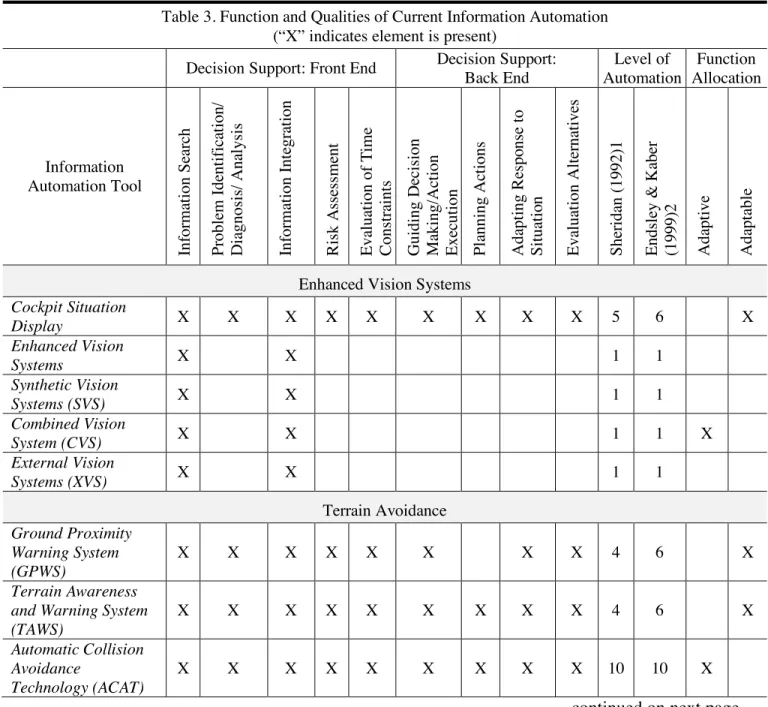
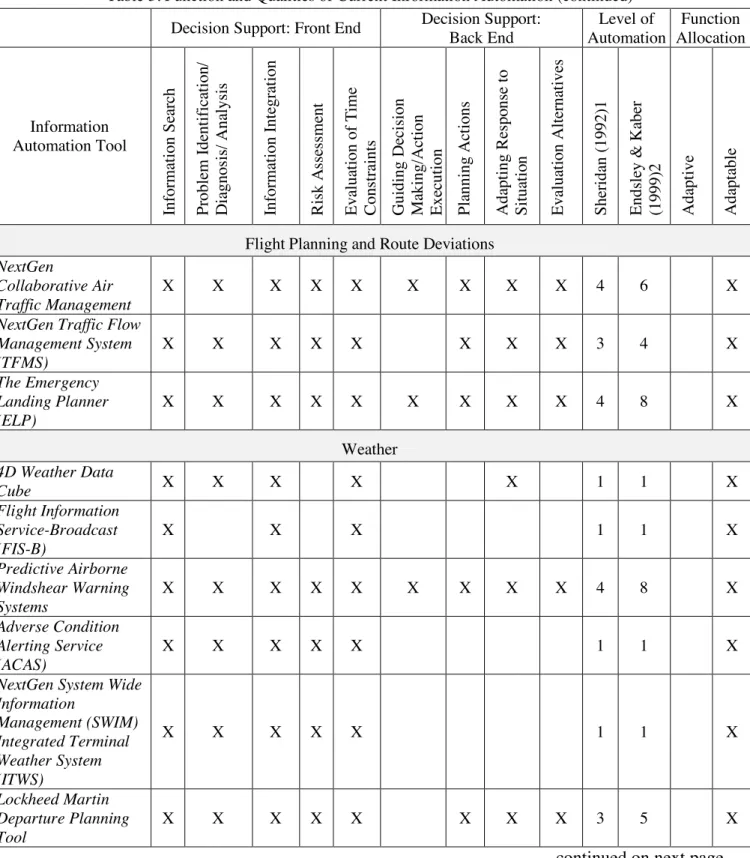
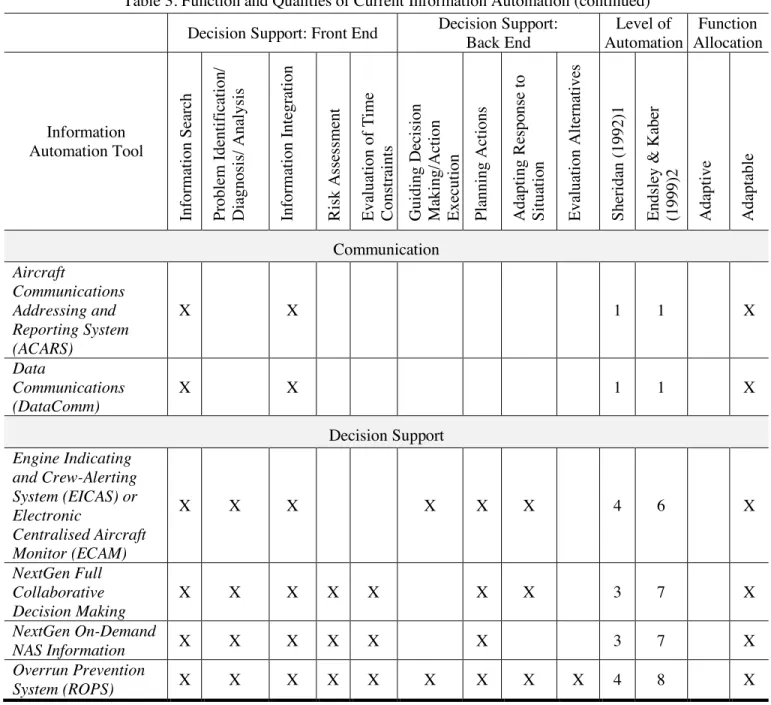
3. Current Information Automation ... 23
3.1 Enhanced Vision Systems ... 23
3.2 Terrain Avoidance ... 24
3.3 Traffic Conflict Avoidance ... 24
3.4 Navigation ... 25
3.5 Flight Planning and Route Deviations ... 25
3.6 Weather ... 25
3.7 Communication ... 26
3.8 Pilot Awareness and Decision Support ... 26
4. Current Approaches to Information Management ... 31
4.1 Supervisory Control vs. Interdependent Team Members ... 31
4.1.1 Playbook ... 31
4.1.2 Pilot’s Associate ... 32
4.1.3 Other Information Management Systems for Transport and Military Aircraft ... 34
4.1.4 Small Aircraft Pilot Assistant ... 35
4.1.5 Digital Copilot ... 35
4.2 Coactive Design ... 36
4.3 Related Technology: Unmanned Aerial Systems (UAS) and Robots ... 37
4.4 Lessons Learned from Existing Information Automation Systems ... 40
5. Human-Human Teams: Components of Team Effectiveness ... 40
5.1 Team Communication ... 41
5.1.1 Challenge 1: What Information to Convey... 41
vi
5.1.3 Challenge 3: How to Communicate Efficiently ... 42
5.2 Team Coordination ... 43
5.2.1 Shared Mental Models ... 43
5.2.2 Mutual Performance Monitoring ... 43
5.2.3 Backup Behavior ... 44 5.2.4 Team Adaptability ... 44 5.2.5 Team Leadership ... 45 5.3 Cooperation ... 45 5.3.1 Team Orientation... 45 5.3.2 Mutual Trust ... 45
5.4 Implications for Human-Automation/Autonomy Teaming ... 46
5.4.1 Teamwork Involves Interdependent Agents ... 46
5.4.2 Human-Automation/Autonomy Interaction as Team Communication ... 46
5.4.3 Shared Mental Models ... 47
5.4.4 Mutual Performance Monitoring ... 47
5.4.5 Backup Behavior ... 47
5.4.6 Team Adaptability ... 48
5.4.7 Team Leadership ... 48
5.4.8 Team Orientation and Mutual Trust... 48
6. Conclusion ... 49
vii
Acronyms and Definitions
4D ... 4-dimensional
AAS ... Automation/Autonomous System AC ... alternating current
ACARS ... Aircraft Communications Addressing and Reporting Systems
ACAS ... Adverse Condition Alerting Service ACAS X ... Airborne Collision Avoidance System ACAT ... Automatic Collision Avoidance Technology ADS-B ... Automatic Dependent Surveillance-Broadcast ASRS ... Aviation Safety Reporting System (NASA) ATC ... air traffic control
ATIS... Automatic Terminal Information Service ATSB ... Australian Transport Safety Bureau CASSY ... Cockpit Assistant System
CDAS ... Cognitive Decision Aiding System CDTI ... Cockpit Display of Traffic Information CIM ... Cockpit Information Manager
CSD ... cockpit situation display CVS ... combined vision systems
DARPA ... Defense Advance Research Projects Agency DataCom ... Data Communications
DOA ... degree of automation
ECAM ... electronic centralized aircraft monitoring EGPWS ... Enhanced Ground Proximity Warning System EICAS ... Engine Indicating and Crew-Alerting System ELP ... Emergency Landing Planner
EVS ... enhanced vision systems FANS ... Future Air Navigation System
FIS-B ... Flight Information Service-Broadcast FMA ... flight mode annunciator
FMS ... Flight Management System
GCAS ... Ground Collision Avoidance System GPS ... global positioning system
GPWS ... Ground Proximity Warning System HAI ... Human-automation/Autonomy Interaction HDD ... head down display
HMD ... helmet mounted display HUD ... head-up display
HWD ... head-worn display IA ... intelligent agent
IAS ... Intelligent Adaptive Systems ITP... in-trail procedure
ITWS ... Integrated Terminal Weather System LED ... light emitting diode
LOA ... level of automation
viii
MCP ... Mode Control Panel
NASA ... National Aeronautices and Space Administration NOPE ... non-optimal play environment
NOTAM... Notice to Airmen
NTSB ... National Transportation Safety Board
OCSIS ... onboard context-sensitive information system OFS ... operator functional state
PA ... Pilot’s Associate
PBN ... Performance-Based Navigation PVI ... Pilot-Vehicle Interface
QF ... Quantas Flight
QRH ... Quick Reference Handbook RNAV ... Area Navigation
ROPS ... Overrun Prevention System pg 26 RPA ... Rotorcraft Pilot’s Associate SA ... situational awareness
SAPA ... Small Aircraft Pilot Assistant SOP ... Standard Operating Procedure
STL ... Lambert-St. Louis International Airport SVS ... synthetic vision systems
SWIM ... System Wide Information Management TAWS ... Terrain Awareness and Warning System TBFM ... Time Based Flow Management
TBO-AID ... Trajectory-Based Operations Adaptive Information Display
TCAS ... Traffic Alert and Collision Avoidance System TFMS ... Trffic Flow Management System
UAS ... unmanned aerial system UAV ... unmanned aerial vehicle USAF ... United States Air Force XVS ... external vision systems
1
Autonomous, Context-Sensitive,
Task Management Systems and Decision Support Tools I:
Human-Autonomy Teaming Fundamentals and State of the Art
Kathleen L. Mosier1, Ute Fischer2, Barbara K. Burian3, and Janeen A. Kochan4
1. Introduction
On November 4, 2010, Qantas Flight 32 (QF 32), an Airbus A380 aircraft, experienced an uncontained No. 2 engine failure during climbout after taking off from Singapore Changi Airport (Australian Transport Safety Bureau [ATSB], 2013). Debris from the engine peppered the aircraft and caused wide destruction to a number of the aircraft systems. Over the course of more than 90 minutes the crew responded to a great number of alerts and warnings displayed on the aircraft’s electronic centralized aircraft monitoring (ECAM) system, including:
• engines No. 1 and 4 operating in a degraded mode
• low system pressure and low fluid level in the Green hydraulic system • engine No. 4 Yellow hydraulic system pump errors
• failure of the alternating current (AC) electrical No. 1 and 2 bus systems • flight controls operating in alternate law
• wing slats inoperative • partial control of ailerons lost • spoiler control reduced • landing gear control issues • multiple brake system messages
• engine anti-ice and air data sensor malfunctions
• multiple fuel system malfunctions, including a fuel jettison fault • center of gravity messages
• autothrust and autoland inoperative
• No. 1 engine generator drive disconnected • left wing pneumatic bleed leaks
• avionics system overheat (ATSB, 2013; p. 170)
Although the crew did a masterful job of completing a successful emergency landing, prior to doing so they spent an inordinate amount of time accomplishing actions associated with the enormous number of ECAM alerts, often being directed to complete the same actions repeatedly, even as the aircraft became more and more out of balance due to a fuel leak. During the subsequent
investigation, the crew stated that they eventually decided to dispense with the ECAM action items associated with the multiple malfunctions and instead focus on identifying what was actually working or was serviceable. Only in making this shift in their thinking were they able to develop a
1San Fracisco State University. 2Georgia Institute of Technology. 3NASA Ames Research Center.
2
viable strategy for completing the emergency landing (ATSB, 2013). Although highly capable, the ECAM logic could not evaluate contextual aspects of the situation and adapt the actions presented to the crew for accomplishment accordingly.
Conflicting action demands have hindered crew effectiveness in older-technology aircraft as well. On September 28, 2007, American Airlines flight 1400, an MD-82 aircraft, experienced an engine fire during initial climbout from Lambert-St. Louis International Airport (STL) (National
Transportation Safety Board [NTSB], 2009). The fire was the result of an air turbine starter valve that was stuck open and alerted through the illumination of a light in the cockpit. The pilots were not sure how to interpret the visual alert and they made no mention of nor did they access the pertinent abnormal checklist in the aircraft’s Quick Reference Handbook (QRH). A few moments after the starter valve light illuminated, the engine fire alert sounded, which appeared to surprise the first officer who had not anticipated that a stuck open starter valve could result in an engine fire (NTSB, 2009). As with the QF32 crew, the American 1400 crew faced multiple systems failures associated with the engine fire, including problems with the hydraulics and electrical systems. In their investigation, the NTSB (2009) determined that these cascading failures were due, in part, to the crew’s delay in accomplishing critical items in the Engine Fire/Damage/Separation checklist, such as shutting off the fuel to the engine that was on fire. They interrupted checklist
accomplishment several times to attend to other tasks, such as informing the flight attendants of the need to return to STL.
These two events share much in common beyond a critical engine emergency during climbout and subsequent multiple failures involving other aircraft systems. Both were highly stressful and required appropriate prioritization of tasks and distribution of workload. Confusing alerts,
interruptions, and distractions were prolific. Developing and maintaining an accurate understanding of the overall situation and responding appropriately to the competing demands encountered in both events was extremely taxing and required the full cognitive resources of all involved.
The management of emergency and abnormal situations has always presented challenges to crews as they have worked to understand their condition and implications for continued safe flight. They have had to quickly grasp the constraints faced—especially the amount of time available—determine and enact the proper response, communicate and coordinate with others as necessary, while still
completing other required normal flight tasks. Accident reports across the globe are full of examples of where this has been done well and not so well. As aircraft systems become more and more
technologically complex, with tightly coupled autonomous systems responsible for more and more of the flight tasks, the accidents of the future are likely to be similar to these two examples, ones involving multiple systems resulting in an extensive list of failures, confusion, and extremely high workload for the flight crews.
Although workload associated with emergencies such as these can be extreme, even normal operations in today’s highly complex and traffic-intense airspace can keep commercial pilots quite busy. Pilots must access and integrate information from a vast array of sources including navigation charts; Notices to Airmen (NOTAMs); Automatic Terminal Information Service (ATIS); aircraft logs and minimum equipment lists; normal checklists; cockpit displays of radar returns, systems status, traffic; and many others as they manage the aircraft automation and their flight path. This workload will only be increased under anticipated reduced crew operations in the future.
3
For some time aircraft manufacturers and researchers have been pursuing mechanisms for reducing crew workload and providing better decision support to the pilots, especially during non-normal situations (Banks & Lizza, 1991; Champigneux, 1995; Matheus et al., 2005). Some of these
approaches, such as increasingly autonomous systems, have indeed reduced workload but have also sometimes had the effect of reducing the pilots’ understanding of what the aircraft is doing (Mosier & Skitka, 1996; Sarter, Woods, & Billings, 1997). So too, previous attempts to develop task
managers or pilot decision support tools have not resulted in robust and fully functional systems (Banks & Lizza, 1991; Miller & Hannen, 1999). However, the increasing sophistication of sensors and automated reasoners, and the exponential surge in the amount of digital data that is now available create a ripe environment for the development of a robust dynamic task manager and decision support tool that is context sensitive and integrates information from a wide array of on-board and off aircraft sources—a tool that monitors systems and the overall flight situation, anticipates information needs, prioritizes tasks appropriately, keeps pilots well informed, and is nimble and able to adapt to changing circumstances.
In this report, we explore fundamental issues associated with the development of such a system. We discuss information automation and associated human factors issues and review the current state of the art of pilot information management and decision support tools. We explore team behavior and expectations to determine how characteristics of effective human-human teams may be
operationalized in teams involving humans and automation or autonomous systems. This report includes a review of critical literature and provides the scientific basis and foundation for the development of a truly robust and highly functional dynamic flight, automation, and information management system. Although much of the report is thus, focused on aviation automation, much of our discussion has relevance for automation and autonomous systems in other domains.
In a companion report (Burian, Kochan, Mosier, & Fisher, 2017) we focus in-depth on constraints and conditions that will drive the functioning and displays of a dynamic flight, automation, and information management system. In this companion report we also explore in great detail the types and sources of data and information that would be integrated into such a system.
As automation and autonomous systems become more and more capable, they have increasingly been imbued with human characteristics including the ability to “assert” themselves as
“independent” or at least “quasi-independent” agents (provided they’ve been programmed as such). Although there is a technical distinction among them, in this document we will use the terms “automation,” “autonomous systems,” and “agents” interchangeably. We will reserve the use of the term “agent” for highly sophisticated automation and autonomous systems, however, and refer to human actors only as “humans.”
2. Information Automation
As described above, pilots in current flight operations are required to make sense of a large amount of data and information from a variety of sources including visual cues, instrument readings, information from automated decision aids, and information received from air traffic control (ATC), and to act tactically and strategically to meet multiple and sometimes competing goals. Flight deck operations in the future will depend on a “Net-centric” environment in which information will come from on-board and off-board sources, and many expected innovations to aviation systems will involve information automation (Bailey, Prinzel, Kramer, & Young, 2011).
4
Information automation is “…devoted to the calculation, management and presentation of relevant information to flightcrew members” (Abbott, McKenney, & Railsback, 2013, p. 40). Although it is typically thought of as distinct from control automation such as an autopilot, it may perform some decision making and action implementation tasks. Information automation monitors relevant data, with associated parameters and/or thresholds fed into dynamic algorithms to identify, “…integrate, summarize, distribute, format, abstract, prioritize, categorize, calculate, process, and display information in a variety of ways to support flight crew tasks” (Letsu-Dake et al., 2015, p. 3D1). In short, it reflects “the programming logic that dictates what information is displayed, when it is displayed, and how it is presented to the flightcrew” (Dudley et al., 2014, p. 296).
The technological capability to deliver almost unlimited information highlights the importance of flight deck systems that “provide the crew with the information they need, when they need it, and with a quality they can trust” (Bailey et al., 2011, p. 9), and to do so without increasing their workload (Abbott et al., 2013; Letsu-Dake et al., 2015). These demands essentially are a call for designing a system that can act like a sensible crewmember, one who perceives information needs and conveys information proactively during the performance of flight tasks. To take up this challenge, a number of fundamental design issues need to be resolved. Insofar as information automation involves the processing of data before they are presented as information to pilots, we need to worry about the appropriate stage and level of data processing. Or put differently, what cognitive processes of pilots—attention, information integration and analysis, option generation— should be supported by information automation? What is the appropriate level of support that information automation should provide? How should information be best presented? Who and what should control the information flow? Additionally, if information automation is to be effective in supporting real-time decisions and actions, it must be sensitive to contextual factors and present information that is relevant to the situation at hand. Which factors should be taken into account to determine the relevance of information? And finally, information automation only ‘works’ when it is used appropriately. How can system designers ensure that pilots understand and trust the
information provided? What human issues and characteristics will impact the use of information automation? These questions outline essential human factors issues in the design and use of information automation.
2.1 Human Factors Issues of Information Automation
2.1.1 What Cognitive Process Should be Supported?
Mosier and Fischer (2010) introduced the terms ‘front end’ and ‘back end’ to characterize different phases of decision making in complex and dynamic environments, such as crew decision making. This distinction is not merely of theoretical significance; rather it is important because human factors applications such as system design or training must be approached very differently depending on the target phase and its related cognitive processes.
The ‘front end’ (judgment phase) engages cognitive processes concerned with problem
identification, information search, problem diagnosis, risk assessment and the evaluation of time constraints (Orasanu, 2010; Orasanu & Fischer, 1997). Related terms are situation awareness and assessment (Durso, Rawson, & Girotto, 2007; Durso & Sethumadhavean, 2008; Endsley, 2000), creating a situation model (Orasanu, 1990), or information acquisition, integration and analysis (Sheridan & Parasumaran, 2006). Several integrated cognitive processes are involved. Problem identification requires perception of and attention to elements in the operational environment, their mental representation, as well as their spatial or temporal relationships. Interpretive processes
5
establish coherent (e.g., causal, temporal, or structural) relationships between elements and relate them to domain knowledge to produce an information-rich and highly structured situation model. The situation model enables pilots to infer causes of events and to predict future developments.
Front-end processes result in a judgment, which may be a rather straightforward evaluation of the initial cue (as when a flight crew judges their fuel remaining as insufficient to reach their destination airport), or it may involve a complex mental representation (as when the crew integrates status indicators from various systems to reach a problem diagnosis; Mosier, 2013). Pilots’ judgment about their situation triggers back-end decision processes concerning an appropriate response.
The ‘back end’ (decision phase) may involve retrieving an appropriate course of action from memory, locating a prescribed response in the appropriate manual, adapting a known response to the specific demands of the current situation, mentally simulating a possible response, planning a sequence of actions, or evaluating alternatives (Mosier & Fischer, 2010; Sheridan &
Parasumaran, 2006).
Researchers have argued that information automation is most beneficial if it supports front-end cognitive processes, in particular information acquisition and integration (e.g., Endsley & Kaber, 1999; Sarter & Schroeder, 2001). This recommendation is consistent with models of expert decision making, which describe the decision process as heavily rooted in situation assessment. For example, participants performing an air traffic control-related task exhibited a more accurate situation
understanding and superior performance when automated aids supported information acquisition rather than performing cognitive functions such as information integration and analysis (Kaber, Perry, Segall, McClernon, & Prinzel, 2006). Likewise Sarter and Schroeder (2001) report research showing some advantage of displays supporting problem detection and diagnosis as opposed to action selection. During simulated flight, pilots encountered icing conditions. Decision aids either provided information on the location of ice accumulation (=status condition) or specified mitigating actions (=command condition); however, both types of aids could provide incorrect information. Decision aids enhanced pilot performance in both experimental conditions (compared to the baseline condition) when the displayed information was correct. In contrast, when the decision aids provided incorrect information, performance by pilots in the command condition was more negatively
affected than the performance by pilots in the status condition. This finding suggests that pilots who are removed cognitively from problem understanding, may “enter a purely reactive mode and blindly follow system recommendations” (Sarter & Schroeder, 2001; p. 581). On the other hand, if pilots are engaged in the process of problem analysis and understanding, they are better able to detect any flaws in action recommendations and are more prepared to intervene as needed.
2.1.2 What is the Appropriate Level of Support?
Automated systems can be described in terms of the level of support they provide to human operators. Sheridan (1992) and Endsley and Kaber (1999) both proposed 10 levels of automation that vary from manual decision making and control to complete automation. An inspection of Table 1 reveals a few interesting characteristics of and differences between these taxonomies. First, the two schemes seem to emphasize different aspects of automation. For example, Endsley and Kaber do not make fine distinctions at the high levels of automation, and consider all types of feedback from the system to be equivalent. Instead, they emphasize the lower end of automation by
6
observation is that the two schemes are not monotonically compatible. Sheridan’s Level 3— ‘computer offers some alternatives’—resembles Endsley and Kaber’s Level 7 ‘rigid system.’
Table 1. Comparison of Sheridan’s Levels of Automation with the Classification by Endsley and Kaber
LOW—Low Level Of Automation
Sheridan (1992) Endsley & Kaber (1999)
1. Human makes all decisions.
1. Manual: Human makes all decisions.
2. Action support: Computer assists with action. 3. Batch processing: Human generates options;
selects; computer implements.
4. Shared control: Both generate options; human selects; both implement.
2. Computer offers all alternatives. 3. Computer offers some alternatives.
5. Decision support: Computer generates options; human chooses or ignores; computer implements. 4. Computer offers one alternative.
5. Computer executes suggestion if approved.
6. Blended decision making: Computer generates options; computer selects; human consents or chooses or ignores.
(3. Computer offers some alternatives).
7. Rigid system: Computer presents some options; human must select from this list.
8. Automated decision making: Computer selects best option from joint list.
6. Computer executes if operator does not
veto in time. 9. Supervisory control: Computer generates, selects, implements action; operator can intervene. 7. Computer executes then informs operator.
8. Computer executes and informs when queried.
9. Computer executes and informs if computer chooses.
10. Computer decides and acts autonomously (full automation).
10. Full automation: Computer carries out all steps.
7
Endsley and Kaber (1999) hypothesized that using intermediate levels of automation (LOA) “may provide better human system performance and situational awareness than found with highly automated systems” (p. 483). They examined participants’ abilities to perform a dynamic control task with automation supporting them at each of the levels listed in Table 1. Task performance required participants to: 1) monitor the location, speed and size of targets; 2) generate a situation analysis as well as potential courses of action; 3) select an action;and 4) implement it. Results showed that performance (target collapses, expirations, and collisions) was best under lower LOAs, specifically when humans were involved in situation assessment and generating possible responses, and automation assisted only in implementation. Higher LOAs that provided automated guidance for option selection actually hindered decision making or caused participants to second-guess their judgment. This study is typically cited as providing the rationale for lower LOAs; however, it should be noted that the Endsley and Kaber LOAs do not distinguish between information automation and control automation and, importantly, do not incorporate any variance in automation at the front end of decision making (information acquisition, integration, and analysis).
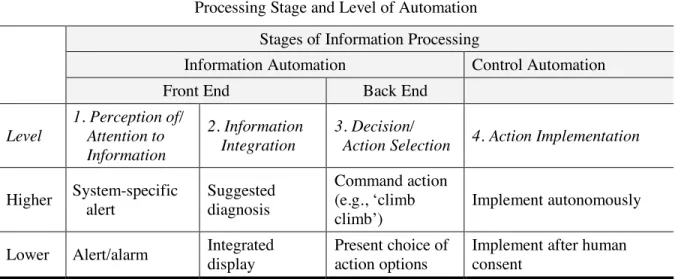
The concept of LOA was refined by Wickens and colleagues (Wickens, Li, Santamaria, Sebok, & Sarter, 2010) who introduced the notion of degree of automation (DOA). The degree of automation for a given procedure or system/task depends on both the stage of information processing involved and the level of automated support (Onnasch, Wickens, Li, & Manzey, 2014; Parasuraman,
Sheridan, & Wickens, 2000, 2008). This characterization may be more appropriate than LOA for the design of information automation because it includes a consideration of the stage of information processing being supported.
Table 2 outlines how automation can provide support for human performance within the four stages of information processing. Moving from lower left to upper right of Table 2, higher levels and later stages (e.g., action automation rather than diagnostic automation) characterize higher DOAs and hence more automation authority and autonomy, whereas lower DOAs imposes greater cognitive and/or motor work on the pilot. Within the columns, higher-level automation means that more integration and synthesis of information is accomplished by the system. Lower levels of automation at each stage keep the operator in the loop by requiring attention, analysis, choice, or
acknowledgment and consent.
Table 2. Degree of Automation as the Intersection of Information Processing Stage and Level of Automation
Stages of Information Processing
Information Automation Control Automation
Front End Back End
Level 1. Perception of/ Attention to Information 2. Information Integration 3. Decision/
Action Selection 4. Action Implementation
Higher System-specific alert Suggested diagnosis Command action (e.g., ‘climb climb’) Implement autonomously Lower Alert/alarm Integrated display Present choice of action options Implement after human consent
8
Different DOAs have been shown to have different advantages and drawbacks - for example, a command message in the action selection phase (e.g., ‘climb, climb’ in Table 2 above) may elicit quick response, but may not guarantee that the best option is selected. Manual performance of checklist or procedure items keeps the operator engaged and enhances situation awareness (SA), but also imposes high workload on operators, and the operators may skip steps or forget to return to the procedure after an interruption (Wickens 2005; Loukopolous, Dismukes, & Barshi, 2009). Fully automated checklists and procedures, on the other hand, are lower in workload and facilitate speedy and sometimes more accurate performance of steps, but also may foster complacency and
automation bias (see below) so that automation errors are not likely to be detected and corrected (e.g., Mosier, Palmer, & Degani, 1992). Additionally, the higher the DOA, the more serious the potential negative consequences can be when automation errs (Onnasch et al., 2014). This is particularly true for the “first failure” off-nominal event that a person may experience with an automation system (Clegg, Vieane, Wickens, Gutzwiller, & Sebok, 2014; Wickens, Hooey, Gore, Sebok, & Koenicke, 2009). Additionally, the DOA is directly related to the allocation of tasks and the extent to which pilots can control task and information flow. These considerations will be important in the design of information automation, as each DOA entails tradeoffs among workload, time (speed of response), and SA.
The concepts of LOA, and by extension DOA, have come under criticism because of their emphasis on function allocation between computers and humans and the relative neglect of the possible ways in which human and machine agents may collaborate (Defense Science Board, 2012). Coactive Design, discussed later, addresses such human and computer collaborations by considering how the capabilities of humans and agents are most effectively combined to meet task requirements.
2.1.3 Who is in Charge of Information Flow?
In modern cockpits, specific features of the task, context, and/or automation can predict how pilots will choose to interact with information automation, the type of automation they will use, and the level of support they will select. With a higher degree of information automation, the pilot has lower workload compared to identifying and synthesizing information and making a decision by
him/herself. However, high degrees of information automation may also result in decreased awareness and, unless there is system transparency and good feedback, lower predictability concerning the implications of the information and decision for system status or actions. Design questions for information automation include how and when information should be distributed to the pilot, and how functions and tasks should be allocated between the pilot and automation.
Pushing and Pulling Information. Information push and pull are concepts to describe how information resources are distributed to users. “Loosely speaking, if a user requests and receives a very specific piece of information, this is information pull. If information is sent in anticipation of the user’s need, or the agent’s response includes information not directly solicited, then the situation is characterized as information push” (Cybenko & Brewington, 1999, p. 9). Information push has become associated with autonomous agents that may function as intermediaries and perform computational tasks with respect to processing information (Cybenko & Brewington, 1999).
Functions of the pushing agent may include locating, filtering, organizing, and alerting information. An issue for information automation is the determination of what information should be constantly displayed, available at operators’ discretion by request (pulled), or made salient to the operator by the automation (pushed). For example, changes in system or situation status or contextual
9
information (e.g., adverse weather conditions) are candidates for information push. Automation should also flag pilot input or actions that are inconsistent with flight plan or current flight context.
Function Allocation. Function allocation is the determination of assignments of work to human and automated agents in a team (Pritchett, Kim, & Feigh, 2014). One early method of function allocation was the Fitts’ list approach: Men (or more recently Humans) are better at/ Machines are better at (M/HABA- MABA; Fitts, 1951). The rationale behind this approach was that humans and automation should be allocated the tasks for which they are better suited. For example, because information automation has a larger capacity than human operators for memory and storage, deductive reasoning, and simultaneous operations, many of the data tracking, computational tasks, and alert delivery for fires or malfunctions have been routinely allocated to automation (see also the HART group, 2011).
Fitts’ list represented a reasoned approach to function allocation, but is limited in that it is very machine-centered and static (Hoffman & Militello, 2008). More dynamic approaches base function allocation on how tasks can best be shared by humans and automation working together (e.g., Licklider, 1960; Bradshaw, Dignum, Jonker, & Sierhuis, 2012; Bradshaw, Feltovich, & Johnson, 2012). In
adaptive systems, the automation controls the division of tasks; adaptable automated systems are adjusted by the operator, who maintains control over automation and is able to designate whether the human or automation will do all or part of tasks (Sheridan & Parasuraman, 2006). Feigh and Pritchett (2014) provided a review of the requirements for effective function allocation, focusing on taskwork functions (performance of activities to meet collective work goals) and their related teamwork functions (communication and coordination among agents). They identified requirements for guiding, measuring, and modeling function allocation that can be used in the design of automated systems.
Taskwork Requirements identified by Feigh and Pritchett consider human issues associated with vigilance and the assignment of authority vs. responsibility. These issues are critical for information automation. In particular, functions should be allocated in so that the human maintains responsibility over automation; that is, the machine may have authority over a function such as providing a
decision recommendation, but the human is responsible for overall safety and can override automated suggestions or requirements. Moreover, the collective set of functions (taskload— including monitoring, information integration, or decision making) assigned to an agent cannot exceed the agent’s capabilities at any given moment. Automated systems should not create workload spikes—cognitive or manual—for humans, or introduce high interaction demands during
off-nominal or emergency situations.
Adaptive approaches to function allocation must also take into account sequential and reciprocal task interdependencies implicit in the distribution of work (see Thompson, 1967), something that is becoming increasingly important from the perspective of human-automation teams. Teamwork requirements suggest that automation should be treated as a team member. Communication between team members is an important component of task accomplishment, and human-human conventions around the timing, interruptive quality, and even politeness of communication should be observed (Dorneich, Ververs, Mathan, Whitlow, & Hayes, 2012; Miller, 2004). As a team member,
information automation should be expected to share its rationale for decisions with the human. For instance, in order for the human to approve an action recommended by information automation, he/she needs the system to provide reasoning behind its selection (see Johnson, Bradshaw, Feltovich, Hoffman et al., 2011). Moreover, the human-automation team must have the ability to be resilient,
10
that is, to respond to and cope with dynamic and unexpected situations, and human agents must be able to select strategies appropriate to the situation at hand (Pritchett, 2010; Hollnagel, 1993).
Pritchett, Kim, & Feigh (2014) outlined the metrics to evaluate function allocation including
resultant workload/taskload, authority-responsibility mismatches, stability of the work environment, coherence of function allocation, interruptions, automation boundary conditions, system cost and performance, and the humans’ ability to adapt to the situational context. Interestingly, these guidelines and metrics imply a consideration of context sensitivity in dynamic function allocation, but do not specify which agent has responsibility for identifying the proper allocation for given contextual variables. Adaptive and adaptable function allocation, which are variations of dynamic function allocation, represent attempts to address this issue (Kaber & Riley, 1999; Kaber, Riley, Tan, & Endsley, 2001; Bailey, Scerbo, Freeman, Mikulka, & Scott, 2003; Miller & Parasuraman, 2007; see also Hancock et al., 2013).
Adaptive and adaptable automation may adjust either the assignment of a task (e.g., the pilot will integrate available information and select a diversion airport or will ask the automation to do so) or the DOA invoked (e.g., the automation will integrate available information and recommend a diversion airport vs. the automation will select the diversion airport and fly the approach). The Playbook approach (Miller & Parasuraman, 2007) discussed in a later section is a form of adaptable automation, in which the human delegates tasks in the form of ‘plays’ to automated systems. These approaches address some common drawbacks of full automation such as non-vigilance/
complacency/ automation bias threats, manual skill deterioration, loss of SA, and the misuse or disuse of automation, and also address the need for dynamic rather than static allocation of tasks according to user state, required tasks, and the situational context.
Research on degree of automation as well as on function allocation indicates that there is no ‘one size fits all’ DOA or allocation of tasks. The best design for information automation will be flexible and adaptable. However, some basic guidelines are evident from the research:
1. Information automation should be targeted toward the front end (first two stages) of cognitive processing, providing input for information acquisition and integration. When back-end options/decisions are provided, automation should provide a traceable rationale for these.
2. Keeping the pilot in the loop will be a critical function of future information automation. System design must account for the tradeoff between the speed and efficiency inherent in automation and the loss of pilot awareness when DOA is high. Function allocation must be adaptive to task demands and pilot workload.
3. System design should replicate the capabilities and characteristics of effective human teams; for example, team members should ensure that no one is overloaded, team
members should be ‘polite’ to each other, team members should communicate intentions and goals.
4. System design and task allocation should enable resilience—recovery from unexpected or abnormal states.
5. In order to respond adaptively to dynamic events, automation must be responsive to the situational context.
11
2.2 Context-Sensitive Information Automation
Information automation has to be sensitive to context if it is to be useful and not wantonly increase user workload. Context-sensitive automation is distinct from ‘dumb but dutiful’ automation (Weiner, 1988, p. 433) whose displays may or may not provide the most relevant information and whose behavior reflects the operative command whether it make sense in the situation or not. Context-sensitive information automation senses and takes into account situational characteristics, and adjusts dynamically in response to them. Context sensitivity requires timeliness, relevance,
accessibility, and comprehensiveness of information. A challenge to designers will be to ensure that the right information (relevance and comprehensiveness) is easily available (accessibility) at the right time (timeliness), especially when decisions need to be made under time pressure.
Burian and Martin (2011) discuss the concept of dynamic operational documents, that is, information that is driven by and organized according to specific task demands and aspects of situations or conditions encountered. In their conceptualization, documents such as checklists would be integrated with other types of operational data to support the specific task, anomaly, or situation at hand. Context sensitivity as discussed in this report represents an extension and enhancement of this concept to the broad class of information automation systems. To address safety and operational demands, context-sensitive information automation must take into account flight and aircraft
characteristics (e.g., phase of flight, altitude, time, aircraft systems and equipment status, aircraft performance limitations), environmental factors (e.g., weather, smoke, terrain), and existing company policies, procedures and regulations (e.g., SOPs, stable approach criteria), as well as human cognitive and performance variables (e.g., workload, mental models, situation
assessment/awareness, memory).
2.2.1 Flight and Aircraft Characteristics
Phase of flight is a characteristic that dictates workload (including tasks/procedures to be completed) and time constraints. Departure (takeoff, climb) and arrival phases (approach, landing) are highest in workload and lowest in available time for information acquisition compared with enroute phases. This means that information pushed during those phases (e.g., regarding system failures, traffic) must be highly relevant and easy to comprehend and that non-relevant information should be suppressed. In fact, even some critical alerts, such as engine failures, are suppressed by some alerting systems during these critical high workload phases of flight lest they distract the pilots (Berman et al., in press). Information automation should also be able to sense equipment failures or system problems, as well as links and dependencies among aircraft systems and take these into account when integrating or displaying operational information or recommended actions. Automation databases must incorporate the performance characteristics and limitations of the aircraft, so that information can be tailored to these as well. If the pilot does not have a realistic assessment of what actions can be taken and what the aircraft can do, the effectiveness of his or her response to a situation may be constrained or misguided. For example, in the US Airways 1549 landing on the Hudson, information automation did not alert Captain Sullenberger that his pitch control inputs were restricted by the aircraft systems, giving him the illusion that he could exert more nose-up control than was actually possible (Harris, 2007).
2.2.2 Environmental Factors
Environmental factors are also part of the context. Inside the aircraft, conditions such as smoke, decompression, or toxic fumes generate the need for specific behaviors and actions. Externally, weather-related factors such as precipitation, icing, air pressure, or turbulence will impact both the
12
information needed by the operator and the actions that can be taken. Limitations imposed by ground variables such as terrain, obstacles, or airport status and runway conditions must be integrated and made available or pushed to the pilot as needed.
2.2.3 Policies, Procedures, and Regulations
Current operational documents (electronic or paper) such as checklists, manuals, or Standard Operating Procedures (SOPs) provide pilots with information structured around airline and federal flight operation policies and regulations. Some of these prescribe requirements that apply across general situational contexts—for example, the criteria for a stable approach—and this information should be integrated with current flight parameters so that pilots can be informed of discrepancies and deviations. Other types of documents are more context-dependent, such as a non-normal checklist with several branches, as was the case in the US Airways 1549 landing in the Hudson (NTSB, 2010). One purpose of context-sensitive information automation, such as dynamic checklists, would be to eliminate non-relevant branches or information searches (e.g., what is my altitude?) and facilitate accurate and timely completion of procedures (Burian, 2014).
2.2.4 Human and Cognitive Performance Variables
A primary purpose of context-sensitive information automation is to facilitate the development of situational awareness (SA) and accurate situational mental models. This means it must be designed with consideration for human cognition and cognitive factors that impact performance, how people identify and make sense of a situation, and how they develop accurate mental models of systems and situations. As discussed earlier, supporting the front-end processes of information acquisition and analysis/ integration will be most effective in terms of SA and the development of mental models, and also keeps the operator in the loop (e.g., Endsley & Kaber, 1999; Sarter & Schroeder, 2001).
Context-sensitive information automation must also take into account other factors that impact performance such as workload, psychophysiological state, or experience. For example, adaptations in information automation should occur with changes in task demands or operator functional state (OFS, physiological signals; Wilson & Russell, 2003a,b). Additionally, the system should sense and suppress non-relevant information during high-workload phases such as takeoff or landing, or perhaps would synthesize information and make different types of recommendations according to pilot variables such as fatigue.
Proper weight and value must be given to these various factors to ensure that the information automation displayed at any moment is properly prioritized relative to the context encountered. The constraints and conditions associated with context-sensitive information automation prioritization and display are explored in more depth in the companion document to this report (Burian, et al., 2017).
2.2.5 Quality, Usability, and Integrity of Context-Sensitive Information Automation
Timing of Information. The value of information provided by automation is directly related to its timeliness and ‘freshness’ as well as to its contextual relevance. Information automation must incorporate real-time sensing of information needs. Pilots will need all information related to a particular task, situation, or phase of flight soon enough to incorporate it into decisions, etc., but not so early as to induce premature closure on SA or resultant actions. Additionally, ‘stale’ information, such as outdated weather forecasts or airport status data, is not only not useful, but it also may be hazardous if pilots use it to plan their actions.
13
Information Sources. Data for context-sensitive information automation may come from different sources such as sensors, databases, algorithms, or data entered by the pilot or ground. It is imperative that, regardless of the source, data must be as specific, accurate, reliable, accessible, comprehensive, and timely as possible. Additionally, information automation must be transparent concerning the limitations of its data, so that pilots know which elements it cannot sense or calculate (e.g., the presence of birds or large animals on the runway, or data whose validity may be suspect).
Resilience. Resilience is a construct that has been discussed with respect to organizational and socio-technical systems as well as to physical (e.g., automation hardware and software) systems. Four basic concepts have emerged from within different technical approaches: 1) resilience as rebound from disruption/harm; 2) resilience as robustness; 3) resilience as graceful extensibility of boundaries rather than brittleness; and 4) resilience as architectures that are adaptable to unforeseen events (Woods, 2015).
Importantly, information automation systems must be robust and resilient enough to facilitate, rather than hinder performance during non-normal or emergency situations. Early, and some current, automation has been described as ‘brittle,’ that is, it addresses a limited set of pre-specified situations, has little or no capability to learn, and fails catastrophically when it reaches its limits rather than degrading gracefully and obviously (e.g, Bainbridge, 1983; Pritchett, Kim, & Feigh, 2014; Thurman, Brann, & Mitchell, 1997). Resilient systems, in contrast, are able to prevent or adapt to changing conditions, avoid failures and losses through anticipation, recover from disruptions—especially those that are not within the set of abnormalities the system is built to handle—and maintain control over properties such as safety or risk within the larger socio-technical system (e.g., National Airspace) or the physical system (e.g., automation on the aircraft) itself (Leveson et al., 2006; Madni & Jackson, 2009; Woods & Hollnagel, 2006). Resilience is a key component of context-sensitive information automation, as it must be able to respond to dynamic normal and non-normal situations.
2.3 Design Issues
Although sophisticated software technology enables collection of vast amounts of information, possibilities for visual information display are constrained by so-called “real estate” limitations; in other words, the number and size of screens and indicators in a cockpit, information that is dedicated or reserved for different displays or parts of displays, and ergonomic considerations about where the displays are placed on the flight deck. Additionally, the most effective information display mode— visual, aural, tactile—must be determined. Human limitations in terms of attention, visual and auditory overload, and processing must be considered in the design of information automation. Information display format (e.g., gauges, numbers, graphics, symbols, text) and coding (e.g., type and length of audible or tactile alarms, localization within the flight deck) should also enable the pilot to track its source and reasoning, and should elicit the appropriate cognitive response.
Each of the issues discussed below must be considered with respect to its individual resolution (e.g., how to make information salient, which mode to use, etc.) and also with respect to its impact on the overall system. Design features that improve one system, for example, may add complexity,
14 2.3.1 Salience
The salience of information automation is a key determinant of attention and use. Salience in turn is related to automation compellingness (Dorneich et al., 2015; Dudley et al., 2014). Pilots (as most people) are inclined to pay attention to salient cues, such as stick shakers, or visual and aural alarms (Dismukes, Berman, & Loukopoulus, 2007). Central placement, bright lights, or aural disruptions elicit and concentrate the attention of the pilot and these design decisions have implications for what information is attended to. Salience, however, has a flip side: on one hand, it is essential to the compellingness and thus the attention to information; on the other hand, salient information automation may engulf or overwhelm other necessary information, curtailing situation assessment and leading to possible errors (Mosier & Skitka, 1996; see also section on Automation Bias).
2.3.2 Display Placement and Mode
One of the challenges for information automation is avoiding potential visual overload, as most such data are acquired visually. This is particularly important with respect to status changes and warnings. The failure of pilots to notice mode transitions and mode changes, for example, may be due to their visual display, which is not preemptive enough to command the crew’s attention (Wickens, 2003; also see Salience above). Other examples of inadequate information display include presentations in which related information is scattered across different displays or checklists, critical information is insufficiently highlighted or buried, or displays that are so cluttered that discerning relevant
information is difficult.
Experiments using various display technologies have been geared toward identifying pilot perceptions and characterizations of display clutter and influences of display clutter on pilot performance (e.g., Alexander, Stelzer, Kim, Kaber, & Prinzel, 2009; Kaber, Alexander, Stelzer, Kim, & Hsiang, 2008; Kim et al., 2011). Some results indicate there may be a clutter “threshold” beyond which pilot performance degrades (Kaber et al., 2008), suggesting that advanced
technologies that increase display clutter may be counter-productive,and pointing to the need to both eliminate clutter and improve the salience of critical symbology and information (e.g., Naylor, Kaber, Kim, Gil, & Pankok, 2012).
One solution to visual overload is the employment of other sensory modalities. Warnings or alarms presented in the auditory modality are effective in interrupting ongoing visual monitoring in the electronic cockpit (Stanton, 1994; Wickens & Liu, 1988), and do not add to the array of data and information that must be absorbed visually. For example, a typical traffic alerting system such as TCAS (Traffic Alert and Collision Avoidance System) uses aural alerts as the level of potential danger rises, and a combination of visual and auditory commands if it detects that the likelihood of collision is high (Wickens, 2003). Three-dimensional localized auditory alerts, which place the origin of the alert spatially in the cockpit corresponding to the location of the traffic threat outside the aircraft, have also been found to result in faster traffic detection than conventional head-down displays (Begault & Pittman, 1996). Feedback may also be distributed across modes of presentation or provided in the tactile mode. For example, the stick shaker is a traditional tactile warning of impending aerodynamic stall. Sklar and Sarter (1999) found that tactile cues were also better than visual cues for detecting and responding to uncommanded mode transitions.
Other display solutions involve changing the format and accessibility of visual cues and information. For example, the head-up display (HUD) superimposes symbology representing aircraft trajectory parameters (e.g., altitude, airspeed, flight path) on the pilot’s external view (e.g., Pope, 2006), enabling
15
easy monitoring of both electronic and naturalistic cues and information. Head-worn displays (HWDs) providing augmented reality (i.e., spatially-integrated symbology and imagery) have been proposed as essential elements for a Better-Than-Visual operational concept (Bailey et al., 2011).
2.3.3 Transparency and Accessibility vs. Opaqueness and Layers
Providing sufficient information and transparency in displays while avoiding cognitive overload is a difficult task. However, automation visibility, that is its transparency and the feedback it provides on its sources and functioning (Dorneich et al., 2015), is a key determinant in whether pilots will trust information automation, as will be discussed below. Moreover, design decisions concerning the placement of visual information (e.g., electronic flight bags vs. primary displays vs. secondary displays) and its accessibility (e.g., surface vs. layered or hidden) will impact how and how well flight crews can use visual information automation. Many cockpit displays represent hidden stores of complex data, highly complex combinations of features, options, functions, and system couplings that may produce unanticipated, quickly propagating effects if not analyzed and taken into account (Woods, 1996). Decision support systems, in particular, may often present only what has been deemed “necessary,” making it difficult for pilots to monitor them and assess their accuracy (in judgment) and adequacy (of decision). Data are pre-processed, and presented in a format that allows, for the most part, only a surface view of system functioning, and precludes analysis of the
consistency or coherence of data. Information automation that provides this type of synthesis removes the pilot from the diagnosis phase, and lack of transparency precludes the capability to track its processes (e.g., Woods, 1996; Sarter, Woods, & Billings, 1997).
Part of the problem with lack of transparency is that information calculations and resultant commands/actions often occur without the awareness of the human operator. Moreover, system status may not be clear because within many displays are numerical data that signify different commands or values in different aircraft, phases of flight, or modes. Pilots may not have sufficient knowledge about system functioning to recognize or understand potential consequences of specific mode selections, or may be confused about what aircraft behaviors to expect (Abbott et al., 2013). For example, mode confusion was a factor in the Strasbourg A320 accident in which pilots flew a -3300 ft/min descent into a mountain. In this situation, the cockpit setup for a flight path angle of -3.3 deg in one flight mode looks very much like the setup for a -3300 ft/min approach in another flight mode (Ministre de l’Equipement, des Transports et du Tourisme, 1993).
2.3.4 Display Format and Interpretation: Intuition vs. Analysis
A key element in display design is that performance depends on the degree to which task properties elicit the most effective cognitive response (Hammond, Hamm, Grassia, & Pearson, 1997).
Characteristics of information display (e.g., graphical vs. text) will facilitate or hinder pilots’ effective cognitive processing of it. For example, the graphic representations that exploit human intuitive pattern-matching abilities and enable quick detection of some out-of-parameter system states are compatible with and facilitate intuitive cognition. However, they may also set up the false expectation that the electronic cockpit can be managed solely via intuitive cognition (Mosier, 2008). Pilots who rely on intuition when analysis is required—as when information is presented textually or numbers must be calculated, integrated, or compared—may miss important data as well as the implications of these data.
Information automation display format must match the cognitive mode required to synthesize and use the information. Formats that elicit intuitive and holistic processing, such as pictures or symbols,
16
should not require analysis for interpretation and understanding. Displays that rely on the use of text or numbers should not be used when quick recognition or understanding is needed, as they reduce the ability to use intuition or to pattern-match and increase the need for analytical processing (Mosier & McCauley, 2006).
2.4 Psycho-Social Issues: Trust, Complacency, and Automation Bias
The willingness of the human team member to use information provided by an automated agent and allocate tasks to automated systems depends to a great extent on the psycho-social variable trust, which is impacted by system properties and performance as well as system understandability and transparency. Trust can facilitate appropriate use of information automation—or may lead to complacency and resultant errors characterized as automation bias.5
2.4.1 Trust in Automation
A key component in human-automation interaction is the extent to which the operator trusts the system (e.g., Chen & Barnes, 2014; Lee & See, 2004). Bailey and Scerbo (2007), for example, found an inverse relationship between trust and monitoring performance. Moreover, the development of complex autonomous systems has heightened the importance of trust in human-automation teaming (Schaefer, Chen, Szalma, & Hancock, 2016). Not surprisingly, antecedents and outcomes of trust in automation have received much research attention. Early taxonomies of trust characterized the antecedents in terms of predictability, dependability, and faith (Muir, 1994). Similarly, Lee and his collaborators (Lee & Moray, 1992; Lee & See (2004) described the factors that form the bases of trust as performance (what the automation does and its competence), process (how the automation operates and the appropriateness of its algorithms), and purpose (why the automation was developed and extent to which its use is consistent with its purpose).
A review by Hoff and Bashir (2015) provides a synthesis of the empirical research on trust in automation between 2002-2013. They characterized antecedents of trust into three categories: 1) Dispositional trust or personal trust factors include personality traits, age, gender, and culture; 2) Situational trust factors include internal, context-dependent characteristics of the operator such as self-confidence, subject matter expertise, mood, and attentional capacity, as well as external environment variables such as type and complexity of system, task difficulty, workload, perceived risks and benefits, the framing of a task, and the organizational setting; and 3) learned trust factors are a combination of initial trust, which incorporates preexisting knowledge about a system based on attitudes, experiences, system reputation, and one’s understanding of a system, and dynamic learned trust, a function of system performance—it’s reliability, validity, predictability, dependability, error types and timing, and usefulness, and design features such as transparency/feedback, and level of control (Hoff & Bashir, 2015). Of these, learned trust variables discussed below are most
fundamental for system design.
Performance, Capability, and Reliability. In general, findings across many studies suggest that automation reliability is strongly associated with trust development and maintenance, and that
5 In addition to an individual human operator’s trust in automation and autonomous systems, the trustworthiness of human-automation teams (as a team) and the quality of their joint decision-making has also been of interest to the computing and artificial intelligence communities for a number of years (e.g., Taylor & Reising, 1995). Although important, this issue is outside the scope of this manuscript.
17
operators adjust their trust in automation in line with its performance (Hoff & Bashir, 2015). Experience with reliable automated systems increases trust; negative experiences with automation can reduce it (Manzey, Reichenbach, & Onnasch, 2012). For example, participants using an automated decision aid to identify the presence or absence of a camouflaged soldier were more likely to rely on the aid when it was more reliable than manual operation, and conversely were less likely to trust and rely on it when it was less reliable than they were (e.g., Dzindolet, Peterson, Pomranky, Pierce, & Beck, 2003). Moreover, the reliability/performance of one facet of a system (e.g., one gauge or indicator) has been found to have ‘contagion effects,’ influencing operator system-wide trust (Geels-Blair, Rice, & Schwark, 2013).
Interestingly, different error types can differentially and over time impact trust, reliance, and
compliance with information automation. Automation misses (failures to detect a signal or problem) vs. false alarms (incorrect alerts or directives) affect whether and how operators rely on the system and what facets of the system they trust. A high number of automated alert misses, for example, led participants to under-rely on automation during normal periods (they did not trust it to detect
anomalies and alert them to abnormal events) and to over-rely on system alarms (they always trusted that system alarms that did occur were ‘real’). In contrast, a prevalence of false alarms affected participant compliance with the system. Operators trusted the automation to catch system anomalies (it would not miss an event) but did not automatically comply with alerts (because they did not trust that all of the alerts they received were ‘real;’ Sanchez, Rogers, Fisk, & Rovira, 2014). Lees and Lee (2007) also found that false alarms decreased trust and compliance levels; however, when the alarm was viewed as unnecessary rather than false (e.g., the automation viewed the situation as more hazardous than the human), trust and compliance actually increased.
Similar patterns were noted in a series of studies by Dixon and Wickens (2003, 2004, 2006). Participants in a multi-task unmanned aerial vehicle (UAV) simulation were required to detect system failures with the help of an imperfect automated aid. The researchers found that participants adjusted their interaction with the system according to its primary failure mode. When the system gave many false alarms, participants began to ignore alarms, thus missing true indications of system failures. When the system exhibited a pattern of missed failures, participants paid more attention to the gauges (raw data), but neglected secondary tasks. Also, participants responded to alarms more quickly in a mostly misses condition than in a false alarms condition, suggesting that they were not verifying the alarms. Additionally, the difficulty of automation’s assigned task is a factor in trust. When automation errs on a task that the human perceives as easy, trust is likely to decrease—but not if the task is perceived as difficult (Madhavan & Wiegmann, 2007; Madhavan, Wiegmann, &
Lacson, 2006).
Overall, system predictability and dependability are critical to sustained trust. When the human operator experiences expected and predictable automation actions and interactions, trust builds and continues (e.g., Cahour & Forzy, 2009). If the human operator experiences unexpected or erroneous behaviors from automation, trust is likely to drop and automation use is likely to decrease or
information provided by the automation may be disregarded or disused (Weigmann, Eggman, ElBardissi, Parker, & Sundt, 2010).
Understandability and Transparency. Early in the evolution of automation, experts cautioned that we must guard against pilots’ misconception of systems, especially concerning the connections between subsystems and built-in assumptions that drive system behavior. Billings (1996)