Digital Commons @ Gardner-Webb University
Digital Commons @ Gardner-Webb University
Nursing Theses and Capstone Projects Hunt School of Nursing
2018
Implementation of Shared Governance and its Impact on Shared
Implementation of Shared Governance and its Impact on Shared
Decision Making
Decision Making
Jennifer Vigodsky
Follow this and additional works at: https://digitalcommons.gardner-webb.edu/nursing_etd
Implementation of Shared Governance and its Impact on Shared Decision Making
by
Jennifer Kate Vigodsky
A thesis submitted to the faculty of
Gardner-Webb University Hunt School of Nursing in partial fulfillment of the requirements for the
Master of Science in Nursing Degree
Boiling Springs, NC
2018
Submitted by: Approved by:
_________________________ __________________________ Jennifer K. Vigodsky Dr. Sharon Hall
_________________________ __________________________ Date Date
ii
Abstract
Shared governance is a management style where frontline nurses, nursing assistants, and unit secretaries share power, control, and responsibility in their work area. The primary purpose of the unit governance council is to evaluate their current practice for
improvement as it correlates to patient care, patient satisfaction, and physician
communication. A positive nursing work environment has been elevated as an essential component for improving nursing engagement and patient outcomes. The purpose of this study was to implement a unit-based shared governance council on two medical surgical units which share the same leadership team, staff, and have more than 85 employees. Since 2014, over 50 employees have resigned from these two units to work elsewhere. For the pre-survey and post-survey of The Index of Professional Nursing Governance (IPNG) Survey Tool, the sample consisted of 53 registered nurses in a convenience sample. Any full time, part time, or per diem nurse employed by the organization was eligible to be a participant in the study, this excluded any contracted agency nurses. The unit governance council was established with the members consisting of registered nurses, nursing assistants, and unit secretaries. This study used descriptive analysis to summarize and analyze the relationship between the quantitative data. Fifty-three pre-surveys and post-pre-surveys were sent out electronically through email of the research organization. Twenty-one pre-surveys were completed with a response rate of 39% and 18 post-surveys were completed for a response rate 31%. This research study showed shared governance is present on the unit.
iii
Keywords: Employee engagement, share governance, unit governance council, and The Index of Professional Nursing Governance (IPNG) Survey Tool
iv
Acknowledgements
I would like to thank and express my deepest gratitude to my thesis advisor, Dr. Sharon Hall, for her guidance, support, and constructive feedback during this study. I would also like to thank Mrs. Betty Warlick, Spartanburg Medical Center Director of Research, and Mr. Miles Lane, lead statistician, who’s work on this study assisted me in determining valuable results. Finally, I would like to express my heartfelt gratitude to my husband, Bill Vigodsky, my son, Chase Vigodsky, my mother, Tanya Daves, and mother-in-law, Gail Vigodsky for their continued encouragement, support, and their love
v
© Jennifer Vigodsky 2018
vi Table of Contents CHAPTER I: INTRODUCTION Introduction ...1 Significance...2 Purpose ...3
Theoretical or Conceptual Framework ...3
Research Question or Hypothesis ...5
Definition of Terms...5
CHAPTER II: LITERATURE REVIEW Review of Literature ...6
Literature Related to Statement of Purpose ...6
Defining Shared Governance ...6
Importance of Shared Governance ...7
Benefits of Unit Governance Councils ...9
Literature Related to Theoretical Framework ...9
Summary ...12
CHAPTER III: METHODOLOGY Introduction ...13
Study Design ...13
Setting ...13
Sample...13
Intervention and Materials ...14
vii
Data Collection and Procedures ...18
Protection of Human Subjects ...18
Data Analysis ...19
CHAPTER IV: RESULTS Sample Characteristics ...20
Major Findings ...21
Pre-Survey Results ...24
Post-Survey Results ...25
Comparisons of Pre-Survey and Post-Survey ...25
Summary ...26
CHAPTER V: DISCUSSION Discussion ...27
Implication of Findings ...27
Application to Theoretical/Conceptual Framework ...29
Limitations ...30
Implications for Nursing ...30
Recommendations ...31
Conclusion ...32
viii
List of Figures
Figure 1: Overall Difference in Pre-Survey and Post Survey based on Subset ...21
Figure 2: Overall Difference in Pre-Survey and Post Survey based on Subset ...22
Figure 3: Response Comparisons-Overall Scores, Pre-Survey vs. Post-Survey ...24
Figure 4: Response Comparisons-Pre-Survey by Subscale ...24
Figure 5: Response Comparisons-Post-Survey by Subscale ...25
ix
List of Tables
CHAPTER I INTRODUCTION
A primary focus for many hospital organizations is the retention of registered nurses by implementing employee engagement tactics. One tactic organizations are focusing on is the implementation of shared governance at the unit level. Shared governance is also now a key component of the Magnet® Recognition Program of the American Nurses Credentialing Center (Clavelle, O'Grady, & Drenkard, 2013). Hospitals are implementing unit-based governance councils which provide active
participation by frontline staff in decision making for change. As defined by Havens and Vasey (2003), decisional involvement is “the pattern of distribution of authority for decisions and activities that govern nursing practice policy and the proactive
environment” (pg. 332). The shared governance model was created from management and business studies which investigated how to improve employee engagement and decision making within the organization. Geoghegan and Farrington (1995) believed excellence with an organization starts at the grassroots level instead of the traditional hierarchal models of the top down. In the latter 1970’s and early 1980’s nursing shared governance was first established in response to the nursing shortage. Researchers (Kramer & Schmalenberg, 2008) questioned why some hospitals were having a better success of nurse retention and recruiting. The American Academy of Nursing was interested in identifying what nurses found satisfying about their jobs and working environment (Aiken, Havens, Sloane, & Vomund, 2009). The American Academy of Nursing followed 165 hospitals having success in recruiting and retaining nurses while delivering high quality nursing care with good patient outcomes (Aiken et al., 2009).
Forty-one of these hospitals shared the common theme of core organizational values which included: the nurse executive is the highest decision-making body in the
organization, nursing services are organized in a flat organizational structure rather than a pyramid structure, and decision-making is decentralized to the unit level giving nurses on each unit as much discretion as possible (Aiken et al., 2009).
Shared governance is a management style where frontline nurses, nursing
assistants, and unit secretaries share power, control, and responsibility in their work area. Shared decision making must be supported by nurse managers to be effective and provide culture change. Unit governance councils are not involved in human resource, budgeting, or collective bargaining issues. The primary purpose of the unit governance council is to evaluate their current practice for improvement as it correlates to patient care, patient satisfaction, and physician communication. A positive nursing work environment has been elevated as an essential component for improving nursing engagement and patient outcomes (Institute of Medicine, 2001).
Significance
A low retention of experienced and newly licensed registered nurses is a major concern. The workforce of newly graduated nurses is on the rise; however, the high turnover of staff affects the quality of patient care. According to Blegen, Spector, Lynn, Barnsteiner, and Ulrich (2017) every registered nurse who resigns from a nursing unit costs the organization up to 1.3 times their salary to replace them.
Frontline nurses providing direct patient care can impact the nursing professional practice through identification of what practices are working, what practices are not effective, and what practices need to be changed or improved. This will result in higher
quality patient outcomes and empower nurses to higher employee engagement by the nursing staff. Duncan and Hunt (2011) stated:
Providing opportunities for the frontline to have control over changes in
professional practice, work environment, policies, procedures, and unit-specific initiatives is an important component of achieving success, ownership, and professional accountability. As a result, benefits are realized by the nurses, the patients, families, and the organization. (p.42)
Purpose
The purpose of this study was to implement a unit-based governance council on two medical surgical units which share the same leadership team, staff, and with more than 85 employees. Since 2014, over 50 employees have resigned from the units to work elsewhere. After the implementation of the unit-based council, the study evaluated nurse engagement related to the implementation of the unit based shared governance council. Nursing leadership within the medical surgical division was informed about the strength and weakness of shared governance. Improved communication, establishment of positive practice environments, increasing of professional growth, improved employee retention, improved patient outcomes, strengthening of relationships, and feelings of engagement in the work the associate performs are the goals of shared governance. By accomplishing the goals set forth work, engagement should elevate.
Theoretical or Conceptual Framework
Kurt Lewin’s Management Theory offers a strategic approach in planning, implementing, and evaluating the proposed change. In humans, change is not a static process, rather, it is a dynamic state in which one's world view, thoughts, feelings, and
attitudes are restructured (Payne, 2013). Even a change from an external area of an organization to a nursing unit causes an internal adaptation in the individual or group. Additionally, individuals and groups react to change in very similar ways. Payne (2013) describes change as the requirement of the individual or group to unlearn old habits, methods of performing routine tasks, and customary thought patterns and is referred to as unfreezing. Within the unfreezing stage, individuals acknowledge the need for change and prepare for the change. Moving is the next step. Moving is the relearning of the new a process or method. For true change to occur, the group or individual must participate in the change; they must invent it and tailor it to themselves and their situation. Bozak (2003) states educating individuals regarding the motives for change can enhance the strength of driving forces and facilitate the transition from the first to second stage of Lewin's model. The last stage is refreezing the change, the entire group must support it, so it becomes the norm. Per Bozak (2003), change is incorporated into routine procedures and practices within the organization. To prevent individuals from regressing to their previous state, it is vital to continuously maintain and reevaluate the change that has been established. In organizations, this means administrators and leaders must support the change along with staff members.
Lewin’s theory was incorporated in the study by promoting the change of leadership style from traditional to self-governance. The members of the unit based shared governance council required a change in their customary thought process of workflow and process improvement rooted at the conception of ideas of change. By using Lewin’s theory, the staff created a voluntary council of peers, developed plans to provide positive feedback to peers on the daily meeting sheet by verbally giving
accolades given by fellow peers and patients, implemented safety measures to prevent patient falls by reminding the staff to never leave a patient unattended in the bathroom or while using a bedside commode, and established a meeting with the Patient Experience Officer for the organization on effective communication techniques between associates when holding each other accountable.
Research Question or Hypothesis
The implementation of a unit based shared governance council will assist in producing a shared decision-making leadership model.
Definition of Terms
Employee Engagement: A positive attitude held by the employee towards the organization and its value. An engaged employee is aware of business context and works with colleagues to improve performance within the job for the benefit of the organization. The organization must work to develop and nurture engagement, which requires a two-way relationship between employer and employee (Robinson, Perryman, & Hayday,
2004).
Shared governance: A management structure for shared decision making based on the principles of partnership, equity, accountability, and ownership (Swihart, 2006).
Unit governance councils: Unit based councils utilizing shared governance with a formal council structure involving frontline associates in decision making (Wessel, 2012).
CHAPTER II
LITERATURE REVIEW
The purpose of this project was to implement a unit-based governance council on two medical surgical units which share the same leadership team, staff, and with more than 85 employees which has endured high employee turnover using a shared governance leadership model. Prior to and after the implementation of the unit-based council the study evaluated the nurse engagement related to the implementation of the unit based shared governance council.
Review of Literature
A review of the literature was conducted to define what is shared governance, the importance of shared governance, and the benefits of shared governance. The
university’s web-based library system utilizing the key words employee engagement, shared governance, unit governance council and The Index of Professional Nursing Governance (IPNG) Survey Tool by searching Cumulative Index to Nursing and Allied (CINAHL) and ProQuest Health, and the search engine of Google were used. All resources were from reputable stand-alone websites and peer-reviewed journal articles.
Literature Related to Statement of Purpose Defining Shared Governance
Shared governance is defined as a management structure for shared decision making based on the principles of partnership, equity, accountability, and ownership (Swihart, 2006). The purpose of shared governance was to engage all associates of an organization in advancing the mission and vision of the organization by supporting decision making at the point of service. This type of management structure is a
decentralized and collaborative structure characterized by the balancing of power between management and staff on issues relating to professional nursing practices. The process of decision making and communication is completed through a front-line staff-based council empowered to make cultural and process changes with approval from management. A shared governance model represents an initial step toward professional nursing excellence that provides a means of achieving high quality and performance (Watters, 2009). By encouraging frontline bedside staff nurses to share relevant
operational and clinical issues with proposed resolutions for change, it has been linked to greater employee empowerment which is transposed into shared governance (Barden, Griffin, Donahue, & Fitzpatrick, 2011). Porter-O’Grady (2001) states “implementing an empowered format such as shared governance means that relationships, decision
structures, and the processes will be changed at every level of the system and that all players in the organization will be different and behave different as a result” (p.471).
Importance of Shared Governance
In the late 1970’s and early 1980’s shared governance in nursing started to emerge based on business management literature as a tactic to address the shortage of nurses. During this period, changing elements within societal and economic elements continued to evolve in healthcare and the nursing field felt a significant impact. Career choices of women started to shift from nursing as society’s expectations and expanded career opportunities outside of the nursing field became more readily available. In the 1980’s, two major studies recommended the healthcare field begin incorporating shared governance structure to improve patient, professional, and organizational health
shared governance continued to expand, however, hospital organizations who launched shared governance in the 1980’s identified the council structures needed revamping as the evolution of the professional nursing practice was no longer the central focus. The focus began to shift to patient-centered care, patient satisfaction, and quality patient outcomes. The early 2000’s hallmarked when patient safety became a pillar of health care
governance stemming from the Institute of Medicine (IOM) report “To err is human: building a safer health system” (Kohn, Corrigan, & Donaldson, 1999). In addition, an increasing nursing shortage began resulting from aging nurses leaving the bedside due to retirement and a deficit of nursing school graduates to meet the demand caused by a shortage of nursing. A shift of organizational based shared governance councils began to emerge providing greater autonomy to unit practice councils.
Shared Governance is now a key component of the American Nurses
Credentialing Center’s Magnet® Recognition Program. Outcomes such as decreased employee turnover, increase in financial performance and an increase of patient outcomes have been correlated to an organization’s achievement of Magnet® status. Ballard (2010) states shared unit governance is more than establishing councils and drafting and
implementing new policies and procedures as the underlying success is based on the commitment of nursing leadership.
A gap analysis study at Mercy Medical Center examined the knowledge deficit of the underlying importance of shared governance councils and implementation of shared governance at the leader and staff levels (Ballard, 2010). To measure the success of the unit based shared governance councils, definitive goals were created in a strategic plan with specific outcomes. One goal was for each unit to have a minimum of three bedside
nursing driven decisions annually because of their unit-based council. It is imperative for a unit to find their own structure that best fits their culture.
Benefits of Unit Governance Councils
McDowell et al. (2010) examined the transformational journey and restructuring of Wake Forest University Baptist Medical Center’s shared governance structure from 1996-2007. During this time, the development of unit based shared governance resulted in a more formal process to empower the bedside staff nurse with decision making. Findings of the study included an improvement in patient care, improved employee satisfaction, increased nurse retention, increased patient satisfaction, however, data was not provided to support these results (McDowell et al., 2010).
Literature Related to Theoretical Framework
Moore and Wells (2010) conducted a quasi-experimental prospective designed study of shared governance restructuring and found no significant change in the nurses’ perception of organizational commitment or empowerment. The sample size and lack of repeated measures are the basis of minimal statistical significance, however, observed patient outcomes and workflow indicated the increasing of empowerment is essential to contributing to the improvement of the work environment and patient satisfaction.
Today, quality driven data is the primary indicator for the implementation and evaluation of the effectiveness of the unit based shared governance council. At the Hospital of the University of Pennsylvania (HUP), a nurse employee satisfaction survey indicated nurses want a greater influence on the practice methods related to patient care (Bretschneider, Eckhardt, Glenn-West, Green-Smolenski, & Richardson, 2010). Based on these findings, a unit based shared governance council was implemented with the focus
on patient specific outcomes, specifically the quality measures from the National Database of Nursing Quality Indicators (NDNQI). The Index of Work Satisfaction was used to evaluate progress and success of the council since implementation. Over a four-year period, progressive improvement was shown by staff nurses in measures of decision making, autonomy, and professional status (Bretschneider et al., 2010). Engagement of staff nurses lead to an increase of patient centered projects to promote patient safety which increased patient satisfaction.
Rheingans (2012) used quality outcomes data to validate the effectiveness of shared governance structure and processes at a 450 bed Magnet® accredited community healthcare system. The level and impact on specific nursing and patient outcomes was measured by quality outcomes data, the Safety Climate Survey, the Caring Nurse-Patient Interaction scale (CNPI-Short Scale) and the Measure of Job Satisfaction (Rheingans, 2012). Findings of the study validated the use of the shared governance and the positive relationship between patient outcomes and nursing outcomes. Rheingans (2012) states there is a positive influence of unit based shared governance and patient identification, decrease in patient falls, decrease in the incidences of hospital acquired pressure ulcers, increased medication management, and improved patient satisfaction.
A case study conducted at the Central Arkansas Veterans Healthcare System (CAVHS) examined the implementation of unit-based governance councils and the relation to an increase in nurse retention and satisfaction by empowering staff nurses to actively participate in decision making (Brandt, Edwards, Cox-Sullivan, & Zehler, 2012). Specific unit-based outcomes measured included the 50% reduction of the administration of antipsychotic medications on a geriatric psychiatry unit and patient satisfaction
increased by 29% with the implementation of mental health case management (Brandt et al., 2012). According to Brandt et al. (2012), the nurse turnover rate decreased while staying below the national Veteran Affairs national benchmark and nurse satisfaction improved and remained above the Veteran Affairs national benchmark due to the implementation of unit based shared governance which empowered the staff to be engulfed in the culture change of the unit.
A study conducted by Kutney-Lee et al. (2016) examined the nurse engagement using shared governance and the relationship between nurse engagement and patient satisfaction using a cross-sectional observational study using the Penn Multi-State
Nursing Care and Patient Safety Survey of registered nurses from California, New Jersey, Pennsylvania, and Florida conducted in 2006-2007, HCAPHS patient survey data for the period of October 2006-June 2007 and the 2007 American Hospital Association Annual Survey of Hospitals. The nurse survey was gathered by mail from large, random sampled population derived from state licensure lists. The sample consisted of 20,674 registered nurses working in 425 non-federal acute care hospitals. The findings were the percentage of patients in the “most engaged” hospitals having unit-based governance councils scored 9.42 points higher in-patient satisfaction surveys than those with “least engaged”
hospitals. The study concluded hospitals that provide nurses with the most opportunities to be involved in shared governance are more likely to provide superior quality of care, better patient satisfaction and have more favorable nurse job outcomes. Bedside nurses have an invaluable knowledge and insight of the needs of the patient population and can easily identify barriers and facilitators to the care of the delivery process. In 2018, HCAPHS will total 25% of CMS’ value-based payment to hospitals. Kutney-Lee et al.
(2016) suggested nurses with increased nurse engagement in shared governance can assist hospital organizations in obtaining the maximized reimbursement for quality care.
Summary
Shared governance’s management structure for shared decision making is based on the principles of partnership, equity, accountability, and ownership with a purpose to engage all associates of an organization in advancing the mission and vision of the organization by supporting decision making at the point of service. Shared governance is a decentralized and collaborative structure characterized by the balancing of power between management and staff on issues relating to professional nursing practices. A shared governance model represents an initial step toward professional nursing
excellence that provides a means of achieving high quality and performance and better patient outcomes. As outcomes of studies conducted at the Central Arkansas Veterans Healthcare System (Brandt et al., 2012) and Hospital of the University of Pennsylvania (Bretschneider et al., 2010), employees wanted and obtained greater influence on the practice methods related to patient care and the nurse retention rates progressively increased. Therefore, this study explored the impact of the implementation of unit based shared governance council and its impact on shared decision making. The purpose of this project was to implement a unit-based governance council on two medical surgical units which share the same leadership team, staff, and employee of more than 85 employees.
CHAPTER III METHODOLOGY
Introduction
Hospital organizations have been attempting to find solutions to increase employee retention and engagement. The implementation of unit based shared governance councils by healthcare organizations have improved nurse retention. The purpose of this study was to implement a unit based shared governance council to increase employee engagement and employee retention. This study analyzed the perception of the leadership style by providing participants with a pre-survey and post-survey.
Study Design
The study consisted of a pre-survey and post-survey design. The Index of
Professional Nursing Governance (IPNG) Survey Tool developed by Dr. Robert Hess
was utilized.
Setting
The setting in which the research was conducted is a 12-bed medical-surgical unit and a 23-bed medical-surgical unit within a hospital organization. The healthcare
organization in which the study was conducted is a 540-bed research and teaching hospital located in the southeastern United States. The healthcare organization provides healthcare services to an urban and rural population.
Sample
For the pre-survey and post-survey of the IPNG, the sample consisted of 53 registered nurses in a convenience sample. Any full time, part time, or per diem nurse
employed by the organization was eligible to be a participant in the study, this excluded any contracted agency nurses.
The unit governance council was established with the members consisting of registered nurses, nursing assistants, and unit secretaries. Volunteers for the study were recruited during roving education. A voluntary council of seven to nine members was preferred with a maximum participation of 11. Membership to the council was
completed on a first come first serve basis with a one-year commitment. The council brought all ideas for change to the nurse manager for approval. Council meetings lasted for one hour and the associates were paid for their time per hospital policy. Three council meetings were held. The leadership team consisted of the nurse manager, assistant nurse manager, clinical unit educator, charge nurses, and the
admission/discharge/transfer nurse were not invited to the meetings and would only be invited by invitation only. If they choose to attend upon receiving an invitation, they would not have any voting rights.
Intervention and Materials
Participants were notified of the benefits of shared governance for the unit and the expectations of participation of being on the council and survey participation during roving education. Roving education consisted of speaking with the staff during the evening shift change occurring daily at 7:00 pm. Education was performed on three separate shift changes. An information sheet and informed consent was given to all staff during education sessions. During roving education, the benefits of the shared
governance based on evidenced based practice, the expectations of participation of being on the shared governance council, the confidentially of the study, and process of
participating in the pre-survey and post-survey was explained. Council members had the option of attending the meeting in person or through Skype for Business
videoconferencing.
A pre-survey was provided to the subjects prior to the first unit based shared governance meeting and the post-survey was administered four weeks after the implementation of the unit based shared governance council. The pre-survey was confidentially administered via email to the participants using the Forms application by Microsoft Office 365. An electronic link generated by Forms containing the pre-survey was emailed by the primary investigator to all subjects using their work email address for completion. Microsoft Office 365’s application Forms is an online survey tool which features settings to allow anonymous responses to the surveys. Each subject accessed their secure work Microsoft Office 365 account using their employee network
identification and secure password to access and respond to the survey. There were no identifying factors of employee identification number or employee name on the survey or within the results of the completed survey. Any full time, part time, or per diem nurse employed was eligible to be a participant in the electronic survey and excluded any contracted agency nurses. All subjects were provided a pre-survey. A post-survey was administered three weeks after the implementation of the unit based shared governance council. Only registered nurses were provided the pre-survey and post-survey.
Information and implementation of new ideas from the council was disseminated to all associates during a daily meeting. The daily meeting was led by the charge nurse at 10:30 am and 10:30 pm, and a less than five-minute meeting took place on the unit. All associates were required to attend. New initiatives implemented by the council focused
on patient safety, improving hourly rounding and bedside shift report, and sharing accolades of the staff from patients were the topics included in the meeting. Each
Monday the information shared was updated and was shared until the following Monday. This ensured all staff members heard the same information. A member of the council was responsible for generating this meeting sheet weekly, printing it and providing a copy to the Charge Nurse by Monday morning.
The council wanted to focus on the purpose of the hospital wide hourly rounding log mounted in each patient room. The purpose of the hourly rounding log was to ensure a staff member was entering the room hourly to meet any of the patient’s needs. The nurse or certified nursing assistant was required to sign the log hourly. The council obtained approval from the nurse manager to post a laminated sign above the hourly rounding log which stated, “Ask Me About This Form”. The council requested the sign be laminated and used to prompt the conversation between the patient, staff, and family members to explain the purpose of the hourly rounding log to assist with compliance.
Measurement and Methods
The Index of Professional Nursing Governance (IPNG) Survey Tool developed by Dr. Robert Hess was utilized as the pre-survey and post-survey. The IPNG survey tool scores healthcare organizations functioning as a shared governance model, a traditional governance model, or a self-governance model (Hess, 2011). The IPNG survey tool scores healthcare organizations functioning as a shared governance model, a traditional governance model, or a self-governance model (Hess, 2011). The IPNG survey tool consists of 86 items including six subscales using a five-point Likert scale. The subscales are control over personnel (22 items), access to information (15 items), influence over
resources supporting practice (13 items), participation in organizational decisions (12 items), control over practice (16 items), and goal setting and conflict resolution (8 items). According to Hess (2011) interpretation of the IPNG scores are as follows: Traditional Governance: a score of 86 to 172 is representative of management/administration input only; Shared Governance: a score of 173 to 257 is representative of primarily
management/administration with some staff input; a score of 258 is representative of equally shared by staff and management/administration, a score of 259 to 344 is representative of primarily staff with some management/administration input; and Self-Governance: a score of 345 to 430 is representative of staff input only.
Initial psychometric testing of the 86-item IPNG included 1,162 registered nurses from 10 hospitals and included internal consistency and test–retest reliability along with testing of content and construct validity (Hess, 1998). Internal consistency alphas ranged from 0.87 to 0.91 and test–retest reliability was 0.77 (Hess, 1998). Two rounds of content validity, with a total of 12 hospital administrators, were conducted with the final
congruency scores of 0.95–0.97 (Hess, 1998). Permission was received by Dr. Hess to use the form and permission was granted to alter any demographic information. All identifying demographic information from the original tool has been removed.
Informed consent was provided to the subjects prior to the administration of the pre-survey and prior to the first unit based shared governance meeting. The informed consent includes explanation of the purpose, methods and confidentiality of the study. Participation in this study was voluntary. Participants had the right to refuse to answer any question(s) in the pre-survey or post-survey for any reason without penalty.
Data Collection Procedures
The pre-survey and post-survey was confidentially administered via email to the participants using the Forms application by Microsoft Office 365. An electronic link was generated by Forms containing the pre-survey and post-survey, and was emailed by the primary investigator to all subjects using their work email address for completion.
Microsoft Office 365’s Application Forms is an online survey tool which features settings to allow anonymous responses to the surveys. Each subject accessed their secure work Microsoft Office 365 account using their employee network ID and secure password to access and answer the survey. There was no identifying factors of employee
identification number or employee name on the survey or within the results of the completed survey. The project posed minimal risk to the subjects and the primary investigator was prepared to address any adverse events which could occur.
The primary investigator completed all data collection and all data remained confidential and secure during the three-week data collection period. Upon completion of the administration of the post-survey data analysis began. The right to privacy and all information obtained in connection with this study remained confidential to the extent permitted by law. Review of the information collected during the project can be reviewed by the primary investigator, statistician, members of the Nursing Research subcommittee, and members of the Institutional Review Board.
Protection of Human Subjects
The Collaborative Institutional Training Initiative (CITI) course was completed by the primary investigator. Prior to any data collection or the implementation of the unit based shared governance council, the Institutional Review Board (IRB) was obtained
from the university’s IRB where the primary investigator attends and from the healthcare organization where the study will be conducted. Protection of human rights was
maintained throughout the study. There were minimal risks to the subjects who participated in the study. There were no penalties to the associates who choose not to participate in the study and no incentives were provided to those agreeing to participate in the unit based shared governance council, pre-survey and post- survey.
Data Analysis
Data collection was completed by the primary investigator and provided to an appointed statistician. The data of the anonymous IPNG survey results were analyzed and evaluated by the statistician using R Studio, a statistical program. The significance level was set at p < .05. Data was analyzed to obtain a means distribution or total mean score to give a total score to determine the type of governance. An ANOVA test was performed from the pre-survey and post-survey to identify any significant difference in the means and will give an overall comparison total of 86 items.
Dr. Hess provided guidelines on how data should be analyzed in The Measurement of Professional Governance: Scoring Guidelines and Benchmarks.
CHAPTER IV RESULTS
This research study explored the relationship of the implementation of a unit-based shared governance council and nurse engagement. This chapter presents the findings of this study.
Sample Characteristics
From the final sample size of 53 participants, the response rate for the pre-survey was 39% with a 21 total responses. Respondents took an average of 20.65 minutes to complete the survey. Of the 21 total survey responses, 16 surveys were complete with all questions answered. There were nine answers missing across all responses. From the final sample size of 53 participants, the response rate for the post-survey was 31% and there were 18 total responses to the post-survey. Respondents took an average of 12.53 minutes to complete the survey. Of the 18 total survey responses, 12 surveys were complete with all questions answered. There were nine answers missing across all responses.
Three unit-based unit governance meetings were attended by seven associates; three registered nurses, three certified nursing assistants, and one unit secretary and both nursing units were represented. None of the participants withdrew from the study during the implementation of the unit based shared governance council.
Major Findings
The hypothesis identified was the implementation of a unit based shared
governance council will assist in producing a shared decision-making leadership model. Following the implementation of the unit based shared governance council and the completion of the pre-survey and post-survey, data analysis began. A general
comparison of the overall total scores and scores by each individual subset, based on the 5-point Likert IPNG survey were completed to determine if any change in scores was evident as illustrated in Figure l and Figure 2.
Table 1 identifies each subset and subscale. An overall mean score of 2.11 (see Figure 3) was derived, showing there was a decrease of 2.11 points from the pre-survey to the post-survey scores. The classification of leadership style of shared governance was maintained.
Table 1
Six Dimensions of Governance
Subset Subscale Description
1 Personnel Who controls personnel
and related structures
2 Information Who has access to
information relevant to governance activities
3 Resources Who influences resources
that support professional practice
4 Participation Who creates and
participates in committee structures related to governance activities
5 Practice Who controls professional
practice
6 Goals Who sets goals and
negotiates the resolution of conflict at various
*data types of the columns: ctr: factor (i.e. categorical variable); dbl: double (numerical); chr: character (string) Figure 3. Response Comparisons-Overall Scores, Pre-Survey vs. Post-Survey
Pre-Survey Results
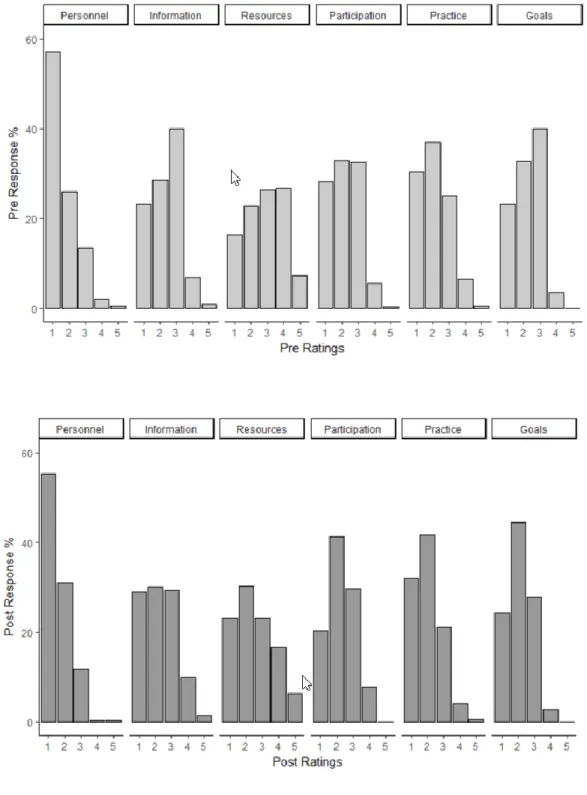
The combined mean score of all subscales for the pre- survey was 184.48 (sd = 36.27). This corresponds to a shared (173 - 345) governance classification (see Figure 4).
*data types of the columns: ctr: factor (i.e. categorical variable); dbl: double (numerical); chr: character (string) Figure 4. Response Comparisons-Pre-Survey by Subscale
Post-Survey Results
The combined mean score of all subscales for the post-survey was 176.22 (sd = 33.51). This corresponds to a shared (173 - 345) governance classification (see Figure 5).
*data types of the columns: ctr: factor (i.e. categorical variable); dbl: double (numerical); chr: character (string) Figure 5. Response Comparisons-Post-Survey by Subscale
Comparisons of Pre-Survey and Post-Survey
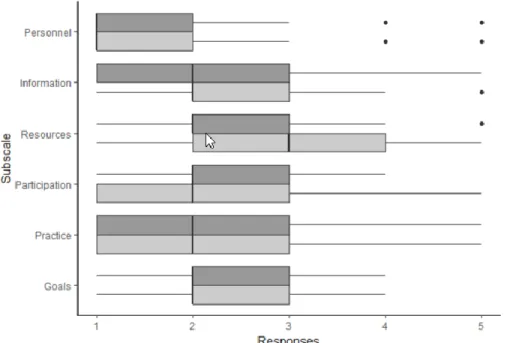
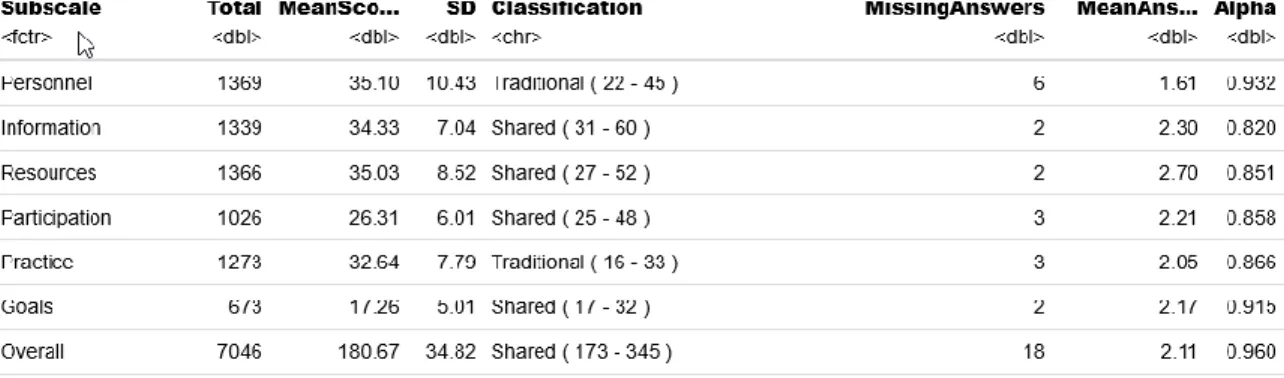
The mean score of both the survey and post-survey were compared. The pre-survey mean was 2.6 and the post-pre-survey mean was 2.06 for an overall mean score of 2.11 (see Figure 6). Although the overall mean 180.67 is categorized as shared governance, the Personnel (mean 35.10) and Practice (mean 32.4) subscales were categorized as traditional governance.
*data types of the columns: ctr: factor (i.e. categorical variable); dbl: double (numerical); chr: character (string) Figure 6. Response Comparisons - Overall Scores by Subscale
An ANOVA test was conducted to specifically examine the level of significance of the pre-survey and post-survey scores. The level of significance was set at p<0.05. The results of the ANOVA were p=0.0067. Based on the results there was a significant difference between the mean scores of the pre-survey and post-survey. Next, ANOVA tests were performed on each subset with a level significance set at p<0.05. For the subsets of Personnel (p=0.524), Information (p=0.279), Participation (p=0.309), Practice (p=0.174), and Goals (p=.0115) were not significant. However, the subset of Resources (p=0.002) was significant.
Summary
Overall, the initial hypothesis, which was that the management style of shared governance would increase following the implementation on the unit based shared governance council over a three-week implementation period was determined to be significant in the mean scores between the pre-survey and post-survey. Specifically, only the subset category of Resources demonstrated a significant change. The subsets of Personnel, Information, Participation, Practice, and Goals were identified as not having significant change. The results indicated the implementation of a unit based shared governance council maintained the leadership management style in the utilization of the Robert Hess’s shared governance model.
CHAPTER V DISCUSSION
The purpose of this project was to implement a unit-based governance council on two medical surgical units which share the same leadership team, staff, and with more than 85 employees which has endured high employee turnover using a shared governance leadership model. Prior to and after the implementation of the unit-based council, the study evaluated the nurse engagement related to the implementation of the unit based shared governance council. Following the implementation of the unit based shared governance council and the completion of the pre-survey and post-survey, data analysis began. A general comparison of the overall total scores and scores by each individual subset, based on the 5-point Likert IPNG survey were completed to determine if any change in scores was evident.
Implication of Findings
Based on the findings outlined in Chapter IV, there was significant change (p=0.0067) from the pre-survey to the post-survey scores. However, the post-survey mean score decreased from 184.48 to 176.22 but remained in the classification of shared governance. The subscale category of Resources had an increase in the mean score while the subscales of Personnel, Information, Participation, Practice, and Goals had a decrease in mean score. A pattern which was evident was the decrease in survey response time from 20.65 minutes to 12.53 minutes with an 8% decrease in response rate. Survey participants verbally expressed the IPNG Survey Tool was lengthy and time consuming.
The unit based shared governance council was well received by the staff and new processes were implemented. New initiatives implemented by the council focused on
patient safety, improving hourly rounding and bedside shift report, and improving communication on the unit. The council implemented a daily staff meeting. The daily staffing meeting was held on each of the two units, was led by the charge nurse at 10:30 am and 10:30 pm, and lasted less than five-minutes. All associates were required to attend and sign an attendance sheet. Each Monday the meeting information was shared until the following Monday; this ensured all staff members heard the same information. A member of the council was responsible for generating this meeting sheet printing it and providing a copy to the Charge Nurse by Monday morning. Meeting topics included acknowledging individual staff members for their teamwork, feedback received from patients and their peers. A daily list of high fall risk patients were discussed in the meeting and the patient room numbers were updated on a whiteboard located in the nurses station. In addition, high acuity patients were mentioned to assist in the staff being mindful of assisting on checking on the patient even if the patient was not part of their patient assignment.
Bedside shift report was improved as the council members reintroduced the use of the electronic documentation system to ensure the oncoming nurse understood the plan of care, any outstanding orders, and reviewing lab results during their change of shift.
The purpose of the hourly rounding log was to ensure a staff member was entering the room hourly to meet any of the patient’s needs. The nurse or certified
nursing assistant was required to sign the log hourly. The council obtained approval from the nurse manager to post a laminated sign above the hourly rounding log which stated, “Ask Me About This Form”. The council requested the sign be laminated and used to
prompt the conversation between the patient, staff, and family members to explain the purpose of the hourly rounding log to assist with compliance.
Application to Theoretical/Conceptual Framework
Kurt Lewin’s Management Theory offers a strategic approach in planning, implementing, and evaluating a proposed change. The framework on which the study was based on was Kurt Lewin’s Management Theory of Change by empowering nurses, nursing assistants, and unit secretaries to create change through the implementation of the shared governance council. The goal of the unit based shared governance council was to allow staff to recommend changes in practices and procedures upon approval from the nurse manager. Seven associates volunteered to participate in the council. Within Lewin’s unfreezing stage, individuals must acknowledge the need for change and the associates within the nursing unit did acknowledge this change with minimal resistance. Initially, resistance was met among the council members who attended council meetings on their day off or those associates who were scheduled to work the night of meeting as the council was held during the day. A suggestion was made to establish a set day and time the council would meet for the next 12 months and it would be placed in the unit’s scheduling calendar. This would ensure individuals had the flexibility to participate in the council and schedule themselves to work as they see appropriate. The nurse manager agreed if the associate works night shift they are not to be scheduled to work the previous night unless the associate schedules themself.
Limitations
The small sample size presented a potential limitation to the study as well as the length of the IPNG Survey Tool. Participants of the survey did express a burden to answering an 86 questions Likert Scale survey on two separate occasions. The response time to taking the 86-question survey dramatically decreased from 20.65 minutes to 12.53. In the post-survey, the participants were familiar with the survey questions since they were the same as the pre-survey but it the researcher’s opinion the participants may have not thoroughly read the questions as they previously stated the 86 questions was a burden.
During a three-week period, a pre-survey, post-survey, and implementation of the unit based shared governance council was implemented. The time constraints were a limitation of the study and it would be advantageous to re-administer the survey in a three, six, nine, and yearlong period so the unit-based council would have adequate time to propose and implement changes related to nurse engagement and the patient
experience.
Implications for Nursing
Unit based shared governance is important to nurse engagement and enhancing the patient experience. McDowell et al. (2010) examined the Wake Forest University Baptist Medical Center’s shared governance structure from 1996-2007 and his study found an improvement in patient care, improved employee satisfaction, increased nurse retention, and increased patient satisfaction.
The continuous evolution of the unit based shared governance structure with the organization being studied can ultimately result in better patient care, higher nurse
engagement leading to a decrease in employee turnover. According to Blegen et al. (2017) every registered nurse who resigns from a nursing unit costs the organization up to 1.3 times their salary to replace them. This study is significant to the current nursing profession for these two units as the council members are paving the way to learning how to hold one another accountable. The council will be meeting with the organization’s Patient Experience Officer to request assistance on how to approach difficult
conversation with their peers by holding them accountable for their work. Patient safety initiatives are being promoted by talking about high risk fall patients and any patients whom have fallen since admission. The continuity of this information is allowing the staff to become more aware of falls that are occuing on previous shifts. The council has drafted a proposal to the nurse manager to request staff interviews for nursing, nursing assistant, and unit secretary job candidates as they have voiced they would like to be involved in the interview process of who they will be working with daily. This in turn, will assist in increasing employee engagement.
Recommendations
Related to the small sample size and length of the survey tool, future
recommendations would be to conduct this study with a larger population of subjects with a less lengthy survey tool over a longer period of three weeks. To gain a better understanding of the utilization and perception of unit based shared governance, a future recommendation would be to conduct a study like this among several nursing units within the organization. If the implementation of unit based shared governance councils was incorporated over an extended period, all nursing within the organization to assist in
decreasing employee turnover and increasing nurse engagement scores. Positive changes from studies such as this could generate a new sense of employee engagement.
Conclusion
A primary focus for many hospital organizations is the retention of registered nurses by implementing employee engagement tactics. One tactic organizations are focusing on is the implementation of shared governance at the unit level. Shared governance is also now a key component of the Magnet® Recognition Program of the American Nurses Credentialing Center (Clavelle et al., 2013). Hospitals are
implementing unit-based governance councils which provide active participation by frontline staff in decision making for change. As defined by Havens and Vasey (2003), decisional involvement is “the pattern of distribution of authority for decisions and activities that govern nursing practice policy and the proactive environment” (pg. 332). The shared governance model was created from management and business studies which investigated how to improve employee engagement and decision making within the organization. For this study, by implementing a unit based shared governance council, positive results were obtained as the management classification remained in the shared governance category.
References
Aiken, L., Havens, D., Sloane, D., & Vomund, S. (2009). The Magnet® nursing services
recognition program: A comparison of two groups of Magnet® hospitals. Journal
of Nursing Administration, 39(7).
Ballard, N. (2010). Factors associated with success and breakdown of shared governance.
Journal of Nursing Administration, 40(10), 411-416.
Barden, A., Griffin, M., Donahue, M., & Fitzpatrick, J. (2011). Shared governance and
empowerment in registered nurses working in a hospital setting. Nursing
Administration Quarterly, 35(3), 212-218.
Blegen, M., Spector, N., Lynn, M., Barnsteiner, J., & Ulrich, B. (2017). Newly licensed RN retention: Hospital and nurse characteristics. Journal of Nursing
Administration, 47(10), 508.
Bozak, M. G. (2003). Using Lewin's force field analysis in implementing a nursing
information system. CIN: Computers, Informatics, Nursing, 21(2), 80-8.
Brandt, J., Edwards, D., Cox-Sullivan, S., & Zehler, J. (2012). Empowering
staff nurses through unit-level shared governance: The nurse executive's role for success. Nurse Leader, 10(4), 38.
Bretschneider, J., Eckhardt, I., Glenn-West, R., Green-Smolenski, J., & Richardson, C. (2010). Strengthening the voice of the clinical nurse: The design and
implementation of a shared governance model. Nursing Administration
Clavelle, J., O'Grady, T., & Drenkard, K. (2013). Structural empowerment and the
nursing practice environment in Magnet® organizations. Journal of Nursing
Administration, 43(11), 566.
Duncan, P., & Hunt, K. (2011). Strengthening nursing shared governance through
implementation of unit-based councils. Nurse Leader,9(5), 42-44.
Geoghegan, J., & Farrington A. (1995). Shared governance: Developing a British model.
British Journal of Nursing, 4 (13), 780-783.
Havens, D., & Vasey, J. (2003). Measuring staff nurse decisional involvement. Journal of Nursing Administration,33(6), 331-336.
Hess, R. (1998). Measuring nursing governance. Nursing Research, 47(1), 35-42.
Hess, R. (2011). Slicing and dicing shared governance in and around the numbers.
Nursing Administration Quarterly,25(3), 235-24.
Institute of Medicine. (2001). Crossing the quality chasm: A new health system for the 21st century. Washington, DC: The National Academies Press.
Kohn, L., Corrigan, J., & Donaldson, M. (1999). To Err is Human: Building a Safer Health System, Report by the Committee on Quality Health Care in America, IOM, National Academy Press, Washington, DC.
Kramer, M., & Schmalenberg, C, (2008). Essentials of a productive nurse work environment. Nursing Research, 57(1), 2.
Kutney-Lee, A., Germack, H., Hatfield, L., Kelly, S., Maguire, P., Dierkes, A., & Aiken, L. (2016). Nurse engagement in shared governance and patient and nurse
McClure, M., Poulin, M., Sovie, M., & Wandelt, M. A. (1983). Magnet® hospitals: Attraction and retention of professional nurses. Kansas City, MO: American Nurses Association.
McDowell, J., Williams, R., Kautz, D., Madden, P., Heilig, A., & Thompson, A. (2010).
Shared governance: 10 years later. Nursing Management, 41(7), 32-37.
Moore, S., & Wells, N. J. (2010). Staff nurses lead the way for improvement to
shared governance structure. The Journal of Nursing Administration, 40(11),
477-482.
Payne, S. (2013). The implementation of electronic clinical documentation using lewin's
change management theory. Canadian Journal of Nursing Informatics, 8(1-2).
Porter-O’Grady, T. (2001). Is shared governance still relevant? The Journal of Nursing
Administration, 31(10), 468-473.
Rheingans, J. I. (2012). The alchemy of shared governance: Turning steel (and sweat) into gold. Nurse Leader, 10(1), 40-42.
Robinson D., Perryman S., & Hayday S. (2004). The Drivers of Employee Engagement
Report 408, Institute for Employment Studies, UK.
Swihart, D. (2006). Introduction: The concept behind shared goverence. Shared
governance: A practical approach to reshaping professional nursing practice. (p. 2). Marblehead, MA: HCPro.
Watters, S. (2009). Shared leadership: Taking flight. The Journal of Nursing Administration, 39(1), 26-29.
Wessel, S. (2012). Impact of unit practice councils on culture and outcomes. Creative