• No results found

Extracting Business Intelligence from Social Networks

N/A
N/A
Protected

Academic year: 2021

Share "Extracting Business Intelligence from Social Networks"

Copied!
10
0
0

Loading.... (view fulltext now)

Full text

(1)

G00168222

Extracting Business Intelligence from Social

Networks

Published: 29 May 2009

Analyst(s): Carol Rozwell, Cassio Dreyfuss

The structure of a network emerges when connective actions are explored

and made explicit. This research presents a model for classifying social

networks and describes examples of how social network analysis (SNA) has

been used to determine the impact of these networks on business

performance.

Key Findings

Organization charts seldom reveal how work really gets accomplished.

An understanding of social networks is valuable today, but will become increasingly important

in business process analysis during the next three to five years.

In addition to telecom, banks and retail, insurance and consumer package goods companies

are candidates for SNA, as they have significant customer knowledge available to be mined.

Recommendations

Look beyond the organization chart to ascertain how work gets accomplished. Social network

analysis helps uncover the critical people in an organization, untapped or underutilized resources as well as the complexity and variability of job roles.

Examine relationships outside the organization's boundaries to ascertain how dependent it is on

the many external social networks it is connected to. Some of those connections are related to well-known business processes, but there are many other less visible or formal sources of social interaction.

When the desired results are not being achieved through business process analysis alone,

augment the analysis by using social network analysis. Business process analysis is useful for examining task-related work but might miss the intricacies of working relationships.

(2)

Analysis

Social Networks Vary by Purpose and Participation

Networks exist and are having an impact on performance in organizations of all shapes and sizes. Networks of customers and partners exist outside of a company's "four walls" that also exert an influence over the organization. However, what kind of impact is unknown without analysis. The structure of a network emerges when connective actions (such as conversations, e-mails and face-to-face encounters) are explored and made explicit. This research presents a model for classifying social networks and describes examples of how SNA (see Note 1) has been used to determine the impact of these networks on business performance. It will be of interest to professionals who want to expand their use of business intelligence and business process analysis to assess the impact of the "friending phenomenon" and foster collaboration.

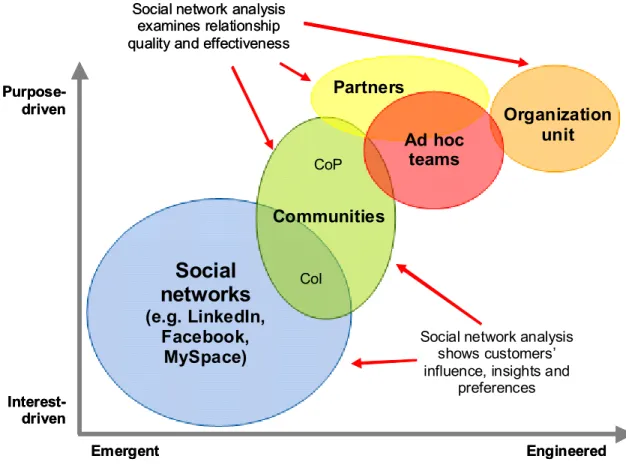
Figure 1 shows five types of networks where people engage with others on an ongoing basis. The types of networks are charted based on whether they are expected to produce specific results (purpose driven) or exist simply because of the interest of members (interest driven), and by the degree of emergence they exhibit. Social network analysis is useful for identifying relationships among people in all five types of networks.

(3)

Figure 1. Social Networks Vary by Purpose and Participation Purpose-driven Interest-driven Communities Organization unit Engineered Emergent CoP CoI

Social

networks

(e.g. LinkedIn, Facebook, MySpace) Social network analysis

examines relationship quality and effectiveness

Social network analysis shows customers’ influence, insights and

preferences Partners Ad hoc teams Purpose-driven Interest-driven Communities Organization unit Engineered Emergent CoP CoI

Social

networks

(e.g. LinkedIn, Facebook, MySpace) Social network analysis

examines relationship quality and effectiveness

Social network analysis shows customers’ influence, insights and

preferences Partners

Ad hoc teams

CoP = communities of practice, CoI = communities of interest

Source: Gartner (May 2009)

Traditionally, SNA has been employed by organizations that want to get a better understanding of relationship quality and effectiveness (see "Social Network Analysis: What A Difference an 'A' Makes" and "Value Network Analysis Highlights Tangible and Intangible Value Exchanges"). Data is collected surveying members of the network, examining the patterns in electronic communication and documents or both. The analysis can examine the interactions of individuals in the network (the traditional approach of organizational network analysis [ONA]) or of clusters of individuals

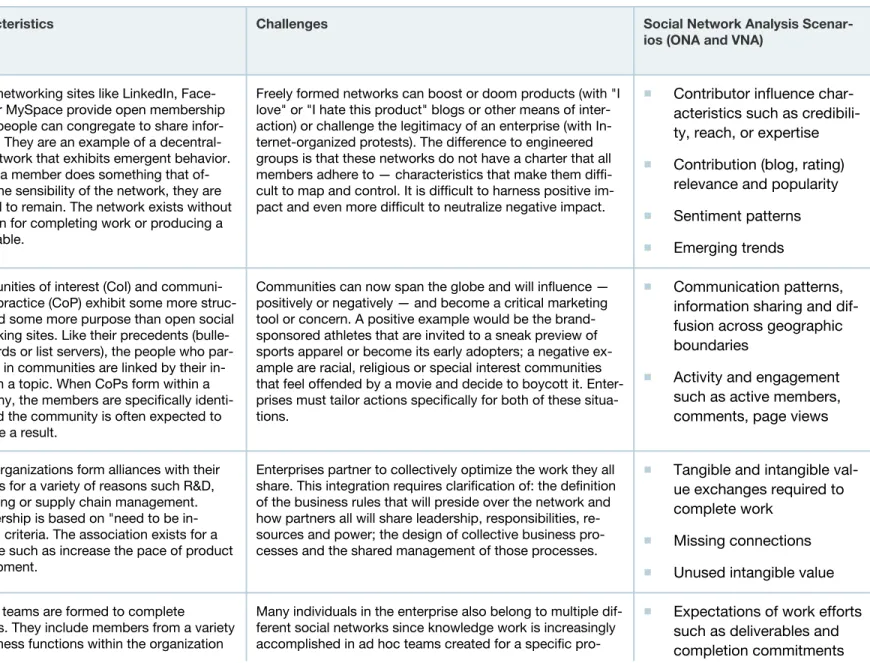
performing the same role (the traditional approach of value network analysis [VNA]). More recently, SNA has been used in media and marketing to explore how much influence a person has over their network. The data that exists in electronic records is collected and analyzed. Telecommunications is one of the industries that is starting to embrace SNA as a means to detect customer churn and to better target marketing spend. In addition to telecom, banks, retail, insurance and consumer package goods companies are candidates for SNA, because they have significant customer knowledge available to be mined. A description of the social network classifications and typical network analysis scenarios is presented in Table 1.

(4)

Table 1. Social Networks Classification and Analysis Scenarios

Social Network Type

Characteristics Challenges Social Network Analysis Scenar-ios (ONA and VNA)

Social network-ing sites

Social networking sites like LinkedIn, Face-book or MySpace provide open membership where people can congregate to share infor-mation. They are an example of a decentral-ized network that exhibits emergent behavior. Unless a member does something that of-fends the sensibility of the network, they are allowed to remain. The network exists without any plan for completing work or producing a deliverable.

Freely formed networks can boost or doom products (with "I love" or "I hate this product" blogs or other means of inter-action) or challenge the legitimacy of an enterprise (with In-ternet-organized protests). The difference to engineered groups is that these networks do not have a charter that all members adhere to — characteristics that make them diffi-cult to map and control. It is diffidiffi-cult to harness positive im-pact and even more difficult to neutralize negative imim-pact.

■ Contributor influence char-acteristics such as credibili-ty, reach, or expertise

■ Contribution (blog, rating) relevance and popularity

■ Sentiment patterns

■ Emerging trends

Commun-ities Communities of interest (CoI) and communi-ties of practice (CoP) exhibit some more struc-ture and some more purpose than open social networking sites. Like their precedents (bulle-tin boards or list servers), the people who par-ticipate in communities are linked by their in-terest in a topic. When CoPs form within a company, the members are specifically identi-fied and the community is often expected to produce a result.

Communities can now span the globe and will influence — positively or negatively — and become a critical marketing tool or concern. A positive example would be the brand-sponsored athletes that are invited to a sneak preview of sports apparel or become its early adopters; a negative ex-ample are racial, religious or special interest communities that feel offended by a movie and decide to boycott it. Enter-prises must tailor actions specifically for both of these situa-tions.

■ Communication patterns, information sharing and dif-fusion across geographic boundaries

■ Activity and engagement such as active members, comments, page views

Partner

networks Many organizations form alliances with theirpartners for a variety of reasons such R&D, marketing or supply chain management. Membership is based on "need to be in-volved" criteria. The association exists for a purpose such as increase the pace of product development.

Enterprises partner to collectively optimize the work they all share. This integration requires clarification of: the definition of the business rules that will preside over the network and how partners all will share leadership, responsibilities, re-sources and power; the design of collective business pro-cesses and the shared management of those propro-cesses.

■ Tangible and intangible val-ue exchanges required to complete work

■ Missing connections

■ Unused intangible value

Ah hoc

teams Ad hoc teams are formed to completeprojects. They include members from a variety of business functions within the organization

Many individuals in the enterprise also belong to multiple dif-ferent social networks since knowledge work is increasingly accomplished in ad hoc teams created for a specific

pro-■ Expectations of work efforts such as deliverables and completion commitments

(5)

and sometimes even customers or partners. Members of ad hoc teams may be selected for their expertise, availability or position.

pose and duration. This means that enterprises need to train workers in repertory skills so they can easily shift from as-signment to asas-signment.

■ Links to teams doing rela-ted work

Organiza-tional units

Organizational units are the most engineered type of social network. People are grouped in-to teams that have responsibility in-to completed tasks that will accomplish the stated business goals of the organization.

Most enterprises assign individuals to a hierarchical organi-zational unit for the purpose of completing work. For exam-ple, one person can belong to a local sales office, a regional sales team, the national sales operation. These are purpose-driven and highly engineered associations. In each of these, individuals affect the achievement of the enterprise's busi-ness objectives in different ways. To create a positive atti-tude toward business objectives the enterprise will address its various internal social networks with communication and organizational development programs.

■ Key players in organization-al effectiveness and infor-mation diffusion

■ Disconnected team mem-bers at risk

■ Underutilized resources

ONA = organization network analysis, VNA = value network analysis Source: Gartner (May 2009)

(6)

Social Network Analysis Complements Business Process Analysis

Organizations that want to execute their business operations more efficiently and effectively — that is, to save money by eliminating redundancy and waste — have multiple analysis methods at their disposal. In addition to business process analysis which highlights events, steps and transactions, both forms of social network analysis — organizational and value network analysis — delve into the relationships and value exchanges that occur while companies are performing routine business operations. It goes further than value chain analysis since both the players in the network and the value exchanges are identified and examined.

The methods complement each other. Organizations that have completed a detailed business process analysis (BPA), including the development of "as is" and "to be" process maps, have found that an ONA brings out the intricacies and variability of the roles of the people performing the work. Thus, by performing an ONA in addition to the BPA, they have achieved an additional measure of performance improvement. A value network analysis takes this exploration even further by

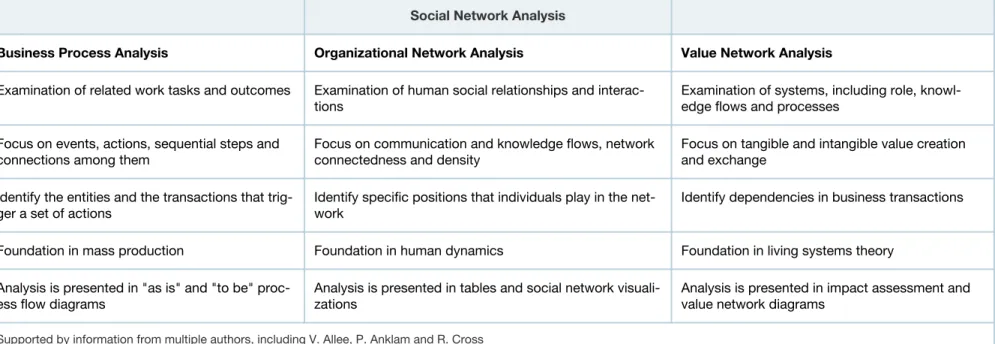
examining the tangible and intangible value exchanges among groups. As with ONA, it will provide visibility into knowledge flows, but among groups rather than individuals. A comparison of the analysis methods is presented in Table 2.

(7)

Table 2. Comparison of Analysis Methods

Social Network Analysis

Business Process Analysis Organizational Network Analysis Value Network Analysis

Examination of related work tasks and outcomes Examination of human social relationships and

interac-tions Examination of systems, including role, knowl-edge flows and processes Focus on events, actions, sequential steps and

connections among them Focus on communication and knowledge flows, networkconnectedness and density Focus on tangible and intangible value creationand exchange Identify the entities and the transactions that

trig-ger a set of actions Identify specific positions that individuals play in the net-work Identify dependencies in business transactions Foundation in mass production Foundation in human dynamics Foundation in living systems theory

Analysis is presented in "as is" and "to be"

proc-ess flow diagrams Analysis is presented in tables and social network visuali-zations Analysis is presented in impact assessment andvalue network diagrams

Supported by information from multiple authors, including V. Allee, P. Anklam and R. Cross Source: Gartner (May 2009)

(8)

Niche and Mainstream Vendors Offer Tools for Social Network Analysis

Technology that can be used to analyze social networks and visualize the social network graph have been available for many years. Pioneers in the SNA field have been joined by other newer entrants such as Trampoline Systems that can create detailed social network depictions using survey data or derive them from electronic artifacts such as e-mail and instant messaging (IM) (see "Cool Vendors in Collaboration and Social Software, 2008"). Valuenetworks.com can be used to explore role's workflows and processes of groups (see "Cool Vendors in Collaboration, 2009"). As interest in performing social network analyses grows, the distinction between ONA and VNA will lessen. Vendors will offer tools that will address both analysis needs.

More recently, a number of vendors have emerged that use swarm intelligence techniques to mine relationship information. Some vendors such as Galaxyadvisors offer general purpose products (see "Cool Vendors in Social Software, 2009") while others such as Grupo AIA and NeoMetrics offer products for specific industries (see "Social Network Analysis Is Proving a Useful Tool for Telecommunications Operators"). In addition, collaboration vendors such as IBM with Lotus Connections, Jive and Lithium have extended their products to include social networking analysis capabilities. Vendors such as Xobni and ClearContext are building SNA tools into their e-mail efficiency add ins.

Gartner expects that vendors of collaboration and social software tools will continue to build out their capability for analyzing social interactions of people who work together using social networks. Most will focus on providing the relatively straightforward measures of engagement such as

membership trends, percentage of active users, frequency of comments and ratings, and the like. These activity metrics provide useful data without revealing too much about network associations. However, as the ease of depicting individual relationships grows, Gartner expects increased resistance to revealing this information unless explicit permission is given. For this reason, the adoption of tools for social network analysis using individually identifiable data will not be widespread and will be targeted at specific situations where a better understanding of personal relationship dynamics is essential to business performance.

Recommended Reading

Forthcoming research: "Mapping Social Networks and Their Impact on the Enterprise's Business Objectives"

"Social Network Analysis: What A Difference an 'A' Makes"

"Value Network Analysis Highlights Tangible and Intangible Value Exchanges" "Five Case Study Examples of Social Network Analysis"

"The Gartner Collaboration and Social Software Vendor Guide, 2009" "Cool Vendors in Collaboration and Social Software, 2008"

(9)

"Cool Vendors in Social Software, 2009" Note 1 Examples of SNA

The report "Five Case Study Examples of Social Network Analysis," details examples of SNA. They are summarized here:

SNA In an IT Organization. Value: SNA reveals regional interaction patterns that were used to

more effectively design and manage a reorganization.

SNA In a Human Resources Organization. Value: SNA uncovers new sources of expertise in a

geographically dispersed organization.

SNA In an R&D Organization. Value: SNA will point out critical staffing requirements.

SNA In Biopharmaceutical Sales. Value: SNA highlights influential people for targeted sales

activities.

SNA In a Professional Services Firm. Value: SNA identifies overloaded workers and

information bottlenecks.

This research is part of a set of related research pieces. See Roundup of Business Intelligence and Information Management Research, 2Q09 for an overview.

(10)

Regional Headquarters

Corporate Headquarters

56 Top Gallant Road Stamford, CT 06902-7700 USA

+1 203 964 0096

Japan Headquarters

Gartner Japan Ltd.

Atago Green Hills MORI Tower 5F 2-5-1 Atago, Minato-ku Tokyo 105-6205 JAPAN + 81 3 6430 1800 European Headquarters Tamesis The Glanty Egham Surrey, TW20 9AW UNITED KINGDOM +44 1784 431611

Latin America Headquarters

Gartner do Brazil

Av. das Nações Unidas, 12551 9° andar—World Trade Center 04578-903—São Paulo SP BRAZIL

+55 11 3443 1509

Asia/Pacific Headquarters

Gartner Australasia Pty. Ltd. Level 9, 141 Walker Street North Sydney

New South Wales 2060 AUSTRALIA

+61 2 9459 4600

© 2009 Gartner, Inc. and/or its affiliates. All rights reserved. Gartner is a registered trademark of Gartner, Inc. or its affiliates. This publication may not be reproduced or distributed in any form without Gartner’s prior written permission. The information contained in this publication has been obtained from sources believed to be reliable. Gartner disclaims all warranties as to the accuracy, completeness or adequacy of such information and shall have no liability for errors, omissions or inadequacies in such information. This publication consists of the opinions of Gartner’s research organization and should not be construed as statements of fact. The opinions expressed herein are subject to change without notice. Although Gartner research may include a discussion of related legal issues, Gartner does not provide legal advice or services and its research should not be construed or used as such. Gartner is a public company, and its

shareholders may include firms and funds that have financial interests in entities covered in Gartner research. Gartner’s Board of Directors may include senior managers of these firms or funds. Gartner research is produced independently by its research organization without input or influence from these firms, funds or their managers. For further information on the independence and integrity of Gartner

Figure

Figure 1. Social Networks Vary by Purpose and Participation  Purpose-driven  Interest-driven Communities  Organization unit EngineeredEmergentCoPSocial CoInetworks(e.g
Table 1. Social Networks Classification and Analysis Scenarios Social
Table 2. Comparison of Analysis Methods

References

Related documents

•Methodology used by the French water basin agencies and mentioned in the European Water Framework Directive as a relevant system to determine a class of aptitude of the water

Unless otherwise provided, every person violating any of the provisions of this chapter shall be guilty of an offense and upon conviction shall be punished by imprisonment in the

because benefits and reserves under a fixed premium variable benefit policy depend not only on the actual investment performance o f the separate account but also on

Probe’s iPro™ monitoring systems provide life of well real-time data to enhance optimization and improved reservoir

One problem with the proposed algorithm is that the global polygon’s medial axes might not let us locally adjust certain regions with high area error (see, for example, Figure

Social value creation Traditional non-profit organization Non-profit with income- generating activities Traditional profit- maximizing business (Grameen) social business

This chapter introduces social marketing as a tool to in fl uence individual behavior and societal structure for the bene fi t of the individual and society, ethically using

“EXPLORING THE MODERATING EFFECT OF THE PERCEIVED FOOD ENVIRONMENT ON THE THEORY OF PLANNED BEHAVIOR AND FRUIT AND VEGETABLE CONSUMPTION IN OLDER ADULTS” .... “FOOD