Doctoral Projects Kirkhof College of Nursing
4-2019
Development of a Depression Screening Protocol
for At Risk Patients Based on the Adverse
Childhood Experience Questionnaire
Brittany J. TaylorGrand Valley State University
Follow this and additional works at:https://scholarworks.gvsu.edu/kcon_doctoralprojects Part of thePsychiatric and Mental Health Nursing Commons
This Project is brought to you for free and open access by the Kirkhof College of Nursing at ScholarWorks@GVSU. It has been accepted for inclusion in Doctoral Projects by an authorized administrator of ScholarWorks@GVSU. For more information, please [email protected].
Recommended Citation
Taylor, Brittany J., "Development of a Depression Screening Protocol for At Risk Patients Based on the Adverse Childhood Experience Questionnaire" (2019).Doctoral Projects. 78.
Development of a Depression Screening Protocol for At Risk Patients Based on the Adverse Childhood Experience Questionnaire
Brittany J. Taylor Kirkhof College of Nursing Grand Valley State University
Advisor: Dr. Dianne Slager DNP, FNP-BC
Advisory Team Members: Dr. Gwenden Dueker PhD, Iris ZinkMSN, RN, ANP-BC
Journal of Doctoral Nursing Practice
Title Page
Title:Development of a Depression Screening Protocol for At Risk Patients Based on the
Adverse Childhood Experience Questionnaire
Author Name and Academic Title: Brittany J. Taylor
Author Primary Affiliation: Grand Valley State University Kirkhof College of Nursing
Name: Brittany J. Taylor
Address: 9 Congress Ave SE, Grand Rapids MI, 49506
Email: [email protected]
Phone: (313)505-5133
Acknowledgements/credits: Grand Valley State University
Abstract
Background: Adverse childhood experiences (ACEs) are associated with increased risk for adult
depression. Utilization of the Patient Health Questionnaire Nine (PHQ-9), in combination with Diagnostic and Statistical Manual of Mental Disorders, 5th Edition (DSMV) criteria, aids in the diagnosis of comorbid depression and assessment of severity.
Objectives: To standardize the process of screening new adult patients at a specialty care clinic
for ACEs. Then, implement a depression screening protocol based on ACE criteria to identify adult patients with comorbid depression.
Methods: Demographic, ACE score, PHQ-9 score, and protocol implementation data collected
and analyzed by the Doctor of Nursing Practice (DNP) student during initial new patient visit, as well as subsequent visits (if applicable).
Results: Of the 105 patients, 104 (99%) were appropriately screened for ACEs, and if applicable
depression via the PHQ-9. Following protocol implementation, 15 patients were identified and diagnosed with comorbid depression with appropriate follow-up completed in 93%.
Conclusions: Depression screening in at risk patients demonstrating significant childhood
trauma leads to an increase in diagnosis comorbid depression.
Implications: Depression screening in adults, following assessment of childhood trauma via the
ACE questionnaire, aids in the identification of patients with comorbid depression.
Table of Contents
Abstract ... 3
Table of Contents ... 4
Development of a Depression Screening Protocol ... 5
Introduction ... 5
Feasibility Assessment of Organization ... 6
Methods ... 7 Ethical Consideration ... 10 Results ... 10 Discussion ... 12 Limitations ... 13 Conclusions... 14
Implications for Practice ... 14
Figures ... 15
Development of a Depression Screening Protocol for At Risk Patients Based on the Adverse Childhood Experience Questionnaire
Introduction
The association between adult depression and childhood trauma has been well researched and documented throughout literature (Cambron, Gringeri, & Vogel-Ferguson, 2015; Felitti et al., 1998; Kalmakis & Chandler, 2014;. Li, D’Arcy, & Meng, 2016; Mandelli, Petrelli, & Serretti, 2015; Manyema, Norris, & Richter, 2018; Patterson, Moniruzzaman, & Somers, 2014). One method of assessment for childhood trauma currently used in the organizational site is the Adverse Childhood Experience (ACE) Questionnaire. Ten experiences are assessed in the ACE Questionnaire including negative events related to childhood abuse, neglect, and household dysfunction (Felitti et al., 1998). Specific to the State of Michigan, as identified by the Michigan Behavior Risk Factor Surveillance System (MiBRFSS), 61.9% of adults aged 18 and older reported at least one ACE, while 15.2% scored at least a four on the adverse childhood
experience questionnaire (Surveillance Brief MiBRFSSSB, June 2016). Furthermore, Michigan adults with ACE score of four or greater were four times as likely to report comorbid depression compared to adults without history of adverse childhood experiences (MiBRFSSSB).
The providers at the organizational site have identified the importance of screening for childhood trauma in patients. However, no standardized interventions or follow-up is completed after assessment. The current practice of screening for ACEs within the specialty care setting without use of a standardized protocol following assessment may not be providing care that is based on current evidence. Consequently, patients with increased risk of depression, and with comorbid depression, are not being identified within the practice. As such, screening for depression through utilization of a standardized depression screening tool, the PHQ-9, could
allow specialty care providers the ability to gain a better understanding of the mental and emotional state of patients who have experienced childhood trauma (Mandelli et al., 2015; Mitchell, Yadegarfar, Gill, & Stubbs, 2016). This quality improvement project was completed using Kotter’s 8 Steps of Change Model (Kotter, 1995) and The Donabedian Model
(Donabedian, 1988).
Feasibility Assessment of Organization
A feasibility assessment represents a detailed analysis of an organizations ability to accept change. To assess feasibility, an organizational assessment as well as an assessment of organizational strengths, weaknesses, opportunities, and treats (SWOT) were completed prior to implementation.
The Burke-Litwin Model of Organizational Change
The Burke-Litwin Model is composed of 12 interconnected factors representing an open system approach to organizational change, where a change in one factor of the model results in a change in another (Burke & Litwin, 1992). The DNP student utilized this model to aid in
assessment of the organization, and identified multiple variables which support the proposed project, including, but not limited to, receptive organizational leadership, positive climate for change/organizational culture, and staff motivation. Within the clinic, these factors interact with each other to create an environment that welcomed and supported change.
SWOTAnalysis
Organizational strengths and weaknesses represent internal attributes impacting the organization, and organizational opportunities and threats represent external factors which drive organizational success or failure (Moran, Burson, & Conrad, 2016). Pertaining to the organization and phenomenon of interest, this information has the potential to significantly impact project
success. As an independent, privately-owned Nurse Practitioner (NP) led office, there are numerous internal strengths, weaknesses, opportunities, and threats which impact organizational success. These include provider and staff experience, office environment, and state and national policy.
Accordingly, an evidence-based project to answer the following clinical question was proposed and accepted; in patients that score greater than a four on the ACE questionnaire, did the implementation of a depression screening tool (the PHQ-9), and protocol to guide diagnosis of depression result in identification of specialty care patients at risk for, and with, comorbid depression. The purpose of this project was:
1. Development and implementation a standardized protocol for the screening and diagnosis of comorbid depression in patients with history of childhood trauma.
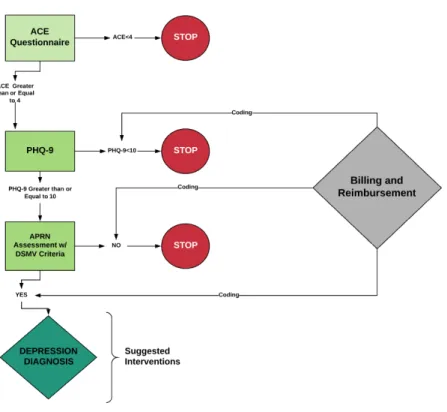
a. Depression screening protocol included PHQ-9 screening criteria based on ACE score. Following administration of PHQ-9, a score of 10 or greater prompted organizational staff to address depression risk with patients. If a depression
diagnosis was made based on screening and DSMV criteria, this protocol included suggested individualized interventions and follow-up based on patient
characteristics.
2. Determine and provide staff support related to education, screening implementation, and new EHR documentation process.
3. Completion of a six to eight-week pilot. Following pilot, data analysis, and staff
recommendations were assessed and protocol modifications were completed to promote protocol sustainability.
Intervention
Through use of Kotter’s Eight Step Change Model and The Donabedian Model, a depression screening protocol based on ACE score was implemented at a specialty care clinic that sees a high proportion of chronic pain patients (figure 4). The Donabedian Model is the theoretical model chosen by the DNP student to guide protocol implementation. The three core elements of the Donabedian Model, structure, process, and outcomes, were each used during initial project design to facilitate successes implementation. Additionally, the implementation model of choice, Kotter’s Eight Step Change Model, was thoroughly analyzed and utilized during both project design and implementation.
As identified by the protocol developed by the DNP student, all new adult patients with ACE score of 4 or greater were administered a PHQ-9 during initial new patient visit by the medical assistant (MA). Following administration, patients with PHQ-9 score of 10 or greater were flagged for assessment by the Advanced Practice Registered Nurse (APRN) for depression. Documentation within the EHR of both the ACE score and PHQ-9 (if applicable), and charted characteristics in all patients with PHQ-9 score of 10 or greater, including risk of depression, antidepressant use and indication, counseling status, and primary care role, were assessed. Additionally, International Coding of Disease Tenth Revision (ICD-10) coding of F32.9 (Depression, unspecified), F34.1 (Dysthymic Disorder), Z13.31 (Encounter for screening for depression), and Z13.89 (Encounter for screening for other disorder) were implemented to facilitate assessment and billing and reimbursement from insurance providers.
Approach
A quality improvement design was used to develop and implement a depression
prior to and after protocol implementation. Data analysis was completed with the assistance of the project committee.
Measures
Adverse Childhood Experience (ACE) Questionnaire.
The ACE Questionnaire represents a method of assessment for childhood trauma, including questions regarding negative events and experiences related to childhood abuse, neglect, and household dysfunction. The questionnaire utilized at the clinic in composed of 10 questions whereby the patient receives one point for each question that they answer yes to. Previous research reported the retrospective account of ACEs as good to excellent test-retest reliability (Murphy et al., 2014). Internal reliability was determined by Cronbach’s alpha (0.88) for the 10 questionnaire items (Murphy et al). Validity established though analysis of the association of ACEs with emotional support indicators (Murphy et al). ACE scores range from zero to ten, with higher scores associated with increased risk of health problems. Identified as the first step of the protocol, clinic patients with ACE score of 4 or greater were then administered a PHQ-9 depression screening tool to complete prior to APRN interaction.
Patient Health Questionnaire Nine (PHQ-9)
The PHQ-9 is a nine-item questionnaire used to guide both diagnostic and severity measures for depression (Kroenke & Spitzer, 2002). Use of this screening tool is based on a meta-analysis which reported on the accuracy of using the PHQ as an initial step in the assessment of depression in patients in the outpatient setting (Mitchell et al., 2016). Internal reliability was determined by Cronbach’s alpha, and ranged from 0.86 to 0.89. Criterion validity established and assessed by mental health professionals and construct validity established following assessment of functional status (Kroenke & Spitzer). A score of 10 or greater is both
88% sensitive and 88% specific for diagnosis of major depression. Defined by the DNP project protocol, depression screening tool was administered to patients with ACE score greater than 4.
Protocol Implementation
Accurate advancement through the depression screening protocol based on ACE score and if applicable, subsequent PHQ-9 score was tracked via EHR documentation.
Analysis
Project data was analyzed throughout the data collection period during weekly chart audits and summarized at the conclusion of the data collection period on March 19th, 2019. The DNP student utilized both quantitative and qualitative methods of data collection and analysis. Quantitative data included descriptive measures of protocol participants and protocol
implementation. Qualitative data included themes derived from staff interviews after the data collection period. Descriptive statistics were used to analyze each quantitative measure.
Ethical Consideration
Prior to project implementation, approval from the University Institutional Review Board (IRB) was received with determination that this project met criteria to be deemed Quality
Improvement (IRB determination letter available upon request). Additionally, IRB approval was not required by the organizational site; however, site approval was obtained. Project data was stored in a file dedicated to the DNP student’s project on a lockable computer housed in the APRNs office at the practice. The data was not transferred or removed off the organization computer without permission. The DNP student and project committee analyzed project data with end results summarized prior to presentation to organizational site and project defense.
Results
All practice change suggestions were implemented during the data collection period with the exception of consistent repeated PHQ-9 screening during follow-up visits. Tracked via EHR data, the depression diagnosis was assessed in 93% of patients during subsequent visits, however the PHQ-9 was not readministered. During the data collection period, 19 (18%) protocol
participants were male, and 86 (82%) participants were female. Participants age ranged from 15 to 89. The average age was 49 (M=49, SD=18.5).
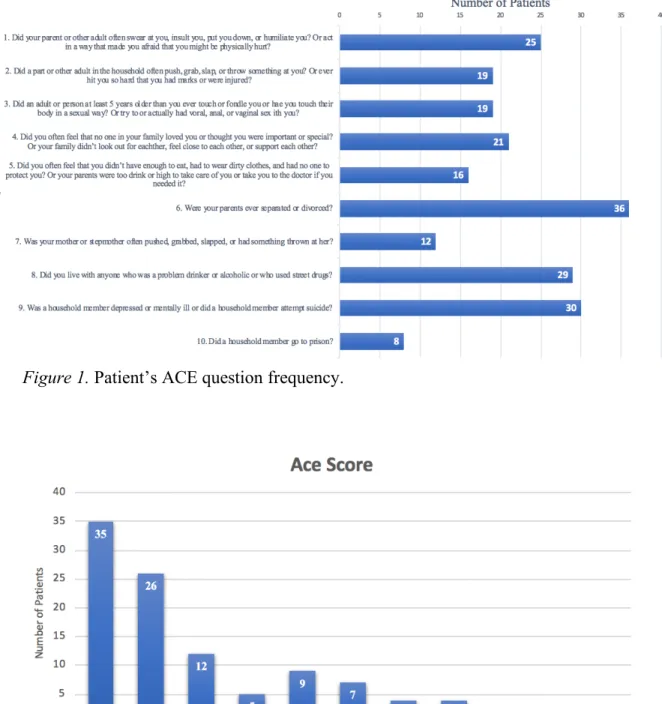
Average ACE score during the data collection period was two. ACE scores ranged from zero to nine (M= 2, SD=2.4). See figure one for description of ACE questions and frequency. In terms of specific questions, the most frequently scored question was number 6, with a response rate of 34.3% (36 participants). The least commonly scored question was question 10 (response rate of 7.6%, or 8 participants). See figure two for ACE question prevalence. Within the state of Michigan, research shows 26.6% of Michigan adults had a parent that was separated or divorced (MiBRGSSSB, 2016). Specific to the organizational site, the frequency of this question
answered was 34.3%.
Of the 105 participants, 31 (29%) patients met criteria for PHQ-9 administration following assessment for ACE score (figure 3). PHQ-9 scores ranged from zero to 27 (M=3, SD=6.42). 15 (14.3% of total pilot participants, and 48.4% of patients with ACE score 4 or greater) patients scored 10 or greater, prompting continued protocol progression. 15 patients had a PHQ-9 score of 10 or greater.
Protocol Implementation
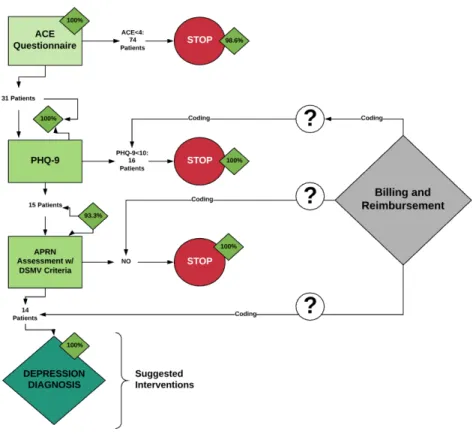
Overall, a total of 104 out of 105 (99%) protocol participants were appropriately screened for childhood trauma, and if applicable screened for depression via the PHQ-9 based on protocol criteria. See figure five for protocol implementation flowchart. In total, one patient was
inappropriately screened via PHQ-9 without meeting the required ACE score to continue through the protocol. Following protocol implementation, 15 patients were assessed for depression or dysthymia by the APRN including assessment for DSMV criteria, antidepressants use,
counseling status, ICD-10 coding, and follow-up during subsequent visits. Follow up assessment was completed for 93% of new patients diagnosed with depression during subsequent visits, without standardized administration of PHQ-9.
Following the data collection period, to assess implementation, the DNP student completed face-to-face interviews with five members of the organizational site. All five staff members verbalized the benefit of utilizing the tool within the practice and the need to continue the protocol for at risk patients. Furthermore, each staff member interviewed reported positive reactions from patients related to screening for depression.
Discussion
Overall, there was a substantial increase in patients screened and identified as at risk for depression following assessment for childhood trauma. Previously, no screening for depression was conducted at the clinic. After project implementation, all new patients who met ACE criteria were screened with PHQ-9. Furthermore, the appropriate diagnosis code was utilized on 93% of protocol participants, resulting in the potential for increased billing and reimbursement for the practice. Missing data discovered following the data collection period included PHQ-9 scores during subsequent visits
Within the specialty care setting, specifically rheumatology, due to comorbid chronic pain, patients are statistically at increased risk of depression (Heiman, Kravitz, & Wise, 2016; J.-X. Li, 2015). Additionally, as discussed throughout this document, data shows that increased ACE scores are associated with increased risk of depression and poor health outcomes in adults (Chang, Jiang, Mkandarwire, & Shen, 2019).
Future office policy changes and coding guidelines have the ability to impact successful sustainability. Currently, as a result of this project the organization has implemented PHQ-9 screening in all new patient with ACE score of 4 or greater. Additionally, there has been
discussion of screening all new patients with the PHQ-9 (regardless of ACE score) to assess risk of depression, as evidence supports screening. However, specific practice policy has not been confirmed.
Limitations
Various limitations were discovered throughout the course of project implementation. The overall design and scope of the project focused on one cohort of patients during initial office visit. Therefore, the design and scope of the project was limited in that it did not include
interventions related to management of depression, and reassessment following those
interventions. One new patient screened for depression was below the inclusion age of 18, and one patient screened for depression had an ACE score of zero. Following identification of this, discussions with staff occurred to increase sustainability.
Protocol criteria for PHQ-9 advancement was an ACE score of four. This number was based on provider preference. However, research has shown an ACE score of one is associated with increased risk of psychological distress in adulthood (Chapman et. al., 2004). As such, this screening protocol could have had the potential to identify additional patients at risk for, or with, comorbid depression.
Additionally, during the allotted time frame, this quality improvement project was unable to verify billing for depression screening for the 31 patients who met protocol criteria for PHQ-9 administration. Discussions with the clinic’s office manager about this issue are ongoing.
Appropriate coding, billing, and reimbursement for screening has the potential to promote sustainability within the practice.
Conclusions
Following project implementation, APRNs at the organization endorsed the benefit of depression screening within the specialty care setting. Per one provider, identification of comorbid depression lead to enhanced understanding of the patient’s mindset and an
understanding of how best to approach management of the specific health condition. Based on the positive response, office staff approved the continued use of the PHQ-9 in all new patient packets based on ACE Score. In the future, depression screening may be completed on all patients regardless of history of childhood trauma, however details have not been finalized.
The results of this project were unique to this setting and are not generalizable. Nonetheless, following successful project deference, dissemination of results may prove beneficial to similar specialty care settings. As such, presentation of this project will occur at various academic sites, as well as submission to ScholarWorks.
Implications for Practice and Further Study in the Field
Assessment for childhood trauma through use of the ACE score aids in the identification of patients at risk, and with, of depression. Screening for depression in the specialty care setting through use of the PHQ-9 aids in the diagnosis and assessment of severity in patients. Following PHQ-9 assessment, patient assessment and DSMV criteria, patients with comorbid depression can be identified within the specialty care setting. Future projects should include specific clinical interventions related to the management of depression within the specialty care setting as well as an assessment of patient satisfaction related to said interventions. Accordingly, a follow-up project related to management of depression within the specialty care setting has been suggested
to organizational staff.
Figures
Figure 1. Patient’s ACE question frequency.
Figure 3. Percentage of patients who met ACE score criteria. Protocol criteria for PHQ-9 administration = ACE score greater than or equal to 4.
Figure 4. Depression screening protocol developed by the DNP student to identify patients with
Figure 5. Assessment of execution of each stage of the implemented protocol including percentage of patients whom implementation was completed accurately based on DNP project criteria
References
Cambron, C., Gringeri, C., & Vogel-Ferguson, M. B. (2015). Adverse childhood experiences, depression and mental health barriers to work among low-income women. Social Work in
Public Health, 30(6), 504–515. https://doi.org/10.1080/19371918.2015.1073645
Chang, X., Jiang, X., Mkandarwire, T., & Shen, M. (2019). Associations between adverse childhood experiences and health outcomes in adults aged 18–59 years. PLOS ONE, 14(2), e0211850. https://doi.org/10.1371/journal.pone.0211850
Chapman, D., Whitfield, C., Felitti, V., Dube, S., Edwards, V., & Anda, R. (2004). Adverse childhood experiences and the risk of depressive disorders in adulthood. Journal of Affective Disorders, 82(2), 217–225. https://doi.org/10.1016/j.jad.2003.12.013
Cheong, E. V., Sinnott, C., Dahly, D., & Kearney, P. M. (2017). Adverse childhood experiences (ACEs) and later-life depression: perceived social support as a potential protective factor.
BMJ Open, 7(9), e013228. https://doi.org/10.1136/bmjopen-2016-013228
Donabedian, A. (1988). The quality of care: how can it be assessed? Journal of the American
Medical Association, 260(12), 1743–1748.
https://doi.org/10.1001/jama.1988.03410120089033
Felitti, V. J., Anda, R. F., Nordenberg, D., Williamson, D. F., Spitz, A. M., Edwards, V., Marks, J. S. (1998). Relationship of childhood abuse and household dysfunction to many of the leading causes of death in adults. American Journal of Preventive Medicine, 14(4), 245– 258. https://doi.org/10.1016/S0749-3797(98)00017-8
Heiman, E., Kravitz, R. L., & Wise, B. L. (2016). Rheumatologists’ approaches to diagnosis and treatment of depression. JCR: Journal of Clinical Rheumatology, 22(6), 307.
Kalmakis, K. A., & Chandler, G. E. (2014). Health consequences of adverse childhood experiences: A systematic review. Journal of the American Association of Nurse
Practitioners, 27(8), 457–465. https://doi.org/10.1002/2327-6924.12215
Kotter, J. P. (1995). Leading change: why transformation efforts fail. Boston, MA: Harvard Business School Press.
Kroenke, K., & Spitzer, R. L. (2002). The PHQ-9: A new depression diagnostic and severity measure. Psychiatric Annals, 32(9), 509–515. https://doi.org/10.3928/0048-5713-20020901-06
Li, J.-X. (2015). Pain and depression comorbidity: A preclinical perspective. Behavioural Brain
Research, 276, 92–98. https://doi.org/10.1016/j.bbr.2014.04.042
Li, M., D’Arcy, C., & Meng, X. (2016). Maltreatment in childhood substantially increases the risk of adult depression and anxiety in prospective cohort studies: systematic review, meta-analysis, and proportional attributable fractions. Psychological Medicine;
Cambridge, 46(4), 717–730. http://dx.doi.org/10.1017/S0033291715002743
Mandelli, L., Petrelli, C., & Serretti, A. (2015). The role of specific early trauma in adult depression: A meta-analysis of published literature. Childhood trauma and adult depression. European Psychiatry, 30(6), 665–680.
https://doi.org/10.1016/j.eurpsy.2015.04.007
Manyema, M., Norris, S. A., & Richter, L. M. (2018). Stress begets stress: the association of adverse childhood experiences with psychological distress in the presence of adult life stress. BMC Public Health, 18(1), 835. https://doi.org/10.1186/s12889-018-5767-0 MIBRFSS Surveillance Brief. (2016). Retrieved February 27, 2019, from
Vol9No2_FINAL_491078_7.pdf
Mitchell, A. J., Yadegarfar, M., Gill, J., & Stubbs, B. (2016). Case finding and screening clinical utility of the Patient Health Questionnaire (PHQ-9 and PHQ-2) for depression in primary care: A diagnostic meta-analysis of 40 studies. British Journal of Psych Open, 2(2), 127– 138. https://doi.org/10.1192/bjpo.bp.115.001685
Moriarty, A. S., Gilbody, S., McMillan, D., & Manea, L. (2015). Screening and case finding for major depressive disorder using the Patient Health Questionnaire (PHQ-9): A meta-analysis. General Hospital Psychiatry, 37(6), 567–576.
https://doi.org/10.1016/j.genhosppsych.2015.06.012
Murphy, A., Steele, M., Dube, S. R., Bate, J., Bonuck, K., Meissner, P., Steele, H. (2014). Adverse childhood experiences (ACEs) questionnaire and adult attachment interview (AAI): Implications for parent child relationships. Child Abuse & Neglect, 38(2), 224– 233. https://doi.org/10.1016/j.chiabu.2013.09.004
Patterson, M. L., Moniruzzaman, A., & Somers, J. M. (2014). Setting the stage for chronic health problems: cumulative childhood adversity among homeless adults with mental illness in Vancouver, British Columbia. BMC Public Health; London, 14, 350.