Knowledge Management in ERP Practice: the Paradox of Flexibility
Mark Govers
HOPE, University Maastricht
Maastricht, NL-6200 MD Maastricht, The Netherlands
Ingrid Mur-Veeman
HOPE, University Maastricht
Maastricht, NL-6200 MD Maastricht, The Netherlands
ABSTRACT
Modern organizations invest heavily in advanced enterprise information systems, like Resource Planning (ERP) systems, to improve their organizational flexibility. The comprehensiveness and complexity of such systems require advanced and specialized knowledge and skills, which are generally not sufficiently available in organizations. Therefore ERP experts are contracted as consultants. From Argyris’ theory of action it is known that what people intend to do, i.e. their espoused theory, is often different from what they actually do, i.e. their theory-in-use. The question is if this is also the case with ERP consultants and, if so, what are possible consequences for organizations hiring them? Despite its significance for organizations that hire ERP consultants to improve their flexibility with ERP systems, it has, yet, received little scientific attention. To answer these questions research data, collected in a PhD study on the relation between ERP computerization and the level of bureaucratization, was used. The research design adopted is influenced by the social constructivism and interpretative tradition of IT phenomena. The results revealed that ERP consultants concerning flexibility act differently compared with the in advance intended. Espoused it is assumed that ERP fits any organization and can be configured accordingly by which it also facilitates organizational flexibility; in their reality, however, the assumed fit is often impossible and needs to be turned around. It uncovers the phenomenon of skilled incompetence. ERP consultants use practiced routine behaviour (skills governed by a normative, technical isomorphism of the ERP community) to produce what they do not intend (incompetence to comply with client’s flexibility requirements). It actually implies that organizations in pursuit of organizational flexibility can end up with the opposite: a non-flexible ERP computerization. This puts a challenge to the ERP community’s knowledge management to actually get the espoused, i.e. intention to help organizations with organizational flexibility, actually into action.
Keywords: knowledge management, theory of action and learning, ERP systems, organizational flexibility, bureaucracy, skilled incompetence, isomorphism.
1. INTRODUCTION
Modern organizations are required to be flexible and agile, in order to adequately anticipate and react on the environmental dynamics [cf. 14, 15, 25, 33, 34]. For this they have to act rapidly and to control their information processing systems. As a result, they invest heavily in the development and
implementation of advanced information systems. Enterprise Resource Planning (ERP) is such a system. It aims to establish central and integrated control over all organizational processes by using a common data base with only one data entry point [9, 10, 12, 21]. Currently, ERP systems are widely used. Main reason for this is that they, according to Benders et al. [9], “refer to functional rational goals, such as increased efficiency in providing information and more effective decision making due to an improved insight in the state of affairs.” Increased efficiency and more effective decision making are indications of adaptive behaviour concerning goals, control, processes and information. In other words, they contribute to organizational flexibility [16, 33, 34] – also called business agility [28]. From an organizational point of view, ERP systems are demanding. By providing smooth, continuous and coherent information flows as well as end-to-end connectivity, they aim at various forms of integration (from integration of business processes to geographic integration of dispersed subsidiaries), at connecting functions and divisions and at coordinating and monitoring performance [9, 22, 30]. The comprehensiveness and complexity of ERP systems require advanced and specialized knowledge. Generally, this knowledge is not sufficiently available in organizations. Therefore the management contracts ERP experts on a temporary basis, to give advice on the organizational and technical aspects of the ERP system, which they plan to implement or have already implemented. To achieve the desired results, well-considered knowledge management by the consultants is needed, in the sense that thinking and acting should be in accordance. According to Argyris [5], however, this is not automatically true. The question is if this is also the case with ERP consultants and, if so, what are the possible consequences for the organization? To answer these questions we use research data, collected in a PhD study on the relation between ERP computerization and the level of bureaucratization [16].
2. THEORY
Theories on learning provide a firm basis for acquiring insight in knowledge management. Argyris and Schön’s [7] and Argyris’ [5] conceptualizations and theories on learning seem to be helpful in this respect, especially their ideas about single loop and double loop learning. Single loop learning occurs “(…) when matches are created or mismatches are corrected by changing actions. Double loop learning occurs when mismatches are corrected by first examining and altering the governing variables and then the actions.” [3, 5]. It can be said that organizational flexibility, which modern organizations so desperately need in the current dynamic environment, requires
double loop learning. Also (management) consultants involved in ERP systems implementation and management should be able to practice double loop learning. But how does this work in practice? To understand this, the theory of action approach as developed by Argyris and Schön [6] is helpful. According to this theory individuals design action to achieve results. Professional and skilful action reveals tacit knowledge (know-how), representing a theory of action. On this view, learning means to become able to produce the learning in action. This leads to distinguishing espoused theories, “those that an individual claims to follow” [5], referring to cognitions [18] from theories-in-use, as can be inferred from actual behavior. Individuals are aware of their espoused theories, but mostly unaware of their theories-in-use. The two are often inconsistent, especially when people feel embarrassed or threatened. In addition, Argyris [3] indicates that espoused theories can vary widely, while there are only a few variances in theories-in-use. Argyris and Schön [6, 8] picture two (maybe ideal) types that can be considered two opposite models as far as it concerns learning:
1. A ‘defensive’ theory, with a low freedom of choice and self sealing processes. The underlying behavioural strategy is unilateral control over others and inhibiting other persons’ learning and self-development (Model I). This model leads to low trust, low commitment and limited learning.
2. An ‘open’ theory, focusing on helping others to reflect on the world they create and to learn to change it in ways more congruent with the values and theories they espouse (Model II). Applying this model enables people to learn, even in difficult situations, and to act as agents of organizational learning. The latter model is often used as an espoused theory, but as a theory-in-use it is rare [5]. This means that people often say that they aim at promoting other persons’ self-development and learning (including giving valid information, permitting free and informed choice and supporting internal commitment), but that they act differently, i.e. more in accordance with model I, including focusing on established purposes and winning the game, suppressing feelings and/or cognitive intellective aspects of action. With these concepts in mind we can sharpen our central question into: “To what extent do ERP consultants have the ‘open’ model II as espoused theory to guide their cognitions, while they take the ‘defensive’ model I as theory-in-use to guide their actions and what are the consequences for the organization and ERP practice?”
The assumption is that ERP consultants during their training to become a professional informatics expert focus on best practices, including fixed rules of logic, which they finally incorporate in their working routines. In that case they will adopt the best practices as a self-evident norm to follow. They will not be able anymore to double loop learning, at least when acting (theory in use). But what about their espoused theory, in other words their tacit knowledge?
3. METHOD
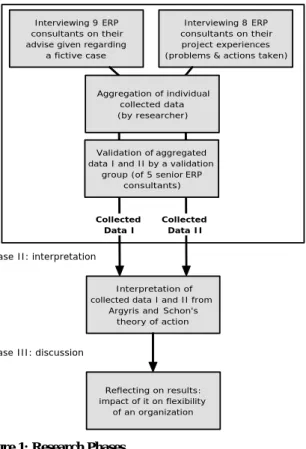
The research design adopted is influenced by the social constructivism and interpretative tradition of IT phenomena [23, 26, 27, 29, 35]. Figure 1 presents the research design in three phases: collected data, interpretation and discussion.
The two used data sets were gathered to provide insight in “the ERP theory of action”. Data set I was about providing insight
how ERP consultants think about ERP computerization to support an organization with its flexibility requirements, i.e. be able to timely adjust itself organizationally. For this nine ERP consultants were asked to give their professional advice on a fictive case. Data set II was about providing insight into their project experiences. Eight ERP consultants were asked to describe one of their memorable problems encountered in projects and the actions taken to solve these problems. All interviewed had consultancy experience of at least five years with one of the three major ERP systems, i.e. SAP, Baan or Oracle. The gathered individual interview data were aggregated by the researcher. To make sure that the aggregation represented the ERP practice reliably, face validity was used [11]. The data set was validated by a group of five ERP consultants with ERP consultancy experience of at least eight years. The validation step was not only necessary to minimize research bias, but also to minimize the bias of the interviewed ERP consultants.
Figure 1: Research Phases
The validated data sets are interpreted by the researchers from Argyris and Schon’s theory of action to distinguish the espoused from the theory-in-use of ERP consultants - as described in the theoretical section. Finally, we reflect on the meaning and impact of it for organizations which use or want to use ERP computerization - for which ERP consultants are required due to its complexity.
4. RESULTS
The research results are presented in three stages. We start with the validated interview results of the ERP consultants on their advice given to a fictive case (collected data I), to be followed with the validated interviews of the ERP consultants on their project experiences (collected data II); we end with an interpretation of the collected data from Argyris’ theory of action.
Interviewing 8 ERP consultants on their project experiences (problems & actions taken) Interviewing 9 ERP
consultants on their advise given regarding
a fictive case
Interpretation of collected data I and II from
Argyris and Schon's theory of action
Phase I: collected data
Phase II: interpretation
Aggregation of individual collected data (by researcher)
Validation of aggregated data I and II by a validation
group (of 5 senior ERP consultants)
Reflecting on results: impact of it on flexibility
of an organization
Phase III: discussion
Collected Data I
Collected Data II
Collected Data I
Aggregated the following two advices surfaced. All nine ERP experts claimed that with ERP computerization an organization can be modernized in terms of controllability as well as flexibility. Five justifications were given:
1. customization: ERP systems can be customized in various ways in terms of business processes (e.g. financial, logistical and sales), industries and organizational forms.
2. modular structure: ERP systems have a modular structure which gives organizations the opportunity to computerize the business processes in various stages. 3. development: ERP vendors contentiously extend ERP
suites with new functionality and technology.
4. modernization: ERP provides organization via so called ‘best practices’ with the latest and most modern business models.
5. leverage for organizational improvement: ERP is the informational synonym for a modern organization, and provides also the leverage to improve organizations to the level of ‘best practices’.
In addition two experts claimed that, regardless the first claim, modernizing of an organization can cause severe problems to an ERP computerization. Especially the requirements for organizational flexibility might be problematic. Two justifications were given:
6. adjustability: Once started with the customization process, it is not that simple and obvious to change, to turnaround certain parts of the already finished customization. It can trigger a partial or even complete re-customization process.
7. standardization: If flexibility requires that several business models need to be customized in an organization, it can increase the complexity of the ERP computerization. It can negatively impact the manageability of the ERP computerization, especially the implementation phase.
Furthermore, it became clear what the interviewed ERP consultants mean with flexibility. Flexibility is seen as the customization capabilities of ERP. An ERP system can be customized in various ways, and this provides organizations with flexibility. In addition flexibility is also comprehended in operational terms. It means that an operational ERP system provides organizations with accurate, integrated and timely information which allows them to analyze, even predicted, the consequence of management actions. It provides organizations with means to increase their sensitivity for internal and external changes.
Collected Data II
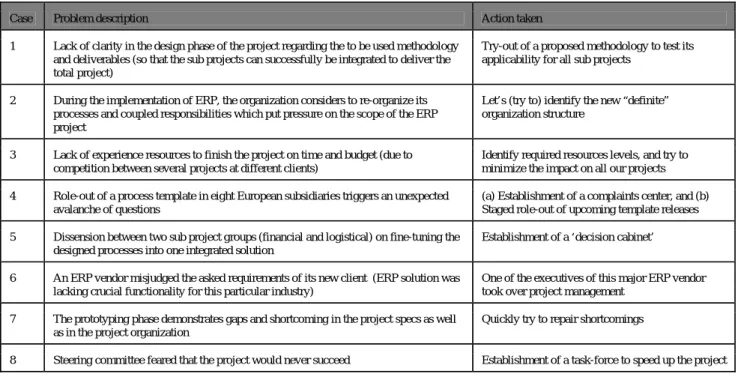
Table 1 briefly summarizes for each of the eight ERP consultants one of their most notable projects in terms of problems encountered and actions taken. The cases accord with two underlying but conflicting types of actions: directive (cases 5, 6, 7 and 8) and interactive (cases 1, 2, 3 and 4). All interviewed agreed that directive or interactive actions were required due to non-fully compliance with related industry ERP best practices. Directive actions were taken to re-ensure the progress of the project in order to deliver the computerization within the agreed time and budget framework. It was assumed that directive actions are successful for one of the following
reasons. The less people are involved in the decision process, the faster decisions will be made. Some can decide for many because they can oversee the total impact of decisions. Made decisions must, will and can be executed. And, made decisions will improve progress of the project. Interactive actions were taken to re-ensure the relations between the various stakeholders in order to meet their expectations and deliver an acceptable computerization. It was assumed that interactive actions are successful for one of the following reasons. Managing and fine-tuning relations asks for mutual communication. The more stakeholders are involved in the decision process, the more significant issues can be taken into account resulting in more profound decisions. Participation in the decision leads to more enthusiastic execution of decisions. And, computerization decisions are not limited to technological issues only; it also has social impact which needs to be taken into account too.
Interpretation
From Argyris’ theory in action, the collected data sets I and II can be interpreted from two perspectives. The first perspective concerns data set I and is about the espoused theory the ERP professionals interviewed hold on ERP’s abilities. They defined flexibility as ERP’s ability to be configured in any organizational setting, and as ERP’s operational ability to signal and to predict fluctuations from various viewpoints, like logistics, sales, and finance. Both the configuration and the operational interpretation contemplate flexibility as an ability to be injected into organizations by technology. It grounds on the following. They stated that various requirements can be complied with the countless configuration possibilities of ERP, regardless the organizational nature and context. ERP can be configured on request in an operational status successfully, with the assistance of the available best practices for customization and implementation. Therefore, an organization can organize and computerize requested business, information, and management models in a flexible, timely and modern way. The configuration ability of ERP should therefore offer organizations also the means to timely adjust ERP whenever changes are required. Timely and requested customization and adjustment should be possible because best practices contain state of the art solutions for (1) various business functions, e.g. logistics, sales, and finance, and (2) for implementation issues. Grounded on these abilities, they believe that ERP offers any organization the means to be or to become flexible.
The project realities of the ERP professionals interviewed showed, nevertheless, a different situation (data set II). It introduces the second interpretation concerning their theory-in-use which significantly differed from their espotheory-in-used theory. The assumed conditions for the diffusion of ERP, laid down in best practices, often did not occur in their actual consultancy reality. Usually they started ERP projects to comply as much as possible with the requirements of organizations - as agreed upon in project contracts; it is regarded as a professional code and as a market necessity for their consultancies. As in all projects, problems occur during the implementation or adjustment process of ERP. Looking more closely to the problem solving used, the following theory-in-use becomes apparent.
Whenever the progress of the project required improvement, they preferably used directive actions aiming towards time and budget issues; the acceptance of the stakeholders on project decisions were (or: became) more or less underexposed. Whenever the acceptance of the stakeholders on project decisions required improvement, they preferably used interactive actions aiming towards communication and relation issues; time and budget issues were (or: became) more or less underexposed.
Table 1: short description of the projects cases
Case Problem description Action taken
1 Lack of clarity in the design phase of the project regarding the to be used methodology and deliverables (so that the sub projects can successfully be integrated to deliver the total project)
Try-out of a proposed methodology to test its applicability for all sub projects
2 During the implementation of ERP, the organization considers to re-organize its processes and coupled responsibilities which put pressure on the scope of the ERP project
Let’s (try to) identify the new “definite” organization structure
3 Lack of experience resources to finish the project on time and budget (due to competition between several projects at different clients)
Identify required resources levels, and try to minimize the impact on all our projects 4 Role-out of a process template in eight European subsidiaries triggers an unexpected
avalanche of questions
(a) Establishment of a complaints center, and (b) Staged role-out of upcoming template releases 5 Dissension between two sub project groups (financial and logistical) on fine-tuning the
designed processes into one integrated solution
Establishment of a ‘decision cabinet’
6 An ERP vendor misjudged the asked requirements of its new client (ERP solution was lacking crucial functionality for this particular industry)
One of the executives of this major ERP vendor took over project management
7 The prototyping phase demonstrates gaps and shortcoming in the project specs as well as in the project organization
Quickly try to repair shortcomings
8 Steering committee feared that the project would never succeed Establishment of a task-force to speed up the project
Both directive and interactive actions focused primarily on one set of necessary conditions to comply successfully with project targets as agreed in the project contract: time and budget on the one hand, and acceptance on the other hand. ERP professionals stated that they have to alternate attention to these issues during the project. Whenever the project tension between these issues remained, which often occurred, they tried more strictly to stick to and comply with ERP’s best practices for (1) business, information, and management models, and (2) for project management. This “sticking” mostly turned out in implementing – preferably - one uniformed standard in which a complete organizational setting was computerized. Notwithstanding encountered implementation problems, they believe that their theory-in-use ensured a successful diffusion of ERP anyway as long as organizations, regardless the actual requirements, were willing to adapt to the uniformed standard. In other words, it revealed a gap between their espoused theory and their theory-in-use; a gap which asks for an account.
4. DISCUSSION
Whenever an organization decides to use or to adjust an existing ERP system, it requires ERP consultants due to the complexity and comprehensiveness of ERP systems. Consultants espouse that ERP offers viable solutions which also include flexibility requirements client organizations may have. During the actual realization of the ERP computerization, however, outcomes are mostly brought in-line with best practices embedded in ERP standards - even if clients require different solutions. Davenport [12] describes it as “putting the organization into the system”; Benders et al. [9] talk about “sticking to standards”. DiMaggio and Powell [13] explain in their influential article “The Iron Cage Revisited” such conducts with the concept of isomorphism: the phenomenon that practices are quite similar across organizations and professions. They argue that various pressures induce organizations and professionals to become and to behave similarly. Especially normative isomorphism can be conceived of as the collective struggle of members of an occupation to define the conditions and methods of their work,
to control their own educational programs and to establish a cognitive base and legitimating for their occupational autonomy. DiMaggio and Powell mention two aspects of professionalization as important sources of normative isomorphism. First, professionals control their own educational programs and second, they build large professional networks that span many organizations and are also a vehicle for rapid diffusion of new models. In the case of ERP consultancy the same professionals, with similar knowledge and standardized rules and programs are filtered out to help organizations to implement and manage ERP computerization. More precisely, it means that the conduct of ERP consultants is normatively regulated by ERP embedded standards for content, i.e. business processes, and for project management, i.e. how to implement the system. Benders et al. [9] accentuate DiMaggio and Powell’s normative isomorphism towards a technical one, because the regulation is not only enforced by and can not only be related to one particular type of ERP professional, like a business consultant, but it results from complex interactions between various professionals related to the ERP community, like technical consultants, business consultants and software designers.
Together with frequently failing outcomes of ERP projects [1, 9, 13, 20], i.e. outcomes are not always in-line with the actual requirements of client organizations, it uncovers what Argyris [4, 5] defines as skilled incompetence. ERP consultants use practiced routine behavior (skills governed by ERP embedded standards) to produce what they do not intend (incompetence to comply with clients’ requirements). Skilled incompetence puts forward its impact on the flexibility client organizations are in pursuit of with ERP computerization. As long as the flexibility requirements are embedded in the ERP standard, client organizations seem not to be affected by skilled incompetence. However, the results also reveal the concept ERP consultants hold for flexibility. As described, they see flexibility as a technical and an operational capability, but not as an organizational one. As Volberda [33, 34], Govers [17] and Van Oosterhout et al.[28] state, organizations are more and more in
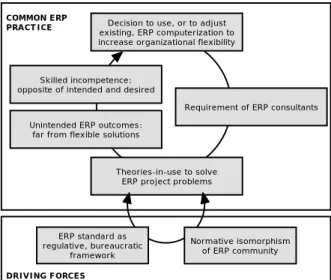
need of organizational flexibility in order to timely adjust their organized process, control and information models. ERP, on the other hand, not only fixates process, control and information models [19], it also ‘forces’ to use the system in one uniformed way throughout the whole organization to guarantee effective exploitation. In this way, the ERP objectives regarding improved coordination, connection and integration are considered to be served best. This may even result in wriggling the organizational structure and culture into the regulative framework of the ERP system; a framework closely linked with functional, centralized integration [19, 16] which Mintzberg [24] organizationally labels as bureaucratic. It actually implies that ERP consultants with the intention to facilitate organizations in their pursuit of organizational flexibility feel the pressure to move their clients toward the opposite to comply with the governing norms of their profession and community. With it they unintendedly cause, so to speak, a vicious circle. By addressing flexibility requirements with misaligned practices, client organizations end up with non-flexible ERP computerization. Figure 2 shows this phenomenon which seems to accentuate the vicious circle of bureaucracy [2, 31, 32] applied to ERP computerization. The impact of this paradox of flexibility for the ERP community is self-evident too. To facilitate client organizations with flexibility requirements, it must consider changing its knowledge management with the purpose of harmonizing the espoused with the actual theories-in-use. Without it, it remains nearly impossible to fulfil their intention of helping client organizations with flexibility.
Decision to use, or to adjust existing, ERP computerization to increase organizational flexibility COMMON ERP
PRACTICE
DRIVING FORCES
Requirement of ERP consultants
Theories-in-use to solve ERP project problems Unintended ERP outcomes:
far from flexible solutions Skilled incompetence: opposite of intended and desired
ERP standard as regulative, bureaucratic
framework
Normative isomorphism of ERP community
Figure 2: Driving Forces of Common ERP Practice
5. CONCLUSION
In conclusion we may say, that ERP consultants concerning flexibility act differently compared with the in advance intended. Espoused it is assumed that ERP fits any organization and can be configured accordingly by which it also facilitates organizational flexibility; in their reality, however, the assumed fit is often impossible and needs to be turned around. It actually means that ERP consultants are subtly forcing organizations to adapt themselves as much as possible towards ERP best practices, otherwise successful diffusion of ERP is jeopardized. Client organizations are unintended pushed toward more bureaucratic functioning and pulled away from flexibility as originally desired. It is, nevertheless, believed that this will have no major impact on the flexibility of an organization; it is also
believed that organizational flexibility is actually facilitated and created by it, because the ERP grounds on a modern, flexible view on organizing and computerizing organizations. It puts a challenge to the ERP community’s knowledge management to actually get the espoused into action.
6. REFERENCES
[1] M. Al-Mashari, M. and A. Al-Mudimigh, “ERP implementation: lessons from a case study”, Information Technology & People 16 (1), 2003, pp. 21-33.
[2] P. van Amelsvoort,The Design of Work and Organisation: the Modern Sociotechnical Systems approach An overview of the
Dutch sociotechnical systems theory, Vlijmen, 2000.
[3] C. Argyris, Reasoning, Learning, and Action, Jossey-Bass, San Francisco (CA). 1982.
[4] C. Argyris, “Skilled Incompetence”, Harvard Business Review (1. Sept.), 1986, pp. 74-79.
[5] C. Argyris, On Organizational Learning, 2nd ed., Backwell Publishing, Malden (MA), 1999.
[6] C. Argyris and D.A Schon, Theory in Practice, Addison-Wesley, Reading (MA), 1974.
[7] C. Argyris and D.A Schon, Organizational Learning, Addison-Wesley, Reading (MA), 1978.
[8] C. Argyris and D.A Schon, Organizational learning II, Addison-Wesley, Reading (MA), 1996.
[9] J. Benders, J. Batenburg and R. van der Blonk, “Sticking to Standards; Technical and other Isomorphic Pressures in Deploying ERP-systems”, Information & Management 43, 2006, pp. 194-203.
[10] P. Bingi, M. Sharma and J. Godla, “Critical issues affecting an ERP implementation”, Information Systems Management 16 (3), 1999, pp. 7-14.
[11] J.W. Creswell, Research Design: Qualitative, Quantitative, and
Mixed Methods Approaches, 2nd ed., Sage Publications,
Thousand Oaks (CA), 2003.
[12] T.H. Davenport, “Putting the enterprise into the enterprise system”, Harvard Business Review 76 (4), 1998, pp. 121-131. [13] P.J. DiMaggio and W.W. Powell, “The iron cage revisited;
institutional isomorphism and collective rationality in organizational fields”, American Sociological Review 48 (1), 1983, pp.147-160.
[14] J.R. Galbraith, Designing complex organizations, Addison-Wesley, Reading (MA), 1973.
[15] J.R. Galbraith, Organization Design, Addison-Wesley, Reading (MA), 1977.
[16] M.J.G. Govers, Met ERP-systemen op weg naar moderne
bureaucratieën?, PhD study, Radboud University Nijmegen,
2003. Setting out for modern bureaucracies with ERP systems?) [17] M.J.G. Govers, “ERP-software ondermijnt organisatorische
flexibiliteit”, Automatisering Gids 10, 2006, p. 17. (ERP software undermines organisational flexibility)
[18] L. Hoogerwerf, Opnieuw leren organiseren: sociotechniek in
actietheoretisch perspectief, PhD Study, Nijmegen, 1998.
(Learning to organize again: socio technology from an action-theoretical perspective)
[19] J. Kallinikos, “Deconstructing information packages. Organizational and behavioural implications of ERP systems”,
Information Technology & People 17 (1), 2004, pp. 8-30.
[20] Y.Z. Kim, Z. Lee and S. Gosain, “Impediments to successful ERP implementation process”, Business Process Management 11(2), 2005, pp. 158-170.
[21] H.H. Klaus, M. Rosemann and G.G. Gable, “What is ERP?”,
Inform Syst Front 2 (2), 2000, pp. 141-162.
[22] S. Laughlin, “An ERP game plan”, Journal of Business Strategy 20 (1), 1999, pp. 32-37.
[23] J.K. Liker, C.J. Haddad and J. Karlin, “Perspectives on Technology and Work Organization”, Annual Review of Sociology, 25 (1), 1999, pp. 575-596.
[24] H. Mintzberg, Structure in Fives: designing effective organizations, Printice Hall, Englewood Cliffs (NJ), 1983. [25] G. Morgan, Images of Organization, Sage, London, 1986. [26] W. Orlikowski, “The Duality of Technology: Rethinking the
Concept of Technology in Organisations”, Organisation Science 3, 1992, pp. 398-427.
[27] W. Orlikowski and S.R. Barley, “Technology and Institutions: What Can Research on Information Technology and Research on Organizations Learn From Each Other?”, MIS Quarterly, 25 (2), 2002, pp. 145-165.
[28] M. van Oosterhout, M. Waarts and J. van Hillegersberg, “Change factors requiring agility and implications for IT”, EJIS 15, 2006, pp. 132-145.
[29] T.J. Pinch and W.E. Bijker, “The Social Construction of Facts and Artifacts: Or How the Sociology of Science and the Sociology of Technology Might Benefit Each Other”, in: W.E. Bijker, T.P. Hughes and T.J. Pinch (eds.) The Social Construction of
Technological Systems, (Cambridge: MIT), 1992.
[30] P. Rajagopal, “An innovation-diffusion view of implementation of enterprise resources planning (ERP) systems and development of a
research model”, Information Management 40 (2), 2003, pp. 87-114.
[31] H.A. Simon, The Sciences of the Artificial, MIT, 1969. [32] L.U. de Sitter, Op weg naar nieuwe fabrieken en kantoren,
Deventer, 1982. (Towards new factories and offices.) [33] H.W. Volberda, De flexibele onderneming: strategieën voor
succesvol concurreren, Kluwer, Deventer, 2004. (The flexible
venture: strategy for successful competing)
[34] H.M. Volberda, “Building flexible organizations for fast-moving markets”, Long Range Planning 30 (2), 1997, pp. 169-183. [35]R. Williams and D. Edge, “The Social Shaping of technology”,