Built Environment Brassersplein 2 2612 CT Delft P.O. Box 5050 2600 GB Delft The Netherlands www.tno.nl T +31 88 866 70 00 F +31 88 866 70 57 [email protected] TNO report TNO 2012 R11277
Making User Created News Work
Date 27 December 2012
Author(s) Jop Esmeijer, Ottilie Nieuwenhuis, Carolien Mijs, Corné Versloot (TNO), Natali Helberger, Bart van der Sloot, Tarlach McGonagle (IViR)
Copy no No. of copies
Number of pages 130 (incl. appendices) Number of
appendices Sponsor
Project name Making User Generated News Work Project number 055.01288
All rights reserved.
No part of this publication may be reproduced and/or published by print, photoprint, microfilm or any other means without the previous written consent of TNO.
In case this report was drafted on instructions, the rights and obligations of contracting parties are subject to either the General Terms and Conditions for commissions to TNO, or the relevant agreement concluded between the contracting parties. Submitting the report for inspection to parties who have a direct interest is permitted.
Summary
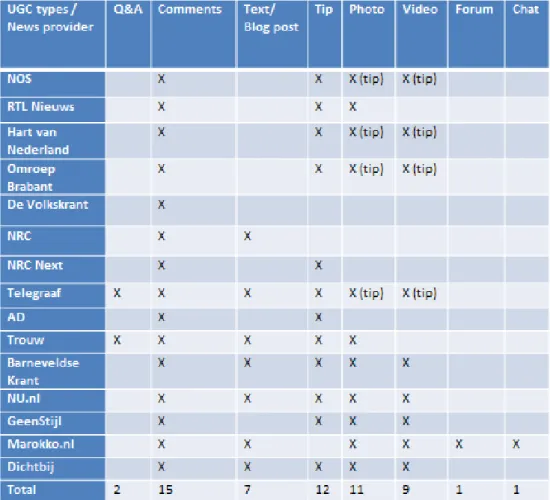
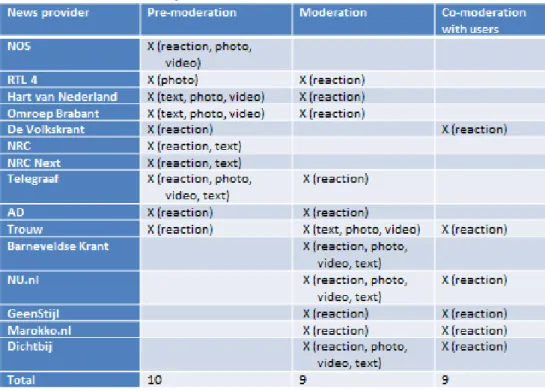
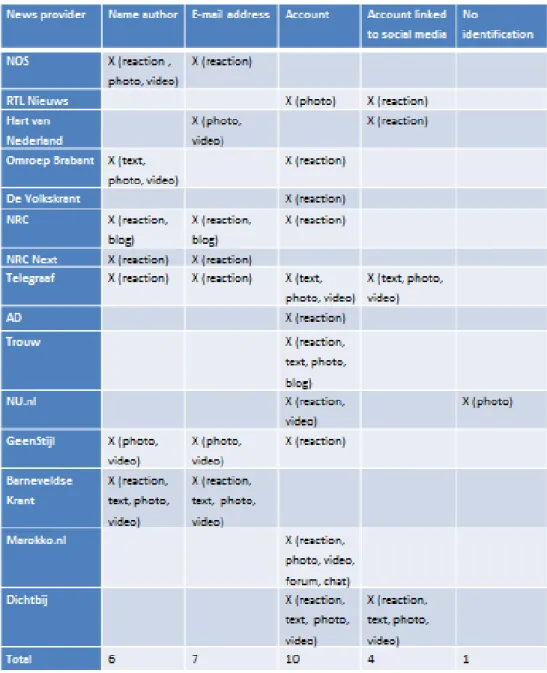
Voor de pers bieden user generated content (UGC) en gebruikersparticipatie kansen in een tijd waarin ze ‘meer met minder’ moeten doen omdat zowel reclame- als abonnementsinkomsten dalen en redacties krimpen. Alle vijftien Nederlandse nieuwsaanbieders die in het kader van deze studie zijn geanalyseerd bleken dan ook lage tot middelmatige participatievormen, zoals het geven van reacties, te faciliteren. Bij ongeveer de helft van de aanbieders was het mogelijk om een artikelen en video’s te uploaden en bij tien aanbieders kan men ook foto’s aanleveren. De waarde die aan UGC en gebruikersparticipatie wordt toegekend, kent drie kernelementen: 1) het levert content op van nieuwsgebeurtenissen die de redactie zelf niet, of niet zo snel had kunnen produceren of verkrijgen, 2) het versterkt de band tussen de nieuwsaanbieder en de community die het bedient, en 3) het kan een aanvulling zijn op het eigen journalistieke product door aanvullingen, verbeteringen of nieuwe ideeën.
Het gebruik van UGC en het benutten van gebruikersparticipatie is echter nog geen eenduidige succes gebleken. Behalve de voordelen zijn er ook de nodige
problemen waar redacties in de praktijk mee te maken hebben. Deze hebben zowel betrekking op de content als op het productieproces. Het grootste probleem komt voort uit de enorme diversiteit in kwaliteit van UGC die soms hoog is, maar ook veel vaker niet voldoet aan professionele standaarden. Omdat nieuwsaanbieders hun reputatie als kwaliteitsmedium moeten bewaken, betekent dit dat er erg veel tijd gaat zitten in het modereren van de UGC, wat weer erg kostbaar is. Daarnaast hebben nieuwsaanbieders te maken met juridische aspecten. Zo spelen er
belangrijke vragen met betrekking tot de verantwoordelijkheid en aansprakelijkheid van nieuwsaanbieders voor content van gebruikers die op hun website geplaatst wordt. Dit zorgt voor lastige een afweging tussen dat wat UGC en
gebruikersparticipatie op kan leveren, en wat het kost.
Wat zijn de belangrijkste strategieën die worden ingezet om gebruik te maken van UGC en gebruikersparticipatie te benutten, en hoe zouden technologische tools deze strategieën kunnen ondersteunen om het beter te benutten?
Nieuwsaanbieders willen over het algemeen meer doen met UGC en de participatie van gebruikers. De wijze waarop ze dat willen inrichten, verschilt echter per
nieuwsaanbieder. Er zijn grofweg twee (elkaar niet uitsluitende) benaderingen te onderscheiden, elk met hun eigen strategie met betrekking tot de verzameling, selectie, verwerking en presentatie van content, die door iedere aanbieder op eigen wijze wordt ingepast in de dagelijkse activiteiten. De eerste is een
redactie-georiënteerde benadering waarbij de redactie UGC als een extra bron van nieuws ziet, in aanvulling op de traditionele bronnen zoals de persbureaus. De redactie probeert UGC – zowel content die wordt hen wordt aangeboden door gebruikers als content die op externe sites en sociale netwerken zoals Twitter wordt geplaatst – zo efficiënt mogelijk te verwerken. Het doel is om de beperkte middelen van de
redactie zo optimaal mogelijk in te zetten om de content te verzamelen, te selecteren, te verwerken en te presenteren. De tweede benadering is
samenwerking-georiënteerd waarin de redactie relevante gebruikers probeert te activeren om in de verschillende stappen van het productieproces samen te werken om zo het nieuws te co-creëren. Beide perspectieven gaan uit van een ontwikkeling
waarbij de nieuwsaanbieder niet langer de enige producent van het nieuws is, maar (daarnaast) meer een ‘regisseur’ van het nieuws is. Vanuit de
redactie-georiënteerde benadering heeft de regisseur echter veel meer controle over het gehele productieproces en het eindproduct. De regisseur staat nog wel ‘boven’ de gebruiker. In de gebruiker-georiënteerde benadering heeft de regisseur eerder een sturende, coördinerende rol en staat hij veel meer ‘naast’ de gebruiker.
Het is belangrijk om hier bij op te merken dat er niet één superieure strategie is om met UGC en gebruikersparticipatie om te gaan. Elke nieuwsaanbieder moet bepalen in welke mate het de participatie van gebruikers wil – en kan –
implementeren. Het moet passen binnen de cultuur, het productieproces en de (technologische) infrastructuur. Het moet ook aansluiten bij de waarden en
verwachtingen van de doelgroep die wordt bediend en overige stakeholders, zoals bijvoorbeeld adverteerders. Het is dus ook niet gezegd dat het voor elke
nieuwsaanbieder een doel moet zijn om de participatie van gebruikers te maximaliseren als dit niet past bij het huidige product en de verwachtingen en wensen van het publiek.
Tools ter ondersteuning
De behoefte aan, en mogelijkheden voor technische ondersteuning – en met name het type ondersteuning – is gekoppeld aan de wijze waarop de nieuwsaanbieder gebruik wil maken van UGC en de mate waarin zij samen met gebruikers het aanbod op de nieuwssite wensen te co-creëren, of hen meer als een nieuwsbron zien.
Beide perspectieven kennen ieder aparte uitdagingen. Bij de redactie-georiënteerde benadering zit de uitdaging voor een groot deel in het verzamelen, filteren en overzichtelijk presenteren van UGC die het meest relevant is of juist niet geschikt is voor de site. Dit wordt steeds belangrijker naarmate de hoeveelheid UGC die gebruikers zelf aanleveren, maar uiteraard ook de UGC die extern beschikbaar is, toeneemt. De uitdaging van het tweede perspectief is om de juiste (potentiële) gebruikers te laten participeren in het productieproces rond de juiste onderwerpen zodat zij de grootste meerwaarde kunnen bieden. Dit betekent dat gebruikers gestimuleerd, maar ook gefaciliteerd moeten worden om bij te dragen met hun kennis, content, opinie of bereidheid om content te delen binnen hun netwerk.
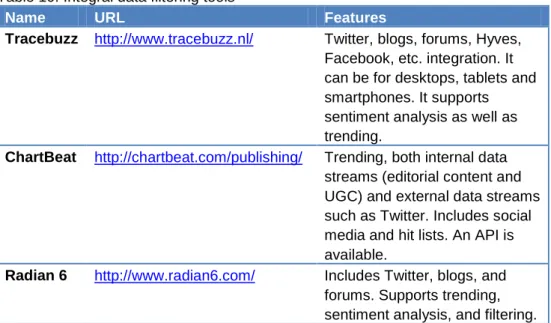
Voor de redactie-georiënteerde benadering zijn er momenteel verschillende tools beschikbaar die redacties in een deel of enkele delen van de werkzaamheden kunnen ondersteunen en ook passen in het werkproces van verzamelen en selecteren. Deze tools (veelal ontstaan in het domein van online marketing) richten zich met name op het filteren van sociale media, blogs en fora op bepaalde
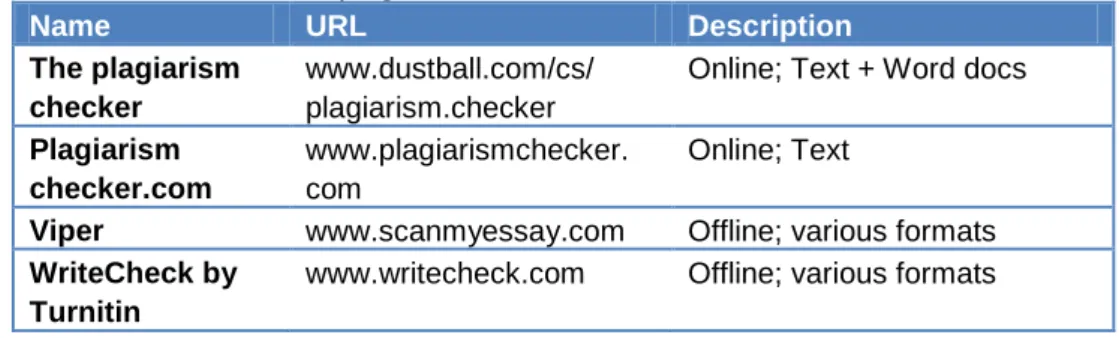
keywords om de juiste content boven water te halen met analyses die onder andere informatie bieden over het bereik van deze content, gebruikers en trends. Dit wil niet zeggen dat alle nieuwsaanbieders deze tools al in dezelfde mate toepassen. Dit komt gedeeltelijk omdat niet alle journalisten bekend zijn met de mogelijkheden van verschillende tools. Daarnaast is het huidige aanbod - om waardevol te kunnen zijn voor redacties - ook nog wel voor verbetering vatbaar. Men moet nu nog steeds met verschillende losse tools werken die niet geïntegreerd zijn in het eigen CMS-systeem. Ook de kwaliteit en flexibiliteit van filtering kan beter. Met name het vinden van content die in juridisch opzicht van lage kwaliteit is, blijkt lastig. Het detecteren van racistische content is mogelijk, hoewel het lastig blijft om nuances, zoals
bijvoorbeeld ironie, te herkennen. Het automatisch detecteren van de schending van privacy of smaad is voor de huidige technologie echter nog een brug te ver. Bovendien zijn deze tools volledig tekstgericht. Beeldanalyse (voor foto’s en video’s) wordt nog niet toegepast in tools die bruikbaar zijn in een journalistieke context.
Voor het tweede perspectief – waarin gebruikers met de nieuwsaanbieder het nieuws co-creëren – zijn er slechts beperkt tools beschikbaar voor
nieuwsaanbieders. Er zijn tools die het samenwerken stimuleren maar deze tools bevinden zich extern, buiten de site van de nieuwsaanbieder. Deze kunnen de optimale integratie van proces en product daarom niet realiseren. Bovendien voorzien zij niet in de basisbehoefte om de juiste gebruikers bij de juiste onderwerpen te vinden en deze op een effectieve manier te activeren om te participeren.
Gezien de ontwikkelingen in de markt en de scope van het project is besloten om een proof-of-concept van een tool te ontwikkelen die redacties moet ondersteunen in de samenwerking-georiënteerde benadering.
Een tool om participatie te stimuleren
Bij de samenwerking-georiënteerde benadering gaat het om het vinden van de juiste gebruikers (met relevante expertise of kennis) op het juiste moment met de juiste communicatie-strategie om hem of haar te verleiden om op een bepaald niveau te participeren in het productieproces. Dit kan betrekking hebben op het schrijven van een artikel, het maken van een foto of een video, maar het kan ook gaan om het aanvullen (of corrigeren) van bestaande artikelen, het reageren op artikelen, het delen van bepaalde content in het sociale netwerk van de gebruiker of simpelweg de consumptie van content.
Dit proces kan gedeeld worden in vier stappen:
1. Het filteren en analyseren van content en de gerelateerde gebruikers.
2. Het profileren van gebruikers op basis van content, historie van participatie en het sociale netwerk.
3. Het definiëren van vervolgstappen (communicatie-strategie) om (potentiële) gebruikers te activeren om te participeren.
4. Het faciliteren van participatie en co-creatie.
De kern van deze vier stappen ligt besloten in het begrip ‘relevantie’: wat maakt een gebruiker relevant voor een redactie in een specifieke context voor een specifiek doel? Dit begrip van relevantie is essentieel in de ontwikkeling van de ‘analytical engine’ die verder gaat dan het herkennen van keywords, zoals bijvoorbeeld veel huidige Twitter-tools werken. De resultaten die deze technologie opleveren zijn niet relevant genoeg voor een redactie, vooral niet als het gaat om zeer korte teksten zoals tweets. De analytical engine moet dus een juiste mix inzetten van
semantische en contextuele indicatoren, zoals sociale signalen (bijvoorbeeld het aantal comments, ‘duim omhoog’, ‘duim omlaag’, likes, retweets, het aantal volgers, de frequentie waarmee geproduceerd wordt), professionele erkenning (van de redactie of andere experts), de analyse van content waar door URL’s in artikelen of tweets naar verwezen wordt, cross analyses van keywords in andere relevante nieuwsbronnen, de analyse van de mate van expertise in het sociale netwerk van een gebruiker, etc.
Om dit begrip van ‘relevantie’ op te bouwen is nauwe samenwerking met redacties vereist in de vorm van een iteratief ontwerpproces. Hun ervaring en input is van groot belang om de bovengenoemde elementen goed in kaart te brengen. De feedback van redacteuren op de relevantie van de resultaten die een tool levert is nodig om de analytical engine te verbeteren en om de tool zelf-lerend te laten zijn.
Een tweede belangrijk element, naast de analyse van gebruikers, is de
communicatie met de relevante gebruikers om hen op het juiste niveau te laten participeren. Om de vervolgstappen en communicatiestrategie te definiëren is er een beter begrip nodig van de interactie tussen de verschillende factoren die een rol spelen in de motivatie om te participeren (persoonlijk, sociaal en content-gerelateerd) en de context waarin deze samenkomen. Met behulp van dit begrip van de motivatie bij een bepaalde gebruiker en de context waarin deze zich bevindt, zou het doel om een gebruiker te activeren tot participatie vertaald moeten worden in effectieve communicatie.
Een ander zeer belangrijk element in de ontwikkeling van een nieuwe tool die redacties moet ondersteunen in het beter inzetten van UGC en
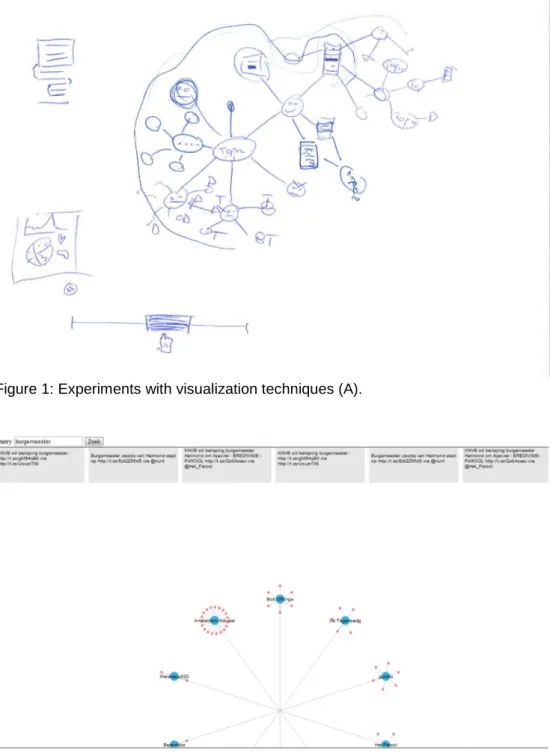
gebruikersparticipatie zijn het interactie design en de visualisatie. Deze bepalen voor een groot gedeelte de algemene gebruiksvriendelijkheid. De tool moet uiteindelijk ingepast worden in de dagelijkse activiteiten op de werkvloer en tijdswinst opleveren. De resultaten die de tool genereert moeten daarom op een dusdanige manier weergegeven worden dat het een duidelijk overzicht biedt met logische vervolgstappen om deze resultaten in meer detail te onderzoeken voor het activeren van gebruikers. De principiële designkeuze die is gemaakt in dit project voor de ontwikkeling van het proof-of-concept - het tonen van gebruikers als startpunt voor vervolgstappen, zoals het activeren of het doorzoeken van de content - lijkt logisch en effectief te zijn.
Tools in een juridische context
Het is belangrijk om bij de ontwikkeling van een tool die het gebruik van UGC door redacties moet ondersteunen, ook een juridisch perspectief mee te nemen. Redacties moeten bij het gebruik rekening houden met verschillende juridische issues, zoals bijvoorbeeld privacy, intellectueel eigendom en smaad of laster. Voor de twee verschillende benaderingen van het gebruik van UGC en
gebruikersparticipatie spelen deze issues op verschillende wijzen een rol.
Voor de redactie-georiënteerde aanpak is het hoofddoel van een tool het filteren van UGC. Enerzijds gaat het hierbij om het vinden van de meest relevante en nieuwswaardige content en anderzijds om de content van een te lage kwaliteit om deze van de site te kunnen weren. Een van de aspecten van kwaliteit is de juridische status. Zoals hierboven al beschreven zijn de huidige tools niet goed in staat schadelijke content te herkennen.
Een van de consequenties van het gebruik van tools die content filteren – nog los van de kwaliteit – is dat het waarschijnlijk is dat nieuwsaanbieders niet langer aanspraak kunnen maken op de bescherming van de zogenaamde ‘safe harbor rules’ van de E-Commerce Directive, voor zover deze van toepassing zijn op nieuwsaanbieders. Daarentegen zorgt het gebruik van tools die een zekere vorm van pre-moderatie kunnen vervullen er wel voor dat de nieuwsaanbieder, in de vorm van ‘verantwoordelijke journalistiek’, voldoet aan ethische richtlijnen die de
sector zelf via de Raad voor de Journalistiek heeft opgesteld. Deze
tegenstrijdigheid geeft aan hoe de ethische richtlijnen – waarbij pre-moderatie een vereiste is – en de E-Commerce Directive die in feite pre-moderatie ontmoedigt omdat daarmee de mogelijke bescherming wegvalt wanneer een partij zich met de inhoud van het platform bemoeit. Op dit vlak is verheldering gewenst.
De samenwerking-georiënteerde benadering heeft op een ander manier te maken met deze juridische issues. Deze benadering is niet zozeer gericht op het filteren van content, maar om de meest relevante mensen te herkennen en te activeren om te participeren. Tools die gericht zijn op deze benadering helpen de redactie niet om schadelijke content te herkennen. Deze tools dragen dan ook niet bij aan het principe van ‘verantwoordelijke journalistiek’, hoewel het wel mogelijk zou zijn om het profileren van gebruikers in te zetten om de makers van schadelijke content te herkennen en de content die zij aanbieden prioriteit te geven in het
moderatieproces.
Doordat de nieuwsaanbieder gebruikers zelf, met behulp van de tool, gebruikers selecteert en benadert is het waarschijnlijk dat zij nog meer verantwoordelijk gehouden worden voor de content die op de site aanwezig is, ook als deze niet door de nieuwsaanbieder zelf gemaakt is. Bij deze tools speelt ook privacy een belangrijke rol, zij het op een andere manier. Omdat de tool informatie over gebruikers verzamelt, verwerkt en mogelijk combineert is het van groot belang dat zij voldoen aan de geldende privacy richtlijnen. Daarnaast moet men ook rekening te houden met de attitudes binnen de community.
Contents
Summary ... 3
1 Introduction ... 11
1.1 Background ... 11
1.2 A changing news landscape ... 14
1.3 The level of participation: UGC as a source vs co-creation? ... 18
1.4 In this report ... 20
2 Legal analysis ... 21
2.1 Freedom of Expression and Journalistic Freedoms: The European and Dutch Legal Context ... 21
2.2 Legal Requirements... 35
2.3 Legal and Ethical Responsibility of Newsrooms for the Contributions of Users... 51
3 Making User generated News Work – in practice ... 67
3.1 Types of User Generated Content ... 67
3.2 The production process ... 70
3.3 Value and issues ... 74
3.4 Ambitions regarding UGC and technological solutions ... 76
4 Technological overview ... 79
4.1 Introduction ... 79
4.2 The technological foundation ... 79
4.3 Tools for leveraging UGC ... 83
4.4 Conclusions ... 87
5 A New Tool ... 89
5.1 A new tool to support the use of UGC ... 89
5.2 Towards a pilot ... 89
5.3 A tool for the collaboration oriented approach ... 90
5.4 What the tool does and does not do ... 93
6 The results from the pilot ... 95
6.1 The experience of the tool ... 95
6.2 Future Development ... 98
6.3 Challenges ... 100
7 Conclusions ... 103
8 Bibliography ... 107
APPENDIX A–LIST OF PARTICIPANTS OF EXPERT WORKSHOP AND ADVISORY GROUP ... 113
APPENDIX B–TWITTER CLIENTS ... 115
1
Introduction
1.1 Background1.1.1 More with less
The printing press has been facing multiple challenges in recent years. A combination of both falling advertising revenues as well as the number of subscribers due to audience fragmentation over different devices and media, is forcing newspapers and magazines to economize. The number of journalists employed by news organizations is declining (Tijdelijke Commissie Innovatie en Toekomst Pers, 2009). In other words, they have to do more with less.
At the same time enhancements in (new) digital technologies have enabled users to participate considerably in the production of news. The growing availability of (wireless) broadband internet, affordable and user friendly hardware and software and (social media) publication platforms has spurred the growth of user generated
content (UGC), see box below. (Helberger, Leurdijk, & De Munck, 2010).
User Generated Content
User generated content (UGC), according to a definition from the OECD, is media content that has been published in a specific context that required a certain creative effort and was produced outside of the professional routines and practices (OECD, 2007), for instance posting to a blog or uploading a self-made photo to a website. It is essential that the user has had an active, creative contribution to the content. In this report we will use a broad definition of UGC; a couple of lines in a comment are considered UGC as well, although it is clear that such a short contribution requires less creative effort than writing a 1000 word essay or producing a video.
The perception of UGC by news journalists and its status in the newsroom is ambiguous. According to a study by Pantti and Bakker (2009) some news organizations consider UGC to be an enrichment for professional journalism. It enhances and corrects the content produced by professional journalists and, importantly, it can provide content from a newsworthy event where no professional journalists were present or – when they were present – were not able to create the content themselves. This is an interesting proposition for news media, especially for those who, indeed, have to do ‘more with less’. Furthermore UGC is considered to strengthen the relationship between news organizations and their audiences. Furthermore, from an economic point of view, integrating ‘free’ UGC is viewed as beneficial (Bakker & Pantti, 2009). On the other hand, the study shows that a number journalists considers UGC to be a threat to professional journalism. Regardless whether this is actually the case or not; it shows that not all news providers are won over (see also Chung, 2007).
It is true that the use of UGC does not only come with benefits. If users upload massive amounts of content, this could result in a lot of extra work for the newsroom to guarantee the quality of the content on their website and preserve their status as a high quality medium which, consequently, can be very expensive.
And if users create valuable content - both by uploading it to the website but even more so by posting it on other websites and social networks - how will journalists find the few golden news nuggets in a flood of UGC? Furthermore, there are legal matters that need attention especially regarding the lawfulness of user generated content, the relationship between journalists and users, and the legal responsibility of news organization for UGC on its website. UGC can, for instance, contain hate speech or infringe on the right of third parties such as copyright or privacy. Although it is in the first place the author (user) who is responsible for her contribution, news services that incorporate UGC may be held responsible for infringing material under certain circumstances. Vice versa, when integrating UGC and collaborating with users, newsrooms need to respect the rules that protect users in their relationship to the newsroom.
It is, therefore, important to note that simply increasing the use of UGC does not automatically equals ‘better’ use. As mentioned above, news organizations have to define a strategy to implement the participation of their users and UGC that suits the organization, the product, the production process, the community it serves and other stakeholders involved.
To utilize UGC to its full potential, (new) technological support could be (part of) a solution. Using text-mining tools and profiling technologies, for instance, it would be possible to automatically screen content to assess it on specific criteria. This kind of software can support journalists by making a first broad selection of (un)suitable or (ir)relevant content. Or it could support them to find the most relevant users that could collaborate in various stages of the production process, comment on specific content or distribute it in their (social) networks.
The abundance of UGC
The last decade both the volume of UGC – created on platforms such as YouTube and social networks – and the number of people who created UGC has grown enormously in the Netherlands.
According to Marketingfacts (Oosterveer, 2012), Facebook is the most popular social network in the Netherlands with over 9 million users, having surpassed the dwindling native Hyves in 2011 in terms of number of unique visitors per month. Although users spend well over 4 hours per month on Facebook it is hard to assess how much content they have created, especially because in general this content is not public but only shared with friends. However, numbers indicate a steady increase in the interaction on fan-sites - for example sites from TV-programs and companies - over the last twelve months.
Numbers from Twittermania (Kok, 2011) illustrate that Twitter has shown huge growth as well in the Netherlands over the last couple of years, especially since 2009. After a surge from 2009 up to the first half of 2011 the number of users seems to be plateauing somewhat this year at roughly 1,3 million active users, although other numbers indicate that almost a fifth of the Dutch population uses Twitter (3,2 million) with over 1,5 million active users per day. The number of tweets that Dutch speaking people produce, however, still seems to be growing rapidly with an average of somewhere between 5 to 6,4 million tweets per day (depending on the source, Twittermania or Marketingfacts) – the highest number of tweets per user in the world – up from a little bit over 4 million tweets per day a year earlier.
Worldwide, the number of tweets per day in 2011 had tripled since 2010 from 55 million to 155 million. It should be noted, though, that those tweets are also created by (media) companies.
Of course there are many other platforms that allow users to post UGC, such as YouTube (worldwide over 60 hours of video are uploaded every minute, although this includes many hours of professional content as well), Instagram (with worldwide 80 million users who have shared 4 billion photos by July 2012) and Pinterest (200.000 Dutch users in 2012, up from 150.000 a year earlier) to name but a few.
1.1.2 About this project: ‘Making User Created News Work’
This report is the result of the project ‘Making User Created News Work’, which was co-funded by the Netherlands Press Fund (Stimuleringsfonds voor de Pers).
The goal of this project was to provide an overview of strategies to use UGC currently deployed by Dutch news media, and the most relevant international and national legal principles and regulations. Furthermore, the goal was to assess (possible) technological solutions that would enable news organizations to use UGC so they could 1) benefit from its potential, 2) in a way that suits their journalistic formula, ethics and practices, 3) while guarding their reputation as a quality medium, and 4) complying with the legal and ethical order.
The main research question of this report is:
What are possible strategies to improve the implementation and utilization of UGC in newsrooms, and how could (new) technical tools support these strategies?
The overview of current practices, ambitions and issues is based on the analysis of the websites of fifteen Dutch news providers, six interviews with chief (online) editors and additional desk research to assess technological solutions that are already available. The legal analysis was based on both the interviews and a literature study. The results from these analyses were discussed in an expert-workshop with professionals from the Dutch news industry (see Appendix A). Based on this workshop and a consultation from the expert sounding board, a direction for a new technological solution was selected and further explored. After a second workshop the initial ideas were translated into a set of requirements for a proof of concept, which was built, tested and discussed in a pilot with hyper local news platform Dichtbij.
1.2 A changing news landscape
1.2.1 New roles for users
Contemporary news audiences have substantially more tools at their disposal to participate in the news production process than before. Regular citizens are equipped with smartphones and other digital devices that allow them to submit newsworthy content to newsrooms and online news platforms. Waldman (2011) describes users in this role as ‘non-professional journalists’ who do not just give their opinion, but also participate in the journalistic process by collecting facts, sounds and images to create a news item. They are able to cover both big, national disasters but they can also capture more personal stories from daily life. More and more, users are prompted by news media to send their photos and videos, especially regarding big news events.
The traditional roles of professional content producers and their passive audience have been upended, especially due to the access to new digital and networked technologies. The audience is no longer refrained to being just a consumer.
Citizens can also be producers themselves. This development of the empowerment of users has inspired the coinage of terms like ‘prosumer’ (Toffler, 1980) or
‘produser’ (Bruns, 2006). However, it is important to note that the fact that users have access to a myriad of technologies and platforms to create and distribute content does not necessarily mean that they will actually actively engage with news: “It’s a great leap to presume that the availability of digital networked technologies turns everyone into active participants.” (Van Dijck, 2008). Users “[…] do not seem to massively embrace the possibilities offered by the web to participate to the news.” (Picone, 2011).
Picone (2010) distinguishes three motivational dimensions to engage with news and to overcome the threshold to participate:
• Social: the desire to help or inform others. It refers to the anticipated effect on the audience and the impact it will have.
• Personal: the ability, knowledge and confidence of the user.
The extent to which a user is willing to display a specific level of participation depends on the interplay between these three dimensions on a specific moment. The willingness (or lack thereof) to create UGC is not a fixed personal characteristic of a particular user. Although some studies divide users into specific categories depending on their level of participation - like Forresters’ “creators”, “critics”, “collectors”, “joiners, spectators” (Li & Bernoff, 2008) - it is more useful to
acknowledge that consumption and production are part of the same continuum. The desire to engage with news often arises by accident, ad hoc, after the user reads or sees something online. It is only rarely that someone makes a deliberate decision to publish something online before he or she turns on the computer to visit a news website. Interestingly, most general self-publishing happens outside of the realm of news websites, but rather on social networks such as Facebook and Twitter. It is, therefore, more likely that news enters ‘regular’ UGC-platforms than the other way around. These insights in different kinds motivations and the ad hoc nature of user participation are relevant for news providers who want their users participate, as we will discuss in more detail in chapter four and five.
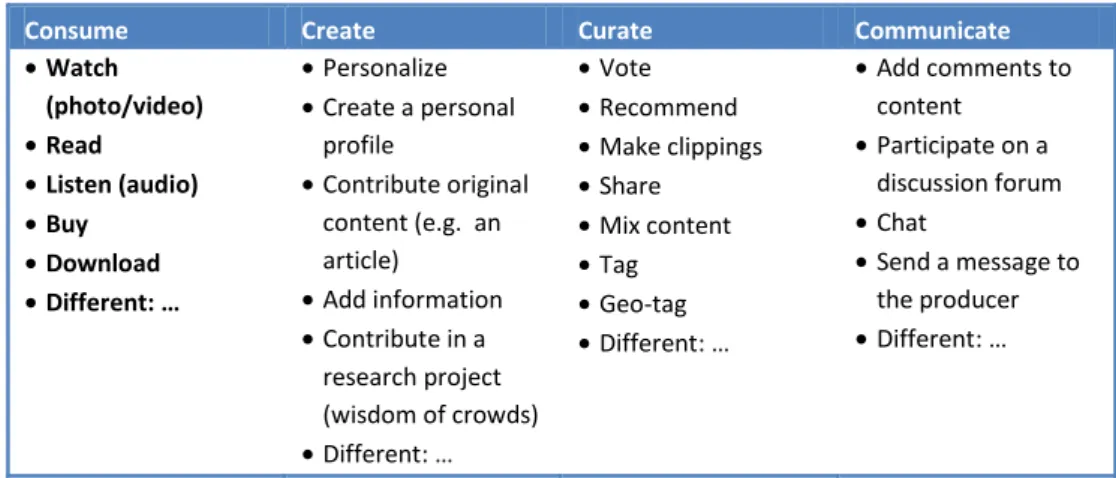
As mentioned above, there is a continuum of user engagement that ranges from consumption to production and contains different kinds of user participation. Pickard (2010) distinguishes four different roles for the ‘new’ user: consuming, creating, curating and communicating. Consuming covers traditional activities such as reading an article or watching a video. Creating is contributing one’s own original or adapted content. Curating is organizing or preserving content, for instance making it easier to be found by tagging it, or by sharing it with others. Communicating is contributing to an online discussion and discuss with other users or producers.
Table 1 offers an overview of different activities that the four user roles encompass (Slot, Ruhe & Frissen, 2011).
Table 1: New user roles
Consume Create Curate Communicate
• Watch (photo/video) • Read • Listen (audio) • Buy • Download • Different: … • Personalize • Create a personal profile • Contribute original content (e.g. an article) • Add information • Contribute in a research project (wisdom of crowds) • Different: … • Vote • Recommend • Make clippings • Share • Mix content • Tag • Geo-tag • Different: … • Add comments to content • Participate on a discussion forum • Chat • Send a message to the producer • Different: …
This overview of the different user roles and their specific activities cover different levels of user participation. Jönsson and Örnebring (2011) have categorized different user activities according to three different levels of user participation: low, medium and high (see Table 2). The low level participation concerns more
traditional consumer activities or activities that require no real creative effort by the user, such as a poll. Medium level participation concerns ‘prosumer’ activities where
users respond to or contribute to other content, such as a comment on a article. High level participation concerns activities where the user produces original content or engages in direct interaction with other users. The degree in which a user takes op certain roles other than consuming – creating, conserve, communicate – increases as the participation level gets higher.
Table 2: Levels of user participation
Low level participation Medium level Participation High level participation RSS Feeds Rating Polls Comment on an article E-mail Q&A
Comment in general (‘have your say’) Forum Chat Wiki Blogs Write articles Create photos/videos
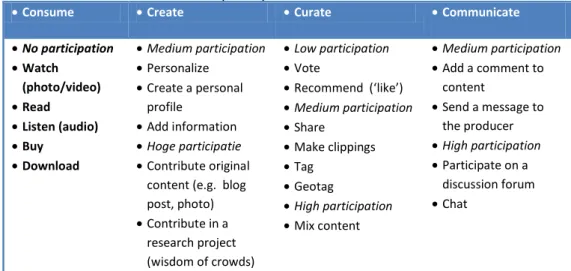
It is interesting to combine both the overview of Slot and Frissen, who categorized different activities according to the different user roles with the overview of Jönsson and Örnebring. This way we can have an overview of the different roles and the different participation levels of the activities within these roles, see Table 3.
Table 3: User roles and levels of participation.
•Consume •Create •Curate •Communicate
•No participation • Watch (photo/video) •Read • Listen (audio) • Buy • Download •Medium participation • Personalize • Create a personal profile • Add information •Hoge participatie • Contribute original content (e.g. blog post, photo) • Contribute in a research project (wisdom of crowds) •Low participation • Vote • Recommend (‘like’) •Medium participation • Share • Make clippings • Tag • Geotag •High participation • Mix content •Medium participation • Add a comment to content • Send a message to the producer •High participation • Participate on a discussion forum • Chat
This overview of the different types of participation in the different user roles, shows that as the degree of participation increases to a medium or high level, both the creative effort required and the freedom of users in the way they can fulfill that role increases as well. The ‘formats’ available to the user, such as - in the case of medium participation - adding a tag to a specific piece of content, offer (and require) more creative freedom to the user than just being able to ‘like’ a specific piece of content. Contributing original content, such as a blog post, offers more creative freedom than being able to post a comment with a hundred words maximum. This means that as the level of participation increases – especially regarding the roles of creating and communicating – this also may increases the workload of the
newsroom in terms of guarding the quality of the content on their website, as we will discuss in the next paragraph.
1.2.2 New roles for newsrooms
The new user roles, and the extent to which users actually fulfill these roles, influence the relationship between news organizations and their audience and, consequently, the role of the newsroom.
Traditionally, journalists consider themselves to be gatekeepers (Herman, Vergeer & Pleijter, 2010; Domingo et al., 2008). They decide what news events are relevant, which items meet their quality standards and which items do not and, by doing so, what makes it in the paper, the eight-o-clock news or on the website. This, however, is changing as well. In addition to this traditional role, news media are more and more fulfilling two ‘new’ roles: gate watchers and gate-openers. As gate watcher the news organization refers to or links to other relevant content on other websites or alternative news sources, a role which is generally speaking adopted less often by more traditional news organizations than non-traditional news organizations (Slot, Ruhe & Frissen, 2011). As a gate-opener, news organizations offer their users a platform to share their own content, which is important when news organizations want to collect and use UGC.
As gatekeepers or gate watchers, news organizations check the content before publication. Users may contribute by offering their content or referring to content from third parties, but this content will be screened to check the quality and
factuality (Slot, Ruhe, & Frissen, 2011). Checking for the authenticity of the content is an important aspect in this regard: a lot of (audio)visual content is modified in one way or another (Pantti & Bakker, 2009) which could compromise the truthfulness of the representation of an event, which is an important ethical, journalistic principle. Often, when news organizations position themselves as gate openers, the quality of UGC is checked after publication (Slot, Ruhe & Frissen, 2011), which can be done by both the newsroom or other users who moderate the content from other users.
As mentioned above, these shifts in the relationship between news organizations and users indicate that participation of users - and UGC in particular - as a new source of content or means of distribution is not merely valuable. They also pose important questions regarding the quality of the content. Quality, of course, is an ambiguous term. There is no general, commonly shared definition of what quality content is. The notion of quality and the parameters to measure it will differ between different categories of content, contexts and the intended use and audience
(Helberger, Leurdijk & De Munck 2010). Personal content, that is only meant to be enjoyed by close friends and families, thrives on personal value and the feeling of connectedness. Professional journalistic content, however, is measured in terms of truthfulness and timeliness. Furthermore, different news organizations hold different standards. Traditional news organizations, such as newspapers and broadcasters - generally seem to hold UGC to a higher standard than non-traditional news
organizations (Helberger, Leurdijk & De Munck, 2010).
For news organizations, the main quality parameter is the importance and timeliness of content. It is, however, possible to distinguish three other main categories of quality-parameters that determine the value of UGC in a news context. First of all, there is an ‘aesthetic’ or ‘topical’ quality, for instance the quality of the spelling and the match between the content and the focus of the news organization (national or hyper local, on topic or not). It is also possible to discuss quality from a more technological perspective, such as the size the content or the
format that is being used and how easily it can be processed by the newsroom and the technological tools it has at its disposal. Secondly, the legal status of the content is very important as mentioned above: does the content infringe the right of others (copyright, privacy), or is the content hateful? Such content, although
possibly important from a journalistic perspective, could still be harmful for the news provider. A dubious legal status, therefore, can diminish the overall quality of the content. Thirdly, as with all news content, there are professional, ethical values: is the content truthful? Is it balanced? These three elements determine the quality that could counterbalance the news value of the content.
As users become more active, the newsroom no longer holds the monopoly on content creation. And although citizens are engaging (more) actively in the
journalistic process of professional news organizations, they do not have the same professional training or hold themselves to the same professional standards as journalists. So how can news organizations fully profit from UGC, but at the same time guarantee the quality of their overall product and secure their reputation as a quality medium? Furthermore, when integrating UGC news media have to take into account possible pressure from both legislators and advertisers (Helberger, Leurdijk & De Munck, 2010). On the one hand newsrooms have to find the most relevant content in a vast amount of UGC uploaded or e-mailed by users or available on other websites, social networks and public discussion platforms. Furthermore, when users are able to comment on articles and post their own articles or videos,
newsrooms have to guard the quality of their own websites. Chapter three will discuss different strategies that are being deployed by news providers to deal with these issues.
1.3 The level of participation: UGC as a source vs co-creation?
News organizations that want to integrate UGC have to adapt their traditional production process. The scope of these organizational changes depend on the extent to which news organizations choose to incorporate UGC and user participation, and the role UGC will play in both its product and the production process. News organizations that solely want to use UGC as a possible source for their own editorial content – and still act as traditional gatekeepers - will implement a different strategy than news organizations that present themselves as gate-openers and aspire to co-create the news with their users.
There is no clear, commonly shared definition of ‘co-creation’, a term that was coined by Prahalad and Ramaswamy in 2004 to describe how the interaction between a company and individual customers can create unique experiences for customers and, subsequently, value. In this report, in a journalistic context, we define co-creation as the collaboration between professionals (the newsroom) and users on an egalitarian level during the different steps in the production process of news content.
It is interesting to assess to what extent news organizations allow users to
participate, but also in what phase of the production process. Domingo et al (2008) studied the openness of several news organization by looking at the participation of users in the five different steps of the journalistic production process which they
defined: access/observation, selection/filtering, processing/editing, distribution and interpretation.1
How UGC is being used
According to Slot, Ruhe and Frissen (2011) who analyzed 57 news organizations (both Dutch and foreign), newsrooms are more and more trying to integrate user participation in the production process of their services. Users are increasingly asked to comment on news articles, to share content on social networks and also to contribute original content such as articles, photos and videos. By doing so, news providers allow their users to participate on both a low level, for instance by participating in a poll, and on a high level, like posting a blog entry.
The publication of UGC on the websites of news organizations has become more common. Over 70 percent of the news organizations allow users to contribute UGC (news services that were offered on the iPad are not taken into account). However, there is a big difference between the level of participation and the different types of UGC. The above-mentioned 70 percent refers to websites where users can comment on articles. The percentage of news organizations that allow users to contribute with their own original content is much lower. Roughly 30 to 50 percent of the analyzed news organizations facilitate users in uploading articles or blog posts to their websites with print media leading the pack and broadcasters lagging behind. The percentage of news organizations that allow users to upload photos and videos is slightly lower: 30 to 40 percent with a negative outlier in the case of video for print media. Less than one out of five publishers offer users the possibility to contribute their videos to the website. The ‘crowdsourcing’ of certain activities, for instance asking users to contribute to a research projects, is only adopted by less than 10 percent of the news organizations. Another notable result is that especially the non-traditional news organizations that do not have their roots in print or broadcast media score above average regarding the adoption of UGC.
The strategies regarding the participation of users vary between different news organizations, but there are also differences in the level of participation in the various phases in the production process. In some cases users are able create their own articles, photos and videos and share it with a news organization. In doing so, users can fulfill the first three stages in the production process – or even beyond those three. However, for some news organizations the UGC that is being offered is only part of their first stage in the production process wherein they gather
information and make their own selection: they decide what content will be actually available on their website. Other news organizations have a different strategy and open up their website to users who can upload content directly, although very often there is a very strict distinction between editorial content and UGC, which will have its own dedicated page on the website. In these scenarios both professional
1
In this report we will use a slightly different description of the production process: gathering, selection, editing and presentation. The focus in this report on presentation, rather than distribution, is the result of the importance of presentation in legal terms: How is UGC presented in relation to editorial content and the website as a whole?
journalists and users create their own content and do not really work together on the same product(s).
As mentioned earlier, a news organization has to determine to what extent it wants (and will be able) to adopt co-creation that fits its own culture, production process and infrastructure (including technical tools), and matches the values and
expectations of the community it caters to and other stakeholders involved. This means that there is no single solution to optimally use UGC that fits every news organization. But each and every one of them will have to define their own strategy and will have to translate this into a (new) daily routine and product. As we will see in chapter three, different news organizations have implemented the use of UGC differently and have different views and ambitions for the future.
1.4 In this report
Chapter two provides an overview of the legal context in which news providers move when using UGC or collaborating with users in the production process of the news. First, it describes the most relevant European and national standards regarding journalistic practices – and freedom of expression and journalistic freedom in particular. Second, it zooms in on the different rules and regulations in copyright law, data protection law, criminal and civil law. Third, it looks at the question of who is responsible for making sure that UGC actually complies with these requirements, and what the consequences are in terms of liability.
Chapter three provides an overview of current attitudes and practices regarding the use of UGC in Dutch news media: the value that is ascribed to UGC, the different kinds of UGC that are being used, the way it is being integrated in the production process (e.g., moderation strategies and presentation) and the issues and ambitions regarding the use of UGC.
Chapter four describes the technological foundations of tools that support the use of UGC. It also provides an overview of typical tools that offer different functionalities regarding the implementation of UGC.
Based on these three elements and two workshops, a proof of concept of a new tool was developed and tested in a pilot by news provider Dichtbij. Chapter five will provide a brief overview of the development process and the most important design choices that were made. Chapter six describes the results of the pilot and insights for future development of tools that support newsrooms in the use of UGC. Chapter seven will provide the most important overall conclusions.
2
Legal analysis
The goal of this legal chapter to the report is to sketch an overview of the normative context in which professional (and amateur) journalists move when producing and implementing User generated Content in the news. Laws influence the activities of journalists in several ways: they create the constitutional and legal breathing space for journalists to operate, by protecting them from censorship and interference, both from governments and, to a lesser extent, from private parties. Laws create
privileges and exceptions to make the work of journalists easier. Norms guide the activities of journalists by setting benchmarks of what permissible or offensive behavior is, also and particularly in relation to those that are the subject of reporting. And finally, they lay the ground rules for the relation between journalists, and of journalists and third parties, and determine if, how and by whom, once an infringement has taken place, the aggrieved party can be set to its right.
The chapter consists of three sections. Section one adopts the meta-perspective. It describes the constitutional and legal context in which journalism takes place, as well as the role of the media in realizing important goals and freedoms for society. The focus of this section is on freedom of expression and journalistic freedom. It provides a brief overview and analysis of the most relevant European and national standards. The second section zooms in on the different rules and regulations in copyright law, data protection law, criminal and civil law. It explains in detail and with various examples what the legal requirements are for journalism in general, and citizen journalism in specific. The third section is dedicated to the question of who is responsible for making sure that the implementation of UGC actually
complies with these requirements, and for undertaking action in situations that UGC is in conflict with the legal order and protection worthy interests of individuals or society.
Point of departure of the analysis is European and Dutch law. European law has shaped the national order, such as in the fields of fundamental rights, copyright law or data protection law. Other areas of national law have remained largely untouched by European influences, including the rules in general civil and criminal law, but also the complex body of self-regulatory measures that also guide the activities of the press. Where opportune, the analysis will bring examples from other
jurisdictions, by way of comparison or to highlight certain particularities or different approaches.
2.1 Freedom of Expression and Journalistic Freedoms: The European and Dutch Legal Context
2.1.1 Introduction
The legal space within which journalists operate is largely shaped by the complex and continuous interplay of legal and ethical standards developed at international, European and national levels. This section provides a brief overview and analysis of the most relevant European and national standards. The overview and analysis will span legally-binding standards as well as relevant policy and self-regulatory texts, which are important sources of ethical and practical guidance for journalists. The overview is initially general in scope, but it proceeds towards a sharper focus on the
use of user generated content (UGC) in the production and presentation of news. The focus will then sharpen further to deal primarily with the specificities of the print media, including/especially their online presence. The analysis has been organized around selected key themes: freedom of expression and media freedom; privacy and data protection; copyright, and liability and responsibility.
The following analysis is structured as follows: (I) European standards (Council of Europe and European Union); (II) National standards; (III) Self-regulation; (IV) Use of UGC for news purposes. Section I explains how freedom of expression and media freedom are safeguarded in European human rights standards. Section II examines national constitutional and legislative provisions concerning freedom of expression and media freedom. Section III sets out the complementary regulatory role of media self-regulation. Section IV draws on all of the preceding sections and spells out their implications for the use of UGC in the news. It focuses first on European jurisprudential developments and then turns to national legal and self-regulatory frameworks.
2.1.2 European Standards
At the European level, relevant regulation has been developed by both the Council of Europe and the European Union. The legal status of those regulatory texts varies: some are directly binding on States; others are indirectly binding and more still are not legally-binding, but politically-binding. In other words, they create political commitments for States that are not legally enforceable. Sometimes regulatory texts that are politically binding can have a greater impact in practice than other legally-binding texts. For instance, the negotiation and drafting of treaties can be very time-consuming, whereas political standards can be adopted in various shapes or forms and at various levels. Practical impact can be influenced by the nature of the text. They often have the character of declarations of existing states of affairs, or recommendations to undertake particular action.
The overview of relevant standards will pay special attention to a number of specific texts, but it is important to note at the outset that each of the texts examined is only part of a broader whole. It is the interaction between those texts that creates the overall legal and policy framework.
2.1.2.1 The Council of Europe
The Council of Europe has adopted a number of treaties that create an enabling environment for freedom of expression, information and media freedom. The European Convention of Human Rights is the oldest and most important of those treaties. Thematically specific treaties like the Convention on Access to Official Documents and the Convention for the Protection of Individuals with Regard to Automatic Processing of Personal Data are also relevant. Each of these treaties will now be discussed in turn.
European Convention on Human Rights
Article 10 of the European Convention on Human Rights (ECHR), is the centerpiece of European-level protection for the right to freedom of expression. It reads:
1. Everyone has the right to freedom of expression. This right shall include freedom to hold opinions and to receive and impart information and ideas without interference by public
authority and regardless of frontiers. This article shall not prevent States from requiring the licensing of broadcasting, television or cinema enterprises.
2. The exercise of these freedoms, since it carries with it duties and responsibilities, may be subject to such formalities, conditions, restrictions or penalties as are prescribed by law and are necessary in a democratic society, in the interests of national security, territorial integrity or public safety, for the prevention of disorder or crime, for the protection of health or morals, for the protection of the reputation or rights of others, for preventing the disclosure of information received in confidence, or for maintaining the authority and impartiality of the judiciary.
Article 10(1) sets out the right to freedom of expression as a compound right comprising the freedom to hold opinions and to receive and impart information and ideas. As such, there are three distinct components to the right, corresponding to different aspects of the communicative process, i.e., holding views, receiving and sending content. These rights are prerequisites for the functioning of media and journalism.
Article 10(1), ECHR, countenances the possibility for States to regulate the
audiovisual media by means of licensing schemes. This provision was inserted as a reaction to the abuse of radio, television and cinema for Nazi propaganda during the Second World War. Article 10(2) then proceeds to trammel the core right set out in the preceding paragraph. It does so by enumerating a number of grounds, based on which the right may legitimately be restricted, provided that the restrictions are
prescribed by law and are necessary in a democratic society. It justifies this
approach by linking the permissibility of restrictions on the right to the existence of
duties and responsibilities which govern its exercise. Whereas the right to freedom
of expression is regarded as being subject to general duties and responsibilities, the European Court of Human Rights sometimes refers to the specific duties or
responsibilities pertaining to specific professions, e.g. journalism, education, military service, etc.
Notwithstanding the potential offered by Article 10(2) to restrict the right to freedom of expression on certain grounds (although legitimate restrictions must be narrowly drawn and interpreted restrictively), as the European Court of Human Rights famously stated in the Handyside case, information and ideas which “offend, shock or disturb the State or any sector of the population” must be allowed to circulate in order to safeguard the “pluralism, tolerance and broadmindedness without which there is no ‘democratic society’”.i
Aside from the permissible grounds for restrictions set out in Article 10(2), ECHR, the right to freedom of expression may also be limited on the basis of Article 17, ECHR (‘Prohibition of abuse of rights’).2 This article has been applied consistently
2
It reads: “Nothing in this Convention may be interpreted as implying for any State, group or person any right to engage in any activity or perform any act aimed at the destruction of any of the rights and freedoms set forth herein or at their limitation to a greater extent than is provided for in the Convention”.
by the Court to ensure that Article 10 protection is not extended to racist,
xenophobic or anti-Semitic speech; statements denying, disputing, minimizing or condoning the Holocaust, or (neo-)Nazi ideas. This means that in practice, sanctions for racist speech, do not violate the right to freedom of expression of those uttering the racist speech. In other words, national criminal and/or civil law can legitimately punish racist speech.
The scope of the right to freedom of expression is not only determined by the permissible restrictions set out in Articles 10(2) and 17, ECHR. It is also determined be the interplay between the right and other Convention rights, e.g. the right to privacy, freedom of religion, etc.
The European Court of Human Rights has developed a standard test to determine whether Article 10, ECHR, has been violated. Put simply, whenever it has been established that there has been an interference with the right to freedom of expression, that interference must first of all be prescribed by law (i.e., it must be adequately accessible and reasonably foreseeable in its consequences). Second, it must pursue a legitimate aim (i.e., correspond to one of the aims set out in Article 10(2)). Third, it must be necessary in a democratic society (i.e., correspond to a “pressing social need”) and be proportionate to the legitimate aim(s) pursued.
Under the margin of appreciation doctrine, which has an important influence on how the ECHR is interpreted at national level, States are given a certain amount of discretion in how they regulate expression. The extent of this discretion, which is subject to supervision by the European Court of Human Rights, varies depending on the nature of the expression in question. Whereas States only have a narrow margin of appreciation in respect of political expression, they enjoy a wider margin of appreciation in respect of public morals, decency and religion. This is usually explained by the absence of a European consensus on whether/how such matters should be regulated. When exercising its supervisory function, the European Court of Human Rights does not take the place of the national authorities, but reviews the decisions taken by the national authorities pursuant to their margin of appreciation under Article 10, ECHR. Thus, the Court looks at the expression complained of in the broader circumstances of the case and determines whether the reasons given by the national authorities for the restriction and how they implemented it are “relevant and sufficient” in the context of the interpretation of the Convention.
The particular importance of the media for democratic society has been stressed repeatedly by the Court. The media can make important contributions to public debate by (widely) disseminating information and ideas and thereby contributing to opinion-forming processes within society. As the Court consistently acknowledges, this is particularly true of the audiovisual media because of their reach and impact. The Court has traditionally regarded the audiovisual media as more pervasive than the print media and it has yet to set out a clear policy line for online media. The media can also make important contributions to public debate by serving as forums for discussion and debate. This is especially true of new media technologies which have considerable potential for high levels of individual and group participation.
Furthermore, the role of “public watchdog” is very often ascribed to the media in a democratic society. In other words, the media should monitor the activities of governmental authorities vigilantly and publicise any wrong-doing on their part. In
respect of information about governmental activities, but also more broadly in respect of matters of public interest generally, the Court has held time and again that: “Not only do the media have the task of imparting such information and ideas: the public also has a right to receive them”.ii
In light of the important democratic functions which the media and journalists can fulfil, the case-law of the Court, as well as relevant standard-setting texts adopted by the Council of Europe’s Committee of Ministers and Parliamentary Assembly, tend to acknowledge enhanced freedom for media and journalistic freedoms (as opposed to ordinary individuals). This enhanced freedom comprises legal
recognition and protection of specific journalistic practices and realities: freedom to report and comment on matters of public interest; presentational and editorial freedom (including recourse to exaggeration); protection of sources; intellectual property rights. On another level, this enhanced freedom also includes protection against searches of professional workplaces and private domiciles and seizure of materials; protection against physical violence and intimidation; various rights in times of crisis and in war situations.
Together, these freedoms help to safeguard the operational autonomy necessary for the fulfillment of journalistic tasks in democratic society. The enjoyment of these freedoms is, however, coupled with the expectation of adherence to professional ethics and codes of conduct. Typically, such codes include provisions about accuracy, fairness, avoidance of stereotypes, etc. They will be discussed in greater detail, below.
The right to freedom of expression also includes editorial and presentational autonomy for media professionals because Article 10, ECHR, protects “not only the substance of ideas and information, but also the form in which they are conveyed”.iii As the European Court of Human Rights famously held in its Jersild judgment, it is not for the courts “to substitute their own views for those of the press as to what technique of reporting should be adopted by journalists”.iv The right to freedom of expression, as applied to the media, clearly includes protection of pre-publication procedures and processes for the gathering and selection of material, such as research and enquiry.v Indeed, interferences with those processes can pose such a serious threat to the right to freedom of expression that they demand the highest levels of scrutiny by the Court.vi
Convention on Access to Official Documents
Information is the lifeblood of the media and the Convention on Access to Official Documents is therefore of considerable importance for journalists and media professionals. The Netherlands has neither signed nor ratified this Convention (although it has been the subject of parliamentary debates), so it is not legally-binding in the Netherlands. Nevertheless, it is the first international treaty dealing with the topic and it is increasingly used as a reference point. The Convention covers “all information recorded in any form, drawn up or received and held by public authorities”. The definition of “public authorities” is:
1. Government and administration at national, regional and local level;
2. Legislative bodies and judicial authorities insofar as they perform administrative functions according to national law;
3. Natural or legal persons insofar as they exercise administrative authority.
Thus, the Convention guarantees everyone a right of access to official documents held by all of the above bodies. It does not distinguish between journalists and ordinary individuals: there is no privileged access regime for journalists, as such.
What is relevant for journalists, though, is that “an applicant for an official document shall not be obliged to give reasons for having access to the official document”. This provision seeks to reduce the risk of requests for access to official documents on politically-sensitive topics being arbitrarily blocked. The right of access to official documents can only be limited when the limitations are set out precisely in law, are necessary in a democratic society and are proportionate to the aim of protecting: a. national security, defense and international relations;
b. public safety;
c. the prevention, investigation and prosecution of criminal activities; d. disciplinary investigations;
e. inspection, control and supervision by public authorities; f. privacy and other legitimate private interests;
g. commercial and other economic interests;
h. the economic, monetary and exchange rate policies of the State;
i. the equality of parties in court proceedings and the effective administration of justice;
j. environment; or
k. the deliberations within or between public authorities concerning the examination of a matter.
Furthermore, States may stipulate that “the reigning Family and its Household or the Head of State shall also be included among the possible limitations”. This is a lengthy list of grounds for limiting disclosure of official documents. However, any of those limitations could be rebutted if there is an “overriding public interest in disclosure”.
Convention for the Protection of Individuals with Regard to Automatic Processing of Personal Data
This Convention, which has binding legal force in the Netherlands, aims to protect individuals in respect of automated processing of their personal data. It takes “personal data” to mean “any information relating to an identified or identifiable individual (‘data subject’)”. It sets out a number of basic principles for data protection, which States are obliged to uphold. For instance, it has quality and security requirements for data and offers safeguards for the data subject.
According to the qualitative criteria, personal data undergoing automatic processing must be:
a. obtained and processed fairly and lawfully;
b. stored for specified and legitimate purposes and not used in a way incompatible with those purposes;
c. adequate, relevant and not excessive in relation to the purposes for which they are stored; accurate and, where necessary, kept up to date;
d. preserved in a form which permits identification of the data subjects for no longer than is required for the purpose for which those data are stored.
These criteria would have to be respected in instances of automatic data processing for journalistic (e.g., information-gathering) purposes.
The Convention recognizes “special categories of data” that “may not be processed automatically unless domestic law provides appropriate safeguards”. Those special categories include: “Personal data revealing racial origin, political opinions or religious or other beliefs, as well as personal data concerning health or sexual life [... and] personal data relating to criminal convictions”. Again, this would have to be
respected whenever automatic data processing is carried out to facilitate journalistic activities. The Convention does not provide for a journalistic exception or privilege in respect of automatic data processing.
2.1.2.2 The European Union
The European Union, too, has adopted an array of texts that govern media and journalistic freedom. With the envisaged accession of the European Union to the ECHR, it is likely that there will be greater alignment between Council of Europe and European Union approaches to media freedom and regulation. This sub-section briefly discusses the Charter of Fundamental Rights of the European Union, before sign-posting where other relevant European Union regulations are analyzed later in the text.
Charter of Fundamental Rights of the European Union
Since the entry-into-force of the Lisbon Treaty, the Charter of Fundamental Rights of the European Union has been legally-binding on all EU Member States, thereby enhancing its status and relevance. The other key European-level provision that safeguards the right to freedom of expression is Article 11 of the Charter. It reads:
1. Everyone has the right to freedom of expression. This right shall include freedom to hold opinions and to receive and impart information and ideas without interference by public authority and regardless of frontiers.
2. The freedom and pluralism of the media shall be respected.
Article 11 of the Charter should be interpreted consistently with Article 10, ECHR, and relevant case-law of the European Court of Human Rights. The text of Article 11 of the Charter is modeled on Article 10, ECHR, but is more succinctly formulated and one of its purported aims is to provide a modern interpretation of Article 10, ECHR. Its added value – explicit mention of media freedom and pluralism – is diluted by the weak formula (“shall be respected”) adopted (See further: McGonagle 2011: p. 464).
Other European Union regulation
Various other regulatory instruments adopted by the European Union are relevant for the present discussion, but they have been integrated into the issue-specific analysis later in this report. For example, the Data Protection Directive is examined at the core of the discussion on ‘Privacy and Data Protection’ (see section 2.2.4.) and the E-Commerce Directive (see section 2.3) is central to the discussion in the section, ‘Liability and Responsibility’.
2.1.3 National Standards
Article 10, ECHR has a very strong influence on how freedom of expression is protected in the Netherlands. By virtue of Article 94 of the Dutch Constitution, all international treaties ratified by the Netherlands have binding effect at national level and, indeed, take precedence over domestic legislation.