THE IMMORALITY BIAS: WHY “JOHN FLURBED MARY” SEEMS WRONG
Neil Randal Hester
A thesis submitted to the faculty at the University of North Carolina at Chapel Hill in partial fulfillment of the requirement for the degree of Master of Arts in the department of Psychology
and Neuroscience (Social Psychology).
Chapel Hill 2017 Approved by: Kurt Gray B. Keith Payne Peter C. Gordon
ii © 2017 Neil Randal Hester ALL RIGHTS RESERVED
iii ABSTRACT
Neil Randal Hester: The Immorality Bias: Why “John Flurbed Mary” Seems Wrong” (Under the direction of Kurt Gray)
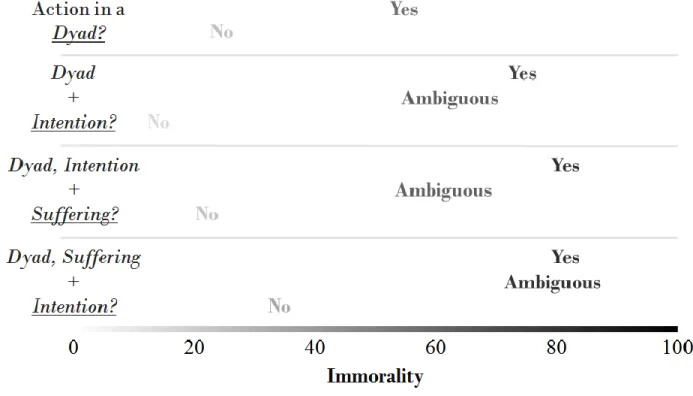
Seven experiments reveal the immorality bias: in morally ambiguous situations, people automatically jump to conclusions of wrongdoing. In Experiment 1, ambiguous acts (e.g., “A woman leaves work early to meet a man who is not her husband”) were rated as more immoral when people reported initial interpretations rather than most likely explanations. In Experiments 2-5, neutral nonsense actions (e.g., “John flurbed”) were judged as immoral to the extent that their context matched the dyadic moral template through the presence of a patient (“John flurbed Mary”; Experiments 2 and 3), intentionality (“John intentionally flurbed Mary”; Experiment 4), and suffering (“John intentionally flurbed Mary, who cried”; Experiment 5). The immorality bias is stronger under time pressure (Experiment 6), and process-dissociation reveals its automaticity (Experiment 7). The immorality bias suggests that intuitive moral judgment can be understood as a heuristic—one that hinges upon the dyadic moral template.
iv
ACKNOWLEDGEMENTS
Thank you to my advisor, Kurt Gray, for his support and mentorship during this project and many others. Thanks also to Keith Payne for his wisdom and input on this project. Finally, thanks to Lindsey Helms and Hanne Schrickx for helping with stimulus creation for the
v TABLE OF CONTENTS LIST OF TABLES ... ix LIST OF FIGURES ... x INTRODUCTION... 1 Adaptive Biases ... 1 Innocence or Guilt?... 3
Biases Arise from Heuristic Cognition ... 4
Efficiency. ... 5
Intuition. ... 5
Substitution. ... 5
Dyadic Morality and the Immorality Bias ... 6
The Present Research ... 8
EXPERIMENT 1: FIRST THING VERSUS MOST LIKELY ... 10
Method ... 10
Participants and Design... 10
Procedure and Materials ... 10
Results and Discussion ... 11
EXPERIMENT 2: THE IMMORALITY OF NONSENSE ACTIONS ... 13
Method ... 13
Participants and Design... 13
vi
Results and Discussion ... 15
EXPERIMENT 3: IMMORALITY AND VIRTUE ... 17
Method ... 17
Participants and Design... 17
Procedure and Materials ... 17
Results and Discussion ... 18
EXPERIMENT 4: INTENTIONAL AGENTS ... 20
Method ... 21
Participants and Design... 21
Procedure and Materials ... 21
Results and Discussion ... 22
Intention Increases the Immorality Bias ... 22
Intention Matters More for Dyads ... 22
People Assume Immoral Intent ... 23
EXPERIMENT 5: SUFFERING PATIENTS ... 25
Method ... 26
Participants and Design... 26
Procedure and Materials ... 26
Results and Discussion ... 27
Suffering Increases the Immorality Bias ... 27
Suffering Matters More for Intentional Acts ... 27
People Assume Suffering Victims ... 28
vii
People Assume Immoral Intent ... 28
EXPERIMENT 6: TIME PRESSURE AND REAL ACTIONS ... 30
Method ... 30
Participants and Design... 30
Procedure and Materials ... 31
Results and Discussion ... 31
Harmful and Helpful Actions Are Unambiguous ... 31
Nonsense Actions are More Immoral under Time Pressure ... 32
Nonsense Actions Resemble Harmful Actions ... 33
EXPERIMENT 7: PROCESS DISSOCIATION AND SHORT SENTENCES ... 34
Method ... 35
Participants and Design... 35
Procedure and Materials ... 35
Results and Discussion ... 36
Immoral Responses ... 36 Process Dissociation ... 37 GENERAL DISCUSSION ... 40 Caveats ... 41 Theoretical Implications ... 42 Adaptiveness. ... 42 Moral cognition. ... 44
Reducing the Immorality Bias ... 46
viii
ix
LIST OF TABLES
Table 1. Scenarios used in Experiment 1 ... 49 Table 2. List of nonsense actions by source... 50 Table 3. Sentences categorized by participants in Experiment 6... 51
x
LIST OF FIGURES
Figure 1. Percentage of “Immoral” or “Virtuous” Responses ... 52
Figure 2. Percentage of “Immoral” Responses by Intent and Patient. ... 53
Figure 3. Percentage of “Immoral” Responses by Intent and Suffering ... 54
Figure 4. Percentage of “Immoral” Responses by Time and Verb Type ... 55
Figure 5. Percentage of “Immoral” Responses by Time and Category ... 56
1
INTRODUCTION
Imagine you came home early from work and saw the front door ajar with an unfamiliar car parked in driveway. Your first thought is likely either of a cheating spouse or a daylight burglary, despite many other innocuous possibilities, such as a repairperson fixing the cable or your spouse’s nephew driving through town. In this ambiguous example, your mind seems to jump to nefarious explanations, even if they are relatively unlikely. We hypothesize that people generally assume wrongdoing in ambiguous situations, a phenomenon called the immorality bias. The presence of this fundamental asymmetry in moral intuitions would be practically important: while the law states that people are innocent until proven guilty, our minds may assume the opposite. Revealing an immorality bias would also suggest that moral judgment is similar to nonmoral decision making—with its heuristics and biases—and thus speak to debates about the nature of moral cognition.
Adaptive Biases
Biases are systematic errors in information processing that are especially prevalent in ambiguous situations. They are typically adaptive, nudging people towards safety, efficiency, reproductive success, or emotional wellbeing. Biases can be attentional, privileging the salience of information in consciousness, and include the bias to detect snakes in a visual field (Öhman, Flykt, & Esteves, 2001), to focus on sexually attractive women when mating goals are salient (Maner, Gailliot, & DeWall, 2007), and to attend to angry faces over happy faces (Hahn, Carlson, Singer, & Gronlund, 2006).
2
Given the importance of morality to individual and group well-being (de Waal, 2008; DeScioli & Kurzban, 2009), moral cognition might be expected to show an attentional bias. Consistent with this idea, morality cues are more quickly identified than competence cues (Ybarra, Chan, & Park, 2001), people are quicker to judge moral issues than nonmoral issues (Van Bavel, Packer, Haas, & Cunningham, 2012), and to react to language expressing moral disagreement than moral agreement (Van Berkum, Holleman, Nieuwland, Otten, & Murre, 2009). An attentional moral bias may even extend to visual perception such that moral stimuli are perceived more quickly than nonmoral stimuli (Gantman & Van Bavel, 2014).1
Biases can also be judgmental, in which evaluations or assessments consistently lean in the more adaptive direction. In ambiguous cases of failure, people blame the situation rather than themselves, because high self-esteem is generally beneficial (e.g., Bradley, 1978; Mezulis, Abramson, Hyde, & Hankin, 2004). In ambiguous social interactions, people assume that others hold the same attitudes, because similarity facilitates beneficial outcomes such as interpersonal liking and closeness (Mullen et al., 1985; Ross, Greene, & House, 1977). In ambiguous
situations of potential loss, people err on the side of caution and avoid risk (Tversky & Kahneman, 1981, 1991)
Given that morality is itself adaptive—it increases evolutionary and cultural fitness—we might also expect that moral judgment should show a judgmental bias, such that people assume either others’ innocence or guilt. On one hand, people might give others the benefit of the doubt, judging something as innocuous when it is actually immoral; on the other hand, they might instead judge actions as automatically immoral.
3 Innocence or Guilt?
At first blush, there are reasons why assuming innocence could be adaptive. Accusations, especially false ones, can destroy relationships and create enemies (Coy, Lambert, & Miller, 2016; Hall & Hall, 2001)—many families, congregations and political parties have been torn apart by harsh allegations. People appear to have an intuitive understanding of the risk involved in condemning others (Bottoms, Goodman, Schwartz-Kenney, & Thomas, 2002; Whitman & Davis, 2007) and show a reluctance to accuse others of cheating (Hyland, 2001; Nora & Zhang, 2010; Trevino & Victor, 1992) or lying (Bottoms et al., 2002; Reuben & Stephenson, 2013). However, although people may be reluctant to publically condemn others, the mind may still show a bias for immorality. Disjunctions between initial intuitions and eventual actions and judgments are frequent (e.g., Bodenhausen, 1990; Stroop, 1935; Toplak, West, & Stanovich, 2011; see Chaiken & Trope, 1999), and it may be adaptive to first assume immorality in ambiguous situations.
Most canonical and common cases of immorality involve physical or emotional harm (Graham et al., 2011; Gray, Young, & Waytz, 2012; Hofmann, Wisneski, Brandt, & Skitka, 2014; Malle, 2006), and an immorality bias might protect against such harm. As a potential victim of wrongdoing, the more quickly you recognize immorality, the better able you are to prevent yourself from being killed, injured or otherwise harmed (Blanchette, 2006; LoBue, 2010; LoBue & DeLoache, 2010; Öhman et al., 2001). As a potential bystander, the immorality bias may help you quickly aid victims, preserving the well-being of family members, friends, and other members of your coalition (Latané & Darley, 1968; Schroeder, Penner, Dovidio, & Piliavin, 1995). Furthermore, quickly recognizing wrongdoers is a necessary step to quickly distancing yourself from them, thereby guarding against guilt-by-association (Fortune &
Newby-4
Clark, 2008; Walther, 2002). Finally, although moral judgments can sometimes tear communities apart, these judgments are also often instrumental in the formation and maintenance of social groups (DeScioli & Kurzban, 2013; Lewis, Gray, & Meierhenrich, 2014; Rai & Fiske, 2011)— few things bring people together more than shared perceptions of villainy (Bosson, Johnson, Niederhoffer, & Swann, 2006; Sherif, 1961).
Biases Arise from Heuristic Cognition
Judgmental biases are often associated with heuristics, which are rules of thumb that simplify and expedite decision-making (Gilovich, Griffin, & Kahneman, 2002). These heuristics make complex situations more manageable and often yield accurate judgments (Gigerenzer & Brighton, 2009)—and they have a set of similar features. First, heuristics function efficiently, demanding little time and few cognitive resources (Chaiken, 1980; Gigerenzer & Goldstein, 1996). Second, they are intuitive, relying on natural assessments that often occur without deliberation (Tversky & Kahneman, 1983). Third, they involve substitution, relying on simple judgments as proxies for complex judgments (Kahneman & Frederick, 2002).
By efficiently and intuitively using judgmental proxies, heuristics lead to systematically incorrect judgments in certain situations—i.e., bias. Because judgmental biases are dependent on the operation of heuristics, an immorality bias requires that moral judgments proceed
heuristically. Sunstein (2005) argues for just such “moral heuristics” that simplify complex decisions such as assignments of blame and punishment. Many of these heuristics apply to certain situations, such as taboo tradeoffs (Tetlock, Kristel, Beth, Green, & Lerner, 2000), corporate neglect (Viscusi, 2000), and judgments of medicine and pollution (Bergström & Lynöe, 2008; Scheske & Schnall, 2012). However, there is evidence that moral judgments are globally heuristic—featuring efficiency, intuition, and substitution.
5
Efficiency. Heuristics are partly adaptive due to their “fast and frugal” nature, which allows them to function with limited knowledge, time, and cognitive resources (Gigerenzer & Goldstein, 1996). Moral decisions are certainly efficient, as people pass moral judgments in under a second—and on stimuli as spare as a single word (Schein & Gray, 2015; Wright & Baril, 2011). In fact, moral judgments are likely more efficient than even nonmoral judgments, as moral judgments are processed more quickly than other judgments (Van Bavel et al., 2012). Intuition. Heuristics are efficient largely because of their intuitive nature, generating judgments without conscious deliberation or reasoning (Gilovich et al., 2002). For example, the availability heuristic is unimpaired by cognitive load (Menon & Raghubir, 2003), the affect heuristic influences judgments without deliberation (Schwarz & Clore, 1983; Slovic, Finucane, Peters, & MacGregor, 2007) and gaze heuristics for catching moving objects are unconsciously employed (McLeod, Reed, & Dienes, 2003). Notably, many biases arising from heuristics are not appreciably reduced by incentivizing rational thought (Camerer & Hogarth, 1999). Moral
judgments are also intuitive, relying more upon affect-based gut reactions than upon reasoned calculation (Haidt, 2001). As with nonmoral heuristics, these initial affective reactions are difficult to dispel with conscious deliberation (Gray, Schein, & Ward, 2014; Jacobson, 2012; Royzman, Kim, & Leeman, 2015).
Substitution. When someone is faced with a complex question, such as “How likely is it that this job candidate could be tenured in our department?” they may instead think “How impressive was the talk?” and answer this simple question instead (Kahneman & Frederick, 2002, p. 53). Heuristics are efficient and intuitive because they substitute judgments of easy-to-understand attributes in place of more complex attributes. For example, the availability heuristic
6
substitutes ease of recall (“How readily does this come to mind?”) for base rates (“How often does this happen, taking into account many factors?”).
People’s moral judgments also seem to rely on substitutions. Negative affect inductions often lead to harsher moral judgments (e.g., Helzer & Pizarro, 2011; Wheatley & Haidt, 2005), as do high arousal inductions (Cheng, Ottati, & Price, 2013), suggesting that people often refer to the question “How do I feel?” when judging immoral situations, rather than carefully weighing aspects of the situation. However, moral judgments are based upon more than just negative affect—otherwise everything that left us feeling bad would seem immoral (Schein, Ritter, & Gray, in press). What are the elements within acts that moral cognition uses as substitutes for moral wrongness? The Theory of Dyadic Morality (Gray et al., 2012) suggests that three key elements for heuristic moral judgments: a dyad (person x acts upon person y), intention (x acts intentionally) and suffering (y suffers).
Dyadic Morality and the Immorality Bias
The Theory of Dyadic Morality suggests that moral judgment is fundamentally rooted in a cognitive template of two perceived minds—an intentional agent causing suffering to a
vulnerable patient (i.e., a perpetrator and victim)—and that moral judgment proceeds by
comparing acts to this dyadic template (i.e., dyadic comparison), with closer matches resulting in stronger moral judgment (Gray et al., 2012; Schein, Goranson, & Gray, 2015). Thus, acts which feature an obvious intentional agent and suffering patient should be most robustly judged as immoral, consistent with the greater perceived wrongness of murder and rape versus
pornography and masturbation (Schein & Gray, 2015). The process of dyadic comparison, in which greater perceived harm translates to greater judged immorality, has all the characteristics
7
of a heuristic: it is efficient, intuitive, and features a small number of simple elements—a dyad, intention, and suffering (Schein & Gray, 2015).
Such a dyadic heuristic is adaptive because it affords quick judgments of the most
canonical and dangerous cases of immorality (Wilson, 1997), such as murder and rape; however, it also allows for bias—the immorality bias. Given the dyadic elements, dyadic morality predicts that the immorality bias should emerge most robustly when acts seem to feature an intentional dyad with suffering. Revealing a systematic link between the “dyadicness” of situations and assumptions of immorality would not only reveal the cognitive mechanism of the immorality bias (i.e., dyadic comparison), but would also address an important question in moral
psychology.
There is a debate in the field about whether moral judgments involve a domain-general cognitive template (espoused by dyadic morality) or special domain-specific modules (espoused by moral foundations; Graham et al., 2013). Revealing the immorality bias would lend support to the dyadic morality position for two reasons. First, if the immorality bias is amplified by each additional element of dyad, intention, and suffering, it would argue against “basic” and indivisible moral modules which—by definition—cannot be deconstructed into more
fundamental components (Ekman, 1992; Haidt, 2012). Second, if the immorality bias hinges on the presence of dyadic elements, it would reveal that the dyad is causally involved in moral cognition (i.e., it determines moral judgment), rather than being a common, but non-essential component of moral situations.
Substantial past research is consistent with both of these dyadic claims (Cameron, Lindquist, & Gray, 2015; Gray & Schein, in press), but these studies have often used specific acts (e.g., murder, incest), which some have argued could involve specialized moral judgment
8
(Graham, 2015; but see Gray & Keeney, 2015a, 2015b). For example, murder seems very wrong, but is it wrong because it matches the dyad (i.e., intentionally caused harm), or because it’s just “murder?” The current research will address this concern by—among other methods—
manipulating the dyad with nonsense actions (e.g., “pelled”). If it intuitively seems wrong when “John intentionally pelled Mary, who cried,” then such assumptions of immorality can only be explained by a dyadic context because “pelled” is not a real immoral act.
The Present Research
Seven experiments tested for the immorality bias: the tendency to automatically assume wrongdoing in morally ambiguous situations. In Experiment 1, participants read ambiguous vignettes (e.g., “While a high school student takes a shower, he thinks of his younger sister”) and we predicted that their first thoughts would show more immorality than what they believed to be the most likely explanation. In Experiment 2, people read about nonsense actions taken from psycholinguistics research that were either dyadic (e.g., “John pelled Mary”) or nondyadic (“John pelled”). We predicted that the immorality bias would be much stronger in a full dyadic context (with agent acting upon patient), rather than a partial dyadic content (with only agent acting). In Experiment 3, people provided ratings of either immorality or virtue in response to dyadic and nondyadic sentences. This experiment tested the alternate explanation of a general “morality bias” in which people assume both immorality and virtue. In Experiments 4 and 5, we manipulated the presence of intention and suffering with these nonsense actions, predicting that both would amplify the immorality bias.
In Experiment 6, participants judged nonsense actions under a shorter or longer time limit. As the immorality bias is hypothesized to be intuitive, we predicted that it would be stronger under time pressure. Finally, in Experiment 7, participants judged sentences under
9
variable time pressure and process dissociation was used to reveal the extent of automatic versus controlled processes in the immorality bias. We predicted that participants would show a stable automatic assumption of immorality.
Revealing the immorality bias would be practically important: if people first assume guilt before later considering innocence, it would have implications for any cases of rapid moral decision-making, such as judgments of other drivers (i.e., leading to road rage), judgments of children (i.e., leading to child abuse), and police judgments of suspects (i.e., leading to decisions to shoot; Correll, Park, Judd, & Wittenbrink, 2002; Payne, 2001). Revealing the cognitive determinants of the immorality bias would also provide a key commentary on dyadic morality and suggest that moral judgment can be understood similarly to nonmoral judgments, with its heuristics and biases. This would imply that moral psychology need not reinvent the wheel when investigating the processes of moral judgment, but rather start from the voluminous literature on nonmoral decisions making.
Of course, there are some notable differences between moral judgment and nonmoral judgment: for example, moral judgments are more affective in nature (Haidt, 2001) and more motivating of action (Skitka & Bauman, 2008) compared to nonmoral judgments. Perhaps most importantly, there is no obvious objective standard for measuring the immorality bias; judgments of immorality lack the objective base rates or tradeoffs that are often present for heuristic
judgments (and facilitate strong claims about accuracy). However, such a bias can be revealed by contrasting intuitive and more considered decisions (Experiments 1, 6, 7), and by examining nonsense actions which lack any intrinsic immorality (Experiments 2-6). An immorality bias would be revealed if rapid, more intuitive judgments displayed more immorality than slower, more reasoned judgments.
10
EXPERIMENT 1: FIRST THING VERSUS MOST LIKELY
In this first experiment, participants read five morally ambiguous scenarios (e.g., A woman leaves work early to meet a man who is not her husband) and wrote down either the “first thing that comes to mind” or the “most likely explanation.” The immorality bias predicts that first thoughts should be more immoral (for example, cheating on a partner) than later thoughts (meeting a brother or friend).
Method
Participants and Design
Participants for all experiments were recruited using Amazon Mechanical Turk (MTurk) and paid between $.20 and $.75. Previous research has established MTurk as a viable
marketplace for recruiting diverse and high-quality participants (Buhrmester, Kwang, & Gosling, 2011; Goodman, Cryder, & Cheema, 2012). For this first experiment, we recruited one hundred participants via MTurk who completed a two-condition (Instructions: First Thing, Most Likely) between-subjects experiment. Thirteen participants failed the attention check, leaving 87 participants (52.9% female, Mage = 34 years).
Procedure and Materials
Scenarios. Participants read five scenarios (presented in random order) and then described either “the first thing that comes to mind” (First Thing condition) or “the most likely explanation” (Most Likely condition) for each scenario. See Table 1 for a list of the scenarios. We also recorded the amount of time taken to complete each scenario.
11
Ratings. After providing their responses, participants rated the extent to which these responses were related to “immoral thoughts or behaviors” using a 5-point scale from Not at all (1) to Extremely (5). No effect of specific scenarios emerged, (α = .83), and so participants’ ratings were collapsed into a single rating.
Manipulation Checks. As participants’ first thoughts should reflect rapid intuitions, we predicted that thoughts in the First Thing condition should be listed more quickly, and perhaps also involve less perceived difficulty. For this reason, we assessed the speed of responses and had participants rate “how difficult” they found the task on a scale from Not at all (1) to Extremely (5), as well as how often they had to “subdue or ignore other thoughts about the passage to follow instructions” on a scale from Never (1) to Very often (5).
After excluding one extreme outlier (Cook’s D = .79), a between-subjects t-test
(Instructions: First Thing, Most Likely) confirmed that participants in the First Thing condition used fewer seconds to complete each scenario (M = 16.38, SD = 8.58) than participants in the Most Likely condition (M = 25.90, SD = 11.71), t(84) = 4.34, p < .001, d = .94.2 Contrary to our
predictions, the same t-test (Instructions: First Thing, Most Likely) revealed no significant differences between conditions for either the difficulty or the intrusion item, ps > .2. This result suggests that participants may not subjectively view the Most Likely task as more difficult, even though it takes longer to complete.
Results and Discussion
Consistent with the immorality bias, a between-subjects t-test (Instructions: First Thing, Most Likely) revealed that people perceived greater wrongdoing in the First Thing condition (M
2 Due to a programming error, the time for one of the scenarios in the First Thing condition was not recorded in Experiment 2. The Cronbach’s alpha for the four remaining times is .85, which suggests that the remaining values sufficiently capture participants’ average response times.
12
= 3.78, SD = 1.13) than in the Most Likely condition (M = 2.58, SD = 1.29), t(85) = -4.63, p < .001, d= 1.00.
One limitation of this experiment is that these longer scenarios are evocative and may have led people “down the garden path.” Specific language can subtly influence our perceptions of meaning, and people have an intuitive sense of how euphemisms and roundabout descriptions often describe unsavory events (Bohner, 2001; Frazer & Miller, 2008; Henley, Miller, &
Beazley, 1995).
Furthermore, detailed scenarios do not provide the flexibility necessary to cleanly manipulate contextual factors, such as the presence of a patient, the intentionality of an act, or the suffering of a patient. For these reasons, we used a nonsense action paradigm for
13
EXPERIMENT 2: THE IMMORALITY OF NONSENSE ACTIONS
The immorality bias predicts that people will see immorality even in minimal situations, given the right context. To create these minimal situations, we provided participants with nonsense actions, such as “John pelled Mary” and “Jennifer gished Lisa” and they categorized these sentences as either immoral or not immoral. Of course, some actions might seem more “intrinsically” immoral by sounding similar to actual moral words (e.g., “frangled” sound like “strangled”), and we could be (unconsciously) predisposed to choose such words in our experiments (even “flurbed” might seem intrinsically bad). For this reason, we used only nonsense actions from past research in linguistics and cognitive psychology—actions which were used to investigate hypotheses completely unrelated to morality.
As biases are triggered by the presence of heuristic elements, dyadic morality predicts that the immorality bias should occur largely in the dyadic context of agent and patient. Accordingly, this experiment manipulated whether nonsense actions targeted a patient (“John pelled Mary”) or not (“John pelled”). Although the very presence of an agent might trigger some immoral judgments, we predicted that the immorality bias would be much larger in the dyadic context.
Method
Participants and Design
We recruited 54 participants via MTurk (46.3% female, Mage = 37 years), who completed
a two-condition (Patient: Absent, Present) within-subjects experiment. No participants’ data were excluded from the study.
14 Procedure and Materials
Nonsense actions. In this experiment, we used nonsense actions as ambiguous stimuli, an often-used approach in cognitive psychology and linguistics. To create our stimulus set, we compiled nonsense actions from 15 cognitive psychology and linguistics articles. We then excluded verbs with irregular conjugations (e.g., strink and strunk) and verbs longer than two syllables (e.g., dorfinize) to create a more uniform set of actions. This selection process left us with a word bank containing 76 nonsense actions. See Table 2 for all nonsense actions and citations.
Agent and patient names. In addition to nonsense actions, the sentences also involved specifying agents and patients. Because specific names can influence judgments (Erwin, 2006; Silver & McCann, 2014), we created two name banks to ensure that the immorality bias is not driven by certain names. The agent and patient word banks each contained 40 names—20 male and 20 female—drawn from a list of the 40 most popular male and female names in the United States in the last 100 years (Social Security Administration, 2016). In all experiments, male and female names were randomly chosen to ensure that effects were not driven by particular agent or patient genders. See Appendix A for a full list of male and female names.
Sentence presentation. Using Inquisit Lab (version 4.0.9.0), we designed a program that dynamically creates sentences for each participant by combining a random agent, a random nonsense action, and a random patient (e.g., Jose “stiped” Louis; Helen “blicked” Kenneth”). This approach ensures that our effect is not driven by the inclusion of specific stimuli (Wells & Windschitl, 1999).3
3 Across the four studies that use this nonsense action paradigm, this dynamic approach to creating stimuli yielded the possibility of providing participants with over 17 million unique sentences.
15
Sentence categorization task. Each participant viewed 76 unique sentences— one for each nonsense action—and categorized each as either Immoral or Not Immoral. The use of a binary outcome variable is common when participants make judgments of ambiguous or quickly-presented stimuli (e.g., Correll et al., 2002; Greenwald, Mcghee, & Schwartz, 1998; Payne, Cheng, Govorun, & Stewart, 2005). Within-subjects, we manipulated the presence of a Patient (Absent/Present): half of the sentences did not feature a patient (e.g., “John pelled”), whereas the other half did (“John pelled Mary”). The first eight sentences were presented as practice trials and were not included for analysis. We asked participants to provide each of their responses within five seconds; this amount of time proved ample, with participants successfully categorizing sentences in 98.9% of trials with an average latency of 1.12 seconds. Results and Discussion
To account for variance owing to specific effects of participants, actions, or names, we analyzed the data using a fully cross-classified linear model with a binary outcome variable (Baayen, Davidson, & Bates, 2008). This model provided a more accurate and more powerful test of our manipulations than a traditional repeated measures ANOVA and also allows for some missing data (i.e., missing trials; Krueger, 2004). In all of the models, the intercepts varied randomly across both participant and verb levels so that our effects generalize beyond the current sample.
As predicted, the analysis of fixed effects revealed a main effect of Patient, F(1, 3630) = 321.40, p < .001, such that participants were more likely to rate sentences as immoral when a patient was Present (Mpct = 54.3, 95% CI [52.0, 56.6]) than when a patient was Absent (Mpct =
24.7, 95% CI [22.7, 26.7]). These results suggest that the presence of a patient influences the extent to which people show the immorality bias, and also suggests that the immorality bias
16
cannot simply be explained by the negativity bias—the greater power of negativity versus positive stimuli (Baumeister, Bratslavsky, Finkenauer, & Vohs, 2001)—because the presence of a patient is not intrinsically negative.
However, another alternate explanation is that people gravitate toward morally relevant assumptions, both immoral and virtuous, in a dyadic context. In other words, the “immorality bias” could just be a “morality bias” in which people assume both helpful and harmful actions in a dyadic context. To test this alternate explanation, we replicated Experiment 2 and had a second group of participants categorize the sentence by virtue, instead of immorality.
17
EXPERIMENT 3: IMMORALITY AND VIRTUE
The first two experiments provide evidence that that people jump to conclusions of wrongdoing in dyadic situations. However, one possible explanation for this pattern is that people simply jump to morally relevant conclusions when an agent and patient are present—that is, we may assume that people are more likely to both help and hurt in a dyadic context,
compared to a nondyadic context. In Experiment 3, participants either gave ratings of immorality (Immoral–Not Immoral) or virtue (Virtuous–Not Virtuous) for both dyadic and nondyadic sentences. We predicted that people would show a bias toward immoral responses, but not virtuous responses, when sentences were dyadic.
Method
Participants and Design
We recruited 102 participants via MTurk (57.7% female, Mage = 35 years), who
completed a 2 (Rating Type: Immoral, Virtuous) by 2 (Patient: Absent, Present) between-within experiment. One participant did not respond to over 50% of the trials and skipped the
demographics; his or her data were excluded from the analyses. Procedure and Materials
Sentence manipulations. Participants again read sentences with nonsense actions. As in Experiment 2, a patient was either absent or present in each sentence.
Sentence categorization task. Participants categorized each of the sentences as either Immoral–Not Immoral or Virtuous–Not Virtuous. The first eight sentences were presented as practice trials and were not included for analysis. We asked participants to provide each of their
18
responses within five seconds; this amount of time proved ample, with participants successfully categorizing sentences in 98.4% of trials with an average latency of 1.08 seconds.
Results and Discussion
We predicted that participants would show the immorality bias, such that Immoral ratings were higher when the Patient was Present. We also predicted that no such effect would emerge for Virtuous ratings. We used a fully cross-classified linear model to analyze the effects of Rating Type (Immoral, Virtuous) and Patient (Absent, Present) on participants’ ratings.
The analysis revealed no main effect of Rating Type, F(1, 6891) = .39, p = .54, as well as a main effect of Patient, F(1, 6891) = 84.43, p < .001. The main effect of Patient was qualified by a Rating Type x Patient interaction, F(1, 6891) = 291.74, p < .001. The pattern found in Experiment 2 replicated: Immoral ratings were higher when the patient was Present (Mpct = 57.1,
95% CI [54.7, 59.4]) than when the patient was Absent (Mpct = 26.0, 95% CI [23.9, 28.1]). This
finding suggests that, in a dyadic context, people assume immorality. They do not, however, appear to assume virtue in the same way: Virtue ratings were actually higher when the patient was Absent (Mpct = 44.7, 95% CI [42.4, 47.0]) rather than Present (Mpct = 35.1, 95% CI [32.9,
37.4]). This reversal is likely explained by the opposition of immorality and virtue: if actions seem more immoral in a dyadic context, then they also seem less virtuous. Furthermore, a comparison of Immoral and Virtue ratings when the patient was Present shows that ratings of immorality (Mpct = 57.1, 95% CI [54.7, 59.4]) are higher than ratings of virtue (Mpct = 35.1, 95%
CI [32.9, 37.4]) in a dyadic context, again consistent with the immorality bias. See Figure 1 for means and confidence intervals.
These results of Experiment 3 suggest that the immorality bias—a tendency to assume wrongdoing in ambiguous social situations—cannot be explained by a more general “morality
19
bias” that compels people to assume both virtuous and immoral actions in a dyadic context. Ratings of immorality were higher than those of virtue when the patient was present; they were also higher when the patient was present, rather than absent, consistent with dyadic morality.
20
EXPERIMENT 4: INTENTIONAL AGENTS
Dyadic morality suggests that intention is a key element of the moral template, and so the immorality bias should be stronger when acts are dyadic and clearly intentional. In this study, we therefore manipulated both whether the patient was absent or present, and whether the agent acted intentionally (“John intentionally pelled Mary”), accidentally (“John accidentally pelled Mary”), or ambiguously (“John pelled Mary”). We predicted that ratings of immorality would be highest for intentional actions with a patient (“John intentionally pelled Mary”), and lowest for accidental actions without a patient (“John accidentally pelled”).
The predictions regarding the other conditions are more complex. Although the most canonical immoral actions feature a complete dyad with intention and suffering, the mind often fills in other elements of the dyad when they are left unspecified. This is the phenomenon of “dyadic completion” in which immoral contexts prompt people to perceive either intentional agents or suffering patients in incomplete dyads of either random suffering or “victimless” crimes (DeScioli, Gilbert, & Kurzban, 2012; Gray, 2012; Gray et al., 2014; Gray & Wegner, 2010; Shweder, Much, Mahapatra, & Park, 1997). In other words, dyadic completion nudges acts with some elements of immorality (e.g., the dyad) to seem to include more elements of immorality (e.g., intention).
Therefore, in our study, we expected that when a patient was present but intention was ambiguous, participants’ would perceive some intent—and therefore give immorality judgments closer to “intention present” than “intention absent.” On the other hand, in the absence of a dyadic context (patient absent), we expected lesser assumptions of intention (and immorality).
21
Revealing this pattern of results would support the existence of an immorality bias that “assumes the worse” when morally-relevant—but ambiguous—elements are present.
Method
Participants and Design
We recruited 81 participants via MTurk (58.0% female, Mage = 37 years), who completed
a 3 (Intention: Intentional, Accidental, Ambiguous-Intent) by 2 (Patient: Absent, Present) within-subjects experiment. No participants’ data were excluded from the study.
Procedure and Materials
Sentence manipulations. Participants again read sentences with nonsense actions. As in Experiments 2 and 3, a patient was either absent or present in each sentence. In order to further reduce ambiguity about the absence of presence of a patient, we added “by himself/herself” when the patient was absent (e.g., “John pelled by himself”).
We also manipulated agent intention. Participants read sentences with clear intentional action (e.g., “John intentionally/willfully/purposely pelled Mary”), clear accidents (“John accidentally/unintentionally/inadvertently pelled Mary”), and Ambiguous-Intent actions (“John pelled Mary”). Because there were 76 total trials, each-within subjects cell included 12 or 13 sentences (M = 12.67). The multilevel framework used to analyze the data allowed us to easily account for differences in trial numbers.
Sentence categorization task. Participants categorized each of the sentences as Immoral or Not Immoral. The first eight sentences were presented as practice trials and were not included for analysis. We asked participants to provide each of their responses within six and a half seconds; this amount of time proved ample, with participants successfully categorizing sentences in 99.5% of trials with an average latency of 1.48 seconds.
22 Results and Discussion
Intention Increases the Immorality Bias
Because intention is an important element of the moral template, we predicted that ratings of immorality would be highest for Intentional acts and lowest for Accidental acts. We again used a fully cross-classified linear model to analyze the effects of Patient (Absent, Present) and Intention (Intentional, Accidental, Ambiguous-Intent) on participants’ ratings of immorality.
The analysis revealed the predicted main effect of Intention, F(2, 5636) = 383.96, p < .001. Participants rated Intentional actions (Mpct = 60.3, 95% CI [58.0, 62.6]) as more immoral
than Ambiguous-Intent actions (Mpct = 42.2, 95% CI [39.8, 44.7]), which in turn were rated as
more immoral than Accidental actions (Mpct = 11.6, 95% CI [10.2, 13.2]). These results support
our basic prediction that intentional acts increases the immorality bias, whereas accidents mitigate it.
The analysis of fixed effects revealed a main effect of Patient, F(1, 5636) = 304.02, p < .001. Participants categorized sentences as immoral more often when the patient was Present (Mpct = 48.8, 95% CI [46.6, 51.1]) than when the patient was Absent (Mpct = 22.6, 95% CI [21.0,
24.3]), replicating the finding in Experiments 2 and 3. See Figure 1 for means and confidence intervals.
Intention Matters More for Dyads
We further predicted that the effect of Intention would be especially strong when the patient was Present. The main effects in the analysis were qualified by a Dyad x Intention interaction, F(2, 5636) = 21.86, p < .001. Although there was a significant difference between ratings of Intentional and Accidental actions when the patient was Absent, (Mdiffpct = 34.1, 95%
23
95% CI [57.0, 64.2]). Intention impacted ratings of immorality more strongly in a dyadic context, as predicted by dyadic completion (Gray et al., 2014).
People Assume Immoral Intent
Although it is noteworthy that Intention is more immoral in a dyadic context, what is more important for the immorality bias is that people assume immoral intent when intention is ambiguous. We predicted that people would assumes immoral intent when a patient was Present, such that immoral ratings of Ambiguous-Intent actions more closely resemble ratings of
Intentional actions than Accidental actions. In other words, even when people had no clear information about intent, we predicted that they would nevertheless assume its presence in dyadic contexts, rather than assuming innocent accidents.
To test whether ratings of Ambiguous-Intent actions more closely resemble ratings of Intentional actions when the patient is Present, we compared the confidence intervals of the difference scores for [Intentional – Ambiguous-Intent] and [Ambiguous-Intent – Accidental]. If the confidence intervals for two estimates do not overlap at 95%, then the values are significantly different.4 When standard inferential tests are inaccessible due to the constraints of statistical programs, comparing confidence intervals has been established as an acceptable alternative for significance testing (MacGregor-Fors & Payton, 2013; Payton, Greenstone, & Schenker, 2003). These comparisons were conducted for when the patient was Absent and when the patient was Present.
4 However, if the 95% confidence intervals for two estimates do overlap, they may still be significant. These instances can be clarified using 84% confidence intervals; checking whether or not these intervals overlap approximates a significance test with an alpha of .05 (MacGregor-Fors & Payton, 2013; Payton, Greenstone, & Schenker, 2003). Although the validity of this approach has been debated for within-subjects models, the intervals generated in a multilevel framework should allow for accurate comparison, given a balanced design (Baguley, 2012).
24
When the patient was Present, Ambiguous-Intent ratings more closely resembled Intentional ratings (Mdiffpct = 12.2, 95% CI [8.1, 16.4]) than Accidental ratings (Mdiffpct = 48.4,
95% CI [44.5, 52.2])—that is, ratings of Ambiguous-Intent actions were more similar to ratings of Intentional actions, consistent with the immorality bias (and with dyadic morality). When the patient was Absent, no bias emerged as Ambiguous-Intent ratings resembled both Intentional ratings (Mdiffpct = 19.4, 95% CI [15.2, 23.6]) and Accidental ratings (Mdiffpct = 14.7, 95% CI [11.4,
18.0])5 by approximately the same amount. This finding supports the idea that participants assume immoral intent when a patient is Present, even when the situation is more ambiguous. This is consistent with the immorality bias in which people automatically jump to immoral conclusions unless the action is unambiguously described as accidental.
5 The non-significance of this difference was clarified by finding that the 84% CIs still overlap, [16.6, 22.7] and [12.5, 17.3].
25
EXPERIMENT 5: SUFFERING PATIENTS
Although intention is an important component of immorality, many intentional actions are perfectly benign. It is intentional actions that seem to cause suffering that best fits the dyadic moral template. Thus, the immorality bias should be stronger when actions appear to cause suffering and substantially weaker when actions do not appear to cause suffering. Furthermore, dyadic completion—coupled with the immorality bias—could mean that the mere presence of suffering in a dyadic context may prompt robust judgments of immorality.
To test this idea, participants categorized nonsense actions as in the previous experiment. All actions were dyadic in nature (i.e., all had a patient present), and we manipulated both the intention of the agent and whether the patient suffered (“John pelled Mary, who cried”), benefited (“John pelled Mary, who laughed”), or gave no clear reaction (“John pelled Mary”).
We predicted that ratings of immorality would be highest with a suffering patient and lowest with a benefiting patient, especially when the action was clearly intentional. We also predicted that participants’ would assume suffering and intention when its presence is
ambiguous, especially when other dyadic elements are present. In other words, when suffering is present, people should assume intention, and when intention is present, people should assume suffering. These findings would support an immorality bias: people assume the elements of immorality when they are ambiguous to the extent that the context is dyadic.
26 Method
Participants and Design
We recruited 64 participants via MTurk (51.6% female, Mage = 39 years), who completed
a 3 (Suffering: Suffering, Benefiting, Ambiguous-Suffering) by 3 (Intention: Intentional,
Accidental, Ambiguous-Intent) within-subjects experiment. No participants’ data were excluded from the study.
Procedure and Materials
Sentence manipulations. Participants read sentences with nonsense actions. As in Experiment 3, participants read sentences with clear intentional action, clear accidents, and Ambiguous-Intent actions.
We also manipulated patient suffering. Participants read sentences with a clearly suffering patient (e.g., “John pelled Mary, who cried/shuddered/screamed/yelled/sobbed”), a clearly benefiting patient (“John pelled Mary, who laughed/smiled/grinned/beamed/nodded”), and Ambiguous-Suffering patients (“John pelled Mary”). Because there were 76 total trials, each-within subjects cell included either 8 or 9 sentences (M = 8.44). The multilevel framework used to analyze the data allowed us to easily account for differences in trial numbers.
Sentence categorization task. Participants categorized each of the sentences as Immoral or Not Immoral. The first eight sentences were presented as practice trials and were not included for analysis. We asked participants to provide each of their responses within eight seconds; this amount of time proved ample, with participants successfully categorizing sentences in 99.3% of trials with an average latency of 1.78 seconds.
27 Results and Discussion
Suffering Increases the Immorality Bias
Because suffering is a key element of morality, we predicted that participants’ immoral ratings would be highest for suffering patients. We again used a fully cross-classified linear model to analyze the effects of Intention (Intentional, Accidental, Ambiguous-Intent) and Suffering (Suffering, Benefiting, Ambiguous-Suffering) on participants’ ratings of immorality.
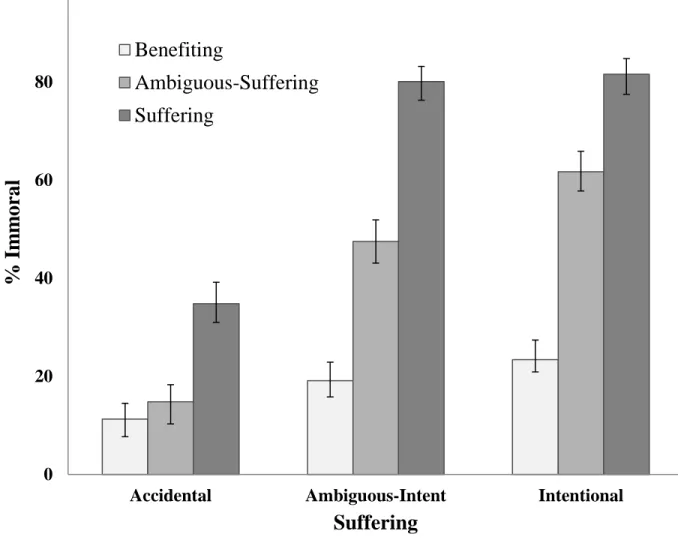
The analysis of fixed effects revealed the predicted main effect of Suffering, F(2, 4311) = 295.27, p < .001, such that participants rated sentences with Suffering patients (Mpct = 67.9, 95%
CI [65.2, 70.6]) as more immoral than those with Ambiguous-Suffering patients (Mpct = 38.7,
95% CI [35.9, 41.6]), which in turn were rated as more immoral than those with Benefiting patients (Mpct = 17.3, 95% CI [15.4, 19.4]). These results suggest that a suffering patient increase
the immorality bias, whereas a benefiting patient mitigates it.
The analysis of fixed effects revealed a main effect of Intention, F(2, 4311) = 182.27, p < .001, such that participants rated Intentional actions (Mpct = 56.4, 95% CI [53.4, 59.4]) as more
immoral than Ambiguous-Intent actions (Mpct = 48.7, 95% CI [45.7, 51.8]), which in turn were
rated as more immoral than Accidental actions (Mpct = 18.6, 95% CI [16.5, 20.8]). This result
replicates the finding in Experiment 4 that intention amplifies the immorality bias. See Figure 2 for means and confidence intervals.
Suffering Matters More for Intentional Acts
We further predicted that the effect of Suffering would be especially strong when acts were Intentional (further completing the moral template). The main effects in the analysis were qualified by an Intention x Suffering interaction, F(4, 4311) = 12.73, p < .001. As predicted, the difference in participants’ ratings of Suffering and Benefiting patients was greater in the
28
Intentional condition (Mdiffpct = 58.2, 95% CI [53.0, 63.4]) than in the Accidental condition
(Mdiffpct = 23.5, 95% CI [18.3, 28.6]).
People Assume Suffering Victims
The immorality bias specifically suggests that people assume the presence of a suffering patient even when the patient’s experience is ambiguous, and rate ambiguous sentences as immoral—especially when that action is Intentional. The data supported this prediction: when acts were Intentional, Ambiguous-Suffering ratings more closely resembled Suffering ratings (Mdiffpct = 19.9, 95% CI [14.3, 25.5]) than Benefiting ratings (Mdiffpct = 38.3, 95% CI [32.5, 44.1]).
Unless the patient is clearly benefiting, people assume immorality. Intention Matters More for Suffering Patients
Just as information about Intention influences how Suffering changes people’s responses, we also predicted that information about Suffering would change the influence of Intention. Specifically, we predicted that the effect of Intention would be especially strong when the patient was Suffering. The data supported this prediction: there was a greater difference in participants’ ratings of Intentional and Accidental actions in the Suffering condition (Mdiffpct = 46.8, 95% CI
[41.2, 52.3]) than in the Benefiting condition (Mdiffpct = 12.0, 95% CI [7.3, 16.8]).
People Assume Immoral Intent
The immorality bias specifically suggests that that people assume immoral intent even when the agent’s intentions are unclear, especially when the patient is Suffering. The data again supported our prediction: when the patient was Suffering, Ambiguous-Intent ratings more closely resembled Intentional ratings (Mdiffpct = 1.5, 95% CI [-3.5, 6.4]) than Accidental ratings (Mdiffpct =
29
between Intentional and Ambiguous-Intent ratings, suggesting that the presence of suffering powerfully implies the presence of immoral intent.
The findings of Experiment 5 converge to support an immorality bias that is amplified by the presence of intention and suffering. When one of these elements is present, people not only weigh the other element more heavily when making judgments of immorality, but also simply assume that the other element is present. In this way, people “complete” the moral dyad and assume intention and suffering—and thus immorality—even when the action itself remains ambiguous.
30
EXPERIMENT 6: TIME PRESSURE AND REAL ACTIONS
Biases in judgment are typically stronger when people are placed under either cognitive load (Goldinger, Kleider, Azuma, & Beike, 2003; Greene, Morelli, Lowenberg, Nystrom, & Cohen, 2008) or time pressure (Finucane, Alhakami, Slovic, & Johnson, 2000; Rosset, 2008), especially for ambiguous stimuli. In this experiment, we varied the amount of time available to participants to categorize sentences as immoral or not immoral, with the prediction that
participants under time pressure would express the immorality bias more strongly by categorizing nonsense actions as more immoral.
Additionally, we added two unambiguous action categories—harmful actions and helpful actions—for two reasons. First, we wanted to compare overall ratings of nonsense actions to those of harmful and helpful actions. Consistent with the immorality bias, we predicted that nonsense actions would elicit ratings that more closely resemble harmful actions than helpful actions. Second, we did not expect time pressure to influence participants’ ratings of harmful actions, since these stimuli are already unambiguous immoral.
Method
Participants and Design
We recruited 110 participants via MTurk (56.5% female, Mage = 38 years), who
completed a 3 (Action: Nonsense, Harmful, Helpful) by 2 (Speed: Fast, Slow) within-between experiment. No participants’ data were excluded from the study.
31 Procedure and Materials
Sentence categorization task. Participants again read sentences and categorized each sentences as either Immoral or Not Immoral. Unlike previous experiments, some of the actions included in these sentences were real actions, both harmful (e.g., killed, slapped, threatened) and helpful (e.g., accepted, hugged, romanced). These actions were chosen to be very clearly
immoral or very clearly not immoral, both to serve as objective comparison points for the nonsense actions and to test the effect of time pressure on unambiguous targets. In total, participants rated 30 nonsense actions, 30 harmful actions, and 30 helpful actions. The first twelve sentences were practice trials and were not included for analysis. See Appendix C for a full list of harmful and helpful actions.
Time pressure manipulation. Participants had either 1.5 seconds (Fast) or 5 seconds (Slow) to categorize each sentence. To check the effectiveness of the time manipulation, we used a linear model to test whether Speed influenced response latency. We found a significant effect of time pressure, F(1, 8629) = 632.28, p < .001, such that participants in the Fast condition responded to the sentences more quickly (771ms) than those in the Slow condition (1248ms). Overall, participants successfully responded 96.2% of trials, suggesting that participants had adequate time to respond.
Results and Discussion
Harmful and Helpful Actions Are Unambiguous
The harmful and helpful actions were chosen to serve as unambiguous stimuli for comparison. We used a hierarchical linear model to analyze the effects of Action Type (Negative, Nonsense, Positive) and Speed (Fast, Slow) on participants’ ratings of immorality. The analysis of fixed effects revealed a main effect of Verb Type, F(2, 8300) = 1127.04, p <
32
.001, such that participants rated sentences with Harmful actions (Mpct = 90.3, 95% CI [87.7,
92.4]) as more immoral than those with Nonsense actions (Mpct = 58.2, 95% CI [51.8, 64.3]),
which in turn were rated as more immoral than those with Helpful actions (Mpct = 5.5, 95% CI
[4.2, 7.1]). The extreme ratings and small confidence intervals for the Harmful and Helpful actions suggest that participants had little uncertainty categorizing these stimuli.
Nonsense Actions are More Immoral under Time Pressure
The current study primarily tested whether participants expressed the immorality bias more strongly under time pressure, as is typically the case with judgmental biases. In particular, we predicted that the immorality bias would influence judgments of nonsense actions more strongly under time pressure.
The analysis of fixed effects did not reveal a main effect of Speed, F(1, 8300) = 1.79, p = .18. However, the main effects were qualified by a significant interaction, F(2, 8300) = 39.00, p < .001. An analysis of simple effects showed that the effect of Speed was significant for
Nonsense actions, t(8300) = 2.87, p = .004, such that participants in the Fast condition
categorized more sentences as immoral (Mpct = 66.8, 95% CI [58.2, 74.4]) than participants in the
Slow condition (Mpct = 49.0, 95% CI [40.2, 58.0]), suggesting that time pressure amplifies the
immorality bias. See Figure 3 for means and confidence intervals.
Furthermore, the effect of Speed was significant in the opposite direction for Negative verbs, t(8300) = -2.06, p = .04, such that participants in the Fast condition categorized fewer sentences as immoral (Mpct = 87.4, 95% CI [82.6, 91.0]) than participants in the Slow condition
(Mpct = 92.6, 95% CI [89.5, 94.8]). These results support our prediction that time pressure would
33
actions showed the opposite pattern, suggesting that these actions are unambiguous and that time pressure simply caused a loss of accuracy.
A similar “loss of accuracy” effect occurred for Helpful actions: the effect of Speed was significant for Helpful actions, t(8300) = 2.77, p = .006, such that those in the Fast condition categorized more sentences as immoral (Mpct = 8.2, 95% CI [5.7, 11.7]) than those with more
time to respond (Mpct = 3.6, 95% CI [2.4, 5.3]). Overall, these results suggest that the immorality
bias influences judgments more strongly under time pressure, but only for ambiguous stimuli. Nonsense Actions Resemble Harmful Actions
Finally, we predicted that ratings of Nonsense actions would more closely resemble ratings of Harmful actions than Helpful actions. A comparison of difference scores shows that Nonsense actions more closely resemble Harmful actions (Mdiffpct = 32.1, 95% CI [27.7, 36.6])
than Helpful actions (Mdiffpct = 52.7, 95% CI [47.6, 57.9]). Nonsense actions are perceived as
more similar to harmful actions than helpful actions, further suggesting that people show an immorality bias in response to ambiguous dyadic situations.
These results suggest that people’s moral judgments rely more strongly on the immorality bias when they have less time to think, suggesting that the immorality bias exhibits one of the common characteristics of biases. The next experiment attempts to clarify the processes underlying this effect of time pressure using a process dissociation procedure.
34
EXPERIMENT 7: PROCESS DISSOCIATION AND SHORT SENTENCES Just as judgmental biases are often influenced by factors such as cognitive load and time pressure, so too are these effects often understood using dual process models that include both controlled and automatic pathways. Contextual factors such as cognitive load and time pressure typically inhibit controlled responding, rather than increasing automatic assumptions. Though the previous experiment showed that time pressure can increase participants’ expression of the immorality bias, it did not pinpoint the mechanism of this effect.
To test whether the effect of time pressure is explained by a shift in controlled
responding, we designed an experiment that allowed us to use a process dissociation procedure to differentiate automatic and controlled processes (see Table 4; Jacoby, 1991; Payne, 2001). In order to use a process dissociation procedure, we created two sets of short sentences: Probably Immoral or Possibly Immoral. This procedure allowed us to separately test the influence of time pressure on automatic and controlled processes (see Table 4; Jacoby, 1991; Payne, 2001). Automatic processes require little cognitive effort and operate regardless of conscious intent. Controlled processes, on the other hand, are consciously executed and require greater cognitive effort; these processes can be disturbed by time pressure, cognitive load, and depleted cognitive resources. People attempt to respond using controlled processes, but are often unable to.
We predicted that participants who are unable to use controlled processes will instead rely on an automatic assumption of immorality. In particular, this bias will be influential when controlled and automatic processes are expected to yield opposite outcomes. That is, for the Possibly Immoral sentences, an automatic assumption of immorality would lead subjects to
35
respond “immoral,” but a thoughtfully controlled response would lead them to respond that it is not immoral. These results would suggest that people tend to automatically assume
wrongdoing—the immorality bias— and that this assumption is more likely to lead to errors when it is difficult to exert effortful control over responses.
Method
Participants and Design
We recruited 104 participants through MTurk, who completed a 2 (Sentence Type: Probably Immoral, Possibly Immoral) by 2 (Speed: Fast, Slow) within-between experiment. Six of these participants either failed to respond to three or more of the sentences in a given category or encountered technical difficulties; these participants were excluded, leaving 98 participants, 4 of whom did not provide demographic information but completed all other elements of the experiment (52.1% female, Mage = 33 years).
Procedure and Materials
Piloting the short sentence sets. To create a set of ambiguous immoral sentences for this experiment, two 60-participant groups recruited through MTurk categorized short sentences as either “Not Immoral” or “Immoral.”6 These participants were not placed under any time
pressure. We created two sets of stimuli, “Probably Immoral” and “Possibly Immoral,” by sorting the scenarios by the percentage of immoral responses and creating two sets with an average of approximately 75% immoral responses (Probably Immoral) and 25% immoral responses (Possibly Immoral). The final sets included 14 sentences in each category.
Short sentence categorization task. Participants received instructions to categorize each sentence that flashed on the screen as either “Not Immoral” or “Immoral.” Participants received
36
either 1500ms or 5000ms to complete each trial. Participants completed 14 practice trials using a set of practice items, then completed 28 main trials in which the sentences from the Probably Immoral and Possibly Immoral sets were randomly presented.
Time pressure manipulation check. As in Experiment 6, we used a linear model to check the effectiveness of our time manipulation. We found that Speed (Fast, Slow) significantly influenced response latency, F(1, 2908) = 104.34, p < .001, such that participants in the Fast condition responded to the sentences more quickly (897ms) than those in the Slow condition (1819ms). Participants provided responses for 92.3% of trials, suggesting that they had adequate time to respond.
Results and Discussion Immoral Responses
We used a fully cross-classified hierarchical linear model to analyze the effects of Sentence Type (Probably Immoral, Possibly Immoral) and Speed (Fast, Slow) and on
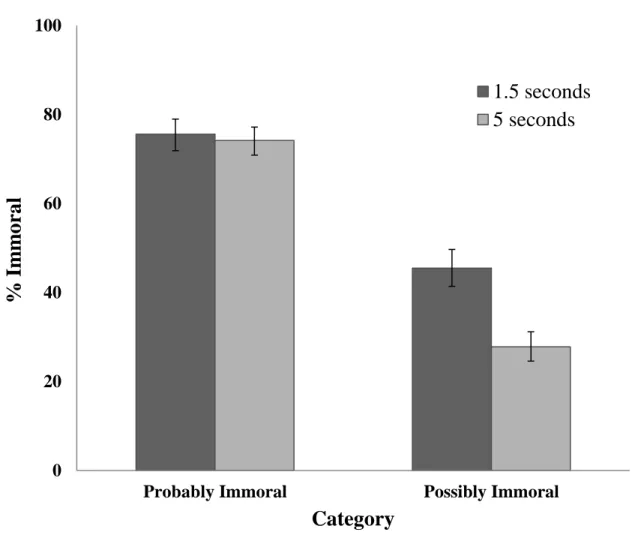
participants’ ratings of immorality. Unsurprisingly, the analysis of fixed effects showed a main effect of Sentence Type, F(1, 2684) = 370.82, p < .001, such that participants rated Probably Immoral sentences as more immoral (Mpct = 74.9, 95% CI [72.4, 77.2]) than Possibly Immoral
sentences (Mpct = 36.2, 95% CI [33.5, 38.9]). The analysis of fixed effects also revealed a main
effect of Speed, F(1, 2684) = 22.25, p < .001, such that participants with less time to respond categorized more sentences as immoral (Mpct = 61.7, 95% CI [58.5, 64.7]) than those with more
time to respond (Mpct = 51.3, 95% CI [48.3, 54.2]).
These main effects were qualified by a significant interaction, F(1, 2684) = 16.50, p < .001. An analysis of simple effects showed that the effect of Speed was significant for Possibly Immoral verbs, t(2684) = 6.56, p < .001, such that participants with less time to respond
37
categorized more sentences as immoral (Mpct = 45.5, 95% CI [41.4, 49.7]) than those with less
time to respond (Mpct = 27.8, 95% CI [24.6, 31.2]). However, the effect of Speed was not
significant for Probably Immoral, t(2684) = 0.58, p = .56.7 See Figure 4 for means and confidence intervals.
These results fit a control-impairment explanation: participants who have an automatic tendency to assume immorality will do so for both kinds of sentences, but this assumption will be opposed by more controlled thinking when the statement is likely to be nonmoral. Controlled processes are more likely to fail under fast responding, leading subjects to incorrectly “guess” that a sentence is immoral more often for the Possibly Immoral sentences than for the Probably Immoral sentences. We more directly addressed this possibility by analyzing the data using a process dissociation procedure.
Process Dissociation
In order to more directly test the mechanisms that account for the effect of Speed, we calculated two dependent variables—controlled processing and automatic assumption—using the guidelines provided in Payne (2001). These estimates can be dissociated because the experiment includes both congruent trials, in which controlled and automatic processes lead to the same answer, and incongruent trials, in which controlled and automatic processes lead to different answers. When a trial is congruent, the probability of responding that a sentence is “Immoral” is the probability of Control, C, plus the probability of assuming immorality when control fails, A(1 – C):
Congruent = C + A(1 – C). (1)
7 The dichotimized categories of Possibly Immoral and Probably Immoral were necessary for process dissociation. However, dichotomizing variables can raise concerns due to lost information or variability about the specific stimuli. To address this concern, additional analyses using the pilot test’s Percent values instead of dichotomized Categories is available in the Supplemental Materials.
38
In this experiment, Probably Immoral trials are congruent, since both controlled
processing and automatic assumptions lead to answering “Immoral.” Possibly Immoral trials, on the other hand, are incongruent, since controlled processing leads to answering “Not Immoral,” but automatic assumptions lead to answering “Immoral.” The probability of answering
“Immoral” for an incongruent trial is the probability of assuming immorality, A, whenever control fails, (1 – C):
Incongruent = A(1 – C). (2)
These equations for congruent and incongruent trials allow for the separation of controlled and automatic processing. Estimates of controlled processing represent a person’s ability to intentionally provide a certain response (i.e., “Immoral”) when they intend to, and not provide that response when they do not intend to. A higher estimate indicates greater controlled processing across all trials. The control estimate is the difference between answering “Immoral” in congruent and incongruent trials:
C = Congruent – Incongruent. (3)
On the other hand, estimates of automatic assumption represent a person’s tendency to provide a certain response (i.e., Immoral”) regardless of whether or not that response aligns with controlled processing. A higher automatic estimate indicates a stronger bias toward immorality. Solving for an estimate of control allows the automatic estimate to be solved:
A = Incongruent/(1 – C). (4)
If the immorality bias is driven by a stable automatic assumptions of wrongdoing, then the Speed condition should influence people’s ability to engage in controlled processing (i.e., their ability to accurately categorize the sentence based on their content and counteract their