Original Research Article
Study of sociodemographic factors affecting outcome of babies
admitted in neonatal care unit
Suchita N. Kawale
1*, Manjusha A. Shinde
2, Prashant S. Shinde
3INTRODUCTION
The first 28 days after birth is known as “neonatal period”. It is further divided into very early (birth to less than 24 hours), early (birth to less than 7 days) and late neonatal period (7 days to less than 28 days).1 One of the United Nations Millennium Development Goals is the reduction by two-thirds of the mortality among children <5 years of age by 2015.2 Of the 4 million neonatal deaths that occur every year, 98% are in the poorest countries of the world.3 Indeed, of all the components of the under-five mortality, early neonatal mortality has been the slowest to decline. The slow decline of neonatal
mortality, and in particular that of early neonatal mortality rate (ENMR), is a major stumbling block that could derail India‟s otherwise steady march towards reaching the Millennium Development Goal 4. The rate of decline in NMR, and to an extent ENMR, has accelerated with the introduction of National Rural Health Mission (NRHM) in mid-2005.
Several attempts to strengthen newborn care in India have been made, but a review of these interventions found that their overall impact on neonatal mortality was limited.4 Under the NRHM, newborn care has become central to the child survival strategy both in community and facility
ABSTRACT
Background: A country needs sound epidemiological information to prioritize, plan and implement the public health care system effectively. Outcome data from hospitalized patients reflect the causes of major illnesses and care seeking behaviour of the community. Thus, we felt the need to conduct this study at our hospital to assess the socio-demographic factors affecting outcome of babies admitted in neonatal intensive care unit.
Methods: The present study was a hospital based observational descriptive study. The study was undertaken in neonatal intensive care unit (NICU) of department of paediatrics of tertiary care centre. The study period was from January 2013 to December 2013 i.e. total period of one year.
Results: Among 1050 total neonatal admissions 601 (57.29%), were from rural area and 449 (42.70%) were from urban area. Multinomial regression analysis reveals that socio-demographic factors like age of mother, parental intake of tobacco alcohol in any form, socioeconomic class IV, in born place of delivery, occupation and education of father, low birth weight and male sex of baby affects the outcome of babies.
Conclusions: Cure rate in NICU admissions was 69% which may be due to available speciality staff and logistics. Taking this into account, 40 bedded NICU in tertiary care hospital seemed to be essential and sufficient.
Keywords: Sociodemographic factors, Outcome, Neonatal intensive care unit
1Department of Community Medicine, Mallareddy Institute of Medical Sciences, Suraram, Secundrabad, Telangana,
India
2
Department of Physiology, Chalmeda Anandrao Institute of Medical Sciences, Kareemnagar, Telangana, India
3Department of Paediatric Gastroenterologist, Gleneagles Global Hospital, Hyderabad, Telangana, India
Received: 20 November 2019
Revised: 06 December 2019
Accepted: 07 December 2019
*Correspondence:
Dr. Suchita N. Kawale,
E-mail: [email protected]
Copyright: © the author(s), publisher and licensee Medip Academy. This is an open-access article distributed under the terms of the Creative Commons Attribution Non-Commercial License, which permits unrestricted non-commercial use, distribution, and reproduction in any medium, provided the original work is properly cited.
level interventions. Hospital-based neonatal units are being strengthened in India to provide specialized treatment services, which are classified into different levels. Level II care includes special care newborn units (SCNUs) at the district hospital level. These units are equipped to handle sick newborns other than those who need ventilatory support and surgical care. The level III units are the neonatal intensive care units (NICU).5 In order to strengthen provision and utilization of neonatal services Government of India launched a maternal and newborn safety program (Janani Shishu Suraksha Karyakram (JSSK)), a scheme for provision of free delivery services and treatment for sick newborn till 30 days of birth in public hospitals.6 There is only scanty data which is available regarding the socio-demographic factors affecting the outcome of babies in the Indian NICU and even if it was there, it would be available mainly from the tertiary care level 3 NICUs in the metropolitan cities.7
Our objective was to study the socio-demographic factors affecting outcome of babies and facilities made available in the NICU of a tertiary care teaching hospital.
A country needs sound epidemiological information to prioritize, plan and implement the public health care system effectively. Outcome data from hospitalized patients reflect the causes of major illnesses and care seeking behaviour of the community. Understanding of hospital burden due to different neonatal morbidity could contribute to a more effective approach in designing appropriate service. This information also provides the basis for patient care and bed management in a hospital.8 The Government of India is implementing several intervention programs to improve pregnancy outcome in order to lower the existing high prevalence of neonatal morbidity and consequent high NMR. Still it is imperative to monitor birth weights as well as asses the magnitude of neonatal morbidity and mortality and its subsequent causes and predisposing factors in order to prevent it. Thus, we felt the need to conduct this study at our hospital to assess the socio-demographic factors affecting outcome of babies admitted in neonatal intensive care unit
METHODS
The present study was a hospital based observational descriptive study. The study was undertaken in NICU of Department of Paediatrics of Dr. V.M.G.M.C. Solapur. The study period was from January 2013 to December 2013 i.e. total period of one year.
In our study, all the neonates admitted in NICU were included which were 1050.
The unit was divided in three sections for inborns (delivered in this tertiary care centre), outborns (referrals) and isolation section for seriously ill infectious newborns. Daily visits were done to the neonatal intensive care unit
for data collection of new admissions and follow up of case records for knowing the outcome.
The purpose of the study was explained to the parent or guardian of the neonate and informed consent was taken before enrolling them in the study. The socio-demographic and epidemiological information of the cases were collected by interviewing the parents or guardians of the baby. The information regarding the study variables was recorded on a predesigned, pretested questionnaire. Neonatal information was collected at time of admission and outcome of the baby was later known from case paper of the baby. On arrival in neonatal unit, baby was examined by attending neonatologist/ paediatrician of the paediatric department in NICU.
With the help of pretested, predesigned proforma, detailed history and clinical examination was done. Physical examination was undertaken after the interview of attending parent. It included anthropometric measurements such as length and weight of the baby, head circumference, chest circumference etc. For final diagnosis and management, the help of attending paediatrician was taken. The admitting unit carried out the investigations and gave the treatment as per the need. The reports of the investigations were studied and the important findings were recorded from the case paper of the baby. The data extracted included socio-demographic characteristics, gestational age, birth weight, neonatal morbidity, diagnosis on discharge or death, duration of stay, investigations done, and management events such as antibiotic use, intravenous fluids, blood transfusions, exchange transfusion, phototherapy, oral feeds or nasogastric feeds etc, and age at death of the enrolled new born. Apart from the neonatal variables, other variables like father‟s education and occupation, socioeconomic status, type of residence, type of family, mother‟s education and occupation, age at marriage and age at first conception, mothers height and weight, parity, spacing between pregnancies, gestational age, no. of antenatal care visits, iron and folic acid tablets received, anemia, physical activity during pregnancy, parental habits of tobacco/alcohol in any form, residential details, bad obstetric history, obstetric complication during pregnancy, mode of delivery were also obtained.
Medico-legal cases (orphans, unknown babies, illegitimate babies, etc.), brought dead neonates, patients parents or guardian not giving consent or not willing to take part in the study were excluded from the study.
Institute ethical committee approval was taken prior to the study. Permission of Head of Department of Paediatrics was taken. Informed verbal consent of each parent or guardian of the child was taken before the interview and nature and purpose of study was explained to them.
Definitions of outcome of neonates
Cured and discharged: it is the discharge of a live neonate from the hospital after cure.
Expired (neonatal mortality): it is defined as death of a live born occurring in the first 28 days of life.10
DAMA: it is discharge against medical advice.
Referred: it is referral of the neonate for further management.
The detailed data was entered into the Microsoft Excel sheets, presented in the form of tables and figures and subsequently analyzed statistically using percentages, multinominal regression in SPSS format. For all the statistical tests, a „p value‟ of less than 0.05 was considered as statistically significant and p value of less
than 0.01 was considered as statistically highly significant.
RESULTS
Table 1 shows area wise distribution of outcome of neonates. Among 1050 total neonatal admissions 601 (57.29%), were from rural area and 449 (42.70%) were from urban area.
Cure rate was more 370 (50.6%) in urban babies while mortality rate 131 (73.1%), discharged against medical advise 59 (74.6%) and reffered 51 (82.2%) was more in rural babies. A statistically highly significant association was found between area wise distribution and outcome of neonates (p<0.01) except for cured and discharged babies (p>0.01).
Table 1:Area wise distribution of outcome of neonates (n=1050).
Morbidity Urban Rural Total Z value P value
N (%) N (%) N (%)
Cured and discharged 370 (50.6) 360 (49.3) 730 (69.52) 0.37 >0.01
Expired 48 (26.8) 131 (73.1) 179 (17.04) 6.20 <0.01
Discharged against medical advice 20 (25.3) 59 (74.6) 79 (07.52) 4.38 <0.01
Referred 11 (17.7) 51 (82.2) 62 (05.90) 5.08 <0.01
Total 449 (42.7) 601 (57.2) 1050 (100) 4.69 <0.01 Z test for population proportion equivalent was used.
Figure 1 showed that out of the 1050 neonates, the major causes of neonatal morbidity were low birth weight (LBW) 362 (34.47%), neonatal sepsis 212 (20.20%), pretmaturity 168 (16%) followed by respiratory distress syndrome 157 (14.95%), perinatal asphyxia (PNA) 149 (14.19%), hypoxic ischeamic encephalopathy 126 (12.07%), meconium aspiration syndrome 119 (11%), hyperbilirubinemia 114 (10.85%), congenital anomalies 81 (7.71%), congenital heart disease 21 (02%), necrotizing enterocolitis 17 (1.61%) and miscellaneous 12 (01.14%) (miscellaneous included undiagnosed inborn errors of metabolism, babies of HIV positive mothers, etc.)
Figure 1: Causes of neonatal morbidity admitted in NICU in percentage.
Association of socio-demographic factors and outcome of neonates was analyzed by multinominal regression test. To perform multinominal regression analysis, maternal socio-demographic factors like age, occupation, education, parity, parental habits of tobacco alcohol, socioeconomic status of family and father‟s factors like occupation, education and baby‟s factors like birth weight, sex, gestational age in weeks, delivery place and age in days at admission were taken as independent factors. The reference category was considered as Referred among the variables of outcomes. In each table, the variable of outcome namely cured and discharged, expired, discharge against medical advice (DAMA) was taken as single dependent factor.
In Table 2, multinominal regression analysis for outcome as cured and discharged neonates reveals that age of mother in 15-19 years and 20-24 years age group, gestational age in 37-39 weeks and inborn place of delivery were significantly associated with cure rate of neonates.
Association of socio-demographic factors and outcome as expired neonates in Table 3 by multinominal regression analysis reveals that age of mother in 15-19 years, 20-24 years and 25-29 years age group, parental habits of tobacco alcohol in any form, socio-economic class IV of family, semi-skilled occupation of father and 2000-2499 gms birth weight of baby were significantly associated with outcome as expired neonates.
34
20
16 15 14 11
10 7
2 1 1
Causes of neonatal morbidity(%)
LBW Sepsis Prematurity RDS PNA MAS
Hyperbilirubinemia Congenital anomalies CHD
Table 2: Association between socio-demographic factors and outcome as cured and discharged neonates by multinominal regression analysis.
Parameter estimates
Outcome of neonatesa B Std error Wald df Sig. Exp (B)
95% confidence interval for Exp (B) Lower
Bound
Upper Bound
Cured and discharged
Intercept -0.963 1871.080 0.000 1 1.000 Age of mother (yrs)
15-19 -3.539 0.567 38.889 1 0.000* 0.029 0.010 0.088
20-24 -2.107 0.654 10.364 1 0.001* 0.122 0.034 0.439
Occupation of mother 0.772 0.641 1.451 1 0.228 2.163 0.616 7.594 Education of mother 3.082 57.722 0.003 1 0.957 21.799 1.605E-48 2.961E50
Parity 1.198 0.885 1.830 1 0.176 3.313 0.584 18.788
Parental habits of
tobacco alcohol -0.137 0.357 0.147 1 0.701 0.872 0.434 1.754 S.E. status of family -1.477 0.927 2.542 1 0.111 0.228 0.037 1.403 Occupation of father -0.938 0.502 3.484 1 0.062 0.392 0.146 1.048 Education of father 3.813 1870.196 0 1 0.998 45.264 0.000 - Birth weight of baby 1.009 0.951 1.127 1 0.288 2.743 0.426 17.675
Sex of baby -0.204 0.340 0.360 1 0.549 0.815 0.418 1.589
Gestational age in
weeks completed -1.867 0.652 8.205 1 0.004* 0.155 0.043 0.555 Place of delivery 0.721 0.356 4.104 1 0.043* 2.056 1.024 4.130 Age at admission -0.314 0.364 0.742 1 0.389 0.731 0.358 1.492 a: The reference category is: Referred, *Statistically significant.
Table 3: Association between socio-demographic factors and outcome as expired neonates by multinominal regression analysis.
Parameter estimates
Outcome of neonatesa B Std error Wald df Sig. Exp (B)
95% confidence interval for Exp (B)
Lower Bound
Upper Bound
Expired
Intercept -1.249 3777.337 0 1 1.000
Age of mother (years)
15-19 -3.632 0.627 33.590 1 0* 0.026 0.008 0.090
20-24 -1.722 0.692 6.192 1 0.013* 0.179 0.046 0.694
25-29 -1.716 0.841 4.159 1 0.041* 0.180 0.035 0.935
Occupation of mother 2.613 6.784 0.148 1 0.700 13.641 2.294E-5 8113126.886 Education of mother 1.192 66.587 0 1 0.986 3.294 6.897E-57 1.574E57
Parity 6.328 4.424 2.046 1 0.153 559.981 0.096 3262688.750
Parental habits of
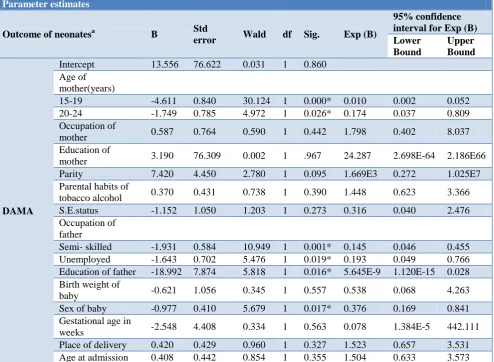
Table 4: Association between socio-demographic factors and outcome as DAMA of neonates by multinominal regression analysis.
Parameter estimates
Outcome of neonatesa B Std
error Wald df Sig. Exp (B)
95% confidence interval for Exp (B) Lower
Bound
Upper Bound
DAMA
Intercept 13.556 76.622 0.031 1 0.860 Age of
mother(years)
15-19 -4.611 0.840 30.124 1 0.000* 0.010 0.002 0.052
20-24 -1.749 0.785 4.972 1 0.026* 0.174 0.037 0.809
Occupation of
mother 0.587 0.764 0.590 1 0.442 1.798 0.402 8.037
Education of
mother 3.190 76.309 0.002 1 .967 24.287 2.698E-64 2.186E66
Parity 7.420 4.450 2.780 1 0.095 1.669E3 0.272 1.025E7
Parental habits of
tobacco alcohol 0.370 0.431 0.738 1 0.390 1.448 0.623 3.366
S.E.status -1.152 1.050 1.203 1 0.273 0.316 0.040 2.476
Occupation of father
Semi- skilled -1.931 0.584 10.949 1 0.001* 0.145 0.046 0.455 Unemployed -1.643 0.702 5.476 1 0.019* 0.193 0.049 0.766 Education of father -18.992 7.874 5.818 1 0.016* 5.645E-9 1.120E-15 0.028 Birth weight of
baby -0.621 1.056 0.345 1 0.557 0.538 0.068 4.263
Sex of baby -0.977 0.410 5.679 1 0.017* 0.376 0.169 0.841 Gestational age in
weeks -2.548 4.408 0.334 1 0.563 0.078 1.384E-5 442.111
Place of delivery 0.420 0.429 0.960 1 0.327 1.523 0.657 3.531 Age at admission 0.408 0.442 0.854 1 0.355 1.504 0.633 3.573 a. The reference category is: Referred, *Statistically significant.
Association of socio-demographic factors and outcome as DAMA of neonates in Table 4 by multinominal regression analysis reveals that age of mother in 15-19 years and 20-24 years age group, unemployed and semi-skilled occupation of father, father‟s education upto higher secondary class (HSC) and male sex of baby were significantly associated with outcome as DAMA of neonates.
DISCUSSION
In the present study, area wise distribution of outcome of 1050 total neonatal admissions shows that 601 (57.29%), were from rural area and 449 (42.70%) were from urban area.
Cure rate was more 370 (50.6%) in urban babies while mortality rate 131 (73.1%), discharged against medical advise 59 (74.6%) and referred 51 (82.2%) was more in rural babies. A statistically highly significant association was found between area wise distribution and outcome of neonates (p<0.01) except for cured and discharged babies (p>0.01).
Dalal et al was done study on neonatal transport at tertiary care centre, Ahmadabad, India, In this study 236 (78.7%) from slum and rural areas and rest from urban society areas. The mortality (83.1%) was higher in the patients from slum and rural areas compared to urban society (23.4%). The study findings were similar to the present study.
Multinominal regression analysis in our study reveals that socio-demographic factors like age of mother, inborn place of delivery, occupation of father, education of father, parental habits of tobacco and alcohol in any form, socioeconomic class IV, low birth weight and male sex of baby affects the various outcomes of babies. Nimbalkar et al studied the socioeconomic status of the slum dwellers were significantly lower (p<0.001).12 The study findings were comparable to the present study.
reported that VLBW and lower gestational age (<32 weeks) carried a high mortality risk.14
In our study we found that there was less number of AMA discharge in babies where fathers education was upto HSC which underlines the importance of education of the parents. Nimbalkar et al studied that most mothers from slums were illiterate (44.2%) whereas 83.7% mothers from villages had at least primary education. Multiple logistic regression model revealed that lack of care seeking behavior was common in Illiterate mothers (OR 4.71, 95% CI 2.06, 10.80, p<0.0001).12 The current study findings were similar to the present study.
CONCLUSION
Cure rate in NICU admissions was 69% which may be due to available speciality staff and logistics. Taking this into account, 40 bedded NICU in tertiary care hospital seemed to be essential and sufficient. The neonatal mortality rate is the important contributor in infant mortality rate and some neonatal morbidities like sepsis, PNA, congenital anomalies, jaundice have to be managed with NICU set-up. Every first referral unit and district hospital should have properly equipped NICU.
Need of the hour is to make people aware of the facilities for maternal and newborn care and fully utilise them. There is need to strengthen information, education and communication activities in general population to facilitate the care seeking behaviour.
Limitations of study
As it was a hospital based study and as most of the patients had a low socio-economic status, the results of this study may not reflect the true burden which is prevalent in the community as a whole.
Funding: No funding sources Conflict of interest: None declared
Ethical approval: The study was approved by the Institutional Ethics Committee
REFERENCES
1. Kleigman RM, Stanton BF, SP Geme III JW, Schor NF, Behrman RE. Nelson Textbook of Pediatrics, 19th ed. Philadelphia: Elsevier, WB Saunders; 2011;87:532.
2. UN General Assembly 5s. Road map towards the implementation of the United Nations Millennium declaration: Report of the Secretary General. UN document no. 756/326. New York: United Nations; 2001.
3. Ngoc NT, Merialdi M, Abdel-Aleem H, Carroli G, Purwar M, Zavaleta N, et al. Causes of stillbirths and early neonatal deaths: Data from 7933 pregnancies in six developing countries. Bull World Health Organ. 2006;84:699-705.
4. Ved RR, Dua AS. Review of women and children‟s health in India: Focus on safe motherhood: NCMH Background Papers - Burden of Disease in India. 2005.
5. Neogi SB, Malhotra S, Zodpey S, Mohan P. Assessment of special care newborn units in India. J Health Popul Nutr. 2011;29:500-9.
6. MOHFW. Brief Note on Child Health. New Delhi: Ministry of Health and Family Welfare. Government of India. Available at: http://mohfw.nic.in/NRHM/on28/11/2019,
Documents/Brief Note on CH Nov2011.pdf. Accessed on 30 December 2011.
7. National Neonatology Forum. Report of the National Perinatal Database 2002-2003. New Delhi; 2004.
8. Roy RN, Nandy S, Shrivastava P, Chakraborty A, Dasgupta M, Kundu TK. Mortality Pattern of Hospitalized Children in a Tertiary Care Hospital of Kolkata. Indian J Community Med. 2008;33(3):187-9.
9. Kruse AY, Binh TT Ho, Phuong CN, Stensballe LG, Greisen G, Pederson FK. Prematurity, asphyxia and congenital malformations underrepresented among neonates in a tertiary pediatric hospital in Vietnam. Biomed Central J Paediatr. 2012;12:129.
10. Gawande UH, Pimpalgaonkar MS, Betharia SH. Biosocial determinants of birth weight in rural urban Nagpur, Indian J Community Med. 1994;2-4:64-7. 11. Dalal E, Vishal G, Solanki D. Study on Neonatal
Transport at Tertiary Care Centre, Ahmadabad, India. Int J Sci Res. 2013;2(12):289-92.
12. Nimbalkar AS, Shukla VV, Pathak AG, Nimbalkar SM. Newborn Care Practices and Health Seeking Behavior in Urban Slums and Villages of Anand, Gujarat; Central Research Centre: 2012.
13. Kumar MK, Thakur SN, Singh BB. Study of the Morbidity and the Mortality Patterns in the Neonatal Intensive Care Unit at a Tertiary Care teaching Hospital in Rohtas District, Bihar, India; J Clin Diagnost Res. 2012;6(2):282-5.
14. Yasmin S, Osrin D, Paul E, Costello. Neonatal mortality of the low birth weight infants in Bangladesh. World Health Organization. 2001;79:608-14.