http://www.ijcmph.com pISSN 2394-6032 | eISSN 2394-6040
Original Research Article
Attitudes and barriers of undergraduate students towards conducting
research at Fakeeh college for medical sciences, Jeddah, KSA:
a cross-sectional descriptive study
Nelly N. Abulata
1,2*, Amira S. Ismail
3,4, Nouf A. Sabra
5, Reem A. Alnezawi
6,
Rahma M. Bazhair
6, Nedaa F. Ahyaf
6, Raghad H. Alsaati
6, Amani A. Alhattami
7,
Lora E. Fatani
7, Tahani K. Hawsawi
8INTRODUCTION
Research training is a critical element of education in the medical field. Medical colleges are expected to train students in research to meet accreditation standards, to
support students’ career prospects and to generate a pool of researchers. A long-term strategy for promoting health research is to target medical students early in their careers so that, they are equipped with sufficient research training during their undergraduate studies. This will ABSTRACT
Background: To evaluate attitudes and barriers toward medical research among undergraduate students at Fakeeh College for Medical Science (FCMS), Jeddah, KSA in order to improve their awareness towards medical research criteria and develop action plan to subdue all obstacles.
Methods: This descriptive cross-sectional multi-disciplinary study was conducted from March to September 2018 on undergraduate students at FCMS. A questionnaire was completed by 129 students; addressing 6 factors, consisting of 30 questions: 15 questions assessing the attitudes and 15 questions assessing the barriers.
Results: Out of the 443 students enrolled in all 3 Programs 129 of the students responded. No significant differences towards research were noted between genders. A comparison between the three programs (medicine, nursing and medical laboratory sciences) towards research revealed that there were no statistically significant differences (P<0.01) between the 3 programs for all factors. Overall, the assessment of students' perception was the highest for factor on the relevance of research to their everyday life with a mean of 4.2 (0.40) whereas, the factor that addressed the research anxiety had the lowest perception with a mean of 3.76 (0.77).
Conclusions: The majority of students in the study considered research to be valuable but, at the same time they had little time to conduct research because of their educational tasks. Accordingly, allocating credited hours in their educational schedules for research activities can help encourage students at FCMS to conduct research projects.
Keywords: Undergraduate Students, Research, Attitudes, Barriers, FCMS
1Department of Pathological Sciences, Fakeeh College of Medical Sciences, Jeddah, KSA
2
Department of Clinical and Chemical Pathology, Kasr Al-Ainy Faculty of Medicine, Cairo University, Cairo, Egypt Department of Medical Education, 3Fakeeh College of Medical Sciences, Jeddah, KSA; 4Faculty of Medicine, Suez Canal University, Ismailia, Egypt
5
Department of Medical Laboratory Science, 6Medicine & Surgery Program, 7Medical Laboratory Science Program,
8
Nursing Program, Fakeeh College of Medical Sciences, Jeddah, KSA
Received: 19 December 2018
Revised: 20 January 2019
Accepted: 22 January 2019
*Correspondence:
Dr. Nelly N. Abulata,
E-mail: [email protected]
Copyright: © the author(s), publisher and licensee Medip Academy. This is an open-access article distributed under the terms of the Creative Commons Attribution Non-Commercial License, which permits unrestricted non-commercial use, distribution, and reproduction in any medium, provided the original work is properly cited.
promote their critical thinking, will develop critical appraisal skills so they become research-oriented.1 Most of the students are not aware of why research is crucial to health care.2 Attitudes towards, knowledge of and barriers against research are the three key factors that have an impact on the success of research.3 The research world in Saudi Arabia has yet to establish its full identity, especially in the private sectors. A review of literature showed that there were no data related to attitude, practice, and barriers of students at FCMS toward medical research. Other Saudi Arabian universities had produced data of such purpose; therefore, this study aimed to assess further characteristics of this issue at FCMS so that it will be used as a guide for future recommendations and strategic planning to harvest the best research environment amongst students.
METHODS
Study design and participants
This is a cross-sectional multidisciplinary descriptive study, where students’ perception, attitudes and barrier towards research were evaluated. This study was conducted from March to September 2018 on undergraduate students at FCMS, who were enrolled in 3 Programs; medicine, nursing and medical laboratory science. A convenient sample was taken. So, all the students were included in the sample.
Data collection
Participants were informed about the objectives of the study, and that participation was voluntary and anonymous through a self-reported online questionnaire.
The questionnaire
The research questionnaire was used to collect data from the undergraduate students to assess attitudes and barriers towards research. The research questionnaire addressed 6 factors and consisted of 30 questions.
The six factors were labeled as follows:
Factor 1: Relevance of research to my everyday life.
Factor 2: Relevance of research to my personal
interest.
Factor 3: Relevance of research to my educational needs.
Factor 4: Research usefulness to my work.
Factor 5: Research anxiety.
Factor 6: Research difficulties.
The following were assessed:
Attitudes towards research was measured by 15
questions which measure relevance of research to my everyday life, relevance of research to my personal interests as well as relevance of research to my educational needs.
Barrier towards research was measured by 15
questions which measure research usefulness to my work, research anxiety as well as research difficulties.
Socio-demographic background, questions, covered
information about students’ age, sex, level and Specialty.
All items in the inventory were constructed using five-point Likert response scales ranging from strongly disagree to strongly agree. Each point on the Likert scale is assigned a value ranging from 1 (strongly disagree) to 5 (strongly agree).
Ethical issues
IRB approval was obtained. All procedures contributing to this work comply with the ethical standards of the relevant national and institutional committees on human experimentation and with the declaration of Helsinki 1975, as revised in 2008.
Statistical analysis
Data analysis was conducted using Statistical Package for the Social Sciences (SPSS®) version 22 software and IBM SPSS Amos™ version 20. Data were presented as mean±standard deviation (SD) of each parameter. A p˂0.05 was considered to be statistically significant. Internal consistency reliability for each scale was analyzed using Cronbach’s α statistic. Missing data were treated by replace with mean of missing variables.
Testing the psychometric properties of the research questionnaire through exploratory factor analysis (EFA) was performed. EFA using principal component analysis with varimax rotation, was carried out to identify the different factors. The number of factors that were extracted and used was based on: Kaiser’s criterion, considers factors with an eigenvalue greater than one as a common factor, Scree test criterion (the Cattell criterion): the point of inflexion displayed by the scree plot and the cumulative percent of variance extracted (In the humanities, the explained variance is commonly as low as 50-60%).
Factor solutions retained according to the psychometric criteria were then subjected to analysis according to the following interpretability criteria:
A given factor contained at least three variables with significant loadings, a loading of 0.30 being suggested as the cut-off point;
Variables loading on the same factor share the same
conceptual meaning;
Variables loading on different factors appear to
measure different constructs;
The rotated factor pattern demonstrates ‘simple
structure’, which means that:
Most variables load relatively high on only one
Most factors have relatively high factor loadings for some variables and low loadings for the remaining ones.
Furthermore, product moment-to-moment Pearson
correlation coefficient was measured to see the forms of correlation between study variables. Finally, one-way ANOVA was done for examining the differences between the mean values of the three specialties of the students. In addition, Post-hoc analysis using Bonferroni test was used to examine the significant differences between different genders in the study.
RESULTS
The psychometric analysis of the used questionnaire was tested through exploratory factor analysis (EFA) and reliability analysis (RA).
First: Exploratory factor analysis, checking the suitability of data for factor analysis
Sample size: sample size is 129 participants which is adequate for factor analysis.
Factorability of the correlation matrix: The
correlation matrix revealed statistically significant, moderate correlations among the observed variables used in the analysis. None of the correlation coefficients were large; therefore, there was no need to eliminate any variables at this stage.
Kaiser-Meyer-Olkin Measure of Sampling
Adequacy (KMO) and Bartlett's Test of Sphericity: This test revealed that the KMO Measure of Sampling Adequacy was 0.692. This value indicated that there were sufficient items predicted by each factor.
Furthermore, Bartlett’s test of sphericity was statistically significant (P<0.001) which indicates that the variables were significantly correlated. Therefore, this output indicated the appropriateness of the data for factor analysis.
Extraction of factors
Principal component analysis with varimax rotation was performed to identify and interpret the number of factors that could explain most of the common variance and to remove non-reflective or redundant items. The results revealed that the 30 questions of the questionnaire resulted in six factors with an eigenvalue >1.00. The six factors that emerged from the factor analysis accounted for 53.54% of the total variance. The number of factors was also confirmed with the visual inspection of the scree plot that indicated a sudden drop in the scree beginning with the sixth factor.
Rotation of factors
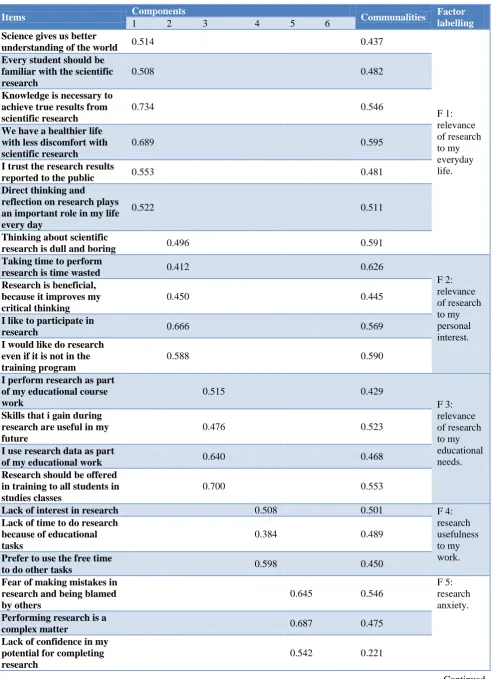
From the initial 30 items, no items were removed from the analysis. The questionnaire addressed 6 factors and
30 items as shown in (Table 2). Factor 1 included 6 items, factor 2 included 5 items, factor 3 included 4 items, and factor 4 included 3 items factor 5 included 3 items factor 6 included 9 items. All the interpretability criteria mentioned above were achieved.
The six factors were labeled as follows:
Factor 1: Relevance of research to my everyday life.
Factor 2: Relevance of research to my personal
interest.
Factor 3: Relevance of research to my educational needs.
Factor 4: Research usefulness to my work.
Factor 5: Research anxiety.
Factor 6: Research difficulties.
Furthermore, the communalities of the 30 items were presented in (Table 2). It reveals that the communalities were ranged between 0.441 and 0.752 that means that the extracted factors explained most of the variance in the variables being analyzed.
Second: Reliability analysis
The Cronbach’s alpha coefficients of the 6 factors of the questionnaire were ranged between 0.80 and 0.436. The overall Cronbach’s alpha for the total items was 0.86.
This result indicates high internal consistency
(reliability). Alpha levels did not increase if any items were deleted.
Descriptive statistics
129 completed forms were collected. The majority of the respondents were females 118 (92%), while the male respondents were 11 (8%) (Figure 1). A descriptive statistic of the six factors were summarized in (Table 3). It reveals that the students' perception for Factor 1: relevance of research to my everyday life was the highest where Factor 5: research anxiety gained the lowest perception.
The Pearson’s correlations between different factors of the used questionnaire revealed that all the factors correlated significantly and positively to each other and the Pearson’s Correlation coefficient was between 0.449 and 0.218 (Table 4). This result indicates that there were moderate correlations between the factors. The Scale (5 strongly agree-1 strongly disagree).
Table 1: Factor structure of the used questionnaire, using principal components analysis.
Items Components Communalities Factor
labelling
1 2 3 4 5 6
Science gives us better
understanding of the world 0.514 0.437
F 1: relevance of research to my everyday life.
Every student should be familiar with the scientific research
0.508 0.482
Knowledge is necessary to achieve true results from scientific research
0.734 0.546
We have a healthier life with less discomfort with scientific research
0.689 0.595
I trust the research results
reported to the public 0.553 0.481
Direct thinking and reflection on research plays an important role in my life every day
0.522 0.511
Thinking about scientific
research is dull and boring 0.496 0.591
Taking time to perform
research is time wasted 0.412 0.626
F 2: relevance of research to my personal interest.
Research is beneficial, because it improves my critical thinking
0.450 0.445
I like to participate in
research 0.666 0.569
I would like do research even if it is not in the training program
0.588 0.590
I perform research as part of my educational course work
0.515 0.429
F 3: relevance of research to my educational needs.
Skills that i gain during research are useful in my future
0.476 0.523
I use research data as part
of my educational work 0.640 0.468
Research should be offered in training to all students in studies classes
0.700 0.553
Lack of interest in research 0.508 0.501 F 4:
research usefulness to my work.
Lack of time to do research because of educational tasks
0.384 0.489
Prefer to use the free time
to do other tasks 0.598 0.450
Fear of making mistakes in research and being blamed by others
0.645 0.546
F 5: research anxiety.
Performing research is a
complex matter 0.687 0.475
Lack of confidence in my potential for completing research
0.542 0.221
Items Components Communalities Factor labelling
1 2 3 4 5 6
Lack of good research ideas 0.403 0.747
F 6: research difficulties.
Lack of access to
laboratory equipment for performing research project
0.801 0.576
Lack of professional
supervisors (mentors) 0.706 0.678
Lack of familiarity with
research proposal writing 0.635 0.449
Lack of research funds 0.368 0.752
Lack of familiarity about
research skills 0.804 0.666
Lack of familiarity with
statistical analysis 0.772 0.662
Lack of skills for writing
papers 0.768 0.562
Lack of ability to publish articles after the completion of the project
0.766 0.437
Table 2: Reliability statistics using Cronbach's alpha.
Factor Number of items
per factor
Cronbach's Alpha per Factor
Cronbach's Alpha of all items
Factor 1: Relevance of research to
my everyday life 6 0.536
0.86
Factor 2: Relevance of research to
my personal interest 5 0.436
Factor 3: Relevance of research to
my educational needs 4 0.663
Factor 4: Research usefulness to my
work 3 0.553
Factor 5: Research anxiety 3 0.633
Factor 6: Research difficulties 9 0.805
Table 3: Means and standard deviation of the six factors of the questionnaire (n=129).
Factors Number of Items Means Standard deviation
Factor 1: Relevance of research to my everyday life 6 4.2138 0.40261
Factor 2: Relevance of research to my personal interest 5 3.8786 0.61347
Factor 3: Relevance of research to my educational needs 4 4.1811 0.59402
Factor 4: Research usefulness to my work 3 4.0106 0.64351
Factor 5: Research anxiety 3 3.7659 0.77321
Factor 6: Research difficulties 9 3.8445 0.62169
N.B. Scales were rated out of 5.
Table 6 shows the mean scores for the 15 questions of the questionnaire that assessed barriers towards research. The highest mean was for item 2 (Lack of time to do research because of educational tasks) 4.3 (0.8) and the lowest mean score was for item 7 (lack of good research ideas) 3.6 (1.1).
Table 4: Pearson’s correlations between different factors of the used questionnaire (n=129).
Factor 1: Relevance of research to my everyday life
Factor 2: Relevance of research to my personal interest
Factor 3: Relevance of research to my educational needs
Factor 4: Research usefulness to my work
Factor 5: Research anxiety
Factor 6: Research difficulties
Factor 1: Relevance of research to my everyday life.
0.449** 0.00
0.408**
0.00 0.046 0.085
0.218** 0.014
Factor 2: Relevance of research to my personal interest.
0.449** 0.00
0.359**
0.00 -0.096- 0.120
0.237** 0.08
Factor 3: Relevance of research to my educational needs.
0.408** 0.00
0.359**
0.00 -0.146- -0.094- 0.007
Factor 4: Research
usefulness to my work. 0.046 -0.096- -0.146-
0.458** 0.00
0.403** 0.00
Factor 5: Research
anxiety. 0.085 0.120 -0.094-
0.458**
0.00 1
0.454** 0.00
Factor 6: Research difficulties.
0.218** 0.014
0.237**
0.008 0.007
0.403** 0.00
0.454**
0.00 1
**Correlation is significant at the 0.01 level (2-tailed).
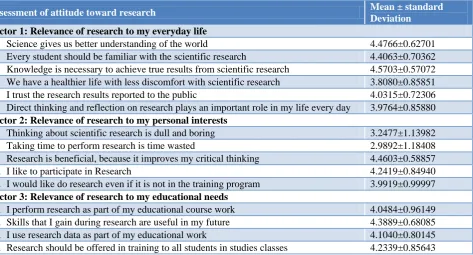
Table 5: Students rated scores of the 15 items of evaluation of attitudes the designed questionnaire (n=129), the scale (5 strongly agree-1 strongly disagree).
Mean ± standard Deviation Assessment of attitude toward research
Factor 1: Relevance of research to my everyday life
4.4766±0.62701 1. Science gives us better understanding of the world
4.4063±0.70362 2. Every student should be familiar with the scientific research
4.5703±0.57072 3. Knowledge is necessary to achieve true results from scientific research
3.8080±0.85851 4. We have a healthier life with less discomfort with scientific research
4.0315±0.72306 5. I trust the research results reported to the public
3.9764±0.85880 6. Direct thinking and reflection on research plays an important role in my life every day
Factor 2: Relevance of research to my personal interests
3.2477±1.13982 7. Thinking about scientific research is dull and boring
2.9892±1.18408
8. Taking time to perform research is time wasted
4.4603±0.58857 9. Research is beneficial, because it improves my critical thinking
4.2419±0.84940 10. I like to participate in Research
3.9919±0.99997 11. I would like do research even if it is not in the training program
Factor 3: Relevance of research to my educational needs
4.0484±0.96149 12. I perform research as part of my educational course work
4.3889±0.68085 13. Skills that I gain during research are useful in my future
4.1040±0.80145 14. I use research data as part of my educational work
4.2339±0.85643 15. Research should be offered in training to all students in studies classes
Table 6: Students rated scores of the 15 items of the designed questionnaire for evaluating barriers (n=129), the scale (5 strongly agree-1 strongly disagree).
Mean ± standard Deviation Assessment of the barriers towards research
Factor 4: Research usefulness to my work
3.6780±0.98607
1. Lack of interest in research
4.3548±0.79831
2. Lack of time to do research because of educational tasks
4.0000±0.82946
3. Prefer to use the free time to do other tasks
Mean ± standard Deviation Assessment of the barriers towards research
Factor 5: Research anxiety
3.8475±1.03467
4. Fear of making mistakes in research and being blamed by others
3.8306±0.93463
5. Performing research is a complex matter
3.6610±0.99761
6. Lack of confidence in my potential for completing research
Factor 6: Research difficulty due to lack of time
3.6639±1.05713
7. Lack of good research ideas
3.6807±1.04096
8. Lack of access to laboratory equipment for performing research project
3.6333±1.05267
9. Lack of professional supervisors (mentors)
4.0159±0.89429
10. Lack of familiarity with research proposal writing
3.8226±0.93746
11. Lack of research funds
Factor 7: Research difficulty due to lack of research skills
3.9919±0.92390
12. Lack of familiarity about research skills
3.9675±0.99123
13. Lack of familiarity with statistical analysis
3.9833±1.02066
14. Lack of skills for writing papers
3.9262±0.97207 15. Lack of ability to publish articles after the completion of the project
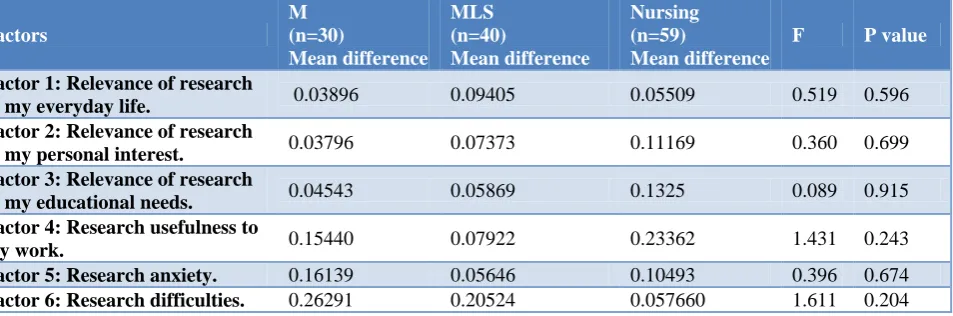
Table 7: One-way ANOVA for examining the differences between the mean values of the three specialties of the study.
Factors
M (n=30)
Mean difference MLS (n=40)
Mean difference
Nursing (n=59)
Mean difference
F P value
Factor 1: Relevance of research
to my everyday life. 0.03896 0.09405 0.05509 0.519 0.596 Factor 2: Relevance of research
to my personal interest. 0.03796 0.07373 0.11169 0.360 0.699 Factor 3: Relevance of research
to my educational needs. 0.04543 0.05869 0.1325 0.089 0.915 Factor 4: Research usefulness to
my work. 0.15440 0.07922 0.23362 1.431 0.243
Factor 5: Research anxiety. 0.16139 0.05646 0.10493 0.396 0.674
Factor 6: Research difficulties. 0.26291 0.20524 0.057660 1.611 0.204
Figure 1: Gender distribution in the study population (n=129).
DISCUSSION
Although the importance of research is well recognized in the medical field, only small numbers of medical students conduct research.4 The analytical process that embodies research contributes to the development of a medical student's critical thinking skills, ability to evaluate the literature and technical tools to communicate scientific
data.5-7 In addition, engaging in the research process also contributes to an increase in the research productivity at the institution where the medical students are enrolled and encourages students to get involved in research after graduation.8,9
To our knowledge, this is the first study to investigate the attitudes and barriers of multidisciplinary students toward research at FCMS. To identify these attitudes and barriers with a high degree of trust, it was essential to use an instrument with proper psychometric properties. This instrument was tested for content evidence for both validity and reliability. An exploratory factor analysis (EFA) was performed to identify and interpret the number of factors that could explain most of the common variances. The reliability of the scale was also evaluated by means of tests for internal consistency, using Cronbach’s alpha coefficient. An exploratory factor analysis was conducted using undergraduate students. It indicated that our questionnaire consisted of six meaningful factors. The first factor was relevance of research to my everyday life. The second factor was relevance of research to my personal interest. The third
Male 8%
factor was relevance of research to my educational needs. The fourth factor was research usefulness to my work. The fifth factor was research anxiety. And the last factor was research difficulties. Our study also examined the relationships between the six factors, information extracted from these domain areas was good.
Our study revealed that no significant differences towards research were noted between genders. The higher number of female participants in our study however is quite notable, particularly as the average male-to-female ratio of student enrollment in undergraduate medical education in Saudi Arabia was nearly 3:1 in 2011.5 A comparison between the three programs (medicine, nursing and medical laboratory sciences) towards research revealed that there were no statistically significant differences between the 3 programs for all factors. The overall perception was the highest for the factor that addressed the relevance of research to their everyday life whereas, the factor that addressed the research anxiety had the lowest perception.
Attitudes towards research
On assessing the attitude towards research, the students had a significant positive attitude towards Research. They considered that knowledge was necessary to achieve true results from scientific research, they believed that Science gave them a better understanding of the world, that research is beneficial because it improves their critical thinking in addition that time taken to perform research was not time wasted and that scientific research was not at all dull or boring. This was similar to the
results of the studies at Taibah college
of medicine in Madinah Saudi Arabia, at Alexandria medical school, Egypt, as well as study conducted in Columbia university in the USA.10-12.
Barriers towards research
On the other hand, when it came toassessing the barriers towards research; the 3 main barriers were lack of time to conduct research because of educational tasks, a lack of familiarity about research skills including proposal writing, statistical analysis and writing publications. Similar barriers to research were reported by medical students at King Saud University in KSA, in Canada, in the UK, in the USA, in Pakistan, in Egypt and in Sudan.11-17
CONCLUSION
The majority of students in the study considered research to be valuable but, at the same time they had little time to conduct research because of their educational tasks.
Accordingly, allocating credited hours in their
educational schedules for research activities can help encourage students at FCMS to conduct research projects.
ACKNOWLEDGEMENTS
Great appreciation is extended to the Dean of Fakeeh College for Medical Sciences and to the Director of Research for granting permission and clearance to conduct this research. We would also like to thank the students who participated in our survey.
Funding: No funding sources Conflict of interest: None declared
Ethical approval: The study was approved by the Institutional Ethics Committee
REFERENCES
1. Osman T. Medical students’ perceptions towards
research at a Sudanese University. BMC Med Educ. 2016;16(1):253.
2. Alghamdi K, Moussa N, Alessa D, Alothimeen N,
Al-Saud A. Perceptions, attitudes and practices toward research among senior medical students. Saudi Pharm J. 2014;22(2):113–7.
3. Memarpour M, Fard AP, Ghasemi R. Evaluation of
attitude to, knowledge of and barriers toward research among medical science students. Asia Pac Fam Med. 2015;14(1):1.
4. Turk T, Al Saadi T, Alkhatib M. Alahdab F,
Firwana B, et al. Attitudes, barriers, and practices toward research and publication among medical students at the University of Damascus, Syria. Avicenna J Med. 2018;8(1):24–33.
5. Abdulghani HM, AlKanhal AA, Mahmoud ES,
Ponnamperuma GG, Alfaris EA. Stress and its effects on medical students: A cross-sectional study at a college of medicine in Saudi Arabia. J Health Popul Nutr. 2011;29:516–22.
6. Frishman W.H. Student research projects and
theses: Should they be a requirement for medical school graduation? Heart Dis. 2001;3:140–4.
7. Houlden RL, Raja JB, Collier CP, Clark AF, Waugh
JM. Medical students' perceptions of an
undergraduate research elective. Med Teach. 2004;26(7):659-61.
8. Aslam F, Shakir M, Qayyum MA. Why medical
students are crucial to the future of research in South Asia. PLoS Med. 2005;2:322.
9. Reinders JJ, Kropmans TJ, Cohen-Schotanus J.
Extracurricular research experience of medical students and their scientific output after graduation. Med Educ. 2005;39:237.
10. Noorelahi M, Soubhanneyaz A, Kasim K.
Perceptions, barriers, and practices of medical research among students at Taibah college of Medicine, Madinah, Saudi Arabia. Advances in Medic Educ and Pract. 2015;6:479–85.
11. Mostafa S, Khashab S, Fouaad A. Engaging
12. Bakken S, Lantigua RA, Busacca LV, Bigger JT. Barriers, Enablers, and Incentives for Research Participation: A Report from the Ambulatory Care Research Network (ACRN). JABFM. 2009;22(4). 13. Al-Hilal S, Al-Kahtani E, Zaman B, Khandekar R,
Al-Shahri A, Edward DP. Attitudes of Saudi Arabian Undergraduate Medical Students towards Health Research. Sultan Qaboos Univ Med J. 2016;16(1):68–73.
14. Siemens DR, Punnen S, Wong J, Kanji N. A survey
on the attitudes towards research in medical school. BMC Med Educ. 2010;10:4.
15. Burgoyne LN, O’Flynn S, Boylan GB.
Undergraduate medical research: The student perspective. Med Educ Online. 2010;10:15.
16. Osman T. Medical students’ perceptions towards
research at a Sudanese University. BMC Med Edu. 2016;16:253.
17. Nisa Q, Raza F Perception, attitudes and barriers in
undergraduate medical students toward medical research at Rehman medical college, Peshawar, Pakistan. KMUJ. 2017;9:(3).