Original Research Article
Utilization of maternal and child health services
in Enugu, South East, Nigeria
Pat U. Okpala
1, Chinwendu L. Okoye
1, Florence O. Adeyemo
2, Peace N. Iheanacho
1,
Anthonia C. Emesonwu
3, Eunice O. Osuala
4, Ikenna G. Okpala
5*
INTRODUCTION
The arrival of a baby makes a big difference to family life, bringing both new joy and new challenges. Pregnancy and the period surrounding it is a dangerous time for too many of the 9.2 million women and girls
who become pregnant in Nigeria each year. Over the last decade, great efforts have been made to improve maternal and child health in Nigeria with some improvements. Maternal complications and the poor perinatal outcome are highly associated with poor usage of skilled maternal health care services.1 Pregnancy-related complications
ABSTRACT
Background: Nigeria continues to have one of the highest rates of maternal mortality in the world at 814 deaths per 100,000 live births despite several efforts. Various factors can influence appropriate utilization of services during pregnancy, childbirth and postpartum. This study examined the perceived factors that influence the utilization of maternal and child-health services among mothers in Enugu, South-East Nigeria.
Methods: A descriptive survey design was adopted for the study. The study population of 323 pregnant women was determined using the Power Analysis formula. The instrument used for data collection was a self-developed questionnaire. Demographic information of the women was also obtained for the study. The analysis was done with the software statistical package for Social Sciences (SPSS) Version 16.0. Study period was from April 2016 to August 2016.
Results: There was high antenatal clinic attendance (93.1%) and utilization of postnatal care services (93.1%). Also, the major factors that influenced the utilization of maternal and child health services were professionally defined needs, accessibility of health care services and economic status.
Conclusions: There was high utilization of maternal and child health care services which was influenced by some factors. There is a need for nurses and other health workers to be actively engaged in educating mothers during antenatal visits. Sustainable financial subsidies and community-based initiatives should be developed to encourage early antenatal clinic visits and to provide the necessary information on the importance of facility-based antenatal and postnatal care.
Keywords: Pregnancy, Utilization, Healthcare services, Nigeria, Maternal, Child
Department of Nursing Sciences, 1University of Nigeria, Enugu Campus, Enugu, 4Nnamdi Azikiwe University, Nnewi Campus, Awka, Nigeria
Department of Nursing, 2College of Health Sciences, Ladoke Akintola University of Technology, Osogbo, 3Imo State University, Orlu Campus, Owerri, Nigeria
5
Department of Family Medicine, University of Nigeria Teaching Hospital, Ituku-Ozalla, Enugu, Nigeria
Received: 18 June 2019
Revised: 03 July 2019
Accepted: 04 July 2019
*Correspondence:
Dr. Ikenna G. Okpala,
E-mail: [email protected]
Copyright: © the author(s), publisher and licensee Medip Academy. This is an open-access article distributed under the terms of the Creative Commons Attribution Non-Commercial License, which permits unrestricted non-commercial use, distribution, and reproduction in any medium, provided the original work is properly cited.
are the leading causes of death and disabilities for women aged 15-49 in developing countries. World Health Organization estimates that more than half a million women lose their lives in the process of reproduction worldwide yearly, with about 99 per cent often from developing countries.2 Sub-Sahara Africa is responsible for more than fifty per cent of maternal deaths occurring in developing countries and lifetime risk of dying from pregnancy is extremely high, that is for every 26 mothers, one mother dies as a result of pregnancy and childbirth in Sub-Sahara Africa.3,4
These outrageous deaths have been attributed to poor/lack of utilization of maternal and child health care service, hence the risk of women in a developing country dying from maternal related causes during their lifetime is about eighty times higher compared to a woman living in developed countries.3,5 Of the 40 countries with the world highest rates of maternal deaths, 30 are from Sub-Saharan Africa.
Every year in Nigeria, there are about 40,000 maternal deaths which account for about 14% of the global total.3 A woman’s chance of dying from pregnancy and childbirth in Nigeria is 1 in 13.2
The deaths of newborn babies in Nigeria represent a quarter of the total number of deaths of children under -five. According to UNICEF Nigeria, every single day, Nigeria loses about 2,300 under- five and 145 women of childbearing age.6 This makes the country the second largest contributor to the under-five and maternal mortality rate in the world. The majority of these occur within the first week of life mainly due to complications during pregnancy and delivery.
The desired outcome of every pregnancy is always a healthy mother and a healthy child. During pregnancy, a
woman can develop serious life-threatening
complications.7 Improving the wellbeing of mothers, infants, and children is an important public health goal as every birth counts.
Maternal and child health services are health care services provided to the women of childbearing ages in order to preserve the life of the mother and the wellbeing of the baby.8 It is one of the components of primary health care services aimed at providing health for all.9 The goal of maternal and child health services is to detect any potential complications of pregnancy and childbirth and early prevention of complications.10 The elements of maternal health services include prenatal care, intrapartum care and postpartum care.
Utilization of maternal and child health services has been associated with improved maternal and neonatal outcomes as health education is an important component of such service.10 Hence, skilled antenatal care and birth attendance have been advocated globally as the most crucial intervention to reduce maternal and child
mortalities, since the majority of the complications occur during or shortly after delivery.7 The World Bank estimates that 74 per cent of these deaths could be averted if all women had access to interventions that address complications of pregnancy and childbirth especially emergency obstetric care.11
Utilization of maternal and child health services may depend on socio-economic and demographic factors, such as level of education, discrimination of the women disease pattern and health care system itself.12 Apart from poverty, bad hygienic conditions and limited access to medical treatment, lacking often is a major cause of mortality among babies (8-20% in their first year of life) and mothers.6
There are reports of inadequate utilization of health facilities in the Obiagu community, Enugu despite the availability of maternal and child health services. This is evidenced by the findings from the antenatal register of the Obiagu health centre 2015, which showed that 1452 women registered in the health centre, but only 130 women delivered in the health centre. It was equally observed that many of them registered late for antenatal care and do not attend the postnatal clinic. This informed the objective of this study which was to examine the perceived factors that influence the utilization of maternal and child healthcare services among mothers in Obiagu Community, Enugu, South East, Nigeria.
METHODS
This is a descriptive survey of the factors determining the utilization of maternal and child health services in Obiagu community in Enugu North Local government of Enugu State, Nigeria. According to the Local government demographic data, the population of women in Obiagu community is 9,536. Therefore, the population of this study is 9,536 mothers in Obiagu community. A sample of 323 women of childbearing age in Obiagu community was used for the study. The sample size of the study was determined using the power analysis formula.
health care coordinator. The questionnaires were distributed in Obiagu community with the aid of research assistants that have been trained on the purpose of the study, selection of the subject and interpretation of the questions. The questionnaires were shared and collected immediately. A total of 323 questionnaires were administered and 304 were properly filled, making a return rate of 94.1%. Data generated for the study were presented using frequency, percentage and mean. All analysis was done with the aid of the software statistical package for social sciences (SPSS) version 16.0.
RESULTS
Socio-demographic data of the respondents
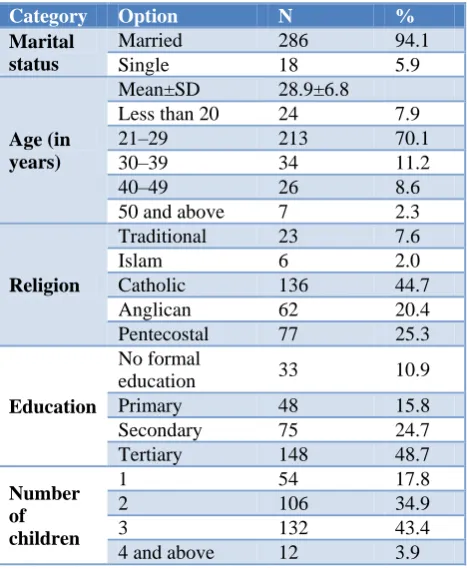
From Table 1, the mean age of respondents was 28.9±6.8 years, with 213 (70.1%) within 21–29 years age group. 286 (94.1%) were married. 132 (43.4%) had tertiary education while 33 (10.9%) had no formal education. 136 (44.7%) and 77 (25.3%) of the respondents are catholic and Pentecostal respectively.
Table 1: Socio-demographic data of the respondents (n=304).
Category Option N %
Marital status
Married 286 94.1
Single 18 5.9
Age (in years)
Mean±SD 28.9±6.8
Less than 20 24 7.9
21–29 213 70.1
30–39 34 11.2
40–49 26 8.6
50 and above 7 2.3
Religion
Traditional 23 7.6
Islam 6 2.0
Catholic 136 44.7
Anglican 62 20.4
Pentecostal 77 25.3
Education
No formal
education 33 10.9
Primary 48 15.8
Secondary 75 24.7
Tertiary 148 48.7
Number of children
1 54 17.8
2 106 34.9
3 132 43.4
4 and above 12 3.9
Utilization of antenatal care services
Most of the respondents 283 (93.1%) had ever attended antenatal clinic, however only 276 (90.8%) of the respondents attended antenatal clinic during their last pregnancy. 106 (38.4%) attended antenatal clinic once in a month while 87 (31.5%) attended antenatal clinic twice in a month. Among the services received during antenatal clinic attendance included; 144 (52.2%) laboratory tests,
106 (38.4%) received counselling and physical examination each. 187 (61.5%) of the respondents mentioned that antenatal care promotes good healthy living for both the mother and the foetus while 166 (54.6%) mentioned that it enhances birth preparedness (Table 2).
Table 2: Utilization of antenatal care services (n=304).
Category Option N %
Ever attended antenatal clinic
Yes 283 93.1
No 21 6.9
Attended antenatal clinic during last pregnancy
Yes 276 90.8
No 28 9.2
Frequency of antenatal clinic attendance during last pregnancy (n=276)
Every week 48 17.4
Twice in a
month 87 31.5
Once in a month 106 38.4
Once in two
months 31 11.2
Once in three
months 4 1.5
Antenatal services received during
attendance
Counselling 106 38.4
Physical exam 106 38.4
Laboratory tests 144 52.2
Medications 75 27.2
Benefits of attending antenatal during pregnancy
It enhances birth
preparedness 166 60.1
It promotes healthy living for both the mother and the foetus
187 67.8
It provides the patient with education and communication
39 14.1
Utilization of skill birth attendant at delivery
Half of the women 154 (50.7%) delivered their babies in hospitals while 80 (26.3%) delivered in maternity clinics. Half of them 166 (54.6%) said midwife conducted their last delivery, 285 (93.8) noted that it was important for midwives to conduct delivery whereas 266 (87.5%) said having any skilled health personnel during delivery is important (Table 3).
Utilization of post-natal services
Table 3: Utilization of skill birth attendance at delivery (n=304).
Category Option N Percentage (%)
Place of last delivery
Traditional birth home 64 21.1
Hospital 154 50.7
Clinic 80 26.3
Who conducted your last delivery
Faith house 6 1.9
Midwife/nurses 166 54.6
Physician 35 11.5
Obstetrician 25 8.2
Medical doctors 78 25.7
Do you think it is important for midwife to conduct delivery
Yes 285 93.7
No 19 6.3
Respondents’ opinion regarding the importance of utilizing skilled Health personnel during delivery
Yes 266 87.5
No 38 12.5
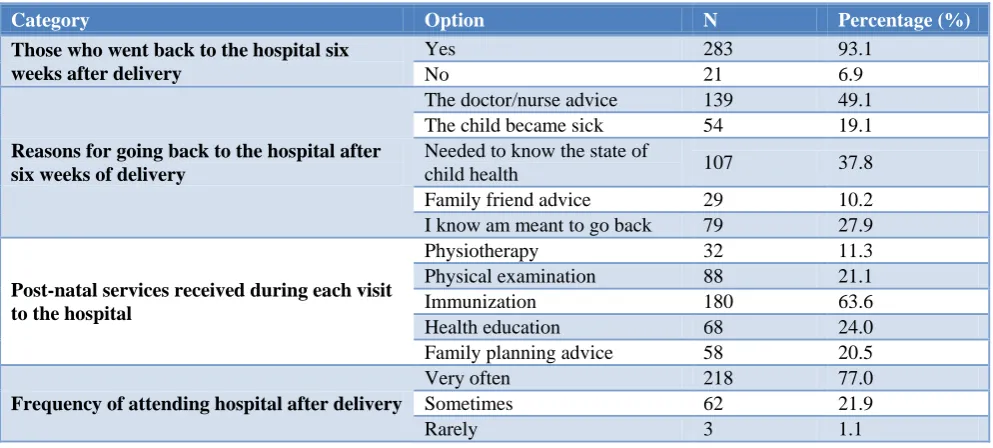
Table 4: Utilization of post-natal services (n=304).
Category Option N Percentage (%)
Those who went back to the hospital six weeks after delivery
Yes 283 93.1
No 21 6.9
Reasons for going back to the hospital after six weeks of delivery
The doctor/nurse advice 139 49.1
The child became sick 54 19.1
Needed to know the state of
child health 107 37.8
Family friend advice 29 10.2
I know am meant to go back 79 27.9
Post-natal services received during each visit to the hospital
Physiotherapy 32 11.3
Physical examination 88 21.1
Immunization 180 63.6
Health education 68 24.0
Family planning advice 58 20.5
Frequency of attending hospital after delivery
Very often 218 77.0
Sometimes 62 21.9
Rarely 3 1.1
Table 5: Factors that influence the utilization of maternal and child health care services (n=304).
Category Option N Percentage (%)
Which of the following factors do think influences the utilization of maternal and child health services
Accessibility of health care
services 159 52.3
Economic status 116 38.2
Cultural belief 91 29.9
Expertise 36 11.8
Professionally defined need 164 53.9
Social network 66 21.7
Demographics, genetics and
pregnancy 37 12.2
Approximately half 159 (52.3%) of the respondents opined that accessibility of health care services influences their utilization of maternal and child healthcare service.
DISCUSSION
Majority of the women attended an antenatal clinic in their last pregnancy, however, a significant number (6.9%) did not which is a risk factor for maternal mortality and morbidity.13
The respondents asserted that antenatal clinic attendance enhances birth preparedness, as well as promotes healthy living for both the mother and the foetus. This could explain why most of them attended it in their last pregnancy.
Most of the respondents had a skilled birth attendant during their last delivery. This is unlike what was earlier reported in Nigeria.10 This could be due to the fact that the study area is an urban area with many hospitals and maternity clinics available, in addition to the opinion of the majority of the respondents' opinion that the presence of a skilled birth attendant is important during delivery.
The high level of postnatal care (93.1%) in our study was in contrast with a previous study done in Nigeria which reported that only 43.7% of the women received postnatal care.10 This could be explained by the fact the mothers in our study were adequately counselled on the importance of postnatal care by the health personnel and this should be encouraged.
Some of the maternal and child healthcare services utilised by the respondents included physical examinations, laboratory tests, immunization, family planning counselling, which is similar to the findings of another study done in urban slums of Lucknow, India.14
More than half of the respondents had laboratory tests during their antenatal visits which are part of the efforts by the health personnel to ascertain the wellbeing of the woman and her foetus.
Studies both within and outside Nigeria have shown that utilization of maternal and child health care services is affected by a multitude of factors namely autonomy, access to transport, quality of facilities, incentive-based programs, cultural beliefs, socio-demographic status, women’s autonomy, economic conditions, physical and financial accessibility and health services issue.10,15-20 The respondents in our study similarly identified with some of them also. According to the respondents, the major factors influencing their utilization of maternal and health child healthcare services were the accessibility of health care services, professionally defined needs, economic status and cultural beliefs.
CONCLUSION
Significant barriers exist to timely maternity and postpartum care, particularly related to professionally defined needs, accessibility of health care services and economic status.
Recommendations
Though maternity care use is nearly universal, there is still need for reach out to few who do not attend antenatal clinic, educating women and decision-makers about the importance of quality antenatal early in pregnancy and postnatal care.
Also, the midwives and other health care workers should actively be engaged in educating pregnant help to reduce the infant and maternal mortality ratios.
Efforts should be made to fill health service gaps with substantial success through more community-based facilities, and financial subsidies.
ACKNOWLEDGEMENTS
We thank all the participants for their time and cooperation throughout the duration of the study. We are grateful to the management of the hospital for giving us approval to embark on this study.
Funding: No funding sources Conflict of interest: None declared
Ethical approval: The study was approved by the Institutional Ethics Committee
REFERENCES
1. Mahajan H, Sharma B. Utilization of maternal and child health care services by primigravida females in urban and rural areas of India. ISRN Prev Med. 2014;2014:123918.
2. World Health Organization: Making Pregnancy Safer: the Critical Role of the Skilled Attendant. Joint Statement by WHO, ICM and FIGO. Geneva: WHO; 2014.
3. African Population and Health Research Center. Maternal Health in Nigeria: A Situation Update. 2016. Available at: www.aphrc.org/publications/ maternal-health-nigeria-situation-update/. Accessed on 10th June 2019.
4. World Health Organization. Maternal Mortality. 2004, Geneva: WHO. Available at: https://www. who.int/news-room/fact-sheets/detail/maternal-mortality. Accessed on 24th June 2019.
5. Navaneetham K, Dharmalingam A. Utilization of maternal health care services in Southern India. Soc Sci Med. 2002;55:1848-69.
6. UNICEF Nigeria. The Children: Maternal and Child Health. Available at https://www.unicef.org/ children_1926.html. Accessed on 24th June, 2019. 7. Odetola TD. Health care utilization among rural
women of child-bearing age: a Nigerian experience. Pan Afr Med J. 2015;20:151.
9. Okeibunor JC, Onyeneho NG, Okonofua FE. Policy and programs for reducing maternal mortality in Enugu State, Nigeria. Afr J Reprod Health. 2010;14:19–30.
10. Babalola S, Fatusi A. Determinants of use of maternal health services in Nigeria- looking beyond individual and household factors. BMC Pregnancy Childbirth. 2009;9(1):43.
11. World Bank. Better Health in Africa: Experience and Lessons Learned. Washington D.C.: World Bank, 2005.
12. Barber SL. Family planning advice and postpartum contraceptive use among low-income women in Mexico. Int Fam Plan Perspect. 2007;33(1):6–12. 13. Ntiomo L, Okonofua FE, Gana M, Ogu R.,
Abdus-salam A, Galadanci H, et al Prevalence and risk factors for maternal mortality in Nigerian referral hospitals. Int J Women’s Health. 2018;10:69–76. 14. Deepak C, Jauhari N, Dhungana H. A Study on
Utilization of Maternal Health Services and Factors Influencing the Utilization in Urban Slums of Lucknow. Int J Med Public Health. 2018;8(2):77-81.
15. Waziri SH. Determinants and Prevalent Factors Associated with Utilization of Maternal and Child Health Services among Women in a Semi- Urban Settlement in Kano, Northern Nigeria. Ann Afr Med. 2009;5(2):68-72.
16. Shaikh BT, Hatcher J. Health seeking behaviour and health service utilization in Pakistan: Challenging the policy makers. J Public Health (Oxf). 2005;27(1):49-54.
17. Gage A. Barriers to the utilization of maternal healthcare in rural Mali. Soc Sci Med. 2007;65(8):1666-82.
18. Say L, Raine R. A systematic review of inequalities in the use of maternal health care in developing countries: Examining the scale of the problem and the importance of context. Bulletin of the World Health Organization. 2007;85(10):812-9.
19. ZelalemAyele D, Belayihun B, Teji K, Admassu Ayana D. Factors Affecting Utilization of Maternal Health Care Services in Kombolcha District, Eastern Hararghe Zone, Oromia Regional State, Eastern Ethiopia. Int Scholarly Res Notices. 2014;27:49-54.
20. Raj Baral Y, Lyons K, Skinner J, Van Teijlingen ER. Maternal health services utilization in Nepal: Progress in the new millennium? Health Sci J. 2012;6(4):618-33.
Cite this article as: Okpala PU, Okoye CL,