Improving Program Comprehension by Automatic
Metamodel Abstraction
Michal Vagaˇc1and J ´an Koll ´ar2
1 Department of Informatics, Faculty of Natural Sciences, Matej Bel University Tajovsk ´eho 40, 974 01 Bansk ´a Bystrica, Slovakia
2 Department of Computers and Informatics, Faculty of Electrical Engineering and Informatics, Technical University of Koˇsice
Letn ´a 9, 042 00 Koˇsice, Slovakia [email protected]
Abstract. The maintenance of a software system represents an impor-tant part in its lifetime. In general, each software system is the subject of different kinds of changes. Bug fixes and a new functionality extensions are the most common reasons for a change. Usually, a change is ac-complished by source code modifications. To make such a modification, correct understanding the current state of a system is required.
This paper presents the innovative approach to the simplification of pro-gram comprehension. Based on the presented method, the affected soft-ware system is analysed and metamodel for the selected feature is cre-ated. The feature represents functional aspect of a system being the sub-ject of the analysis and change. The main benefit is that by focusing on well known (and precisely described) parts of program implementation, it is possible to create metamodel for implementation parts automatically. The level of metamodel is at a higher level of abstraction than implemen-tation.
Keywords:Aspect-oriented programming, feature location, metalevel ar-chitectures, program comprehension, reverse engineering, software change.
1.
Introduction
Software systems help us with many everyday tasks. Since none software sys-tem is perfect, sooner or later there is demand for a change. Software syssys-tems often model a real world situation. That is why changes in real world result in state, in which software system (which was satisfactory in the past) is becom-ing insufficient. To brbecom-ing such system to the sufficient state again, it has to be changed. The most common reasons for a change are bug fixes and additions of a new functionality. It is more common to change the existing system than to create a new from scratch. Software system maintenance and evolution con-sumes up to 80 percent of system’s lifetime [16].
break functionality of a system. Therefore a program comprehension is the prerequisite for program maintenance. After understanding the request for a change, the relevant implementation code fragments have to be identified. Just after that these fragments can be safely modified. As a software system is grow-ing, it is more and more difficult to locate code intended for maintenance. This problem raises also with fluctuation of developers.
In this paper, we propose a new architecture for improving a program com-prehension, based on utilization of well known classes used in object-oriented program. We claim that for these classes it is possible to define accurate lo-calization algorithm. This algorithm, in combination with a predefined feature knowledge base, maps the selected program feature at a higher level of ab-straction automatically. Moreover, this mapping is performed in runtime.
The paper is organized as follows. Section 2 describes the proposed method-ology for automatic abstraction of selected feature. Section 3 presents the ex-periment developed using Java programming language. Section 4 covers the related works. Finally, section 5 concludes the paper and presents future work.
2.
Feature Metamodel at Higher Level of Abstraction
Existing tools for dynamic analysis and visualization of system execution are mostly generic solutions. Visualization result is difficult to use, since it is closer to implementation level than to application domain level. To get application do-main specific visualization, link between application dodo-main concept and code implementation must exist. This link between different levels of abstraction is not explicitly represented in a program code. When reading and understanding program by a developer, this link is built up using previous developer’s experi-ences and knowledge (about problem domain, programming techniques, algo-rithms, data structures, etc.). To reproduce this activity automatically, a kind of knowledge basedescribing link between different levels of abstraction must be established.
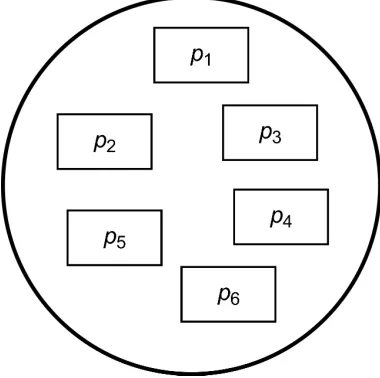
In this paper, we will focus on how to abstract systems constructed in object-oriented manner. A program developed in object-object-oriented language is typically defined by group of classes and their instances – objects. Objects communicate to each other by sending messages. Relationships between classes and objects are defined by program code. Let’s define V as a set of all existing classes (1) and P as a set of classes used in object-oriented program (2). Figure 1 represents a program created in object-oriented language.
V ={v1, v2, . . . , vn} (1)
P={p1, p2, . . . , pm}, P ⊂V (2)
Fig. 1.Object-oriented program using classespi
qualitatively different from the tokens used to construct the source code of the program” [2]. It is essential to move implementation level knowledge to a higher level of abstraction. As mentioned above, to make the translation from one level to another, extensive knowledge – aknowledge base – is required. Complete knowledge base should contain information about all classes, all application do-mains and about their relationship. Since usually new classes are defined, it is impossible to prepare complete knowledge base.
However, there is a group of software components, which are well known and their amount is limited – components defined in software libraries. Defining knowledge base which contains information about software libraries, it is pos-sible automatically create the transformation between the implementation level and higher level of abstraction, i.e. such that implements features comprised in libraries.
Modern object oriented software development platforms provides a compre-hensive set of its own standard class libraries. Let’s designate K as a set of known classes, i.e. all classes with known names and meaning.K is a subset of setV, of all classes. (3). Let’s defineK0as a set of known classes, which are used in the program (4).
K={k1, k2, . . . , kr}, K ⊂V (3)
K0={k0
1, k02, . . . , ks0}, K0=P∩K (4) When using classes from standard library, the program becomes easier readable and understandable (Fig. 2).
Fig. 2.Object-oriented program using classespiand well known classeski
view). Aspect of the program is a subset of program’s features, since it contains only features based on known classes. Since the program may contain several aspects,Ais subset ofK0(5). By defining a knowledge base for known classes and by analyzing program for the way of using these classes, it is possible to define a functionf, which maps an aspect of the program to modelM, which can be created at a higher level of abstraction than implementation level (Fig. 3, equation 6).
A={a1, a2, . . . , at}, A⊂K0 (5)
M =f(A) (6)
In implementation, the knowledge base and the functionf will be presented by combination of tracking algorithm and metamodel builder algorithm. Both algorithms will be specific for each feature.
Fig. 3.Object-oriented program using classespiand known classeski andai. By
ex-amining the way of use of classesaiit is possible to create modelMat a higher level of
abstraction
3.
Tool for Feature Metamodel Building
To validate usefulness of our proposal, we have constructed experimental tool, which automatically builds up metamodel for several predefined features. The experiment is performed using Java programming language. This language was chosen because of its wide use and its rich standard library (Java Class Li-brary).
To extend base level application with tracking code, we decided to use aspect-oriented approach. AOP ability for extending existing code with a new functionality is very helpful for techniques depending on metadata – it is possi-ble to extend base system with monitoring code [25]. This new code will create execution traces used to build metamodel.
Process of extending base level application with monitoring code is defined in knowledge base in form of AOP aspects. For each feature, the knowledge base contains information about its implementation – classes and methods used, as well as the way of using these classes and methods. Aspects de-fined in the knowledge base trace execution and usage of specified classes and methods at the base level of application. According to the traced informa-tion, algorithm (also defined in the knowledge base) builds up corresponding metamodel. Aspects and algorithm building metamodel are specific for each modelled feature.
One scenario supported by the experiment is modelling the feature for in-put/output streams. A stream can be defined as a sequence of data. A stream can represent many different kinds of sources and destinations, including disk files, devices, other programs, and memory arrays. Basic classes used to work with streams are abstract classes java.io.InputStream, java.io.OutputStream, that work with bytes, andjava.io.Readerandjava.io.Writer, that work on charac-ters. Different extensions of these classes allow different kinds of stream trans-formations. Among others, class java.io.ByteArrayInputStream allows reading bytes from byte array, java.io.FileInputStream allows reading bytes from file, java.io.FilterInputStreamallows stream transformations,
java.util.zip.GZIPInputStreamdecompresses stream data, etc. In the knowledge base used in experiment, the description of these classes is defined. One rec-ognized way of using these classes is chaining their instances (instance of one class is used as constructor parameter for another one). This is common way for defining the chain of classes used to process the specific stream. For example, stream is read from a file, then it is decrypted and finally decompressed.
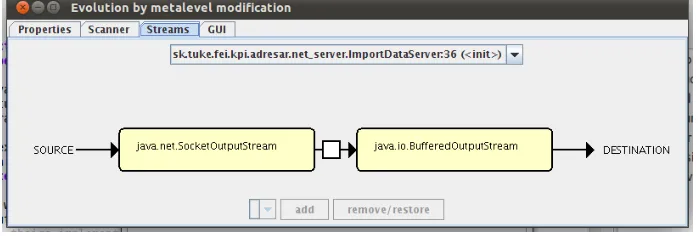
Described feature of input/output streams is modelled as the chain of filters used with a stream (Fig. 5).
To build such metamodel automatically, all invocations of mentioned classes’ constructors must be traced. Metamodel is created according to traced se-quence of constructor invocations. Algorithm building metamodel must consider only related invocations (connected through constructor argument). Finally, the tool displays graphical representation of created metamodel (Fig. 6).
Fig. 6.Data streams metamodel
4.
Related Works
The work presented in this paper addresses the issue for improving program comprehension by automatic metamodel abstraction.
According to a new design principle ofopen implementationa software mod-ule allows its clients to control its implementation strategy [13].
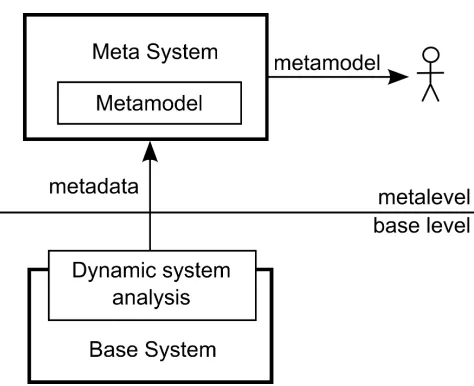
Open implementation contains besides main interface (providing functional-ity) also meta-interface through which a client tunes the implementation under-lying the primary interface. The wide use of open implementation principle is metalevel architecture, see [15].
In general, a metalevel architecture consists of different levels, where one level is controlled by another one. From viewpoint of program represented as a set of objects, it is possible to define several terms in the area of metalevel ar-chitectures. Application describing a problem being solved is located atdomain level. Domain objects are objects of this application. These objects describe the problem being solved. Domain object protocol defines operations (called domain operations) provided by domain object.
The technology of aspect-oriented programming which allows modulariza-tion of crosscuting concerns [14], ability for adding a new functionality to an existing program code [25] has been used in our solution as the basic technol-ogy for our runtime abstraction.
For maintenance tasks, the first step to be done before a change itself is identifying and understanding program code relevant to the requested change. Identifying parts of source code, that correspond to functional part of program, is known as feature or concept location [32].Featureorconcept can be defined as cohesive set of functionality [31]. Each feature represents a well understood abstraction of a system’s problem domain [28]. It exists at runtime as a collab-oration of objects, exchanging messages to achieve a specific goal. The main difference between concepts and features is, that the user can exercise the lat-ter (hence the notion of concept is more general than the notion of feature) [18]. In this work, we focused on features. Features are usually described by the re-quirements of a software system. Typically, users formulate their rere-quirements, change requests or error reports in terms of features [21].
Finding relations between features and source code takes important part in our program comprehension. Feature location is the process of identifying mappings between domain level concepts and their implementations in source code (it identifies code fragments that implements specific feature) [24]. The maintenance request, expressed usually in natural language and using the do-main level terminology is the input of mapping and a set of components that implement the feature [4] is the output. The input and output of the location process belong to different levels of abstraction (domain level on one side, im-plementation level on the other side). To make the transformation from one level to another, extensive knowledge is required (problem domain, program-ming techniques, algorithms, data structures, etc.). Since features are not ex-plicitly represented in source code, the features identification is a difficult task. It is traditionally an intuitive and informal process, based on past experiences.
In general, feature location can be static, dynamic or hybrid. The static tech-niques of feature identification doesn’t need execution of subject program – these techniques instead focus on searching in source code. The feature (or concept) location process can be defined as follows [19]:
1. feature formulation (usually in natural language)
2. query formulation and execution based on the intermediary representation 3. investigation of results
First approaches simply utilized pattern matching tools (such as Unix utility grep). This basic principle was improved in several ways ([4] [7] [20] [33] [29] [10] [11]). Improvements include extending the search process with usage of advanced information retrieval methods, or creating different ways of graphical visualisation of query results.
understanding of the system only by inspecting the source code [28]. Object-oriented characteristics such as inheritance and polymorphism make it difficult to understand runtime behavior of the system only by inspecting source code. Finally, hybrid (combined) feature location techniques utilize both - execution trace and source code information. Usually, static information is used to filter the execution traces.
Works [23] [30] [17] use Java Debug Interface to collect execution traces. Using this approach is complicated and leads to performance penalty – so we decided for the use of AOP to create execution traces. In [8] a set of instru-mentation aspects is defined that add code to a given Java program to collect enough tracing information such that the program can be reverse engineered. In this approach, every method invocation is intercepted and may be recorded. Since recording each method invocation would yield too much data to be an-alyzed, the recorder may be customized using a filter expression. However, to define filter expression, implementation level knowledge is required.
Common approach to handle a big amount of execution trace data is its visualization. Standards provided by execution trace analysis are sequence di-agrams and mapping method calls to source files. Sequence didi-agrams, while originally devised as a notation used during analysis and design, can be also very useful in program comprehension – through the visualization of execu-tion call traces. Reverse-engineered sequence diagrams based on dynamic call traces are typically very large, therefore several techniques to handle theirs size were introduced [1].
Works [12] [3] use aspect-oriented programming to instrument executed pro-gram with a new code, which collects information about propro-gram execution. Collected data are presented as UML sequential diagrams. Paper [22] summa-rizes experiences with the development of a reverse engineering tool for UML sequence diagrams. Author states that the development of a tool supporting the reconstruction of the behavior of a running software system must address the major areas of data collection, representation of this data in a suitable meta-model, and finally its graphical representation. Work [1] provides an overview of sequence diagram tools.
Paper [9] proposes a reverse-engineering tool suite to build precise class diagrams from Java programs. The tool uses both static and dynamic data to infer relationships among classes and interfaces. Work [3] describes class di-agrams used to create metamodels. These metamodels holds collected data and model resulting diagrams.
Described ways of dynamic analysis and visualization of system execution are generic solutions. Such approaches are often difficult to use, since it is im-possible to have only one simple general visualization suitable for different kinds of specific behaviours. Therefore to use such tools, user must understand (of-ten complex) visualization output, which is closer to implementation level than to application domain level. As stated in [26] and [27], understanding the software behavior is a unique problem requiring a specialized solution and a visualiza-tion.
Our approach comes out from the fact introduced above. One of our aims was to provide feature specific visualization, which will be closer to application domain level than to implementation level. To create such a visualization, fea-ture specific model is built up during dynamic analysis of system execution.
5.
Conclusions and Future Work
The paper presents a new approach to automatic feature mapping between different levels of abstraction. The proposed method utilizes knowledge of stan-dard class libraries. The experimental tool based on this method has been de-veloped, to prove the ability for automatic feature visualization at a higher level of abstraction than that of the implementation. Based on the usage of known classes, the tool is able to automatically track down selected predefined fea-ture of existing application and create its metamodel. Since the metamodel is specific for tracked feature, also its visualization can be closer to application do-main and better describes given problem (in contrary to generic visualizations). Predefined knowledge base substitutes developer’s knowledge.
The development of such automatic tool is not so simple. The main difficulty is associated with knowledge base construction – for each recognized feature there must be aspects defined to trace feature implementation and algorithms to model traced implementation details in metamodel. The level of difficulty of aspects and algorithms depends on the specific feature. On the other side, once the tool is developed, it can be used to locate predefined features from any exis-ting application using compatible version of libraries. It is even possible to use the tool with application with no source code available (in case of using load-time weaving of aspects). The prerequisite is just the compatibility of application programming interface.
Acknowledgments.This work was supported by VEGA Grant No. 1/0015/10 Principles and methods of semantic enrichment and adaptation of knowledge-based languages for automatic software development.
References
2. Biggerstaff, T.J., Mitbander, B.G., Webster, D.E.: Program understanding and the concept assignment problem. Commun. ACM 37, 72–82 (May 1994), http://doi.acm.org/10.1145/175290.175300
3. Briand, L.C., Labiche, Y., Leduc, J.: Toward the reverse engineering of uml se-quence diagrams for distributed java software. IEEE Trans. Softw. Eng. 32, 642–663 (September 2006), http://portal.acm.org/citation.cfm?id=1248725.1248762
4. Chen, K., Rajlich, V.: Case study of feature location using dependence graph. In: Proceedings of the 8th International Workshop on Program Comprehension. pp. 241–. IWPC ’00, IEEE Computer Society, Washington, DC, USA (2000), http://portal.acm.org/citation.cfm?id=518049.856972
5. Cornelissen, B., Zaidman, A., Holten, D., Moonen, L., van Deursen, A., van Wijk, J.J.: Execution trace analysis through massive sequence and circular bundle views. J. Syst. Softw. 81, 2252–2268 (December 2008), http://portal.acm.org/citation.cfm?id=1454787.1454981
6. Greevy, O., Lanza, M., Wysseier, C.: Visualizing live software systems in 3d. In: Pro-ceedings of the 2006 ACM symposium on Software visualization. pp. 47–56. SoftVis ’06, ACM, New York, NY, USA (2006), http://doi.acm.org/10.1145/1148493.1148501 7. Griswold, W.G., Yuan, J.J., Kato, Y.: Exploiting the map metaphor in a tool for soft-ware evolution. In: Proceedings of the 23rd International Conference on Softsoft-ware Engineering. pp. 265–274. ICSE ’01, IEEE Computer Society, Washington, DC, USA (2001), http://portal.acm.org/citation.cfm?id=381473.381501
8. Gschwind, T., Oberleitner, J.: Improving dynamic data analysis with aspect-oriented programming. In: Proceedings of the Seventh European Conference on Software Maintenance and Reengineering. pp. 259–. IEEE Computer Society, Washington, DC, USA (2003), http://portal.acm.org/citation.cfm?id=872754.873577
9. Gu ´eh ´eneuc, Y.G.: A reverse engineering tool for precise class diagrams. In: Proceedings of the 2004 conference of the Centre for Advanced Stud-ies on Collaborative research. pp. 28–41. CASCON ’04, IBM Press (2004), http://portal.acm.org/citation.cfm?id=1034914.1034917
10. Hill, E.: Developing natural language-based program analyses and tools to expedite software maintenance. In: Companion of the 30th international conference on Soft-ware engineering. pp. 1015–1018. ICSE Companion ’08, ACM, New York, NY, USA (2008), http://doi.acm.org/10.1145/1370175.1370226
11. Hill, E., Pollock, L., Vijay-Shanker, K.: Automatically capturing source code context of nl-queries for software maintenance and reuse. In: Proceedings of the 31st International Conference on Software Engineering. pp. 232– 242. ICSE ’09, IEEE Computer Society, Washington, DC, USA (2009), http://dx.doi.org/10.1109/ICSE.2009.5070524
12. Khaled, R., Noble, J., Biddle, R.: Inspectj: program monitoring for visualisation using aspectj. In: Proceedings of the 26th Australasian computer science conference -Volume 16. pp. 359–368. ACSC ’03, Australian Computer Society, Inc., Darlinghurst, Australia, Australia (2003), http://portal.acm.org/citation.cfm?id=783106.783147 13. Kiczales, G.: Beyond the black box: Open implementation. IEEE Softw. 13, 8–11
(January 1996), http://portal.acm.org/citation.cfm?id=624611.625543
14. Kiczales, G., Lamping, J., Mendhekar, A., Maeda, C., Lopes, C.V., Loingtier, J.M., Irwin, J.: Aspect-oriented programming. In: ECOOP. pp. 220–242 (1997)
16. Lehman, M.M., Ramil, J.F., Kahen, G.: A paradigm for the behavioural modelling of software processes using system dynamics. Technical report 2001/8, Imperial College, Department of Computing, London, United Kingdom (September 2001) 17. Leroux, H., R ´equil ´e-Romanczuk, A., Mingins, C.: Jacot: a tool to dynamically
vi-sualise the execution of concurrent java programs. In: Proceedings of the 2nd international conference on Principles and practice of programming in Java. pp. 201–206. PPPJ ’03, Computer Science Press, Inc., New York, NY, USA (2003), http://portal.acm.org/citation.cfm?id=957289.957349
18. Liu, D., Marcus, A., Poshyvanyk, D., Rajlich, V.: Feature location via informa-tion retrieval based filtering of a single scenario execuinforma-tion trace. In: Proceed-ings of the twenty-second IEEE/ACM international conference on Automated soft-ware engineering. pp. 234–243. ASE ’07, ACM, New York, NY, USA (2007), http://doi.acm.org/10.1145/1321631.1321667
19. Marcus, A., Rajlich, V., Buchta, J., Petrenko, M., Sergeyev, A.: Static techniques for concept location in object-oriented code. In: Proceedings of the 13th International Workshop on Program Comprehension. pp. 33–42. IEEE Computer Society, Wash-ington, DC, USA (2005), http://portal.acm.org/citation.cfm?id=1058432.1059343 20. Marcus, A., Sergeyev, A., Rajlich, V., Maletic, J.I.: An information retrieval approach
to concept location in source code. In: Proceedings of the 11th Working Conference on Reverse Engineering. pp. 214–223. IEEE Computer Society, Washington, DC, USA (2004), http://portal.acm.org/citation.cfm?id=1038267.1039053
21. Mehta, A., Heineman, G.T.: Evolving legacy systems features using regression test cases and components. In: Proceedings of the 4th International Workshop on Prin-ciples of Software Evolution. pp. 190–193. IWPSE ’01, ACM, New York, NY, USA (2001), http://doi.acm.org/10.1145/602461.602507
22. Merdes, M., Dorsch, D.: Experiences with the development of a reverse engineer-ing tool for uml sequence diagrams: a case study in modern java development. In: Proceedings of the 4th international symposium on Principles and practice of programming in Java. pp. 125–134. PPPJ ’06, ACM, New York, NY, USA (2006), http://doi.acm.org/10.1145/1168054.1168072
23. Oechsle, R., Schmitt, T.: Javavis: Automatic program visualization with object and sequence diagrams using the java debug interface (jdi). In: Revised Lectures on Software Visualization, International Seminar. pp. 176–190. Springer-Verlag, Lon-don, UK (2002), http://portal.acm.org/citation.cfm?id=647382.724668
24. Olszak, A., Jørgensen, B.N.: Remodularizing java programs for comprehension of features. In: Proceedings of the First International Workshop on Feature-Oriented Software Development. pp. 19–26. FOSD ’09, ACM, New York, NY, USA (2009), http://doi.acm.org/10.1145/1629716.1629722
25. Oriol, M., Cazzola, W., Chiba, S., Saake, G.: Object-oriented technology. ecoop 2008 workshop reader. chap. Getting Farther on Software Evolution via AOP and Reflection, pp. 63–69. RAM-SE’08, Springer-Verlag, Berlin, Heidelberg (2009), http://dx.doi.org/10.1007/978-3-642-02047-6 7
26. Reiss, S.P.: Visualizing program execution using user abstractions. In: Proceedings of the 2006 ACM symposium on Software visualization. pp. 125–134. SoftVis ’06, ACM, New York, NY, USA (2006), http://doi.acm.org/10.1145/1148493.1148512 27. Reiss, S.P.: Visual representations of executing programs. J. Vis. Lang. Comput. 18,
126–148 (April 2007), http://portal.acm.org/citation.cfm?id=1230158.1230422 28. R ¨othlisberger, D., Greevy, O., Nierstrasz, O.: Feature driven browsing. In:
29. Shepherd, D., Fry, Z.P., Hill, E., Pollock, L., Vijay-Shanker, K.: Using natural language program analysis to locate and understand action-oriented concerns. In: Proceedings of the 6th international conference on Aspect-oriented soft-ware development. pp. 212–224. AOSD ’07, ACM, New York, NY, USA (2007), http://doi.acm.org/10.1145/1218563.1218587
30. Sundararaman, J., Back, G.: Hdpv: interactive, faithful, in-vivo runtime state vi-sualization for c/c++ and java. In: Proceedings of the 4th ACM symposium on Software visualization. pp. 47–56. SoftVis ’08, ACM, New York, NY, USA (2008), http://doi.acm.org/10.1145/1409720.1409729
31. Turner, C.R., Fuggetta, A., Lavazza, L., Wolf, A.L.: A conceptual ba-sis for feature engineering. J. Syst. Softw. 49, 3–15 (December 1999), http://portal.acm.org/citation.cfm?id=340287.351492
32. Wilde, N., Scully, M.C.: Software reconnaissance: mapping program fea-tures to code. Journal of Software Maintenance 7, 49–62 (January 1995), http://portal.acm.org/citation.cfm?id=249936.249939
33. Zhao, W., Zhang, L., Liu, Y., Sun, J., Yang, F.: Sniafl: Towards a static noninteractive approach to feature location. ACM Trans. Softw. Eng. Methodol. 15, 195–226 (April 2006), http://doi.acm.org/10.1145/1131421.1131424
Michal Vaga ˇcis Assistant Professor at Department of Informatics, Faculty of Natural Sciences, Matej Bel University, and PhD student at Department of Com-puters and Informatics, Technical university of Koˇsice, Slovakia. He received his MSc. in Computer Science, in 2001. The subject of his research is meta-modeling, metaprogramming, programming paradigms, and dynamic software systems adaptation.
J ´an Koll ´ar is Full Professor of Informatics at Department of Computers and Informatics, Technical university of Koˇsice, Slovakia. He received his M.Sc. summa cum laude in 1978 and his Ph.D. in Computer Science in 1991. In 1978-1981 he was with the Institute of Electrical Machines in Koˇsice. In 1982-1991 he was with Institute of Computer Science at the P.J. ˇSaf ´arik University in Koˇsice. Since 1992 he is with the Department of Computer and Informatics at the Tech-nical University of Koˇsice. In 1985 he spent 3 months in the Joint Institute of Nuclear Research in Dubna, USSR. In 1990 he spent 2 months at the De-partment of Computer Science at Reading University, UK. He was involved in research projects dealing with real-time systems, the design of microprogram-ming languages, image processing and remote sensing, dataflow systems, im-plementation of programming languages, and high performance computing. He is the author of process functional programming paradigm. Currently his re-search area covers formal languages and automata, programming paradigms, implementation of programming languages, functional programming, and adap-tive software and language evolution.