IJSRSET173899 | Received : 15 Nov 2017 | Accepted : 29 Nov 2017 | November-December-2017 [(3)8: 312-316]
© 2017 IJSRSET | Volume 3 | Issue 8 | Print ISSN: 2395-1990 | Online ISSN : 2394-4099 Themed Section: Engineering and Technology
312
Implementation of Image Processing Technique’s for Weed
Detection and Discrimination in Groundnut Crop Field
Senthilkumar K, Parthiban A, Sudhashree T
Department of Mechatronics Engineering, Coimbatore Institute of Engineering and Technology, Coimbatore, Tamilnadu, India
ABSTRACT
This paper presents the development of image processing system for identification and classification of weeds in groundnut crop field. Various shape features were analysed and obtained from the crop/weed images. In order to classify a plant as a weed or crop various features such as shape, colour and texture are extracted. In this method pattern matching technique based on pyramidal matching is utilized to make out the decision whether the plant is crop or weed. Using this pattern matching method the successful recognition rate was 90% for groundnut crop and 85% for weeds.
Keywords: Weed/Crop Classification, Precision Agriculture, Image Processing, Machine Vision
I.
INTRODUCTION
In agriculture weed removal and control is an important operation to maintain crop yield. A weed is a type of plant that grows along with crops. It utilizes and consumes water nutrients and shape with crop plants. Therefore weed plant reduces crop yields and production. There are two general methods for used weed control and removal. By using mechanical instruments weed plant growth can be controlled. The other methods for controlling the weeds are to use herbicides and fertilizer. Over use of chemicals pollutes the environment so it is essential to seek alternate method for weed detection and control. Environmental pollution control and healthcare considerations are the two important features that stimulate the design and development of automatic weed control system.
According to [1] Groundnut is one of the important oilseed crops of southern India. Competition for water, nutrients, space with weed plants is the major problem for groundnut crops. It tends to minimize the crop yield. Weeds in groundnut comprise of diverse species of narrow-leaf, broad-leaf and sedges. Although the grassy weeds dominate in number, broad-leaf weeds also offer a stiff competition to the crop. Major weeds associated with the crop are, Amaranthus viridis, Boerhaavia
diffusa, Celosia argentena, Chloris barbata, Cyperus rotundus and Portulaca oleracea. Boerhaavia diffusa is the predominant weed [1] in groundnut fields. 30 images of this weed were used for image processing analysis. For weed detection and classification [2] [3], Image processing technique can provides accurate results.
In recent years the precision agriculture technology is the most focused field of research. In this proposed project work weed or crop plant classification is done by using machine vision and image processing technique. Important features that distinguish crop leaves and weed leaves are extracted from the images using various image processing techniques.
II.
SOFTWARE REQUIREMENT
LabVIEW supports various image processing techniques with the help of special functional blocks in low level VI and high level VI categories. IMAQ vision assistant module comes under the high level VI. It is a type of vision application and helps to perform various mathematical operations effectively.
The vision assistance has different features and facilities which are classified as image processing functions color processing functions, gray scale processing functions, binary processing functions, and machine vision processing functions.
III.
MATERIALS AND METHOD
The crop/weed images were taken for this research work using CCD type digital camera .The crop plants from six leaves stage were observed. The weed plant Boerhaavia diffusa was selected for this work. These weed plants were used as the objects to be distinguished from the crop plant.
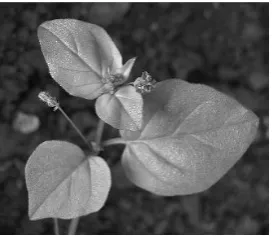
Sample Images of crop and weed is presented in Fig 1 and 2
Figure1: Groundnut Plant
Figure 2 : Boerhaavia Diffusa
A. System Description
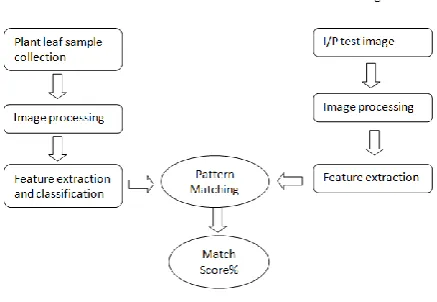
Pattern matching is very important field of machine vision, used in this research work to classify or recognize the patterns associated with the extracted features.
Figure3 : Flow of Operation
B .Weed Detection
The weed is captured from a specific agriculture field has three main parts (i) Soil (ii) Crop plants (iii) Weed plant. In this method the weed or crop discrimination is done by using following three processes.
• Removing soil background • Eliminating crop field • Extracting weed features
The system can extract the physical parameters from the groundnut leaf image and it provides statistical and general information of the crops and weeds.
C. Feature Extraction
Important leaf shape features [3] to be extracted for weed/crop classification are listed below.
IV.
IMAGE PROCESSING OPERATIONS
The plant leaf images are rotated manually in order to arrange leaf apex direction to either leaf or right direction. Gray component for each pixel is computed for each pixel from the colour image by
Graycomp = (0.299*Red)+(0.578*Green)+(0.114*Blue)
where R, G, B corresponds to the colour of the pixel respectively.
A. RGB to Gray Scale Image Conversion
The result of Colour plane extraction is shown in Figure 4
Figure 4 : Colour Plane Extraction- Green Plane
B. Thresholding Operation
The thresholding operation removes soil background and clearly presents the leaf image details of weed plant.
Threshold Type: Entropy
Figure 5 : Threshold Operation Result
C.Edge Detection
The sobel operator performs a 2D spatial gradient measurement on an image. The approximate gradient magnitude is also identified at each point by the edge detector. The operators consist of a pair of 3*3 Convolution kernels which is rotated by 90˚.
Figure 6 : Sobel Operators
D. Edge Detection Algorithm
Input: A Sample weed/crop Image. Output: Detected Edges.
Step 1: Accept the input image from the image database. Step 2: Apply mask Gx, Gy to the input image.
Step 3: Apply Sobel edge detection algorithm and the Gradient.
Step 4: Masks manipulation of Gx,Gy separately on the input image.
Step 5: Results combined to find the absolute magnitude of the gradient.
Step 6: The absolute magnitude is the output edges.
Figure 7 : Edge Detection Results
E.Pattern Matching Process
Two step process
Pyramidal Matching
In this method both the image and template are sampled to smaller spatial resolutions using Gaussian pyramidal.
Gradient method
This method makes use of filtered edge pixels as features matching is based on vector correlation rather than normalized cross correlation.
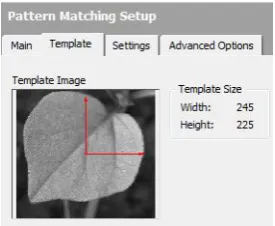
Figure 8 : Weed Plant Leaf Image Pattern
Figure 9 : Groundnut Leaf Image Pattern
Figure10 : Pattern Matching Process
Figure 11 : Pattern Matching-Matching Score
F. Feature Extraction for Weed/Crop Classification
Important Leaf shape features that distinguish weed plant and crop plant obtained by using image processing operations are listed in Table 1.
Table: 1 Extracted features for Weed/Crop
Classification
V.
CONCLUSION
An image processing system based on NI LabVIEW vision assistance was developed for weed detection in groundnut crop field. The important image features for weed/crop plant classification were obtained using image processing techniques. The successful identification rate was 90% for groundnut crop and 85% for weed images further research work is to develop an automated hardware system for the removal of weeds in the agriculture fields.
VI.
REFERENCES
[1] R.S. Jat, H. N. Meena, A. L. Singh, Jaya N. Surya, “Weed Management in Groundnut (Arachis Hypogaea L.) In India - A Review”, in Agricultural Research Communication Centre (ARCC), Agri. Reviews, 32 (3) : 155 - 171, 2011. [2] Riya Desai, Kruti Desai, Zinal Solanki, “Removal
of weeds using Image Processing: A Technical review” in International Journal of Advanced Computer Technology (IJACT) Volume 5, Issue 4, April 2017.
technologies, Biosystems Engineering, Volume 83, Issue 3, November 2002, Pages 275-280.
[4] Latha, Poojith, Amarnath Reddy, “Image Processing in Agriculture” in International Journal of Innovative Research in Electrical, Electronics, Instrumentation and Control Engineering, June 2014.
[5] Xuewen Wua , Wenqiang Xua , Yunyun Songa , Mingxing Caia, “A Detection Method of Weed in Wheat Field on Machine Vision” In Advanced Control Engineering and Information Science Procedia Engineering 15 (2011) 1998 – 2003. [6] Srinivasan, A. Handbook of Precision Agriculture.
Principles and Applications. New York : The Haworth Press; 2006.
[7] Tsampikos Kounalakis, Georgios A. Triantafyllidis, Lazaros Nalpantidis, “Weed Recognition Framework for Robotic Precision Farming” in IEEE 2016.