© 2017 IJSRSET | Volume 3 | Issue 6 | Print ISSN: 2395-1990 | Online ISSN : 2394-4099 Themed Section: Engineering and Technology
An Approach Towards Wireless Sensor Network Design
Optimization Using PSO
Aditi Bajpai, Yukti Kesharwani
Dr. C. V. Raman University, Bilaspur, Chhattisgarh, India
ABSTRACT
Wireless sensor Network Design is the important issue of improving transportation networks by selecting the optimal projection among a set of alternatives. Particle Swarm Optimization (PSO) is a meta-heuristic optimization approach which has been widely applied to various problems. PSO technique that was developed by Kennedy and Eberhart is originated from the behavior of birds ’flocks in which individuals convey information between themselves and the leader in order to seek the best direction to food. In this project we will use PSO for Transportation Network Design problem and we will compare PSO with genetic algorithm.
Keywords: WSN, MANET, PSO
I.
INTRODUCTION
A Wireless Sensor Network (WSN) involves vast number of sensors that are firmly sorted out. Essentially the sensors are the detecting gadgets which sense and screen the physical conditions, for example, temperature, weight, movement, sound, vibration at various areas. For the most part the sensors are battery worked minor gadgets and in this way have restricted memory handling, power and correspondence capacities.
Now a days, the applications of WSNs have increased substantially. Significant applications of these kinds of networks are agribusiness, factory automation, climate control, war machine target tracking and close observation, home ground monitoring, biomedical health monitoring likewise. WSN formed by hundreds or thousands of motes that communicate with each other and pass data along from one to another. In figure-1 Motes are the building blocks of Wireless Sensor Networks (WSN). It is a very low cost low power computer, which monitors one or more sensors through Radio Link to the outside world. Figure-2 is pictorial respresentation of Mote. There are several applications of WSN as:
Environmental/Habitat monitoring Acoustic detection
Seismic Detection
Military surveillance Inventory tracking Medical monitoring Smart spaces Process Monitoring
These sensor systems have countless in the earth. They can be utilized to track development of creatures, fowls and record them. Checking of earth, soil, environment setting, water system and accuracy agribusiness should be possible through these sensors. They can likewise utilized for the recognition of flame, surge, seismic tremors, and synthetic/natural flare-up and so forth.
The typical intention of the particle swarm optimization (PSO) algorithm is to solve an unconstrained continuous minimization problem: find x* such that f(x*)<=f(x) for all n-dimensional real vectors x. The objective function f: Rn -> R is called the fitness function.
particles. The PSO method views the set Rn of feasible solutions as a “space” where the particles “move”. For solving practical problems, the number of particles is usually chosen between 10 and 50.
Advantages and disadvantages
The fitness function can be non-differentiable (only values of the fitness function are used). The method can be applied to optimization problems of large dimensions, often producing quality solutions more rapidly than alternative methods. There is no general convergence theory applicable
to practical, multidimensional problems. For satisfactory results, tuning of input parameters and experimenting with various versions of the PSO method is sometimes necessary. Stochastic variability of the PSO results is very high for some problems and some values of the parameters. Also, some versions of the PSO method depend on the choice of the coordinate system.
Node Placement Methods
Genetic Algorithm Based Node Placement: The operational modes of the sensor nodes are optimized by the genetic algorithm along with clustering schemes and transmission signal powers. The GA (Genetic algorithm) foremostly finds the operational modes of the nodes so as to meet the application specific rations along with minimization of energy depletion by the network. More explicitly, network design is examined in terms of active sensors location, clustering and communication range of sensors, while performance estimation includes, collected with connectivity and energy-related features, some application-specific properties like consistency and spatial density of sensing points. Optimization Parameters in GA are according to Amol P. Bhondekar IMECS 2009:
Application-specific parameter: The effectiveness of a distributed WSN highly depends upon the sensor deployment scheme. It is highly desirable to deploy the sensing nodes such that maximum field coverage and high quality communication is achieved. Here, a field coverage parameter is defined as under:
Where,
nx : Number of X Sensors (cluster-in-charge)
ny : Number of Y Sensors
nz : Number of Z Sensors
nor : Number of Out of Range Sensors
ninactive : Number of Inactive Sensors
ntotal : Total number of sensing points
Connectivity parameters: Perpetual network connectivity is a crucial issue in WSNs. Following parameters are taken into account for reliable network connectivity.
LEACH Algorithm: Mahmood et al. proposed MODLEACH algorithm by extending the basic LEACH algorithm for WSNs to increase the throughput and lifetime of the network. Two ideas such as efficient cluster head replacement and dual transmitting power levels were introduced in the MODLEACH algorithm. Cluster head replacement was done by checking the energy of current CH with the threshold. If the residual energy is greater than the threshold, then the CH remains same for the next round. Because the CH did not spend more energy in previous round, the residual energy remains approximately same and can be used for further rounds. This scheme saved the energy of new CH selection. Dual transmission power level was used to use different amplification power to transmit the data based on the distance to the destination. Because need of amplification of signal transmission by a node to the closest CH is less than transmitting to farthest base station.
Power-Efficient Gathering in Sensor Information Systems: Another clustering protocol which aims to enhance the network lifetime is (PEGASIS) [S. Lindsey et. Al.]. Power-Efficient Gathering in Sensor Information Systems (PEGASIS) uses a greedy algorithm to organize nodes into a chain, so that each node transmits and receives from only one of its neighbors. In each round, a randomly chosen node from the chain will transmit the aggregated data to the base station and reduce the number of nodes that communicate directly with the base station.
Base station Controlled Dynamic Protocol [S. D. Muruganathan et. al.] : An approach called Base station Controlled Dynamic Protocol (BCDCP) is proposed which produces clusters of equal size to avoid cluster head overload and to ensure similar power dissipation of nodes.
II.
Literature SurveyChun-Cheng Lin Elsevier 2013 first models a mathematical form for our concerned problem, then proposes a particle swarm optimization (PSO) approach, and, from a theoretical aspect, provides the convergence and stability analysis of the PSO with constriction coefficient, which is much simpler than the previous analysis. Experimental results show the quality of the proposed approach through sensitivity analysis, as well as the adaptability to the topology changes at different times.
Marcin Molga et. al. Wiley Online Library 2005 provides the review of literature benchmarks (test functions) commonly used in order to test optimization procedures dedicated for multidimensional, continuous optimization task. Special attention has been paid to multiple-extreme functions, treated as the quality test for “resistant” optimization methods (GA, SA, TS, etc.). Author said that Quality of optimization procedures (those already known and these newly proposed) are frequently evaluated by using common standard literature benchmarks. There are several classes of such test functions, all of them are continuous: (a) unimodal, convex, multidimensional, (b) multimodal, two-dimensional with a small number of local extremes, (c) multimodal, two-dimensional with huge number of local extremes (d) multimodal, multidimensional, with huge number of local extremes, . Class (a) contains nice functions as well as malicious cases causing poor or slow convergence to single global extremum. Class (b) is mediate between (a) and (c)- (d), and is used to test quality of standard optimization procedures in the hostile environment, namely that having few local extremes with single global one. Classes (c)-(d) are recommended to test quality of intelligent “resistant” optimization methods, as an example GA, SA, TS, etc. These classes are considered as very hard test problems.
Amol P. Bhondekar et. al. IMECS 2009 have demonstrated the use of genetic algorithm based node placement methodology for a wireless sensor network. A fixed wireless network of sensors of different operating modes was considered on a grid deployment and the GA system decided which sensors should be active, which ones should operate as cluster-in-charge and whether each of the remaining active normal nodes should have medium or low transmission range. The network layout design was optimized by taking into
consideration application specific parameter, connectivity parameters and energy related parameters. From the evolution of network characteristics during the optimization process, Author concludes that it is preferable to operate a relatively high number of sensors and achieve lower energy consumption for communication purposes than having less active sensors with consequently larger energy consumption for communication purposes. In addition, GA-generated designs compared favorably to random designs of sensors. Uniformity of sensing points of optimal designs was satisfactory, while connectivity constraints were met and operational and communication energy consumption was minimized. Author also showed that dynamic application of the algorithm in WSN layout design can lead to the extension of the network’s life span, while keeping the applicationspecific properties of the network close to optimal values. The algorithm showed sophisticated characteristics in the decision of sensors’ activity/inactivity schedule as well as the rotation of operating modes (X, Y & Z modes). But there still exists lot of scope for future work to deal with the development of heuristic methodologies for optimal routing of dynamically selected cluster-in-charge sensors, through some multi-hop communication protocols. Also, methodologies could be developed for dynamic integration of battery capacity.
Prerana Shrivastava et. al. IJETAE 2014 roposed strategy the sensors position is first estimated by the estimated step forward metric and then the particle swarm optimization algorithm is used to minimize the localization errors. This results in accurate localization information about the various sensors. The simulation results showed that the various performance metrics like the packet delivery ratio, end to end delay and energy consumption showed a significant amount of improvement as compared to the traditional method of localization Scheme. The work can further be extended by considering the impact of PSOLS on node density, node connectivity and location estimation error.
on LEACH algorithm aims to use the multi hop communication pattern and optimal number and election of cluster heads.
Amin Rostami et. al. IJMIT 2014 said that Wireless sensor networks (WSN) is composed of a large number of small nodes with limited functionality. The most important issue in this type of networks is energy constraints. In this area several researches have been done from which clustering is one of the most effective solutions. The goal of clustering is to divide network into sections each of which has a cluster head (CH). The task of cluster heads collection, data aggregation and
transmission to the base station is undertaken. In this paper, we introduce a new approach for clustering sensor networks based on Particle Swarm Optimization (PSO) algorithm using the optimal fitness function, which aims to extend network lifetime. The parameters used in this algorithm are residual energy density, the distance from the base station, intra-cluster distance from the cluster head. Simulation results show that the proposed method is more effective compared to protocols such as (LEACH, CHEF, PSO-MV) in terms of network lifetime and energy consumption.
S. No. Author/Title/Publication Algorithm Energy Consumptio
n
Packet Delivery
Ratio
Description
1. Prerana Shrivastava et. al./Design of PSO Based Localization Technique for Mobile Sinks in Wireless Sensor Networks/IJETAE 2014
PSO base Localizatio n
16.39% 61% In proposed strategy the sensors position is first estimated by the estimated step forward metric and then the particle swarm optimization algorithm is used to minimize the localization errors. This results in accurate localization information about the various sensors.
2. Pavlos Antoniou, Andreas Pitsillides , Tim Blackwell et. al./ Congestion control in wireless sensor networks based on bird flocking behavior/ Elsevier 2012
Flock-based Congestion Control (Flock-CC) mechanism
Low High The proposed Flock-based Congestion Control (Flock-CC) mechanism in dynamically balancing the offered load by effectively exploiting available network resources and moving packets to the sink. Furthermore, Flock-CC provides graceful performance degradation in terms of packet delivery ratio, packet loss, delay and energy tax under low, high and extreme traffic loads. In addition, the proposed approach achieves robustness against failing nodes, scalability in different network sizes and outperforms typical conventional approaches.
3. Amol P. Bhondekar et. al./ Genetic Algorithm Based Node Placement
Methodology For Wireless Sensor Networks/ IMECS 2009
Genetic Algorithm
Low High (Optimized
Parameter Values)
deployment and the GA system decided which sensors should be active, which ones should operate as cluster-in-charge and whether each of the remaining active normal nodes should have medium or low transmission range.
4. K.SyedAliFathima, T.Sumitha/To Enhance the Lifetime of WSN Network using PSO /ICGICT 2014
LEACH Protocol+P SO
- - In this paper, LEACH protocol is used for energy efficiency in wireless sensor network .Clustering technique is used in LEACH protocol to improve the lifetime of network .It will increase the energy but still it need some energy. In future work include Particle swarm optimization technique with LEACH protocol it provides more energy efficient to increase network lifetime of wireless sensor network.
5. M. Madheswaran and R. N. Shanmugasundaram / Enhancements Of Leach Algorithm For Wireless Networks: A Review / ICTACT 2013
LEACH Low - In this paper, various enhancements used in the original LEACH protocol are examined. The basic operations, advantages and limitations of the modified LEACH algorithms are compared to identify the research issues to be solved and to give the suggestions for the future proposed routing algorithms of wireless networks based on LEACH routing algorithm.
6. Xiangyu Yu, Jiaxin Zhang, Jiaru Fan et.al. /A Faster Convergence Artificial Bee Colony Algorithm in Sensor Deployment for Wireless Sensor Networks/ Hindavi 2013
Artificial Bee Colony Algorithm
Energy Efficient
III.
Problem Identification
We have experienced different literary works and discovered some problems in existing system. We have gone through several literature and given comparison based on packet delivery ratio and energy consumption, and we found some bottleneck as follows:
• Energy consumption is very high in nodes.
• Earlier algorithm uses genetic algorithm which is not energy efficient.
• Energy consumption in active node is very high. • Error accumulation is high among nodes.
•
Unlike GAs, PSOs do not change the population from generation to generation, but keep the same population, iteratively updating the positions of the members of the population (i.e., particles). PSOs have no operators of “mutation”, “recombination”, and no notion of the “survival of the fittest”. On the other hand, similarly to GAs, an important element of PSOs is that the members of the population “interact”, or “influence” each other.IV.
Proposed Methodology
Goal of our project is to design an optimal network by making optimization on some optimization parameters of WSN. Multiple objectives of our optimization problem are combined in a single objective function. Design and performance parameters for a WSN are divided into three sets. The first set consists of some application-specific parameters. These parameters are specified exactly based on the application of the WSN. Here, two parameters are considered, uniformity of sensing points and some desired spatial density of measuring points. The second set refers to the connectivity parameters. One metric is used for assurance on connectivity of each sensor to at least one clusterhead. Considering restricted resources of clusterheads leads to set out another metric for confining the number of sensors communicating with clusterheads. Each clusterhead can communicate just with predefined amount of sensors. The third set is energy-related parameters consists of major energy consumption parts in WSNs. The operational energy consumption which depends on the types of active nodes, and the communication energy consumption being dependent on distances between sensors are parameters within this class which are investigated.
PSO
nVar=10; // Number of Decision Variables VarSize=[1 nVar]; // Size of Decision Variables Matrix VarMin=-10; // Lower Bound of Variables
VarMax= 10; // Upper Bound of Variables //// PSO Parameters
MaxIt=1000; // Maximum Number of Iterations nPop=100; // Population Size (Swarm Size)
// PSO Parameters
w=1; // Inertia Weight
wdamp=0.99; // Inertia Weight Damping Ratio c1=1.5; // Personal Learning Coefficient c2=2.0; // Global Learning Coefficient // Velocity Limits
VelMax=0.1*(VarMax-VarMin); VelMin=-VelMax;
Repeat i=1:nPop
1. Initialize Position 2. Initialize Velocity // Evaluation
particle(i).Cost=CostFunction(particle(i).Position); // Update Personal Best
particle(i).Best.Position=particle(i).Position; particle(i).Best.Cost=particle(i).Cost; // Update Global Best
if particle(i).Best.Cost<GlobalBest.Cost GlobalBest=particle(i).Best; end
end
// PSO Main Loop Repeat it=1:MaxIt Repeat i=1:nPop 1. Update Velocity 2. Apply Velocity Limits 3. Update Position 4. Velocity Mirror Effect 5. Apply Position Limits // Evaluation
particle(i).Cost = CostFunction(particle(i).Position);
// Update Personal Best
if particle(i).Cost<particle(i).Best.Cost
particle(i).Best.Position=particle(i).Position; particle(i).Best.Cost=particle(i).Cost;
// Update Global Best
if particle(i).Best.Cost<GlobalBest.Cost GlobalBest=particle(i).Best; end
end end end
BestSol = GlobalBest;
V.
RESULTS AND DISCUSSION
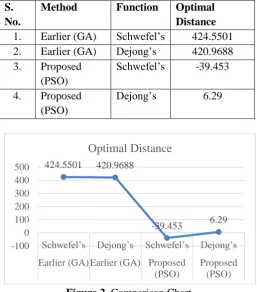
project. PSO and GA has been compared based on two test functions.
1. De Jong’s function 2. Schwefel’s function
For implementation of our research work we have used Matlab 2016a. Following are the some snippet of project. PSO and GA has been compared based on two test functions.
Fig. 1 shows the main GUI of project implementation GUI shows two options 1. PSO (Particle Swarm Optimization) and 2. GA (Genetic Algorithm) with two two functions.
S. No.
Method Function Optimal Distance
1. Earlier (GA) Schwefel’s 424.5501 2. Earlier (GA) Dejong’s 420.9688 3. Proposed
(PSO)
Schwefel’s -39.453
4. Proposed (PSO)
Dejong’s 6.29
Figure 2. Comparison Chart
VI.
CONCLUSION
The proposed payment system combines the Iris recognition with the visual cryptography by which customer data privacy can be obtained and prevents theft through phishing attack [8]. This method provides best for legitimate user identification. This method can also be implemented in computers using external iris recognition devices.
VII.
REFERENCES
[1]. Prerana Shrivastava et. al.Design of PSO Based Localization Technique for Mobile Sinks in Wireless Sensor NetworksIJETAE 2014
[2]. Pavlos Antoniou, Andreas Pitsillides , Tim Blackwell et. al. Congestion control in wireless sensor networks based on bird flocking behavior Elsevier 2012
[3]. Amol P. Bhondekar et. al. Genetic Algorithm Based Node Placement Methodology For Wireless Sensor Networks IMECS 2009
[4]. K.SyedAliFathima, T.SumithaTo Enhance the Lifetime of WSN Network using PSO ICGICT 2014 [5]. M. Madheswaran and R. N. Shanmugasundaram
Enhancements Of Leach Algorithm For Wireless Networks: A Review ICTACT 2013
[6]. Xiangyu Yu, Jiaxin Zhang, Jiaru Fan et.al. A Faster Convergence Artificial Bee Colony Algorithm in Sensor Deployment for Wireless Sensor Networks Hindavi 2013
[7]. Amin Rostamiand Mohammad Hossin MottarWIRELESS Sensor Network Clustering Using Particles Swarm Optimization For Reducing Energy Consumption Novemebr 2014
424.5501 420.9688
-39.453 6.29
-100 0 100 200 300 400 500
Schwefel’s Dejong’s Schwefel’s Dejong’s
Earlier (GA) Earlier (GA) Proposed (PSO)
Proposed (PSO)