IJEDR1901085 International Journal of Engineering Development and Research (www.ijedr.org) 473
Detection of Life during Building Collapse Using
PIC Microcontroller
1
G.Meenakshi,
2VM Moulika,
3S.Indhumathi
1Assistant Professor, 2Student, 3Student 1Department of ECE,
1 Velammal Engineering College, Chennai, Tamil Nadu, India
_____________________________________________________________________________________________________
Abstract—Building collapse has become very frequent in recent times disaster management which has imparted with latest technologies. In our project, a sensor based system is developed to locate human beings who are trapped under collapsed building of an organization. The heartbeat of human beings is detected using a heartbeat sensor and the obtained data is sent to the microcontroller. The exact location of the person is sent to the microcontroller. This provides the information of whether the person is alive or not along with the location of the person are processed and updated to a server database every few minutes via a GSM/GPRS module. The server is maintained with the details of the employees in the organization. The status the location of the person can be viewed from the server. The rescuers team from disaster management can get the information from the server and immediately rescue the person.
Index Terms— Building Collapse, Heartbeat sensor, GSM/GPRS module.
_____________________________________________________________________________________________________
I. INTRODUCTION
People are being affected by all types of disasters like earthquake, flood, cyclones, landslides, droughts, accidents, plane crash, forests fire, etc. Based on technological advancements, the force of disasters is also changing. The impact leads to loss of lives, property and health disorders, which is also same as in case of man-made disasters like building collapse while construction. In building collapsed, rescuing is not the ultimate technical solution which would guarantee efficient detection and localization of victims. During building collapse, rescuers look for voids or pockets where people may be trapped when walls collapse or where survivors may have hidden, such as under desks, in bath tubs or stairwells. They feed a camera on the end of a flexible pole into the collapsed building- this shows where people are and how much of the building’s structure is left. Rescuers use sound location devices, which is connected to a microphone system. The device bangs on the rubble three times and if people tap back or call out for help, they can be tracked and assistance will be provided. Other search tools are a thermal image camera system, which shows areas of body heat, and trained sniffer dogs. They also use a carbon dioxide analyzer which helps us detect people who might be unconscious but still breathing. The disadvantages of these approaches are that the exact location of the victim and whether the victims are alive or not cannot be determined. To overcome these disadvantages, a system has been designed using a heartbeat sensor, GSM/GPRS module, PIC microcontroller and a GPS module. This system senses the heartbeat of the person using a heartbeat sensor and the location of the person is detected using a GPS module. These two pieces of information are sent to the microcontroller and processed. The information of whether the person is alive or not and the location of the person is updated to a server database via a GSM/GPRS module every few minutes. During building collapse, the rescuers can view the information of the person from the server and immediately undergo rescue operation.
II. LITERATURE SURVEY
An infrared ray detects the defects in human body, which is emitted to human and the reflected temperature from the human is deducted by the IR. Detection results with transparent or bright colored materials are not accurate. There is a detection accuracy loss with increasing the reflection distance. Due to the changes in weather conditions the detection results may change [1].
If a microwave beam of particular frequency is targeted on rubble which covers a human subject, the microwave beam penetrates the rubble or the barrier to reach the human subject[2].
GPRS is used to find the object, which is placed in the moving vehicle and it deducts the object. The captured is converted into 3D image by digital image processing. In this system only the objects are found, when it is used in collapsed buildings means, it denotes the objects and gives intimation to us. So this is difficult to save the human’s life [4].
Robots for earthquake rescue operation detects human, by using Wireless Camera, where affected area is sensed and information is given to Zigbee (Transceiver) which is used to deduct the human and pass the signal to control room. In this system they are focusing only the surface and do not deduct the persons in depth[5].
III. BLOCK DIAGRAM
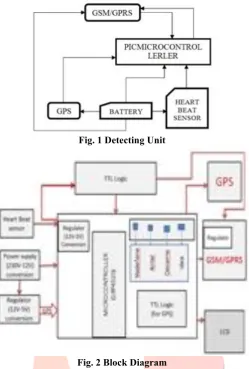
IJEDR1901085 International Journal of Engineering Development and Research (www.ijedr.org) 474 Fig. 1 Detecting Unit
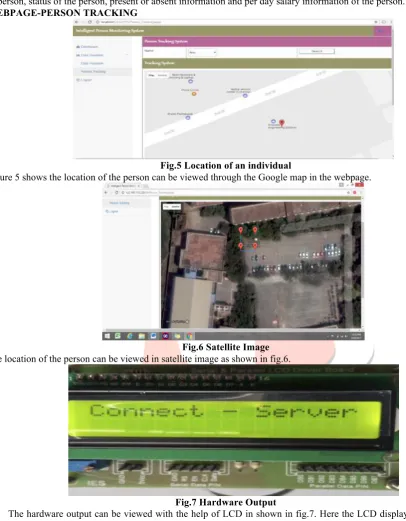
Fig. 2 Block Diagram
The detecting unit consists of the heartbeat sensor which senses the heartbeat of the person and the signal from the sensor is sent to the PIC microcontroller. The received signal is processed. Then the location of the person is detected by the GPS module and this information is also sent to the microcontroller. The microcontroller is programmed in such a way that the information of whether the person is alive or not along with the location information is sent to a server database via GSM/GPRS module. The server is maintained with the details of the employees in the organization. After some regular interval of time, the server is updated with the employee’s location and the information of whether the employee is alive or not. The server details can be backed up and stored in two or more systems. During building collapse, the rescuers can check the server for the individual’s details and immediately start the rescue operation. Figure 2 shows the block diagram.
IV. HARDWARE DESCRIPTION
Heartbeat Sensor is designed to give output of heartbeat, when a finger is placed on the sensor. The heartbeat sensor works on the principle of light modulation by blood flow through the finger at each pulse. The heartbeat sensor consists of super bright LED and the light detector. The working of the sensor is based on the fact that the LED must be super bright as the maximum light must pass spread in finger and detected by detector. Now, when the heart pumps blood through the blood vessel, the finger becomes slightly opaque and so less light will reach the detector. With each heart pulse the detector signal varies. This variation is converted to electrical pulse. The digital output signal is indicated by the LED which blinks on each heartbeat. Then the digital output is connected to the microcontroller to measure the Beats Per Minute (BPM) rate
Global Positioning System (GPS)
IJEDR1901085 International Journal of Engineering Development and Research (www.ijedr.org) 475 Fig.3 GPS Module (SKG13BL)
V. PROPOSED SYSTEM
The heartbeat sensor senses the heartbeat of the person. When the finger is placed on the sensor, the infrared led transmits infrared signal through the finger of the person. The blood cell reflects the part of the infrared light. Then the photodiode sensor detects the reflected signal. Since the blood volume changes with heartbeat, the train of pulses is produced at the output of the photodiode sensor. The obtained output is of less magnitude to be detected by a microcontroller. Hence the signal is passed to an operational amplifier LM358 to amplify and filter the received pulse. The received signal is then sent to the PIC microcontroller.
Then the location of the person is detected by the GPS module. The GPS module receives the GPS signal using GPS antenna of 1575.42MHz and voltage of (3-5V). When the GPS module is given the power supply, the module connects automatically with the available satellites. The LED in the module starts blinking when the module has connected with at least 3 satellites properly. Two types of data are required by the GPS receiver: the almanac and the ephemeris, where the location of the GPS satellites can be determined. The obtained data is continuously transmitted by the GPS satellites and GPS receiver collects and stores this particular data. Received data is in ASCII text and thus varies in precision. Every sentence begins with a ‘$’ sign, and has about 80 characters which ends up with a carriage return/line feed sequence. Sentences are mostly framed in single lines or multiple lines and the data items in each sentence are separated by commas. This module provides details of some important parameters like current time, date, latitude, longitude, speed, and altitude along with travel direction/heading among other data. Hence complete serial message given by the GPS module presented at the serial interface with NMEA protocol. This information is sent to the microcontroller serially.
The microcontroller is programmed in such a way that once the signal from the heartbeat sensor is received, the status of whether the person is alive or not is manipulated.
The person’s detecting unit is connected with the server for every thirty seconds via GSM/GPRS module. Hence any information to be transmitted is updated every thirty seconds to the server. Once the server is connected to the person’s detecting unit, the server sends the latitude and longitude information of the server to the PIC microcontroller. The PIC microcontroller acts as I/O as well as transceiver. The microcontroller is programmed in such a way that once the server’s position information is received, the microcontroller compares this value with the person’s position. If the difference between these two values is within a set threshold value, then the person is considered to be present and the person’s per salary is considered. The threshold value is chosen according to the organization’s total latitude and longitude coverage area. Once the microcontroller manipulates all the above information, it is transmitted to the server database through GSM/GPRS module. The webpage is developed to display the status of each employee in the organization along with their salary and attendance details. Once the server receives the information about the employees, the webpage is automatically updated. The server details can be backed up and stored in two or more systems. During building collapse, the rescuers can view the webpage and identify whether the person is alive or not and immediately start the rescue operation.
VI. RESULTS AND DISCUSSION
The webpage is developed with the separate pages for viewing the location of the person through Google map and the status of the person. The page for viewing employee’s details is given as data visualizer. It is for viewing location through Google is given as tracking system.
WEBPAGE-DATA VISUALISER
IJEDR1901085 International Journal of Engineering Development and Research (www.ijedr.org) 476 Fig.5 Location of an individual
Figure 5 shows the location of the person can be viewed through the Google map in the webpage.
Fig.6 Satellite Image The location of the person can be viewed in satellite image as shown in fig.6.
Fig.7 Hardware Output
The hardware output can be viewed with the help of LCD in shown in fig.7. Here the LCD display indicates that the person’s detecting unit is connected with the server.
Fig.8 Status of person’s life
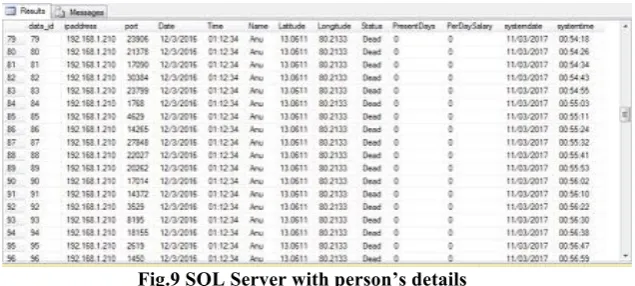
IJEDR1901085 International Journal of Engineering Development and Research (www.ijedr.org) 477 Fig.9 SQL Server with person’s details
Figure 9 shows the SQL server page receiving the person’s details in the back-end is shown.
VII. CONCLUSION
It provides a comprehensive solution for disaster management by identifying the survivors in the shortest span of time. The heartbeat sensor senses the heartbeat of the person hence the person is alive or dead can be easily detected. By proper processing the data, the status of the person under trap can be easily identified and the location of the person under the rubble can be detected by using GPS. The presence of life is identified by detecting the heart-pulse which is extracted from the person’s wrist and transmitted to a server location. The co-ordinates of this unit are then relayed back to a ground station which can be viewed by the rescue personnel in order to pin-point the location of the survivor. The project can thus serve as a useful tool to help rescue personnel in their research and rescue operation. This can be used to save for any disasters, which can practically be applied in real time situations.
In future, the work can be enhanced in adhoc network technology, which might replace the GSM/GPRS by Wi-Fi technology.Thus, hardware size can be reduced and feasibility can be increased.
REFERENCES
[1] David W. Paglieroni, Christian T. Pechard, and N. Reginald Beer, “Change detection in constellations of buried objects extracted from ground penetrating radar data”, IEEE Transactions on Geosciences and Remote Sensing, vol.53, No.5, May 2015.
[2] Ashutosh Gupta, Besty Thomas.”A new revolutionary infrared life detection system using ATMEGA168”, International Journal of Embedded systems and Applications, vol.2 (3), 2014.
[3] Vijayaragavan S P, Hardeeppaulsharma, Gunasekar C H, Adithyakumar.S, “Life human deducting robot for earthquake
rescue operation”, International Journal of Business Intelligence, Vol. no. 2, June 2013.
[4] Chen, K. M., Y. Huang, J. Zhang, and A. Norman, “Microwave life-detection systems for searching human subjects under earthquake rubble and behind barrier”, IEEE Transactions on Biomedical Engineering, vol. 27, pp. 105-114, 2000.