341 | P a g e
PRINCIPAL COMPONENT ANALYSIS IMAGE
DENOISING USING LOCAL PIXEL GROUPING
Divesh Kumar
1and Dheeraj Kalra
21
Department of Electronics & Communication Engineering, IET, GLA University, Mathura
2
Department of Electronics & Communication Engineering, IET, GLA University, Mathura
ABSTRACT
In recent years various image processing techniques have been developed. These include medical, satellite,
space, transmission and radar etc. But noise in image effect all applications. So it is necessary to remove noise
from image. There are various methods and techniques to remove noise from images. Wavelet transform (WT) is
effective in noise removal but it has some limitations that are overcome by PCA method.
For image denoising a Principal component analysis (PCA) based scheme is proposed by using a moving
window to calculate the local statistics, from which the local PCA transformation matrix is estimated. PCA is
applied directly to the noisy image without data selection and many noise residual and visual artifacts will
appear in the denoised outputs.
Keywords:
PCA, WT, LPGI.
INTRODUCTION
A very large portion of digital images processing is devoted to restoration. Image restoration is the reduction of
degradations that are incurred while the image is obtained. Degradation comes from blurring as well as noise
due to electronics and photometric sources.[1] A noisy channel introduce noise in the transmission medium,
error may be during the measurement process and during quantization of the data. Each element contributes to
the degradation in the imaging chain such as lenses, film, digitizer, etc.[2]
Image denoising is often used in the field of image processing where an image was somehow degraded but
needs to be improved. “We need to know something about the degradation process in order to develop a model
for it. When we have a degradation process model, to restore the image inverse process can be applied. This
type of image restoration is often used in space exploration to help eliminate artifacts generated by mechanical
jitter in a spacecraft or to compensates for distortion in the optical system of a telescope” [3]. Image denoising
finds application in the field as astronomy where the resolution limitations are severe, in medical imaging, the
physical requirement for high quality imaging are needed for analysing images of unique event, and in forensic
342 | P a g e
II.
PRINCIPAL COMPONENT ANALYSIS
Principle Component Analysis is a statistical analytical tool. It takes a large number of interrelated variables and
transforms this data into a smaller number of uncorrelated variables while retaining maximal amount of
variation. These uncorrelated variables are known as principal components. "PCA is a way of identifying
patterns in data, and expressing the data in such a way as to highlight their similarities and differences. Since
patterns in data can be hard to find in data of high dimension, where the luxury of graphical representation is not
available, PCA is a powerful tool for analysing data."[7]
Fig.1. Model of PCA based Denoising Using LPG
A pixel and its nearest neighbours are selected as a vector variable as shown in figure 1. The training sample of
this variable is selected by grouping the pixel with similar local spatial structure.
III.
LPG PCA DENOISING ALGORITHM
For a better preservation of image local structures, a pixel and its nearest neighbours are modelled as a vector
variable, whose training samples are selected from the local window by using block matching based LPG. Such
an LPG procedure guarantees that only the sample blocks with similar contents are used in the local statistics
calculation for PCA transform estimation, so that the image local features can be well preserved after coefficient
shrinkage in the PCA domain to remove the noise. The LPG-PCA denoising procedure is iterated one more time
to further improve the denoising performance, and the noise level is adaptively adjusted in the second stage.
Experimental results on benchmark test images demonstrate that the LPG-PCA method achieves very
competitive denoising performance, especially in image fine structure preservation, compared with
state-of-the-art denoising algorithms.
This proposed LPG-PCA algorithm consists of two stages. The first stage yields an initial estimation of the
image by removing most of the noise and the second stage will further refine the first stage output.
In PCA-LPG based image denoising method most of the computational cost spends on LPG grouping and PCA
transformation and thus complexity mainly depends on two parameters: the size of k of variable block and size
L of training block.
The first step is to select any image; it may be coloured or gray-scale image. Then we will add noise of our
choice, preferably additive Gaussian noise. You may also add salt and pepper noise. Then we will employ local
343 | P a g e
input of second stage. Again local pixel grouping method followed by principal component analysis algorithm isapplied, as shown in figure 1.
Figure 1: Two Stages of LPG - PCA Algorithm
The parameter of noise level will be different in both the stages. Accuracy will be much improved in the second
stage as noise is significantly reduced in the first stage. The final denoised image will be visually much better.
IV.
RESULTS
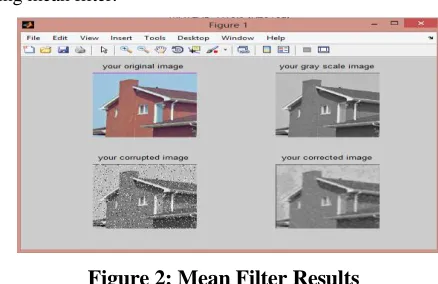
Image corrupted with salt and pepper noise, p(salt)=0.05 and p(pepper)=0.02
Image corrected using mean filter.
Figure 2: Mean Filter Results
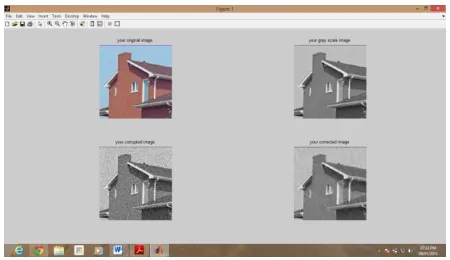
Image corrupted with Gaussian noise, mean=0.2 and standard deviation=20
344 | P a g e
Figure 3: Median Filter Results
Image corrupted with Gaussian noise, mean=0.2 and standard deviation=20
Image corrected using Discrete Wavelet Transform.
Figure 4: Discrete Wavelet Transform Results
Image corrupted using Gaussian noise, mean=0.2 and standard deviation=20
Image corrected using two stage LPG-PCA.
Figure 6: LPG-PCA Results
345 | P a g e
Table 1: Comparison of PSNR values of different filters
Monarch Cameraman House
Median 20.6154 20.8301 28.5012
Mean 25.2337 24.3735 28.3971
DWT 28.0575 28.3796 31.2737
PCA 1st Stage 29.6746 29.4875 32.1877
PCA 2nd Stage 30.0384 29.7061 33.0613
V CONCLUSIONS
Principal Component Analysis (PCA) reduces the dimensionality of the data while retaining most of the
information. This reduction is accomplished by identifying principal components, along which the variation in
the data is maximal. By few components, each sample can be represented by relatively few numbers instead of
by values for numbers of variable. Samples can then be plotted, making it possible to visually assess
similarities and differences between samples and determine whether samples can be grouped.
In this way we proposed a spatially adaptive image denoising scheme by using principal component analysis
(PCA). To preserve the local image structures when denoising, we modelled a pixel and its nearest neighbors as
a vector variable, and the denoising of the pixel was converted into the estimation of the variable from its noisy
observations. The PCA technique was used for such estimation and the PCA transformation matrix was
adaptively trained from the local window of the image. However, in a local window there can have very
different structures from the underlying one; therefore, a training sample selection procedure is necessary.
Local pixel grouping (LPG) uses the block matching technique and it guarantees that only the similar sample
blocks are used in the PCA transform matrix estimation. The PCA transformation coefficients were then
compressed to remove noise. One more iteration of LPG-PCA denoising procedure was used to improve the
performance. Our experimental results demonstrated that LPG-PCA can effectively preserve the image fine
structures while smoothing noise.
VI. FUTURE SCOPE
PCA is applied in a lot of others sector such as computer science, image pattern, finding common features of
facial images of human beings, image compression and computation biology . Many applications such as
classification and clustering have taken advantage of this decomposition. Applications include identifying
patterns, estimating missing data, expression patterns and associating genes helping to uncover the dynamic
346 | P a g e
REFERENCES
[1] Guangyi Chen and Shen-En Qian, “Denoising of Hyperspectral Imagery Using Principal Component
Analysis and Wavelet Shrinkage”, IEEE Transactions On Geoscience and Remote Sensing, Vol. 49, No. 3,
March 2011.
[2] Lei Zhang, Weisheng Dong, David Zhang and Guangming Shi, “Two-Stage Image Denoising By Principal
Component Analysis With Local Pixel Grouping”, Pattern Recognition Journal 43 (2010) 1531–1549.
[3] Y. Murali Mohan Babu, Dr. M.V. Subramanyam and Dr. M.N. Giri Prasad, “PCA based image denoising”,
an International Journal (SIPIJ) Vol.3, No.2, April 2012.
[4] Jolliffe, I. T. (2002). Principal component analysis (Second ed.): Springer.
[5] Pearson, K. (1901). On lines and planes of closest fit to systems of points in space. Philosophical Magazine,
2(6), 559-572.
[6] Shlens, J. (2009). A Tutorial on Principal Component Analysis.Unpublished manuscript.
[7] Smith, L. (2002). A tutorial on Principal Components Analysis.Unpublished manuscript.
[8] R.C. Gonzalez, R.E. Woods, Digital Image Processing, second ed., Prentice- Hall, Englewood Cliffs, NJ,
2002.
[9] M. Elad, M. Aharon, Image denoising via sparse and redundant representa- tions over learned dictionaries,
IEEE Transaction on Image Processing 15 (12) (2006) 3736–3745.
[10] M.K.Mıhcak, I.Kozintsev, K.Ramchandran, P.Moulin, Low-complexityimage denoising based on
statistical modelling of wavelet coefficients, IEEE Signal Processing Letters 6(12)(1999)300–303.
[11] R. Yang, L. Yin, M. Gabbouj, J. Astola, and Y. Neuvo, “Optimal weighted median filters under structural constraints,” IEEE Trans. Signal Processing, vol. 43, pp. 591–604, Mar. 1995.
[12] Monika Raghav, , IJECS Volume 3 Issue 5 May, 2014 Page No.5637-5641.
[13] A. Hyvärinen, “Sparse code shrinkage: denoising of nongaussian data by maximum likelihood estimation”,