IJEDR1904012 International Journal of Engineering Development and Research (www.ijedr.org) 53
Optimization of Buckling Restrained Bracings
(BRB) by Comparative Study of Energy Dissipation
in Commercial Structures
1Aishwarya Anil Modi, 2Dr. V. G. Sayagavi, 3P. J. Salunke 1Student, 2Professor, 3H.O.D
MGM’s College of Engineering and Technology, Navi Mumbai, India
_____________________________________________________________________________________________________
Abstract - This paper deals with the study, design and analysis of Buckling Restrained Bracings (BRB) and the
appropriate placings of BRB in the building so as the damage caused by seismic loadings is minimized to a greater extent. For doing so an analytical study of a G+7 commercial structure was carried out for the various parameters such as Maximum Story Drift, Maximum Story Displacement, Maximum Story Shear and Maximum Overturning Moment considering the frames without braces(conventional methods), with steel core braces and aluminium core braces (Al-BRB) by using E-tabs for finding the effect of each type of bracing on the parameters. Finally, the results were analyzed for the optimum use of BRB for seismic performance. Based upon the results, it is revealed that the use of steel core BRBs has increased the self – weight of the structure and hence the Light Weight BRB (LWBRB) can be used as an effective alternative for the Steel Core BRB. Ductile material such as Aluminium core can be used as a replacement for the steel core of the BRB. due to reduced self – weight of the BRB as the section in the Buckling Restrained Braced Frame can be lighter in weight.
keywords - Buckling Restrained Braces, Conventional methods, BRB, Al-BRB, LWBRB
_____________________________________________________________________________________________________
I.INTRODUCTION
Earthquakes are the natural phenomenon which are caused by the abrupt movement of seismic waves causing ground motions occurring in earth surface. The seismic damage induced by the earthquakes is to a greater extent. Earlier provision of bands, arches and domes were done to resist earthquake loads. Nowadays several measures are been taken to resist seismic damage so that the loss can be minimized such as base isolation techniques, SIMCOM, RHCBM and bracing systems.
Base isolation is one of the most widely used technique in earthquake prone areas. It mitigates the effect of an earthquake by essentially isolating the structure from potentially, dangerous ground motions. Seismic isolation is a design strategy, which uncouples the structure for the damaging effects of the ground motion.
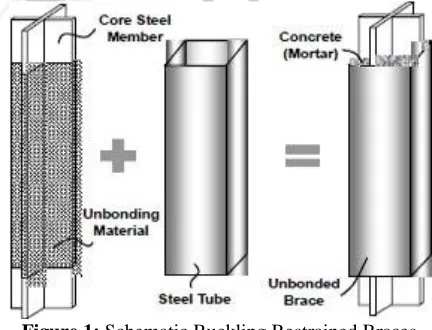
A Buckling Restrained Brace (BRB) is a structural brace which is designed in such a way that it resists cyclic lateral loadings especially earthquake produced seismic loadings. It comprises of steel core, concrete casing which supports the core against buckling under axial compression and a de-bounding material so that it prevents bond formation or contact between the core and the casing. BRB’s are the latest technology used nowadays to resist and dissipate the energy induced by the earthquakes and to efficiently increase seismic performance of building. And further various materials can be found so that self-weight of BRB’s is reduced.
Figure 1: Schematic Buckling Restrained Braces II. REVIEW OF LITERATURE
IJEDR1904012 International Journal of Engineering Development and Research (www.ijedr.org) 54 Jinkoo Kim and Hyunhoon Choi (2004) gave the basic concept of energy based seismic design procedure for framed structures with BRB using hysteretic energy spectra and ductility spectra. The design procedure was applied to 3 storey and 8 storey framed structure. The cross-sectional area of the braces required to meet the given target displacement was obtained by equating the hysteretic energy demand to the accumulated plastic energy dissipated by braces. After the analysis, the values of the mean top storey displacement were very efficient owing to the performance displacement values.
W. N. Deulkar, C. D. Modhera and H. S. Patil (2010) carried out the study of Buckling Restrained Braces (BRB) with its analysis, design, modelling and its application in steel building frame were studied. A 5 storey framed building was studied using different parameters such as natural time period, storey displacement, inter -storey drift, story shear and axial forces to study the seismic performance of the structure. Study in the paper shows that by keeping the cross -sectional area of end offset more than twice of yielding zone and yielding length as 1/3rd of total length, the BRB can be well modelled and gives good control over story displacement and storey drift.
Bin Wu and Yang Mei (2014) focused their research on the finite element analysis related to the buckling mechanism of the Buckling Restrained Bracings. The development of buckling mode was obse rved under axial load. The formulae for the contact force and the maximum bending moment was observed.
Hamdy Abou Elfath Mostafa Ramadan, Fozeya Omar Alkanai (2016) discussed the seismic requirements of the existing structures were studied to know their capacities and vulnerabilities to seismic loads with respect to existing design codes. The existing structure can be retrofitted using the Buckling Restrained Bracings to increase the lateral strength requirements of the structures. A 3 bay 5 storey existing structure was studied and analyzed using retrofitting technique. Using Buckling Restrained Bracing for retrofitting techniques can increase the lateral stability of the existing structures.
Ramazan Ozcelik, Yagmur Dikiciasik, Elif Firuze Erdil (2017) stated the development of the Buckling Restrained Bracings using new end restraints and casing members were discussed using an experimental study. These new end restraints consisted of hollow steel sections and steel plates welded to each other and were attach ed to the casing members. The component tests for ten BRBs with CMs consisting of concrete -filled steel tube (unbonded), plain concrete and plain concrete wrapped with Fiber -Reinforced Polymer (FRP), reinforced concrete and a built-up section were tested. This part may be a candidate for buckling during cyclic excursions. Hence both ends of the BRBs at the unrestrained part of the core plate need to be restrained more effectively. The testing of the new improved BRB indicated the satisfactory improvement in the cyclic performance of the BRB with the core plate strain up to 2%. The energy dissipation capacity of the BRBs were also found to be significantly dependent on compression strength adjustment factor, β, and strain hardening adjustment factor, ω. Conse quently, the improved BRBs with enough stiffness to resist out-of-plane buckling at both ends have acceptable cyclic performance. Thus, this research paper gave the new improved innovation in the BRB system by introducing the new end restraints.
III.OBJECTIVE OF PAPER
Selecting a structural system consisting Buckling Restrained Braces. Modelling, Analyzing & design the BRBF consisting different infill material with the relevant loading conditions and experimental setups. Obtaining results in the form of Maximum Story Drift, Maximum Story Displacement, Maximum Story Shear and Maximum Overturning Moment. Comparison of results between Conventional Bracings, Steel BRBF and Aluminium BRBF to obtain cost optimization as well efficiency so as to where to place BRB and the proper material used to make them.
IV. PROBLEM FORMULATION
In previous research studies, the individual Buckling Restrained Bracings and Aluminium Buckling Restrained Braces and conventional braces were designed and analyzed for different case s and economy was considered for various cases. Software like E-tabs were used. In present study we are going to compare steel BRB, Aluminium BRB and conventional braces by first manually designing the Buckling restrained braces, then carrying out experime ntal testing and operations on it and modelling it in E-tabs keeping the loading and load cases constant, to know which one is more economical and various effects governing the design like storey drift , shear, displacement, etc.
Structural Modelling
In present study G+7 commercial structure is modelled comprising of Buckling Restrained Bracings in software. Software used is E-tabs.
Design parameters used in case study: - Floor load = 4 KN\m2
Roof load = 3 KN\m2 Occupancy category = II Redundancy factor = ρ = 1.3 Seismic Design Category = D System Overstrength Factor: Ω = 3.5 Floor live load = 3 KN\m2
Roof live load = 1.5 KN\m2 Site class = D
Importance factor: I = 1.0 Response reduction factor: R= 8
IJEDR1904012 International Journal of Engineering Development and Research (www.ijedr.org) 55 Figure 2: Plan of the Building
Summary:-
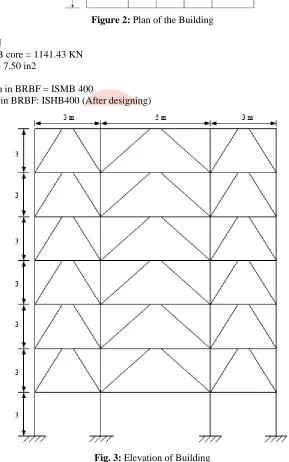
Base shear = 3368.03 KN
Axial strength of the BRB core = 1141.43 KN Area of steel core = Asc= 7.50 in2
Strain: ε = 1.39
Section used for the beam in BRBF = ISMB 400
Section used for Column in BRBF: ISHB400 (After designing)
Fig. 3: Elevation of Building Methodology:-
The cross-sectional area of the braces required to meet the given target displacement was obtained by equating the hysteretic energy demand to the accumulated plastic energy dissipated by braces. Based on literature and theory, the structure will be designed with or without braces and experimental testing will be done on that.
Following results will be determined after complete analysis and design of Buckling Restrained Braces modelled in E-tabs software and the results of both these models will be compared with respect to the safety and structural performance. Base shear, Maximum Lateral & Vertical Displacement, Story drift.
IJEDR1904012 International Journal of Engineering Development and Research (www.ijedr.org) 56 The result comprises of the seismic comprises of the seismic performances of the Steel Core Buckling Restrained Braces and the Aluminium Core Buckling Restrained Braces. Experimental results based on the axial compression test done under the Universal Testing Machine (UTM) are also included.
The parameters which were used for the comparison included: 1. Maximum Story Drift
2. Maximum Story Displacement 3. Maximum Story Shear Maximum Story Drift
From Table 1 and Graph 1, it is inferred that drifting at base is zero for all the three types of bracing. As we go up, drift for 7th story is less in steel core BRB (0.00011) and aluminium core BRB (0.00012) compared to frames without bracings (0.0005).
Table 1 Comparison of Maximum Story Drift
Story
Maximum Story Drift
No Bracing Steel Core BRB Aluminium Core BRB
7th 0.0005 0.00011 0.00012
6th 0.0008 0.00015 0.00017
5th 0.0012 0.00020 0.00021
4th 0.0013 0.00020 0.00023
3rd 0.0012 0.00021 0.00023
2nd 0.0014 0.00027 0.00031
1st 0.0021 0.0025 0.00031
Base 00 00 00
Graph 1 Maximum Story Drift Maximum Story Displacement
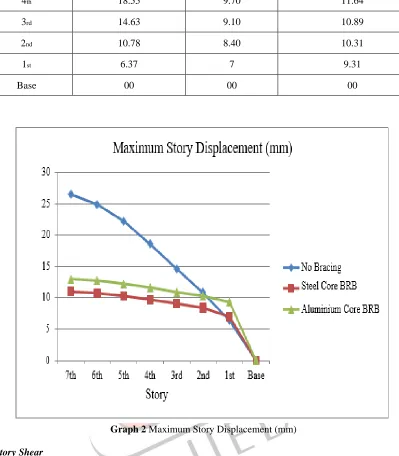
From Table 2 and Graph 2, it is seen that at base story displacement is zero for all the three types of bracing system. As we go above, the story displacement for 1st story for the frames without bracing is 6.37, using steel core BRB is 7 and maximum for aluminium BRB, i.e. 9.31. But as we go for higher story, results for frames using aluminum BRB (13.01) and steel BRB (11.00) are more effective and minimum compared to the frames without bracings (26.49).
Table 2 Comparison of Maximum Story Displacement (mm)
Story
Maximum Story Displacement (mm)
No Bracing Steel Core BRB Aluminium Core BRB
7th 26.49 11.00 13.01
IJEDR1904012 International Journal of Engineering Development and Research (www.ijedr.org) 57
5th 22.23 10.30 12.25
4th 18.55 9.70 11.64
3rd 14.63 9.10 10.89
2nd 10.78 8.40 10.31
1st 6.37 7 9.31
Base 00 00 00
Graph 2 Maximum Story Displacement (mm)
Maximum Story Shear
From Table 3 and Graph 3, it is seen that at base story shear is maximum for steel BRB (185.38) compared to aluminium BRB (156.30) and least for frames without bracings (98.97). As we go above, the same results can be seen maximum for steel core BRB (62.97) and least for frames without braces (34.46). Hence it can be inferred from results that building frames using steel core BRB are more effective.
Table 3 Maximum Story Shear (kN)
Story
Maximum Story Shear (kN)
No Bracing Steel Core BRB Aluminium Core BRB
7th 34.46 62.97 52.87
6th 59.94 111.37 93.81
5th 77.67 145.00 122.23
4th 89.01 166.56 140.43
3rd 95.41 178.68 150.67
2nd 98.26 184.08 155.22
IJEDR1904012 International Journal of Engineering Development and Research (www.ijedr.org) 58
Base 98.97 185.38 156.30
Graph 3 Maximum Story Shear (kN) VI. CONCLUSION
The proper study of theoretical concept of BRB and the literature survey available for that has been studied. Considering it, manual design based on ASCE manual has been carried out. Based on that it can be concluded that BRB’s are way more efficient than other seismic load resistant techniques as it increases its seismic performance and its strength without causing any harm to structure’s stability. The installation of BRB’s is comparatively easy and is economical than the other techniques. Then the results obtained from that are been used to model a prototype for the same. Certain experimental testing and operations are carried out on that and the final data is used for modelling in E-tabs.
Base on the analysis results obtained following conclusions are made:
• The Buckling Restrained Braces are an efficient way to increase the seismic performance of the structure.It reduces the factors such as the Story Drifts, Story Displacement and Story Shears.
• Although the use of steel core BRBs can increase the self – weight of the structure, the Light Weight BRB can be used as an effective alternative for the Steel Core BRB.
• Ductile material such as Aluminium core is used as a replacement for the steel core of the BRB.
• Due to reduced self – weight of the BRB the section in the Buckling Restrained Braced Frame can be lighter in weight. • The design of the BRB is based on the AISC SEI Seismic Design Manual. Thus, for the effective use of the BRB in
India the design of BRB should be included in the Indian Standard (IS) Codes.
The design of the casing and the infill material is not included in the design of the BRB. Hence, more research can be done for the use of BRB using different casing and infill materials.
VII. ACKNOWLEDGMENT
I would like to thank my Guide, Head of the Department, Principal, friends, family and all others who have helped me in completion my research work.
REFERENCES
[1] Jinkoo Kim and Hyunhoon Choi, “Energy-Based Seismic Design of Buckling Restrained Braces”, 13th World Conference on Earthquake Engineering, Paper No. 2113, Canada, August 2004.
[2] W. N. Deulkar, C. D. Modhera and H. S. Patil, “Buckling Restrained Braces for Vibration Control of Building Structure”, September 2010, IJRRAS (Pp- 363-372).
[3] Bin Wu, Yang Mei (2014), “Buckling Mechanism of Steel Core of Buckling-Restrained Braces”, Journal of Constructional Steel Research, September 2014, (pp – 61 – 69).
[4] Hamdy Abou Elfath, Mostafa Ramadan, Fozeya Omar Alkanai (2016), “Upgrading the seismic capacity of existing RC buildings using Buckling Restrained Braces”, Alexandria Engineering Journal, September 2016, (pp – 251 – 262).
[5] Ramazan Ozcelik, Yagmur Dikiciasik, Elif Firuze Erdil (2017), “The development of the buckling restrained braces with new end restrains”, Journal of Constructional Steel Research, 2017, No. 138, (pp – 208 – 220).
[6] American Institute of Steel Construction (AISC) Manual, 2nd Edition, Structural Engineering Institute (SEI).