O R I G I N A L R E S E A R C H
Genetic polymorphisms of CYP3A5, CHRM2, and
ZNF498 and their association with epilepsy
susceptibility: a pharmacogenetic and case
–
control
study
This article was published in the following Dove Press journal: Pharmacogenomics and Personalized Medicine
Laith N AL-Eitan 1,2
Islam M Al-Dalalah1
Mohamed M Mustafa 3
Mansour A Alghamdi 4
Afrah K Elshammari5
Wael H Khreisat 5
Mohammed N
Al-Quasmi 6
Hanan A Aljamal 1
1Department of Applied Biological Sciences, Jordan University of Science and Technology, Irbid, Jordan;2Department of Biotechnology and Genetic Engineering, Jordan University of Science and Technology, Irbid, Jordan;3Department of Neuroscience, Jordan University of Science and Technology, Irbid, Jordan; 4Anatomy Department, College of Medicine, King Khalid University, Abha, Saudi Arabia;5Department of Pediatric Neurology, Queen Rania Hospital for Children, King Hussein Medical Center, Royal Medical Services, Amman, Jordan; 6Department of Medical Laboratory, King Abdullah University Hospital, Irbid, Jordan
Background:A total of 50 million persons were diagnosed worldwide with epilepsy. One-third of them are experiencing debilitating seizures despite optimum anti-epileptic drugs (AEDs) treatment. Several studies have suggested that CYP3A5, CHRM2, and ZNF498 influence the pharmacokinetics of AEDs. Therefore, the severity of the disease as well as the degree of response to the AEDs could be affected by the genetic polymorphisms within these genes.
Objectives:In this study, we assessed the effect of certain single nucleotide polymorphisms (SNPs) within CYP3A5, CHRM2, and ZNF498 genes on the susceptibility to develop epilepsy and the responsiveness to AEDs treatment.
Methods: A case–control and pharmacogenetic study was conducted on samples of 299 healthy individuals in addition to 296 epileptic patients. Genotypic, allelic, and clinical data association were performed for the selected polymorphisms within the (rs324649, rs420817, rs15524, and rs1859690) in the Jordanian population.
Results: The analysis revealed no significant association of the investigated SNPs with epilepsy in general, partial and generalized epilepsy as well as drug responsiveness.CYP3A5
and ZNF498were associated with family history (P=0.003 andP=0.002, respectively) and
the classification of epilepsy for theZNF498variant(P=0.009). On the other hand,CHRM2
was not linked to either disease severity or treatment responsiveness.
Conclusion:Our results failed to confirm the association ofCYP3A5, ZNF498, andCHRM2
variants with either disease development or treatment response. Clinical pharmacogenetic studies may contribute to treatment personalization, appropriate drug dose selection, mini-mizing drug adverse reactions, increasing drug efficacy, and reducing the costive burdens.
Keywords:epilepsy, seizures, cytochrome P-450 CYP3A, pharmacogenetics, humans, anti-epileptic drugs
Introduction
Epilepsy is a chronic neurological disorder with a prevalence of 0.6–1.0% and an
incidence of 50–120/100.000 individuals per year.1–4Epilepsy characterized by
uncon-trolled electrical activity produced by a group of neurons.5,6 It can be caused by
different etiologies such as metabolic disorders and structural brain abnormalities in
addition to idiopathic epilepsies which are caused mostly by genetic factors.7
Therefore, International League Against Epilepsy (ILAE) classified epilepsy into two
main categories; generalized and partial.4,8,9
Correspondence: Laith N AL-Eitan Jordan University of Science and Technology, P.O. Box 3030, Irbid 22110, Jordan
Tel +962 2 720 1000 Ext.:23464 Fax +962 2 720 1071
Email [email protected]
Pharmacogenomics and Personalized Medicine
Dove
press
open access to scientific and medical researchOpen Access Full Text Article
Pharmacogenomics and Personalized Medicine downloaded from https://www.dovepress.com/ by 118.70.13.36 on 26-Aug-2020
Despite the enormous progress that has been made in
the field of epilepsy and the introduction of new
antiepi-leptic drugs (AEDs), it still impossible to achieve
com-plete remission in some patients.10–12Explanations for this
condition is uncertain where it seems that the genetic basis
may be implicated in epilepsy diagnosis and treatment.12
The outcome of AEDs treatment varies even between
patients who have the same syndromes.10 In addition,
20% to 25% of the epileptic patients have a poor response
to AEDs.6This is mostly affected by many factors such as
gender, age, weight, smoking, co-medications, heterogene-ity in the disease, nutritional status, liver and kidney func-tion, and/or genetic variants.5,9
Pharmacokinetics and pharmacodynamics of AEDs is mostly mediated by the cytochrome P450 (CYP) family that encoding isoforms of different activities. Response to AEDs varies greatly according to the interindividual
variability.13 The human CYP3A gene cluster encodes
CYP subfamily enzymes that catalyze the metabolism of many exogenous and endogenous chemicals including more than 50% of the commercially available drugs. CYP3A5 is an isoform of CYP3A with a polymorphic expression that implicated in disease risk and drug
metabolism.14
Carbamazepine (CBZ) is one of thefirst-line drugs for
partial seizures and can be used also for generalized
seizures.8,10,15 CBZ is usually used as monotherapy or
combined with other AEDs such as valproic acid
(VPA).16–18 Moreover, 95% of the CBZ is metabolized
by the liver; CYP3A4 and CYP3A5 are the most common enzymes that convert CBZ to CBZ-10, 11-epoxide
(CBZ-E) in the major pathway of CBZ metabolism.19 CYP3A5
along with 888 other enzymes belongs to the CYP enzymes that encoded by 57 human genes, including zinc
finger protein 498 (ZNF498) whose products are involved
mainly in oxidative drug metabolism.20,21Zinc finger
pro-teins are of the mostly abundant propro-teins in the eukaryotic. These proteins provide extraordinarily diverse functions including DNA recognition, RNA packaging, transcrip-tional activation, apoptosis regulation, binding of lipid, protein folding and assembly, binding interactions in pro-teins, DNA, and RNA, and gene regulation (inhibition or
activation).22,23 For the CHRM2 gene, it belongs to a
family of G-protein-coupled receptors (GPCRs), which involved in signaling pathways that are important for regulation of acetylcholine (ACh) release, modulating
neu-ronal excitability, synaptic plasticity, and feedback.24–26
Therefore, this study aimed to investigate the
associa-tion of CHRM2 (rs324649 and rs420817), CYP3A5
(rs15524), andZNF498(rs1859690) variants with the
sus-ceptibility of epilepsy development and the responsiveness to AED treatments among the Jordanian population.
Materials and methods
Patients and data collection
Jordanian participants including 299 healthy controls and 296 epileptic patients with an age range from neonate up to 15 years of life. This research was conducted in accor-dance with the Declaration of Helsinki 1975, as revised in 2013 and the study protocol was approved by the Ethics
Committee at Jordan University of Science and
Technology (16/111/2017). In addition, written informed consent was provided by the parents or legal guardians of the participants. All patients were recruited from the Pediatrics Department, Queen Rania Al-Abdullah Center (QRAC) in the Jordanian Royal Medical Services (JRMS). Selection criteria included all patients that were using antiepileptic medications in the period between October 2017 and January 2018, regardless of whether it was monotherapy or combination therapy. Patients who have progressive and degenerative neurological diseases, sys-temic diseases (including liver and kidney dysfunction), lack records, unreliable seizure frequency, poor compli-ance with AEDs, did not visit the clinics regularly, and/or do not agree to be enrolled were excluded. Standardized questionnaires were used to collect clinical and
demo-graphic data (Table S1).
According to the international classification of
epi-lepsy, we divided the patients into patients with partial-onset seizures and generalized-partial-onset seizures. Epileptic
patients were also classified into patients with good
response (ie, patients who have not experienced any type of seizures for a minimum of 3 months after receiving AEDs) and poor responder patients (drug-resistant), who have uncontrolled seizures over the same period. The AEDs were selected according to the seizure type and epilepsy syndrome. Informative details about the selected population, study design, and treatment approach were previously published as this study is a continuation of an
extended study by AL-Eitan et al.27
DNA genotyping and analysis
Genomic DNA was extracted from EDTA blood samples (Promega DNA Blood Kit, Madison, WI, USA) according
Pharmacogenomics and Personalized Medicine downloaded from https://www.dovepress.com/ by 118.70.13.36 on 26-Aug-2020
to the manufacture’s procedure. Samples that completed the quantitative requirements and passed DNA integrity test that met with the multiplexing requirements of the SNPs for genotyping were sent to the Australian Genome Research Facility (AGRF, Melbourne Node, Melbourne, Australia). Genotyping of the single nucleotide
poly-morphisms (SNPs) of CHRM2 (rs324649 and rs420817),
CYP3A5 (rs15524), and ZNF498 (rs1859690) were
per-formed with the Sequenom MassARRAY®system (iPLEX
GOLD) (Sequenom, San Diego, CA, USA) at the AGRF
according to the manufacturer’s recommendations
(Sequenom, San Diego, CA, USA) where variants were selected from public databases such as the National Center
for Biotechnology Information (NCBI) (http://www.ncbi.
nlm.nih.gov/SNP/), Ensembl (http://www.ensembl.org/ index.html), and the Applied Biosystems (http://www. appliedbiosystems.com).
The protocol of Sequenom MassARRAY®system was
run intofive steps including template amplification,
depho-sphorylation, single base extension (SBE) reactions, sam-ple conditioning, transfer and genotype calling, and
bioinformatics. Briefly, these steps started with the
ampli-fication of the genomic DNA by polymerase chain reaction
(PCR) followed by removing of the unincorporated dNTPs by using shrimp alkaline phosphatase (SAP) enzyme (Sequenom, San Diego, CA, USA). SBE Reactions include a single base extension primer (SBE) enable
iPLEX reactions with modified masses related with the
termination mixture. Differences in the mass of the exten-sion product used to differentiate the allelic variant. Sample conditioning and transfer were provided to improve the analysis of mass spectrometry by eliminating redundant salts that interfere with it. The information is then presented in type analyzer software (Sequenom Inc., 2003 and 2004).
Genotypic, allelic, and clinical data association were analyzed using the Statistical Package for the Social Sciences (SPSS), version 25.0 (SPSS, Inc., Chicago, IL).
Genotype
–
phenotype correlation
The distribution of genotypes in patients and the associa-tion between the studied variants and several clinical vari-ables (independent varivari-ables) were investigated. Clinical and pathological information were included according to
the patients’medical records: gender, age, age at onset of
seizure, types of seizures, response to medications, being on either single or combined therapy in addition to history of febrile seizure, psychosis, suicidal thoughts or actions,
epilepsy syndromes, response to first drug, as well as
family history and classification of epilepsy.
Correction for multiple testing
The target alpha level (0.05/Nem) was calculated by
applying the modified Bonferroni procedure where the
effective number of SNPs (Nem) was estimated according
to the Li and Ji method.28The overall significance level is
set to be 0.0125 or less.
Results
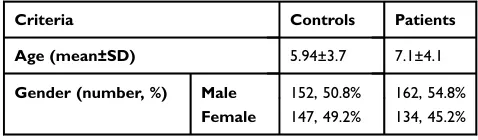
Among the 296 epileptic patients and 299 healthy indivi-duals, the average age was 7.1±4.1 and 5.94±3.7 years
(mean±SD), respectively (Table 1). Around half of the
controls were males in compare to 54.8% in the patients’
group. No differences revealed in the distributions of the
selected SNPs in both the controls and patients (Table 2).
InZNF498(rs1859690), the AG+GG frequency in patients
was 13.2% compared to 20.1% in control group. In
addi-tion, epileptic patients were further classified into 172 with
generalized epilepsy (GE) and 124 with partial epilepsy
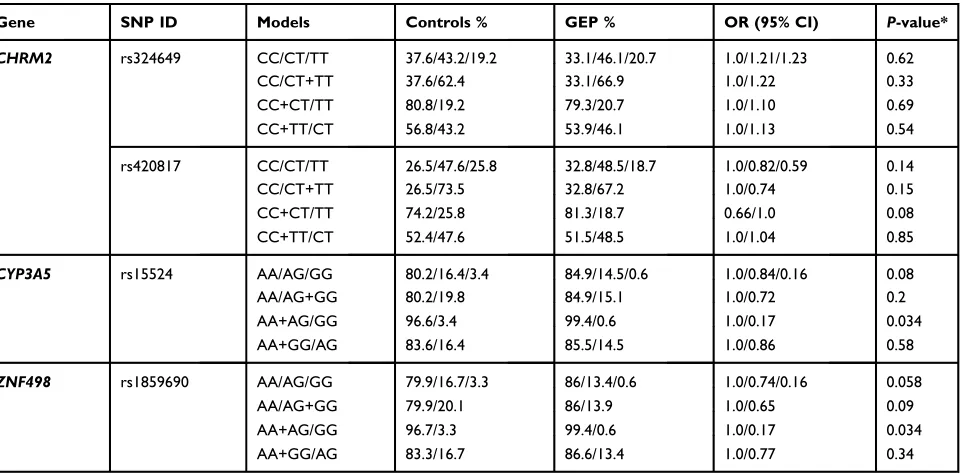
(PE). As shown inTable 3, none of theCYP3A5, CHRM2,
andZNF498variants were linked to the increased risk of
developing GE as well as PE. Notably, the frequency of rs15524 and rs1859690 GG genotype in the GE was lower
than that in controls [0.6% vs 3.4%,P=0.034 and 0.6% vs
3.3%,P=0.034, respectively]. As in the case of GE, PE has
shown no linkage with the included SNPs (Table 4).
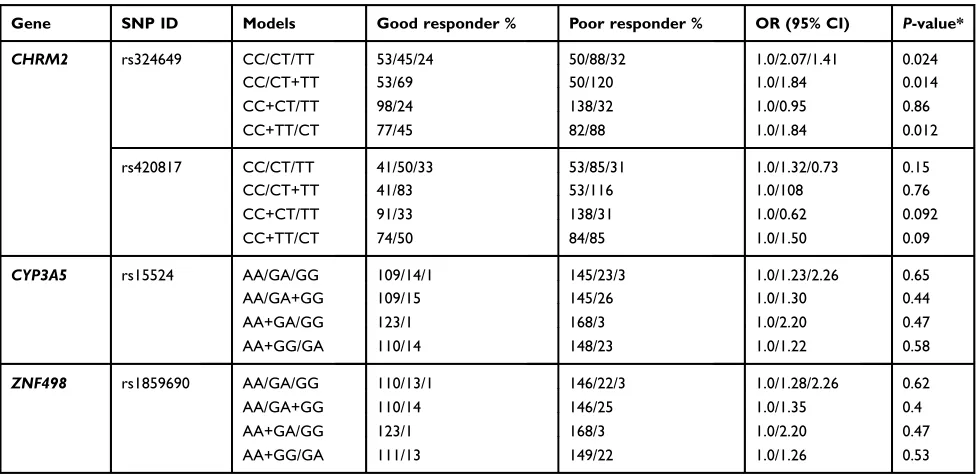
The distributions of the four SNPs (rs324649,
rs420817, rs15524, and rs1859690) were analyzed in 171 poor responder and 124 good responder patients that were
classified according to their response to the AEDs as
previously mentioned in AL-Eitan et al study.29 CHRM2
(rs324649) variant was of a nominal significance (not
statistically significant, but it is in the borderline) in poor
responder patients (P=0.012) (Table 5). Nevertheless,
there was no association between AEDs responsiveness
and the investigated genotypes (Table 5).
Table 1 Gender and age-matched distribution in the epileptic patients (n=296) and the control individuals (n=299)
Criteria Controls Patients
Age (mean±SD) 5.94±3.7 7.1±4.1
Gender (number, %) Male 152, 50.8% 162, 54.8%
Female 147, 49.2% 134, 45.2%
Pharmacogenomics and Personalized Medicine downloaded from https://www.dovepress.com/ by 118.70.13.36 on 26-Aug-2020
Finally, certain pathological and clinical manifestation were assisted for further correlation, revealed no
relation-ship between response to the first drug (ie, 10 mg/kg of
VPA for patients diagnosed with GE or 5 mg/kg daily of CBZ for patients diagnosed with PE) and the included
SNPs (Table 6). InCYP3A5, it was correlated with family
history of epilepsy and the classification of epilepsy (ie,
which is being either idiopathic, symptomatic, or
crypto-genic) (P=0.003 and 0.009, respectively) (Table 6).
Moreover, ZNF498 was also of a linkage with family
history (P=0.002) (Table 6). Haplotypes association of
the CHRM2 gene was conducted and failed to provide
Table 2The association of CHRM2, CYP3A5, and ZNF498 polymorphisms in epileptic patients (EP) (n=296) and control individuals (n=299)
Gene SNP ID Models Controls % EP % OR (95% CI) P-value*
CHRM2 rs324649 CC/CT/TT 37.6/43.2/19.2 35.5/45.4/19.1 1.0/1.11/1.06 0.84
CC/CT+TT 37.6/62.4 35.5/64.5 1.0/1.1 0.59
CC+CT/TT 80.8/19.2 80.9/19.1 1.0/1.0 0.99
CC+TT/CT 56.8/43.2 54.6/45.4 1.0/1.09 0.6
rs420817 CC/CT/TT 26.5/47.6/25.8 32/45.9/22.1 1.0/0.8/0.71 0.29
CC/CT+TT 26.5/73.5 32/68 1.0/0.77 0.14
CC+CT/TT 74.2/25.8 77.9/22.1 1.0/0.81 0.29
CC+TT/CT 52.4/47.6 54.1/45.9 1.0/0.93 0.67
CYP3A5 rs15524 AA/AG/GG 80.2/16.4/3.4 86.2/12.5/1.4 1.0/0.71/0.37 0.089
AA/AG+GG 80.2/19.8 86.2/13.8 1.0/0.65 0.052
AA+AG/GG 96.6/3.4 98.7/1.4 1.0/0.39 0.1
AA+GG/AG 83.6/16.4 87.5/12.5 1.0/0.73 0.17
ZNF498 rs1859690 AA/AG/GG 79.9/16.7/3.3 86.8/11.8/1.4 1.0/0.65/0.37 0.051
AA/AG+GG 79.9/20.1 86.8/13.2 1.0/0.6 0.024
AA+AG/GG 96.7/3.3 98.7/1.4 1.0/0.4 0.1
AA+GG/AG 83.3/16.7 88.2/11.8 1.0/0.67 0.087
Note:*Chi-square test withP-value<0.0125 is considered significant.
Table 3The association of CHRM2, CYP3A5, and ZNF498 polymorphisms in generalized epilepsy patients (GEP) (n=172) and control individuals (n=299)
Gene SNP ID Models Controls % GEP % OR (95% CI) P-value*
CHRM2 rs324649 CC/CT/TT 37.6/43.2/19.2 33.1/46.1/20.7 1.0/1.21/1.23 0.62
CC/CT+TT 37.6/62.4 33.1/66.9 1.0/1.22 0.33
CC+CT/TT 80.8/19.2 79.3/20.7 1.0/1.10 0.69
CC+TT/CT 56.8/43.2 53.9/46.1 1.0/1.13 0.54
rs420817 CC/CT/TT 26.5/47.6/25.8 32.8/48.5/18.7 1.0/0.82/0.59 0.14
CC/CT+TT 26.5/73.5 32.8/67.2 1.0/0.74 0.15
CC+CT/TT 74.2/25.8 81.3/18.7 0.66/1.0 0.08
CC+TT/CT 52.4/47.6 51.5/48.5 1.0/1.04 0.85
CYP3A5 rs15524 AA/AG/GG 80.2/16.4/3.4 84.9/14.5/0.6 1.0/0.84/0.16 0.08
AA/AG+GG 80.2/19.8 84.9/15.1 1.0/0.72 0.2
AA+AG/GG 96.6/3.4 99.4/0.6 1.0/0.17 0.034
AA+GG/AG 83.6/16.4 85.5/14.5 1.0/0.86 0.58
ZNF498 rs1859690 AA/AG/GG 79.9/16.7/3.3 86/13.4/0.6 1.0/0.74/0.16 0.058
AA/AG+GG 79.9/20.1 86/13.9 1.0/0.65 0.09
AA+AG/GG 96.7/3.3 99.4/0.6 1.0/0.17 0.034
AA+GG/AG 83.3/16.7 86.6/13.4 1.0/0.77 0.34
Note:*Chi-square test withP-value<0.0125 is considered significant.
Pharmacogenomics and Personalized Medicine downloaded from https://www.dovepress.com/ by 118.70.13.36 on 26-Aug-2020
any linkage with epilepsy, its subtypes, and response to the
treatment (Table S2, S3, S4, and S5). Sequenom
MassARRAY scatter plot for the investigated SNPs is
shown in Figure 1, that was stained for different genotype
calls where GG (green), GA (yellow) and AA (blue) and
no call (red) in A and B figures, and CC (green), CT
(yellow) and TT (blue) and no call (red) in C and D
figures.
Table 4The association of CHRM2, CYP3A5, and ZNF498 polymorphisms in partial epilepsy patients (PEP) (n=124) and control individuals (n=299)
Gene SNP ID Models Controls % PEP % OR (95% CI) P-value*
CHRM2 rs324649 CC/CT/TT 37.6/43.2/19.2 38.7/44.4/16.9 1.0/1.0/0.86 0.87
CC/CT+TT 37.6/62.4 38.7/61.3 1.0/0.96 0.84
CC+CT/TT 80.8/19.2 83.1/16.9 1.0/0.86 0.59
CC+TT/CT 56.8/43.2 55.6/44.4 1.0/1.05 0.58
rs420817 CC/CT/TT 26.5/47.6/25.8 30.9/42.3/26.8 1.0/0.79/0.89 0.56
CC/CT+TT 26.5/73.5 30.9/69.1 1.0/0.81 0.36
CC+CT/TT 74.2/25.8 73.2/26.8 1.0/1.05 0.83
CC+TT/CT 52.4/47.6 57.7/42.3 1.0/0.8 0.31
CYP3A5 rs15524 AA/AG/GG 80.2/16.4/3.4 87.9/9.7/2.4 1.0/0.54/0.66 0.14
AA/AG+GG 80.2/19.8 87.9/12.1 1.0/0.56 0.51
AA+AG/GG 96.6/3.4 97.6/2.4 1.0/0.71 0.6
AA+GG/AG 83.6/16.4 90.3/9.7 1.0/0.54 0.063
ZNF498 rs1859690 AA/AG/GG 79.9/16.7/3.3 87.9/9.7/2.4 1.0/0.53/0.66 0.13
AA/AG+GG 79.9/20.1 87.9/12.1 1.0/0.55 0.044
AA+AG/GG 96.7/3.3 97.6/2.4 1.0/0.72 0.61
AA+GG/AG 83.3/16.7 90.3/9.7 1.0/0.53 0.054
Note:*Chi-square test withP-value<0.0125 is considered significant.
Table 5The association of ZNF498, CYPA5, and CHRM2 SNPs in good responder (n=124) and poor responder (n=171) patients
Gene SNP ID Models Good responder % Poor responder % OR (95% CI) P-value*
CHRM2 rs324649 CC/CT/TT 53/45/24 50/88/32 1.0/2.07/1.41 0.024
CC/CT+TT 53/69 50/120 1.0/1.84 0.014
CC+CT/TT 98/24 138/32 1.0/0.95 0.86
CC+TT/CT 77/45 82/88 1.0/1.84 0.012
rs420817 CC/CT/TT 41/50/33 53/85/31 1.0/1.32/0.73 0.15
CC/CT+TT 41/83 53/116 1.0/108 0.76
CC+CT/TT 91/33 138/31 1.0/0.62 0.092
CC+TT/CT 74/50 84/85 1.0/1.50 0.09
CYP3A5 rs15524 AA/GA/GG 109/14/1 145/23/3 1.0/1.23/2.26 0.65
AA/GA+GG 109/15 145/26 1.0/1.30 0.44
AA+GA/GG 123/1 168/3 1.0/2.20 0.47
AA+GG/GA 110/14 148/23 1.0/1.22 0.58
ZNF498 rs1859690 AA/GA/GG 110/13/1 146/22/3 1.0/1.28/2.26 0.62
AA/GA+GG 110/14 146/25 1.0/1.35 0.4
AA+GA/GG 123/1 168/3 1.0/2.20 0.47
AA+GG/GA 111/13 149/22 1.0/1.26 0.53
Note:*Chi-square test withP-value <0.0125 is considered significant.
Pharmacogenomics and Personalized Medicine downloaded from https://www.dovepress.com/ by 118.70.13.36 on 26-Aug-2020
Table 6The association between CHRM2 (rs324649 and rs420817), CYP3A5 (rs15524), and ZNF498 (rs1859690) and the clinical characteristics
Clinical characteristic CHRM2 CYP3A5 ZNF498
rs324649 rs420817 rs15524 rs1859690
CC vs CT vs TT CC vs CT vs TT AA vs GA vs GG AA vs GA vs GG
History of febrile seizure 0.384 0.881 0.999 0.999
Family history of epilepsy 0.991 0.881 0.003 0.002
Psychosis 0.218 0.405 0.963 0.966
Suicidal thoughts or actions 0.918 0.569 0.733 0.699
Epilepsy syndromes 0.593 0.845 0.436 0.415
Classification of epilepsy 0.235 0.384 0.009 0.017
Response to AEDs* 0.465 0.034 0.136 0.135
Notes:*Antiepileptic treatment protocol began with 10 mg/kg of valproic acid (VPA) for patients diagnosed with generalized seizure or 5 mg/kg daily of carbamazepine (CBZ) for patients diagnosed with partial seizure. Chi-square test withP<0.0125 is considered significant.
Figure 1Scatter plot from the sequenom data of the studied variants. The scatter plot illustrates rs159690 SNP withinZNF498gene (A) rs15524 SNP withinCYP3A5 (B) and rs420817 and rs324649 SNPs withinCHRM2(CandD, respectively). The X and Y axes denote mass measurements for the two alleles (G, A, low mass allele versus high mass allele) at the rs159690 and rs15524 (AandB, respectively). At (C) and (D) the X and Y axes denote mass measurements for the C, T (low mass allele versus high mass allele) at rs420817 and rs324649 SNPs. Every single sample is represented by one point. The points in the scatter plot are colored depending on the genotype calls.
Pharmacogenomics and Personalized Medicine downloaded from https://www.dovepress.com/ by 118.70.13.36 on 26-Aug-2020
Discussion
Epilepsy is one of the most occurring diseases of the Central Nervous System (CNS) affecting children, with approximately 5% to 10% having a seizure during their
first two decades of life and around 1% of them
develop-ing epilepsy. Childhood epilepsy is one of the major
psy-chiatrists’ concern due to the associated behavioral
problems that found to be of a prevalence of four times in compare to healthy children and two times in compare
to children with non-CNS chronic diseases.30Taking into
account, that around 80% of people diagnosed with epi-lepsy were live in low to middle income countries where
limited resources of diagnosis and treatment.31
There are five major categories of the genes that
involve in the pharmacogenomic response to psychotropic drugs in CNS disorders. These genes could be associated with (1) CNS pathogenesis, (2) drug transporters, (3) drug metabolism, (4) drug mechanism of action, and (5)
multi-faceted cascades and metabolism reactions.32According to
Wang et al, the search in several databases resulted in 977 genes associated with epilepsy, its core symptoms, and
syndromes.7
In this report, the frequency of particular
polymorph-isms in CYP3A5, ZNF498, and CHRM2genes was
inves-tigated in epileptic patients as well as in the healthy individuals to evaluate the association of these variants with epilepsy susceptibility and treatment in Jordanians. This study showed that CYP3A5 (rs15524) lack of asso-ciation with the susceptibility of epilepsy in general, gen-eralized and partial subtypes. Based on the genotypic and allelic analysis, the frequency of GG genotype was six-fold lower in GE patients than in the healthy individuals where the AA genotype could be associated with epilepsy as the frequency was higher in epileptic patients. This hypothesize the possibility that the presence of G in the epileptic patients decreases the risk of GE in compare to A
which increases the risk of PE but not confirmed. CYP3A5
polymorphism is unlikely seem to represent a risk factor for epilepsy development as well as on carbamazepine metabolism in Serbian pediatric epileptic patients. In con-sistence with this study, the variant allele frequencies of
CYP3A5 did not differ significantly in other Caucasian
populations such as Bosnian, Macedonian, Greek, Italian,
Polish, British, Dutch, Finnish, Russian, and Australian.33
Regarding the association of rs1859690 within
ZNF498o, there is a lack of data to the best of our knowl-edge. The AA genotype frequency was higher in patients
suggesting that this genotype may act as a risk factor in epilepsy. On the other hand, AG+GG frequency was higher in controls compared with both partial and general-ized epilepsy patients could indicate that the homozygous G or the heterozygous AG has low risk of epilepsy and may be considered as protective factor. This SNP needs further assessment in the future studies within Jordanian as
well as other populations to confirm its exact role.
Carbamazepine is an anticonvulsant that frequently used
as the first-line therapy for different forms of epilepsy in
both adult and childhood.34,35 Pharmacogenetic analysis
showed no significant differences between the selected
var-iants and drug responsiveness. Moreover, there was no association between these SNP genetic haplotypes and drug resistance, contrasted with previous studies that showed an association of these genotypes with response to
AEDs.18,19CYP3A5 rs15524 was found to be related to the
metabolism of the AEDs such as tacrolimus and
carbamazepine;20,36,37 however, there is a lack of data
regarding its association with epilepsy. Emich-Widera et
al failed to confirm the association of CYP3A5
polymorph-ism with drug resistance in Caucasian children with
epilepsy.15 This could be explained by the diversity in
ethnicity and genetic background of the individuals since for most of the CYP enzymes, the same drug can be differ-entially metabolized as they exhibited an age, sex, and
ethnic differences.32
Muscarinic cholinergic receptors system has been involved in the pathophysiology of some of psychiatric and neurological disorders such as schizophrenia, bipolar,
major depressive, substance abuse, Alzheimer’s and
Parkinson’s disease.38 CHRM2variants did not show any
statistically significant relationship with any of the
epilep-sies, AEDs response, and the studied clinical variables.
The rs15524 of CYP3A5 was the only associated SNP
with the classification of epilepsy. In addition, both
CYP3A5rs15524 andZNF498rs1859690 showed an
asso-ciation with the family history which can elicit the inheri-tance nature of this disease.
There are some limitations related to our investigation. First, SNPs and the selected genes were restricted to what already mentioned in the literatures, as there is limited information about these genes and their functionality.
Second, the sample size was relatively small, andfinally,
the lack of ancestry informative marker data on our popu-lation. All these limitations require additional improve-ments in future investigations.
Pharmacogenomics and Personalized Medicine downloaded from https://www.dovepress.com/ by 118.70.13.36 on 26-Aug-2020
In conclusion, the genetic background of epilepsies is heterogeneous and there is a very limited genetic
associa-tion. The benefits of clinical studies dose not only help in
drugs development strategies, but also will help in devel-oping preventive plans focusing on disease screening, seizure control, and treatment optimization.
Ethics approval and informed
consent
All procedures contributing to this work complied with the ethical standards of the relevant national and institutional committees on human experimentation and the Declaration of Helsinki with an IRB no. 16/111/2017.
Data availability
The datasets generated and analyzed during the current study are not publicly available. The consent from partici-pants did not cover data sharing but are available from the corresponding author on reasonable request.
Acknowledgment
This work was supported by the Deanship of Research at Jordan University of Science and Technology under grant number RN: 104/2017.
Disclosure
The authors report no conflicts of interest in this work.
References
1. Lopez-Garcia MA, Feria-Romero IA, Serrano H, et al. Influence of genetic variants of CYP2D6, CYP2C9, CYP2C19 and CYP3A4 on antiepileptic drug metabolism in pediatric patients with refractory epilepsy.Pharmacol Rep.2017;69(3):504–511. doi:10.1016/j.pharep. 2017.01.007
2. Bhalla D, Lotfalinezhad E, Timalsina U, et al. A comprehensive review of epilepsy in the Arab world.Seizure.2016;34:54–59. 3. Bicalho MA, Sukys-Claudino L, Guarnieri R, Lin K, Walz R.
Socio-demographic and clinical characteristics of Brazilian patients with epilepsy who drive and their association with traffic accidents. Epilepsy Behav.2012;24(2):216–220.
4. Stafstrom CE, Carmant L. Seizures and epilepsy: an overview for neuroscientists.Cold Spring Harb Perspect Med.2015;5(6). 5. Winkler AS, Kerschbaumsteiner K, Stelzhammer B, Meindl M, Kaaya
J, Schmutzhard E. Prevalence, incidence, and clinical characteristics of epilepsy–a community-based door-to-door study in northern Tanzania. Epilepsia.2009;50(10):2310–2313.
6. Cohen N. Pharmacogenomics and Personalized Medicine. Totowa, NJ: Humana Press;2008:299.
7. Wang J, Lin ZJ, Liu L, et al. Epilepsy-associated genes. Seizure.
2017;44:11–20.
8. Allen NM, Conroy J, Shahwan A, et al. Unexplained early onset epileptic encephalopathy: exome screening and phenotype expansion. Epilepsia.2016;57(1):e12–e17.
9. Henning O, Nakken KO. [New epilepsy classification].Tidsskr Nor Laegeforen.2017;137:23–24.
10. Genç F, Kutlu G, Gomceli YB, Inan LE. Demographic and clinical
findings of patients with refractory epilepsy followed by the epilepsy department of the Ankara education and research hospital.Epilepsi.
2013;19(2):79–85. doi:10.5505/epilepsi.2013.68552
11. Piperidou C, Karlovasitou A, Triantafyllou N, et al. Association of demographic, clinical and treatment variables with quality of life of patients with epilepsy in Greece.Qual Life Res.2008;17(7):987–996. doi:10.1007/s11136-008-9375-9
12. Dasgupta A.Handbook of Drug Monitoring Methods. Totowa, N.J.: Humana Press;2008:211–223.
13. Balestrini S, Sisodiya SM. Pharmacogenomics in epilepsy.Neurosci Lett.2018;667:27–39. doi:10.1016/j.neulet.2017.01.014
14. Cacabelos R, Martinez-Bouza R, Carril JC, et al. Genomics and pharmacogenomics of brain disorders. Curr Pharm Biotechnol.
2012;13(5):674–725.
15. Emich-Widera E, Likus W, Kazek B, et al. CYP3A5*3 and C3435T MDR1 polymorphisms in prognostication of drug-resistant epilepsy in children and adolescents. Biomed Res Int. 2013;2013:526837. doi:10.1155/2013/526837
16. Kartal A. Knowledge of, perceptions of, attitudes and practices regarding epilepsy among medical students in Turkey. Epilepsy Behav.2016;58:115–118. doi:10.1016/j.yebeh.2016.02.042 17. Chen HF, Tsai YF, Hsi MS, Chen JC. Factors affecting quality of life in
adults with epilepsy in Taiwan: a cross-sectional, correlational study. Epilepsy Behav.2016;58:26–32. doi:10.1016/j.yebeh.2016.02.019 18. Meng H, Guo G, Ren J, Zhou H, Ge Y, Guo Y. Effects of ABCB1
polymorphisms on plasma carbamazepine concentrations and phar-macoresistance in Chinese patients with epilepsy. Epilepsy Behav.
2011;21(1):27–30. doi:10.1016/j.yebeh.2011.02.015
19. Yun W, Zhang F, Hu C, et al. Effects of EPHX1, SCN1A and CYP3A4 genetic polymorphisms on plasma carbamazepine concen-trations and pharmacoresistance in Chinese patients with epilepsy. Epilepsy Res.2013;107(3):231–237.
20. Wang P, Yin T, Ma HY, et al. Effects of CYP3A4/5 and ABCB1 genetic polymorphisms on carbamazepine metabolism and transport in Chinese patients with epilepsy treated with carbamazepine in monotherapy and bitherapy.Epilepsy Res.2015;117:52–57. 21. Zhu X, Yun W, Sun X, Qiu F, Zhao L, Guo Y. Effects of major
transporter and metabolizing enzyme gene polymorphisms on carba-mazepine metabolism in Chinese patients with epilepsy. Pharmacogenomics.2014;15(15):1867–1879.
22. Laity JH, Lee BM, Wright PE. Zincfinger proteins: new insights into structural and functional diversity.Curr Opin Struc Biol.2001;11(1):39– 46.
23. Isalan M; Zinc Fingers. Encyclopedia of Biological Chemistry. Elsevier Inc;2013:575–579.
24. Szczepankiewicz A, Breborowicz A, Sobkowiak P, Kramer L, Popiel A. [Association of A/T polymorphism of the CHRM2 gene with bronchodilator response to ipratropium bromide in asthmatic chil-dren].Pneumonol Alergol Pol.2009;77(1):5–10.
25. Gosso FM, de Geus EJ, Polderman TJ, Boomsma DI, Posthuma D, Heutink P. Exploring the functional role of the CHRM2 gene in human cognition: results from a dense genotyping and brain expres-sion study.BMC Med Genet.2007;8:66.
26. Gosso MF, van Belzen M, de Geus EJ, et al. Association between the CHRM2 gene and intelligence in a sample of 304 Dutch families. Genes Brain Behav.2006;5(8):577–584.
27. AL-Eitan LN, Al-Dalalah IM, Elshammari AK, Khreisat WH, Almasri AY. The impact of potassium channel gene polymorphisms on antiepileptic drug responsiveness in arab patients with epilepsy.J Pers Med.2018;8(4).
28. Li J, Ji L. Adjusting multiple testing in multilocus analyses using the eigenvalues of a correlation matrix.Heredity.2005;95(3):221–227.
Pharmacogenomics and Personalized Medicine downloaded from https://www.dovepress.com/ by 118.70.13.36 on 26-Aug-2020
29. AL-Eitan LN, Al-Dalalah IM, Mustafa MM, et al. Effects of MTHFR and ABCC2 gene polymorphisms on antiepileptic drug responsive-ness in Jordanian epileptic patients. Pharmgenomics Pers Med.
2019;12:87–95.
30. Dunn DW, Austin JK. Behavioral issues in pediatric epilepsy. Neurology.1999;53(5 Suppl 2):S96–S100.
31. Tamashiro EY, Felipe CR, Genvigir FDV, et al. Influence of CYP3A4 and CYP3A5 polymorphisms on tacrolimus and sirolimus exposure in stable kidney transplant recipients. Drug Metab Pers Ther.
2017;32(2):89–95.
32. Cacabelos R. Pharmacogenomics of Central Nervous System (CNS) drugs.Drug Dev Res.2012;73(8):461–476.
33. Milovanovic DD, Radosavljevic I, Radovanovic M, et al. CYP3A5 polymorphism in serbian paediatric epileptic patients on carbamaze-pine treatment.Serbian J Exp Clin Res.2015;16(2):93–99.
34. Magiorkinis E, Diamantis A, Sidiropoulou K, Panteliadis C. Highights in the history of epilepsy: the last 200 years.Epilepsy Res Treat.2014;2014:582039.
35. Thorn CF, Leckband SG, Kelsoe J, et al. PharmGKB summary: carbamazepine pathway. Pharmacogenet Genomics. 2011;21 (12):906–910.
36. Esterhuizen AI, Carvill GL, Ramesar RS, et al. Clinical application of epilepsy genetics in Africa: is now the time? Front Neurol.
2018;9:276.
37. Zhang X, Men T, Liu H, Li X, Wang J, Lv J. Genetic risk factors for post-transplantation diabetes mellitus in Chinese Han renal allograft recipients treated with tacrolimus.Transpl Immunol.2018;49:39–42. 38. Scarr E. Muscarinic receptors: their roles in disorders of the central nervous system and potential as therapeutic targets.CNS Neurosci Ther.2012;18(5):369–379.
Pharmacogenomics and Personalized Medicine
Dove
press
Publish your work in this journal
Pharmacogenomics and Personalized Medicine is an international, peer-reviewed, open access journal characterizing the influence of genotype on pharmacology leading to the development of persona-lized treatment programs and individuapersona-lized drug selection for improved safety, efficacy and sustainability. This journal is indexed
on the American Chemical Society’s Chemical Abstracts Service (CAS). The manuscript management system is completely online and includes a very quick and fair peer-review system, which is all easy to use. Visit http://www.dovepress.com/testimonials.php to read real quotes from published authors.
Submit your manuscript here:https://www.dovepress.com/pharmacogenomics-and-personalized-medicine-journal
Pharmacogenomics and Personalized Medicine downloaded from https://www.dovepress.com/ by 118.70.13.36 on 26-Aug-2020