Licensed under Creative Common Page 658
http://ijecm.co.uk/
ISSN 2348 0386
DEVELOPING AN EFFICIENT RISK MANAGEMENT SYSTEM
TO ASSESS KEY FACTORS IN SEIZING OPPORTUNITIES
FOR BANKING AND FINANCIAL SERVICES SECTOR
Mohammed Shirazuddin
Compliance Analyst, Bahrain Financing Company, Kingdom of Bahrain
Abstract
We live in a complicated world which is circled with huge competition in every business aspect.
In such a competitive environment where a lost opportunity can result in downfall of an
enterprise, there is a need to form ways to ensure that an opportunity is fully capitalized and see
an uplift in the sales and hence success of an enterprise. An efficient risk management system
is proposed here to evaluate the key factors in seizing the opportunities in the context of
Banking and Financial Services sector. The purpose of the work presented in this paper is to
understand the risks, the interconnections between the risks, mining opportunities from risks
and developing a risk management model to reduce the risks, elevate the brand name and
increase the financial strength of the organization. The proposed system is developed
considering the various risks and the potential impact of the risks on the organization. Several
risks for some crucial departments are described in this paper and proactive measures to avoid
these risks are also suggested. The risk management process is described here as a
continuous process requiring methods to continuously monitor the progress and taking
additional measures as and one when required.
Keywords: Risk Management; Banking and Financial Services; Risks; Opportunities
INTRODUCTION
A perfect risk management system is the key to guarantee stable and continuous development
of commercial banks (Yan, L. 2010). It is said that only the Banks with efficient risk management
Licensed under Creative Common Page 659
a continuous process requiring intensive analytical experience from multiple departments and
management considering the present and future impacts associated with the risks. It is to be
considered that some risks initially look as small and excite towards a fake opportunity which
can bring worse bigger risks and hence losses to the organization. So, every step in the risk
assessment process should be based on considering the possibility of interconnections between
risks knowing that an efficient risk management system can elevate the organization to a
greater height whereas, the poor risk management implementation can result in a downfall.
Various possible risks which can arise through activities of the major departments in the banking
and financial institutions such as compliance, audit, human resource, IT, sales & marketing etc.,
are considered here to better understand the constraints and frame a risk - based model.
Suggestions are also recommended as precautionary measures in the article to avoid such risks
and increase the profits for the organization.
A risk management system cannot see its success unless the set objectives are
measured on a timely basis and compensatory actions are taken to ensure that the work flows
goes in accordance with the set objectives and vision of the company. The flow of risk
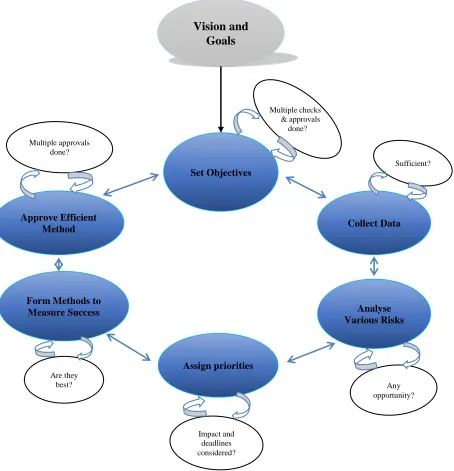
assessment process with the help of the proposed risk management system begins with setting
up objectives to meet the required targets, collecting data related to the set objectives
(exhaustively considering the constraints in meeting the desired objectives), analysing the
various risks associated with the desired goals, assigning priorities in order to address the
higher priority issues first (in case of conflicts, etc.), forming methods to measure the success of
the work progress, approving efficient methods to evaluate the timely success of the formed
methods and measuring the progress in every stage .
One of the crucial parts in the development of an efficient risk management model is to
consider individual objectives of the various departments such as compliance, audit, HR, IT,
sales & marketing etc., to give a clear picture of what is required to be done by all the
departments in meeting the common goals of the company knowing that the success of the
organization lies in the overall work of the various departments. In relation to the successful
working of the various departments and the overall progress and continuity in business, there
are a few major risks which the banking and financial services sector tries to avoid being
commonly referred to as the major banking risks which are in a broad spectrum includes the
below (Kishor, N. 2014; Risks Faced by Banks. Management Study Guide, n.d.; Kanchu, T.
2013):
Licensed under Creative Common Page 660
Interest Rate Risks Operational Risks Compliance Risks etc.,
POSSIBLE ERRORS IN DEVELOPING RISK MANAGEMENT SYSTEM
There are some possible errors which results in a weak risk management system and brings
losses to the organization or which does not seize new opportunities and scope of future
enhancements. Some of the possible errors are:
Evaluating all the risks as independent events not realizing the possible
interdependencies between the risks.
Hoping that the regulatory authorities will provide the risk management model.
Following a „to do list‟ controls and not measuring the success or performance of the
activity being chosen.
Sticking to the previous risk management model not considering the possibility of new
risks.
Relying on old technological methods and considering new methods to be expensive but
not realising the potential benefits they can bring.
Relying only on the past data (previous risks, losses etc.,) and experience but not
analysing the present or possible future risks.
Believing that the organization has not faced major risks in the past and will not face
them in the future also.
Considering insurance as the perfect risk management plan.
Formulating ways after facing losses but taking no preventive measures prior to the
losses i.e., reactive rather than being proactive nature in the risk assessment process. Underestimating or overestimating the risks based on no factual data.
WHY IS THE RISK MANAGEMENT SUCH A BIG CONCERN FOR BANKING AND
FINANCIAL SERVICES SECTOR?
When compared to many other industries, the banking and financial institutions suffers from
paying misconduct costs in billions of dollars; the huge sum of money which could else be
utilised in the expansion or development programs of the banks and financial institutions.
Moreover, the risks associated with banks and financial institutions outlaws the risks linked with
the other industries due to the case specific nature of the problems and knowing that a weak
Licensed under Creative Common Page 661
importance of risk management in the context of banking and financial institutions it can be noted that the JP Morgan blamed risk management failure as the key factor for “London Whale”
loss which has caused around $6.2 billion (Flitter, E. 2013). Global banks misconduct cost has
been said to have reached over $320 billion, the cost which could have been used to provide
support of up to $5 trillion by lending to businesses and households (Carney, M. 2017). The cost
of the misconduct is too large to be framed in the picture of lending to businesses or household
as it could have been used in a deeper way in contributing to the development of the industries
and individuals in providing means to see a greater creativity in the progress of the nation. The
cost of misconduct pertaining to the banks and financial institutions includes variety of the costs
suffered by the banks for their failure in observing the legal and regulatory requirements among
other costs such as customer compensation etc. It has been found that the misconduct costs
are of a case – specific issues kind rather than a mere image of the general trade of the
complete system (Shinar, R. 2017).
An increased emphasis to AML/CFT on the risk-based approach especially in relation
with preventive measures and supervision activities is one of the most important changes made
by FATF in the year 2012 recommendations and considered the risk-based approach as an „essential foundation‟ for a country‟s AML/CFT framework. Moreover, FATF have considered the
risk-based approach as an over-arching requirement which is said to be applicable to all
relevant recommendations (Guidance for a Risk-Based Approach, 2016).
One more important factor which is to be considered in this context is frauds. One
cannot ignore the risks associated with frauds in the banking and financial systems by simply
depending on the code of conduct signed by the employees or by having an efficient
whistleblowing hotline service; it is required to understand and continuously monitor if there is
any fuel which can ignite a fraud due to the high risk nature of the work as the banking and
financial industry deals with activities which are key reasons among the majority of the crimes.
Frauds in banking and financial institutions are considered among major risks when compared
to some other industries due to the confidential work environments as well. Frauds in banking
and financial institutions is not merely stealing cash from customers as one would think of but
can also result through many other ways such as disclosing confidential information about the Company‟s policies and procedures, unauthorized selling of customer‟s information,
unauthorized transactions without collecting proper documentation, creating anonymous fake
accounts, tipping off etc. The fraudsters can find good opportunities in all the major operational
areas in the field of banking (Bhasin, M. 2015). The banks and financial institutions considering
Licensed under Creative Common Page 662
and catch the perpetrators in the event of a fraudulent activity; thereby the banks and financial
institutions can prevent the frauds and assess the profit and loss statement in a fair way.
Regarding understanding why frauds occur, Donald Cressey had developed a fraud
triangle model describing pressure, opportunity and rationalization as the key elements to
understand the root causes of why people commits fraud. Albrecht et al, 2004 has referred to
the two elements of fraud triangle as perceived pressure and perceived opportunity; indicating
the use of perceived pressure rather than just pressure as important since pressure does not
have to be true in all the cases, it can be just the belief of the perpetrator that he/she is under
pressure or pressurized and similarly perceived opportunity rather than just opportunity as
opportunity does not have to be real or cannot always be real knowing that the perpetrator can
consider something as an opportunity which is not for him/her. Relating fraud triangle with the
fire triangle, the stronger the pressure or the bigger the perceived opportunity, the lesser the
rationalization it takes for the perpetrator to commit the fraud (Albrecht, W. 2004).
Discussing about the risks associated with the HR department, it is a common
misconception that people often considers HR as the department which merely deals with hiring
and firing of the staff and considers only the risks which can result from hiring or firing activities.
HR plays a very important role in the construction of an effective risk management system.
More than hiring and firing, an efficient HR department handles various tasks such as preparing
compensation and benefits, arranging motivation events, handling issues related to conduct of
employees, employee supervision, balancing the number of staff, setting up incentive and
overtime benefits and calculations, concerns related to occupational safety and health related
concerns, taking disciplinary actions as and when required, arranging trainings for staff,
managing daily attendance and leave tracking etc. HR is one of the critical departments which
needs to be monitored deeply as there can arise many risks related to HR such as framing
unnecessarily high or extremely low compensation, incentives and other benefits which can
cause financial losses to the company or can demotivate the staff respectively.
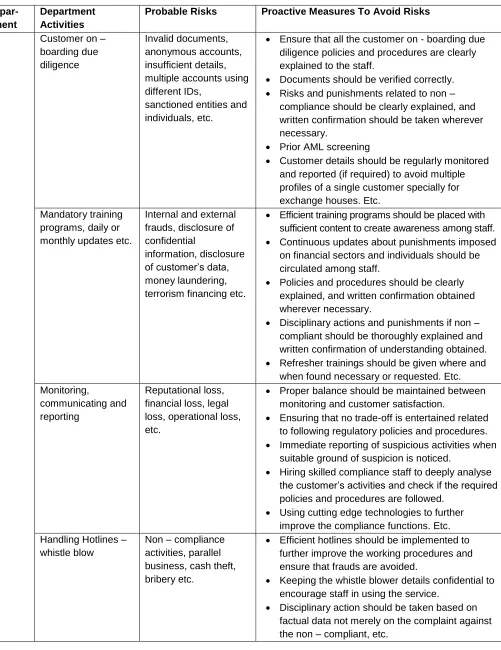
PROBABLE RISKS ASSOCIATED WITH BANKING AND FINANCIAL SERVICES SECTOR AND SUGGESTED PROACTIVE MEASURES – DEPARTMENT WISE
Various potential risks and recommendations suggested as precautionary measures pertaining
to some of the major departments in the banking and financial institutions point of view are
Licensed under Creative Common Page 663
Table 1. Probable risks and proactive measures to avoid risks for banking and financial services
Depar- Tment
Department Activities
Probable Risks Proactive Measures To Avoid Risks
C O M P L I A N C E
Customer on – boarding due diligence
Invalid documents, anonymous accounts, insufficient details, multiple accounts using different IDs,
sanctioned entities and individuals, etc.
Ensure that all the customer on - boarding due diligence policies and procedures are clearly explained to the staff.
Documents should be verified correctly.
Risks and punishments related to non – compliance should be clearly explained, and written confirmation should be taken wherever necessary.
Prior AML screening
Customer details should be regularly monitored and reported (if required) to avoid multiple profiles of a single customer specially for exchange houses. Etc.
Mandatory training programs, daily or monthly updates etc.
Internal and external frauds, disclosure of confidential
information, disclosure of customer‟s data, money laundering, terrorism financing etc.
Efficient training programs should be placed with sufficient content to create awareness among staff.
Continuous updates about punishments imposed on financial sectors and individuals should be circulated among staff.
Policies and procedures should be clearly explained, and written confirmation obtained wherever necessary.
Disciplinary actions and punishments if non – compliant should be thoroughly explained and written confirmation of understanding obtained.
Refresher trainings should be given where and when found necessary or requested. Etc. Monitoring,
communicating and reporting
Reputational loss, financial loss, legal loss, operational loss, etc.
Proper balance should be maintained between monitoring and customer satisfaction.
Ensuring that no trade-off is entertained related to following regulatory policies and procedures.
Immediate reporting of suspicious activities when suitable ground of suspicion is noticed.
Hiring skilled compliance staff to deeply analyse the customer‟s activities and check if the required policies and procedures are followed.
Using cutting edge technologies to further improve the compliance functions. Etc. Handling Hotlines –
whistle blow
Non – compliance activities, parallel business, cash theft, bribery etc.
Efficient hotlines should be implemented to further improve the working procedures and ensure that frauds are avoided.
Keeping the whistle blower details confidential to encourage staff in using the service.
Licensed under Creative Common Page 664 A U D I T Data collection, identification, assessment, reviewing controls, investigations, prioritizing, reporting etc. Fraud, unauthorized access, skipped entries in the financial
statements, improper use of assets, parallel business, disclosure of confidential
information, no proper inclusion of the intrusion activities etc.
Framing an efficient risk management system to evaluate the risks prior to losses.
Reporting all the potential risks which can trigger bigger or smaller losses to the management.
Evaluating all the risks proactively and estimating the magnitude and elasticity of the risks.
Carrying out fair and hidden investigations and collecting sufficient evidence.
Suggesting recommendations as whether to continue (with recommended changes) with the activities/staff linked with the detected risks to the management immediately
Making sure all control procedures are implemented all the time.
S A L E S & M A R K E T I N G
Prospecting for new business
opportunities, making efforts to retain customers, organizing campaigns, identifying budget& targets and forming means to achieve them, creating value to the various products & services, building brand name, market research, suggesting improvements in products & services, calculating return on investments etc.
Losing valuable clients, conflicts, low sales incentive calculations, poor lead qualification techniques, unnecessary heavy discounts, financial punishments, poor objection handling, poor negotiating techniques, reputational losses, regulatory punishments, misreading customer‟s requirements etc.
Implementing efficient automated customer engagement methods using advanced AI and machine learning applications
Implementing analytical software to better assess the marketing fluctuations
Taking prior approvals before implementing sales or marketing events etc.
Configuring reports to measure the progress.
Valuing every client as important.
Setting up immediate measures to retain customers in case of customer dissatisfactions.
Updating customers through efficient means with promotional events.
Strictly following company‟s policies and procedures specially in case of conflicts etc.
H U M A N R E
Recruitment Recruiting inefficient, unsafe or
unnecessarily etc.
Assure that complete screening and background checks are done.
Monitor closely during the probation period.
Check if there were any written promises made to the recruit which can violate human or labour laws?
Check if new recruits are necessary? Code of conduct Disclosure of
confidential
information, abuse, reputational loss etc.
Ensure that all code of conduct policies and procedures are explained to the staff
Make sure staff knows about the disciplinary actions which can be taken against them if code of conduct is violated.
Licensed under Creative Common Page 665 S O U R C E
Safety and Health issues and insurance
Uninsured staff, severe injuries, death, medical leaves, attendance fraud etc.
Ensure that all insurance claims are monitored faithfully based on factual data.
Ensure sufficient staff is available to compensate for loss of staff hours due to severe injuries or deaths
Ensure safe work environment. Terminations Disclosure of
confidential
information, reputation in the community, unsuitable
replacement, property loss, panic among other staff etc.
Ensure that sufficient information is available, and enough ground of evidence is present before terminating staff
Check the level of information which the exiting employee can possibly disclose and make changes accordingly if required.
Check if handover or deactivation specially of cash, keys, logins and access cards is done properly.
Check if companies‟ assets are retrieved etc.
O P E R A T I O N S Staff assignment, aiding related to various services offered, reduction in unnecessary expenses, coordinating with other departments in regards of system failure, upgrades, issues and other activities.
Concerns related to data security and confidentiality, sanctions, contraventions to AML/CFT policies and procedures,
excess/shortage of staff in a branch, insufficient assets, cash stealing, improper cash transfers and transactions
Precise allocation of staff in various branches avoiding excess/shortage issues.
Seizing the opportunities for development and discouraging activities which can bring losses.
Reporting about the deficiencies in accomplishing the work in the branches to the management immediately.
Recommending system upgradations or deactivations to the IT department.
Making sure all the policies and procedures are followed every time.
I T Managing IT infrastructure, ensuring security, facilitating exchange of information, ensuring availability of PCs and required software for
employees, eliminating errors and ensuring service availability.
Intrusions (virus, worms, DOS attacks etc.,), loss of data, data theft, software bugs and crashes, critical outages, human errors, process failures, software loop holes, data corruption, insecure cryptographic storage, social media attacks etc.
Implementing highly secured encryption and decryption algorithms.
Investigating anomalous activities.
Avoiding usage of corporate or confidential data on personal storage devices.
Ensuring IT policies and procedures are always followed.
Multiple password protection for confidential data.
Giving top priority to security.
Screening new recruits.
Implementing fast and efficient recovery plans.
Risks associated with all the other departments should also be considered when implementing
the risk management system to obtain the set objectives. It should also be remembered that an
opportunity associated with one department can raise a bigger risk in the other department such
as sales team allowing extremely high value transactions with insufficient KYC documents can
Licensed under Creative Common Page 666
without sufficient KYC can result in huge misconduct cost to the organization. Hence, when a
risk is analysed, sufficient data should be collected, and assessment should be done
considering all the effects of the potential risk linked with the other departments as well. It
should also be noted that the recommendations (but not limited to) suggested above to avoid
the risks should be practiced conscientiously to ensure that such risks cannot arise as even
smaller risks related with daily activities can spoil the most effective risk management model as
well specially in the banking and financial system where even a single inappropriate transaction can result in closure or suspension of the company‟s license.
PROPOSED RISK MANAGEMENT MODEL
An efficient risk management model is proposed in this paper to understand the various
methods in handling risks and extracting ways to convert risks into opportunities. Not having the right people at the right time to take right decisions in seeing the uplift in the company‟s
progress can cause substantial losses to the company. The effectiveness of an efficient risk
management system depends on the innovative, constructive, proactive, forward thinking, risk
to opportunity converter and steady minded planning. The proposed risk management model is
shown in figure 1, and the components are described below:
Set Objectives:
This is the first stage in the proposed risk management model. The objectives here represent
implementing a risk-based approach to address possible risks which can arise in meeting the set goals or company‟s vision. The objectives should be realistic and achievable considering the company‟s available resources and investment capabilities; setting up and unachievable
objectives can end up the process in an infinite loop bearing no good fruit. Moreover, goal
specific and measurable objectives should be set to ensure that the set goals are achieved.
Suitable deadlines should be assigned (some objectives can be given a grace period) to various
objectives to measure the progress.
Collecting Data:
Collecting sufficient data before developing a risk management model is an essence of
implementing an effective risk management system. In collecting data, a conditional flag to
verify if sufficient data is collected should be used to get adequate amount of data. The data can
Licensed under Creative Common Page 667
Adopting to various survey methods such as questionnaire, interviews etc., to better
assess the customer objections and requirements and to come up with ways to fulfil the
customer needs and seize the market vigorously.
Accumulating data showing misconduct costs imposed on other banking and financial
institutions as well.
Data representing the authorized flow of information.
Amassing data related to internal and external policies and procedures.
Figure 1. Proposed Risk Management Model Set Objectives
Approve Efficient Method
Form Methods to Measure Success
Assign priorities
Analyse Various Risks
Collect Data
Vision and
Goals
Multiple checks & approvals
done?
Sufficient?
Any opportunity?
Impact and deadlines considered? Are they
best? Multiple approvals
Licensed under Creative Common Page 668
Analysing risks:
The next important step in developing a risk-based system is to analyse the magnitude of the
risks considering the other potential risks which can arise from certain risks. In the proposed risk
management system, the various risks are checked not just to minimise the risks but also to
ascertain if certain risks can be converted to opportunities without generating newer risks. The
analysis part is a crucial element as the next stages in the process depends on the ways the
risks are analysed. The analysis part can include the following:
Ascertaining the wide possibilities of the risks pertaining to various departments knowing
that majority of the risks in banking and financial sectors are case specific.
Noting the various foundations of impending risks which can trigger major or minor
losses to banking and financial institutions.
Finding ways to scrutinize if certain risks can be converted to opportunities; considering
all the effects associated with them.
Drawing connections between various risks and the magnitude of the losses they can
trigger or the opportunities they can bring.
Assign Priorities:
Assigning priorities to the risks requires a high level of talent and skills in the risk management
system; a mere knowledge about one department cannot accomplish the task efficiently such as
just focussing on unnecessarily strengthening the audit and compliance internal procedures to
reduce the losses due to misconducts can increase the preventive controls but can compromise
with the sales and customer satisfaction and may result in business losses and vice versa. So, it
requires the knowledge in all the key factors which can directly or indirectly link to the risks. The
priorities can be assigned to various methods which can bring success to the organization and
can result in substantial decrease in the magnitude of the risks. In assigning priorities to various
methods, the deadlines and impact of the assigned methods should be considered. The process
can include:
Detailing the cons and pros of the various methods being proposed by the team to
assign priorities.
Approvals from multiple personals to avoid choice-based assignments.
Considering the daily work flows and miscellaneous activities which can increase the
magnitude of the risk which was initially assigned a lower priority.
Licensed under Creative Common Page 669
Assigning highest priorities to the risks which can impose huge penalties and result in
reputational, legal, financial and operational losses.
Form Methods to Measure Success:
It is one of the common risk management problem that after setting an efficient risk
management model, organizations ignore or fails to measure the success of the ongoing
methods in reducing the magnitude of the risks. The success of an efficient risk management
system is not just in building up an impressive system but also in monitoring the progress and
the potential risks which can result from certain activities. The measurement of success in the
banking and financial services sector covers prevention of misconducts and increase in sales
packed with increased reputation of the organization and customer satisfaction. The success of
the formed methods can be weighed based on below (but not limited to):
Whether a risk can result in a misconduct cost imposed by regulatory authorities if not
taken care of?
Whether the formed methods can balance customer satisfaction and various policies
and procedures (internal and external)?
Whether the formed methods can result in increased profit with reduced risk or losses;
never compromising with the regulatory requirements. The efficiency of the methods being in place.
The coordination between the management, department heads and staff; a poor
coordination can bear no good fruit.
Approve Efficient Methods:
This is the most important part of the risk management model proposed in this paper. Approving
an efficient method should go through several higher officials in the organization and multiple
approvals should be taken from the department heads and management knowing that the
potential losses or benefits the risk management model can bring to the organization. A method
to counter the possible losses due to risks or take a risk as an opportunity to bear greater fruits
should be based on factual data not merely on what one favours without proper reasoning.
RESULTS AND RECOMMENDATIONS
An efficient risk management system has been proposed in this paper wrapping the
development of a risk management model and highlighting the various possible risks which can
Licensed under Creative Common Page 670
to prevent the risks and to seize opportunities resulting in the elevation of the organization. The
probable errors in the development of an efficient risk management system are also described
in the paper. The proposed risk management system can reduce the risks in the banking and
financial services sector and can bring noticeable return on investments. The preventive
measures to avoid several probable risks resulting from various departments is described in the
table 1. And below are listed the recommendations to be considered in developing a good risk
management system.
Forming methods to continuously measure the success of the developed risk
management system knowing that the risk management is a continuous process.
Implementing artificial intelligence (AI) and machine learning based applications to
provide improved customer engagement methods and bring new business opportunities. Embracing AI based algorithms to monitor the developed risk management system. Not considering insurance claims as a complete recovery plan in the risk based system
as there are many costs which are not included in the insurance.
Carrying out extensive research prior to ignoring even the smallest risks.
Violations to regulatory requirements should be recorded among high priority risks, Implementing the risk management system not just to avoid risks but also to seize
opportunities and bring new benefits to the organization.
Believing that the banking and finance is a risky business surrounded with risks requiring
greater analytical skills in various areas.
Taking proactive measures rather than reactive.
Taking each risk and magnifying it to see various interconnections with other possible
risks.
Considering all the regulatory policies and procedures in the development of the risk
management system.
Collecting sufficient data before developing the risk management system.
Including the shortcomings of the previous model, past losses, available resources,
possible new opportunities and risks in the data collection part of the risk management
process.
CONCLUSION
In elevating the company‟s name and bringing greater return on investment for the organization
Licensed under Creative Common Page 671
a challenging environment. In achieving so, the proposed risk management system will be of
great assistance providing efficient means to reduce the number of risks and offer guidelines to
take proactive measures to avoid risks and seize opportunities for organization. The work
presented in this article can be further enhanced using the cutting - edge technologies such as
artificial intelligence and machine learning. Moreover, a department wise risk management
system can also be incorporated which could suggest ways to reduce the department wise risks
and can form a base to assign objectives to the team and individuals in plummeting the risks,
elevating the brand name and increasing the financial strength of the organization.
REFERENCES
Albrecht, W. (2004). Fraud and Corporate Executives: Agency, Stewardship and Broken Trust. Journal of Forensic Accounting, Vol. V, 109 – 130.
Arunkumar, R. (2005). Risk Management in Commercial Banks (A Case Study of Public and Private Sector Banks). SSRN eLibrary.
Bhasin, M. (2015). Menace of Frauds in the Indian Banking Industry: An Empirical Study. Australian Journal of Business and Management Research, 4(12), 1 – 13.
Carney, M. (2017). Remarks at the Banking Standards Board Panel “Worthy of Trust? Law, Ethics and Culture in Banking”. Bank of England. Retrieved August 10, 2018, from https://www.bankofengland.co.uk/-
/media/boe/files/speech/2017/banking-standards-board-worthy-of-trust-law-ethics-and-culture-in-banking.pdf?la=en&hash=140DB30905F90F73DD6A1BADFF3E13BF931AB8E8.
Flitter, E. (2013). JP Morgan Blames Risk Management for “London Whales” Loss. Reuters. Retrieved August 29, 2018, from https://www.reuters.com/article/us-usa-jpm-weiland/jpmorgan-blames-risk-management-for-london-whale-loss-idUSBRE90F18G20130116.
Guidance for a Risk-Based Approach. (2016). FATF. Retrieved August 18, 2018, from http://www.fatf-gafi.org/media/fatf/documents/reports/Guidance-RBA-money-value-transfer-services.pdf.
Kanchu, T. (2013). Risk Management in Banking Sector – An Empirical Study. International Journal of Marketing, Financial Services & Management Research, 2(2), 145 – 153.
Kishor, N. (2014). Risk and Risk Management in the Indian Banking Sector. Galaxy International Interdisciplinary Research Journal, 2(3), 115 – 120.
Risks Faced by Banks. Management Study Guide. Retrieved August 23, 2018, from https://www.managementstudyguide.com/risks-faced-by-banks.htm.
Shinar, R. (2017). Misconduct Cost of Banks – The Meaning Behind the Figures. Banking & Finance Law Review, 32 (3), 495 – 528.