Support of a Problem-Based Learning Curriculum by Basic Science Faculty
William L. Anderson, Ph.D. and Robert H. Glew, Ph.D.
Department of Biochemistry and Molecular Biology School of Medicine
University of New Mexico Albuquerque, NM 87131
Abstract - Although published reports describe benefits to students of learning in a problem-based, student-centered environment, questions have persisted about the excessive faculty time commit-ments associated with the implementation of PBL pedagogy. The argument has been put forward that the excessive faculty costs of such a curriculum cannot be justified based upon the potential benefits to students. However, the magnitude of the faculty time commitment to a PBL curriculum to support the aforementioned argument is not clear to us and we suspect that it is also equally unclear to individuals charged with making resource decisions supporting the educational efforts of the insti-tution.Therefore, to evaluate this cost - benefit question, we analyzed the actual basic science fac-ulty time commitment in a hybrid PBL curriculum during the first phase 18 months of undergraduate medical education. The results of this analysis dodemonstrate an increase in faculty time commit-ments but do not support the argument that PBL pedagogy is excessively costly in terms of faculty time. For the year analyzed in this report, basic science faculty members contributed on average of 27.4 hours to the instruction of medical students. The results of the analysis did show significant contributions (57% of instructional time) by the clinical faculty during the initial 18 months of medi-cal school. In addition, the data revealed a four-fold difference between time commitments of the four basic science departments. We conclude that a PBL curriculu m does not place unreasonable demands on the time of basic science faculty. The demands on clinical faculty, in the context of their other commit ments, could not be evaluated.Moreover, this type of analysis provides a tool that can be used to make faculty resource allocation decisions fairly.
In the 1960s, in response to national calls to in-crease the relevance of undergraduate medical school instruction in the basic sciences to clinical practice, and to improve students' skills in the application of basic science knowledge, several medical schools began exploring the use of Problem-Based Learning (PBL) pedagogy for basic science instruction. By the early 1990s, many medical schools in the United States had begun to adopt different forms of a basic science PBL curriculum moving, to one extent or another, from a traditional lecture- and laboratory- based undergraduate medical curriculum to a prob-lem-based, student-centered curriculum in which a considerable proportion of the learning takes place in a tutorial setting. These changes are most evident in the traditionally basic science portions of the curricu-lum.
However, ever since this grand experiment in medical education began, strong opinions have been expressed and questions raised about the wisdom, effectiveness and educational efficiency of a tutorial,
problem-based, case-oriented approach to teaching the sciences basic to medicine. Unfortunately, many of those arguments have been grounded in emotion, tradition, faculty perceptions and faculty preferences rather than upon a careful analysis of the costs in dollars and human resources versus the benefits of a PBL curriculum. This lack of concrete data has set up a situation in which basic science faculty can decide individually whether or not to support the tutorial goals and objectives, which creates a potential incon-sistency between departments in their support of the institutional tutorial efforts. This inconsistency is often found in the development of departmental fac-tors that are used to modify faculty time commit-ments based on perceived relative worth or value of the different educational components of the curricu-lum rather than on the institutional needs and educa-tional effectiveness.
various basic science disciplines. A substantial litera-ture supports the assertion that, relative to a conven-tional lecture-based curriculum, PBL curricula im-proves student problem-solving skills1,2, enhances understanding and retention of basic science con-cepts3,4
,
and improves performance in clinical clerk-ships. 5 In addition, students appear to enjoy the PBL format more and become more actively involved in their own learning.6 Reports of the benefits of this type of instructional methodology on student per-formance on national licensing examinations vary greatly from showing that no harm was done by mo v-ing to a PBL curriculum6,7 to reports of improved performance for students involved in a PBL curricu-lum.8 This discrepancy in outcomes may be related to limitations in some of the study designs9 or variations in the methods used to implement a PBL curriculum. In spite of the apparent positive effects of PBL peda-gogy on student learning, the results of several stud-ies have led to the recommendation that the benefits associated with a PBL-based curriculum cannot be justified based upon the increased costs of imple-menting that curriculum.9-11 Considering the Univer-sity of New Mexico’s historical emphasis on PBL pedagogy, this finding of unacceptable costs in terms of basic sciencefaculty effort became a critical prob-lem in redesigning the first 18 months of the curricu-lum.In 1993 the School of Medicine undertook a ma-jor revision of the undergraduate medical education curriculum in order to combine two curricular tracks: a small problem-based track with a significantly la r-ger conventional lecture, laboratory-based curricu-lum. A major a goal of this combined curriculum was to more fully integrate basic and clinical science. The majority of the curricular change was concentrated in the first 18 months of the four-year education pro-gram. Some of our colleagues have argued that PBL is labor intensive to an unreasonable extent and that it unduly burdens the basic science faculty and takes them away from research that brings revenue and scholarly recognition to the school. Others see the manpower issue differently: they believe that a PBL-based curriculum is no more labor-intensive than a traditional one and argue that it is simply a matter of utilizing the same amount of human resources, but in a different way12 This curricular change that was made at the School of Medicine provided an excel-lent opportunity to evaluate, quantitatively, the com-mitment of basic scientists to a PBL curriculum and to answer the question of whether a PBL curriculum is significantly more faculty intensive than a tradi-tional curriculum for the basic scientist.
In order to analyze the costs of providing a hybrid PBL curriculum to 73 medical students, we asked the question, How much of a basic scientist's time is ac-tually spent delivering the curriculum? Our analysis revealed surprising results that have implications not only on the use of faculty resources but also regard-ing the question of the proper balance of educational effort provided by basic scientists and clinicians and between different basic science departments. These findings did not answer the larger question of whether or not a PBL curriculum is excessively ex-pensive for the institution in terms of both basic sci-entist and clinician resources.
Methods
The hybrid PBLundergraduate curriculum at the School of Medicine was implemented in 1993 and consists of three educational phases . The first 18 months are designed to provide an integrated basic and clinical science focus within an organ system structure. The traditional basic science disciplines are integrated throughout this initial phase of the curricu-lum. The instructional methodology during Phase I consists of PBL-tutorials, traditional lectures and laboratories. It should be noted, however, that the format of the tutorials varies considerably from one organ system block to another. Generally, students spend between 20 to 30% of their contact time in tutorials. Since there has been relatively little contri-bution of the basic science faculty to either Phases II or III, this analysis will focus solely on Phase I.
however, we judge that the magnitude of these incon-sistencies is substantially smaller than those associ-ated with self-reported data. To test this possibility, we spot-checked some of the departmental contribu-tions by interviewing course chairpersons about un-published last minute schedule changes. One of the known unreported contributions involves a basic sci-ence department that has a major commitment to the first hospital orientation rotation in Phase II. How-ever, this inconsistency would amount to no more than a 20% increase in lecture and tutorial commit-ment of departcommit-mental faculty resources and does not affect conclusions drawn from the overall data. A second known accounting problem was associated with the remediation of students who had encoun-tered difficulty in the standard curriculum. However, this remediation activity, although included during Phase I, is not formally scheduled and is conse-quently a part of a "hidden" curriculum. Over the past several years the total time commitment of basic sci-ence faculty to this remediation program averaged approximately 96 hours (16% increase in departmen-tal faculty commitment). However, since the basic science department that contributes the most to the remediation effort is currently the same one that is most heavily involved in the PBL curriculum, omis-sion of these data did not result in a major change in the conclusions we derived from these data. Another minor inconsistency in using the published curricular schedules to assess individual faculty and department efforts involves the difficulty of finding faculty to cover tutorials and not committing tutors or lecturers until the last minute. In this case, the data are simply listed as "unknown" and the amount of time in this scheduling inconsistency is approximately 90 hours out of a total of 5200 hours, which would be propor-tioned between several departments. A final schedul-ing error and one of unknown magnitude involves laboratories where only a limited number of faculty are listed in the schedule; however, other faculty members at times may assist.
Our analysis did not consider mentoring of medi-cal students who were doing research in the laborato-ries of basic science faculty. Although this is clearly an important and time -consuming educational effort, it is one that is difficult to accurately quantify and generally more related to the basic scientists' research efforts. In addition, since the amount of time avail-able for medical student research during Phase 1 of the curriculum is very limited, we judge that this will not be a major factor in the analysis. Our analysis does include clinical skills teaching because in past years basic scientists have not been involved in this activity. Not included in our analysis are student-generated independent study programs and students
working with clinical mentors or in the biweekly Per-spectives in Medicine (PIM) program because they involves few, if any, basic scientists and a minor amount of time.
In order to conduct this analysis fairly, it was clear to us at the outset that we needed to make a decision about two other issues. The first concerned cooperative teaching in which basic scientists and clinicians were teamed up for a joint lecture, labora-tory or tutorial. In such instances, the time commit-ments of all involved individuals were considered. The second issue concerned what we are defining as “sporadic tutoring”. In this case, multiple tutors are assigned to a single tutorial group; however, since only one of the tutors was present at any point in time, fractional credit was assigned based on the number of individuals assigned per hour. The deci-sion to assign fractional credit is based solely on the description of the tutor role in the course syllabus.
Identificati on of Basic Science Faculty - In or-der to identify and quantify faculty members in each of the basic science departments, we consulted the Web sites published and maintained by these depart-ments. Only full-time tenured, tenure -track or teach-ing contract faculty were considered in our analysis. Adjunct faculty members were considered with their primary departmental affiliation only and all retired faculty were considered as a separate category. The identification of faculty publications was taken from the 1998 edition of the university publication "Fac-ulty Creative Works". This was the latest edition that was publicly posted at the time of the analysis and it represents faculty productivity five years following the curricular change and should not be influenced by the curricular change process. While there may be errors associated with this assessment of faculty scholarship, these errors should apply equally to all departments. In instances of multiple authorship, all authors received credit as contributing to the publica-tion; consequently, a publication may have been counted more than once for any department.
Depart-Clinical 57% Basic
Science 27%
Other 16%
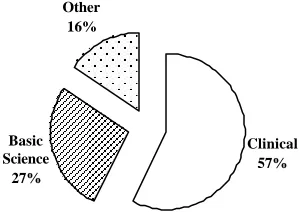
Figure 1. Distribution of the phase I scheduled teaching time. The total number of teaching hours was categorized based on the administrative affilia-tion of the educator. The category labeled other represents both individuals whose primary appoint-ment with outside of the school of medicine and teaching commitments that were unfilled at the time of the analysis.
ment of Pathology was considered to be a clinical department.
Results
Relative Contributions of Clinical and Basic Science Departments to Phase I - Analysis of the curricular content has shown that in the first 18 months (Phase I) of the hybrid PBL curriculum, the School of Medicine faculty, basic scientists and clini-cians combined, committed 5200 hours of faculty time to student instruction. This represents a 270% increase in faculty time commitments to the basic science curriculum compared to the previous conven-tional curriculum. This is not an unexpected finding considering the addition of a tutorial component to the curriculum. However, an unexpected finding was the disproportionate contribution that the basic and clinical scientists (Figure 1) made to the pre-clinical phase of the curriculum, a phase in which the major aim is to provide the students with an introduction to the sciences basic to medicine. Our analysis showed that the basic science departments were responsible for only 27% of the teaching in phase I of the curricu-lum. However, their contribution to phase I does rep-resent a 70% increase in basic scientist commitment to the hybrid PBL curriculum. Although there were a few basic scientists included in the "clinical" and "other" categories, these individuals were not me m-bers of any basic science department. In any event, the contributions of these basic scientists accounted for less than 2% of the total Phase I instructional time. This observation is more striking when the teaching commitment of basic scientists in the hybrid PBL curriculum is compared with their relative teaching commitment in the former conventional curriculum. In the conventional curriculum, the first
year consisted primarily of normal biology and physiology whereas the second year emphasized ab-normal situations and pathophysiology. These data are presented in Table 1.
It is important to note that this analysis did not assess whether the instruction delivered by the clini-cal scientists emphasized basic science concepts or was focused on more clinical issues. It is also
impor-tant to point out that although there has been a major increase in faculty effort, the student time commit-ment remains roughly equivalent between the
con-ventional and hybrid PBL curricula. Consequently , the students see far fewer basic scientists during the basic science portion of their medical education than they did u nder the conventional curriculum.
Since tutoring is, in general, a self-selected activ-ity in the curriculum at this institution, the chairs of the Phase 1 instructional units have little control over
who tutors in their courses. On the other hand, the course committees have a great deal of control in determining who delivers formal lectures. This deci-sion becomes relevant in light of the fact that under the faculty evaluation guidelines for promotion and salary raises, one hour of lecture is considered four times as valuable as one hour of tutorial.
TABLE 1: Percent of the Scheduled Teaching Commitment Delivered by Basic Scientists During the “Basic Science” Portion of the Curriculum
Conventional Curriculum Hybrid PBL Curriculum
Year 1 Year 2 Year 1 + 2 Phase I Percent of
Curriculum
Assuming that clinical lecturers have a predomi-nant clinical focus and that basic science lecturers have predominately a basic science focus, it was in i-tially believed that there were two different logical approaches to curricular design that might optimally integrate the clinical and basic sciences and utilize the basic science input into the curriculum. One ap-proach would be to balance the clinical and basic science focus and have students proceed through the
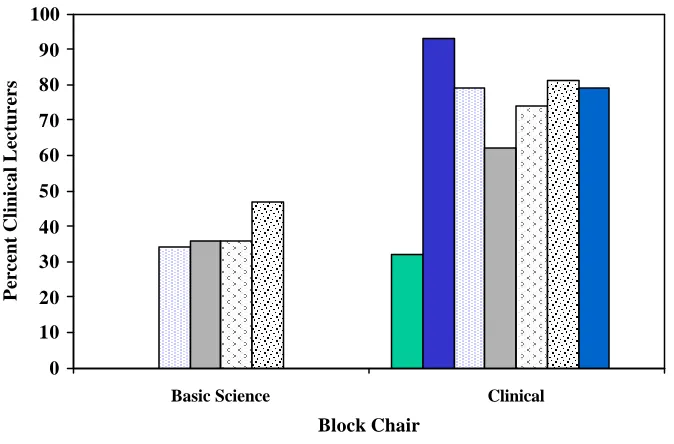
organ system instruction with a similar basic science to clinical science balance. An alternative approach would be to gradually increase the clinical focus as students progress through the curriculum toward the clinical years. When we evaluated how the different course committees selected lecturers we found that neither of these two models was operative. Instead, we found that the clinical/basic science focus de-pended on the composition of the course committee or the focus of the course chair. These data are shown in Figure 2 and demonstrate that, not unexpectedly, a course committee headed by a basic scientist selected basic science lecturers whereas committees headed by clinicians tended to choose clinicians to do the lecturing. The single exception to this generalization
was in one of the courses headed by a clinician; how-ever, that course committee had strong basic science representation.
Consistency of Teaching Commitments Be-tween Basic Science Departments - When the clini-cal departments were removed from our analysis, the results showed a 1.8-fold difference in the contribu-tions between the four basic science departments
(Figure 3), with the instructional commitment rang-ing from 278 hours to 490 hours. It should be noted there were significant contributions to Phase II of the curriculum by the Department D and to the remedia-tion component of the Phase I curriculum by De-partment A. What is most striking about these data is that a single administrative office (OUME) and the group that was comprised of retired faculty made substantial contributions to Phase I of the curriculum. In fact, in most cases , the retired faculty taught more (363 hours, 6% ) of Phase I of the curriculum than did most of the basic science departments. The sig-nificant contributions by these two groups was not evident in the conventional curriculum.
0 10 20 30 40 50 60 70 80 90 100
Basic Science Clinical Block Chair
Percent Clinical Lecturers
The difference in curricular support from the indi-vidual departments may well be explained by differ-ences in their relative size. To account for this possi-bility, we considered the average number of hours
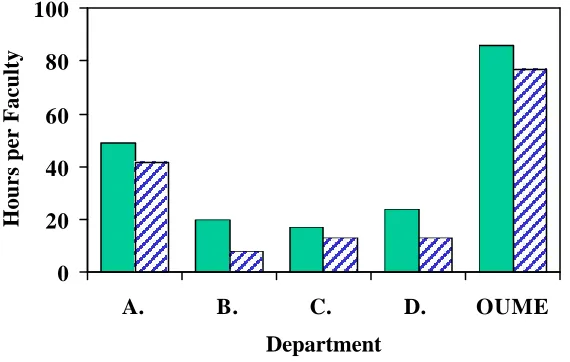
spent in curricular support by each faculty member. These data (Figure 4) show that the average faculty member in a basic science department spent 27.4 hours of their annual time in scheduled Phase 1 sup-port. However, the range in this commitment was
0
100
200
300
400
500
600
A. B. C. D. OUME Library Retired O t h e r
Department
Total Hours
Figure 3. Distribution of phase I teaching hours between different administrative components within the school of medicine. Departments A-D represent the four basic science departments. The Office of Undergraduate Medical Education is represented by OUME. The Other category includes both teachers who are not faculty in the School of Medicine and teaching periods that were not formally assigned at the time of analysis. The ordinate identifies the total Phase I teaching hour commitment by each department.
0
20
40
60
80
100
A.
B.
C.
D.
OUME
Department
Hours per Faculty
large (17.3 – 49.0 hours per faculty member). It is noteworthy that the data for the OUME group repre-sent the efforts of only three faculty members who are involved in delivering instruction. Consequently, the instructional hours per faculty member is some-what skewed compared to the other departments. However, each member in the OUME office, like faculty in the basic science departments, has other duties and responsibilities in the School of Medicine and yet are still able to provide substantial support to the curriculum.
Tutorial Support -The School of Medicine is recognized nationally and internationally for its PBL program and it is publicly acknowledged by the uni-versity that PBL is a major characteristic and element of our undergraduate medical curriculum.
Conse-quently, it is reasonable to expect that each of the basic science departments would support this aspect of the school's mission and would therefore assume an equivalent amount of the new tutorial commit-ment. To evaluate how well this principle was fol-lowed, we isolated the tutorial component of the Phase I curriculum and inquired as to the question of how the various departments contribute to tutorial teaching and problem-based learning. The results of this analysis (Figure 5) revealed a major disparity
between departments in terms of the support each provides to the tutorial component of the curriculum. There was a four-fold difference between basic sci-ence departments in terms of support of the tutoring component of the curriculum. For example Depart-ment A, in contributing a total of 49 hours of curricu-lar support per faculty, provided a major amount of this time (41.9 hours, or 85.5% of their total effort) in support of tutorials . In contrast, Department B, con-tributing a total of only 19.9 hours to the curriculum and supported the tutorial effort to the extent of only 8.1 hours (40.7% of their total effort) per faculty member.
Faculty Scholarship - Because of the major dif-ferences in the commitments the various basic sci-ence departments made to the undergraduate
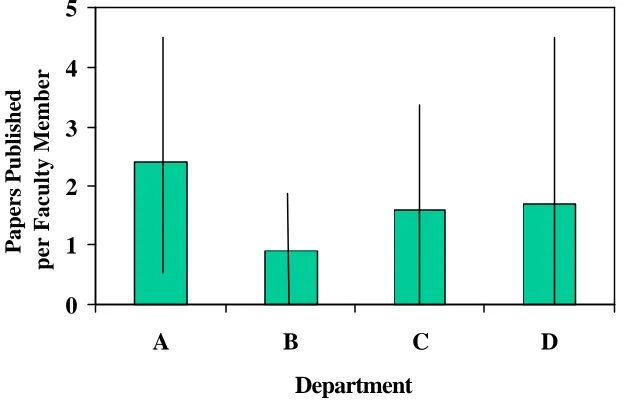
curricu-lum, our institutional database provided an excellent opportunity to evaluate the often-cited reciprocal relationship that is thought to exist between teaching effort and scholarship. Based upon current dogma, it was expected that departments with a high teaching commitment would have a lower scholarly publica-tion output. To test this hypothesis, we evaluated the correlation between instructional hours per faculty and scholarly papers published. These data, presented in Figure 5, when analyzed by the Student’s t-test
0
1
2
3
4
5
A
B
C
D
Department
Papers Published
per Faculty Member
show no significant difference (p > 0.05) in the num-ber of publications per faculty between the various basic science departments. Consequently, the results of this analysis do not support the hypothesis that a negative correlation exists between teaching and scholarship, at the departmental level, and brings into question the practice cited at several institutions of hiring faculty who are either "exempt from" or "pro-tected from" teaching. It should be noted that we did not perform the above analysis based on individual faculty members. Our justification for this decision was that each of the basic science departments has a common requirement to support the educational component of the school, whereas individual faculty members within the departments have unique profes-sional goals and objectives that the departments use in combination to support the overall mission of the school. We are not convinced that the above analysis on an individual faculty level is either meaningful or relevant.
Discussion
The main purpose of this study was to analyze the extent anddistribution of basic science faculty effort and departmental commitment to the first year and a half of a medical school curriculum that is largely problem-based and student-centered and one in which most of the learning took place in a tutorial setting. One of the study’s major aims was to deter-mine the average “burden” such a curriculum places on individual faculty in the medical school’s basic science departments. Another aim was to assess how equally teaching responsibilities were shared between the various basic science departments and between the basic science departments and clinical depart-ments.
With regard to the first of these aims, we learned from our study that, on average, a faculty member in one of the basic science departments spends 27.4 hours tutoring and/or lecturing in Phase I of the cur-riculum, which spans a time period of 18 months. To put these 27.4 hours of teaching into perspective and for purposes of comparison, it is useful to point out that full-time faculty in the Department of Biology or Chemistry at this institution are currently expected to teach three 3-credit courses and two 1-credit labora-tory sections per year. For a faculty member in Bio l-ogy or Chemistry, this corresponds to approximately 150 hours of teaching. Thus, on the same campus where this analysis of a medical school curriculum was conducted, the non-medical school faculty in two science departments had more than 5-fold greater teaching responsibility than their Ph.D. counterparts in the School of Medicine. Even if the entire 2.7-fold
increase in faculty teaching time that was caused by the change to a PBL curriculum were to be shoul-dered by the basic scientists instead of physicians, that still leaves the teaching commitment below that carried by other faculty at the same institution.This comparative figure, together with the fact that basic science faculty are called upon to devote, on average, less than 30 hours of their time to teaching in Phase I of the undergraduate medical curriculum, calls into question assertions about the excessive costs and arguments that PBL-based education, by its very na-ture, will be excessively labor-intensive or costly. It should be noted that this analysis does not address the teaching “burden” shouldered by the clinical faculty as there are no similar baseline numbers with which to judge current and past clinical teaching commit-ments.
The second and perhaps most surprising finding of the study was the dominance of Phase I of the cur-riculum by the clinical faculty. This is most discon-certing because some of the local pressure to change the curriculum yet another time in less than a decade was predicated on the need to address the perceived problem of students not having the essential basic science background necessary to allow them to pro-ceed to Phase II. This clinical dominance of the pre-clinical curriculum was borne out by two sets of sta-tistics. First, in the 2000 calendar year, more than half (57 percent) (Figure 2) of all Phase I faculty stu-dent contact time was by faculty in clinical depart-ments, nearly all of whom were M.D.s. Second, when we divided the 11 different courses that comprise Phase I of the curriculum into those in which the course chair had a clinical assignment versus a basic science affiliation, we found that clinical leaders as-signed almost three-fourths (72 percent) of the lec-tures to a fellow clinician. In contrast, when the course chairperson was a member of one of the four basic science departments, only 38 percent of the lecturers in that course were clinicians.
circum-stance places a proportionately greater burden on the students and faculty of ensuring that basic science topics are covered to an appropriate degree of breadth and depth during those 18 months. This problem is exacerbated by the fact that 3 of the 18 months can be spent in a rural clinical experience. In light of the excessive penetration and control of the undergradu-ate medical curriculum by clinical faculty, it would seem that this circumstance should elicit concern about the degree to which students are learning the basic science subject matter that is the foundation of medical practice and the basis of future therapies. This question will be the subject of another study.
The third major outcome of this study was the finding that the four basic science departments we analyzed varied greatly in the amount of effort each of these administrative units contributed to Phase I of the curriculum. For example, in terms of total teach-ing effort that is, lecturteach-ing and tutorteach-ing — one basic science department taught 9.4 percent of this phase of the curriculum (Figure 4) whereas, in contrast, lecturing, laboratory supervision and tutoring by fa c-ulty in another basic science department accounted for only 5.3 percent of the total formal teaching obligations in Phase I. An even greater disparity between departments was evident when we compared the number of tutors who were provided by different basic science departments: for example, of the 17 faculty in one of the basic science departments, only 9 of them served as either tutors or in the Phase I tutorial or laboratory components of the curriculum, as compared to another basic science department where 9 of the 10 faculty tutored.
One possible way to justify the disparate differ-ences in contributions to one of the major stated ob-jectives of the School of Medicine is to compare the faculty contributions to the other scholarly duties they perform. These competing duties include contri-butions to the graduate program, undergraduate edu-cation, public service, university service and research and educational scholarship. Because the graduate program at this institution is relatively small and sup-ports faculty research, we elected not to evaluate de-partmental contributions to the graduate program. In addition, because only one of the basic science de-partments in this analysis has a major commitment to undergraduate BA and BS education, we did not evaluate this aspect of departmental faculty effort. The amount of departmental emphasis on public ser-vice is unknown and because there is major disparity between the dollar amounts of educational grants and basic science research grants, we elected instead to evaluate departmental scholarship by evaluating the
number of publications. Conventional wisdom and institutional culture suggest that a department with a high teaching load is generally inconsistent with a productive publication record. This is the justification often used by chairpersons to allow faculty members to be hired and promoted with only limited teaching experience or commit ment. Therefore, to fairly evaluate other departmental contributions to the School of Medicine, we elected to use the number of publications as an indication of fulfillment of other departmental responsibilities. The results of this analysis , on a department level, were surprising (Fig-ure 5). The data do not support the conventional wis-dom that teaching compromises scholarly activity. However, this observation is totally consistent with the recommendation of the Boyer Commission re-port13 that teaching, research and educational schol-arship should all be evaluated when assessing the contributions of the professorate.
It is difficult to explain the inconsistencies be-tween departments and/or the variable departmental standards in terms of supporting Phase I of the School of Medicine's undergraduate medical curricu-lum. One explanation is that we have analyzed what amounts essentially to a totally volunteer curriculum and one that lacks support, supervision, or coordina-tion by the administracoordina-tion. This explanacoordina-tion, how-ever, is too illogical to consider and there must be other mechanisms or unknown pressures giving rise to the data presented in this report. Unfortunately, these unknown pressures are not clear to the authors of this report.
the institution where this study was performed do not have other responsibilities and obligations that are so burdensome as to prevent them from substantially increasing the amount of effort they devote to lectur-ing and tutorlectur-ing in the PBL curriculum. This assess-ment seems reasonable in light of the much greater teaching responsibilities their counterparts, on the same campus, have in the Department of Biology and the Department of Chemistry.
Clearly, the findings of this analysis will vary with the culture and educational philosophy of each institution and, consequently, it is unlikely that the results found at one institution can be generalized to another institution. However, the algorithm used in this analysis provides a simple and fair method of obtaining data with which administrators can use to make decisions about the use of institutional re-sources in the context of the institutional culture and educational goals. Consequently, the process of ob-taining these data, which does not rely on modifica-tion of the data by factors such as relative effort or comparative worth, provides a impartial method of making curricular decisions that can be generalized to other institutions.
We end this report with several conclusions and recommendations. First, the teaching burden of basic scientists at medical schools that teach using a PBL model need not necessarily be unreasonable or exces-sive. Second, medical school deans and associate deans of undergraduate medical education should be cognizant of the distribution of teaching responsibili-ties between the various basic science departments, and of the proportion of basic science teaching that is done in the first year or two of the curriculum by cli-nicians versus basic scientists. These are issues not only of effectiveness, but fairness as well. Since it has been suggested that a problem with current medi-cal and science education is that students are pro-vided a significant breadth of knowledge but lack the requisite depth of knowledge,14,15 deans and associ-ate deans of medical education should be equally aware of the risk that in an extensively PBL-based curriculum dominated by clinicians, medical students may not receive the necessary depth or breadth of basic science coverage. However, this risk should be critically analyzed. Finally, we believe there is wis-dom and profit for students and faculty alike in maximizing and optimizing the involvement of basic science faculty in the teaching of medical students during the first two years following matriculation.
References
1. Hmelo CE. Problem-based learning: Effects on the early acquisition of cognitive skill in medi-cine. J Learning Sci 1998;7:173-208.
2. Hmelo CE., Gotterer GS Bransford JD. A the-ory-driven approach to assessing the cogn itive effects of PBL Instructional Science 1997;25:387-408.
3. Dods RF. An action research study of the effec-tiveness of problem-based learning in promo t-ing the acquisition and retention of knowledge. J Educ Gifted 1997; 20:423-37.
4. Finucane PM, Johnson S.M, Prideaux DJ/ (1998). Problem-based learning: its rationale and efficacy. Med J Aust 1998;168:445-8.
5. Schwartz RW, Burgett JE, Blue, AV, Donnelly MB, Sloan DA. Problem-based learning and performance-based testing: Effective alterna-tives for undergraduate surgical education and assessment of student performance. Med Teacher 1997;19:19-23.
6. Antepohl W, Herzig S. Problem-based learning versus lecture-based learning in a course of ba-sic pharmacology: a controlled, randomized study. Med. Educ 1999;33:106-13.
7. Verhoeven BH, Verwijnen GM, Scherpbier, AJJA, Holdrinet RSG, Oeseburg B, Bulte JA, der Vleuten, CPM. (1998). An analysis of pro-gress test results of PBL and non-PBL students. Med Teacher 1998;20:310-6.
8. Blake RL, Hosokawa MC Riley SL. Student performances on Step1 and Step 2 of the United States Medical Licensing Examination follo w-ing implementation of a problem-based learnw-ing curriculum. Acad Med2000; 75:66-70.
9. Albanese MA, Mitchell S. Problem-based learning: a review of literature on its outcomes and imple mentation issues. Acad Med 1993;68:52-81.
10. Colliver J. Effectiveness of problem-based learning curricula: Research and Theory. Acad Med2000; 75:259-66.
12. Mennin SP, Martinez-Burrola. The cost of problem-based vs traditional medical education. Med. Educ 1986;20:187-94 .
13. Glassick CE, Huber MT, Maeroff GI. Schola r-ship Assessed: Evaluation of the Professorate. Jossey-Bass Publishers, San Francisco, 1997.
14. Bordage G. The curriculum: Overloaded and too general. Med Educ 1987;21:183-8.
15. Lawson AE, A review of research on formal reasoning and science teaching. J. Research in Sci Teaching. 1985; 22:569-617.
Correspondence:
William L. Anderson
Department of Biochemistry and Molecular Biology School of Medicine
University of New Mexico Albuquerque, NM 87131
Phone: 505 272-8516 Fax: 505 272-6587