ISSN (e): 2250-3021, ISSN (p): 2278-8719
Vol. 08, Issue 8 (August. 2018), ||V (VI) || PP 01-05
Fast and Effective Network Anomaly Detection
Technique Using
Hybrid Sequential Pattern algorithms
Dr.P.Muhamed Ilyas
1, Arshad PT
2 Principal, SS Arts and Science College, Area code, India 1Assistant Professor, Department of Computer Science, SAFI Institute of Advanced Study, Vazhayoor, India2 Corresponding Author: Dr.P.Muhamed Ilyas
Abstract: Anomaly Detection is a common and dynamic approach in the current network scenario. The securing and safe a network (Secured network) is top most major challenging task, as anomalies which indicate suspicious behaviors, attacks, network malfunctions, or network failures. There are several algorithms and techniques have been used to overcome the detecting the anomalous events and attribution. However, the techniques cannot be efficiently detected anomalies when the number of parallel flows is very large and which of the flows are anomalous. To overcome the issue, an effective adaptive hybrid framework is proposed. The technique is named as Hybrid Sequential Pattern Anomaly Detection (H-SPAD). The H-SPAD includes (i).Sequential Pattern analysis algorithms and Modified SVM with semi supervised nature. The technique is quite adequate for measure Anomaly traffic detection. The experiments are carried with several Intrusion Detection Evaluation dataset and achieved detecting the anomalous events accuracy with good results.
Index Terms: Anomaly detection, Network Traffic, Attribution, cross entropy method.
--- --- Date of Submission: 16-08-2018 Date of acceptance: 03-09-2018 ---
---I.
INTRODUCTION
Today’s communication networks evolve quickly. The same is true for network attacks. New vulnerabilities appear each and every day. This poses a serious securing risk in a network environment. Securing a network which means effectively identify attacks or malicious activities, network scans for vulnerable ports/services, network failures and suspicious behaviors so introduce secure mechanism name called as Anomaly detection [1]. This aims at finding the presence of anomalous patterns in network traffic. This dynamic approach is one of the parts of the network behavior analysis and it offers an additional layer of the security to that provided by traditional anti-threat applications. In data mining, clustering, classification and machine based learning techniques were used to handle anomalies in the network. There are different types of Anomaly detection techniques are proposed, so these techniques are known as maximum entropy [2]. This approach is every time comparing the current network congestion opposes a baseline distribution in the time of network traffic, so it easily detects the network anomalies. Use the maximum entropy framework by estimating the benign traffic (Not traffic congestion) in the time of packet distribution. So, it used to baseline to detect the anomalies. The method is to detect anomalies by analyze only the current traffic instead of an approach called “change point detection approach”.
International organization of Scientific
Research
2 | P a g e
introduced the special metrics, the intrusion factor; it is to measure changes in the probabilistic model after adding a new element.
In this paper [6] author has presented the concept of multi-stage feature selection method, it is use the filters and regression wrappers also. This model reduces the original feature vectors from 41 to only 16 features. The cost analyzing is for generating individual features from standard IP Flow Information Export records, available at many routers. This model is to reducing the computational effort. This effort for generated the on-line feature from real-time or live traffic observations at the network nodes and is eliminates very costly features.
The authors in [7] applied Distance based approaches efficient to detect anomaly. The datasets are usually includes continuous and categorical variables. In this model is used to a pair-wise distance that considers both kinds of variables. The distance based approach finds the distance between two objects and calculates the intrusions. This gives the Complexity in heterogeneous data grouping. The below fig 1.0. Depicts, the given working methodologies is includes various techniques, which can be used to detect the network Anomalies.
II.
PROPOSED WORK
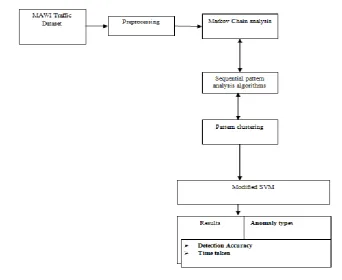
The existing framework requires more training dataset and time. This can be computationally demanding for large data sets. The proposed system provides a framework called Hybrid Sequential Pattern Anomaly Detection (H-SPAD), to minimize the training data collection risk and effectively detect anomalies with classification. The proposed system aims at increasing the classification performance through the hybrid approach along with producing least false alarm rate. This effectively reduces training data by applying the historical data as an input. So this aims at reducing the training overhead. so it is significantly will produce higher results than the other algorithm in training and the detection speed, and have a high enhance of the detection rates of attacking sample.
Figure 2.0 steps of H-SPAD
2.1. H-SPAD
2.1.1 Dataset Collection Preprocessing
The first step of H-SPAD is the process of uploading datasets. This network traffic data obtained from the MAWI repository which archives traffic datasets. The dataset will be preprocessed before starting the implementation. This step eliminates the duplicate and missing items in the uploaded dataset.
2.1.2Markov Chain analysis
This markov chain analysis is a discrete time stochastic progression which is describing a dynamic sequence of possible events in which the probability of each event fully depends only on the state obtained in the previous list of event stage.
Let At denote a random variable representing the state of a system at time t, where t = 0, 1, 2,3, 4,5,6,7,8 Discrete time stochastic process with the following some of the assumptions:
probability distribution of the state at time t+1 depends on the state at time t, and does not depend on the previous states leading to the state at time t;
A state transition from time t to time t+1 is independent of time.
Let assume that pij denote the probability that the system is in a state j at time t+1 given the system is in state t at time t interval. If the system has a finite number of states, 1, 2 s, the stationary Markov chain can be defined by a transition probability[p].
An initial probability distribution
Q = [q1 q2 L qs]
𝑃𝑖𝑗 = 1 j=s
j=1
The effective transition probability matrix and the initial probability distribution of a stationary Markov chain Can be learned from the observations of the system state in the past interval.
2.1.3. Sequential pattern analysis and pattern grouping
International organization of Scientific
Research
4 | P a g e
2.1.4 .Modified SVMStep 1: collect training data samples and test samples.
Step 2: According to data collection, constructs training sample set and test sample set.
Step 3: Set up parameters, initializes the initial support vector object position, every position corresponding a set of attributes (a1, a2, a3, a4, an) in model, builds up MSVM prediction model by parameters and samples.
Step4: From the parameters calculate every class threshold value, and then analyze the hyper plane value.
Step5: Randomly select the P objects from initial cluster, find out the optimal object position best X based on the hyper plane. Set it up as individual target obj X .
Step6: The non-optimal objects in the initial cluster moving to target class position and make the overall search.
Step7: The optimal object make overall search according to its neighborhood.
Step8: Update every objects class
Step8: Apply the optimal parameter (a1, a2…an) and training sample to build up classification model. This algorithm substantially higher than the previous methods for anomaly class detection.
III.
EXPERIMENTAL RESULTS
The traffic data sets is considered in this work consists of attributes like protocol type, service, flag, duration such data are collected from the repositories. To avoid the imbalance of the dataset, the sample set are preprocessed to regenerate new training and test set. In this work H-SPAD with the existing algorithm were compared. The performance evaluation is done based on the performance metrics such as detection time, and accuracy. This performance analysis is represented in the graphical representation. .
The proposed system detects anomaly activities with significant improvement in terms of high detection rate and low false positive rate. This can be analyzed with different set of data’s and results are shown in Figures.
From the results shown in the graphs, it can be observed that the proposed H-SPAD provided better detection rate and reduced false positive rate when it is analyzed with different number of datasets.
International organization of Scientific
Research
5 | P a g e
IV.
CONCLUSION
In this paper, the effective framework presented to detect the anomaly especially in traffic dataset. It is done by introducing a methodology called the Hybrid Sequential Pattern Anomaly Detection (H-SPAD) algorithm, which performs enormous and number of parallel flows is very large dataset. Aim of the paper detecting the presence of anomaly from a large amount of data via a classifier and effectively producing least false alarm rate and improving he classification performance. So this aims at reducing the training overhead. The experimental tests were conducted and analyzed and compared with the existing methodology. The performance analysis is made by comparing it with the existing methodology and it is proved that the proposed method improves in its performance over metrics such as detection accuracy, execution time.
REFERENCES
[1]. Casas, Pedro, Pierdomenico Fiadino, and Alessandro D'Alconzo. "Machine-Learning Based Approaches for Anomaly Detection and Classification in Networks." TMA. 2016.
[2]. Y.Gu, A. McCallum, and D. Towsley,“Detecting anomalies in network traffic using maximum entropy estimation,”in Proc. IMC, 2005, p. 32..
[3]. Silveira, F., Diot, C., Taft, N., & Govindan, R. (2011). ASTUTE: Detecting a different class of traffic anomalies. ACM SIGCOMM Computer Communication Review, 41(4), 267-278.
[4]. Tartakovsky, Alexander G., Aleksey S. Polunchenko, and Grigory Sokolov. "Efficient computer network anomaly detection by change point detection methods." IEEE Journal of Selected Topics in Signal Processing 7.1 (2013): 4-11. [4]
[5]. Khan, Rahul Rastogi1 Zubair Khan2 MH. "Network Anomalies Detection Using Statistical Technique: A Chi-Square approach." (2012).
[6]. Iglesias, Félix, and Tanja Zseby. "Analysis of network traffic features for anomaly detection." Machine Learning 101.1-3 (2015): 59-84..
[7]. Prasad, YA Siva, and G. Rama Krishna. "Statistical Anomaly Detection Technique for Real Time Datasets." International Journal of Computer Trends and Technology (IJCTT)–volume 6 (2013)..