ISSN (e): 2250-3021, ISSN (p): 2278-8719
Vol. 06, Issue 09 (Sep. 2016), ||V1|| PP 30-37
Analysis and Design of Flat Slab with and without Shear Wall
of Multi-Storied Building Frames
Vinod Goud
Corresponding Authors name (1) Goutam varma, SGSITS Indore, Email id: [email protected] (2) Jayant Awasthy UEC Ujjain (3) Sanjay Singh SD Bansal college Indore.
Abstract:- Conventional R.C.C structure i.e flat slab, shear wall , column for different heights are modelled and analyzed for the different combinations of static loading with varying thicknesses of shear wall with varying height of multistoried building .The comparison is made between the conventional R.C.C flat slab structure of 10,20and 30 stories without shear wall . The comparison made between the conventional R.C.C flat slab structure of 10,20 and 30 stories with varying thicknesses of shear wall in multi - storied buildings have been provided at some particular locations .The main objective of analysis is to study the structural behavior of shear wall – flat slab interaction.The main objective of the analysis is to study the behaviour against different forces acting on components of a multistoried building and to study the effect of part shear walls on the performance of these two types of buildings under seismic forces. The analysis is carried out using STAAD Pro2007 software Present work also provides a goodsource of information on various parameters like lateral displacement, plate stresses and storey drift.
Keywords— Flat slab, Shear walls, Plate Stresses, Flexibility, Lateral displacement, Storey drift.
I.
INTRODUCTION
Generally the analysis of flat slab is more complex and also is important to study the behaviour against different forces acting on the components of a multistoried building. The analysis may be carried out using software like Stadd Pro, Sturdd, Etabs etc. In this dissertation work, modern R.C.C structure i.e flat slab, shear wall, column for different heights are modelled and analyzed for the different combinations of static loading with varying thicknesses of shear wall with varying height of multistoried building .The comparison is made between the conventional R.C.C flat slab structure of 10,20and 30 stories without shear wall. The comparison made between the conventional R.C.C flat slab structure of 10,20 and 30 stories with varying thicknesses of shear wall in multi - storied buildings have been provided at some particular locations .The main objective of analysis is to study the structural behavior of shear wall flat slab interaction. A reinforced concrete flat slab, also called as beamless slab, is a slab supported directly by columns without beams. A part of the slab bound on each of the four sides bycentrelinesofcolumnsiscalledapanel.
The flat slab is often thickened near to supporting columns to provide adequate strength in shear and to reduce the quantity of negative reinforcement in the support regions.
A shear wall is a structural system composed of parallel walls that counter the effects of lateral loads acting on a structure. Wind and seismic loads are the most common loads that shear walls are designed to carry.
Shear walls are not only designed to resist gravity/ vertical loads (due to self-weight and other living/ moving loads), but they are also designed for lateral loads of earthquakes / wind. The walls are structurally integrated with roofs / floors and other lateral walls running across at right angles, thereby giving the three dimensional stability for the building. Walls have to resist the uplift forces caused by the pull of the wind. Walls have to resist the shear forces that try to push the walls over. Shear walls are quick to construct, Shear walls don’t need any extra plastering or finishing as the wall itself gives a high level of precision & it don’t require plastering.
II.
PROBLEM FORMULATION & ANALYSIS
Conventional R.C.C flat slab structure without shear wall and flat slab R.C.C structures with shear wall at particular locations are modelled and analyzed for the different combinations of static loading. Comparison is made between the conventional R.C.C flat slab structure and flat slab R.C.C. structure with shear walls situated in seismic zone IV. Different cases of building considered are as given below:
Case-1: Design and analysis of flat slab without shear wall for 10 storied multistoried building.
Case-2: Design and analysis of flat slab with shear wall for 10 storied multistoried building.
wall for 20 storied multistoried building
Case-4: Design and analysis of flat slab with shear wall for 20 storied multistoried building.
Case-5: Design and analysis of flat slab without shear wall for 30 storied multistoried building.
Case-6: Design and analysis of flat slab with shear wall for 30 storied multistoried building.
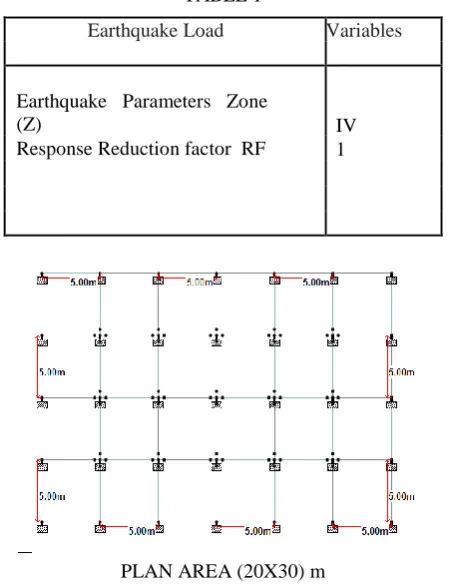
The plan area for the proposed work is 20x30 m in which size of panels is 5x5 m. The properties of material adopted are. The Young’s modulus of elasticity of concrete adopted was 25,000 MPa while the Poisson’s ratio was 0.2. The preliminary sections of columns and beams were fixed on the basis of deflection criteria [i.e. span to depth ratio]. The sections were found to be satisfactory for the given loads for a ten storied model. These sections were maintained uniform throughout the height. Similarly, all other models of (twenty and thirty stories) were analyzed and designed to meet the current Codes (IS 456:2000 and IS 1893:2002) and their structural member sizes chosen for the study are given in table below:In the present work, the self weight of the members is calculated by considering the density as 25 kN/m3 for concrete. According to IS 456 minimum grade of concrete is M20 and grade of steel adopted is Fe415. The self weight of slab =0.2 x 1 x 1 x 25 = 5 kN/m2Load considered due to floor finish= 1 kN/m2To study the behaviour the response parameters selected are lateral displacement and storey drift. All the cases are assumed to be located in zone III, zone IV and zone V. To reduce lateral displacement and storey drift shear walls have been provided at corners without affecting the parking in ground floors. Further, in practice multi-storey buildings are analysed by providing rigidity at various floors using master slave command in STAAD.Pro software. In reality slabs exist at various floor levels which provide additional rigidity to floors. Therefore, in present work a comparative study of above mentioned practice and reality is also made. Observations show that lateral displacement and storey drift are significantly reduced by providing part shear walls.
TABLE 1
Earthquake Load Variables
Earthquake Parameters Zone
(Z) IV
Response Reduction factor RF 1
PLAN AREA (20X30) m
Plate No: 5
III.
RESULT
Following results are tabulated:
FLAT PLATE CENTER STRESS SUMMARY FOR 10 STORIED FLAT SLAB MULTISTORIED BUILDING
FLAT PLATE CENTER STRESS SUMMARY FOR 30 STORIED FLAT SLAB MULTISTORIED BUILDING
more stiff in its own plane. In present study , Flat Slab system of 10,20and30 stories without shear wall and the Flat Slab system with shear wall of 10,20and30 stories having varying thicknesses of shear wall are compared. To study the effectiveness of all these models, the plate center stresses, plate corner stresses , flat plate principal Von Mis . stresses ,shear wall surface forces , storey drift are worked out and are presented in figures. The results presented in various figures are discussed briefly.Reinforcement calculated to resist Mx is called longitudinal reinforcement, and is denoted in the output by the expression "LONG. REINF. The reinforcement calculated to resist My is called transverse reinforcement, and is denoted in the output by the expression "TRANS. REINF. The signs of Mx and My determine which face of the element the steel has to be provided on. Every element has a "top" face, and a "bottom" face, as defined by the direction of the local Z axis of the elements. Mx causes tension on one of those faces, and compression on the other. A similar effect is caused by My. The output report of reinforcement provided on those faces contains the terms "TOP" for top face, and"BOTT" for the bottom face. In the above output, the word TOP and BOTTOM refer to the ‘local’ top and bottom surfaces of the individual elements, and not in the global axis sense. The local top and bottom surfaces depend on the way an element is defined in its incidence statement. TOP is defined as the surface which coincides with the positive side of the local Z axis. BOTTOM is defined as the surface which coincides with the negative side of the local Z axis. The 2 nonzero Principal stresses at the surface (SMAX & SMIN), the maximum 2D shear stress (TMAX), the 2D orientation of the principal plane (ANGLE), the 3D Von Mises stress (VONT & VONB),3D Tresca stress (TRESCAT & TRESCAB) are also printed for the top and bottom surfaces of these elements. The top and the bottom surfaces are determined on the basis of the direction of the local z-axis. The third principal stress is assumed to be zero at the surfaces for use in Von Mises and Tresca stress calculations. However, the TMAX and ANGLE are based only on the 2D inplane stresses (SMAX &SMIN) at the surface. The 3D maximum shear stress at the surface is not calculated but would be equal to the 3D Tresca stress divided by 2.0.
IV.
CONCLUSIONS
Analysis of 10,20 and 30 storied buildings with flat slab system without shear and the buildings with flat slab system with shear wall is carried out and the following conclusions are drawn from the study:
1 The values of storey drift are found to be within permissible limit i.e not more than 0.004 times the storey height as per norms according to IS 1893 :2002 Part-1.
2 Structure with shear wall along periphery is suitable for the effect of wind and earthquake load on the performance of building.
3 In flat slab with shear wall system as the thickness of shear wall is varying with the storey height , the surface shear stresses SQx and SQy increase in 10 & 20 storied building and then decrease in 20& 30 storied building.
4 In flat slab with shear wall system as the thickness of shear wall is varying with the storey height , the surface bending stresses Mx, My ,Mz increase in 10 & 20 storied building and then decrease in 20& 30 storied building.
5 In flat slab with shear wall system as the thickness of shear wall is varying with the storey height , the surface membrane stresses Fx, Fy,Fxy increase in 10 & 20 storied building and then decrease in 20& 30 storied building.
6 The flat slab Von Mis. top and bottom stresses increases for 10,20and30, storied flat slab building without and with shear wall.
7 The Von Mis. bottom stresses is more than the top stresses for 10,20and30 storied flat slab building without and with shear wall.
8 The flat slab Tresca top and bottom stresses increases for 10,20and30 storied flat slab building without and with shear wall.
9 The Tresca bottom stresses is more than top stresses for 10,20and30 storied flat slab building without and with shear wall.
10 The principal top stresses is more than bottom stresses for 10,20and30 storied flat slab building without and with shear wall.
V. REFERNCES
[1] Shaik Tahaseen: (2015) :Shear Wall Design For G+8 Floor Residential Building. Ijsr Issn: 2321-7758 Vol.3., Issue.6., 2015.
[2] Salman I. Khan And Ashok R. Mundhada :( 2014) : Comparative Study Of Seismic Performance Of Multi-Storeyed R.C.C Buildings With Flat Slab & Grid Slab. Ijert Inpressco Vol.5, No.3.
[3] Navyashree And Sahana (2014): Compared The Behaviour Of Multi-Storey Commercial Buildings Having Flat Slabs And Conventional Rc Frame With That Of Having Two Way Slabs With Beams. Ijert E Issn:2319-6613, P Issn:2321-7308.
[4] Anuja Walvekar, H.S.Jadhav: (2014): Parametric Study Of Flat Slab Building With And Without Shear Wall To Seismic Performance. Ijert Eissn: 2319-1163 | Pissn: 2321-7308
[5] Shyam Bhat M, N.A.Premanand Shenoy, And Asha U Rao: (2014): Earthquake Behaviour Of Buildings With And Without Shear. (Iosr-Jmce) E-Issn: 2278-1684, P-Issn: 2320-334x .
[6] Sanjay P N, Mahesh Prabhu, Umesh S :(2014): Behaviour Of Flat Slab Rcc Structure Under Earthquake Loading. Ijert) Ijertijert Issn: 2278-0181 Ijertv3is051624 Www.Ijert.Org Vol. 3.
[7] Mohd Mohibur Rahman, B.Anulatha.G.N, Dr. Narayana.G, Manu.J: Studied The Behaviour Of R.C. Frames Structures With Different Floor Systems Under The Effect Of Lateral Loads. (Ijaret) Vol. 2, [8] Shrikant Harle :( 2014): Analysis And Design Of Earthquake Resistant Multi-Storied Braced R.C.C.
Building Using Nisa Software. Ijesissn: 2277-9655 Impact Factor: 1.852rt
[9] Ky Leng, Chatpan Chintanapakdee, And Toshiro Hayashikawa (2013): Seismic Shear Forces In Shear Walls Of A Medium-Rise Building Designed By Response Spectrum Analysis. Engineering Journal Volume 18 Issue 4 .
[10] Rajib Kumar Biswas, Md.Meraj Uddin, Md.Arman Chowdhury, Md.Al-Imran Khan:(2013):Comparative Analysis Of A 15 Story Flat Plate Building With And Without Shear Wall And Diagonal Bracing Under Wind And Seismic Loads. (Iosr-E-Issn: 2278-1684,P-Issn: 2320-334x Jmce) Volume 9.
[11] R.S.More, V. S. Sawant :( 2013): Analysis Of Flat Slab . Ijirset Vol. 2, Issue 9.
[12] M. Tamim .A Tanwer (2012): Studied Structural Configuration Optimization Of A Multi-Storey Building By Optimum Positioning Of Shear Wall. (Ijsr) Issn (Online): 2319-7064
[13] Prof. K S Sable, Er. V A Ghodechor, Prof. S B Kandekar (2012): Comparative Study Of Seismic Behaviour Of Multi-Storey Flat Slab And Conventional Reinforced Concrete Framed Structures. (Ijsr) Issn (Online): 2319-7064 Impact Factor (2012): 3.358
[14] Surumi R.S., Greeshma S. And Jaya K.P. (2012): Reinforced Concrete Floor Wall Slab Connection. Ijctee Issn 2249-6343 Volume 2, Issue 3.
[15] Shyam Bhat M, N.A.Premanand Shenoy, Asha U Rao :( 2012) Earthquake Behaviour Of Building With And Without Shear Wall. Iset Golden Jubilee Symposium .
[16] Murat Melek, Huseyin Darama, And Aysegul Gogus: (2012): Studied Effects Of Modeling Of Rc Flat Slabs On Nonlinear Response Of High Rise Building Systems.(Iosr-Jmce) E-Issn: 2278-1684, P-Issn: 2320-334x
[17] Mohamed Abdel-Basset Abdo: (2012): Modeling Of Shear-Wall Dominant Symmetrical Flat-Plate Reinforced Concrete Buildings. 15 Wcee Lisboa 2012
[18] R. P. Apostolska, G. S. Necevska-Cvetanovska, J. P.Cvetanovska And N. Mircic: (2008) Seismic Performance Of Flat Slab Building. International Journal Of Advanced Structural Engineering 2012 . The 14th World Conference On Earthquake Engineering October 12-17, 2008, Beijing, China
[19] James B Daton: (2008): Design Reinforced Concrete Flat Plate Systems Based On The Results Of Finite Element Analysis. (Ijsr)