Research Article
CODEN: IJPNL6
FORMULATION AND
IN VITRO
EVALUATION OF GASTRORETENTIVE BILAYER
FLOATING TABLETS OF LOSARTAN POTASSIUM
Sruthi Buddharaju
Department of Pharmaceutics, Sai Pranavi College of Pharmacy, Keesara main road, Diara,
Hyderabad, India
*Corresponding author e-mail: [email protected]
ABSTRACT
The aim of present study was to formulate and evaluate Gastroretentive bilayer floating tablets of Losartan potassium using direct compression technology. Bilayer floating tablets comprised two layers, i.e. immediate release and controlled release layers. The immediate release layer comprised Crospovidone as a super disintegrant and floating layer comprised Sodium carboxy methyl cellulose (SCMC), Metolose SR and Sodium alginate as the release retarding polymers. Sodium bicarbonate was used as a gas generating agent. The powder blends were evaluated for pre-compression parameters. Compressed tablets were further evaluated for hardness, friability, weight
variation, dimensions, Drug Content Uniformity, In-vitro buoyancy and dissolution studies. All the formulations
showed good results which were compliance with pharmacopoeial standards. In-vitro dissolution studies were
performed in USP-XXIII dissolution test apparatus, type II (paddle method) in 1.2pH buffer. More than 99% Losartan potassium of was released from the immediate release layer within 30 min. The results of dissolution studies indicated that formulation BFT8 (drug to polymer[SCMC] 1:0.25), the most successful of the study,
exhibited drug release of approximately 98% at 12th hour with more than 12h buoyancy with floating lag time of
93seconds. An increase in drug release was observed on decreasing polymer ratio. The drug release mechanism of all the formulations was found to be Fickian diffusion-controlled drug release.
Keywords: Losartan potassium, Gastroretentive, bilayer floating tablets, Sodium carboxy methyl cellulose, Metolose SR and Sodium alginate.
INTRODUCTION
In the recent years, a great deal of technological and scientific research has been carried out to the develop rate-controlled oral drug delivery systems in order to overcome physiological problems, such as short gastric residence times (GRT) and unpredictable gastric emptying times (GET). Gastro-retentive dosage forms will allow the delivery of restricted „absorption window‟ drugs which are absorbed in a
particular portion of the GI tract.[1]Floating Bilayer
drug delivery system is combined principle of bilayer tablet as well as floating mechanism. Floating drug delivery systems (FDDS) have a bulk density less than gastric fluids and remain buoyant in the stomach without affecting gastric emptying rate for a longer period of time. Floating drug delivery system
provides advantages such as enhanced
bioavailability ,enhanced first-pass
biotransformation, sustained Drug Delivery / reduced frequency of dosing ,site-Specific Drug Delivery,
reduced fluctuations of drug concentration,
minimized adverse activity at the colon, absorption
Enhancement.[1][2]
Bilayer tablet dosage forms are designed for variety of reasons; to control the delivery rate of either single or two different active pharmaceutical ingredient(s) (API), to separate incompatible APIs from each other, to control the release of API from one layer by utilizing the functional property of the other layer, to administer the fixed dose combinations of different APIs. Bilayer tablets are prepared with one layer of drug for immediate release while second layer
International Journal of Pharmacy
designed to release drug later, either as second dose or in an extended release manner. Bilayer tablet is suitable for sequential release of one drug as immediate release and another drug as sustained release, in which one layer is immediate release as
initial dose and second layer is maintenance dose.[3]
Hypertension may be defined as a repeated elevation of systolic blood pressure above 140 mmHg or a
diastolic blood pressure above 90 mmHg.
Hypertension is a major risk
factor for stroke, myocardial infarction (heart
attacks), heart failure, aneurysms of the arteries (e.g. aortic aneurysm), peripheral arterial disease and
is a cause of chronic kidney disease. [4 ]
Losartan potassium is the first orally active angiotensin-II antagonist used in the treatment of hypertension. Administration of conventional tablets of Losartan potassium may exhibit fluctuations in the plasma drug levels resulting either in manifestation of side effects or reduction in drug concentration at the receptor site. It has low bioavailability due to its first pass metabolism. Systemic bioavailability is about approximately 33% and it has a short biological half-life of 1.5 -2 h ,is eliminated quickly from the body
leading to low therapeutic efficacy . [5 ] So
the present study is aimed to prepare and evaluate Gastro retentive bilayer floating tablets of Losartan potassium so as to increase the bioavailability , gastric residence time, improve patient compliance and to reduce frequency of administration. These tablets have an immediate release layer leading to a quick rise in blood concentration to a therapeutically effective level and further the concentration is maintained by drug release from the sustained release layer. Floating drug delivery technology was used for Losartan potassium in its sustained release layer.
MATERIALS AND METHOD
Materials: Losartan potassium was obtained from Spectrum pharma, India. Sodium carboxy methyl
cellulose(SCMC) was obtained from Oxford
Laboratory, Mumbai; Sodium alginate ,Metolose SR, Crospovidone, Lactose monohydrate, Talc and Hcl was obtained from S. D. Fine Chemical, Mumbai. Microcrystalline cellulose(MCC) was obtained from Otto Chemicals, Mumbai. Sodium bicarbonate was obtained from Ranbaxy Fine Chemical Limited, New Delhi. Magnesium stearate was obtained from Central Drug House(p) Limited, New Delhi. Nacl was obtained from Merk Specialities Pvt Limited, Mumbai.
Preparation of bilayer tablet: Bilayer floating tablets were prepared by direct compression using
Crospovidone as a superdisintegrant, Sodium alginate, SCMC and Metolose SR as the release controlling polymers, Sodium bicarbonate as a gas generating agent, MCC, Lactose monohydrate as diluents and Magnesium Stearate, Talc as lubricant and glidant. The drug, polymers and other excipients used for both immediate (IR) and sustained release (SR) layers were passed through sieve # 60 before their use in the formulation. Preparation of bilayer floating tablets had two steps:
STEP 1: Formulation of the IR Layer: The
ingredients (Table 1) were collected and accurately
weighed. Pre-blend all ingredients (except lubricant- magnesium Stearate) in blender for 15 minutes. Add magnesium Stearate and then again blend for 5-6 minutes and kept in desiccators until further used.
STEP 2: Formulation of the Floating Layer: The
SR layer ingredients (Table 2) were collected and
accurately weighed. Pre-blend all ingredients (except lubricant- magnesium Stearate) in blender for 15 minutes. Add magnesium Stearate and then again blend for 5-6 minutes and subjected for pre-formulation studies.
Compression of bilayer Tablet
Bilayer tablet was prepared manually using Manest
16 Station Punching Machine (Liverpool,
England).Accurately weighed amount of SR powder mixture was fed manually into die cavity. SR layer was compressed at mild compression force. After that accurately weighed IR powder mixture was manually fed into the die on SR layer and compressed using 10
mm circular punches. Both the layers were identified
on the basis of color since the immediate release layer had pink color and the sustained release layer
has white color.[6], [7]
Evaluation of Powder Blend
Angle of repose (θ): The angle of repose is the maximum angle that the plane of powder makes with the horizontal surface on rotation. The angle of repose of granules was determined by the fixed funnel and free standing cone method. It is determined by allowing powder mixture to flow through a funnel and fall freely onto a surface. The height and diameter of the resulting cone are measured and the angle of repose was calculated
using the following equation.
Tan θ = h/r; Where h = height of the powder heap; r =
radius of the powder heap; θ = is the angle of repose.
[8]
volume and weight “as it is”. It is expressed in g/ml and is given by
Db = M / V0; Where, M is the mass of powder and V0 is the Bulk volume of the powder.
Tapped density (Dt): It was determined by placing a graduated cylinder, containing a known mass of drug excipient blend, on mechanical tapping apparatus. The tapped volume was measured by tapping the powder to constant volume. It is expressed in g/ml and is given by
Dt = M / Vt; Where, M is the mass of powder and Vt is the tapped volume of the powder.
Carr’s Index (I): It is expressed in percentage and is expressed by I = (Dt – Db) x100/Dt; Where, Dt is the tapped density of the powder and Db is the bulk density of the powder.
Hausner ratio: It is expressed by H= Dt / Db Where, Dt is the tapped density of the powder and Db is the
bulk density of the powder. [9]
Evaluation of tablets Dimensions:
The thickness and diameter of the tablets was measured using Vernier calipers. It is measured in mm.
Weight Variation
Ten tablets were randomly selected from each batch and individually weighed. The average weight and standard deviation of 10 tablets was calculated. The batch passes the test for weight variation test if not more than two of the individual tablet weights deviate from the average weight by more than the percentage shown in Table- 4 and none deviate by more than twice the percentage shown.
Hardness
The hardness of ten tablets was measured using Monsanto Hardness tester. It was expressed as kg/cm2.
Friability
The friability of the tablets was determined using Roche friabilator. It was expressed in percentage (%). 10 tablets were initially weighed and transferred to the friabilator. The friabilator was operated at 25 rpm for four minutes. After four minutes the tablets were weighed again.
The % friability was then calculated using the formula:
% friability = Win - Wf / Win x 100
Win=Initial weight WF=final weight.
.Acceptance criteria: The friability value should be
less than 1.0%. [10]
Uniformity of drug content:
The drug content was performed to check the dose uniformity in the formulation. Randomly ten tablets were weighed and powered. A quantity equivalent to 100mg of Losartan potassium was added in to a 100ml volumetric flask and dissolved in 0.1N HCI, shaken for 10 minutes and made up to the volume with 0.1N HCl. After suitable dilutions the drug content was determined by UV spectrophotometer at 234nm against blank.
Buoyancy studies:
The in-vitro floating behavior (buoyancy) of the tablets was determined by floating lag time. The tablets were placed in 100 ml beaker containing 0.1 N HCl (pH 1.2). The floating lag time (time taken by the tablet to reach the surface) and total floating time
(floating duration of the tablet) were determined. [5]
In vitro Drug Release Study:
In vitro dissolution studies were performed in a USP XXIII dissolution test apparatus, type II (paddle
method) (Disso 2000, Labindia, India) at 37±0.50C
and with a paddles rotation speed of 75rpm.Seperate Dissolution studies were carried out for IR tablets to optimize the super disintegrant before performing the dissolution studies for bilayer tablets .The bilayer floating tablets (BFTs) were then placed into 900ml of 0.1N HCl solution (pH 1.2) which was used as dissolution medium. Dissolution studies were carried out in triplicate. A 5ml aliquot of sample was withdrawn at 15 minutes, 30 minutes and 1 h. Further samples were collected at 1 h interval up to 12 h. The samples were filtered through a 0.45μm membrane filter and diluted if necessary and estimated for Losartan potassium released using UV-visible spectrophotometer at 234nm. At each time of withdrawal, 5ml of fresh medium was replaced into the dissolution flask. The concentrations were calculated using the standard curve prepared using 0.1N Hydrochloric acid as solvent. The cumulative percentage of Losartan potassium released from the tablets was also calculated.
Release kinetics:
The rate and mechanism of release of Losartan potassium from the prepared bilayer floating tablets were analyzed by fitting the dissolution data into the
zero-order equation .[11]
Q = k0t
Where Q is the amount of drug released at time t, and
dissolution data was fitted to the first order equation. [12]
ln (100–Q) = ln 100 – k1t
Where k1is the first order release rate constant. The
dissolution data was fitted to the Higuchi‟s equation. [13]
Q = k2t1/2
Where k2 is the diffusion rate constant. The
dissolution data was also fitted to the well known equation (Korsmeyer equation), which is often used to describe the drug release behavior from polymeric
systems. [14]
Mt/ M = k3t n
log (Mt/ M ) = log k3 + n log t where Mt is the amount of drug released at time t , M
is the amount of drug release after infinite time, k is
a release rate constant incorporating structural and geometric characteristics of the tablet and n is the diffusional exponent indicative of the mechanism of drug release.
For a matrix tablet, when „n‟ takes the value of ,
0.45 - Fickian diffusion-controlled drug release
0.89 - Swelling-controlled drug release
0.45- 0.89 - Anomalous transport (both diffusion
and swelling controlled)
RESULTS AND DISCUSSION
Bilayer floating tablets of Losartan potassium were developed using SCMC, Sodium alginate and Metolose SR as polymers in sustained release layer and Crospovidone as superdisintegrant in immediate release layer. The results demonstrated an initial burst release of immediate release layer was due to
super disintegrant.[15]The immediate release tablets
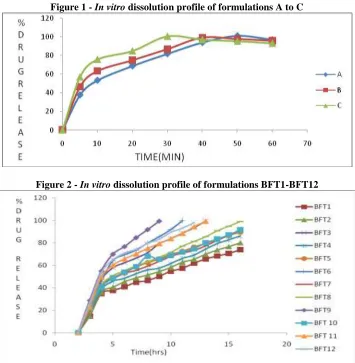
were optimized based on dissolution studies. The fastest release of IR layer was observed in tablets containing 8% Crospovidone as superdisintegrant. Hence formula C was used as immediate layer in all bilayered tablets.
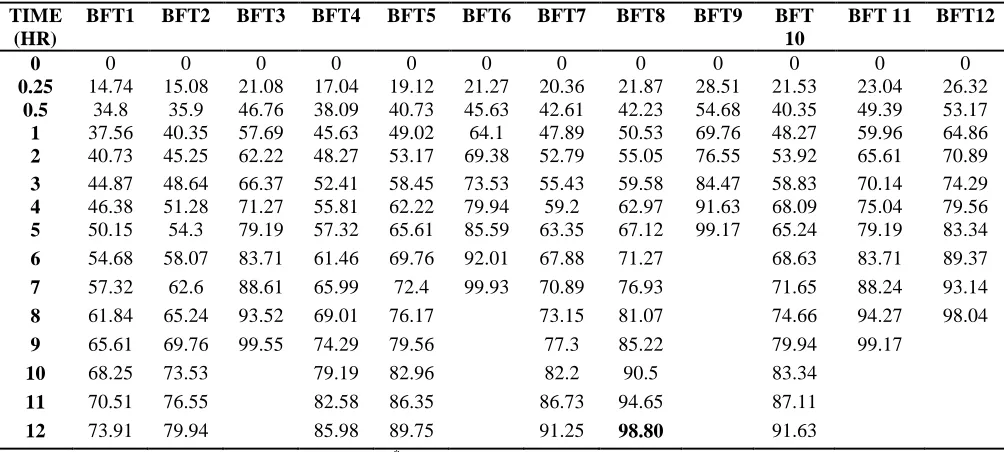
The blend of the drug and excipients was evaluated for micrometric properties and were tabulated in Table 3.Angle of repose was found to be between 23.72 to 34.33. Bulk density was found to be between 0.495 to 0.697 gm/ml and tapped density between 0.572 to 0.839 gm/ml for all formulations. Hausner‟s ratio was found below 1.29 and Carr‟s compressibility index between 11.44 to 21.94 for all formulations, which indicates that the prepared granules of all the formulations have good flow properties. All batches of tablets were evaluated for various physical parameters and were tabulated in Table 4.The weight variation and drug content of all formulations was within the ranges of 398 to 404 mg
and 97 to 102. The hardness of the tablets was within the range of 4.10 to 6.23 kg/cm2.The friability of all tablets below 1% (0.31%-0.82%).The thickness and diameter of all tables was within the range of 6.4 to 6.98 mm and 8.00 to 8.10 mm respectively. Thus all the physical properties of these tablets were satisfactory as specified in the pharmacopoeia (IP, 1996).
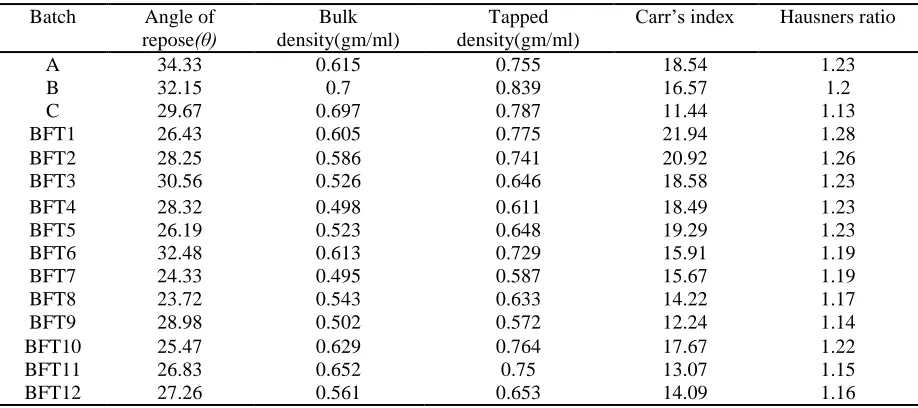
In vitro buoyancy studies and in vitro dissolution studies were performed in 1.2 pH 0.1N HCl are tabulated in Table 4, 5 and 6 and graphs were depicted in (Figure1 and 2).All formulations exhibited floating lag time ranging from 87 to 210 secs ;total floating time of 5 to >12 hours was observed in dissolution medium subjected to rotation . The floating time of all formulations was found to be increasing with the increasing amount of polymer concentration. Formulations BFT1, BFT2,BFT4, BFT5, BFT7, BFT8 and BFT10 showed drug release
of 73.91, 79.94, 85.98, 89.75, 91.25,98.80 and91.63
% respectively at the end of 12 hours. While The
formula BFT3,BFT6,BFT9,BFT11and BFT12
showed drug release of 99.55, 99.93, 99.17, 99.17
and 98.04 % respectively at the end of 9,7,5,9 and 8
hours. Among all the formulations, formulation BFT8 was found to be most promising formulation as it has shown most consistent drug release (98.80 %) up to 12 hrs as compared to other formulations. It is evident from the above data that as the proportion of polymer in the formulation decreases, cumulative percentage drug release increases.
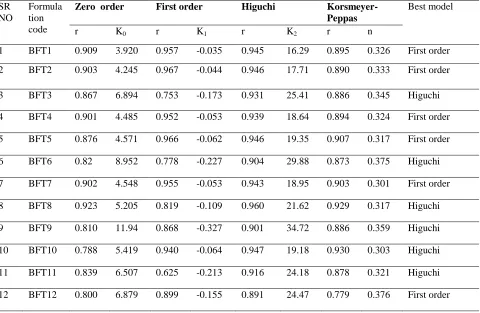
The rate and mechanism of release of Losartan potassium from the prepared bilayer floating tablets were analyzed by fitting the dissolution data into the Zero order, First order, Higuchi matrix, Korsemeyer- Peppas ,the results were tabulated in Table 7.The regression co-efficients obtained for Higuchi‟s plots
(R2:0.960 to 0.891) were higher, when compared with
those of Korsemeyer-peppa‟s plots (R2:0.930 to
0.779) with slope(n) values 0.301 to 0.376,indicating
that the release mechanism of Losartan potassium from bilayered floating tablets followed fickian diffusion for all the formulations.
CONCLUSION
due to super disintegrant Crospovidone. Formulation BFT8 was determined to be the optimized formula which possessed satisfactory quality parameters both in process parameters and parameters for finished products. It showed short floating lag time(93 ses) with total floating time of more than 12 hours and cumulative % drug release of 98.80 at the end of 12 hours following Higuchi release kinetics. All the formulations followed fickian diffusion. Thus, results of the current study clearly indicate, a promising
potential of the Losartan potassium bilayer floating tablets as an alternative to the conventional dosage form.
ACKNOWLEDGEMENTS
The author is thankful to Mr P.Vishnu, Mr Rafeeq, Spectrum Pharma Research Solutions who gave me some important tips during my research work.
Figure 1 - In vitro dissolution profile of formulations A to C
Figure 2 - In vitro dissolution profile of formulations BFT1-BFT12
TABLE 1: Formulation development of immediate release layer
Ingredients A B C
Losartan potassium 25 25 25
Crospovidone 6 9 12
MCC 119 110 107
Mg-Stearate 2.25 2.25 2.25
Talc 3 3 3
Color 0.75 0.75 0.75
Total weight 150 150 150
TABLE 2: Composition of bilayer tablets
Ingredients BFT
1
BFT 2
BFT 3
BFT 4
BFT 5
BFT 6
BFT 7
BFT 8
BFT 9
BFT 10
BFT11 BFT12
FOR IR LAYER
Losartan potassium
25 25 25 25 25 25 25 25 25 25 25 25
Crospovidone 12 12 12 12 12 12 12 12 12 12 12 12
MCC 107 107 107 107 107 107 107 107 107 107 107 107
Mg-Stearate 2.25 2.25 2.25 2.25 2.25 2.25 2.25 2.25 2.25 2.25 2.25 2.25
Talc 3 3 3 3 3 3 3 3 3 3 3 3
Color 0.75 0.75 0.75 0.75 0.75 0.75 0.75 0.75 0.75 0.75 0.75 0.75
FOR SR LAYER
Losartan potassium
50 50 50 50 50 50 50 50 50 50 50 50
Sodium alginate 50 - - 37.5 - - 25 - - 25 25 -
SCMC - 50 - - 37.5 - - 25 - 25 - 25
Metolose SR - - 50 - - 37.5 - - 25 - 25 25
Sodium bicarbonate
20 20 20 20 20 20 20 20 20 20 20 20
Lactose monohydrate
122. 5
122. 5
122. 5
135 135 135 147.
5
147. 5
147. 5
122.5 122.5 122.5
Mg-Stearate 3.75 3.75 3.75 3.75 3.75 3.75 3.75 3.75 3.75 3.75 3.75 3.75
Talc 3.75 3.75 3.75 3.75 3.75 3.75 3.75 3.75 3.75 3.75 3.75 3.75
Total weight 400 400 400 400 400 400 400 400 400 400 400 400
TABLE 3: Recompression flow properties of powder blend.
Batch Angle of
repose(θ)
Bulk density(gm/ml)
Tapped density(gm/ml)
Carr‟s index Hausners ratio
A 34.33 0.615 0.755 18.54 1.23
B 32.15 0.7 0.839 16.57 1.2
C 29.67 0.697 0.787 11.44 1.13
BFT1 26.43 0.605 0.775 21.94 1.28
BFT2 28.25 0.586 0.741 20.92 1.26
BFT3 30.56 0.526 0.646 18.58 1.23
BFT4 28.32 0.498 0.611 18.49 1.23
BFT5 26.19 0.523 0.648 19.29 1.23
BFT6 32.48 0.613 0.729 15.91 1.19
BFT7 24.33 0.495 0.587 15.67 1.19
BFT8 23.72 0.543 0.633 14.22 1.17
BFT9 28.98 0.502 0.572 12.24 1.14
BFT10 25.47 0.629 0.764 17.67 1.22
BFT11 26.83 0.652 0.75 13.07 1.15
Table 4: Physical parameters of bilayer floating tablet of losartan potassium
Formul ation code
Thickness (mm)
Diameter (mm)
Hardness
(kg/cm2)
Friability (%)
Average weight variation
(mg)
Drug content
(%)
Float -ing Lag
time(s)
Total Floating time (h)
BFT1 6.4±0.04 8.00±0.05 6.23±0.45 0.31±0.08 398±0.35 97.34±1.3 210 >12
BFT2 6.74±0.03 8.04±0.02 6.00±0.32 0.43±0.04 400±0.29 98.02±0.9 179 >12
BFT3 6.6±0.04 8.02±0.04 4.20±0.28 0.82±0.11 399±0.40 100.10±1.1 150 >9
BFT4 6.81±0.03 8.07±0.08 5.98±0.61 0.46±0.03 402±0.32 98.15±1.4 184 >12
BFT5 6.92±0.08 8.10±0.06 5.28±0.41 0.54±0.08 404±0.22 98.99±0.96 146 >12
BFT6 6.88±0.05 8.08±0.04 4.57±0.25 0.71±0.13 403±0.40 101.39±1.5 102 >7
BFT7 6.79±0.04 8.07±0.07 5.11±0.45 0.58±0.15 402±0.28 99.08±1.6 118 >12
BFT8 6.75±0.09 8.05±0.03 4.90±0.47 0.65±0.09 401±0.23 99.76±1.1 93 >12
BFT9 6.98±0.07 8.09±0.06 4.10±0.62 0.69±0.09 404±0.50 102.54±1.7 87 >5
BFT10 6.81±0.06 8.06±0.05 5.8±0.50 0.41±0.06 402±0.43 98.97±0.8 122 >12
BFT11 BFT12
6.71±0.08 8.05±0.07 5.04±0.55 0.49±0.10 400±0.25 99.88±1.3 114 >9
6.5±0.07 8.03±0.09 4.70±0.32 0.58±0.08 399±0.52 101.03±1.8 106 >8
TABLE NO 5: Cumulative percentage release of losartan potassium (IR Tablets)*
SR. TIME(MIN) A B C
1 0 0 0 0
2 5 37.56 46.38 57.01
3 10 53.28 63.35 75.91
4 20 68.67 74.89 84.96
5 30 81.68 86.77 100.68
6 40 93.78 99.09 97.17
7 50 100.91 97.63 95.48
8 60 96.84 95.82 93.21
Table no 6: Cumulative percentage release of losartan potassium bfts (bilayer floating tablets)*
TIME (HR)
BFT1 BFT2 BFT3 BFT4 BFT5 BFT6 BFT7 BFT8 BFT9 BFT 10
BFT 11 BFT12
0 0 0 0 0 0 0 0 0 0 0 0 0
0.25 14.74 15.08 21.08 17.04 19.12 21.27 20.36 21.87 28.51 21.53 23.04 26.32
0.5 34.8 35.9 46.76 38.09 40.73 45.63 42.61 42.23 54.68 40.35 49.39 53.17
1 37.56 40.35 57.69 45.63 49.02 64.1 47.89 50.53 69.76 48.27 59.96 64.86
2 40.73 45.25 62.22 48.27 53.17 69.38 52.79 55.05 76.55 53.92 65.61 70.89
3 44.87 48.64 66.37 52.41 58.45 73.53 55.43 59.58 84.47 58.83 70.14 74.29
4 46.38 51.28 71.27 55.81 62.22 79.94 59.2 62.97 91.63 68.09 75.04 79.56
5 50.15 54.3 79.19 57.32 65.61 85.59 63.35 67.12 99.17 65.24 79.19 83.34
6 54.68 58.07 83.71 61.46 69.76 92.01 67.88 71.27 68.63 83.71 89.37
7 57.32 62.6 88.61 65.99 72.4 99.93 70.89 76.93 71.65 88.24 93.14
8 61.84 65.24 93.52 69.01 76.17 73.15 81.07 74.66 94.27 98.04
9 65.61 69.76 99.55 74.29 79.56 77.3 85.22 79.94 99.17
10 68.25 73.53 79.19 82.96 82.2 90.5 83.34
11 70.51 76.55 82.58 86.35 86.73 94.65 87.11
12 73.91 79.94 85.98 89.75 91.25 98.80 91.63
Table no 7: In-vitro drug release kinetics study of all bilayered tablets
SR NO
Formula tion code
Zero order First order Higuchi Korsmeyer-
Peppas
Best model
r K0 r K1 r K2 r n
1 BFT1 0.909 3.920 0.957 -0.035 0.945 16.29 0.895 0.326 First order
2 BFT2 0.903 4.245 0.967 -0.044 0.946 17.71 0.890 0.333 First order
3 BFT3 0.867 6.894 0.753 -0.173 0.931 25.41 0.886 0.345 Higuchi
4 BFT4 0.901 4.485 0.952 -0.053 0.939 18.64 0.894 0.324 First order
5 BFT5 0.876 4.571 0.966 -0.062 0.946 19.35 0.907 0.317 First order
6 BFT6 0.82 8.952 0.778 -0.227 0.904 29.88 0.873 0.375 Higuchi
7 BFT7 0.902 4.548 0.955 -0.053 0.943 18.95 0.903 0.301 First order
8 BFT8 0.923 5.205 0.819 -0.109 0.960 21.62 0.929 0.317 Higuchi
9 BFT9 0.810 11.94 0.868 -0.327 0.901 34.72 0.886 0.359 Higuchi
10 BFT10 0.788 5.419 0.940 -0.064 0.947 19.18 0.930 0.303 Higuchi
11 BFT11 0.839 6.507 0.625 -0.213 0.916 24.18 0.878 0.321 Higuchi
12 BFT12 0.800 6.879 0.899 -0.155 0.891 24.47 0.779 0.376 First order
REFERENCES
1. S. H. Shahaa, J. K. Patel, K. Pundarikakshudu, N. V. Patel.Asian J Pharma Sci, 2009; 4(1): 65-80.
2. Amnon Hoffmana, David Stepensky , Eran Lavy, Sara Eyal ,Eytan Klausner , Michael Friedman.. International
Journal of Pharmaceutics ,2004; 277:141–153.
3. Mr.Priyal.S.Nilawar, V.P.Wankhade, D.B.Badnag. International Journal of Pharmacy and Pharmaceutical
Science Research, 2013; 3(1): 15-21.
4. Oscar A. Carretero. Suzanne Oparil. Circulation, 2000;101(3): 329–35.
5. Samyuktha M, Vasanth PM, Suresh K, Ramesh T, Ramesh Malothu. International Journal of
Biopharmaceutics. 2013; 4(1): 18-26.
6. Abdul S.Althaf , Seshadri.T , Sivakranth .M ,Umal S. Khair. Der Pharmacia Sinica, 2010;1 (2): 61-76 .
7. Sanjit Kr. Roy, Sweet Naskar. World Journal of Pharmaceutical Research, 2013; 2(1):661-672.l
8. Loyd V.Allen Jr.Nicholas G.popovich.Howard C.Ansel. Ansels Pharmaceutical Dosage Forms and Drug
Delivery Systems. 8th ed. USA, 2005,pp:190.
9. Naresh Hiraram Choudhary, Manoj Shivagi Kumbhar, Deepak Annasaheb Dighe, Priti.S. Mujgond,Meera
Chandradatt Singh. International Journal of Pharmacy and Pharmaceutical Sciences, 2013; 5(1):121-125.
10. Jaimini Manish, Shrivastava B , Tanwar Y.S. International Journal Of Research Article Pharmaceutical
Innovations , 2011;1(5):82-87.
11. Khan, G. M. The Sciences, 2001; 1:350-354.
12. Morkhade DM. Indian J Pharm Sci, 2006;68: 53-58.
13. Higuchi, T. J Pharm Sci, 1963; 52: 1145-1149.
14. Peppas, N. A., and Sahlin, J. J. Int J Pharm, 1989; 57, 169-172.
15. Nithin Kumar P., Elango K., Devi Damayanthi R., Vignesh Babu S. IJPI's Journal of Pharmaceutics