R E S E A R C H A R T I C L E
Open Access
Selective versus multi-segmental
decompression and fusion for multi-segment
lumbar spinal stenosis with single-segment
degenerative spondylolisthesis
Wei Sun
1, Cheng Xue
1, Xian-ye Tang
1, Hu Feng
1, Feng Yuan
1, Kai-jin Guo
1and Jie Zhao
2*Abstract
Background:Lumbar spinal stenosis, often accompanied by degenerative spondylolisthesis, is one of the most common conditions in the elderly. Decompression and fusion is a well-accepted treatment for single-segment lumbar spinal stenosis with degenerative spondylolisthesis; however, the treatment for multi-segment lumbar spinal stenosis with single-segment degenerative spondylolisthesis (MLSS) remains controversial. The objective of this study is to compare the effectiveness of selective decompression and fusion to multi-segmental decompression and fusion for MLSS.
Methods:A total of 42 patients suffering from MLSS who underwent surgery between June 2012 and January 2015 were included in this analysis. Of the 42 patients with minimum 3-year follow-up, 22 underwent selective
decompression and fusion, and 20 patients underwent multi-segmental decompression and fusion. Age, gender, symptom duration, operative time, blood loss, the number of decompressed segment and fused segment, and complication were compared between the two groups. The visual analog scale (VAS), Oswestry Disability Index (ODI) and Short Form 36 (SF-36) were used to assess efficacy.
Results:Operative time, blood loss, and the number of fused segment in multi-segmental decompression and fusion group were greater than those in selective decompression and fusion group (P< 0.01). The VAS, ODI, and SF-36 scores at 1-year follow-up and 3-year follow-up were significantly improved compared with those preoperatively in both groups (P< 0.01) but were not significantly different between the two groups at each time point (P> 0.05). There was no iatrogenic spinal instability in the decompressed segments in selective decompression and fusion group, while three patients developed postoperative instability at the adjacent segments above the fused segments in multi-segmental decompression and fusion group at 3-year follow-up.
Conclusions:Selective decompression and fusion is a safe and effective method for the treatment of MLSS, with the advantages of shorter operative time, less blood loss, and more preservation of spinal motion segments when compared with multi-segmental decompression and fusion.
Keywords:Lumbar spinal stenosis, Multi-segment, Degenerative spondylolisthesis, Selective decompression with fusion
* Correspondence:[email protected]
2Department of Orthopaedic Surgery, Shanghai Ninth People’s Hospital,
Shanghai Jiao Tong University School of Medicine, 639 Zhizaoju Road, Shanghai, People’s Republic of China
Full list of author information is available at the end of the article
Background
Lumbar spinal stenosis is one of the most common causes of neurogenic claudication and radicular leg pain. Lumbar spinal stenosis is often accompanied by degenerative spon-dylolisthesis, which commonly occurs in patients more than 50 years [1]. Decompression plus fusion is the well-accepted treatment for patients with single-segment lumbar spinal stenosis with degenerative spondylolisthesis compared with conservative treatment and decompression alone [2, 3]. However, when it comes to multi-segment lumbar spinal stenosis with single-segment degenerative spondylolisthesis (MLSS), the management remains controversial.
Some surgeons selected to perform extensive laminec-tomy to provide the clinical improvement, though extensive decompression may cause segmental instability. In order to reduce the incidence of iatrogenic spinal instability, address the symptoms of lower back pain, and ensure the long-term efficacy, fusion was recommended for the decompressed segments [4, 5]. In view of the problems related to multi-segment fusion, such as increased trauma, medical care costs, and adjacent segment degeneration (ASD) [6,7], recently, other clinicians suggested that patients with MLSS should be treated with decompressive laminectomy at the stenotic segments and a single-level fusion only at the slipped segments [8]. However, besides laminectomy itself, performing a laminectomy above a fused segment may in-crease additional stress on the less stable segment, which may lead to iatrogenic segmental instability if fusion is not performed [9]. Furthermore, in clinical practice, it is some-times challenging to ensure sufficient spinal stability on the premise of adequate decompression in the non-slipped, stenotic segments, especially in patients with developmental lumbar spinal stenosis combined with foramen stenosis.
With the emergence of the concept ‘precision medi-cine’ [10], many medical domains are changing from traditional extensive pattern to modern precise pattern. An increasing number of spine surgeons are pursuing precise diagnosis and treatment for patients. Precise de-compression is advocated for the purpose of maximizing the clinical improvement and minimizing the risk of iat-rogenic instability and the need for concomitant fusion. Selective decompression and fusion, referring to precise decompression and selective fusion, seems to be a viable alternative in the treatment of MLSS. However, to our knowledge, there are currently no studies that have eval-uated the efficacy of selective decompression and fusion for MLSS. In this study, we therefore compared the clin-ical outcomes of selective decompression and fusion with those of multi-segmental decompression and fusion in the treatment of MLSS.
Methods
The diagnostic criteria of lumbar spinal stenosis include clinical symptoms of neurogenic intermittent claudication,
radiculopathy, and/or lower back pain, and confirmed lumbar spinal stenosis based on CT and MRI. Anatomic lumbar spinal stenosis without any symptom was not in-cluded in the study. We retrospectively reviewed all 191 patients with symptomatic multi-segment lumbar spinal stenosis (≥2 levels) who failed 3 months of conservative treatment and underwent decompression and fusion be-tween June 2012 and January 2015. Of the 191 patients with multi-segment lumbar spinal stenosis, there were some patients with associated degenerative spondylolisth-esis, and the others without degenerative spondylolisthesis. Only patients with associated single-segment degenerative spondylolisthesis who have completed a minimum 3-year follow-up were included in this analysis. Patients with metabolic diseases, severe osteoporosis, severe chronic medical comorbidities, or a history of previous lumbar spine surgery were excluded.
Surgical procedure
The decisions of surgical procedure were made by the se-nior surgeons, either selective decompression and fusion (group S) or multi-segmental decompression and fusion (group M). Generally, the patients in group S were treated by means of precise and limited decompression according to the site and degree of spinal stenosis, such as hemilami-nectomy, undercutting decompression of the lateral recess, or total laminectomy with preservation of the spinous process, interspinous, and supraspinous ligaments. At the slipped segments, first, laminectomy and facetectomy were performed to acquire adequate decompression, pedicle screws and rod were used bilaterally, and then the discec-tomy and endplate preparation were performed. The height of disc space was restored by sequentially distracting the disc space and then the disc space was filled with morse-lized bone from the laminectomy and facetectomy. Finally, the suitable cage was inserted obliquely. The decompressed stenotic segments that might develop segmental instability due to resection of more than 50% of the facet joint were performed interbody fusion in the same way. In group M, extensive decompression (a standard laminectomy and fo-raminal decompression), pedicle screw fixation, and inter-body fusion (using the method mentioned above) were performed at the slipped segments and all the decom-pressed segments.
Assessment of clinical and radiological outcomes
higher scores indicating more severe pain), Oswestry Disability Index (ODI, which ranges from 0 to 100, with higher scores indicating more severe disability related to back pain and leg pain), and physical function, general health, and mental health domains of the Short Form 36 (SF-36, which ranges from 0 to 100, with higher scores indicating less severe symptoms).
X-ray imaging was used to assess fusion status (the signs of solid fusion include continuous intervertebral bone bridge formation and angle change of the infused seg-ments <4° in flexion-extension radiographs of the lumbar spine [11]), stability of the operative segments and the ad-jacent segments (the signs of instability include horizontal displacement of the adjacent vertebrae > 4 mm or angle change > 10° in flexion-extension radiographs), and other complications, such as hardware loosening or breakage, or fusion cage migration.
Statistical analyses
Statistical analysis was performed with SPSS 17.0 (SPSS Inc., Chicago, IL, USA). The chi-square and Fisher exact test was used to compare the gender, stenosis segment, listhesis segment, and the incidence of complications be-tween the two groups. Student’sttest was used to com-pare the age, symptom duration, the mean number of decompressed segment and fused segment, operative time, and blood loss between the two groups. A pairedt test was used to compare VAS, ODI, and SF-36 scores preoperatively and postoperatively. P< 0.05 was consid-ered statistically significant.
Results
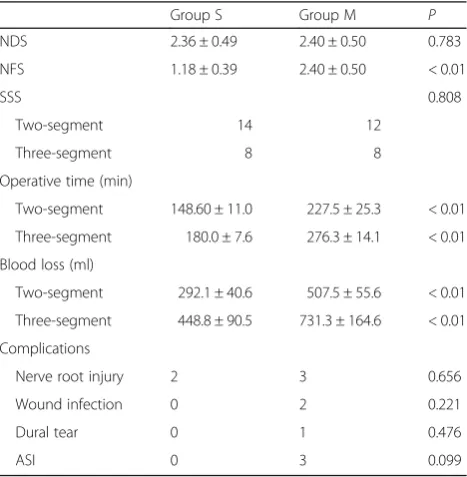
Of the 191 patients with multi-segment lumbar spinal sten-osis, there were 56 patients with associated single-segment degenerative spondylolisthesis. Of the 56 patients, 2 pa-tients with diabetes and 1 with severe cerebrovascular dis-eases were excluded. Only 42 of 53 patients completed a minimum 3-year follow-up and satisfied their inclusion cri-teria. All the 42 patients included in this analysis showed grade 1 degenerative spondylolisthesis. Of the 42 patients, 22 underwent selective decompression and fusion, and 20 patients underwent multi-segmental decompression and fu-sion. There was no significant difference in patient baseline demographics (P > 0.05) (Table 1). As shown in Table 2, there was no statistical difference in the mean number of surgical decompressed segment between the two groups (P> 0.05), while the mean number of the fused segment in group M is more than that in group S (P< 0.01). To investi-gate operative time and intraoperative blood loss, we di-vided the patients of each group into two subgroups on the basis of the number of surgical segment (two-segment sub-group and three-segment subsub-group) and then compared group S with group M in subgroups. The outcomes showed that the mean operative time and intraoperative blood loss
in group S were significantly less than those in group M in both subgroups (P< 0.01). Two patients in group S pre-sented with postoperative numbness of the lower extrem-ities which was relieved by 2 weeks of nerve nutrition treatment. In group M, three patients had radicular leg pain after surgery, which was relieved by 1 month of symptomatic treatment, another two patient experienced a dural injury and cerebrospinal fluid leakage, which healed spontaneously by means of prolonged drainage (5
Table 1Patient baseline demographic characteristics
Group S Group M P
Number of patients 22 20
Gender (F/M) 10/12 9/11 0.976
Mean age (years) 61.1 ± 6.9 63.0 ± 5.5 0.354
Symptom duration (months) 19.3 ± 12.3 21.6 ± 9.8 0.513
Follow-up (months) 37.6 ± 1.7 38.1 ± 2.4 0.472
Stenosis segment 0.657
L2–5 1 0
L3–5 9 7
L4–S1 5 5
L3–S1 7 8
Listhesis segment 0.470
L3/4 0 1
L4/5 14 12
L5/S1 8 7
Ffemale,Mmale
Table 2Surgical segments, operative time, blood loss, complications, and adjacent segment instability
Group S Group M P
NDS 2.36 ± 0.49 2.40 ± 0.50 0.783
NFS 1.18 ± 0.39 2.40 ± 0.50 < 0.01
SSS 0.808
Two-segment 14 12
Three-segment 8 8
Operative time (min)
Two-segment 148.60 ± 11.0 227.5 ± 25.3 < 0.01
Three-segment 180.0 ± 7.6 276.3 ± 14.1 < 0.01
Blood loss (ml)
Two-segment 292.1 ± 40.6 507.5 ± 55.6 < 0.01
Three-segment 448.8 ± 90.5 731.3 ± 164.6 < 0.01
Complications
Nerve root injury 2 3 0.656
Wound infection 0 2 0.221
Dural tear 0 1 0.476
ASI 0 3 0.099
days after surgery) and closure of the skin incision with sutures, the other patient had a superficial infection of the incision, which was cured after anti-inflammatory treat-ment. No other serious complications or reoperation oc-curred in either group.
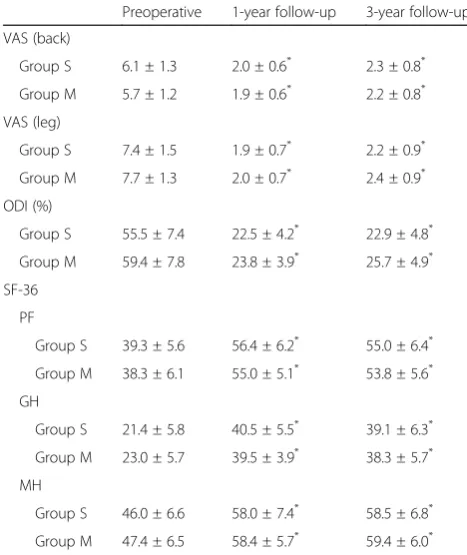
As shown in Table 3, the mean VAS, ODI, and SF-36 scores at 1-year and 3-year follow-up were significantly improved compared with those preoperatively in both groups (P< 0.01), but there were no significant differences in these scores between the two groups at each time point (P> 0.05).
Among patients in both groups, bone fusion was achieved in all the fusion segments at the final follow-up. No hard-ware loosening or breakage, or fusion cage migration oc-curred in either group. No iatrogenic spinal instability was noted in the decompressed segments and the adjacent seg-ments in group S. However, in group M, flexion-extension instability in the upper adjacent segment was noted in three patients at 3-year follow-up despite no statistical difference (Table2,P> 0.05).
Discussion
To date, no consensus exists for the surgical manage-ment of MLSS due to lack of evidence to standardize practice, especially the extent of decompression and fu-sion. In this study, we compared the clinical outcomes of selective decompression and fusion with those of
multi-segmental decompression and fusion for the treat-ment of MLSS.
The so-called selective decompression and fusion in this study refer to precise decompression (decompres-sion was performed only at the responsible sites of the stenotic segments) and selective fusion (fusion was per-formed only at the slipped segments and segments of potentially iatrogenic spinal instability). Actually, this idea incorporates the concept of“minimal invasion”into the open surgery. The key point is to damage the spinal stable elements as little as possible on the premise of ad-equate decompression. Based on detailed medical his-tory, careful physical examination, and comprehensive imaging studies, precise decompression of the affected nerve root only at the responsible sites and limited fu-sion of the slipped or potentially unstable segments were performed, while the extended decompression was not performed.
The present study demonstrated that precise and lim-ited decompression and fusion yielded similar outcomes to multi-segmental decompression and fusion, with shorter operative time, lesser blood loss and trauma, more preservation of motion segments, and fewer com-plications (although there was no statistically significant difference). An increased extent of decompression and fusion could not contribute to the improvement of clin-ical efficacy. In agreement with the results, Smorgick et al. [8] reported that decompression and multilevel fusion provided similar clinical outcomes to decompression and single-level fusion in patients with MLSS, with higher operative time and blood loss. Chang et al. [12] also found that the additional fusion did not result in clinical improvements, but with a higher risk of compli-cations over decompression alone for the treatment of lumbar spinal stenosis at 2-year follow-up. Based on the previous studies, we suggest that the key to success for the surgical treatment of MLSS lies in the precision of decompression and fusion, rather than the extent of de-compression and fusion.
Although decompression alone was deemed as a feasible treatment with similar outcomes to decompression plus fusion for lumbar spondylolisthesis [13], most studies have suggested that decompression plus fusion for lumbar spondylolisthesis has advantages in improvement of phys-ical health-related quality of life and clinphys-ical satisfaction as well as reduction in postoperative leg pain when com-pared with decompression alone [14–16]. With respect to MLSS, in our opinion, the extent of fixation and fusion need not be identical to the extent of decompression, but should only be confined to the slipped segments and po-tentially unstable segments after decompression. Lee et al. [17] compared the postoperative lumbar function of pa-tients undergoing long-segment fusion with those under-going short-segment fusion and found that postoperative
Table 3Change in VAS, ODI, and SF-36 scores
Preoperative 1-year follow-up 3-year follow-up
VAS (back)
Group S 6.1 ± 1.3 2.0 ± 0.6* 2.3 ± 0.8* Group M 5.7 ± 1.2 1.9 ± 0.6* 2.2 ± 0.8* VAS (leg)
Group S 7.4 ± 1.5 1.9 ± 0.7* 2.2 ± 0.9* Group M 7.7 ± 1.3 2.0 ± 0.7* 2.4 ± 0.9*
ODI (%)
Group S 55.5 ± 7.4 22.5 ± 4.2* 22.9 ± 4.8*
Group M 59.4 ± 7.8 23.8 ± 3.9* 25.7 ± 4.9*
SF-36
PF
Group S 39.3 ± 5.6 56.4 ± 6.2* 55.0 ± 6.4*
Group M 38.3 ± 6.1 55.0 ± 5.1* 53.8 ± 5.6*
GH
Group S 21.4 ± 5.8 40.5 ± 5.5* 39.1 ± 6.3*
Group M 23.0 ± 5.7 39.5 ± 3.9* 38.3 ± 5.7* MH
Group S 46.0 ± 6.6 58.0 ± 7.4* 58.5 ± 6.8* Group M 47.4 ± 6.5 58.4 ± 5.7* 59.4 ± 6.0* PFphysical function,GHgeneral health,MHmental health
*
ODI scores were significantly worse in the long-segment group than those in the short-segment group. There was no significant difference in the improvement of lower back pain between the two groups. Moreover, the length of the fused segment is positively associated with stress and mo-bility in the adjacent segments and the incidence of ASD. Yang et al. [18] demonstrated that the incidence of ASD after single-segment, two-segment, and more than three-segment fusion was 11.6%, 14.5%, and 16.3%, respectively. In this study, we noted three patients developed postoper-ative spinal instability at the upper adjacent segment in group M, which may be an indication of ASD. In addition, it has been reported that long fused segments are corre-lated with a low fusion rate and a high incidence of im-plant complications [6,19], such as implant breakage and loosening, as well as interbody cage migration. Although bony fusion was achieved at all fused segments and no im-plant complications occurred in our study, unnecessary fusion should be avoided. The small patient population in this study may be the main reason.
Differ from the previous report [9], no iatrogenic in-stability of the decompressed segments was observed and more spinal motion segments were preserved in group S at the final follow-up. The reasons may be as follows: (1) a proportion of stenotic segments do not have to undergo extensive decompression (a standard total laminectomy and foraminal decompression), ad-equate and effective decompression of the affected nerve root can be achieved by hemilaminectomy, or undercut-ting decompression of the lateral recess with care taken to preserve at least 50% of the facet joint. For patients with severe spinal stenosis, laminectomy with preserva-tion of the spinous process and interspinous and supras-pinous ligaments was performed instead of the classic full laminectomy in order to preserve the tension of pos-terior spinal structures, thus minimizing disruption of biomechanical integrity [20, 21]. 2) Care has also been taken to avoid injuring the joint capsule during exposure or screw insertion to protect the facet joint. Special at-tention should be paid to the fact that a pedicle screw inserted medially will likely damage the cephalic facet joints and increase the risk of ASD [22].
There are several limitations to this study. First, this study is a retrospective analysis with small sample size and short-term follow-up. Prospective multi-center studies with larger sample size and longer follow-up in the future are needed to further determine the benefits of selective de-compression and fusion for MLSS. Second, this study did not include the comparison with the non-fused group be-cause limited decompression without fusion is only recom-mended for elderly, low-demand patients with multiple comorbidities and significant degenerative changes that re-duce the likelihood of slip progression. Additionally, the treatment decisions made solely by the senior surgeon may
have important implications on clinical outcomes. Despite these points, this study provided valuable data for spine specialists when making clinical decisions in the treatment of MLSS.
Conclusion
In summary, selective decompression and fusion is a safe and effective method for the treatment of MLSS, with advantages of shorter operative time, less blood loss and trauma, and more preservation of spinal motion seg-ments when compared with multi-segmental decom-pression and fusion.
Abbreviations
ASD:Adjacent segment degeneration; GH: General health; MH: Mental health; MLSS: Multi-segment lumbar spinal stenosis with single-segment de-generative spondylolisthesis; ODI: Oswestry Disability Index; PF: Physical function; SF-36: Short Form 36; VAS: Visual analog scale
Acknowledgements
Not applicable.
Funding
This research was funded by the Program for Innovative Research of Xuzhou [KC16SY159]. The funder had no role in study design, data collection and analysis, decision to publish, or preparation of the manuscript.
Availability of data and materials
Not applicable.
Authors’contributions
WS, CX, XYT, and JZ designed the study. WS, CX, XYT, HF, FY, KJG, and JZ performed the experiments. KJG, HF, and FY performed the statistical analysis and interpreted the results. WS, CX, and JZ were major contributors in writing the manuscript. All authors critically revised the manuscript. All authors read and approved the final manuscript.
Ethics approval and consent to participate
Ethical approval was given by the medical ethics committee of the Affiliated Hospital of Xuzhou Medical University with the following reference number: xyfylw2012016.
Consent for publication
Not applicable.
Competing interests
The authors declare that they have no competing interests.
Publisher’s Note
Springer Nature remains neutral with regard to jurisdictional claims in published maps and institutional affiliations.
Author details
1Department of Orthopaedic Surgery, The Affiliated Hospital of Xuzhou
Medical University, 99 Huaihai Xi Road, Xuzhou, Jiangsu Province, People’s Republic of China.2Department of Orthopaedic Surgery, Shanghai Ninth
People’s Hospital, Shanghai Jiao Tong University School of Medicine, 639 Zhizaoju Road, Shanghai, People’s Republic of China.
Received: 18 July 2018 Accepted: 5 February 2019
References
1. Wang YXJ, Káplár Z, Deng M, Leung JCS. Lumbar degenerative
2. Weinstein JN, Lurie JD, Tosteson TD, Zhao W, Blood EA, Tosteson AN, Birkmeyer N, Herkowitz H, Longley M, Lenke L, Emery S, Hu SS. Surgical compared with nonoperative treatment for lumbar degenerative spondylolisthesis. Four-year results in the Spine Patient Outcomes Research Trial (SPORT) randomized and observational cohorts. J Bone Joint Surg Am. 2009;91(6):1295–304.
3. Matz PG, Meagher RJ, Lamer T, Tontz WL Jr, Annaswamy TM, Cassidy RC, Cho CH, Dougherty P, Easa JE, Enix DE, Gunnoe BA, Jallo J, Julien TD, Maserati MB, Nucci RC, O'Toole JE, Rosolowski K, Sembrano JN, Villavicencio AT, Witt JP. Guideline summary review: an evidence-based clinical guideline for the diagnosis and treatment of degenerative lumbar spondylolisthesis. Spine J. 2016;16(3):439–48. 4. Bae HW, Rajaee SS, Kanim LE. Nationwide trends in the surgical
management of lumbar spinal stenosis. Spine. 2013;38(11):916–26. 5. Kepler CK, Vaccaro AR, Hilibrand AS, Anderson DG, Rihn JA, Albert TJ,
Radcliff KE. National trends in the use of fusion techniques to treat degenerative spondylolisthesis. Spine. 2014;39(19):1584–9.
6. Försth P, Ólafsson G, Carlsson T, Frost A, Borgström F, Fritzell P, Öhagen P, Michaëlsson K, Sandén B. A randomized, controlled trial of fusion surgery for lumbar spinal stenosis. N Engl J Med. 2016;374(15):1413–23. 7. Pan A, Hai Y, Yang J, Zhou L, Chen X, Guo H. Adjacent segment
degeneration after lumbar spinal fusion compared with motion-preservation procedures: a meta-analysis. Eur Spine J. 2016;25(5):1522–32. 8. Smorgick Y, Park DK, Baker KC, Lurie JD, Tosteson TD, Zhao W, Herkowitz HN, Fischgrund JS, Weinstein JN. Single- versus multilevel fusion for single-level degenerative spondylolisthesis and multisingle-level lumbar stenosis. Spine. 2013;38(10):797–805.
9. Guha D, Heary RF, Shamji MF. Iatrogenic spondylolisthesis following laminectomy for degenerative lumbar stenosis: systematic review and current concepts. Neurosurg Focus. 2015;39(4):E9.
10. Collins FS, Varmus H. A new initiative on precision medicine. N Engl J Med. 2015;372(9):793–5.
11. Zhang K, Sun W, Zhao CQ, Li H, Ding W, Xie YZ, Sun XJ, Zhao J. Unilateral versus bilateral instrumented transforaminal lumbar interbody fusion in two-level degenerative lumbar disorders: a prospective randomised study. Int Orthop. 2014;38(1):111–6.
12. Chang W, Yuwen P, Zhu Y, Wei N, Feng C, Zhang Y, Chen W. Effectiveness of decompression alone versus decompression plus fusion for lumbar spinal stenosis: a systematic review and meta-analysis. Arch Orthop Trauma Surg. 2017;137(5):637–50.
13. Samuel AM, Moore HG, Cunningham ME. Treatment for degenerative lumbar spondylolisthesis: current concepts and new evidence. Curr Rev Musculoskelet Med. 2017;10(4):521–9.
14. Ghogawala Z, Dziura J, Butler WE, Dai F, Terrin N, Magge SN, Coumans JV, Harrington JF, Amin-Hanjani S, Schwartz JS, Sonntag VK, Barker FG 2nd, Benzel EC. Laminectomy plus fusion versus laminectomy alone for lumbar spondylolisthesis. N Engl J Med. 2016;374(15):1424–34.
15. Liang HF, Liu SH, Chen ZX, Fei QM. Decompression plus fusion versus decompression alone for degenerative lumbar spondylolisthesis: a systematic review and meta-analysis. Eur Spine J. 2017;26(12):3084–95. 16. Sigmundsson FG, Jönsson B, Strömqvist B. Outcome of decompression with
and without fusion in spinal stenosis with degenerative spondylolisthesis in relation to preoperative pain pattern: a register study of 1,624 patients. Spine J. 2015;15(4):638–46.
17. Lee CS, Chung SS, Shin SK, Park SJ, Lee HI, Kang KC. Differences in post-operative functional disability and patient satisfaction between patients with long (three levels or more) and short (less than three) lumbar fusions. J Bone Joint Surg Br. 2011;93(10):1400–4.
18. Yang JY, Lee JK, Song HS. The impact of adjacent segment degeneration on the clinical outcome after lumbar spinal fusion. Spine. 2008;33(5):503–7. 19. Deyo RA, Mirza SK, Martin BI, Kreuter W, Goodman DC, Jarvik JG. Trends,
major medical complications, and charges associated with surgery for lumbar spinal stenosis in older adults. JAMA. 2010;303(13):1259–65. 20. Mao L, Zhao J, Dai KR, Hua L, Sun XJ. Bilateral decompression using a unilateral
pedicle construct for lumbar stenosis. Int Orthop. 2014;38(3):573–8. 21. Takaso M, Nakazawa T, Imura T, Okada T, Fukushima K, Ueno M, Saito W,
Shintani R, Sakagami H, Takahashi K, Yamazaki M, Ohtori S, Kotani T. Less invasive and less technically demanding decompressive procedure for lumbar spinal stenosis--appropriate for general orthopaedic surgeons? Int Orthop. 2011;35(1):67–73.