IJPSR (2016), Vol. 7, Issue 5 (Research Article)
Received on 29 November, 2015; received in revised form, 13 January, 2016; accepted, 07 February, 2016; published 01 May, 2016
AN IMPROVED ASSAY METHOD FOR THE ESTIMATION OF TICAGRELOR HYDROCHLORIDE BY REVERSE PHASE LIQUID CHROMATOGRAPHY
M. A. Ambasana*, N. P. Kapuriya, K. M. Mangtani and K. D. Ladva
Department of Chemistry, Shree M. & N. Virani Science College, Rajkot - 360005, Gujarat, India
ABSTRACT: The current investigation was carried out to develop and validate a fairly simple, accurate, precise, reproducible and robust RP-HPLC method for the estimation of Ticagrelor Hydrochloride. The separation was achieved using Agilent Infinity 1220, Infinity Fast-LC (Pressure limit up to 600 bars) with auto sampler and PDA detector. The Chromatographic analysis was performed on ZORBAX Eclipse Plus 300SB C18 (250 x 4.6mm, 5.0 micron, PN 880995-902) column. Mobile phase consist of (A) Acetonitrile: (B) 20mM Potassium dihydrogen ortho phosphate buffer (40:60 v/v) at a flow rate of 1.0 ml/min. The method showed linear in the mentioned concentrations having line equation y = 22.848x + 1.3214 with correlation coefficient R2 of 0.9995. The recovery values for Ticagrelor ranged from 99.63% to 100.34%. The % RSD was 0.49% and 0.54%, respectively for intraday and interday precision. The limit of detection and limit of quantification were 0.05μg/mL and 0.20μg/mL respectively. Newly developed method was statistically validated for accuracy, precision, linearity and solution stability; hence it is directly applicable for the estimation of Ticagrelor up to trace level in routine analysis.
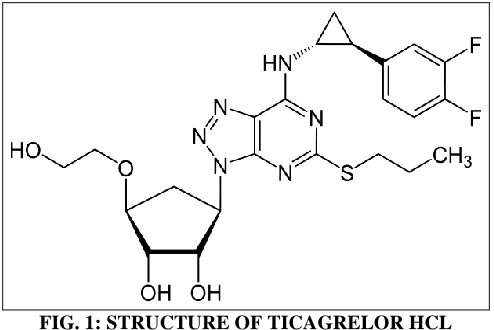
INTRODUCTION: Ticagrelor Hydrochloride is orally active, reversibly binding P2Y12 antagonist inhibiting platelet aggregation via P2Y12 ADP-receptor 1. Chemically, it is (1S,2S,3R,5S)-3-[7-{[(1R,2S)-2- (3, 4 - difluorophenyl) cyclopropyl] amino} - 5-(propylthio)-3H-[1,2,3]-triazolo[4,5-d]pyrimidin-3-yl] - 5 - (2-hydroxyethoxycyclo pentane-1,2-diol) 2. Literature review revels that Ticagrelor lowers the risk of thrombotic cardiovascular events in patients suffering from acute coronary syndrome 3.
QUICK RESPONSE CODE
DOI:
10.13040/IJPSR.0975-8232.7(5).2009-14
Article can be accessed online on:
www.ijpsr.com
DOI link: http://dx.doi.org/10.13040/IJPSR.0975-8232.7 (5).2009-14
Ticagrelor and its major metabolite reversibly interact with the P2Y12 ADP-receptor to slow down platelet aggregation and thrombus formation in atherosclerotic disease 4-8. The wide-ranging methodical literature review for Ticagrelor Hydrochloride revealed very few methods based on varied techniques, viz, UV-spectroscopic 9, LC-MS 10, 11
and HPLC 12, 13; for the estimation of Ticagrelor either in pharmaceutical formulation or in biological fluid. HPLC is often the first choice of analyst compared to UV-Viz, HPTLC or Mass as Liquid chromatographic method has many
advantages over spectroscopic and
spectrophotometry method for quantization.
Till date, none of the reported analytical procedure describes development and validation of HPLC method for estimation of Ticagrelor HCl; with wide Key words:
Ticagrelor HCl; Antiplatelet agent; HPLC; Validation
Correspondence to Author: Dr. Mrunal Ambasana
Department of Chemistry, Shree M. & N. Virani Science College, Kalawad Road, Rajkot -360005, Gujarat
experimental data like of column selection with particular mobile phase and mobile phase selectivity with same column (See Table 1). The authors have tried to point out the comparison of published method with developed method (See Table 2).
FIG. 1: STRUCTURE OF TICAGRELOR HCL
The purpose of this work was to develop a easy and trouble-free HPLC method for estimation of Ticagrelor HCl with mandatory levels of accuracy and reliability and to validate the method in accor-dance with ICH guidelines 14, 15 and the guidelines of USP 30 16.
MATERIALS AND METHODS:
The required quantity of API sample (label claim 99.8% pure) was provided by ANLON CRO, Rajkot (Gujarat) India. Analytical grade methanol, acetonitrile and orthophosphoric acid were procured from Merck India Limited (Mumbai, India). The 0.45 micron PTFE membrane disc filters were obtained from Pall Corporation (Mumbai, India). High purity deionised water was obtain from Millipore, Milli-Q water purification system (Milford, MA, USA).
Instrumentation:
The chromatographic method development and validation was performed using Agilent Infinity 1220, Infinity Fast-LC (Pressure limit up to 600 bars) with auto sampler and PDA detector. Data acquisition and data processing was evaluated with Open Lab Chem. Station.
Chromatographic Condition:
Chromatographic analysis was performed on ZORBAX Eclipse Plus 300SB C18 (2504.6mm,
5.0 micron, PN 880995-902) column. Mobile phase consist of (A) Acetonitrile: (B) 20mM Potassium dihydrogen ortho phosphate buffer (40:60 v/v) at a flow rate of 1.0 ml/min. The mobile phase was filtered through 0.45 micron PTFE disc filter before use. The eluent was monitored using PDA detector at a wavelength 225 nm. The column was maintained at ambient temperature and injection volume of 5 µl was used.
Preparation of Stock and Standard Solutions:
Stock solution (500 µg/ml) of Ticagrelor sample was prepared by transferring 50 mg, accurately weigh, into a 100 ml volumetric flask and adding 20 ml methanol. The solution was sonicated for 2-3 minutes to dissolve Ticagrelor and the solution was then diluted to volume with the same solvent.
Preparation of Test Solutions:
To prepare test solution (100 µg/ml) , pipette out 2.0 ml of stock solution (500 µg/ml) into 10 ml volumetric flask and dilute up to the mark with methanol.
Method Validation: Linearity:
To test the linearity a series of solutions ranging from 40 to 160 µg/ml of Ticagrelor were prepared, which corresponded to 40, 60, 80, 100, 120, 140 and 160%, respectively, of the test solution concentration. Each solution was measured in duplicate. Linearity was evaluated by linear-regression analysis.
Precision:
Standard solution was analyzed five times for the evolution of system precision. Method precision was evaluated by assaying six sets of test samples prepared for assay determination (intraday precision). Intermediate precision was evaluated by performing the same procedures on a different day (interday precision), and by another person under the same experimental conditions.
Accuracy:
[image:2.612.50.297.150.315.2]Robustness:
The robustness of the method was checked by applying slight but deliberate modification in analytical condition like: change in the flow rate (±0.1 ml/min), mobile phase composition [acetonitrile-buffer (38:62 and 42:58), v/v] and using different batch of same column before assaying test preparation.
Solution Stability:
Solution stability of the drug was investigated by keeping test preparation at 5°C and at ambient temperature without protection of light and tested after 12, 24, 36 and 48 hrs. The responses for the aged solution were evaluated by comparison with freshly prepared solutions.
System Suitability:
The system suitability test was performed before each stage of validation by applying five replicates of standard preparation. For each replicates; asymmetry, number of theoretical plates and %RSD of peak area were determined.
RESULTS AND DISCUSSION: Herein we have developed and validated a fairly simple, easy to operate and reliable analytical protocol for determination of assay of Ticagrelor Hydrochloride through reverse phase High Performance Liquid Chromatography (RP-HPLC). All variable parameters were selected on basis of our past experiences in the field 17-19 and were optimized to yield the best possible results. The reported analytical parameters were selected after evaluating different conditions which may affect results of HPLC analysis, viz. column, ratio of aqueous and organic components of mobile phase, detection wavelength, diluents, concentration of analytes, etc.
The ZORBAX Eclipse Plus 300SB C18 (2504.6mm, 5.0 micron) column was selected owing its advantages of high resolution and reproducibility with relatively low-back pressure and tailing. For the selection mobile phase, initial trials were performed using mobile phases of different composition containing water adjusted to acidic pH (1.8 - 4.0) through the addition of o-phosphoric acid and methanol, 0.1% o-o-phosphoric acid with methanol, 0.1% formic acid in combination with methanol, etc. However all these
trials resulted in poor peak shapes. Ultimately methanol was replaced by acetonitrile and applied in combination with 20mM potassium dihydrogen ortho phosphate buffer; that offered improved acceptable peak shape. After selection, the proportion of mobile phase components was optimized to reduce retention times and fine tune the peak shape.
To decide the detection wavelength, scanning of standard solution over the range of 190-350 nm was performed on the PDA detector. Detection wavelength of 225 nm was selected, as scans on 225nm provides results with good response and linearity. This newly developed method was validated as per ICH 14-15 and USP 30 16 guidelines. This furnishes evidence that the method is appropriate for its intended use.
To determine linearity a calibration graph was obtained by plotting Ticagrelor Hydrochloride concentration against peak area. Linearity was good in the concentration range 40-160 µg/ml. The regression equation was y = 22.848x + 1.3214 where x is the concentration in µg/ml and y is the peak area in absorbance units; the correlation coefficient was 0.9995.
The mean values of method precision were 99.3% (RSD 0.28%) for assay on the same day (intraday) and 100.6% (RSD 0.60%) for assay on different days (interday). Intermediate precision was established by determining the overall (intraday and interday) method precision for assay determination. For intermediate precision, overall assay value (n=12) was 101.2% (RSD 0.40%).
The accuracy of the method was evaluated at three concentration levels, 50, 100 and 150 % of the target test concentration. Known amounts of Ticagrelor Hydrochloride (50, 100, and 150µg/ml) were added to sample preparation and the amount of Ticagrelor Hydrochloride recovered, was calculated. The mean recovery of the drug was between 99.63 and 100.34%, which is acceptable (Table 3).
For each condition the standard and test solution were prepared separately. The result wasn’t affected after modification in analytical conditions and was in accordance with the true value. System suitability data were also found to be acceptable during variation of the analytical conditions (Table 4). The analytical method therefore remained unaffected and successfully passes the robustness test.
The stored standard and test preparations were found to be stable for up to 48 hrs in both conditions of solution stability study (Table 5). The system suitability test was performed before each step of validation by measuring of general characteristics like symmetry, theoretical plates and % RSD of peak area for standard solution. The data obtained were satisfactory and in accordance with in-house limits (Table 6).
TABLE 1: COLUMN SELECTIVITY
SN Column Mobile Phase % RSD of 5 Replicates Retention Time
1 Column - 1 ACN:20mM phosphate buffer
(40:60 v/v)
0.22% 5.94
2 Column - 2 0.34% 3.80
3 Column - 3 0.29% 3.89
4 Column - 4 0.48% 4.85
Column – 1: ZORBAX Eclipse plus 300 SB C18 (2504.6 mm, 5.0 micron, PN 880995-902) Column – 2: ZORBAX Eclipse RR C18 (1004.6 mm, 3.5 micron, PN 959961-902)
Column – 3: ZORBAX Eclipse XDB C18 (1003.0 mm, 5.0 micron, PN 880995-902) Column – 4: WATERS X Bridge Phenyl C18 (1504.6mm, 3.5 micron, PN 186003335)
TABLE 2: COMPARISON OF PUBLISHED METHODS WITH DEVELOPED METHOD
Parameters L. Kalyani et al.12 C. Gobetti et al 13 Present method
Column BDS C18
(100 x 4.6 mm, 5µm)
Phemomenex C18
(250 x 4.6 mm, 5μm),
ZORBAX Eclipse Plus 300SB C18 (250
x 4.6 mm, 5.0µm) Mobile phase Acetonitrile : 20mM Potassium
dihydrogen phosphate buffer (30:70 v/v) pH 7.0
Acetonitrile: water with 0.5% triethylamine (57:43 v/v) pH 7.0
Acetonitrile : 20mM Potassium dihydrogen ortho phosphate buffer
(40:60 v/v) pH 5.0
Flow rate 1.0 ml/min 0.7 ml/min 1.0 ml/min
Detector UV PDA PDA
Wave length 254 nm 254 225 nm
Linear range 22.5-135 (µg/ml) 45.0 to 105.0 μg/ml, 40-160 (µg/ml)
R2 0.999 0.9990 0.9995
LOD 0.092 No Data Found 0.045 (µg/ml)
LOQ 0.281 No Data Found 0.200 (µg/ml)
Solution Stability 24 hr at RT No Data Found 12,24,36,48 hr at RT & 5º C
TABLE 3: ACCURACY STUDY DATA Level % Set No Amount of drug
added (µg/ml)
Amount of drug
found (µg/ml) Recovery (%)
Mean Recovery (%)
50
1 50.59 51.22 101.24
100.34
2 50.05 49.75 99.40
3 50.20 50.40 100.39
100
1 100.73 100.09 99.36
99.63
2 100.68 100.48 99.80
3 100.40 100.15 99.75
150
1 150.72 150.33 99.74
100.00
2 150.84 150.95 100.07
3 149.78 150.10 100.21
TABLE 4: ROBUSTNESS STUDY DATA
Conditions Assay (%) RT
(min)
System suitability data Theoretical plates Asymmetry
0.9 ml/min Flow 100.71 6.42 7944 1.12
1.1 ml/min Flow 99.87 5.51 8760 1.07
Acetonitrile : Buffer (38:62, v/v) 99.70 6.14 8633 1.18
Acetonitrile : Buffer (42:58, v/v) 100.16 5.78 8452 1.08
TABLE 5: SOLUTION STABILITY STUDY DATA
Time intervals, H
Difference between assays for standard solution (%)
Difference between assays for test solution (%)
At 5° At room
temperature At 5°
At room temperature
12 0.96 1.14 0.15 0.25
24 1.12 1.34 0.24 0.31
36 1.32 1.53 1.49 1.52
48 1.56 2.05 1.86 2.17
TABLE 6: SYSTEM SUITABILITY DATA
System suitability data RSDa (%) Theoretical plates Asymmetry
In-House limit NMTb2.0 NLTc 8000 NMTb2.0
Linearity 0.16 8590 1.02
Method Precision 0.23 8672 0.98
Intermediate Precision 0.39 8666 1.01
Accuracy 0.35 8524 1.00
Robustness 0.46 8212 1.02
Solution stability 0.24 8431 0.99
a
[image:5.612.93.520.243.740.2]Relative standard deviation, bnot more than, cnot less than
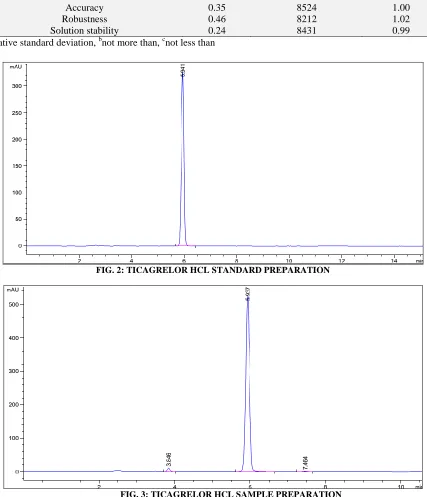
FIG. 2: TICAGRELOR HCL STANDARD PREPARATION
CONCLUSION: Here the intensive approach describes about development and validation of an isocratic RP-HPLC method that can be used for assay as well as purity of Ticagrelor Hydrochloride. The method was successfully developed and validated for its anticipated purpose. The method was shown to specific, linear, precise, accurate, and robust.
ACKNOWLEDGEMENTS: The authors are thankful to the ANLON CRO, Rajkot (India) for providing required APIs and acknowledge the financial support from UGC, New Delhi; under Innovative PG Program Scheme.
REFERENCES:
1. Khaleel A, Rohit S, Kashyap P, Anad S and Ambrish S: Ticagrelor: a new reversible oral antiplatelet agent. International Research Journal of Pharmacy 2010; 1:62-69.
2. Teng R and Butler K: Pharmacokinetics,
pharmacodynamics, tolerability and safety of single ascending doses of Ticagrelor, a reversibly binding oral P2Y12 receptor antagonist in healthy subjects. European Journal of Clinical Pharmacology 2010; 7:487-496.
3. Husted S and Giezen J: Ticagrelor: the first reversibly binding P2Y12 receptor antagonist. Journal of Cardiovascular Therapy 2009; 24: 259-274.
4. Wallentin L, Becker RC, Budaj A, Cannon CP and Held C: Ticagrelor versus Clopidogrel in patients with acute coronary syndromes. The New England Journal of Medicine 2009; 11:1045-1057.
5. Teng R, Oliver S, Hayes MA and Butler K: Absorption, distribution, metabolism and excretion of Ticagrelor in healthy subjects. Drug Metabolism & Disposition 2010; 9:1514-1521.
6. National institute for health and excellence: Ticagrelor for the treatment of acute coronary syndromes. Nice technology appraisal guidance 2011; 236:1-45.
7. Nawarskas J and Clark S: Ticagrelor: a novel reversible oral anti-platelet agent. Craniological Review 2011; 2:95-100.
8. Deeks ED: Ticagrelor: a review of its use in the management of acute coronary syndromes. Drugs 2011; 7:909-933.
9. Ambasana M, Kapuriya N, Faldu N and Ladva K: Development and validation of a UV spectrophotometric method for the determination of ticagrelor in bulk form. Der Pharmacia. Letters 2014; 4:237-240.
10. Sillén H, Cook M and Davis P: Determination of ticagrelor and two metabolites in plasma samples by liquid chromatography and mass spectrometry. Journal of Chromatography B 2010; 25: 2299-2306.
11. Sillén H, Cook M and Davis P: Determination of unbound ticagrelor and its active metabolite (AR-C124910-XX) in human plasma by equilibrium dialysis and LC-MS/MS. Journal of Chromatography B 2011; 23:2315-2322.
12. Kalyani L and Lakshmana Rao A: A Validated Stability-Indicating Hplc Method For Determination of Ticagrelor in Bulk and Its Formulation. International journal of Pharmacy 2013; 3:634-642.
13. Caren G, Pereira RL, Mendez ASL and Garcia CV: Determination of the New Antiplatelet Agent Ticagrelor in Tablets by Stability-Indicating HPLC Method. Current Pharmaceutical Analysis 2014; 4:279-283.
14. Bakshi M and Singh S: Development of validated stability-indicating assay methods: critical review. Journal of Pharmaceutical and Biomedical Analysis 2002; 6:1011-1040.
15. ICH, Harmonized Tripartite Guideline, Validation of Analytical procedure: Text and Methodology, Geneva, Switzerland. 2006.
16. The United States Pharmacopoeia, 30th ed., The United
States Pharmacopoeial Convention, Rockville, USA, 2013
17. Kaila HO, Ambasana MA, Thakkar RS, Saravaia HT and Shah AK: A new improved RP-HPLC method for assay of Rosuvastatin calcium in tablets. Indian Journal of Pharmaceutical Science 2010; 5:592-598.
18. Kaila HO, Ambasana MA and Shah AK: Development and validation of a reversed-phase ultra-performance liquid chromatographic method for the simultaneous determination of six drugs used for combined hypertension therapy. Journal of AOAC International 2013; 2:295-300.
19. Kaila HO, Ambasana MA, Thakkar RS, Saravaia HT and Shah AK: A Stability-indicating High Performance Liquid Chromatographic Assay for the Simultaneous Determination of Atenolol and Lercanidipine Hydrochloride in Tablets. Indian Journal of Pharmaceutical Science 2011; 4:376-380.
20. Ambasana MA, Kaila HO, Thakkar RS, Saravaia HT and Shah AK: Validation of an analytical method for assay of magnesium valproate by gas chromatography. International Journal of Chem Tech Research 2011; 1:342-347.
All © 2013 are reserved by International Journal of Pharmaceutical Sciences and Research. This Journal licensed under a Creative Commons Attribution-NonCommercial-ShareAlike 3.0 Unported License.
This article can be downloaded to ANDROID OS based mobile. Scan QR Code using Code/Bar Scanner from your mobile. (Scanners are available on Google Playstore)
How to cite this article: