Citation:
Shaw, RA and Lee, J (2010) Met mates: the development and evaluation of a course-specific social
network site for pre-registration Nursing students. Assessment, Teaching & Learning Journal, 9. 12
- 15. ISSN 1756-8781
Link to Leeds Beckett Repository record:
http://eprints.leedsbeckett.ac.uk/1115/
Document Version:
Article
The aim of the Leeds Beckett Repository is to provide open access to our research, as required by
funder policies and permitted by publishers and copyright law.
The Leeds Beckett repository holds a wide range of publications, each of which has been
checked for copyright and the relevant embargo period has been applied by the Research Services
team.
ALT JOURNAL NUMBER 9: SUMMER 2010
12
network and share information and ideas for various purposes. Users can typically create profiles describing themselves, make connections with ‘friends’ in the network, and join or create sub- groups (Franklyn, 2007; Boyd, 2007). There has been phenomenal growth in the use of such sites in recent years, and their use has become part of the daily lives and activities of millions of users. Given this, it is unsurprising that social networking has received a great deal of attention in higher education in recent years. The use of such tools for assessment, learning and teaching activities is becoming increasingly well documented (Wilkinson et al, 2009; Minocha, 2009), fuelled by a growing emphasis on the importance of affective factors in the learning process and on the establishment and maintenance of learning communities (Jones & Issroff, 2007).
This report outlines the results of a project which aimed to evaluate the impact of making a course-specific social network (Met mates) available to students on the Pre-registration Nursing degree course at Leeds Met from Summer 2008. The main initial aim of providing the network was to supplement the existing strategies to reduce attrition in a
multi-pronged approach in line with Department of Health recommendations (2006). It was hoped that the provision of a vehicle for new students to make contact with each other and with existing students would help to smooth their transition onto the course and help them to deal with issues in the early stages. The intention from the outset was to emphasise the site as a ‘student space’ and to encourage them to take ownership of its development. There were no directed tasks and use of the network was not specifically integrated with module activities or assessments; X-stream (the Leeds Met Virtual Learning Environment) was used as normal for these module-specific activities. However, the project aimed to evaluate how far the students would independently use the social network as a source of ongoing personal, professional and academic support, why or why not this might be the case, and what the students’ perceptions would be of its ongoing usefulness.
allows private social networks to be created around particular topics. The project leaders were able to block membership to anyone who was not a course member. The only cost associated with use of the service was to remove the context-specific advertisements from the site. [As of August 2010, the pricing structure of Ning.com, the social network service used to set up the site described in this article, has changed. During the period covered by the study, Ning.com offered a free service. The site now uses the Ning Plus plan which provides the functionalities described including removal of advertisements at an annual cost of $199.95. The following posting from The Guardian’s
Technology blog provides background information to the changes at Ning.com together with suggestions for alternative social network providers:
http://tinyurl.com/y67mdhd
https://owa2k3.leedsmet.ac.uk/exchweb/bin/redir. asp?URL=http://tinyurl.com/y67mdhd. Ed.]
The site was populated with a number of features including profile pages, facilities to upload images, videos and documents, and the functionality to add and publicise groups and events. Communication between members was made possible through a forum, a chat facility and the ability to post comments on individuals’ profile pages.
Issues around Intellectual Property Rights, data protection and acceptable usage were considered and clear statements were incorporated stressing, for example, that any materials uploaded to the site should be copyright free, that the site was not held on Leeds Met servers but was created and operated by Ning.com and subject to their terms of use, and that all use of the site should conform to confidentiality and professionalism standards as laid down in the Nursing and Midwifery Council Code of Conduct (2002). Beyond these terms of use, it was emphasised from the outset that members could develop the use of the site in any way they found useful.
ALT JOURNAL NUMBER 9: SUMMER 2010
13
Evaluation
The use of the social network was evaluated through an online questionnaire and a series of focus group interviews to gain a qualitative perspective. Usage of the site was also analysed. The questionnaire focused on:
• how Met mates was used, attitudes towards it, and reasons for usage patterns
• how other social networking websites are used, attitudes towards them and comparisons with Met mates
• levels of satisfaction with social, professional and academic aspects of the students’ experience
• sense of integration with the course and with life in Leeds
• sources of advice and support, and levels of satisfaction with the support received.
Key findings
The research revealed a great deal of information beyond the specifics of the use of social networking. Course-related and personal issues were raised including the sense of isolation from other student groups and the unique stressors arising from
What activities did the students engage in?
[image:3.637.79.559.331.428.2]The addition and checking of profile information was the commonest activity (see Figure 1). Other common activities were adding comments, joining groups, and making / responding to friend requests. Among level 2 and 3 students, responding to events invitations and
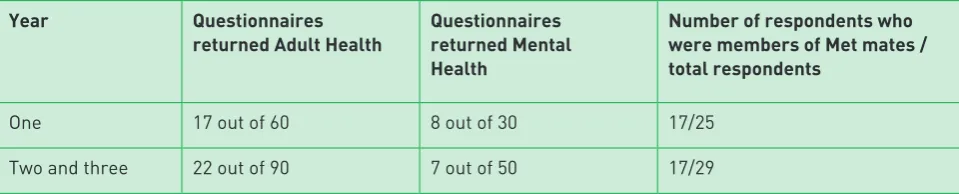
Table 1
Year Questionnaires returned Adult Health
Questionnaires returned Mental Health
Number of respondents who were members of Met mates / total respondents
One 17 out of 60 8 out of 30 17/25
Two and three 22 out of 90 7 out of 50 17/29
ALT JOURNAL NUMBER 9: SUMMER 2010
14
Activity levels were relatively high in the initial stages of the academic year including the enrolment period but they tailed off after the first few weeks of the course. Differences were apparent between the use of the site by prospective and current students. The former used the site almost on a daily basis until enrolment to engage in regular communication and provide or seek advice relating to accommodation and finance. The latter used the site less frequently and mainly for the purpose of enrolling on events publicised there.
How was Met mates regarded in relation to other social networks?
[image:4.637.77.560.198.527.2]ALT JOURNAL NUMBER 9: SUMMER 2010
15
How could Met mates be improved? What would encourage more engagement?
There was a common feeling that usage of the site was likely to grow as the proportion of students on the course who had used Met mates as part of their course induction increases. There was also a feeling that a briefing session on Met mates would be useful to ensure that members are aware of the functionalities and potential uses of the site. Existing students tended to describe the site as being of particular use for new students and this is reflected in the usage patterns. However, these students responded to activities directed at them and to the use of the site to sign-up for events in particular. Whilst the use of comments on profile pages was valued as the most immediate method of communicating, there was also a feeling that more structure would be useful to allow easier access to useful advice or information relating to particular aspects such as placements or accommodation.
Conclusion and recommendations for
developing the site
The introduction of Met mates to the pre-registration Nursing degree has had positive outcomes in terms of facilitating the socialisation of prospective students, although its use by students for ongoing professional and academic support has been limited. If the site continues to be used as a resource for prospective students to prepare for life in Leeds as a student nurse, then it is a valuable student resource. The evaluation suggested that promotion of the site during Freshers’ week could lead to its development for personal, professional and academic support during the course itself rather than simply for pre-admission use. This could further be encouraged through devolving responsibility for the administration and continued development of the site to student STARS or course representatives, who could use the site to obtain student feedback regarding course-related issues and to communicate with members of their cohort as appropriate.
References
Boyd, D. & Ellison, N. (2007) Social network sites: Definition, history, and scholarship. Journal of Computer-Mediated Communication 13(1).
Department of Health (2006) Managing Attrition Rates for Student Nurses and Midwives: A Guide to Good Practice for Strategic Health Authorities and Higher Education Institutions. London: Department of Health. Franklin, T. & van Harmelen, M. (2007) Web 2.0 for Content for Learning and Teaching in Higher Education. Available at: http://www.jisc.ac.uk/media/documents/ programmes/digitalrepositories/web2-content-learning-and-teaching.pdf [Accessed 29 January 2010].
Jones, A. & Issroff, K. (2007) Learning technologies – affective and social issues. In: Conole, G. & Oliver, M. (eds) Contemporary perspectives in e-learning research. Oxford: Routledge, pp.190-202.
Minocha, S. (2009) A Study on the Effective Use of Social Software by Further and Higher Education in the UK to Support Student Learning and Engagement. Available at: http://www.jisc.ac.uk/media/documents/projects/ effective-use-of-social-software-in-education-finalreport.pdf [Accessed 29 January 2010]. Nursing and Midwifery Council (2008) The Code. Standards of conduct, performance and ethics. London: Nursing and Midwifery Council.
Wilkinson, S. with Cope, N., Folley, D. & Thomson, S. (2009) The benefits and challenges of team projects and how Web 2.0 tools can help. Leeds Met Assessment, Learning & Teaching Journal 6, 21-25.
Rob Shaw
Learning Technologist, Faculty of Health Janine Lee