R E S E A R C H
Open Access
Manifold learning and maximum
likelihood estimation for hyperbolic
network embedding
Gregorio Alanis-Lobato
1,2*, Pablo Mier
1,2and Miguel A. Andrade-Navarro
1,2*Correspondence: [email protected]
1Institute of Molecular Biology,
Ackermannweg 4, 55128 Mainz, Germany
2Faculty of Biology, Johannes
Gutenberg Universität, Gresemundweg 2, 55128 Mainz, Germany
Abstract
The Popularity-Similarity (PS) model sustains that clustering and hierarchy, properties common to most networks representing complex systems, are the result of an optimisation process in which nodes seek to form ties, not only with the most connected (popular) system components, but also with those that are similar to them. This model has a geometric interpretation in hyperbolic space, where distances between nodes abstract popularity-similarity trade-offs and the formation of scale-free and strongly clustered networks can be accurately described.
Current methods for mapping networks to hyperbolic space are based on maximum likelihood estimations or manifold learning. The former approach is very accurate but slow; the latter improves efficiency at the cost of accuracy. Here, we analyse the strengths and limitations of both strategies and assess the advantages of combining them to efficiently embed big networks, allowing for their examination from a geometric perspective. Our evaluations in artificial and real networks support the idea that hyperbolic distance constraints play a significant role in the formation of edges between nodes. This means that challenging problems in network science, like link prediction or community detection, could be more easily addressed under this geometric framework.
Keywords: Complex networks, Hyperbolic geometry, Manifold learning, Maximum likelihood estimation, Network embedding, Network geometry, Graph Laplacian
Introduction
The network representation of many complex systems, like the Internet or the pro-tein interactome, shows characteristics commonly present in geometric objects; scale invariance and self-similarity amongst them (Barabási and Albert 1999; Song et al. 2006; Goh et al. 2006; Serrano et al. 2008). It is then no surprise that several models, aimed at mimicking the evolution and formation of these networks, assume the exis-tence of a hidden geometry underlying their structure and shaping their topology (Aste et al. 2005; Aste et al. 2012; Boguñá et al. 2009; Dall and Christensen 2002; Ferretti and Cortelezzi 2011; Krioukov et al. 2010; Papadopoulos et al. 2012; Serrano et al. 2008) (we refer the reader to (Barthélemy 2011) for an extensive review on the subject).
Of special interest is the so-called Popularity-Similarity (PS) model, which sustains that strong clustering and scale-free node degree distributions are the result of an optimisation
process involving two measures of attractiveness: node popularity and similarity between nodes (Papadopoulos et al. 2012). On the one hand, popularity reflects the ability of a node to attract connections from other nodes over time, and it is thus associated with its seniority status in the system. On the other, nodes that are similar simply tend to connect, regardless of their rank.
The PS model has a geometric interpretation in hyperbolic space, where the trade-offs that new nodes have to optimise when joining a system are abstracted by the hyper-bolic distance between them and existing ones (Krioukov et al. 2010; Papadopoulos et al. 2012). In this model, a network lies within a hyperbolic disc of radiusR ∼ lnN, where
Nis the total number of nodes. The popularity dimension is represented by radial node coordinatesri, with senior nodes in close proximity to the disc’s centre. The similarity dimension is associated with the angular positioning of nodesθiand short hyperbolic dis-tances between them (approximatelyxij = ri+rj+2 ln(θij/2)for any two nodesiandj separated by an angleθij) correspond to high probabilities of link formation.
With the simplest version of the model, we can produce networks with scaling exponent γ = 2 in the so-called cold-temperature regime (T = 0), where their clustering is the strongest possible (Krioukov et al. 2010; Papadopoulos et al. 2012). To increase the value of γ, we can simulate popularity fading by moving senior nodes away from the disc’s centre. To decrease clustering, networks can be submitted to higher temperatures (T >0, see Methods). These additional mechanisms give place to a very versatile model to study network dynamics (Papadopoulos et al. 2012).
If the PS model can generate networks that are similar to those we observe in nature and engineering (Krioukov et al. 2010; Papadopoulos et al. 2012), does it mean that pack-ets travelling the Internet, signals going from receptors to transcription factors in the cell or messages between people in social networks traverse the hyperbolic geometry under-lying each of these systems? To answer this question, we need a means to map them to hyperbolic space, to then check whether hyperbolically close nodes tend to connect more than distant ones, and assess whether information travels efficiently through the network topology.
In 2015, Papadopoulos and colleagues introduced HyperMap, a Maximum Likelihood Estimation (MLE) approach, in which the space of PS models with the same structural properties as the network of interest is explored, in search for the one that better fits its topology (see Methods and (Papadopoulos F et al. 2015b; Papadopoulos et al. 2015a) for more details). This search is very accurate, albeit computationally demanding (see Fig. 1a, b), which means that HyperMap requires of correction steps or heuristics in order to make it suitable for big networks (Papadopoulos et al. 2015a).
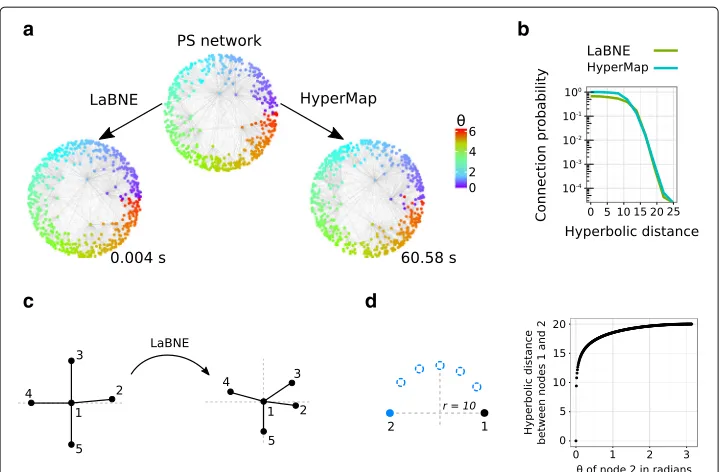
Fig. 1Issues with hyperbolic embeddings by LaBNE.aAn artificial network produced by the PS model, with 500 nodes, 2m=10,γ=2.5 andT=0.3, is mapped to hyperbolic space with LaBNE and HyperMap. Even when LaBNE’s embedding is extremely fast and its inferred node positions, indicated with colours, coincide with those from the input network, panelbshows that HyperMap is more accurate, because the probability of finding connected nodes at small hyperbolic distances is higher than if LaBNE’s coordinates are used. We illustrate the reasons for this with the simple 5-node network of panelcand its embedding by LaBNE. Despite the fact that the inferred and real angular coordinates, together with the corresponding hyperbolic distances, are highly correlated (Pearson correlations of 0.97 and 0.98, respectively), it is clear that the angular positions of nodes 2, 3 and 4 are smaller than they should be. This is a consequence of LaBNE’s aim to map connected nodes as close as possible in the embedding space, disregarding that disconnected nodes should be far from each other. Although this does not have a big impact in Euclidean embeddings, it can be very problematic in hyperbolic space. Paneldshows how the hyperbolic distance between nodes 1 and 2 changes dramatically, even for small changes in the angular coordinate of the latter
extremely fast (see Fig. 1a), but highly depends on topological information to carry out good embeddings. This means that the higher the average node degree (2m) and clus-tering coefficient (c¯) of a network, the better the results it achieves (Alanis-Lobato et al. 2016). In addition, LaBNE’s aim to map connected nodes as close as possible to each other in the embedding space, disregarding that disconnected nodes should be far apart (Shaw and Jebara 2009), can lead to inaccuracies when associating short hyperbolic distances with connections between nodes (see Fig. 1b-d).
In the present article, we assess the pros and cons of both strategies and introduce a hybrid approach that pursues a more efficient and accurate network embedding into the two-dimensional hyperbolic planeH2, represented by the interior of a Euclidean circle (Krioukov et al. 2010). We carry out analyses on artificial and real networks and, based on the results, discuss the strengths and limitations of these hyperbolic mapping techniques.
Results
LaBNE+HM and its performance in artificial networks
they are scale-free (with scaling exponentγ ∈[2, 3]) and have a clustering coefficientc¯
significantly larger than expected by chance.
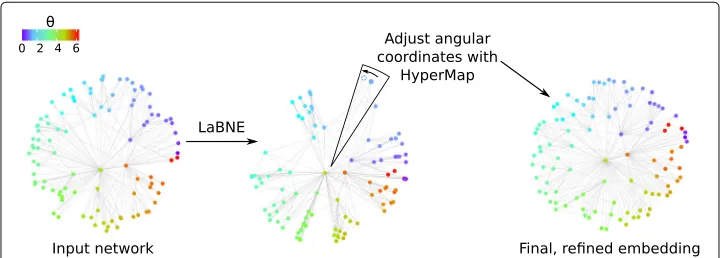
LaBNE+HyperMap (LaBNE+HM), our proposed approach, uses LaBNE to quickly draft a first geometric configuration of a network of interest inH2. This draft is then passed on to HyperMap, which refines the embedding and produces the final mapping to hyper-bolic space. LaBNE+HM profits from LaBNE’s fast embeddings and significantly reduces the search space of HyperMap, which instead of trying to find the best angular coordinate of each node in the range [0, 2π], now only needs to focus on a window around the angles found by LaBNE (see Fig. 2). The size of this window depends on the quality of LaBNE’s embeddings, which, as above-mentioned, are better in networks with high 2m and c¯
(lowT). This means that the window should be narrow in strongly clustered networks, but wider if they are sparser. This has an impact on LaBNE+HM’s execution time, which should be expected to behave as LaBNE if the window is close to 0 and as HyperMap if it is close to 2π. It is also important to mention that, due to rotational invariance of dis-tances, the set of hyperbolic coordinates responsible for the edges observed in a network is not unique (Alanis-Lobato et al. 2016). Therefore, the goal of the proposed technique is not to find a specific set of coordinates, but the one that corresponds better with the hyperbolic, distance-dependent connection probabilities that produce the network of interest.
To investigate the performance of LaBNE, HyperMap and LaBNE+HM in a controlled manner, we generated artificial networks with different structural characteristics using the PS model (N =500, 2m= 10,γ = {2.25, 2.5, 2.75}andT = {0, 0.3, 0.6, 0.9}). Based on the above-mentioned rationale regarding LaBNE+HM’s required window for different temperatures, we used windowsw=π/36 radians (5◦) forT =0,w=π/6 radians (30◦) forT =0.3,w=π/4 radians (45◦) forT =0.6 andw= π/3 radians (60◦) forT = 0.9 in our analyses. For each nodei, different angles separated by 1/iradians are considered within such windows (herei= {1, 2,. . .,N}is the rank of each node, when they are sorted decreasingly by degree).
As described in the Methods, new nodes in the PS model acquire radial coordinates
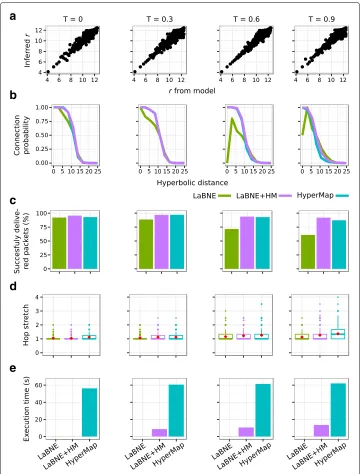
rt = 2 lnt that depend on their birth-timet. This means that the probability of find-ing a node that is close to the centre of the hyperbolic circle containfind-ing the network, is exponentially lower than the probability to find a peripheral node (Alanis-Lobato and Andrade-Navarro 2016). When a new node is added to the system and the existing ones change their radial position according tors(t) = βrs+(1−β)rt, withβ = 1/(γ −1), their seniority is attenuated by increasing their distances to every newly added node (Papadopoulos et al. 2012). Consequently, LaBNE, HyperMap and LaBNE+HM obtain radial coordinates for theNnodes in a network viari=2βln(i)+2(1−β)ln(N), where nodesi = {1, 2,. . .,N}are the network nodes sorted decreasingly by degree. Figure 3a, Additional file 1: Figures S1a and S2a (γ = {2.5, 2.25, 2.75}respectively) show that this is a good strategy, as inferred radial coordinates are practically the same as the ones from the input networks.
To verify whether the similarity dimension is also properly inferred, we measured pair-wise hyperbolic distances between nodes, using the coordinates found by each technique, and computed the fraction of connected node pairs amongst all pairs separated by a cer-tain distance. When distances are short, this fraction should be close to 1, when they are long it should be close to 0. Figure 3b, Additional file 1: Figures S1b and S2b show that this is indeed the case for LaBNE+HM and HyperMap, but LaBNE’s coordinates suffer from the problems discussed in Fig. 1, especially in networks with lowc¯(highT).
a
b
c
d
e
Fig. 3Benchmarking on artificial networks (γ =2.5). Artificial networks withN=500 nodes, average node degree 2m=10, scaling exponentγ=2.5 and temperatureT= {0, 0.3, 0.6, 0.9}were embedded to hyperbolic space with LaBNE, HyperMap and LaBNE+HM.aReal vs inferred radial coordinates in the four networks. Only LaBNE’s coordinates are shown, because all the methods follow the same strategy to infer them.bConnection probabilities as a function of hyperbolic distances measured with the coordinates inferred by each method.cGreedy routing efficiency when the inferred hyperbolic coordinates are used as addresses to send packets between 1000 randomly selected source-target pairs.dHop stretch of successful packet deliveries for the considered source-target pairs. Red diamonds indicate the average hop stretch.e Time needed by each method to embed the networks to hyperbolic space
Finally, we recorded the amount of time required by each embedding technique to map the considered networks intoH2. From Fig. 3e, Additional file 1: Figures S1e and S2e, we
Performance in real networks
Given the accuracy and time performance achieved by LaBNE+HM in artificial networks, we used it to infer the hyperbolic coordinates of nodes in three real ones (see Table 1 and Methods) and repeated the analyses of the previous section. As already discussed, the width of the window used by the HyperMap part of LaBNE+HM depends on the quality of the embedding produced by LaBNE, which is better if the input network has high clustering and average node degree. Consequently, the three real networks analysed here were chosen to investigate the performance of LaBNE, HyperMap and LaBNE+HM in the low, medium and high clustering coefficient scenarios (see Table 1). Furthermore, these datasets represent complex systems from different domains: the high quality human protein interactome (PIN) models the relationships between proteins in the human cell (lowc¯, highT), in the Pretty-Good-Privacy network (PGP) users share encryption keys with people they trust (medium¯candT) and the US airport network (AIR) connects cities in the US if there is a flight between them (high¯c, lowT). The Methods and Additional file 1: Figure S3 describe how temperatures were determined for each network, based on their actual clustering coefficients. Taking the obtained temperatures as a reference, in order to apply LaBNE+HM on the three real networks we considered windowsw=5π/3 radians (300◦) for the PIN,w = π/4 radians (45◦) for the PGP andw = π/12 radians (15◦) for the AIR (see Methods for strategies to choosew).
In the PS model, radial coordinates are directly proportional to node birth-times, i.e. if a nodeiis close to the origin of the hyperbolic circle (ri →0), it means that it was born early in the evolution of the complex system (Papadopoulos et al. 2012). We could not test if this is the case in the PGP or the AIR, as the considered network snapshots lack node birth-time information. However, it was possible to deduce approximate birth-times for the proteins of the PIN (see Methods). Node radial coordinates inferred by LaBNE, HyperMap and LaBNE+HM were compared to actual protein birth-times and, as shown in Additional file 1: Figure S4, nodes that are close to the centre of the hyperbolic space are older than peripheral ones. This shows that, even when the identity of the network nodes is unknown, we can have an idea of their history in the system under study, based merely on their degree and, consequently, their inferred radial positions.
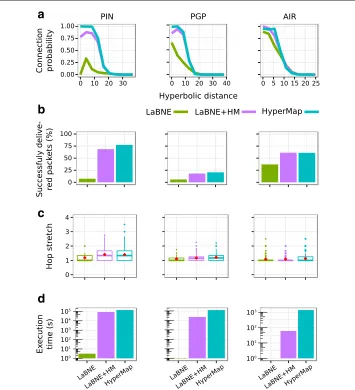
When it comes to connection probabilities, navigation efficiency and greedy path opti-mality, the results on real networks agree with what we observed in the previous section. LaBNE struggles with performing a good embedding of the PIN (lowc¯), but improves in the PGP and the AIR (medium and high¯c). This is reflected in the low connection proba-bility at short hyperbolic distances and the poor routing efficiency in the protein network, whereas these indicators are better in the other two systems (see Fig. 4a-c). HyperMap, on the other hand, is quite stable in all three cases, but it required days to complete the embeddings (see Fig. 4a-d). LaBNE+HM is in the middle of these two extremes, with
Table 1The three real networks analysed in this paper: the high quality protein interaction network (PIN), the Pretty-Good-Privacy web of trust (PGP) and the US airport network (AIR)
Network N L 2m γ c¯ T
PIN 10824 66154 12.22 2.66 0.18 0.77
PGP 14367 37900 5.28 2.14 0.47 0.43
AIR 500 2980 11.92 2.01 0.73 0.15
a
b
c
d
Fig. 4Benchmarking on real networks.aConnection probabilities as a function of hyperbolic distances measured with the coordinates inferred by each method.bGreedy routing efficiency when the inferred hyperbolic coordinates are used as addresses to send packets between 1000 randomly selected
source-target pairs.cHop stretch of successful packet deliveries for the considered source-target pairs. Red diamonds indicate the average hop stretch.dTime needed by each method to embed each real network to hyperbolic space
much better performance than LaBNE in terms of connectivity and greedy routing and shorter execution times in general (see Fig. 4a-d). It is also clear how the coordinates inferred by LaBNE impact LaBNE+HM’s results. In the PIN, it was necessary to probe for better angular coordinates in a very wide window, which in practical terms resulted in neglecting LaBNE’s angles and finding new ones from scratch, increasing execution time (see Fig. 4a-d). At the other extreme, the AIR does not need much angle refinement because the configuration passed on to HyperMap is already good, which derives in a very fast yet accurate embedding (see Fig. 4a-d).
the three analysed (Papadopoulos et al. 2012). In assortative networks, nodes of similar degrees tend to be connected, as opposed to disassortative networks, where high-degree nodes tend to connect with low-degree ones (Newman 2002). As shown by Krioukov and colleagues, heterogeneity is a key feature of more navigable networks, because rout-ing paths follow a zoom-in-zoom-out hierarchical pattern (Krioukov et al. 2010). They exhibit a greedy behaviour that takes a packet from a source node towards the centre of the hyperbolic space, where high-degree nodes lie (zoom-out coarse grain search). These nodes at the top of the network hierarchy process and ship the packet back to the periph-ery of the hyperbolic plane, towards low-degree nodes, until the packet reaches its target (zoom-in fine grain search) (Boguñá et al. 2009; Cannistraci et al. 1613; Krioukov et al. 2010). In an assortative network, this hierarchy is less clear and a packet may get stuck on its way to the target, reducing routing efficiency.
Interestingly, in the AIR, with all the characteristics of a navigable network (high hetero-geneity, clustering and disassortativity), routing efficiency only reaches 61 % (see Fig. 4b). Since this network is comprised of only the 500 busiest airports in the US, from a total of 19512 airport facilities listed by the Federal Aviation Administration (http://www.faa. gov/), the over-representation of hub airports can lead to packets being unable to leave them and reach their less-connected peripheral targets.
Conclusions
Scale-invariance, self-similarity and strong clustering, properties present in com-plex systems and geometric objects alike, have led to the proposal that the net-work representations of the former lie on a geometric space, where distance con-straints play important roles in the formation of links between system components (Boguñá et al. 2009; Cannistraci et al. 2013b; Krioukov et al. 2010; Papadopoulos et al. 2012). Our results and those of others support the idea that hyperbolic space is a good candidate to host complex networks, as it allows for the precise description of their for-mation and function (Alanis-Lobato et al. 2016; Krioukov et al. 2010; Papadopoulos et al. 2012; Papadopoulos F et al. 2015b; Papadopoulos et al. 2015a).
In consequence, efficient methods to embed networks into this space are needed. In this article we exploit the strengths of two such methods, LaBNE and HyperMap, to quickly obtain accurate embeddings of artificial and real networks. Although it is difficult to val-idate this claim in the latter case, we have tested the performance of these embedding techniques from a node birth-time, connectivity and navigability perspective. Further-more, we have shown that good embeddings to H2 are possible in a short amount of time, especially in heterogeneous, dense and strongly clustered networks. Our work also highlights the strengths and limitations of LaBNE and HyperMap, and their impact on LaBNE+HM, the proposed hybrid approach that takes LaBNE’s embeddings and refines them with HyperMap.
et al. 2010; Papadopoulos et al. 2012) and facilitates their visual inspection and analysis. This prompts us to further improve existing hyperbolic mapping techniques, as massive networks with billions of nodes become more and more common in the age of Big Data.
Methods
The PS model
The PS model (Papadopoulos et al. 2012) on the hyperbolic plane of curvatureK= −1 is formulated as follows: (1) initially the network is empty; (2) at timet ≥1, a new nodet
appears at coordinates(rt,θt)withrt=2 lntandθtuniformly distributed on [0, 2π], and every existing nodes<tincreases its radial coordinate according tors(t)=βrs+(1−β)rt withβ=1/(γ−1)∈[0, 1]; (3) new nodetpicks a randomly chosen nodes<tthat is not already connected to it and links with it with probabilityp(xst) = 1/1+e(xst−Rt)/2T, where parameter T, the network temperature, controls the network’s clustering coef-ficient, Rt = rt −2 ln
2T(1−e−(1−β)rt/2)
m(1−β)sin(πT)
is the current radius of the hyperbolic circle containing the network,xst = rs+rt+2 ln(θst/2) is the hyperbolic distance between nodessandtandθstis the angle between the nodes; (4) repeat step 3 until nodetgets connected tomdifferent nodes; (5) repeat steps 1-4 until the network is comprised ofN
nodes. Note that ifT →0,Rt= rt−2 ln
2(1−e−(1−β)rt/2)
πm(1−β)
. In addition, ifβ =1, existing
nodes do not change their radial coordinates andRt=rt−2 ln
Trt
msin(πT)
.
HyperMap
HyperMap (Papadopoulos F et al. 2015b) is a Maximum Likelihood Estimation method to embed a network to hyperbolic space. It finds node coordinates by replaying the network’s hyperbolic growth and, at each step, maximising the likelihood that it was produced by the PS model (Papadopoulos F et al. 2015b). For embedding to the hyperbolic plane of curvatureK = −1 it works as follows: (1) nodes are sorted decreasingly by degree and labelled i = {1, 2,. . .,N} from the top of the sorted list; (2) node i = 1 is born and assigned radial coordinater1 = 0 and a random angular coordinateθ1 ∈[0, 2π]; (3) for
each nodei= {2, 3,. . .,N}: (3.1) nodeiis born and assigned radial coordinateri=2 lni; (3.2) the radial coordinate of every existing nodej < iis increased according torj(i) = βrj+(1−β)ri; (3.3) nodeiis assigned the angular coordinateθimaximising the likelihood Li
L =
1≤j<ip(xij)αij(1−p(xij))1−αij.βandp(xij)are defined as in the PS model andαij is 1 if nodesiandjare connected and 0 otherwise. The maximisation ofLiLis performed numerically by trying different values ofθin [0, 2π], separated by intervalsθ =1/i, and then choosing the one that produces the greatestLiL.
Since the angular coordinates yielded by this link-based likelihood are not very accu-rate for smalli(i.e. for high degree nodes) (Papadopoulos F et al. 2015b), the fast version of HyperMap used in this paper uses information on the final number of common neigh-bours between these old nodes via the maximisation of the log-likelihood lnLiCN =
(i−1)ln√1
2π −
i−1
j=1lnσ (i,j,θi,θj)− ij=−11
ntij−μ(i,j,θi,θj)
2σ2(i,j,θi,θj) , whereμis the mean number of
for the finalθiwithin a small region aroundθiinit. The fast hybrid version of HyperMap with kspeedup = 10 is the one used throughout this work and is the one that refines LaBNE’s embeddings in LaBNE+HM. We refer the reader to (Papadopoulos et al. 2015a) for more details on the speed-up heuristic and the derivation ofLiCN. Finally, even when correction steps can be used together with the fast hybrid HyperMap, their effect on this method has been reported not to be significant (Papadopoulos et al. 2015a) and they are not considered here.
LaBNE
Let us consider only undirected, unweighted, single-component networks, as LaBNE is only applicable to such networks (Alanis-Lobato et al. 2016; Belkin and Niyogi 2001). Moreover, let us assume that these networks are scale-free (with scaling exponentγ ∈ [2, 3]) and have a clustering coefficient c¯ that is significantly bigger than expected by chance. These networks are graphs G = (V,E) with N = |V| nodes and L = |E|
edges connecting them. An undirected, unweighted graph can be represented by an
N×Nadjacency matrixAi,j = Aj,i ∀i,j, whose entries are 1 if there is an edge between nodes i and j and 0 otherwise. The graph Laplacian is a transformation of A given by L = D− A, where D is a matrix with the node degrees on its diagonal and 0 elsewhere.
The Laplacian-based embedding of a complex network to the two-dimensional hyper-bolic planeH2, represented by the interior of a Euclidean circle (Krioukov et al. 2010), is given by theN×2 matrixY=[y1,y2] where theith row,Yi, provides the embedding coor-dinates of nodei. This corresponds to minimising12 i,jAi,j||Yi−Yj||2=tr(YTLY), which reduces toYemb = minYTDY=Itr(YTLY)withDas defined above,Ithe identity matrix,
MTthe transpose ofMand tr(M)the trace ofM. Finally,Yemb, the matrix that minimises this objective function, is formed by the two eigenvectors with smallest non-zero eigen-values that solve the generalised eigenvalue problemLY=λDY(see (Alanis-Lobato et al. 2016) for a detailed derivation of this result).
To complete the mapping to H2, angular node coordinates are obtained via θ =
arctan(y2/y1)and radial coordinates are chosen so as to resemble the rank of each node
according to its degree. This is achieved viari =2βln(i)+2(1−β)ln(N), where nodes
i= {1, 2,. . .,N}are the network nodes sorted decreasingly by degree andβ=1/(γ−1) (Krioukov et al. 2010; Papadopoulos et al. 2012). Finally, to further refine the embedding, angular coordinates are re-adjusted by spreading them uniformly in [0, 2π], based on the order of the angles inferred initially.
The strategy followed by LaBNE is valid, because the native representation ofH2, in
which the hyperbolic space is contained in a Euclidean disc and Euclidean and hyper-bolic distances from the origin are equivalent, is a conformal model. This means that Euclidean angular separations between nodes are equivalent to hyperbolic ones (Krioukov et al. 2010). On the other hand, the radial arrangement of nodes corresponds to a quasi-uniform distribution of radial coordinates in the disc (Krioukov et al. 2010; Alanis-Lobato and Andrade-Navarro 2016).
Network datasets
The high-quality protein interaction network (PIN) is a stringent subset of the Human Integrated Protein-Protein Interaction rEference (HIPPIE) (Schaefer et al. 2012; Alanis-Lobato et al. 2016). HIPPIE retrieves interactions between human proteins from major expert-curated databases and calculates a score for each one, reflecting its combined experimental evidence. This score is a function of the number of studies support-ing the interaction, the quality of the experimental techniques used to measure it and the number of organisms in which the orthologs of the interacting human pro-teins interact as well. In this paper, only interactions with confidence scores ≥ 0.72 (the upper quartile of all scores) in release 2.0 were considered. The raw version of this network is available at http://cbdm-01.zdv.uni-mainz.de/~mschaefer/hippie/ download.php. To determine the birth-time of the PIN nodes, proteins from the man-ually curated database SwissProt were clustered based on near full-length similarity and/or high threshold of sequence identity using FastaHerder2 (Mier and Andrade-Navarro 2016). If proteins from two evolutionarily distant organisms are present in one cluster, this suggests that the protein family is ancient. The minimum common taxonomy from all proteins that are part of a cluster was taken as an indication of the cluster’s age. Each node of the PIN was assigned to one of the following age clusters: Cellular organisms, Metazoa, Chordata, Mammalia, Euarchontoglires or Primates.
Pretty-Good-Privacy (PGP) is a data encryption and decryption program for secure data communication. In a PGP web of trust, each user (node) knows the public key of a group of people he trusts. When user A wants so send information to user B, this infor-mation is encrypted with B’s public key and signed with A’s private key. When B receives the information, he verifies that the message is coming from one of the users he trusts and decrypts it with his private key (Schneier 1996). This encryption and decryption event, forms a directed link between users A and B. In this article, however, the edge direc-tionality of this network is not considered. This is not a problem for the interpretation of the network if we assume that by sharing a key, two users reciprocally endorse their trust in each other (Papadopoulos et al. 2012). From the four temporal snapshots of the undirected PGP network collected by Jörgen Cederlöf (Cederlöf 2003), only the one cor-responding to the period between April and October 2003 was used here. The raw PGP data is available at http://www.lysator.liu.se/~jc/wotsap/wots2/.
The airport network (AIR) corresponds to the connections between the 500 busiest commercial airports in the United States. Two airports are linked if there was a flight scheduled between them in 2002. This dataset was used in (Colizza et al. 2007) and is available at http://opsahl.co.uk/tnet/datasets/USairport500.txt or https://sites.google. com/site/cxnets/US_largest500_airportnetwork.txt.
Real network temperature determination
aT for each real network, based on its clustering coefficient (see Table 1 and Additional file 1: Figure S3).
Choice of window size in LaBNE+HM
The windowswused in the artificial and real networks analysed in this paper were chosen based on their clustering coefficients, determined temperatures and the performance of LaBNE when applied to them. Although we consider the latter as a very good point of reference to decide on window widths, given the speed of LaBNE, a more automated and fast strategy would be to consider a linear or quadratic relationship betweenwand temperatureT ∈[0, 1],w =2πT orw = 2πT2for example. Note that this might result in windows wider than needed and slower LaBNE+HM embedding times, but it would produce very good and refined mappings in most cases.
Hardware used for experiments
All the experiments presented in this paper were executed on a Lenovo ThinkPad 64-bit with 7.7 GB of RAM and an Intel Core i7-4600U CPU @ 2.10 GHz×4, running Ubuntu 16.04 LTS. The only exceptions were the packet delivery and the connection probabil-ity experiments, which were executed on nodes with 30 GB of RAM, within the Mogon computer cluster at the Johannes Gutenberg Universität in Mainz.
Additional file
Additional file 1:Supplementary information. (PDF 539 kb)
Acknowledgements
The authors would like to thank the Zentrum für Datenverarbeitung at the Johannes Gutenberg Universität in Mainz, which made the analysis of big networks possible in the Mogon computer cluster.
Availability of data and materials
R implementations of the PS model and LaBNE are available at http://www.greg-al.info/code, together with an R/C++ implementation of LaBNE+HM. The network data used in this paper and the hyperbolic coordinates of their nodes are also available at the same website. The C++ implementation of the fast version of HyperMap used here is available at https://bitbucket.org/dk-lab/2015_code_hypermap.
Authors’ contributions
GAL created LaBNE and LaBNE+HM, designed, implemented and carried out the experiments. PM was in charge of the protein age assignment. MAAN supervised the research. GAL wrote the manuscript, incorporating comments, contributions and corrections from PM and MAAN. All authors read and approved the final manuscript.
Competing interests
The authors declare that they have no competing interests.
Received: 1 September 2016 Accepted: 25 October 2016
References
Alanis-Lobato G, Andrade-Navarro MA (2016) Distance distribution between complex network nodes in hyperbolic space. Complex Syst 25(3):223–236
Alanis-Lobato G, Andrade-Navarro MA, Schaefer MH (2016) HIPPIE v2.0: enhancing meaningfulness and reliability of protein-protein interaction networks. Nucleic Acids Research. doi:10.1093/nar/gkw985
Alanis-Lobato G, Mier P, Andrade-Navarro MA (2016) Efficient embedding of complex networks to hyperbolic space via their Laplacian. Sci Rep 6:30108. doi:10.1038/srep30108
Aste T, Di Matteo T, Hyde S (2005) Complex networks on hyperbolic surfaces. Physica A 346(1-2):20–26
Aste T, Gramatica R, Di Matteo T (2012) Exploring complex networks via topological embedding on surfaces. Phys Rev E 86(3):036109. doi:10.1103/PhysRevE.86.036109
Barabási AL, Albert R (1999) Emergence of scaling in random networks. Science 286:509–512 Barthélemy M (2011) Spatial networks. Phys Rep 499(1-3):1–101. doi:10.1016/j.physrep.2010.11.002
Boguñá M, Krioukov D, Claffy KC (2009) Navigability of complex networks. Nat Phys 5(1):74–80. doi:10.1038/nphys1130 Cannistraci CV, Alanis-Lobato G, Ravasi T (1613) From link-prediction in brain connectomes and protein interactomes to
the local-community-paradigm in complex networks. Sci Rep 3. doi:10.1038/srep01613
Cannistraci, CV, Alanis-Lobato G, Ravasi T (2013b) Minimum curvilinearity to enhance topological prediction of protein interactions by network embedding. Bioinformatics 29(13):i199–i209. doi:10.1093/bioinformatics/btt208 Cayton L (2005) Algorithms for manifold learning. UCSD tech report CS2008-0923:1–17. http://www.lcayton.com/
resexam.pdf. Accessed 30 Mar 2016
Cederlöf J (2003) The OpenPGP web of trust. http://www.lysator.liu.se/~jc/wotsap/wots2/. Accessed 08 Sept 2015 Colizza V, Pastor-Satorras R, Vespignani A (2007) Reaction–diffusion processes and metapopulation models in
heterogeneous networks. Nat Phys 3:276–282. doi:10.1038/nphys560
Dall J, Christensen M (2002) Random geometric graphs. Phys Rev E 66(1):016121. doi:10.1103/PhysRevE.66.016121 Ferretti L, Cortelezzi M (2011) Preferential attachment in growing spatial networks. Phys Rev E 84(1):016103.
doi:10.1103/PhysRevE.84.016103
Goh KI, Salvi G, Kahng B, Kim D (2006) Skeleton and fractal scaling in complex networks. Phys Rev Lett 96(1):018701. doi:10.1103/PhysRevLett.96.018701
Kleinberg R (2007) Geographic routing using hyperbolic space. In: INFOCOM 2007. 26th IEEE International Conference on Computer Communications. IEEE Computer Society, Washington, DC. pp 1902–1909. doi:10.1109/INFCOM.2007.221 Krioukov D, Papadopoulos F, Kitsak M, Vahdat A, Boguñá M (2010) Hyperbolic geometry of complex networks. Phys Rev E
82(3):036106. doi:10.1103/PhysRevE.82.036106
Kuchaiev O, Rašajski M, Higham DJ, Pržulj N (2009) Geometric De-noising of protein-protein interaction networks. PLoS Comput Biol 5(8):e1000454. doi:10.1371/journal.pcbi.1000454
Mier P, Andrade-Navarro MA (2016) FastaHerder2: four ways to research protein function and evolution with clustering and clustered databases. J Comput Biol 23:270–278. doi:10.1089/cmb.2015.0191
Newman M, Peixoto TP (2015) Generalized communities in networks. Phys Rev Lett 115(8):088701. doi:10.1103/PhysRevLett.115.088701
Newman MEJ (2002) Assortative Mixing in Networks. Phys Rev Lett 89(20). doi:10.1103/PhysRevLett.89.208701 Papadopoulos F, Krioukov D, Boguñá M, Vahdat A (2010) Greedy forwarding in dynamic scale-free networks embedded
in hyperbolic metric spaces. In: INFOCOM, 2010 Proceedings IEEE. IEEE Press, Piscataway, NJ. pp 1–9. doi:10.1109/INFCOM.2010.5462131
Papadopoulos F, Kitsak M, Serrano MA, Boguñá M, Krioukov D (2012) Popularity versus similarity in growing networks. Nature 489(7417):537–540. doi:10.1038/nature11459
Papadopoulos F, Aldecoa R, Krioukov D (2015a) Network geometry inference using common neighbors. Phys Rev E 92(2):022807. doi:10.1103/PhysRevE.92.022807
Papadopoulos F, Psomas C, Krioukov D (2015b) Network mapping by replaying hyperbolic growth. IEEE ACM T Netw 23(1):198–211. doi:10.1109/TNET.2013.2294052
Schaefer MH, Fontaine JF, Vinayagam A, Porras P, Wanker EE, Andrade-Navarro MA (2012) HIPPIE: integrating protein interaction networks with experiment based quality scores. PLoS ONE 7(2):e31826. doi:10.1371/journal.pone.0031826 Schneier B (1996) Applied cryptography. John Wiley & Sons, NJ, USA
Serrano MA, Krioukov D, Boguñá M (2008) Self-similarity of complex networks and hidden metric spaces. Phys Rev Lett 100(7):078701. doi:10.1103/PhysRevLett.100.078701
Shaw B, Jebara T (2009) Structure preserving embedding. In: Proceedings of the 26th Annual International Conference on Machine Learning. ACM, New York. pp 937–944
Song C, Havlin S, Makse HA (2006) Origins of fractality in the growth of complex networks. Nat Phys 2(4):275–281. doi:10.1038/nphys266
Tenenbaum JB (2000) A global geometric framework for nonlinear dimensionality reduction. Science 290(5500):2319–2323. doi:10.1126/science.290.5500.2319
You ZHH, Lei YKK, Gui J, Huang DSS, Zhou X (2010) Using manifold embedding for assessing and predicting protein interactions from high-throughput experimental data. Bioinformatics 26(21):2744–2751.
doi:10.1093/bioinformatics/btq510
Zemel RS, Carreira-Perpiñán MA (2004) Proximity graphs for clustering and manifold learning. Adv Neur I(17):225–232
Submit your manuscript to a
journal and benefi t from:
7Convenient online submission
7Rigorous peer review
7Immediate publication on acceptance
7Open access: articles freely available online
7High visibility within the fi eld
7Retaining the copyright to your article