Volume-5 Issue-1
International Journal of Intellectual Advancements and
Research in Engineering Computations
Unguided bulletin board using digital cellular technology
Ramya.K.V1, Surya devi.K2, Prasanth.V3, Tamil Prabhu.G4, Monica.R5
1,2,3,4, Students, Department of ECE, Nandha Engineering College, Tamil Nadu, Erode, India
5, Assistant professor, Department of ECE, Nandha Engineering College, Tamil Nadu, Erode, India
ABSTRACT:
This project deals with displaying
information’s in colleges on electronic notice
board by sending SMS through mobile phones. It
is a wireless transmission system which has very
less errors and maintenance since, wireless
transmission medium is used for data
transmission in various areas. The hardware
board contains Raspberry pi which is
programmed by python. The Raspberry pi is
interfaced with GSM Modem and a monitor. Any
authorized user can send a message from mobile
phone; this message will be received by GSM
receiver Modem which is placed at the receiver
side. GSM SIM900 sends the message to the
raspberry pi and this message will be finally
displayed in the notice board through monitor.
Thismethod is almost a fastest way to display the
information instantly.
Keywords: GSM module, Raspberry pi, Python
1. INTRODUCTION:
The aim of this project is to develop
a wireless notice board that will be used to
display latest information regarding various
notifications. This system can be
implemented in many important places
where latest information can be displayed.
For example if implemented in colleges all
information for students can be displayed.
It is very convenient for students and
college management to display any
information. In the existing method the
message is sent and received by RF
technology that offers flexibility to control
the notice board within a range of 25
meters. The input is connected to the
electronic notice board by using RF
technology. GSM which is an easily
available wireless technology suitable for
short, medium and long range wireless
communication. It emphasizes the method
of transmitting a notice in the form of short
message service via mobile and receiving
that message by Raspberry pi through GSM
module hardware and displaying the
received message. This project, with an aim
to increase the usability of electronic notice
boards, it deals with wireless reception and
display of messages using Raspberry pi.
Practically, all output resolutions are
supported. The font size is customizable
and it can display multiple notices at a
time.
Wireless e-notice board is a perfect
replacement of paper notice board
providing easy maintenance, portability and
access. Also, the wired communication
faces a lot of shortcomings such as need of
hard wiring, BER (bit error rate) at high
transmission speed due to wire line
capacitance, high cost, high maintenance
and short coverage.
2. PROPOSED SOLUTION:
The system is comprised of both software
and hardware. Software area includes the
python programming. The hardware area
includes the development of receiver
hardware using Raspberry pi and its
configuration with GSM modules. The
developed system reflects the minimum
requirements to realize the wireless notice
board. The notice to be displayed is sent as a
Short Message Service (SMS). The Global
System for Mobile Communications (GSM)
network is digital. This makes it immune to
noise. Also, GSM networks are relatively
free of errors.
The system has the following
sections-
Fig 2.1: Block diagram
1. Since GSM network is being used,
the information can be sent from any
location and it will be displayed on
the screen.
2. This SMS is received by the GSM
modem and it is stored in the
Subscriber Identity Module (SIM)
memory. The GSM modem is polled
at regular intervals by the Raspberry
pi for a new message.
3. This is accomplished by the means
of establishing serial communication
between the Raspberry Pi and the
4. The GSM modem has an RS232 port
while the Raspberry pi has a USB
port. The conversion of signal from
RS232 levels to USB compatible
levels is done using integrated circuit
Microchip MCP2200.
5. To interact with computers
(Raspberry pi in this case), modems
need Attention (AT) commands. The
Raspberry Pi sends AT commands to
the GSM Modem.
In response, the SMS stored in the
SIM memory is transmitted by the
GSM modem. The Raspberry pi after
decoding the received data sends it to
the display.
6. The Raspberry pi has two video
output options – composite (Radio
Corporation of America - RCA) and
High-Definition Multimedia
Interface (HDMI).
7. Display screens with VGA port can
also be used by using HDMI OUT of
the Raspberry pi with a HDMI to
Video Graphics Array (VGA)
convertor.
8. Therefore, the proposed method is
versatile with respect to display
options.
9. The operating system used in
Raspberry pi is Raspbian.
10.The most popular programming
language for Raspberry Pi is Python.
It is a high-level language and thus
lesser coding effort is needed as
compared to using assembly
language for other microcontroller
boards.
11.Thus, the method proposed in this
paper has several advantages over
the prevalent methods used to offer
the same functionality.
3. SYSTEM OVERVIEW:
1. HARDWARE MODULE:
GSM Based Digital Notice Board
has following blocks
A. Mobile phone
B. GSM MODEM
C. Raspberry pi 3 model B+
D. Power Supply
E. Monitor
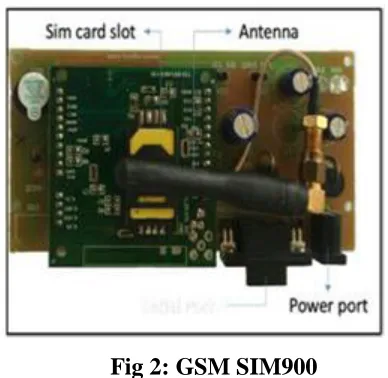
1. GSM Modem:
GSM Modem with Sim900 module is
built with Dual band GSM/GPRS. It works
on frequencies 900 1 1800 MHz. It has a
variable baud rate with range from 9600 to
115200. Baud rate can be configurable using
AT commands. It operates on 12V regulated
power supply. It has a SIM card slot to insert
SIM and a receiving antenna to receive
network signals. It has RS232 interface
Raspberry Pi, microcontroller etc. This
module can perform the basic functions of a
mobile phone like receiving and sending
SMS, voice calls, and TCP/IP
communication over GPRS based on various
AT commands.
Fig 2: GSM SIM900
Fig 3.1. Raspberry pi 3 model B+:
Raspberry Pi is a single board
computer. This board is as small as a credit
card size, cost effective when compared to
an actual computer, uses power rating of 5V,
700mA and it weighs not more than 50g.
Raspberry Pi board [11] comes in three
models A, B, B+. B+ is the advanced
version of the three. B+ model comes with
512 MB RAM. It runs on ARM 11
processor typically operates at 700MHz
frequency. It has a SD card slot for installing
a bootable Operating System using SD card.
Operating Systems like Raspbian, Pidora,
Raspbmc etc can be installed. It has four
USB2.0 ports to connect to devices like
keyboard, mouse, Wi-Fi adapter etc.,
according to our use to make it a full size
computer. It has an Ethernet port to connect
to network. GPIO pins are used to interface
and control LEDs, switches, sensors and
other devices. With the help of HDMI port,
all kinds of monitors like LCD screens,
projectors, TVs also can be connected.
Fig 3.2: Raspberry pi 3 model B+
3. Power supply:
Power supply is the source of electrical
power. Normally any electronic circuit uses
+5v DC power for its regular working .User
can directly built +5v Dc power supply
using 4 diodes, filter capacitors and
regulator IC-7805(Integrated Circuit)or can
directly purchase a +5v DC power adopter
from the local market.
4. Monitor:
A computer monitor or a computer display
computers. A monitor usually comprises
the display device, circuitry, casing, and
power supply. The display device in
modern monitors is typically a thin film
transistor liquid crystal display (TFT-LCD)
or a flat panel LED display, while older
monitors used a cathode ray tubes (CRT). It
can be connected to the computer via VGA,
DVI, HDMI, DisplayPort, Thunderbolt,
LVDS (Low-voltage differential signaling)
or other proprietary connectors and signals.
2. SOFTWARE:
It mainly consists of programming
language used for coding the Raspberry Pi
board and GSM modem. Python language is
used for coding raspberry pi board and AT
commands is used to operate GSM modem.
A. Python
B. AT commands
A. Python:
Python is a widely used general
purposed high level programming language.
Its design philosophy emphasizes code
readability. It is used to code raspberry pi
model
B. AT Commands:
AT commands are used to control
MODEMs. AT is abbreviation for attention.
These commands come from Hayes
commands used by Hayes smart modems.
The dial up and wireless MODEMs need AT
commands to interact with computers. In
this project it is used to operate the GSM.
Table 3.1: AT Commands
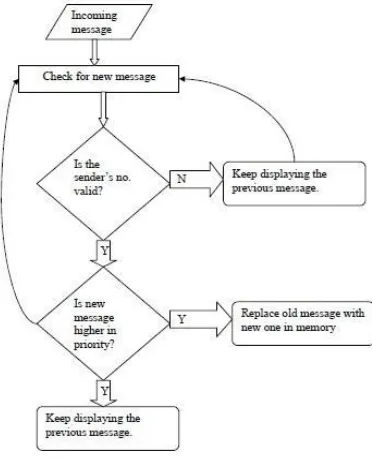
4. FLOW CHART OF E-NOTICE
BOARD:
The operational flowchart of GSM
based e-notice board is as follows:
5. ADVANTAGES:
1. Digital notice board can reduce use
of papers and hence deforestation
can be turned into afforestation.
2. It can reduce physical effort of
printing and distributing paper based
notices.
3. It can spread among more people in
lesser time since large screen display
is used.
6. CONCLUSION:
This paper presents a way to display
messages in Monitor. It offers an edge over
other notice boards because of features such
as customizable font size, color and
background color. The size of the screen, a
major limitation of other methods, is
overcome by this system.
7. Future Work:
Message is displayed in text format
in the proposed system. Future work
includes the display of message in the image
format and documents in the monitor.
8. REFERENCES:
1. R. Teymourzadeh, S. Ahmed, K. W.
Chan, and M. V. Hoong, “Smart gsm based home automation system,” in Systems, Process Control (ICSPC), 2013 IEEE Conference on, Dec 2013, pp. 306–309.
2. G. Cao, T. Xu, T. Liu, Y. Ye, and G. Xu, “A gsm-based wireless remote
controller,” in Electronics,
Communications and Control
(ICECC), 2011 International
Conference on, Sept 2011, pp. 2413– 2416.
3. Bollen, L., Eimler,S. and Hoppe, H.U. “SMS-based Discussions – Technology Enhanced Collaboratifoa Literature Course”. In Proceedings of the 2nd IEEE International Workshop on Wireless and Mobile Technologies in Education, 24- 27 May 2004, Germany, pp. 1-2, 2004
4. Pawan Kumar, Vikas Bhardwaj,
Narayan Sing Rathor, Amit Mishra,
GSM Based e-Notice
Board:Wireless Communication.
ISSN: 2231-2307, Volume-2, Issue-3, July 2012
5. Prachee U. Ketkar, Kunal P. Tayade, Akash P. Kulkarni, Rajkishor M. Tugnayat: “ GSM Mobile Phone
Based LED Scrolling Message
Display System”, International
Journal of Scientific Engineering and Technology Volume 2 Issue 3; PP : 149-155
6. Jeff Brown, Bill Shipman and Ron Vetter, “SMS: The Short Message Service”, IEEE Computer Society, pp.106-111, December.
7. QianXu, Evan Wei Xiang, Qiang
Yang, Jiachun Du, JiepingZhong, Agamanolis.S “SMS Spam Detection Using Noncontent Features”, IEEE Computer Society, pp.44-51, (2012). 8. Shruthi K., “Smart Notice Board”, in
Coming Decades (CRT 2013), National Conference on Challenges, IET, 27-28 Sept. 2013, pp. 1-4 9. IEEE paper by A Gaikwad Wireless
Electronic Notice Board ... paper, printer ink, man power and also brings about loss of time (IEEE 802.15.3), Zig- Bee (over IEEE 802.15.4).
10.Safaric, S.; Malaric, K;XBEE
Wireless Standard , IEEE
International conference on
Multimedia Processing and Communications, March 2006. 11.J. S. Lee, Y. W. Su, and C. C. Shen,
”A Comparative Studyof Wireless
Protocols: Bluetooth, UWB, XBEE , and Wi-Fi”,Proceedings of the 33rd Annual Conference of the IEEE Industrial Electronics Society (IECON), pp. 46-51, November 1, 2007.