Pages 367-371
1. Bousquet 1992. We are grateful to Nancy Bookidis for providing photographs and for permission to include them here, as well as to P. E. Easterling, Mark Landon, Eliz- abeth Pemberton, and Joyce Reynolds for a number of helpful suggestions and observations. Our thanks also to the anonymous referees of Hesperia for their comments.
2. Corinth I, iv, p. 64. Kantharos C-34-397. Diam. lip 0.114 m. Broneer 1935, pp. 71-72, fig. 15b (photographs of sides A and B); Corinth I, iv, pp. 63- 64, fig. 41 (drawing of decoration from above); Corinth VII, iii, pp. 85-86, no. 489, pls. 39, 42 (drawing of in- scription; the shape not illustrated).
3. On such kantharoi and their sequence, see Corinth XVIII, i, pp. 34-36. The deposit is Corinth VII, iii, pp. 224-225,no. 94, which is now referred to as Corinth Fill 1934-1.
4. Corinth XVIII, i, p. 3.
A
LITERARY
QUOTATION
ON A
POT
IN CORINTH
ABSTRACT
An extended graffito on a Hellenistic kantharos at Corinth seems to express a topos of greeting, quite likely in the form of a classic quotation from Euripides,just as we might quote Shakespeare today, whether or not we know the formal origin of the expression. The graffito forms another item of evi- dence for the currency of theater among many sections of Hellenistic society, not least in the context of the symposium.
A recent observation by Jean Bousquet that a young stonemason practic- ing his letters at Delphi sometime near the beginning of the 3rd century
B.C. used lines of Euripides as his text should prompt us to be alert for other examples outside literary sources.' After all, we are told, all the world's a stage.
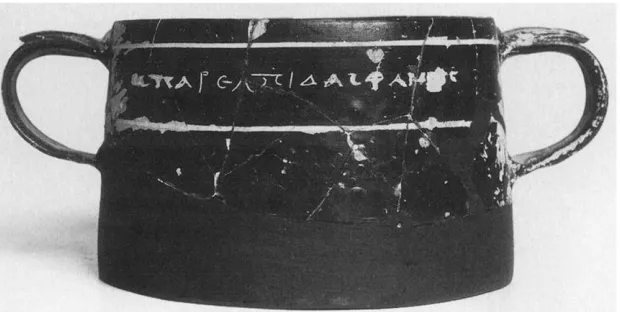
Another likely example indeed occurs on a kantharos from Corinth, already described by Oscar Broneer as "probably a quotation from a play."2 The vase is a kantharos of the so-called articulated type with ledged verti- cal handles (Fig. 1); it was found in a fill beneath the stairs of Shop I of the South Stoa.3 Its date is not as evident as one might have hoped. More recent research has suggested that G. R. Edwards's chronology for this material, proposed in Corinth VII, iii, was too high.4 The construction of the South Stoa is now placed at the end of the 4th century, and the deposit in which the vase was found represents a dumped fill dating from the Early Hellenistic period to 146 B.C. On stylistic grounds, the kantharos certainly dates to the 3rd century, but without a full profile it is difficult to say even whether it belongs to the earlier or later part, although our im- pression is that it should not be dated as early as the first quarter. As we shall see, the style of the script of the inscription would also suggest a date markedly after the beginning of the century.
The script is a well-formed rounded capital, reminiscent of a typical formal hand of the earlier Ptolemaic period. The text gives eleven letters of the alphabet: the alpha is made with a narrow left-hand loop, which tends to reduce, as in some book scripts, to a simple diagonal; the delta is quite small, the epsilon rounded, with its horizontal slightly detached, and the sigma is also rounded; the clearer specimen of the two pi's shows neatly
American School of Classical Studies at Athens is collaborating with JSTOR to digitize, preserve, and extend access to Hesperia
Figure 1. Inscribed kantharos from Corinth, C-34-397. Sides A and B.
? ; :,:-: .:::::
Courtesy Corinth Museum
curved verticals; the rho and phi are tall, projecting slightly above and below the bilineal norm, and with flattened curved parts (the bow of the rho is tinyS); the omega is almost cursive, with a double flattish curve. For parallels from around the middle of the 3rd century, one can mention PLit. Lond. 73, a fragment of a copy of Euripides, Hippolytus, together with a comparable hand in a contemporary letter, PCair. Zen. 57578, not before 261 B.C.6 It is easy to quote good later examples, such as the well-known
and well-illustrated Paris papyrus of Menander, Sikyonioi, assigned to the last third of the 3rd century B.C. (and most probably to near the end of it).7
On the other hand, projecting backward to a date as early as the end of the 4th century (the date of the earliest material in the deposit) for script of this style would be, palaeographically speaking, a leap into the dark. Indeed, it is a move one would much rather not make on the evidence of
5. The rho also needs some skill to 6. These two are respectively nos. 3a incise, not least in the medium of fired and 3b in Roberts 1955.
clay: Touo-cL -6 Too p IoxOYpov, "Tough, this 7. PSorb. inv. 2272-3 + 72, from rho," cries Mnesilochos when playing the Ghoran. Blanchard and Bataille 1965; role of Palamedes writing on wood, Ar. Turner 1987, no. 40.
the writing of the papyri that survive from this period.8 There is, however, cause to welcome a date in the 3rd century for the vase, and to welcome this specimen of script, small though it is, to its due place in the palaeo- graphical handbooks.9
This competent performance shown in the lettering is consistent with the nature of the text, which has the pattern of a half-line of iambic trimeter verse:
X icap ?X'tra& (pavesi
Hail to you, coming here beyond our hopes!
The other inscriptions on the kantharoi from the same or similar contexts are, as Broneer remarked, names of divinities or personified abstractions of the kind that might be invoked at drinking parties: for example, ALo; oaor-ipo;, Eipdovac, (LtXocg.'? This special cup, one imagines, was intended for a party given to celebrate someone's return from a long exile, say, or a distant journey, perhaps as a mercenary soldier. For the origin of the text, an interesting speculation offers itself from Menander. But there is some- thing else to notice first.
Broneer's diagnosis that our half-line comes from a play can be rein- forced by parallels that show that its tone is elevated above the level of ordinary everyday discourse, as is the emotion it seeks to express. A good example is Sophocles, Philoctetes 1445-1446, in anapaestic dimeters, where Philoktetes responds to the appearance of Herakles with the words o
(p0?yuIa Tro0ELVOv ?oL 7rCtacxtO; o6vL6oc T? (pavd(;; another can be found in
Electra's words to Orestes at Euripides, Electra 578 and following: o Xpo6vc
c(pav?i, Xo &aXTcoXs.... o' In a Hellenistic lyric, Helen, once rescued and
now abandoned by Menelaus, begins her lament with o ( pavEoi xdcpto
LotI, "You once came to me, my delight."'1 7tap' iXri8a is found at a level
of high style in tragedy, as at Aeschylus, Agamemnon 899 and Sophocles, Philoctetes 882, and Trap' iXTm8as in a lyric passage of comedy at Aris-
tophanes, Peace 794.
And Menander? Tco oo6[sevos (pavei;, cries the heroine of the play,
Krateia, to her long-separated father in Misoumenos (214 Sandbach/615 Arnott), continuing with 6pco d iv o6x av 6oYIv i8siv ?`t,, "I see you
though I would never have thought to see you more." Significantly, this is
8. As recently discussed by Maehler
(2001, pp. 50-57).
9. In Corinth VII, iii, p. 83, Edwards says that the inscription was incised before firing. The cursive style of the script implies that the incision of the letters was not intrinsically difficult, but Elizabeth Pemberton, Nancy Bookidis, and Ian McPhee put in a great deal of effort on our behalf to determine whether it was done before or after firing. Some chipping of the glaze is evident under a microscope, so, if incised before firing, it would have to
have been when the glaze/slip was well dried (as one might in any case assume); even the horizontal grooves of the decoration, presumably created on the wheel before firing, show some chipping. They report that there is also one inscription (C-50-24, Corinth VII, iii, no. 452) with pink (miltos) in the letters, which must originate before firing, but no other example like this exists at Corinth.
10. Broneer in Corinth I, iv, p. 64. For a recent collection of references on ypa[raxrtxa exrtc ax-a, see Arnott
1996, pp. 761-762 (on fr. 272). The genitive ("of the toast") is usual in such expressions: see Arnott 1996, pp. 181- 183 (on fr. 59). He omits the important reference to Corinth VII, iii, pp. 64-66 and p. 245, Index I. The design of this vase (with floral decoration on one side only), and others like it, implies that they were planned from the start with this purpose in mind, with the lip zone on the front left blank for the appropriate message.
again in the high style that Menander occasionally produces at moments of peak emotion, as in this recognition scene, and (very prominently) in the one at Perikeiromene 349-394.12
The question that presents itself, given the evidence of the kantharos from Corinth, is whether its half-line and Menander's are independent creations, or whether the two are related. If the two are related, a tenable and quite probable relationship would be that the half-line inscribed on the kantharos is from Euripides, recalled as a classic quotation by the per- son who inscribed or commissioned it, and by Menander (who must have expected his audience to be familiar with it). In each case, the effect is to make a memorable situation of the stage a paradigm for one from the world of everyday life, whether real or fictional. This, we think, is a genu- ine and interesting possibility.
We might have left it at that, but for encouragement from colleagues13 to remark on two other passages of related interest, which seem to be con- sistent with the possibility we raise. At Menander, Sikyonioi 280-311, a broken fragment of the Paris papyrus gives part of a recognition scene resembling the one quoted above from Perikeiromene. Judging from the remains, it has strict meter, and language appropriate to tragedy.14 Some verbal manifestations of the "Rover's Return" motif are also very striking: at 286, ]vI xc T6;6' [e,prcAs oCE, arcc, "I see you face to face, my child"
(compare Misoumenos, as quoted above); at 287, ;S rcap' ?X7tiac; at 293, the corresponding verb ] Xrcoaaoa T?; and at 300, ]Socq (pveiq. Though the broken text would accommodate ra rp' EAX cas cpocv6g at 287-288 and/or
at 300, there is no way to tell that it did, and short of further discovery one must be content, with Belardinelli, to note parallels in similarly emotional contexts in drama, including one from New Comedy in Latin at Plautus, Poenulus 1259-1260: salue, insperate nobis pater, te complecti nos sine; as Belardinelli remarks, interestingly, her one prose parallel, from Heliodorus, Aethiopica 10.13.1, is also from a recognition scene.15
Euripides remains hard to pin down. Another text that points in his direction, suggestively perhaps, but with no proof, are the words of a com- mentator elucidating the lyric lines of Phoenissae 310-311: iEL ico, L6LXt (pc0VWL; cX7CTCTa x&a6xYTCa arcp6o doXevalS. Jocasta is greeting the exiled
Polynices; Schwartz gives the words of the scholiast as follows: ic?XT'ca
x6C86xyTo'ra rap' XM8oca c(pcXve xOa aGr(Ooa8ox'tR)c EiS TaOC5 S'ag XcEpac;,
"O you who have come to my arms against hope and unexpectedly"; the form trap' sAirciO appears in the scholia given by Dindorf but not by
Schwartz.16 While it would hardly be difficult for a commentator on tragic
poetry to have arrived without prompting at his vocative 6 and his clarifi- cation of &aXTrcca ("unhoped"), it remains to be considered that he may
have drawn, consciously or not, on a phrase made memorable by a key context of his author in which it was once uttered.
This is not the place to pursue these issues further, although we may note, on the one hand, the well-known observation attributed to Aristophanes of Byzantium comparing Menander's imitation of life and life's use of Menander;17 and, on the other, the demonstrable way in which, already in the third quarter of the 4th century, well-known situations from the tragic theater were being used as points of reference by the people of Taranto at moments of crisis in their personal lives.18
12. Lines 779-824 Sandbach, whose discussion in Gomme and Sandbach 1973 is essential further reading on this topic. For other references, see Levrini 1990, p. 87, ns. 1-2.
13. Notably by an anonymous referee for Hesperia.
14. See, among others, Gomme and Sandbach 1973, p. 661.
15. Belardinelli 1994.
16. Schwartz 1887-1891; Dindorf 1863.
17. Syrianus, in Hermogenem 2.23, quoted universally, and not least in Koerte and Thierfelder 1959, p. 7, test. 32; Ar. Byz. T. 7 Slater.
19. Handley 1965, p. 6, on Men. Epit. 149-157/325-333 Sandbach.
The apprentice stonemason with whom we began this article must have thought Euripides an appropriate text to use, and one might guess that he thought inscriptions were items of some importance, so that even when practicing, he automatically sought to use a text of standing, some- thing beyond his everyday experience. His choice also reflects the popu- larity of tragedy, and knowledge of it by an ordinary workman at this pe- riod. "It is perhaps mildly amusing, but certainly not ridiculous, to find a charcoal-burner quoting myth as seen in tragedy as part of his case in an argument with a shepherd."19
REFERENCES
Arnott, W. G. 1996. Alexis: The Fragments, Cambridge.
Belardinelli, A.-M. 1994. Menandro, Sicioni, Bari.
Blanchard, A., and A. Bataille. 1965. "Fragments sur papyrus du EIKTONIOE de Menandre," Recherches de Papyrologie 3, pp. 103- 176, and facsimile.
Bousquet, J. 1992. "Inscriptions de Delphes," BCH 116, pp. 183-186. Broneer, 0. 1935. "Excavations in
Corinth," AJA 39, pp. 55-75. Corinth I, iv = O. Broneer, The South
Stoa and Its Roman Successors, Princeton 1954.
Corinth VII, iii = G. R. Edwards, Corinthian Hellenistic Pottery, Princeton 1975.
Corinth XVIII, i = E. G. Pemberton, The Sanctuary ofDemeter and Kore: The Greek Pottery, Princeton 1989. Dindorf, W. 1863. Scholia graeca in
Euripidis tragoedias, Oxford. Gomme, A. W., and F. H. Sandbach.
1973. Menander:A Commentary, Oxford.
Green, J. R. 1996. "Messengers from the Tragic Stage: The A. D. Trendall Memorial Lecture," BICS 41, pp. 17-30.
J.
Richard GreenUNIVERSITY OF SYDNEY SCHOOL OF ARCHAEOLOGY SYDNEY, NSW 2006 AUSTRALIA
.1999. "Tragedy and the Spec- tacle of the Mind: Messenger Speeches, Actors, Narrative, and Audience Imagination in Fourth- Century Vase-Painting," in TheArt
ofAncient Spectacle (Studies in the History of Art 56), B. Bergmann and C. Kondoleon, eds., Washing- ton, D.C., pp. 36-63.
Handley, E. W. 1965. The Dyskolos of Menander, London.
Koerte, A., and A. Thierfelder. 1959. Menandri quae supersunt, 2nd ed., Leipzig.
Levrini, L. 1990. "Echi euripidei in Menandro," Lexis 12, pp. 87-95. Maehler, H. 2001. Review of R. Seider,
Paliographie der griechischen Papyri 3.1: Urkundenschrift, in GGA 253, pp. 40-60.
Powell, J. U. 1925. Collectanea Alexandrina, Oxford.
Roberts, C. H. 1955. Greek Literary
Hands, 350 B.c-A.D. 400, Oxford.
Schwartz, E. 1887-1891. Scholia in
Euripidem I-II, Berlin.
Turner, E. G. 1987. Greek Manuscripts oftheAncient World (2nd ed., revised
and enlarged by P. J. Parsons; BICS Suppl. 46), London.
Eric W.
Handley
TRINITY COLLEGE CAMBRIDGE CB2 ITQ UNITED KINGDOM