Title: A single arm study to evaluate the transfer of drospirenone to breast milk after reaching steady state after oral administration of 4 mg drospirenone only pill in healthy lactating female volunteers
Authors:
Dace Melka MD1, Kalev Kask2, Enrico Colli MD3, Pedro-Antonio Regidor PhD MD 4, 5
1Dace Melka. Riga Maternity Hospital, Latvia, Miera Street 45, Riga LV 1013, Latvia. Tel.: +371
67011225. E-Mail: [email protected]
2 Kalev Kask, EGeen International Corporation, 1949 Landings Drive Mountain View, CA 94043 USA. Tel: +16509675010 Fax: +16504690600. E-mail: [email protected]
3 Enrico Colli. Exeltis HealthCare Madrid. C/ Manuel Pombo Angulo 28, 4thFloor 28050 Madrid,
Spain. Tel.: +34917188502. E-Mail: [email protected]
4 Pedro-Antonio Regidor. Exeltis Europe, Ismaning, Germany. Adalperostr. 84 85737 Ismaning
Germany. Tel.: +4989452052919. Mobil: +491738938132. Fax: +49894520529819. E-Mail: [email protected]
5 Corresponding Author
Clinical Study Register
EudraCT number: 2013-002374-43
Word count
Abstract: 313. Main document: 2109 Funding
The studies were funded by Insud Pharma, Spain
Abstract
Objective
The primary objective of this trial was to assess the transfer of drospirenone to breast milk after daily administration of an oral test preparation containing 4 mg of drospirenone at the steady state. The secondary objective of the trial was to assess the safety of the preparation based on safety clinical and laboratory measurements (at the beginning and at the end of the trial) and reporting of adverse events and/or adverse drug reactions.
Patients and Methods
This was an open label, non-comparative single center study. Drospirenone 4mg per day was the first postpartum contraceptive for the study participants who were no longer breastfeeding yet were still lactating. It was administered for 7 (seven) days to achieve steady-state concentration. All participants were volunteers who planned to use oral contraceptives as their family planning method in the future.
Results
A total number of 12 volunteers completed the trial according to the protocol and the samples of all the 12 study completers were analyzed. The average concentration-time curve of drospirenone in plasma 24 h after the administration of the last dose (AUC(0-24h)) was 635.33 ng*h/mL and 120 h after the single repeat dose administration (AUC(0-120h) was 1180.57 ng*h/mL, respectively. The average Cmax was 48.64 ng/mL.
The average concentration-time curve of drospirenone in milk 24 h after the administration of the last dose (AUC(0-24h)) was 134.35 ng*h/mL and 120 h after the single repeat dose administration (AUC(0-120h) was 227.17 ng*h/mL respectively. The average Cmax was 10.34 ng/mL.
Conclusion:
On average 18.13% of plasma drospirenone made it to breast milk and the highest concentration of drospirenone in breast milk was 17.55% of that in plasma. The total quantity of drospirenone passing to breast milk is on average 4478 ng during a 24 h period representing 0.11% of the maternal daily dose. Thus, at the recommended doses, no effects on breastfed newborns/infants are anticipated with drospirenone 4 mg.
Introduction
Drospirenone (DRSP), a derivative of 17α-spirolactone, has a chemical structure like the aldosterone antagonist spironolactone. It has a low to moderate binding capacity to the PR, high binding properties to the mineralocorticoid receptor and a low binding affinity to the androgen receptor [1]. Drospirenone has, in relation, only 10% of the progestogenic activity of levonorgestrel on the human endometrium. Due to the strong anti-mineralocorticoid effect of drospirenone the use of 2 mg in fertile women during the follicular phase caused an increase in sodium excretion. By the same the way a rise in the plasma renin activity by 100% was observed, so that the effect of sodium excretion was compensated. The aldosterone serum levels raised by 65% [2]. DRSP has also an antiandrogenic activity, approximately 30% of that of cyproterone acetate. Like dienogest it has no estrogenic and no significant glucocorticoid activity [3].
Also, like dienogest DRSP has no binding affinity to SHBG and CBG as in the serum it is bound to albumin so that the free blood amount is about 3 to 5%. The oral bioavailability is in a range between 75 %. and 85 %
After a single administration of 3 mg drospirenone in combined oral contraceptives serum levels of 35 ng/ ml can be measured after one to two hours of intake. After this peak, the levels go down, but 24 h later the DRSP concentrations in the serum remains at values of 20 to 25 ng/ml. This is the reason why an accumulation of drospirenone in blood after repeated dosing, and treatment in combination with estrogens leads to peak serum concentrations of 60 ng/ml after seven to ten days. (Drospirenone is depleted through a metabolic pathway that consist in the opening of the lactone ring resulting in an acid group. Afterwards a reduction of the Δ4-double bond is performed [4].
DRSP half-lives are 1.6 hours (t1/2α) and 27 hours (t1/2β).
Recent studies on a new 4mg non micronized drospirenone only pill (Slinda Exeltis) found that after repeated dose administration, the mean ratio of drospirenone alone versus the combination to a 0,02 mg EE and 3 mg drospirenone (Yaz, Bayer) formulation was only 76.5% and after applying a dose correction 58.4%. The accumulation ratio Rac (AUC) was 1.9 for the product containing drospirenone alone, while it was 2.8 for drospirenone in combination with EE. These findings indicate that, after repeated dosing, there is an influence of EE on the PK of drospirenone. The total exposure to drospirenone is statistically significantly lower for drospirenone alone, even though the individual strength in the tablet formulations is higher (4 vs. 3 mg) [5].
performance when used during lactation. Several studies demonstrated no effects of POPs on infant growth, health or development from 6 months to 6 years of age [6, 7]. Only one study has evaluated the transfer of drospirenone to breast milk after a single dose administration of a combined pill containing 0,03 mg EE and 3 mg drospirenone (Yasmin, Bayer). The authors could find that the amount of DRSP measured to be transferred into breast milk in the six women participating in the present study was, on average, 635 ng (range 256.2-1357.9 ng) within 24 h, corresponding to about 0.02% of the maternal dose. Based on the average concentration of the drug in breast milk over 24 h and assuming a daily ingestion of approximately 800 ml breast milk, the daily dose that reaches an infant via breast milk is estimated to be approximately 3 microg DRSP [8].
The aim of the presence study hence was to assess the transfer of drospirenone to breast milk after daily administration over 7 days of the new oestrogen free contraceptive pill containing 4 mg of drospirenone (Slinda Exeltis) at steady state to evaluate the safety of this new contraceptive in breast feeding women.
Material and Methods
This was an open label, non-comparative single centre study. The investigational medicinal product used in this trial (LF111) was the first postpartum contraceptive for study participants who were no longer breastfeeding yet were still lactating. It was administered for 7 (seven) days to achieve steady-state concentration. All participants were volunteers who planned to use oral contraceptives as their family planning method in the future. After completion of the study all participants were supplied with a similar medication (Cerazette®, an already marketed Progesterone Only Pill). The Ethics Committee for Clinical Research at Pauls Stradins Clinical University Hospital Development
Society in Riga, Latvia approved the trial on March 19, 2014 with the numberCF111/107.
Clinical Study Register: EudraCT number: 2013-002374-43.
Study Populations
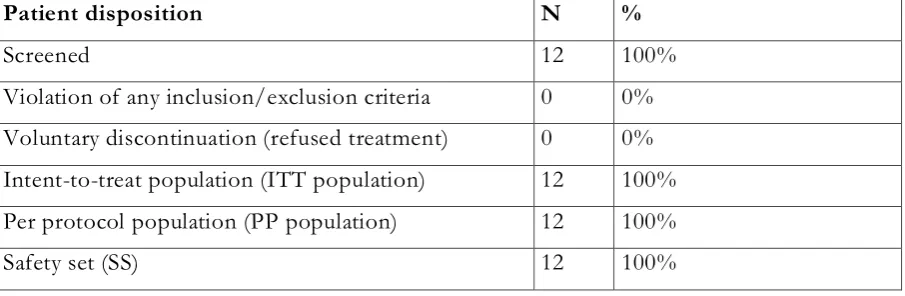
At the beginning of the study 12 subjects were screened. Intent-to treat, per-protocol and safety population include all 12 subjects. all patients attended all visits and were included in the Safety set (see table 1).
First 7 days. Aim: To reach the steady state with oral administration of the new formulation of drospirenone (one tablet containing 4 mg of drospirenone, Slinda Exeltis) during standard breakfast. During this period safety control procedures were performed, and breast milk was pumped twice a day to maintain lactation.
At 8 – 12 days from the first intake of investigational drug blood and breast milk samples were obtained simultaneously prior to 0, 1, 2, 4, 8, 12, 24, 30, 36, 48, 72 and 120 hours after the last tablet administration.
The probands and newborns stayed overnight in the hospital on day 8. Serum samples were prepared and stored at -20°C until required for analysis. Milk samples were collected by pumping from both breasts empty at each of the sampling times. The milk samples were pooled from both breasts and then split into 2 aliquots and frozen immediately at -20°C until required analysis.
Primary pharmacokinetic endpoint
The primary objective of this trial was to assess the transfer of drospirenone to breast milk after daily administration of an oral test preparation containing 4 mg of drospirenone at the steady state.
Secondary pharmacokinetic endpoints
The secondary objective of the trial was to assess the safety of the preparation based on safety clinical and laboratory measurements (at the beginning and at the end of the trial) and reporting of adverse events and/or adverse drug reactions.
Pharmacokinetic endpoints:
Descriptive evaluation for all pharmacokinetic (PK) endpoints after single repeated dose
Parametric method (ANOVA-log) for the primary endpoints Cmax and AUC of drospirenone after repeated dose. 90% confidence interval (CI) for the ratio for the primary endpoints Cmax and AUC after the single repeated dose of drospirenone.
Safety evaluation:
Descriptive statistical methods for the evaluations of:
Results
Subject disposition
For pharmacokinetic evaluation all patients who were included to the trial and received the study drug were included. None of the patients were excluded and all 12 were included to the pharmacokinetic evaluations.
All patients were Caucasian, the average age was 29.25 and median 29. Upper range of age was 35 and lower 25. Average (on visit 1) weight was 59.5, systolic BP 107.8, diastolic BP 68.3, breathing rate 13.4 and heart rate 72. Mean height, weight, BMI, blood pressure, pulse and breathing rate on visit 1 are seen in table 2.
Primary endpoints Pharmacokinetics
Pharmacokinetic parameters AUC(0-24h), AUC(0-120h) and Cmax were evaluated as pharmacokinetic endpoints after a single repeat dose administration of 4 mg of drospirenone in plasma and milk.
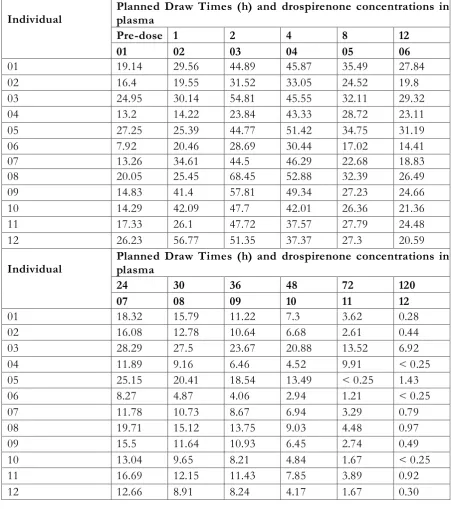
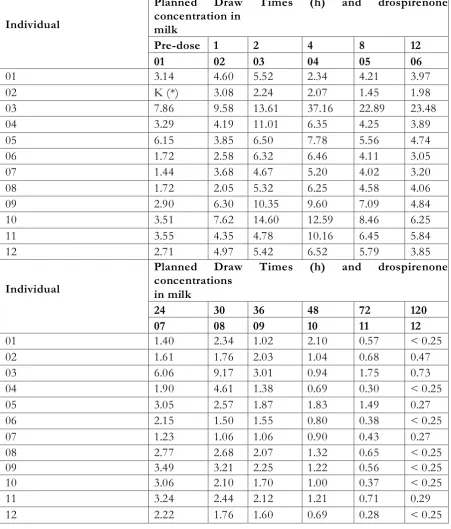
The pharmacokinetic endpoints of drospirenone were obtained from data of all 12 volunteers. The individual data obtained from plasma and milk of each volunteer is listed in tables 3 and 4.
The average concentration-time curve of drospirenone in plasma 24 h after the administration of the last dose (AUC(0-24h)) was 635.33 ng*h/mL and 120 h after the single repeat dose administration (AUC(0-120h) was 1180.57 ng*h/mL, respectively. The average Cmax was 48.64 ng/mL.
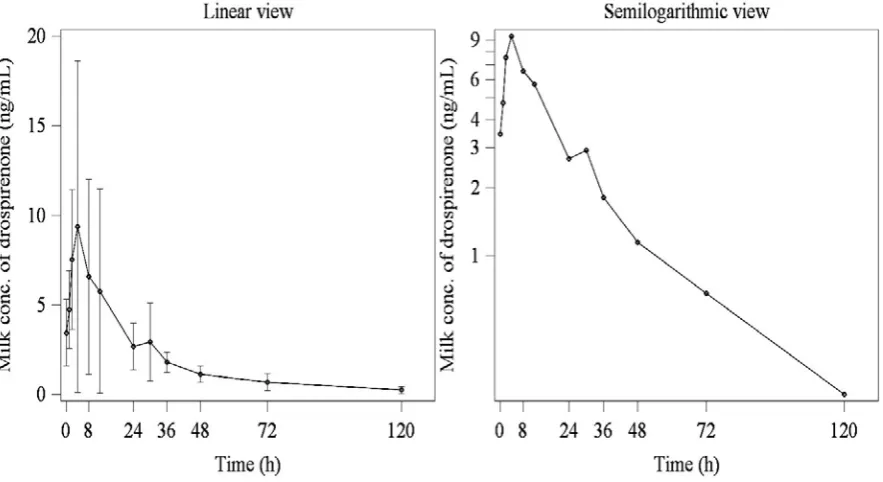
The average concentration-time curve of drospirenone in milk 24 h after the administration of the last dose (AUC(0-24h)) was 134.35 ng*h/mL and 120 h after the single repeat dose administration (AUC(0-120h) was 227.17 ng*h/mL respectively. The average Cmax was 10.34 ng/mL.
From these data we can conclude that on average 18.13% of plasma drospirenone made it to breast milk and that the highest concentration of drospirenone in breast milk was 17.55% of that in plasma.
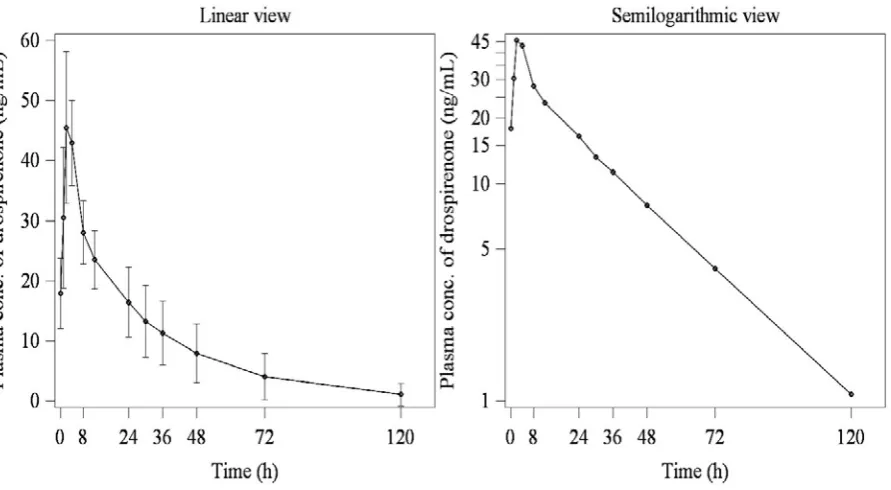
A summary of the descriptive statistics of all pharmacokinetic endpoints of drospirenone is presented in table 5 and figures 1 and 2. for plasma and milk, respectively. The milk to plasma ratio of pharmacokinetic parameters are presented in table 6.
Secondary endpoints
The average drospirenone concentration in breast milk over the 24 h period ranged from 1.90 to 19.22 ng/ml, with an average value of 5.60 ± 4.51 ng/mL Assuming that an average daily intake of breast milk by an infant is 800 ml [9], the total quantity of drospirenone passing to breast milk is 4478 ng during 24 h after the last dose of single repeat daily administration of drospirenone. The average drospirenone concentration in breast milk over the 120 h period ranged from 1.12 to 5.49 ng/ml, with an average value of 1.89 ± 1.19 ng/mL Hence the total quantity of drospirenone passing to breast milk is 7572 ng during 120 h after the last dose of single repeat daily administration of drospirenone.
Adverse events
No serious adverse events (SAEs) were reported in the course of the trial. No clinically relevant laboratory changes or trends were observed during the study. The laboratory and clinical screening revealed no indications for adverse events or poor tolerability.
Discussion
The study investigated the transfer of drospirenone to breast milk following a repeated oral
administration of the new estrogen free contraceptive containing 4 mg drospirenone. The
pharmacokinetic parameters of drospirenone in serum and in breast milk were in a similar
range to previous single oral dose studies of 3 mg DRSP + 30 µg EE and indicate that
lactation does not influence the pharmacokinetics of the drug.[10]
The transfer of steroid hormones used in other contraceptives into breast milk has been reported
previously. Milk to plasma or serum concentration ratios of about 0.1-0.34 have been reported for
norethisterone, and for levonorgestrel after single or repeated oral administration of different
doses of the drug, either alone or in combination with EE [9, 11, 12]. The corresponding ratios
following oral administration of cyproterone acetate [13] and megestrol acetate [14] were reported
to be about 0.36 and 0.8, respectively; however, with a large interindividual variation observed in
all studies, which was not seen in the present study. A similar variability emerged when
transferred to breast milk observed in this study is consistent with the range reported for
other progestogens used in oral contraceptives. For EE, a milk to plasma ratio of 0.25 has been
reported [15].
The amount of drospirenone transferred to the infant by breast milk has been calculated based on the average concentration of DRSP found in breast milk 24 h after tablet administration and the average milk volume known to be ingested by a 2-5-month-old infant. The value of drospirenone passing to the breast milk was in the present study 4478 ng during a period of 24 hours representing 0.11 % of the maternal daily dose. This amount is negligible and so it has been stated in the summary of product characteristics of the product in USA and Europe [16, 17].
This estrogen free contraceptive containing 4 mg of drospirenone in a 24/4 regimen intake provides effective contraception with a good safety/tolerability profile in a broad group of women, including breast feeding women and is an option for most women with cardiovascular risk factors like high BMI or thromboembolic risks also in the time after delivery.
Conclusions
If an average daily infant intake of breast milk is 800 ml, 24 h after the oral administration of 4 mg of drospirenone, the total quantity of daily drospirenone intake by the mother passing into breast milk is 4478 ng. If an average daily infant intake of breast milk is 800 ml, 120 h after the oral administration of 4 mg of drospirenone, the total quantity of daily drospirenone intake by the mother passing to breast milk is 7572 ng. The highest concentration of drospirenone in breast milk was 17.55% of that in plasma. The total quantity of drospirenone passing to breast milk is on average 4478 ng during a 24 h period representing 0.11% of the maternal daily dose.
References
1.) Norman P, Castaner J, Castaner RM. Drospirenone. Drugs of the Future 2000; 25: 1247-56. 2.) Oelkers W, Berger V, Bolik A, Bähr V, Hazard B, Beier S, Elger W, Heithecker A. Dihydrospirorenone, a new progestogen with antimineralocorticoid activity: effects on ovulation, electrolyte excretion, and the renin-aldosterone system in normal women. J Clin Endocrinol Metab 1991; 73: 837-42. DOI: 10.1210/jcem-73-4-837
3.) Krattenmacher R. Drospirenone: pharmacology and pharmacokinetics of a unique progestogen. Contraception 2000; 62: 29-38. DOI: 10.1016/s0010-7824(00)00133-5
4.) Rübig A. Drospirenone: a new cardiovascular-active progestin with antialdosterone and antiandrogenic properties. Climacteric 2003; 6: 49-54.
5.) Richter WH, Koytchev R, Kirkov V, Merki G, Colli E, Regidor P-A. Comparative pharmacokinetic estimates of drospirenone alone and in combination with ethinyl estradiol after single and repeated oral administration in healthy females. Contraception 2020. 101 (2), 137-143.
DOI: 10.1016/j.contraception.2019.10.005
6.) Kapp N, Curtis K, Nanda K. Progestogen-only contraceptive use among breastfeeding women: a systematic review. Contraception. 2010; 82: 17-37. DOI: 10.1016/j.contraception.2010.02.002
7.) Polakow-Farkash S, Gilad O, Merlob P, Stahl B, Yogev Y, Klinger G. Levonorgestrel used for emergency contraception during lactation-a prospective observational cohort study on maternal and infant safety. J Matern Fetal Neonatal Med. 2013; 26: 219-21. DOI: 10.3109/14767058.2012.722730
8.) Blode H, Foidart JM, Heithecker R. Transfer of Drospirenone to Breast Milk After a Single Oral Administration of 3 Mg Drospirenone + 30 Microg Ethinylestradiol to Healthy Lactating Women. Eur J Contracept Reprod Health Care 2001; 6: 167-71.
9.) Toddywalla VS, Mehta S, Virkar KD, Saxena BN. Release of 19-nor-testosterone type of contraceptive steroids through different drug delivery systems into serum and breast milk of lactating women. Contraception. 1980; 21:217-23. DOI: 10.1016/0010-7824(80)90002-5
10.) Blode H, Wuttke W, Look W, Röll G, Heithecker R. A 1-year pharmacokinetic
investigation of a novel oral contraceptive containing drospir enone, in healthy female
10.1080/13625180008500407
11.) Nilsson S, Nygren K-G, Johansson EDB. d-Norgestrel concentrations in maternal plasma,
milk, and child plasma during administration of oral contraceptives to nursing women. AmJ Obstet
Gynecol 1977; 129:178-84. DOI: 10.1016/0002-9378(77)90741-4
12.) Saxena BN, Shrimankar K, Grudzinskas JG. Levels of contraceptive steroids in breast
milk and plasma of lactating woman. Contraception 1977; 16:605-13. DOI:
10.1016/0010-7824(77)90061-0
13.) Stoppelli I, Rainer E, Humpel M. Transfer of cyproterone acetate to the milk of lactating
women. Contraception 1980; 22:485- 93. DOI: 10.1016/0010-7824(80)90101-8
14.) Nilsson S, Nygren K-G, Johansson EDB. Megestrol acetate concentrations in plasma and milk
during administration of an oral contraceptive containing 4 mg megestrol acetate to nursing women.
Contraception 1977; 16:615- 24. DOI: 10.1016/0010-7824(77)90062-2
15.) Nilsson S, Nygren K-G, Johansson EDB. Ethinyl estradiol in human milk and plasma
after oral administration. Contraception 1978; 17:131-9. DOI:
10.1016/0010-7824(78)90069-0
Legends
Table 1: Patient disposition
Tale 2: Clinical data of the 12 patients
Table 3: Individual drospirenone concentrations in plasma Table 4: Individual drospirenone concentrations in milk
Table 5: Pharmacokinetic endpoints in plasma and milk of drospirenone after 7 x 4mg of DRSP
Table 6: Milk to plasma ratios
Figure 1: Arithmetic mean (±SD) plasma concentrations of drospirenone vs time curve (linear and semilogarithmic)
Figure 2: Arithmetic mean (±SD) milk concentrations of drospirenone vs time curve (linear and semilogarithmic)
Declaration of interest:
Pedro-Antonio Regidor and Enrico Colli are employees of Exeltis Healthcare. Dace Melka and Kalev Kask declare no conflict of interest.
Table 1: Patient disposition
Patient disposition N %
Screened 12 100%
Violation of any inclusion/exclusion criteria 0 0% Voluntary discontinuation (refused treatment) 0 0% Intent-to-treat population (ITT population) 12 100% Per protocol population (PP population) 12 100%
Tale 2: Clinical data of the 12 patients
Variable Average Median Range
Age 29.25 29 25-35
Weight 59.5 56.9 52.0 – 74.5
Systolic BP 107.8 110 90 – 131
Diastolic P 68.3 70 50 – 86
Pulse rate 72 72 64 – 93
Table 3: Individual drospirenone concentrations in plasma
Individual Planned Draw Times (h) and drospirenone concentrations in plasma
Pre-dose 1 2 4 8 12
01 02 03 04 05 06
01 19.14 29.56 44.89 45.87 35.49 27.84
02 16.4 19.55 31.52 33.05 24.52 19.8
03 24.95 30.14 54.81 45.55 32.11 29.32
04 13.2 14.22 23.84 43.33 28.72 23.11
05 27.25 25.39 44.77 51.42 34.75 31.19
06 7.92 20.46 28.69 30.44 17.02 14.41
07 13.26 34.61 44.5 46.29 22.68 18.83
08 20.05 25.45 68.45 52.88 32.39 26.49
09 14.83 41.4 57.81 49.34 27.23 24.66
10 14.29 42.09 47.7 42.01 26.36 21.36
11 17.33 26.1 47.72 37.57 27.79 24.48
12 26.23 56.77 51.35 37.37 27.3 20.59
Individual Planned Draw Times (h) and drospirenone concentrations in plasma
24 30 36 48 72 120
07 08 09 10 11 12
01 18.32 15.79 11.22 7.3 3.62 0.28
02 16.08 12.78 10.64 6.68 2.61 0.44
03 28.29 27.5 23.67 20.88 13.52 6.92
04 11.89 9.16 6.46 4.52 9.91 < 0.25
05 25.15 20.41 18.54 13.49 < 0.25 1.43
06 8.27 4.87 4.06 2.94 1.21 < 0.25
07 11.78 10.73 8.67 6.94 3.29 0.79
08 19.71 15.12 13.75 9.03 4.48 0.97
09 15.5 11.64 10.93 6.45 2.74 0.49
10 13.04 9.65 8.21 4.84 1.67 < 0.25
11 16.69 12.15 11.43 7.85 3.89 0.92
Table 4: Individual drospirenone concentrations in milk
Individual
Planned Draw Times (h) and drospirenone concentration in
milk
Pre-dose 1 2 4 8 12
01 02 03 04 05 06
01 3.14 4.60 5.52 2.34 4.21 3.97
02 K (*) 3.08 2.24 2.07 1.45 1.98
03 7.86 9.58 13.61 37.16 22.89 23.48
04 3.29 4.19 11.01 6.35 4.25 3.89
05 6.15 3.85 6.50 7.78 5.56 4.74
06 1.72 2.58 6.32 6.46 4.11 3.05
07 1.44 3.68 4.67 5.20 4.02 3.20
08 1.72 2.05 5.32 6.25 4.58 4.06
09 2.90 6.30 10.35 9.60 7.09 4.84
10 3.51 7.62 14.60 12.59 8.46 6.25
11 3.55 4.35 4.78 10.16 6.45 5.84
12 2.71 4.97 5.42 6.52 5.79 3.85
Individual
Planned Draw Times (h) and drospirenone concentrations
in milk
24 30 36 48 72 120
07 08 09 10 11 12
01 1.40 2.34 1.02 2.10 0.57 < 0.25
02 1.61 1.76 2.03 1.04 0.68 0.47
03 6.06 9.17 3.01 0.94 1.75 0.73
04 1.90 4.61 1.38 0.69 0.30 < 0.25
05 3.05 2.57 1.87 1.83 1.49 0.27
06 2.15 1.50 1.55 0.80 0.38 < 0.25
07 1.23 1.06 1.06 0.90 0.43 0.27
08 2.77 2.68 2.07 1.32 0.65 < 0.25
09 3.49 3.21 2.25 1.22 0.56 < 0.25
10 3.06 2.10 1.70 1.00 0.37 < 0.25
11 3.24 2.44 2.12 1.21 0.71 0.29
Table 5: Pharmacokinetic endpoints in plasma and milk of drospirenone after 7 x 4mg of DRSP
PLASMA
Variable Geom
. Mean
Arith. mea n
SD CV Range Median N
Cmax (ng/mL) 47.54 48.64 10.47 21.
5 30.44 – 68.45 47.71 12
tmax (h) 2.67 2.92 1.16 39.
9 1 - 4 3 12
AUC(0-24h)
(ng*h/mL) 623.93 635.33
121.0 0
19.
0 391.76 – 799.85 615.55 12 AUC (0- 120h)
(ng*h/mL) 1122.83 1180.5 7 416.6 7 35. 3 581.81 – 2285.76 1135.76 12
MILK
Variable Geom
. Mean
Arith. mea n
SD CV Range Median N
Cmax (ng/mL) 8.34 10.34 9.01 87.
14 3.08 – 37.16 7.15 12
tmax (h) 2.83 3.08 1.16 37.
8 1 – 4 4 12
AUC(0-24h)
(ng*h/mL) 112.57 134.35
108.2 0
80.
5 45.68 – 461.17 101.11 12 AUC (0- 120h)
Table 6: Milk to plasma ratios
Variable Method Point
estimator
Confidence