15
A KNOWLEDGE-BASED SOCIETY NEEDS
QUALITY IN HIGHER EDUCATION
Andrea Bernhard
University of Graz, Austria E-mail: [email protected]
Abstract
The model of a “knowledge-based society” represents an ideal towards which the whole world strives. Today’s society is based on knowledge as the main good, virtue and competitive advantage and higher education plays a crucial role in shaping a knowledge-based society. The purpose of this article is to position higher education within knowledge-based societies and to emphasis the growing importance of higher education. Discussions about the shift from elite to mass higher education will be outlined as well as the concept of “universal higher education“in the 21st century. With this theoretical basis the need of quality assurance in higher education will be stressed in to enhance, improve and even maintain a quality-focused orientation. Higher education institutions are in a time of great tensions – they have to react quickly to educational needs of a fast-changing society and to assert one’s position with other higher education providers. At present as well as for the future the necessity to assure quality for higher education systems to compete in a knowledge-based society at all levels – national and global – is evident.
Key words: knowledge-based society, quality, higher education.
Higher Education within a Knowledge-Based Society
Research in higher education is a quite new fi eld of interest and can be seen as a multidisciplinary subject. Researchers from different fi elds of study are interested in learning about the complexity of higher education. They are looking on higher education from different angles as for instance, educational or political sciences, psychology, sociology, history, economy or law – different fi elds of research are interested to bring light into the complex system of higher education (educational, management and social science approach). Nevertheless the term higher education is relatively new and became popular in the 1970s because universities lost their exclusive right to provide higher education. From the middle age to the 60s the main and often the only post secondary institution have been the university. After that time other forms of tertiary education emerged and higher educa-tion came up to include universities as well as vocaeduca-tional and professional institueduca-tions (Scott, 2007, p.13).
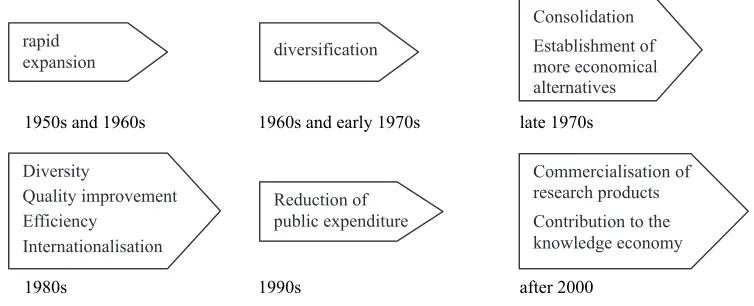
16 diversifi cation and marketisation of higher education in a knowledge driven economy. In the last phase especially research in higher education is emphasised ‘’as primary differentiator of higher education institutions’’ (Colding & Meek, 2006, p.32) in the 21st century.
1950s and 1960s 1960s and early 1970s late 1970s
1980s 1990s after 2000
Figure 1. Phases of higher education developments.
Today’s university are facing great strain and tension because of ongoing societal developments. Knowledge changed to a factor of production and theoretical knowledge gains more importance as source of innovation and basis for political decisions in highly industrialized societies (Pellert, 1997, p.7/8). The Nobel Prize winner Joseph Stiglitz (1999) stated thatknowledge is a global public good
though the source of brainpower is limited by genetic distributions of talent and cultural disadvantages. The nature of education is bound to change and will become a continuing life-time affair for the pro-fessional and technical person. In this context Daniel Bell (1968) articulated that we need especially postdoctoral universities where new knowledge and new techniques can be passed along.
The arrival of knowledge-based societies, of course, has a great importance according to the development of universities. One could say that they are the fi rst institutions to benefi t from this increasing usage of information. These days universities compete with other institutions as, for instance, vocational colleges, research institutions and high-tech companies in popularity to cope with the increasing importance of knowledge. Universities cannot handle all these new forces and demands of the knowledge society which means that they are in an unstable situation and loose their position of high status and power. They have to be powerful and successful but loose at the same time their clear position (success vs. uncertainty) (Baggen et al., 1998, p.7-9). There is an intrinsic relationship between universities and knowledge societies but the future consequences are not foreseeable. One sees a future of knowledge as strategic resource for universities. Others see a world of academic capitalism. Thus, academia goes together with the knowledge society where “competition with other institutions and a loss of the monopoly of universities” prevails (virtual universities, corporate universities, media organisations, consortia, strategic alliances, private and public institutions) (Boer et al., 2002, p.43).
17 Volume 12, 2009
Trow´s Model of Elite, Mass and Universal Higher Education
A society of experts developed throughout Europe as well as in the United States in the 19th and 20th century which contributed to an expansion of higher education signifi cantly. This expansion changes the whole knowledge society and creates a diverse picture because learners themselves change and become more varied. Massifi cation of higher education started fi rstly in the United States in the 1920s while Europe followed later in the 1960s, parts of Asia in the 1970s and the developing countries even no later but with the highest growth. Today there are more than 140 million students in postsecondary education worldwide and it will expand even more in the future (Altbach, 2008, p.2).
In taking a closer look at the changes occurring in higher education all over the world, it may be useful to recall the well-known distinction made by Martin Trow in the 1970s. The American higher education scholar was the fi rst scientist to describe the idea of “Elite, Mass and Universal” higher education at the OECD Conference on Future Structures of the Post-Secondary Education in 1973. Trow associated the problems of higher education with aspects of growth and transition which have their impact on every form of activity and manifestation of higher education (fi nance, government and administration, recruitment and selection of students, curriculum etc.). Trow classifi ed the higher education growth into phases and concentrated on the consequences associated with such an expan-sion in terms of access, functions of higher education, curriculum and forms of instruction, student ‘’career’’, institutional diversity, characteristics and boundaries, academic standards, governance, administration and the locus of power and decision making (Trow, 1973, p.2-18). In the following a short distinction of elite, mass and universal higher education will be made according to Trow´s ideas from 1973:
Elite higher education system
• : about 5 % of the proportion of an age grade are enrolled in
a higher education institution; institutions with high academic standards with a qualitative homogeneity in the student population; university main function is to train students by developing their personality for high positions in society.
Mass higher education system
• : new institutions with new functions and increased
par-ticipation of the age cohort (at least 15%); fuzzy and permeable boundaries from an institution to another; universities lose their monopole in providing higher education; boundaries among higher education providers are weak or even non existent.
Universal higher education system
• : age cohort beyond 50%; main function of higher
education institution is to prepare a great part of the population to social and technologi-cal changes.
Trow developed his work from the 1970s in later papers (1976, 1979, 1981, 2000) and always claimed that these elaborations are not empirical descriptions but models or “ideal types” to under-stand higher education systems (Brennan, 2004, p.22). Though Trow formulated sequential phases, he left it open if earlier stages are completely replaced by later ones which means that elite forms can still survive in mass and universal stages. For instance, today’s demand for top level higher education institution can be seen as way back within the stages. Still most of those people who are in positions of power have graduated at one of those elite institutions.
Trow’s model sees this expansion process as a blind as well as main force triggering changes and evolution in higher education systems. If there are more students in higher education changes in structures, objectives and purpose as well as the way to operate are evident. Nevertheless Trow has given ideal models but also changed his original idea of the 70s to modify and “illuminate con-temporary conditions” as far as this could be possible (Trow 2006, p.245).
qual-18 ity (external examiners, audits, subject reviews, benchmark statements etc.) is evident but it is not clear if quality and standards are consequently maintained in such enlarged and diversifi ed higher
education systems (Brennan 2004, p.22). To show how higher education is infl uenced by quality
assurance mechanisms the following observations shall provide more clarity but also to serve a plea for those higher education institution that are not on the road to assure their quality.
The Need of Quality Assurance in Higher Education
The transition from “elite” to “mass” higher education (Trow 1973) caused many fundamental changes as well as challenges for all decision makers in the fi eld of higher education that the real “pre-quality” era started (Ewell 2007, p.123). All these changes the higher education sector is con-fronted with are closely linked to a “growing interest in quality, demands for accountability, and the establishment of national quality agencies. By the end of the 1990s concern for quality and standards was global” (Newton 2007, p.14).
The roots of the rise of quality assurance can be found by the end of the 19th century. At this time the U.S. established the fi rst accreditation organisations. In Europe the fi rst formal national quality assurance policies date back to around 1985 with the rise of “the Evaluative State” (Neave 1988, p.8). Thus, quality is in the centre of higher education and is reviewed through national quality mechanisms (specifi c laws, rules, regulations). In the literature there are numerous defi nitions from quality in education. A heuristic framework is provided, for instance, by Harvey and Green (1993), who suggest that quality can be seen as excellence, transformation, fi tness for purpose, value for money or as perfection.
The growing interest for quality in education is closely linked to the expansion of higher education and the increasing costs since the 1980s. The state-university relationship changed from a traditional strong ”state steering approach” to a more market-driven model, the so called “ su-permarket model” (Gornitzka & Maasen, 2000, p.273ff). The traditional role of the government changed signifi cantly which is illustrated in table 1. It shows that the main focus on public fi nancing and provision of education shifted towards a more fl exible policy and regulatory framework (World Bank, 2003, p.58f).
Table 1. Traditional role of government and new role in the knowledge economy.
Policy issue Current role Role in the knowledge economy
Integration/coordination at national level
Adopts compartmentalized, sectoral approach Coordinates multisectoral approach
Coordination across
govern-ance levels One-way control and regulation Two-way mutual support and partner-ships
Government as an enabler Controls and regulates Creates choices, provides information
and incentives, facilitates cooperation and provision
Linkage between education
and the labor market/society Supply is institution-driven Demand is learner driven
Qualifi cation assurance
system National standards linked with curriculum and student assessment Diverse system of recognition and quality control
Administration and manage-ment
Provides rules and regulation Creates incentives, facilitates diverse
providers
Source: World Bank, 2003, p.59
19 Volume 12, 2009
universities and colleges use the large autonomy in such a way that the outcomes the governments expect of enlarging the autonomy are indeed achieved“ (p. 284).
For that reason the New Public Management (NPM) was implemented to enhance outcomes and cost-effi ciency of public services (Marginson & van der Wende, 2007, p.8ff) of more autonomously organised institutions. This goes along with a loss of trust according to the academic community on the one hand and a “rise of managerialism” on the other hand (Trow, 1994). However, lots of aca-demics link quality assurance with “bureaucracy”, “burden”, “accountability” and further negative associations as fi gured out in a UK-study by the end of the 1990s (Newton, 2002, p.45). Nevertheless quality in education is important for graduates either to take part in a knowledge-based society in an effi cient manner as well as to be able to keep their knowledge and skills up-to-date. Hence, different stakeholders are interested to assure quality in education but with a different approach.
Within the Lisbon strategy (European Council, 2000) quality in higher education has become
an important matter to make the Europe to “the most competitive and dynamic knowledge-driven
economy in the world” because research and innovation were seen as key motors for today’s global economy. Already more than one decade ago El-Khawas, DePietro-Jurand and Holm-Nielson (1998) claimed that quality assurance as well as enhancement will play a major role in the 21st century. Moreover, they highlighted the importance of international cooperation in terms of quality assurance (p.14). A report of the World Bank (2002) “Constructing Knowledge Societies: New Challenges for Tertiary Education” points out several important implications why quality assurance is becoming such an important factor in our knowledge-based society: mobility of students and staff, creation of new types of higher education institutions, franchising of higher education programmes, distance education and other domains where higher education goes beyond the (national) borders (p.35).
Therefore different mechanisms and practices of quality assurance are needed. A (internationally and nationally recognised) quality assurance system should be able to guarantee transparency and control of higher education programmes and that diplomas and degrees of students are approved. Although nearly all over the world international and national quality assurance agencies have been developed there are different approaches to ensure quality (internal or external procedures, accredita-tion vs. evaluaaccredita-tions, quality audits etc.). While some countries established only one naaccredita-tional agency (e.g. Finland) others have separate agencies with different responsibilities (e.g. Germany), which shows the political and cultural diversity of the countries all over the world. Furthermore the initia-tive to establish international qualifi cation frameworks (EQF – European Qualifi cation framework, NQF – National Qualifi cation Framework) helps small countries to set up a regional quality assurance system or assist different global quality assurance initiatives (World Bank, 2002, p.xxx).
Tertiary education has to cope with lots of new challenges due to enormous changes (globaliza-tion, ICT, socio-political transformations, lifelong learning and knowledge-based society) but faces also new opportunities as playing the key role in today’s society. Santiago et al. (2008) recommend some practical arrangements for a functioning quality assurance system:
Avoid fragmentation of the quality assurance organisational structure Avoid excessive costs and burdens
•
Improve quality information base
•
Improve information dissemination (p.315/316)
•
With these suggestions current quality assurance systems, which vary among countries in their scope and emphasis, could be improved. Quality assurance schemes have to be developed as neces-sary instruments to adjust higher education institutions to the ongoing transformation processes. As the different systems are most of the time newly developed they should be able to adapt to changes and try to act quickly to the needs of our knowledge-based society. Quality assurance in higher education is not fully developed but still under construction!
References
Altbach, P.G. (2008). Globalization and Forces for Change in Higher Education. International Higher
Educa-tion,50, 2-4.
20 London, Paris: Concorde Publishing House. (Philosophy of Higher Education Series, Vol.1).
Bell, D. (1968). The Measurement of Knowledge and Technology. In Sheldon, E.B., & Moore, W.E. (Eds.).
Indicators of Social Change. Concepts and Measurements (pp. 145-246). Hartford, Connecticut: Russell Sage Foundation.
Boer, de H. Et al. (2002). Academia in the 21st century. An analysis of trends and perspectives in higher
educa-tion and research. Den Haag: AWT. (CHEPS, Vol.28)
Brennan, J. (2004). The Social Role of the Contemporary University: Contradictions, Boundaries and Change.
Ten Years On: Changing Education in a Changing World, CHERI (pp. 22-26). Milton Keynes: The Open University.
Colding, A., & Meek, V.L. (2006). Twelve Propositions on Diversity in Higher Education. Higher Education
Management and Policy, 18(3). 31-54.
El-Khawas, E., DePietro-Jurand, R., & Holm-Nielsen, L. (1998). Quality Assurance in Higher Education:
Recent Progress; Challenges Ahead. Washington, D.C.: World Bank.
European Council (2000). Presidency Conclusion – Lisbon European Council. Retrieved on 16 February, 2009,
from http://www.europarl.europa.eu/summits/lis1_en.htm
Ewell, P. (2007). The “Quality Game”: External Review and Institutional Reaction over Three Decades in
the United States. In Westerheijden, D.F. et al. Quality Assurance in Higher Education.Trends in Regulation,
Translation and Transformation (pp. 119-153). Dortrecht: Springer. (Higher Education Dynamics, Vol.20)
Gibbons, M. et al. (1994). The New Production of Knowledge: The Dynamics of Science and Research in
Contemporary Societies. London: Sage Publications.
Goedegebuure, L., & Meek, V.L. (1997). On Change and Diversity: the Role of Government Influences. Higher
Education in Europe, 22(3), 309-319.
Gornitzka, A., & Maassen, P. (2000). Hybrid Steering Approaches With Respect to European Higher
Educa-tion. Higher Education Policy, 13(3), 267-285.
Harvey, L. & Green, D. (1993). Defining Quality. Assessment and Evaluation in Higher Education, 18(1),
9-34.
Marginson, S. and M. Van der Wende (2007). Globalisation and Higher Education. OECD Education Working
Paper, No. 8.
Neave, G. (1988). On the Cultivation of Quality, Efficiency and Enterprise: An Overview of Recent Trends in
Higher Education in Western Europe, 1986-1988. European Journal of Education, 23(1/2). 7-23.
Newton, J. (2002). Views from below: academics coping with quality. Quality in Higher Education, 8(1),
39-61.
Newton, J. (2007). What is quality? In Bollaert, L. et al. (Eds.). Embedding Quality Culture in Higher
Educa-tion. (pp. 14-20). A Selection of Papers from the 1st European Forum for Quality Assurance, 23 – 25 November
2006, hosted by the Technische Universität München.(EUA Case Studies 2007).
Nowotny, H., Scott, P., & Gibbons, M. (2001). Re-Thinking Science: Knowledge and the Public in an Age of
Uncertainty. London: Polity Press.
Pellert, A. (1997). Die Universität in der Wissensgesellschaft. Zum Verhältnis von Forschung und Lehre.
Innsbruck/Wien: Studienverlag.
Santiago, P., Tremblay, K., Basri, E., & Arnal, E. (2008). Tertiary Education for the Knowledge Society. OECD
Thematic Review of Tertiary Education: Synthesis Report, Vol.2. Paris: OECD.
Scott, P. (2007). Back to the Future? The Evolution of Higher Education Systems. In Kehm, B. (Ed.). Looking
Back to Look Forward: Analyses of Higher Education after the Turn of the Millennium (pp. 13-27). Kassel: INCHER. (Werkstattberichte 67).
Stiglitz, J.E. (1999). Knowledge as a Global Public Good. In Kaul, I., Grumberg, I., & Stern, M.A. (Eds.).
Global Public Goods. International cooperation in the 21st century (pp. 308-325). New York: Oxford
Uni-versity Press.
Trow, M. (1973). Problems in the Transition from Elite to Mass Higher Education. Berkley: Carnegie
Com-mission on Higher Education.
Trow, M. (1976). Elite Higher Education: An Endangered Species? Minerva, 14(3). 355-76.
21 Volume 12, 2009 into Higher Education: Processes and Structures (pp. 183-219). Stockholm: National Board of Universities
and Colleges.
Trow, M. (1981). Comparative Perspectives on Access. In Fulton, O. (Ed.). Access to Higher Education (pp.
89-121). Guildford: SRHE.
Trow, M. (1994). Managerialism and the academic profession: quality and control. QSC Higher Education
Report, 2. London: Quality Support Centre.
Trow, M. (2000). From Mass Higher Education to Universal Access: The American Advantage. Research and
Occasional Paper Series, CSHE.1.00, 1-17.
Trow, M. (2006). Reflections on the Transition from Elite to Mass to Universal Access: Forms and Phases of
Higher Education in Modern Societies since WWII. International Handbook of Higher Education, 18,
243-280
World Bank (2002). Constructing Knowledge Societies: New Challenges for Tertiary Education. Washington,
D.C.: World Bank.
World Bank (2003). Lifelong Learning in the Global Knowledge Economy: Challenges for Developing
Coun-tries. Washington, D.C.: World Bank.
Adviced by Werner Lenz, University of Graz, Austria
Andrea Bernhard Research Fellow, Institute of Educational Sciences, University of Graz, Austria.