Forestry & Natural-Resource Sciences Last Correction: Feb. 28, 2011
THE DEVELOPMENT AND IMPLEMENTATION OF FOREST
FIRE MANAGEMENT DECISION SUPPORT SYSTEMS IN
ONTARIO, CANADA: PERSONAL REFLECTIONS ON PAST
PRACTICES AND EMERGING CHALLENGES
David Martell
Professor, Fac. For., U of T, Toronto, ON, Canada. Ph/FAX: 416.978.6960/3834
Abstract. Forest fire managers in the province of Ontario, Canada have used computer-based decision
support systems (DSSs) and actively supported their development since the late 1970’s. I describe four DSS projects in which I was involved and discuss factors that I believe contributed to the success and failure of those initiatives. I then outline some emerging fire management challenges and present some recommendations concerning the development and implementation of forest and wildland fire management DSSs.
Keywords: Multi-objective optimization, integer programming, public good provisions, auctions
1
Introduction
Fire supports many natural forest ecosystem processes but it also poses significant threats to people, property and forest resources. The detrimental impact of fire has featured prominently in the media in recent years largely due to destructive wildland-urban interface (WUI) inci-dents in parts of North America, Europe and Australia as well as other regions. Climate change is expected to exacerbate fire problems and complicate the lives of fire mangers who are regularly called upon to resolve increas-ingly complex decision-making problems. It is therefore not surprising that Operational Researchers, Informa-tion Technology Specialists and Decision Support Sys-tem specialists have developed and continue to be asked to develop forest and wildland fire management decision support systems. In this paper I describe some of the fire management DSS projects in which I have been involved and reflect on the extent to which they were successful. I then discuss some emerging needs and challenges and how those in the OR/MS/DSS communities might ad-dress them.
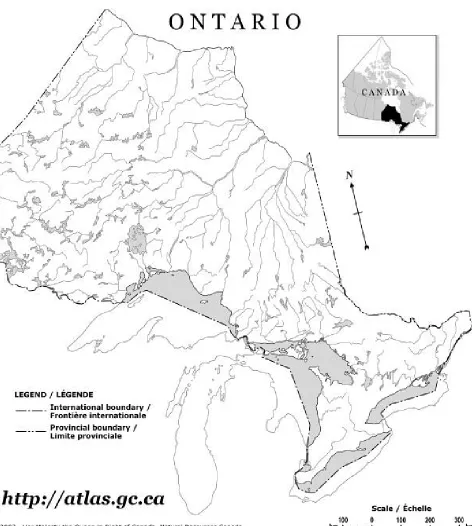
My focus is primarily on fire management in the bo-real forest region of the province of Ontario, Canada (Fig. 1) in which there are many small widely scattered communities inhabited by residents engaged in indus-trial forestry, mining and tourism activities and small isolated First Nations communities. Fires are ignited by both people and by lightning and a small fraction
(typically less than 3%) of the roughly1,500 fires that are reported each year escape initial attack and a small number of those become large “project fires”, some of which can exceed 100,000 ha or more in size.
I have focussed on Ontario not because it is unique but because 1) it is in many respects, representative of the type of forest fire management that takes place across much of the actively managed portion of the boreal for-est region of Canada and 2) it is the area in which my students and I have carried out most of our research. There has of course been an extensive amount of DSS-related research and development carried in the United States, Russia, Australia and parts of Europe. Although I learned at conferences and through the scientific liter-ature what my colleagues in those areas have done and achieved (see, for example, Martell (1982), Martell et al. (1998), Martell et al. (1999) and Martell (2007)), I restrict my comments and observations to some of the projects with which I have been involved.
2
What is a DSS?
My use of the term Decision Support System (DSS) is consistent with that of Keen and Scott Morton (1978) for whom decision support implied “the use of computers to:
1. Assist managers in their decision processes in semi-structured tasks.
Copyright c2011 Publisher of theMathematical and Computational Forestry & Natural-Resource Sciences
Figure 1: The province of Ontario in central Canada.
2. Support, rather than replace managerial judgment.
3. Improve the effectiveness of decision-making rather than its efficiency.”
My primary interest has been and remains, the use of Operational Research and Management Science (OR/MS) methods to develop forest fire management decision support systems. In this paper I focus on computer-based DSSs that include mathematical mod-els that can be used to predict and sometimes evaluate the consequences of implementing alternative courses of action. I do not cover, for example, traditional computer-based management information systems (e.g. fire danger rating or inventory management systems) or computer-based models that predict fire activity (e.g. fire occurrence and fire spread models) but focus rather, on computer-based optimization and simulation models that fire managers can use to help resolve their strategic, tactical and operational decision-making problems.
2.1 Forest Fire Management in the Province of Ontario The Aviation, Forest Fire and Emergency Ser-vices (AFFES) Branch of the Ontario Ministry of Nat-ural Resources (OMNR) is the provincial government agency that is responsible for forest fire management on public forest land in the Fire Region which comprises about 80% of the approximately 1 million km2province
of Ontario. Organized forest fire management began in Ontario with the 1878 passage of the Fire Act but it did not begin in earnest until the early 1900’s when a num-ber of tragic incidents associated with large fires resulted in the loss of many lives and precipitated increased ef-forts to minimize the impact of fire on people, property and timber.
Figure 2: Number of fires per year in the province of Ontario (source of data: Ontario Ministry of Natural Resources)
The number of fires and area burned vary significantly
from year to year as depicted in the figures 2 and 3. Roughly 40 % of the fires are caused by lightning and 60 % by people but lightning-caused fires produce 75 % of the area burned.
Figure 3: Annual area burned by forest fires in the province of Ontario. (source of data: Ontario Ministry of Natural Resources)
Ontario’s forest fire management policy has, as have those of most North American forest and wildland fire agencies, evolved from administering an essentially fire exclusion policy under which fire was viewed as a de-structive force that was to be eliminated from the forest at almost any cost, to delivering a more progressive pro-gram that is based on explicit recognition that fire is natural and that it is neither ecologically sound or eco-nomically feasible to suppress all fires. The AFFES’s ac-tivities are guided by a fire strategy that designates the extent to which different values (e.g. public safety or the ecological benefits of fire) should influence how specific fires are managed. For a description of the strategy see Ontario Ministry of Natural Resources (2004).
During each day of the fire season (which usually be-gins on or near April 1 and ends on or near October 31), fire managers across Ontario engage in the follow-ing suppression-related activities:
1. They predict when and where fires are likely to oc-cur,
2. Decide when and where to route detection patrol aircraft to find fires while they are small,
3. Deploy airtankers, fire fighters, and transport air-craft close to areas where fires are likely to occur to minimize response times,
5. Deploy incident management teams and other re-sources to manage escaped fires that pose threats.
Computer-based DSSs and management information systems are used extensively to support such activities.
3
Past Successes and Failures
There have been many attempts to develop and imple-ment forest fire manageimple-ment decision support systems, some of which are documented in the traditional peer-reviewed literature and some of which are described on public web sites. It’s reasonable to assume however, that many fire management organizations have devel-oped and/or contracted out the development of DSSs that have not been publicly documented. I will focus on projects in which I have been directly involved on the assumption that I am well positioned to assess, albeit subjectively, the extent to which they were successful.
One of the first DSS projects in which I participated was the development and implementation of the Ontario Initial Attack Model (IAM). I was one of a group of four that was asked to develop a model that the OMNR could use to help evaluate its airtanker needs. It was a simula-tion model that was used to evaluate how the OMNR’s initial attack system would perform with different mixes of airtankers, fire fighters and transport helicopters. The OMNR used the results of our analysis to support its re-quest to the Management Board of Cabinet of the gov-ernment of Ontario to acquire nine CL-215 airtankers to enhance their initial attack system. The development and implementation of our model is described in Martell et al. (1984). The OMNR later enhanced it to create the LEOPARDS Level of Protection DSS that the OMNR has since been used to support its planning and policy development (see, for example, McAlpine and Hirsch, 1999).
Many factors contribute to the success and/or failure of DSS projects but I think three that contributed to the success of that project were:
1. Senior managers asked us to help them resolve what they considered to be a very important decision-making problem.
2. We met with one of the senior managers on a reg-ular basis to keep him abreast of our progress and most importantly, to obtain his feedback concern-ing which features of the system he deemed to be most important and merited special attention as we developed and tested our model.
3. Our collective expertise spanned both operational research and forest fire management and we were led by an analyst (G.E. Doan, an OMNR employee)
who had studied operational research, had field ex-perience and had exex-perience in preparing proposals for the Management Board of Cabinet.
A graduate student and I developed a mathematical pro-gramming model that the OMNR used to help decide where to home base their airtankers, which is described in MacLellan and Martell (1996). They had an airtanker fleet that included nine CL-215 airtankers and five much smaller multi-purpose Twin Otter aircrafts that were used for firefighting when required. Some OMNR staff were concerned that the airtankers were not properly allocated to home bases for the fire season – that some bases had more than they needed while others experi-enced shortages. The OMNR did not implement the “model solution” but gained insight from our collabora-tion as we developed and ran the model. I attribute our success to the fact that:
1. We were asked to solve what senior OMNR fire mangers considered to be an important problem.
2. We worked closely with a working group of OMNR staff who were responsible for airtanker manage-ment while we formulated, tested and ran our model.
3. We both had OR and initial attack fire fighting ex-pertise.
DSS initiatives are not always successful and one of my failures resulted from an attempt to develop and im-plement a queueing model that the OMNR could use to help resolve their daily airtanker deployment prob-lems. Jim Bookbinder and I published (Bookbinder and Martell 1979) a paper in which we described how a time-dependent queueing model could be coupled with a dy-namic programming model to specify optimal deploy-ment strategies for helicopters that transport fire fight-ers to initial attack fires. Ours was a curiosity driven project that we undertook in part, to illustrate how such models might be used, but we made no attempt to im-plement our model. Later, an OMNR staff person and I drew on the Bookbinder and Martell (1979) model and developed an airtanker deployment model that could be used to evaluate alternative daily airtanker deployment strategies. An OMNR software specialist developed the software required to run our model and it was run in test mode in the Northwest fire region of Ontario for one fire season. The regional field staff ran the model each day and perused the results but were not asked nor, to my knowledge, did they use them to help resolve their daily deployment decisions. At the end of the fire season they were polite but firm – they characterized the model as being “interesting” but pointed out that it did not ac-count for a very important aspect of airtanker operations in their region – airtanker bases do not operate indepen-dently, and they were not at all interested in using the model unless it could account for such behaviour. My failure to appreciate that a complex model that did not account for what managers considered to be an essen-tial feature of their system made it impossible for us to implement our model.
4
Common
Factors
That
Contribute
To Success and Failure
The projects described above illustrate several com-mon themes that arise when the topic of implement-ing OR and DSS technology arise (see, for example, the many columns that Gene Woolsey has published in the journal INTERFACES, some of which have been re-printed in Woolsey and Hewitt (2003)) and one (the need to develop HQP) that is not often addressed in the lit-erature. Success appears to be more likely when:
1. Analysts address what senior managers consider to be important problems.
2. They work closely with the senior managers and technical specialists they designate to work on the project.
3. The analysts have both fire management experience and DSS expertise.
I have also indentified and consider another important contributing factor to be:
1. The training of HQP who ultimately join the or-ganizations with which one is working, to support what has been developed and to contribute to new DSS initiatives within the organization.
5
Some Observations
During the course of developing, testing and assisting with the implementation of forest fire management DSSs in Ontario, I have come to learn and appreciate a number of things that were not at all obvious to me when I first began to work in this area.
5.2 A Need for both Basic and Applied Re-search Research can be classified as being either basic (curiosity driven) or applied (focussed on solving prac-tical problems). I expect many philosophers or sociol-ogists of science would view any forest fire research as applied but I think it is reasonable to classify fire re-search initiatives on a basic to applied scale. The devel-opment of new methodologies for formulating and solv-ing stochastic integer programmsolv-ing models to support the eventual development of spatial harvest plans for flammable forest landscapes or investigating how high intensity fires interact with the atmosphere are exam-ples of basic fire research. The development of simula-tion models of initial attack systems or the development of fire danger rating systems that can be used to predict fire occurrence and fire behaviour are clearly applied re-search.
Both basic and applied research are important and complement each other and I believe researchers should work with organizations and institutions that are sup-portive of both types of research. Agencies cannot ex-pect researchers to provide good solutions to practical problems unless they are able to draw upon applied sci-ence that is well grounded on both practical experisci-ence and basic research. The development of sound decision support systems calls for a thorough understanding of the systems being managed and in the absence of basic research, such understanding will be sorely lacking. I also share the widespread belief that investment in ba-sic research sometimes leads, serendipitously, to knowl-edge that can eventually be used to help resolve practical problems. Furthermore, most university-based research is linked with graduate education and that if we sim-ply train rather than educate graduate students we will short-change them and future generations by undermin-ing their ability to develop their own research programs.
5.3 It Takes Time When I first began developing forest fire management decision support systems Peter Kourtz (a research scientist with the Canadian Forestry Service) and I tended to think in terms of five year plan-ning horizons with the expectation that one could de-velop, implement, test and revise a DSS within a five year period. Although some DSS projects can and in-deed must be completed in much less than five years, I have since come to appreciate that it often takes much more time to bring the development of a fire manage-ment DSS project to a successful conclusion. The rapid pace with which new information technology appears gives one the impression that information technology is developed and implemented very quickly. In fact, R. Martin, the Dean of the Rotman School of Manage-ment at the University of Toronto, writing in a column in the Business section of the Globe and Mail
newspa-per (Friday, June 11, 2010, page B2), reported on the results of a United States National Research Council study that found “the average time from invention to market exceeded 20 years for communications and com-puter technologies”. That may come as a shock to young researchers who need to produce publications to meet research granting agency and university and promotion tenure committee expectations, but will be re-assuring to those that find it often takes much longer than ex-pected to complete DSS development projects.
6
Emerging Challenges
Fire management and fire management decision-making has changed dramatically and become far more complicated since the 1960’s when Shephard and Jew-ell (1961) first proposed that OR be brought to bear on forest and wildland fire management problems. Dur-ing those “fire exclusion” times fire was viewed as an almost entirely destructive force that posed threats to public safety, property and forest resources. The fire management objective was to exclude fire from forested landscapes at almost any cost and decision-making was relatively simple. Most fire management agencies are no longer driven by fire exclusion policies and there is widespread recognition that fire supports natural ecosys-tem processes and of the need to both ecosys-temper wild-fire suppression and to use prescribed wild-fire to achieve ecological objectives. Although many fire management agencies still practice what is essentially fire exclusion over large areas where public safety and resource values are at high risk, modern information technology, trans-portation infrastructure and inter-agency resource shar-ing agreements now make it possible for them to mobilize and share suppression resources on national, continen-tal and even global scales. One consequence of carry-ing out fire management in McLuhan’s global village is that agencies can quickly mobilize, deploy and eventu-ally have to pay for much larger suppression forces than their predecessors could ever imagine. Decisions con-cerning how best to use the available resources in the past have morphed into decisions about how many re-sources should be marshalled and how they should be deployed.
suf-fered enormous losses of both lives and homes in 2009. Such incidents, which many attribute to fuel build-ups and changing land-use patterns, complicate already chal-lenging decision-making problems.
The suppression imperative has also no doubt been bolstered in part, by media coverage that has, induced many fire managers to use costly resources (e.g., air-tankers) to demonstrate a willingness to “engage the enemy” even when such efforts are ineffective. Fire man-agers who were once left to decide how best to contain fires that threatened to destroy mostly forest resources out of the limelight in isolated forested regions must now contend with far more complex incidents under intense media scrutiny and political pressure in areas that are heavily populated by residents with ready access to me-dia resources they can use to publicize their “needs”.
7
Recommendations
There is a large and rapidly growing gap between the DSS needs of fire managers and the decision support currently available, ironically, at a time when informa-tion technology and its use are expanding at phenomenal rates in other sectors. Operational researchers and many others have studied and developed models and gener-ated valuable insight that, I believe, can contribute to improved fire management decision-making. However, much of that knowledge and experience will be lost and our credibility as potential “problem solvers” will be lost unless the OR/MS/DSS communities quickly re-spond to the urgent needs of fire managers. I view it as essential that we focus not only on our research but that we also work closely with fire management orga-nizations to develop and support a global community of fire managers and OR/MS/DSS specialists who can work together to develop and implement solutions and that they share their knowledge, expertise, experience and solutions with each other. Some of the measures we should consider adopting to begin to build and support such a community include but are by no means restricted to the following:
1. Pay attention to what fire managers have done and are doing for themselves: Computer expertise is no longer the sole domain of computer “experts” and line managers and their staff often possess and draw upon their own expertise to de-velop their own “desktop” solutions to their DSS needs; the quality of some of these DSSs that I have seen surpass some of the applications described in the scientific literature.
2. Don’t ignore junior staff: Those engaged in ef-forts to develop DSSs should pay heed to what is happening within the larger organizations in which
they are working and think about the long term maintenance and use of the DSSs they are devel-oping. That calls for listening to and address-ing the needs, not only of the primary client, but also of those currently occupying junior positions. The knowledge, insight and support of the manager who has commissioned the development of a DSS is pivotal in the project’s success, but junior staff members often possess crucial detailed information about systems and, in many cases, will become re-sponsible for the maintenance and use of a DSS if and when their supervisor moves on.
3. Share knowledge and experience with other researchers and practitioners: Academics are rewarded for peer reviewed publications but man-agers are motivated to improve the performance of their organizations. With the exception of those that choose to publicize innovations to enhance their corporate image, most managers have little or no incentive to document their innovations in the scientific literature; in fact, many innovations are not widely publicized for competitive reasons. Such practices make it difficult to share knowledge and increase returns on research investments. Some forest “science” journals implicitly label applied re-search as marginal and encourage rere-searchers to submit their “applied” research papers to regional and applied journals which further undermines at-tempts to transfer knowledge to managers that wish to practice “science-based management”. Although some scientific and professional societies now go to great lengths to recognize and reward excellence in applied research (e.g. the Institute for Operations Research and Management Sciences’ Edelman com-petition and the Canadian Operational Research Society’s Practice competition), it is not always ac-corded the status it deserves.
4. Share solutions: Fire management is ultimately a public good that is delivered by both large and small organizations, many of which have neither the expertise nor resources to develop DSSs. We should therefore support the development of well documented open source DSS software that can be adopted for use by others.
with seasonally employed college and university stu-dents, some of which are enrolled in formal educa-tion programs in which they study informaeduca-tion tech-nology and are seeking to build fire management careers. Academics should recruit fire fighters with several years of fire experience to enrol in their grad-uate programs where they could share their practi-cal knowledge and experience with both their pro-fessors and their fellow graduate students as they complete their thesis research.
8
Ontarios Decision Analysis Culture
On the preceding pages I have drawn on my personal experience with developing and implementing a small number of fire management decision support systems in Ontario but I am but one of many that carried out re-search in this area in Ontario. Other rere-searchers (e.g. P. Kourtz of the Canadian Forest Service) played very major roles but even more importantly, the OMNR’s fire program leaders recognized very early, that the OMNR could and should develop its own “in house” DSS exper-tise, and it did so. P.C. Ward, for example, spear-headed the development and implementation of Ontario’s Daily Fire Operations Support Systems (DFOSS). J. Caputo has, for a number of years, developed and maintained many of Ontario’s fire management DSSs. D. Boychuk, who played a major role in the development and imple-mentation of the original Ontario initial attack model, is now developing a much more powerful strategic fire management planning DSS that will satisfy Ontario’s needs in the coming years.
Ontario’s forest fire managers use and rely on many computer-based decision support and information sys-tems and they are now very capable of developing and satisfying many of their own DSS needs, but even more importantly, Ontario’s fire management program has developed and adopted an analytical culture that now
permeates its fire organization. Although researchers continue to study forest fire management in Ontario, more often than not, when Ontario fire mangers are con-fronted with challenging decision-making problems, they either develop their own models or contract software developers to satisfy their decision support needs. Al-though fire managers always have and will no doubt con-tinue to have to resolve many of their decision-making problems “by the seat of their pants”, Ontario’s fire managers are now firmly committed to science-based management and the use of computer-based decision support systems to augment their knowledge and experi-ence and thereby enhance the performance of Ontario’s fire program.
Acknowledgements
I have collaborated with the Ontario Ministry of Nat-ural Resources (OMNR) and its predecessor, the Ontario Department of Lands and Forest for 40 years and during that time I had many opportunities to work with very many individuals who went out of their way to support my research program in many ways. Space limitations preclude my naming all of the many individuals who have assisted me and my graduate students but spe-cial thanks are due G. E. Doan who first hired me as a summer student and introduced me to fire management and R.J. Drysdale, P.C. Ward, A. Tithecott and R.S. McAlpine who provided invaluable assistance in their science and technology development and liaison roles. Ontario’s fire managers welcomed me into their response centres and fire planning sessions, let me wander freely throughout their operations and chat with their staff, and answered my many questions. They suggested in-teresting research topics and always responded positively to my many demanding requests for background infor-mation and data. I will forever be grateful to my friend and mentor, B.J. Stocks of the Canadian Forest Service, who took me out into the field, involved me in his fire behaviour field research program and taught me how to interact with fire managers in the field.
Particular thanks are due H. Redding, R. Kincaid, A. Johnson and G. Frenette who had the courage to assign me, then a newly appointed assistant professor, to a fire fighting unit crew in Thunder Bay District for part of the 1975 fire season, and P. Parker who took me under his wing at the Shebandowan base during that period. I also wish to thank A. Tithecott, G. Gordon and D. Manol who continued that tradition by assigning me to one of the OMNR’s incident management teams for the 2010 fire season.
I also wish to acknowledge the Natural Sciences and Engineering Research Council of Canada (NSERC) and its predecessor, the National Research Council of Canada (NRC), that has supported my research since I was a graduate student, the Faculty of Forestry at the University of Toronto which gave me an opportunity to teach and study forest fire management and the many students I have had the pleasure to collaborate with over the years. I wish to thank D. Boychuk, J. Colgan, R. McAlpine, P.C. Ward and three anonymous referees and the editor for their helpful comments on earlier versions of this manuscript.
Finally, this paper that was scheduled to be presented1
at the Workshop on Decision Support Systems in Sus-tainable Forest Management - Experiences and
tives, Lisbon, Portugal, April 19-21, 2010
References
Bookbinder, J.H. and D.L. Martell. 1979. Time-dependent queuing approach to helicopter allocation for forest fire initial-attack. INFOR 17(1):58-70.
Davis, R.G. and D.L. Martell. 1993. A decision support system that links short-term silvicultural operating plans with long-term forest-level strategic plans. Can. J. For. Res. 23:1078-1095.
Keen, P.G.W. and M.S. Scott Morton. 1978. Deci-sion support systems: an organizational perspective. Addison-Wesley. Reading, Massachusetts. 264 pp. MacLellan, J.I. and D.L. Martell. 1996. Basing air
tankers for forest fire control in Ontario. Oper. Res. 44(5):677-686.
Martell, D.L. 1982. A review of operational research studies in forest fire management. Can. J. For. Res. 12(2):119-140.
Martell, D.L. 2007. Forest Fire Management: cur-rent practices and new challenges for operational re-searchers. in Handbook of Operations Research in Natural Resources. Edited by Andres Weintraub, Car-los Romero, Trond Bjørndal, and Rafael Epstein with the collaboration of Jaime Miranda. Springer Sci-ence+Business Media, New York, NY. Pp 489-509. Martell, D.L., R.J. Drysdale, G.E. Doan and D.
Boy-chuk. 1984. An evaluation of forest fire initial attack resources. Interfaces. 14(5):20-32.
Martell, D.L., E.A. Gunn and A. Weintraub. 1998. Forest management challenges for operational re-searchers. Eur. J. Oper. Res. 104(1):1-17.
Martell, D.L., P. H. Kourtz, A. Tithecott and P. C. Ward. 1999. The development and implementation of forest fire management decision support systems in Ontario, Canada.In “Proceedings of the symposium on fire economics, planning and policy: bottom lines”; 1999 April 5-9; San Diego, CA. Gen. Tech. Rep. PSW-GTR-173. Albany, CA. Pacific Southwest Research Station, Forest Service, U.S. Department of Agricul-ture; pp. 131-142. P. N. Omi and A. Gonzalez-Caban, technical coordinators.
McAlpine, R.S. and K. G. Hirsch. 1999. An overview of LEOPARDS: The Level of Protection Analysis Sys-tem. For. Chron. 75:615-621.
Ontario Ministry of Natural Resources. 2004. Forest Fire Management Strategy for Ontario. http:// www.mnr.gov.on.ca/en/Business/AFFM/Publication /MNR E000016P.html. Accessed July 18, 2010. 64 pp.
Reed, W. J. and D. Errico. 1986. Techniques for assess-ing the effects of pest hazards on long-run timber sup-ply. Can. J. For. Res. 17(11):1455-1465.
Shephard, R.W. and W.S. Jewell. 1961. Operations re-search in forest fire problems.In A study of fire prob-lems. Nat. Acad. Sci. Natl. Res. Council Comm. Fire. pp. 145-165.
Woolsey, R.E.D. and R.L. Hewitt (editor). 2003. Real World Operations Research:
The Woolsey Papers. Lionheart Publishing. Marietta, GA. 164 pp.