IJSRR, 7(4) Oct. – Dec., 2018 Page 238
Research article Available online www.ijsrr.org
ISSN: 2279–0543
International Journal of Scientific Research and Reviews
Solution of Fractional Differential Equations By Adomian
Decomposition Method With Chebyshev Polynomials
Baishya Chandrali
*and Jaipala
Department of Studies and Research in Mathematics, Tumkur University, Tumkur -572103, Karnataka, India. [email protected] and [email protected]
ABSTRACT
: We study the nonlinear fractional differential equations using AdomianDecomposition with Chebyshev polynomials. The source terms are represented in terms of Taylor
series and Chebyshev basis elements. The schemes are tested for some examples and the validity of the
results are compared with the exact solution obtained by taking the value of fractional derivative as
integer.
2010 Mathematics Subject Classification.: 26A33, 34K28, 35C10, 35G20.
KEYWORDS
: Adomian Decomposition Method, Chebyshev polynomials, Fractional differentialequations.
*Corresponding author
Chandrali Baishya
Department of Studies and Research in Mathematics,
Tumkur University, Tumkur -572103,
Karnataka, India.
IJSRR, 7(4) Oct. – Dec., 2018 Page 239
1.
INTRODUCTION:
George Adomian1, 2, 3, 4 introduced a powerful method named as Adomian decomposition method (ADM) for solving linear and nonlinear functional equations. Adomian decomposition
method, is a well-known for analytical approximate solutions of linear or nonlinear differential
equations. In the last two decades, extensive work has been done using ADM, as it provides analytical
approximate solutions for nonlinear equations and considerable interest in solving fractional
differential equations using ADM has been developed5, 6, 7, 8, 9, 10.
In the recent times, technque of approximating the solutions of differential equations by
orthogonal polynomial has become extreemly popular. In that line of thoughts, Chebyshev polynomial
is one of the important polynomials which is widely used11, 12, 13 to solve various linear and nonlinear differential equations having physical significance.
In this paper, we have presented a simplified technique to handle highly complicated source
term present in nonlinear fractional differential equations. Adomian Decomposition method is applied
to these equations by using Taylor series expansion and Chebyshev polynomial representation of
source terms.
2.
PRELIMINARIES
2.1 BASIC DEFINITION OF FRACTIONAL CALCULUS
In the section we have quoted some of the important definitions of fractional calculus 14.
Definition 2.1 The Riemann-Liouville fractional integral operator of order is
defined as
∫ , such that
Definition 2.2 The fractional derivative of order in Caputo sense with
of is defined by
∫
2.
2 CHEBYSHEV POLYNOMIAL
is the first kind of orthogonal Chebyshev polynomial,
IJSRR, 7(4) Oct. – Dec., 2018 Page 240 Applying the method described in [14 ] we have
∑
2.3
ADOMIAN DECOMPOSITION METHOD
The Adomian decomposition method has been used in 9-14 to solve effectively, easily and accurately a large class of linear and non-linear ordinary, partial, deterministic or stochastic fractional
differential equations with approximate solutions which converge rapidly to accurate solutions. In this
part, the concept of Adomian decomposition method is presented. For this reason, we consider the
differential equation
(1)
With initial value ,
Here L is and invertible linear operator, R is the linear operator and N is a nonlinear operator
Using the inverse operator to both sides of Eq.1, we obtain
Where arises from the given initial condition.The ADM suggests that the solution y(x)
may be decomposed by the infinite series of components
∑ (2)
and the non-linear operator can be decomposed by an infinite series of polynomials given by
∑ (3)
and the are the so-called Adomian Polynomials of defined by
∑ =0 (4) considering the fractional differential equation of the form
(5)
with initial condition , and , where represents fractional
derivative operator,R is the linear operator, N is the nonlinear operator and g(x) is the source term.
The method is based on applying the Riemann-Liouville fractional integral operator . Using
the inverse on equation 5 , we get
∑
(6)
We write ∑ and ∑ , where the components of ,
called adomain polynomials for each i, depends on only.
IJSRR, 7(4) Oct. – Dec., 2018 Page 241
∑
The required expressions for ’s are
If the series converges, we can see that
∑
And where F(y)=N(y).
To perform ADM for complicated source term g(x), we shall express it in Chebyshev
polynomials as
∑
where is the first kind of orthogonal Chebyshev polynomial 11 .
In the following section, we have applied the above method to two nolinear fractional
differential equations.
3.
APPLICATIONS
Example 3.1: We consider the fractional differential equation
(7)
.
Exact solution at is
Solution: According to Eq.5 we have
, and .
Since , the Adomain polynomials are,
IJSRR, 7(4) Oct. – Dec., 2018 Page 242
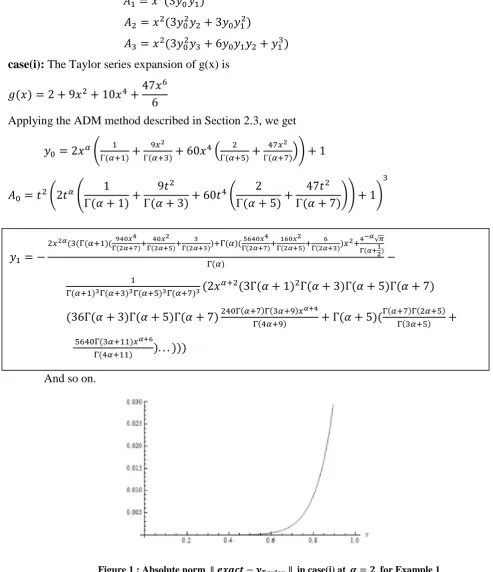
case(i): The Taylor series expansion of g(x) is
Applying the ADM method described in Section 2.3, we get
( ( ))
( (
(
)) )
And so on.
Figure 1 : Absolute norm in case(i) at for Example 1
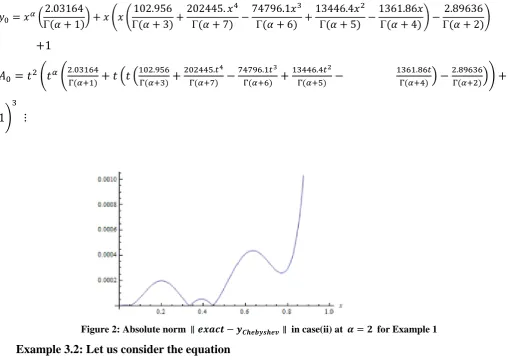
case(ii): Now let M=6, since Riemann-Liouville fractional integral operator and the
Chebyshev polynomials of g(x) is
√
IJSRR, 7(4) Oct. – Dec., 2018 Page 243 Applying the methods described in section 2.3 yields
Figure 2: Absolute norm in case(ii) at for Example 1
Example 3.2: Let us consider the equation
(8)
.
Exact solution at is
Solution According to Eq.5 we have
where , and .
in addition, , the Adomain polynomials are,
case(i): Now let M=8, since Riemann-Liouville fractional integral operator and the Taylor series
of g(x) is
(
) ( (
)
)
( ( ( ( ) ))
IJSRR, 7(4) Oct. – Dec., 2018 Page 244
So, by Eq.2.3, we have
(
( (
)
))
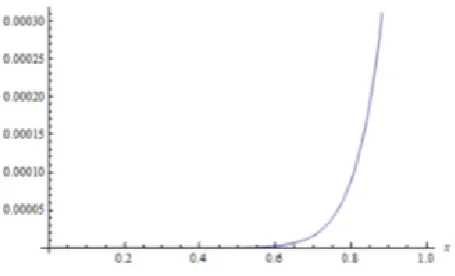
Figure 3: Absolute norm in case(i) at for Example 2
case(ii): Now let M=6, since Riemann-Liouville fractional integral operator and the
Chebyshev polynomials of g(x) is
Baishya Chandrali et al., IJSRR 2018, 7(4), 238-246
IJSRR, 7(4) Oct. – Dec., 2018 Page 245
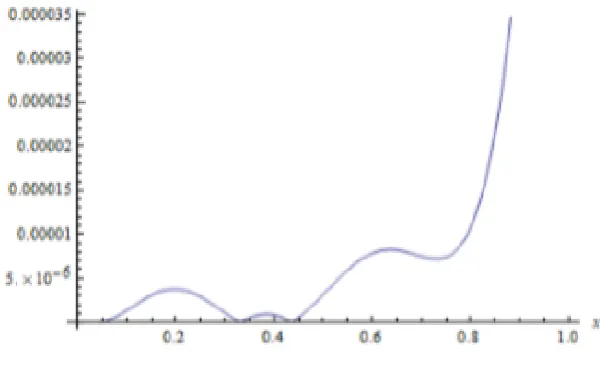
Figure 4: Absolute norm in Case(ii) at for Example 2
4.
CONCLUSION:
In this work, we have applied Adomian Decomposition method with Taylor series and
Chebyshev polynomials. On applying the method to the examples with inhomoheneous source terms
we can conclude from Fig.1, Fig.2, Fig.3 and Fig.4 that Chebyshev polynomial series representation of
inhomogeneous source term produces better results than Taylor series expansion.
REFERENCES
1. Adomian G., The decomposition method for nonlinear dynamical systems, Journal of
Mathematical Analysis and Applications, 1986; 120(1): 370-383.
2. Adomian G., A review of the decomposition method in applied mathematics, J. Math. Anal.
Appl., 1988; 135(2): 501-544.
3. Adomian G. Solving Frontier problem of Physics: The Decomposition Method, 1st ed., Springer, Netherlands, 1994.
4. Wazwaz A., El-Sayed S., A new modification of the Adomian decomposition method for linear
and nonlinear operators, Appl. Math. Comput., 2001; 122(3): 393-405
5. Mehdi Safari, Mohammad Danesh, Application of Adomians Decomposition Method for the
Analytical Solution of Space Fractional Diffusion Equation, Advances in Pure Mathematics,
2011; 1(6): 345-350.
6. Hosseini M. M., Adomian decomposition method with Chebyshev polynomials, Applied
Mathematical and Computation, 2006; 175(2): 1685-1693.
7. He J.H., Homotopy Perturbation Technique, Comput.Methods Appl.Mech.Eng., 1999; 178:
257-262.
IJSRR, 7(4) Oct. – Dec., 2018 Page 246 8. Seng V., Abbaoui K., Cherruault Y., Adomian’s polynomials for nonlinear operators,
Mathematical and Computer Modeling, 1996; 24(1): 59-65.
9. Wazwaz A.M., A comparison between Adomian decomposition method and Taylor series
method in the series solutions, Applied Mathematics and Computation, 1998; 97(1): 37-44.
10. Daftardar-Gejji V. and Jafari H., Adomian decomposition: a tool for solving a system of
fractional differential equations, J. Math. Anal. Appl., 2005; 301: 508-518.
11. Mason J.C, Hanscomb D.C., Chebyshev Polynomials, 1st ed., Chapman and Hall/CRC, Florida, 2003.
12. Light W.A., Some optimality conditions for Chebyshev expansions, Journal of Approximation
Theory, 1979; 27(2): 113-126.
13. Sezer M., Kaynak M., Chebyshev polynomial solutions of linear differential equations, Int.
Math. Educ. Sci. Technol.,1996; 27(4): 607-61.
14. Podlubny I., Fractional Differential Equations, 1st ed., Academic Press, New York, 1998; 198.