Licensed under Creative Common Page 595
http://ijecm.co.uk/
ISSN 2348 0386
EFFECTS OF SUPPLIER SELECTION ON PROCUREMENT
PERFORMANCE OF PUBLIC INSTITUTIONS
A CASE STUDY OF KISII COUNTY, KENYA
Venn Bisieri Manyega
Student, MSc Procurement and Logistics,
Jomo Kenyatta University of Agriculture and Technology, Kenya [email protected]
Walter Okibo
Faculty Member, Jomo Kenyatta University of Agriculture and Technology, Kenya
Abstract
This study seeks to evaluate effects of supplier selection on procurement performance of public
institutions taking a case study of public institutions in Kisii County, Kenya. This study was
guided by three specific objectives which were: to determine the effect of tendering on
procurement performance, to establish the effect of pre-qualification on procurement
performance and to investigate the effect of single sourcing on procurement performance on
public institutions. Achieving and sustaining operational excellence is more important than ever
in today’s challenging economic environment. The study was guided by three theories namely;
Just-in-time theory, Kaizen theory and Theory of constraints. The study adopted a descriptive
research design. The target population was 90 respondents. Simple random sample selection
was used thus a sample size of 27 respondents. Descriptive statistics was used to summarize
the data. Tables and other graphical presentations were used to present the data that was
collected. Multiple regression and Content analysis method were applied to analyze the data.
The study ascertained that procurement performance includes monitoring results, comparing to
benchmarks and best practices, evaluating the efficacy and efficiency of the process, controlling
for variances, and making adjustments to the process as necessary. The management on public
institutions should therefore adopt tendering and prequalification supplier selection methods
thus ensuring effective procurement performance.
Licensed under Creative Common Page 596
INTRODUCTION
Supplier selection from a global point of view encompasses the myriad activities used to evaluate the capabilities of potential suppliers and then to select them to configure a buyer's supply chain for long-term competitive advantage (Choi and Hartley, 1996; Vonderembse and Tracey 1999). Supplier selection is critical (Lao, Hong and Rao 2010) as firms become more and more dependent on their suppliers; the capabilities of those suppliers serve as key resources in the development of the buyer's own capabilities and performance. For example, Gonzalez and Quesada (2004) found that supplier selection was the most influential supply management process for achieving product quality. However, a firm's ability to create or enhance its own capability in a strategically important domain such as quality by leveraging supplier capabilities in quality may depend not only on its ability to select a capable supplier in the quality domain but also on its ability to successfully integrate the supplier into the firm's operations and network. Successful supplier selection is a source for competitive advantage; they affect competitive performance of public institutions positively if effectively selected. Although scant empirical research has examined the performance effects of supplier selection (Petersen, Handfield and Ragatz 2005 is a notable exception), several studies have investigated the effects of supplier integration. In some studies supplier integration is modeled as a construct separate from customer integration or internal integration (e.g., Scannell et al. 2000; Petersen et al. 2005; Swink, Narasimhan and Wang 2007), whereas in others it is subsumed into other integration constructs (e.g., encompassing internal and supplier integration; Maloni and Benton 2000; Nairn and Lalwani 2008). The global construct "supply chain" integration encompasses supplier integration, customer integration and internal integration.
Licensed under Creative Common Page 597 objectives and strategies which will cascade into their personal aims and objectives. From a practitioner standpoint, the issue of selection and its relationship to integration in fostering buyer capability has become increasingly important (Monczka, Trent and Handfield 1998; Krause et al. 2001). Consider the case of Sun Microsystems which has repeatedly tapped into the expertise of Imation, a well-known developer of tape storage technology, to obtain leading-edge product and process technologies (leading to numerous enhancements to Sun's products). In early 2006, the companies announced a partnership agreement to develop and launch an extension to drive platform and their strategic collaboration continues to expand (Carter and Carter 2008). The study's approach is patterned after Ray et al. (2004), who suggest a business process level unit of analysis for examining competitive advantage. Quality-and cost-based supplier selection, as well as subsequent supplier integration, are critical supply management processes (Narasimhan, Jayaram and Carter 2001; Lao et al. 2010).
Procurement performanceinvolves allocation of sufficient resources financial, personnel, time, and establishing a chain of command or organizational structure. It involves assigning responsibility of specific tasks or processes to specific individuals or groups. It also involves managing the process. This includes monitoring results, comparing to benchmarks and best practices, evaluating the efficacy and efficiency of the process, controlling for variances, and making adjustments to the process as necessary. Procurement performance is an on-going, never-ending, integrated process requiring continuous reassessment and reformation (Olson et al. 2005).
Statement of the Problem
Clear established process for selecting suppliers and extending the existing suppliers has been observed to be very important while selecting suppliers to ensure procurement performance (Shanmugan and Bourke, 2001). Thus, if the supplier selection process is not done effectively, the capabilities of suppliers which serve as key resources in the development of the operations’
own capabilities and performance will be negatively affected, e.g. in achieving product quality which depicts the picture of the organization to its clients and users rather than the failure by the on procurement performance of public institutions; this study sought to fill the existing research gap by conducting a study evaluating effects of supplier selection on procurement performance of public institutions taking a case study of public institutions in Kisii County.
The specific objectives of the study were:
i. To determine the effect of pre-qualification on procurement performance of public institutions
Licensed under Creative Common Page 598 iii. To investigate the effect of single sourcing on procurement performance of public
institutions
Limitations of the study
The study used questionnaires as the only instrument for collecting data. The researcher did not have much control on the respondents in regard to the information they filled in the questionnaires. The respondents were not willing to give full information in fear that it could leak to their competitors.
THEORETICAL FRAMEWORK
Theoretical review comprises formulated theories and prepositions about concepts and relationships. The researcher aimed to show how the study in question is related to the theoretical background. The researcher may also choose to deal with a few selected concepts from a particular theory (Mugenda & Mugenda 2003).
Just in time Theory
Just in time (JIT) is a production strategy that strives to improve a business' return on investment by reducing in-process inventory and associated carrying costs.(Goran Svensson, 2001) Just in time is a type of operations management approach which originated in Japan in the 1950s. It was adopted by Toyota and other Japanese manufacturing firms, with excellent results: Toyota and other companies that adopted the approach ended up raising productivity (through the elimination of waste) significantly. To meet JIT objectives, the process relies on signals or (Kanban Kanban) between different points, which are involved in the process, which tell production when to make the next part. Kanban are usually 'tickets' but can be simple visual signals, such as the presence or absence of a part on a shelf. Implemented correctly, JIT focuses on continuous improvement and can improve a manufacturing organization's return on investment, quality, and efficiency. To achieve continuous improvement key areas of focus could be flow, employee involvement and quality (John T. Dalton, 2013).
Licensed under Creative Common Page 599 inventory, and are therefore not a simple solution for a company to adopt it. The company must follow an array of new methods to manage the consequences of the change. The ideas in this way of working come from many different disciplines including statistics, industrial engineering, production management, and behavioral science. The JIT inventory philosophy defines how inventory is viewed and how it relates to management (Goran Svensson, 2001).
Inventory is seen as incurring costs, or waste, instead of adding and storing value, contrary to traditional accounting. This does not mean to say JIT is implemented without awareness that removing inventory exposes pre-existing manufacturing issues. This way of working encourages businesses to eliminate inventory that does not compensate for manufacturing process issues, and to constantly improve those processes to require less inventory. Secondly, allowing any stock habituates management to stock keeping. Management may be tempted to keep stock to hide production problems. The Just-in-Time inventory system focuses in having the right material, at the right time, at the right place, and in the exact amount, without the safety net of inventory.
Theory of constraints
Licensed under Creative Common Page 600 constraint can overall throughput be increased. Assuming the goal of a system has been articulated and its measurements defined, the steps include; the identification of the system's constraint(s), deciding how to exploit the system's constraint(s), subordinating everything else to the above decision(s) and elevating the system's constraint(s). The five focusing steps aim to ensure ongoing improvement efforts are centered on the organization's constraint(s). In the TOC literature, this is referred to as the process of ongoing improvement (POOGI). A constraint is anything that prevents the system from achieving its goal. There are many ways that constraints can show up, but a core principle within TOC is that there are not tens or hundreds of constraints. There is at least one but at most only a few in any given system. Constraints can be internal or external to the system. An internal constraint is in evidence when the market demands more from the system than it can deliver. If this is the case, then the focus of the organization should be on discovering that constraint and following the five focusing steps to open it up (and potentially remove it). An external constraint exists when the system can produce more than the market will bear. If this is the case, then the organization should focus on mechanisms to create more demand for its products or services. Constraints can be in the form of; Equipment i.e the way equipment is currently used limits the ability of the system to produce more salable goods/service, People: Lack of skilled people limits the system. Mental models held by people can cause behavior that becomes a constraint and Policy: A written or unwritten policy prevents the system from making more. The concept of the constraint in Theory of Constraints is analogous to but differs from the constraint that shows up in mathematical optimization. In TOC, the constraint is used as a focusing mechanism for management of the system. In optimization, the constraint is written into the mathematical expressions to limit the scope of the solution (X can be no greater than 5). Organizations have many problems with equipment, people, policies, etc. (A breakdown is just that – a breakdown – and is not a constraint in the true sense of the TOC concept) The constraint is the limiting factor that is preventing the organization from getting more throughput (typically, revenue through sales) even when nothing goes wrong.
Kaizen Theory
Licensed under Creative Common Page 601 organizations all over the world. Kaizen is a way of thinking, working and behaving, embedded in the philosophy and values of the organization. Kaizen should be 'lived' rather than imposed or tolerated, at all levels. Key concepts of Kaizen are every is a key word in Kaizen: improving everything that everyone does in every aspect of the organization in every department, every minute of every day, evolution rather than revolution: continually making small, 1% improvements to 100 things is more effective, less disruptive and more sustainable than improving one thing by 100% when the need becomes unavoidable and everyone involved in a process or activity, however apparently insignificant, has valuable knowledge and participates in a working team or Kaizen group. Everyone is expected to participate, analyzing, providing feedback and suggesting improvements to their area of work. Every employee is empowered to participate fully in the improvement process: taking responsibility, checking and co-coordinating their own activities. Management practice enables and facilitates this and every employee is involved in the running of the company, and is trained and informed about the company. This encourages commitment and interest, leading to fulfillment and job satisfaction (Maurer, Robert, 2012).
Like any methodology however, poor interpretation and implementation can limit the usefulness of Kaizen practices, or worse cause them to be counter-productive. Kaizen is unsuccessful typically where: Kaizen methods are added to an existing failing structure, without fixing the basic structure and philosophy; Kaizen is poorly integrated with processes and people's thinking, training is inadequate, executive/leadership doesn't understand or support Kaizen and employees and managers regard Kaizen as some form of imposed procedure, lacking meaningful purpose. Kaizen works best when it is 'owned' by people, who see the concept as both empowering of individuals and teams, and a truly practical way to improve quality and performance, and thereby job satisfaction and reward. As ever, such initiatives depend heavily on commitment from above, critically: to encourage and support Kaizen, and to ensure improvements produce not only better productivity and profit for the organization, but also better recognition and reward and other positive benefits for employees, whose involvement drives the change and improvement in the first place (Dinero, Donald, 2001).
Conceptual Framework
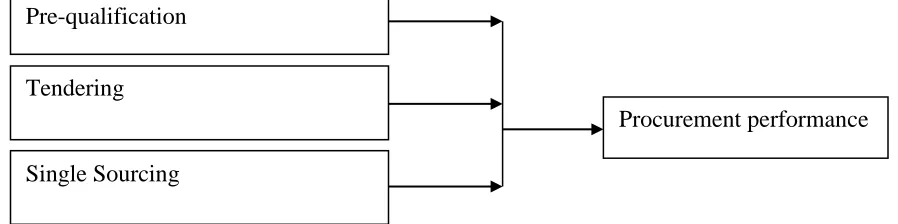
Conceptual framework, according to (Mugenda and Mugenda, 2003), refers to a conceptualization of the relationship between variables in the study and it is shown graphically or diagrammatically. It is the researchers’ own position on the problem and gives direction to the
Licensed under Creative Common Page 602 Figure 1. Conceptual Framework
Research Gaps
A good number of researchers have done studies on factors affecting procurement practices in both public and private entities. In public learning institutions, Kenyanya, et al., (2010) looked at the influence of public procurement regulations on procurement practices in public secondary schools. Karioki (2010) did a research on the assessment of procurement procedures in public secondary schools. Achola (2010) researched on effectiveness of procurement quality assurance mechanism in enhancing performance of procurement in public universities. Arani (2012) researched on role of procurement practices on internal customer satisfaction in public secondary schools. Theses previous studies affirms that the role played by the procurement department in public institutions cannot be underestimated , however there are some loopholes in the process, resulting to poor delivery of services to their internal customers. This study was specifically focusing on supplier selection processes and address how it influences procurement performance.
RESEARCH METHODOLOGY
This research problem was studied through the use of a descriptive research design. According to (Cooper and Schindler 2003), a descriptive study is concerned with finding out the what, where and how of a phenomenon. This study therefore was able to generalize the findings to all the institutions. The target population composed of 90 procurement staff, from five public institutions in Kisii County, namely; Kisii University, Kisii County Assembly, Kisii County Executive, Gusii Institute of Technology and Kisii Referral Hospital. The study selected at random, various procurement staff taking 30% as evidenced by (Mugenda& Mugenda, 1999)
Pre-qualification
Tendering
Single Sourcing
Licensed under Creative Common Page 603 thus giving a sample size of 27 respondents. The questionnaire were carefully designed and tested with a few members of the population for further improvements. The questionnaire had both open and close-ended questions. The study administered the questionnaire individually to all respondents of the study using a drop and pick later method. A pilot study to pretest and validate the questionnaire was carried out. Cronbach’s alpha methodology, which is based on internal consistency, was used. Cronbach’s alpha measures the average of measurable items
and its correlation. The Cronbach’s alpha estimated value was 0.7. Content validity employed by this study was a measure of the degree to which data was collected using a particular instrument represented a specific domain or content of a particular concept. The study selected a pilot group of 10 individuals from the target population to test the reliability of the research instrument. Before processing the responses, the completed questionnaires were edited for completeness and consistency. Quantitative data collected was analyzed by the use of descriptive statistics using SPSS and presented through percentages and frequencies. The information was displayed by use of bar charts, graphs and pie charts and in prose-form.
EMPIRICAL RESULTS AND DISCUSSION
Descriptive statistics was used to discuss the findings of the study. The study targeted a sample size of 27 respondents from which 26 filled in and returned the questionnaires making a response rate of 96.3%, this response rate was satisfactory to make conclusions for the study as Cooper and Schindler (2003), states that a response rate of between 30 to 80% of the total sample size can be used to represent the opinion of the entire population.
Pre-Qualification
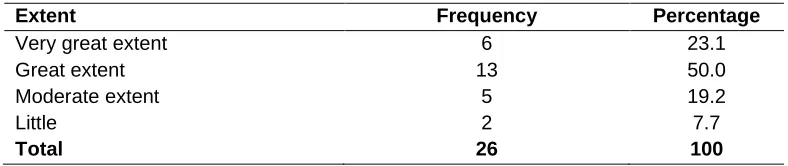
Table 1: Influence of choice of prequalification supplier selection criteria on lead time of goods/services
Extent Frequency Percentage
Very great extent 6 23.1
Great extent 13 50.0
Moderate extent 5 19.2
Little 2 7.7
Total 26 100
Licensed under Creative Common Page 604 extent 19.2 % of the respondents indicated to moderate extent whereas 7.7% of the respondents indicated to a little extent. This is an indication that choice of pre-qualification supplier selection criteria influence lead time of goods/services in public institutions in Kisii County to a great extent, the finding above concurs with the study findings by Lao et al, (2010), that there are various benefits associated with an effective pre-qualification process such as mitigation against poor supplier performance or performance failures. The benefits typically include sourcing from suppliers that provide high standards of product and service levels whilst offering sufficient capacity and business stability. Pre-qualification can help customers and suppliers identify and remove hidden cost drivers in the supply chain. Associated challenges with pre-qualification include resource and cost commitments in establishing and maintaining a robust and effective system, challenges with specifying and gathering meaningful and relevant information, data integrity, scorecards that do not get at the root causes of supplier problems, and subjective or inconsistent scoring which may result in inaccurate assessment. Thus, management commitment to and support of a pre-qualification process is essential. Some of the challenges associated with pre-qualification may be mitigated by the use of appropriate tools. For simple projects a spreadsheet can be used. But as evaluations become more complex or more frequent data management and data integrity issues become significant. Some products provide functionality for combining both initial selection and ongoing evaluation and benchmarking.
Tendering
Table 2: Influence of choice of tendering supplier selection criteria on lead time of tendered goods/services
Extent Frequency Percentage
Very great extent 5 19.2
Great extent 15 57.7
Moderate extent 4 15.4
Little 2 7.7
Total 26 100
Licensed under Creative Common Page 605 selection criteria influence lead time of tendered goods/services in public institutions in Kisii County to a great extent, the finding above concurs with the study findings by Lysons et al, (2006), that negotiated tenders allow the terms of the contract to be negotiated with one or more suppliers without prior publication of a tender notice, but the negotiation procedure is only available in certain defined circumstances such as where, because bids were irregular or unacceptable, no suitable supplier has been found by open or restricted tender procedures, Where such procedures have resulted in no tender being received, Where the required product is manufactured purely for research and development or experimental purposes, where, for technical or artistic reasons, or the existence or exclusive rights, there is only one supplier. In public purchasing, procedures are usually codified within standing orders that usually prescribe a cash limit above which tenders must be invited, the forms of contracts to be used and to whom and under what circumstances responsibility for the evaluation of tenders may be delegated, such as to senior officers. Open tendering procedure begins with the issuing of a public advertisement inviting tenders, then tender documents are issued to those responding to the document normally includes a letter of invitation and instruction to tenders, a pricing document, specification and or schedule of rates, contract conditions and a pre-addressed tender return label.
Single Sourcing
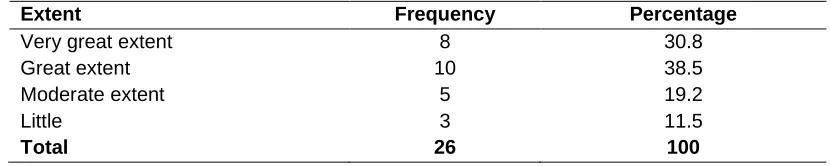
Table 3: Influence of choice of single sourcing supplier selection criteria on lead time of goods/services
Extent Frequency Percentage
Very great extent 8 30.8
Great extent 10 38.5
Moderate extent 5 19.2
Little 3 11.5
Total 26 100
Licensed under Creative Common Page 606 Bachtel, (2001), that a single source purchase is one where there are multiple sources of supply, but for specific reasons the item or service must be purchased from a specified vendor. An order will not be placed without proper documentation, including a written quotation from the awarded vendor. The competitive bidding requirement can be waived for an equipment purchase or services with an aggregate value when the product or service is available from only one non-contract supplier, thereby exempting the purchase from the otherwise required competitive bid policy of the public institution. Many governments publish quite stringent regulations that must be adhered to before single sourcing can be authorized. With small companies, single sourcing is quite common and is an inherent weakness of running a small business. It is rarely cost effective to purchase the same small set of product requirements from more than one vendor. Combined with the fact that small orders are not particularly important to a large vendor, this puts the small company at a disadvantage in any purchaser/vendor relationship, in this situation, it is imperative that the small company has an excellent supplier relationship and takes on more vendors as soon as the company has expanded enough to make this a viable proposition.
Procurement Performance
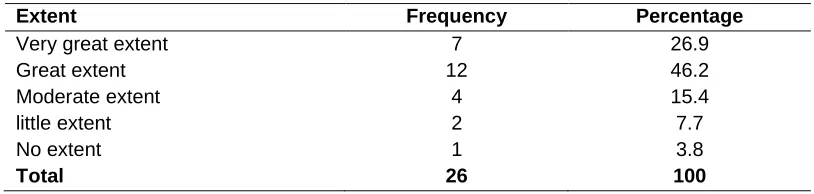
Table 4: Extent supplier selection methods compliment procurement performance
Extent Frequency Percentage
Very great extent 7 26.9
Great extent 12 46.2
Moderate extent 4 15.4
little extent 2 7.7
No extent 1 3.8
Total 26 100
Licensed under Creative Common Page 607 specific individuals or groups; it also involves managing the process. This includes monitoring results, comparing to benchmarks and best practices, evaluating the efficacy and efficiency of the process, controlling for variances, and making adjustments to the process as necessary. Procurement performance is an on-going, never-ending, integrated process requiring continuous reassessment and reformation.
CONCLUSIONS
From the findings the study established that pre-qualification is positively significant to influence procurement performance thus the study concludes that pre-qualification had a positive influence on procurement performance in public institutions in Kisii County.
The study established it is useful to consider pre-qualification it involve resource and cost commitments in establishing and maintaining a robust and effective system, challenges with specifying and gathering meaningful and relevant information, data integrity, scorecards that do not get at the root causes of supplier problems, and subjective or inconsistent scoring which may result in inaccurate assessment.
The study revealed that tendering procedure begins with the issuing of a public advertisement inviting tenders, then tender documents are issued to those responding to the document normally includes a letter of invitation and instruction to tenders, a pricing document, specification and or schedule of rates, contract conditions and a pre-addressed tender return label having a positive influence on procurement performance in public institutions in Kisii County. The study ascertained that procurement performance includes monitoring results, comparing to benchmarks and best practices, evaluating the efficacy and efficiency of the process, controlling for variances, and making adjustments to the process as necessary thus it is an on-going, never-ending, integrated process requiring continuous reassessment and reformation.
RECOMMENDATIONS
Based on the findings, the study recommends that the management on public institutions should consider adopting tendering and prequalification supplier selection methods during procurement process. This will allow the management to create a comprehensive understanding that can be leveraged to influence stakeholders and create better decisions in ensuring effective procurement performance.
The study also recommends that is very crucial that the organization doesn’t under rate
Licensed under Creative Common Page 608 performance of procurement and the necessary input to find effective suppliers that will facilitate timely delivery of orders.
The study recommends that the management keeps on monitoring as well as re-assessing the whole process of procurement. This will help to identify whether the adopted counteractive supplier selection methods are making any acceptable difference.
The study recommends that the management keeps on adopting new supplier selection approaches since they are particularly critical for public institutions because of the role they play in relation to well performance of the whole procurement process.
RECOMMENDATIONS FOR FURTHER STUDIES
This research had intended to determine the effects of supplier selection on procurement performance of public institutions taking a case study of public institutions in Kisii County, Kenya. Other researcher may focus on the relationship between procurement process and financial performance in public institutions in Kenya.
REFERENCES
Kiyoshi Suzaki, 1987, The New Manufacturing Challenge: techniques for continuous improvement, the Free Press, London.
Lysons, K., & Farrington, B. (2006). Purchasing and Supply Chain Management. (7th ed.) New Jersey:
Prentice Hall.
Mugenda, O. & Mugenda, G. (1999). Research Method, Quantitative and Qualitative Approaches. Nairobi: Nairobi Act Press
Monezka , R., Trent, R., & Handfield, R. (2002). Purchasing and supply chain management. (2nd ed).
South-West: Tomson Learning
Halldorsson, A., Kotzab, H., Mikkola, J. H., Skjoett-Larsen, T. (2007). Complementary theories to supply chain management. Supply Chain Management: An International Journal, Volume 12 Issue 4, 284-296. Hines, T. (2000). Supply chain strategies: Customer driven and customer focused. Oxford: Elsevier. O’Riordan, J. & Humphreys, P.C. (2003). Developing an effective internal customer’s service ethos: Institute of Public Administration Ireland.
Republic of Kenya (2005). Public Procurement and Disposal Act, Nairobi: Government of Kenya.
Republic of Kenya (2006). The Public Procurement and Disposal Regulations. Nairobi: Government of Kenya.
Kaushik K.D., & Cooper, M. (2000). Industrial Marketing Management. Volume 29, Issue 1, January 2000, Pages 65–83
Ketchen Jr., G., & Hult, T.M. (2006). Bridging organization theory and supply chain management: The case of best value supply chains. Journal of Operations Management, 25(2) 573-580.
Licensed under Creative Common Page 609 Achola, M. D. (2010). Effectiveness of procurement quality assurance mechanism in enhancing performance of procurement in public universities: A case study of the University of Nairobi. JKUAT. Larson, P.D. and Halldorsson, A. (2004). Logistics versus supply chain management: an international survey. International Journal of Logistics: Research & Application, Vol. 7, Issue 1, 17-31.
Lavassani K., Movahedi B., Kumar V. (2009) Developments in Theories of Supply Chain Management: The Case of B2B Electronic Marketplace Adoption, The International Journal of Knowledge, Culture and Change Management, Volume 9, Issue 6, pp. 85–98.
Mentzer, J.T. et al. (2001): Defining Supply Chain Management: Journal of Business Logistics, Vol. 22, No. 2, 2001, pp. 1–25
Mentzer, J. T., Stank, T. P. & Esper, T. L. (2008). Supply chain management and its relationship to logistics. Marketing Production, and Operations Management. Journal of Business Logistics, 29(1), 31-46.
Kenyanya, P., Onyango, J. & Mamati, F. (2011). Influence of procurement regulation on procurement practices among secondary schools. Publication: Alburma conference.
Karioki, N.M. (2010). An assessment of procurement procedures in public secondary schools in Thika. JKUAT.
Farmer, D. and Weele, V. (2000) Handbook of Purchasing Management; (2nded.) Hampshire: Gower.
Lysons, K. anad Gullingham, M. (2003) Purchasing and Supply Chain Management,( 6th ed.) London:
Pearsons Hall.
APPENDIX: QUESTIONNAIRE
Pre-Qualification
To what extent does the choice of supplier selection criteria affect the lead time of goods/services
Very great extent [ ]
Great extent [ ]
Moderate extent [ ]
Little extent [ ]
No extent [ ]
Tendering
How does the choice of supplier selection criteria affect the lead time of goods/services
Very great extent [ ]
Great extent [ ]
Moderate extent [ ]
Little extent [ ]
No extent [ ]
Single Sourcing
To what extent does the choice of supplier selection criteria affect the lead time of goods/services
Very great extent [ ]
Licensed under Creative Common Page 610 Moderate extent [ ]
Little extent [ ]
No extent [ ]
Procurement Performance
To what extent does a supplier selection method compliment procurement performance?
Very great extent [ ]
Great extent [ ]
Moderate extent [ ]
Little extent [ ]