Themed Section: Science and Technology
Design of Traffic Rotary at Forest Complex, Karimnagar, TS
Venkatesh Koudagani, Ramya. S, Vinod. G, Soujanya, KumarjithCivil Engineering Department, Telangana, India ABSTRACT
Design of traffic rotary is an enlarged road intersection. This includes traffic volume, rotary capacity, design speed. Rotary intersection designed to decrease traffic time, delay, severity of accidents and cost. The vehicles entering into the rotary are forced to move in a clockwise direction. Traffic volume study plays an important role in the evaluation of requirement of the rotary junction. For the analysis of the traffic volume, traffic has to be conducted in the peak hours at a rotary junction.
Keyword : Traffic Time, Traffic Rotary, Rotary Intersection, Weaving Man Oeuvre, Passenger Car Units
I.
INTRODUCTIONRotary Intersection
A rotary intersection or traffic rotary is an enlarged road intersection where all converging vehicles are forced to move round a large central island in one direction before they can weave out of traffic flow into their respective directions radiating from central island .
Figure 1
In India and other countries which follow „keep to the left „ regulation, clock-wise direction of flow around the island is followed. The main objects of providing a rotary are to eliminate the necessity of stopping even for crossing streams of vehicles and to reduce the area of conflict.
The crossing of vehicles is avoided by allowing all vehicles to merge into streams around the rotary and
then to diverge out to the desired radiating road. Thus the crossing conflict is eliminated and converted into „weaving man oeuvre‟ which consists of (i) merging man oeuvre form the left and diverging to the right or (ii) a merging from the right and diverging out to the left
Figure 2 Traffic Operations in a Rotary:
Merging:
When a vehicle travelling along an adjoining lane or roadway desires to enter the main traffic stream by looking for an opportunity of sufficient gap between the vehicles of the main stream, this operation is called „merging manoever‟.
Diverging:
adjacent traffic lane or to a side road, this operation is called „diverging man oeuvre‟.
Weaving:
When a vehicle moves obliquely across the path of another vehicle moving in the same direction at relatively small angle of crossing, the man oeuvre is termed as weaving.
Design Factors of Rotary Intersection: Design speed
Shape of Central Island Radius of rotary roadway
Weaving angle and weaving distance Width of carriageway at entry and exit Width of rotary roadway
Radius of entrance and exit curves Capacity of the rotary intersection Channelizing islands
Camber and super elevation Sight distance and grade lighting and
Traffic signs
Passenger Car Units (PCU):
Different classes of vehicles such as cars, vans, buses, trucks, auto rickshaws, motor cycles, pedal cycles, bullock carts, etc. are found to use the common roadway facilities without segregation on most of the roads in developing countries like India.
It is rather difficult to estimate the traffic volume of roadway facilities under mixed traffic flow, unless the different vehicle classes are converted to one common standard vehicle unit. Therefore it is necessary to determine or to assign equivalency factors for different classes of vehicles. It is a common practice to consider the passenger car as the standard vehicle unit to convert the other vehicle classes and this unit is called “PASSENGER CAR UNIT” or “PCU”.
Factors Affecting PCU Values:
The PCU values of different vehicle classes depend upon several factors. Some of these factors are listed below:
1. Dimension of vehicles such as width and length. 2. Dynamic characteristics of vehicles such as
power, speed, acceleration braking.
3. Transverse and longitudinal gaps or clearances
between moving vehicles which depends upon the speeds, driver characteristics
and the vehicle classes at the adjoining spaces 4. Traffic stream characteristic such as composition
of different vehicle classes, mean speed and speed distribution of the mixed traffic stream and volume to capacity ratio.
5. Roadway characteristics such road geometrics including gradient and curves, access controls, rural or urban road, presence of intersections and the type of intersections.
6. Regulation and control of traffic such as speed
limit, one way traffic, presence of different traffic control devices, etc.
7. Environmental and climate conditions.
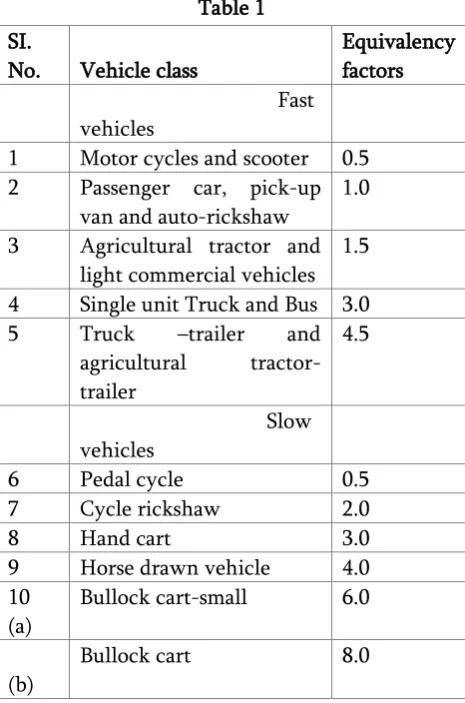
Recommended PCU values for different conditions: The Indian Roads Congress has recommended a set of PCU values for different types of fast and slow moving vehicles generally found on roads in India passing through rural areas. These PCU factors have been suggested by the IRC while providing the guidelines for capacity of roads in rural areas.
Table 1 SI.
No.
Vehicle class
Equivalency factors Fast
vehicles
1 Motor cycles and scooter 0.5 2 Passenger car, pick-up
van and auto-rickshaw
1.0
3 Agricultural tractor and light commercial vehicles
1.5
4 Single unit Truck and Bus 3.0 5 Truck –trailer and
agricultural tractor- trailer
4.5
Slow vehicles
6 Pedal cycle 0.5
7 Cycle rickshaw 2.0
8 Hand cart 3.0
9 Horse drawn vehicle 4.0 10
(a)
Bullock cart-small 6.0
(b)
Bullock cart 8.0
PCU values for roads in urban areas recommended by the IRC:
The Indian Roads Congress has recommended a set of PCU values for different types of fast and slow moving vehicles generally found on urban roads in India. These PCU values have been suggested by the IRC while providing the guidelines for capacity of roads in India. These PCU values have been suggested by the IRC while providing the guidelines for capacity of roads in urban areas
Table 2 SI.
no.
Vehicle type Equivalent PCU factors
Percentage
composition of vehicle type in traffic stream
Fast vehicles 5% 10%
etc.
2 Passenger car, pick-up van
1.0 1.0
3 Auto- rickshaw 1.2 2.0 4 Light commercial
vehicle
1.4 2.0
5 Truck or bus 2.2 3.7 6 Agricultural
tractor-trailer
4.0 5.0
Slow vehicles
7 Pedal cycle 0.4 0.5 8 Cycle-rickshaw 1.5 2.0 9 Tonga (horse drawn
vehicle)
1.5 2.0
10 Hand cart 2.0 3.0
II.
LITERATURE REVIEWAs per Dr. Kadiyali the radii and weaving lengths elements are governed by design speed. Dimension should be keep within practical limits only; the design speed should be least than that of the intersecting highways design speed. When it comes to Indian design speed in rural and urban areas are ranges up to 40 K.M.P.H. and 30 K.M.P.H. respectively. According to Khanna and Justo .Vehicles approaching towards the intersection at the junction has to slow down their speed limits when compared to that of the design speed of the standard highway. With these in view the design speed for rotaries in India is taken as 40 kmph for rotaries in rural area. In all other cases and for rotaries in urban areas, a speed 30 kmph is adopted for design.
Entrance and Exit Curve
According to Khanna and Justo Radius and shapes to which the kerb line is to be set can be determined by curve traced by the inner rear wheel of vehicles. The radius of the entrance curve should be the same as the minimum recommended radius of the central island as vehicle entering a rotary will slow down to the design speed of the rotary. For the design speeds of 40 kmph the suggested radius at entry curves is 20 to 35 cm and for 30 kmph, 15 to 25 m. Simple circular curve are provided instead of practicable three centered entry curves. In order to prevent clustering of mixed traffic at the approaches the normal pavement width at entrance and exit should be equivalent to two lanes. At entrance and exit curve extra widening has to be provided. In the view of Dr.Kadiyali . The radius at entry is determined by the design speed, super-elevation and co-efficient of friction. For rural designs a range of 20 to 35 m is found to be suitable and for urban designs a range of 15 to 25m is suitable. The exit radius should be higher than the radius of the rotary island so that it favors a higher speed by drivers. This will enable the vehicles to leave the rotary rapidly. The general practice is to keep the radius of exit curves 1.5 to 2 times the radius of the entry curves. For both author‟s discussion For the design speed of 40 kmph the suggested radius at entry curves is 20 to 35m and for 30 kmph, 15 to 25m. it has been seen that the buses and trucks can take right angled turn easily at these curves at the design speeds. Extra widening has to be provided at the entrance and exit curve. The exit radius should be higher than the radius of the rotary island so that it favors a higher sped by drivers. This will enable the vehicles to leave the rotary rapidly. The general practice is to keep the radius of exit curves 1.5 to 2 times the radius of the entry curves.
Weaving Angle and Weaving Distance
According to Khanna and Justo. Vehicles entering the rotary from a road and leaving towards another radiating road have to first merge into the single way
traffic flow in the circular way around the central island. For smooth flow of traffic the weaving angle should be small but not less than 15 as the diameter of the Central Island required will be too large. For 40KMPH the recommended value of weaving length is 45 to 90 meters and for 30KMPH design speed 30 to 60 m. According to Dr. Kadyali, The ease with which the traffic can merge and diverge will determine the weaving distance. On the basis of factors such as the width weaving section, the average width of entry, total traffic and the proportion of weaving traffic in it the weaving length are decided.
Minimum length of weaving section from Dr. Kadyali
Table 3 DESIGN SPEED (KMPH)
MAXIMUM WEAVING LENGTH(m)
40 45
30 30
From both the authors point of view the angle between the path of a vehicle entering the rotary and that of another vehicle leaving the rotary at adjacent road, thus crossing the path of the former is termed as the weaving angle. The weaving operation including merging and diverging can take place between the two channeling islands of the adjacent intersecting legs, and this length is 45 meters for 40KMPH and 30 m for 30KMPH design speeds.
Width of carriageway at entry and exit
As per the author Dr. Kadyali. The carriageway width of the intersection legs can be given by the design year traffic entering into intersection and moving away from the intersection. A minimum width of the carriageway can be taken as 5 meters, with providing for extra widening due to curvature, may be provided for the entrance and exit.
Table 4 Carriageway
width of approach road
Radius at entry(m)
Width of carriageway at entry and exit(m) 7m(2 lanes)
10.5m (3 lanes) 14m(4 lanes) 21m (6 lanes)
25-35
6.5 7.0 8.0 13.0 7m (2 lanes)
10.5m (3 lanes) 14m (4 lanes) 21m (6 lanes)
15-25
7.0 7.5 10.0 15.0
As per authors Khanna and Justo. The carriageway width at the entrance and exit of the rotary can be taken by the amount of vehicles entering into the circular intersection and vehicles leaving the circular intersection to the road. The minimum width of the carriageway at the entrance and exit should be 5m and the entry width may be increased to 6.5,7 and 8m when the carriageway width of approach road is 7, 10.5 and 14m respectively and the radius of entry is 25-35m. The carriageway width of the intersection legs is governed by the design year traffic entering and leaving the intersection. The minimum width of the carriageway at the entrance and exit should be 5m and the entry width may be increased to 6.5,7 and 8m when the carriageway width of approach road is 7, 10.5 and 14m respectively and the radius of entry is 25-35m.
III.
DESIGN OF ROTARYDESIGN OF PROPOSED ROTARY INTERSECTION: Design Speed:
For rural and urban areas 30 kmph and 40kmph respectively.
Radius at Entry:
For ideal design rural and urban areas 20 and 15 meters .
Radius at Exit:
The exit radius is 1.5 to 2 times the entry radius.
The radius of the central island is 1.3 times entry curve.
Weaving Length:
45m and 30 m weaving length designed for 30kmph 40kmph design speed.
Width of Rotary Carriage way :
The width of weaving section (w) for one lane traffic is 3.5m.
It is wider than the mean entry width. Entry and Exit Angles:
Entry angles should be larger than exit angle, it should be should be about 60o.
Procedure:
As Per Collected Volume Design of Rotary: Step-1:
Design speed for urban area = 30kmph
Figure 3 Step-2:
Entry and Exit Angle Entry angle Ø1 = 45o Exit angle Ø2 = 45o Ø =90o Step-3:
Radius at Entry curve
A range for urban area is 15 to 25 m, So suitable for urban area design Radius at entry is 15m.
Step-4:
Radius at Exit =30m Step-5:
et al. Int J S Res Sci. Tech. 2018 July-August-201; 4(9) : 01-05
Table 5
Approaches
Left
Turning
Straight
Turning
Right
Turning
1) Hospital
road(North)
281
598
173
2) Bus stand
road(South)
5563
599
845
3)Tower
road(East)
327
340
224
4)I.B
Chowrastha
(West)
280
320
290
T
o
tal
3494 3961 4840 4583 4133 4229 4287 4482. 25 4345 4369 4430 4576
B u s s tan d R o ad R ig h t
400 757 845 830 740 798 820 761 720 798 744 804
Stra
ig
h
t
360 266 599 436 560 531 570 464 500 535 559 574
L
ef
t
350 316 563 455 490 513 495 482 499 487 495 520
I. B C h o wr asta R o ad R ig h t
275 175 290 230 270 268 251 260 257 277 285 280
Stra ig h t
289 280 320 290 280 276 287 285 279 250 280 300
L
ef
t
200 245 280 247 207 234 368 240 267 240 266 250
T o wer R o ad R ig h t
190 17
3 .4 2 2 6 .7 5
257 220 221 189 26
1
.5
218 230 200 235
Stra
ig
h
t
330 33
8 .0 5 3 3 9 .2 5 2 8 0 .2 5
276 260 280 406 350 299 298 305
L
ef
t
200 26
3
.7
5 32
6 .5 3 0 3 .5
280 230 299 272 285 243 290 310
Ho
sp
it
al Ro
ad
R
ig
h
t
130 23
4
.9
173 24
6
.9
Stra
ig
h
t
500 666 59
7
.1
5
6
9
2
.7
5
450 530 350 55
7
.5
540 580 570 550
L
ef
t
270 240 281 306. 6 230 248 250 222. 25 270 260 270 270
T
im
e
7
:4
5
to
8
:4
5
8
:4
5
to
9
:4
5
9
:4
5
to
1
0
:4
5
1
0
:4
5
to
1
1
:4
5
1
1
:4
5
to
1
2
:4
5
1
2
:4
5
to
1
:4
5
1
:4
5
to
2
:4
5
2
:4
5
to
3
;4
5
3
:4
5
to
4
:4
5
4
:4
5
to
5
:4
5
5
:4
5
to
6
:4
5
6
:4
5
to
7
:4
5
S.No 1 2 3 4 5 6 7 8 9 10 11 12
The maximum weaving traffic section is,
PNS = 0.772
PES = 0.74
= 0.71
= 0.56
PMAX = PNS = 0.772
So, the maximum weaving occurs in the Hospital Road To Bus stand Road Section.
Step-7:
Width of non –weaving section e1 =6.5m, e2 = 7.5m
The average entry ( e ) = =
= +3.5 w = 10.5m
l = 4 × w = 4 × 10.5 l = 42m Step-8:
Practical capacity of Rotary:-
The capacity of a rotary is directly determined by the capacity of each weaving section.
( )
( )
Capacity of Rotary(QP) = 2911.25 PCU/Hour
Figure 4
Check for Acceptance:
2) w/l should be between 0.12 and 0.40 10.5/42=0.24 Hence OK. 3) P should be between 0.4 and 1. P = 0.77 Hence OK. 4) l should be between 18 and 90m. L = 42m Hence OK.
Results:-
The study of rotary intersection present at Forest complex, Karimnagar. Traffic volume is the major element of the analysis of the traffic capacity. Lots of parameters were monitored, evaluated and analyzed to understand the traffic improvement necessities to be implemented.
In this study traffic volumes were analyzed from each leg of the rotary intersection. The volume and capacity were considered in terms of Passenger Car Unit (PCU) for the uniformity of the analysis.
IV.
CONCLUSION
(i) Capacity matters at peak times and peak hours where most of the drivers are familiar with the route they are moving daily to work and back from work. Rotary can be used as traffic reducing device than as control for high flow junctions and it is proved they are effective.
(ii) For efficient working of rotary intersection sufficient gap must be provided in circulatory carriage way.
(iii) Rotary intersections are proven to be safe for pedestrian. The construction and maintenance of rotary is expensive. The land required for construction of rotary is more.
(iv) Once the rotary is developed the property value will be higher and development process can be considered.
(v) Painting and signboard‟s can be used for the safety reasons. Attractive message giving mesh can be used in public interest and awareness around rotary.
(vi) Reuse material can be used in construction of road surface which is environmental friendly.
(vii) The properly designed rotary will have angles at which traffic merges or diverges will be small. This results in slow the traffic and reducing the accident rate.
(viii) Rotary has major drawback dealing with unbalanced traffic flow in this case signalized rotary is used.
(ix) Rotary intersection designs helps in maintaining the environment by providing space for vegetation in and around it.
(x)The design process of rotary intersection is first the traffic data of peak hour should be collected, data on the site should be collected (horizontal alignment and vertical alignment), then looking at the standards to select the type of junction constructed. The layouts of design of unction can be altered according to operating, cost and environmental aspects.
Finally safe rotary design can reduce accidents and serve people better compared to any other form of junctions.
V.
REFERENCES
[1]. IRC 65-1976, "Recommended Practice for Traffic Rotaries", Indian Road Congress, New Delhi.
[2]. S.K.KHANNA., C.E.G.JUSTO., And A.VEERARAGHAVAN (2015), "Highway Engineering", NEM CHAND & Bros, 10th Edition, New Delhi.
[3]. Dr.L.R.KADIYALI (2005) "Traffic Engineering transportation planning", KHANNA publishers Delhi.
[5]. Akcelik, RahmiRoundabouts: Comments on aaSIDRA gp-acceptnce Model and the UK Liner Regression Model, Akcelik & Associates Pty Ltd., Vermont south, Australia, 2001.
[6]. Tanner,J.C.(1962)A theoretical analysis of delays at an uncontrolled intersectionBiometrica, 49:163-170.
[7]. Polus, A.,Shmueli,S (1997)Analysis and Evaluation of the Capacity of RoundaboutsTRB Annual Meeting, Jan.1997, Washington, Preprint970115.
[8]. Akcelik,R.(2011)An Assessment of the Highway Capacity Manual 2010 Roundabout Capacity ModelProceeding of the 3rd International Conference on Roundabouts, Carmel, IN, May 18-20,2011
[9]. Veethika Gomasta, Mohit Malviya, Abhishek Singh and Saleem Akhtar, "Design nd Analysis of Intersections for Improved Traffic Flow at Bhopal-Case Studies of Jyoti Talkies Square and Vallabh Bhawan Roundabout" International Journal of Current Engineering and Technology, Vol.5, No.6 (Dec 2015).
[10]. Patel Mira (2014), Solution for reduction of traffic congestion – A case study of Thatlej rotary intersection International Journal of Applied Engineering and Technology.
[11]. Ar.Jaiswal Anuj and DrSharma Ashutosh (JULY 2012): Optimization of Public Transport demand- A case study of Bhopal, International Journal of Scientific and Research Publlications. [12]. Tom V.Mathew and K V Krishna Rao,
"Introductiom to traffic engineering, traffic signal design design-II"(NPTEL, May 3, 2007). [13]. IRC93-1985 "Guideline s on Design and
Installation of Road Traffic Signals".
[14]. George Yannis, Petros Evgenikos (2000) – "Effectiveness of road safety measures at junctions".
[15]. D.WHarwood, I.BPotts (2002) "Safety
[16]. Kazunori Hokao and Shihana Sulaiha (2002) "Traffiic impact mitigation for new developments: a way to reduce traffic Congestion in major cities".
[17]. Kazunori Hokao and Shihana Sulaiha (2014) "Design and simulation nalysis of at-grade intersection channelization of city roads". [18]. Vikram JPatel,Hemraj R.Kumavat (2014)
"Modelling of Speed- Flow Equations on Four- Lane National Highway-8".
[19]. Weili Sun, Xinkai Wu, Yunpeng Wang , Guizhen Yu "A continuous-flow-intersection-lite design and traffic control for oversaturated bottleneck intersections".