IJSRR, 7(4) Oct. – Dec., 2018 Page 1572
Research article
Available online www.ijsrr.org
ISSN: 2279–0543
International Journal of Scientific Research and Reviews
Localization Technique Considering Position
Uncertainty of
Reference Nodes In Wireless Sensor Networks
A. Nithya
KG College of Arts and Science, Coimbatore-35.
ABSTRACT
This paper proposes a distributed localization algorithm in wireless sensing element
networks. The formula considers the position uncertainty of reference nodes, that are unnoticed
within the past analysis, within which imperfect position info of reference nodes intensifies the error
accumulation development. The formula calculates position uncertainty by the dilution of
preciseness and presents a balance purpose between varies errors and position errors by applying the
changed spring mass methodology. It has a tendency to verify the practicableness of the planned
formula by dynamical multiple parameters below numerous circumstances. The result proves that the
general performance of localization is increased by considering the position uncertainty.
KEYWORDS:
Position uncertainty, spring mass method, dilution of precision, distributed localization, wireless sensor networks.*Corresponding author
A. Nithya
M.Sc.,M.Phil.,(Ph.D).,
Assistant Professor,
KG College of Arts and Science,
Coimbatore-35.
IJSRR, 7(4) Oct. – Dec., 2018 Page 1573
I.INTRODUCTION
In recent years, wireless communication of small and low power electronic devices has been
actively mentioned and studied. it's expected that each device within the home, office, warehouse,
and shopping centre may well be connected to web within the close to future, and connections may
well be a variety of wireless sensing element network (WSN). One among the main analysis issue for
wireless sensing element networks is localization. Many applications, like target following,
wide-area watching, search and rescue, need position info. The international positioning system (GPS) is a
representative technique to seek out a footing of devices. However, GPS isn't acceptable for indoor
house or high-rise urban wherever GPS signal is stopped up. Moreover, arming every device with
GPS is neither efficient nor energy economical. Thus, the choice thanks to estimate device location is
required. A lots of WSN localization techniques are studied to propose numerous algorithms1–3.
These localization algorithms are often classified into centralized algorithms and distributed
algorithms. During a centralized algorithmic rule, one or a lot of central devices gather all info of the
whole network elements devices need high procedure power inflicting massive energy consumption.
In a distributed algorithmic rule, on the different hand, every device estimates its own position with
info from neighbouring devices. Generally, a sensing element network consists of variety of devices
equipped with a coffee procedure ability processor and restricted capability battery. Therefore, a
distributed algorithmic rule is a lot of most popular to sensing element network localization. In a
method of localization, inter-device vary info calculated from the received-signal-strength (RSS)
worth or the time-of-arrival (TOA) measuring worth, etc. during a sensible scenario, a variety can't
be specifically measured thanks to measurement error. Moreover, calculable device positions area
unit imperfect attributable to location estimation error and error accumulation development. various
studies are projected so as to scale back these uncertainties in numerous ways that. In [4]–[6], high
resolution algorithms like MUSIC, ESPRIT, and MPLR were applied to cut back move error. In [7]–
[9]
, probabilistic densities perform and anchor nodes readying were thought-about for decreasing
position error. In [10], a spring mass technique is used to refine initial device position for fine position
estimation. In [11]–[12], mobile anchor nodes enhance position accuracy by providing further
measurement as they move around a target node. Most of those numerous tries area unit centred on
minimizing the position error of a target device in things wherever solely distance error is given.
However, the position error of neighbouring devices concerned in measuring is often unnoticed.
During a sensible scenario, it's a lot of natural for each of position errors of near devices and vary
measuring errors to be handled at the same time.
In this paper, I have a tendency to propose a distributed range-based localization algorithmic
IJSRR, 7(4) Oct. – Dec., 2018 Page 1574
Moreover, it estimates corrected neighbour devices’ position in addition as target device position by
victimization changed spring mass technique (SMM) of that resolution is settled and it's noise
lustiness. During this algorithmic rule, it have a tendency to adopt a dilution of precision (DOP) to
quantify a footing uncertainty. It has a tendency to verify AN accuracy of the projected algorithmic
rule by gathering RSS values from multiple Zig Bee devices in numerous eventualities, together with
AN node readying. As a result, have a tendency to demonstrate that the projected algorithmic rule
will scale back overall location estimation errors.
The main contributions of this paper are summarized as follows: to propose a distributed
localization formula that considers each vary and position uncertainty. Specially, the projected
formula handles position uncertainty of neighbouring devices, That is usually unnoticed. In our
formula, tend to take into account the connection between vary and position uncertainty by
victimization DOP conception and SMM.I tend to judge the projected formula by constructing
ad-hoc networks, that consists of multiple k-mote devices. The remaining portion of the paper is
organized as follows: tend to describe notations, assumptions for the projected localization, and
drawback tend to solve in Section II. Then, to justify the spring mass localization methodology and
therefore the details of the projected formula in Section IV. In Section V, to verify the performance
of the projected formula through simulation and experiment. In addition, tend to analyse the results
of simulation and experiment.
II. PROBLEM DE FINITION
A. Terms and
conditions
A primary field of interest is localization in a distributed ad-hoc network composed of
multiple communication devices. It can call each of these devices as a node. According to the ability
to get the position information by itself, nodes are classified into two types: an anchor node and an
ordinary node. An anchor node can acquire its location information via onboard GPS or some other
methods, whereas an ordinary node tries to find its position by exchanging a specific information
with nodes in the vicinity. In another way, nodes are divided into a reference node and a target node
according to their role in the localization process. A target node is the one to be localized during the
estimation process. The reference node, meanwhile, already knows its position and can support
position localization of the target node. In a distributed network, if two nodes can exchange
messages directly or with the aid of other nodes, call they are connected.
IJSRR, 7(4) Oct. – Dec., 2018 Page 1575
Every localization method has a position estimation error has some range measurement error
and an imperfection of the algorithm itself. In this paper, it has denominate quantified estimation
error as uncertainty. Range uncertainty is caused by measurement range error and surrounding
environment. Position uncertainty depends on range uncertainty, performance of localization
algorithm and spatial placement of reference nodes.
In different words, most of localization ways assume that position of reference nodes is
completely correct. However, distributed localization algorithmic program accompanies reference
node position errors. If reference node position uncertainty is unheeded, it propagates through AN
iteration method and accumulates in target node position uncertainty while not attenuation.
Therefore,it have a tendency to propose AN algorithmic program that takes under consideration the
reference node position uncertainty. It can use a plan of the dilution of exactness (DOP) for
quantifying position uncertainty. A DOP is that the quantitative relation of vary error to position
estimation error that varies with reference node pure mathematics. Therefore, position estimation
error are often handled with mathematical kind by mistreatment the DOP. Theoretically, a
calculable target node position is decided by the purpose point of intersection point of 3 circles of
that the radius is that the same because the measured distance and centre point is that the reference
node position. If there's no measuring error, the point should exist. In follow, however, the point
doesn't exist because of vary measuring errors. 3 circles of that a line thickness is decided by
quantity of the measuring error build a intersection space rather than AN point. A size of the world
depends on the road thickness and a geometrical preparation of reference nodes. The relation
between the reference node pure mathematics, vary measuring error, and position estimation errors
area unit outlined as follows:
x = H−1 ρ, (1)
where x∈RN D is a vector related to the position error of target node in ND dimensional
coordinates, ρ is a vector related to an error in range measurement, and H is a transform matrix containing the relation between x and ρ. If x and ρ differ in size, following equation is applied
in place of equation.
x = (HT H)−1 HT ρ
A matrix H is composed of hij , as shown in Equation (3),
Where hij can be derived as Equation where NRT is the number of reference nodes that participate
in localization for target node DT Elements of the matrix H varies according to a localization
IJSRR, 7(4) Oct. – Dec., 2018 Page 1576
From Equation (2), the relation between the standard deviation of position error vector σ p and that of ranging error vector σ r is calculated as follows:
(a) (b)
Fig1. Two distribution of DOP, (a) error resistive geometry and (b) error-prone geometry
regarding to reference nodes (white dots) geometry on the near area.
Fig2. Example of scenario.
It cam can estimate a target node’s position uncertainty which is determined by a geometric
deployment of reference nodes participating in target node localization by calculating a DOP. The
DOP distribution which varies according to the reference nodes geometry is shown in Fig. 1.
III. SYSTEM MODEL
A.
Scenario
An example of our targeting system is shown in Fig. 2. Each node is denoted by Di (i = 1, 2,
. . . , N ) of which the position is denoted by XDi . Da (a = 1, 2, . . . , M ) are anchor nodes of which
positions are known. Other nodes are ordinary nodesof which positions are unknown. Each
ordinary nodes has at least three neighboring nodes (three-connected network). An actual
distance between two nodes, Di and D j , is denoted by Ri, j . A measured distance and an
estimated distance are denoted by R˜i, j , Rˆi, j , respectively.
It estimates its position and calculates its position uncertainty by the aid of its neighbouring
nodes. Then, it's used for locating the position of another neighbouring standard node. In Fig. 2, for
instance, the position and also the position uncertainty of the node D4 are calculable 1st. as a result
IJSRR, 7(4) Oct. – Dec., 2018 Page 1577
i
famous. Then, the position of D5 , position uncertainty of D5 associated an updated position of the
node D4 ar calcu- lated. Likewise, identical method is applied to node D6 and node D5.
IV. LCPU (LOCALIZATION CONSIDERING POSITION UNCERTAINTY)
It uses the spring mass methodology to refine a target node position from associate degree
roughly calculable initial position. The planned algorithmic program, in distinction, handles
reference node position uncertainty and varies uncertainty at the same time. Moreover, it estimates
updated reference node position similarly as position of the target node at an equivalent time.To be a
lot of specific, the planned algorithmic program differs from the spring mass methodology
mentioned in section III-B therein the planned algorithmic program assumes a virtual reference node
that is found at the position of the reference node as shown in Fig. 3. A virtual reference node has
associate degree unalterable position X i and is taken into account a stationary objects, like a stake or
wall.
Furthermore, I have a tendency to assume that a virtual reference node D and a movable reference
node Di is joined by a logical spring of that an explicit length is zero and a spring constant ki ,i is calculated from position uncertainty σpi.Whereas,a spring constant of a logical spring between a movable reference node and a target node, ki,T , is decided by a spread uncertainty σri,T
.recursively runs until every nodes estimates its final position. In mathematics expression, an
equilibrium state satisfies thefollowing relationship:
Fi = 0.
i=1
The magnitude of two forces acting on a reference node Di are the same. Therefore,
following equation is established:
ki, j Ri = k R , (8) here Ri is an extended length of a logical spring connected
between the target and the reference node Di , and R is that of a logical spring connected between
Di and D .
Fig3. Estimation result of the proposed algorithm
IJSRR, 7(4) Oct. – Dec., 2018 Page 1578
1. procedure
2. while The number of node which knows it position < Ndo
3. if X Dt is unknown and NRT ≥ 3 then
4. for i = 1 → NRT do
5. Measure R˜i
6. Receive σ pi and X Di from Di
7. end for
8. Compute minX DT CT (XDT )
9. Update XDT
10.for i = 1 → NRT do
11.Update X Di
12. end for
13. end if
14. end while
15. end procedure
uncertainty as follows:
ki, j = ωr (σri,T ) ,
k = ω p (σ p )−1 ,
where ωr (σr ) and ω p (σ p ) are weight functions changed by a position estimation algorithm. In
this paper, ωr (σr ) = σr and ω p (σ p ) = σr · DO P . Moreover, R , Ri , and estimated range
are defined.
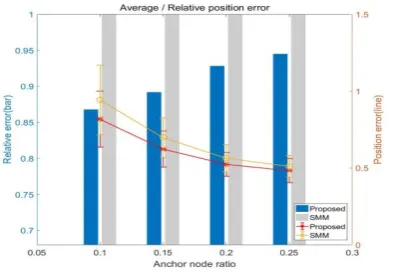
IJSRR, 7(4) Oct. – Dec., 2018 Page 1579 Fig. 5 An average position error and a relative position error with respect to anchor node ratio minimizing the
cost function CT (XDT ).
A. Simulation results
A simulation was performed in a 4 × 4 two-dimensional region. Since all variables
related to distance are relative to the length of one side, there is no unit of length. The total number
of devices was N = 100. It is assumed that the given networks were three-connected network.
Moreover, It was assumed that entire nodes have an identical transmission range and channel
reciprocity is guaranteed. It has assumed that measurement errors were form of the Gaussian
distribution.
It compared the proposed algorithm to the spring mass method that did not consider
reference node position uncertainty. It has been verified performance of the proposed algorithm by
transmission range ratio in the platform of MATLAB. Details of the simulation results are
described.
IJSRR, 7(4) Oct. – Dec., 2018 Page 1580 Fig6 (a) and (b) Estimation results of various node deployments.
Fig7. Estimation results of various node deployments.
B.
Experiment
Results
I confirmed the applicability of the proposed algorithm to reality through experiments. The
verification was conducted with ZigBee-based k-mote devices in practical environment.The
experiment area was a 10m × 10m square region in a gym (Fig. 10).
VI. CONCLUSION
In this paper, to project a localization formula supported the changed SMM for wireless
detector networks. The projected formula at the same time estimates target node position and
corrects reference nodes’ position. There in method, the formula considers reference node position
uncertainty that has been typically unnoticed in past researches. By exploitation the projected
formula, it's potential to estimate a node position wherever the balance between vary errors and
position errors is achieved. A performance verification of the projected formula was conducted in
each simulation and experiments with varied node deployments dynamic multiple parameters. As a
result, the projected formula achieved higher accuracy than previous SMM. It confirmed that the
position estimation accuracy is considerably improved by considering a reference node position
uncertainty.
REFERENCES
1. J. Wang, R. K. Ghosh, and S. K. Das. A survey on sensor localization, J. Control Theory
Appl..2010; 8(1): 2–11.
2. A. Pal. Localization algorithms in wireless sensor networks: Currentapproaches and future
challenges. Netw. Protocols Algorithms, 2010; 2(1):45–73.
3. S. Halder and A. Ghosal,. A survey on mobility-assisted localizationtechniques in wireless
sensor networks. J. Netw. Comput. Appl., Jan 2016; 60: 82–94.
4. A. Chehri, P. Fortier, and P.-M. Tardif. On the TOA estimation forUWB ranging in complex
confined area in Proc. Int. Symp. Signals, Syst. Electron. (ISSSE), Aug. 2007; 533–538.
IJSRR, 7(4) Oct. – Dec., 2018 Page 1581
near-field and far-field sources based on esprit and music method. Prog. Electromagn. Res.,
Jan 2013; 136(1): 435–456.
6. Z. He, Y. Ma, and R. Tafazolli. Improved high resolution TOA estimation for
OFDM-WLAN based indoor ranging. IEEE Wireless Commun. Lett., 2013; 2(2) :163–166.
7. R. Peng and M. L. Sichitiu. Probabilistic localization for outdoor wireless
sensor networks. ACM SIGMOBILE Mobile Comput. Commun. Rev., 2007; 11(1):53–
64.
8. S. Hadzic and J. Rodriguez. Utility based node selection scheme for cooperative localization.
in Proc. IPIN, Sep. 2011;1.
9. Z. Yang and Y. Liu. Quality of trilateration: Confidence-based iterative localization. IEEE
Trans. Parallel Distrib. Syst., May 2010; 21(5): 631–640.
10. S. Lee, H. Woo, and C. Lee. Wireless sensor network localization with connectivity-based
refinement using mass spring and Kalman filtering. EURASIP J. Wireless Commun. Netw.,
April 2012; 1:152–162.
11. G. Han, H. Xu, J. Jiang, L. Shu, T. Hara, and S. Nishio. Path planning using a mobile
anchor node based on trilateration in wireless sensor networks. Wireless Commun. Mobile
Comput., 2013; 13(14): 1324–1336.
12. Keerthana.V. A Survey on VANET & MANET Protocols. International Journal for Research