AUTO CORRELATION PROPERTIES
USING MULTIPLE ULTRA WIDE BAND
(UWB) PULSES
CH.SRINIVASU* Research scholar,
Department of ECE, Andhra University college of Engineering(A), Visakhapatnam, Andhra Pradesh, India
K.RAJA RAJESWARI#
Department of ECE, Andhra University College of Engineering, Visakhapatnam, Andhra Pradesh, India
Abstract:
The concept of a generalized ambiguity function which is a two dimensional autocorrelation function is convenient tool for the performance analysis of carrier free radar represented by a Sequence of (Positive and negative) ideal Gaussian pulses. In this paper the concepts of waveform design and autocorrelation properties are presented based on a physically realizable non-sinusoidal multiple Gaussian pulses. The time variation of the non-sinusoidal signal is that of a UWB frequency spectrum is free from dc component. The autocorrelation function for UWB coded signals composed of finite sequence of GGP signals. The plots of autocorrelation functions of the GGP signals can achieve the target resolution and clutter suppression capabilities. This paper presents the autocorrelation properties of multiple ultra wideband waveforms, because single pulse cannot achieve the desired energy. Hence this paper presents the improvement of energy spectrum by using multiple UWB pulses in time and frequency domain. Traditional methods of ultra wideband radar signal generation suffer from several disadvantages low radiation efficiency, lack of accurate control of signal parameters like shape, pulse repetition interval (PRI) and its spectrum. Multi UWB pulses overcome the disadvantages of traditional non sinusoidal signals. The range resolution functions are observed analytically and are presented two dimensional surfaces as a function of time delay and autocorrelation energy.
Keywords: Non sinusoidal waveforms; Autocorrelation function; radar resolution.
1. Introduction
The rapid technological advances during the last two decades of the 20th century have made it possible for UWB transmission technology.UWB radar is classified into categories
1. Radar system operating with a sinusoidal carrier and large relative bandwidth
2. Carrier free radar system utilizing ultra short pulses referred to as non-sinusoidal waves or impulses.
The relative BW is defined as
c
f
f
∆
=
η
for non -sinusoidal signal (1)
L
f H
L H
f
f
f
+ −
=
η
for non sinusoidal signals (2)Where ∆f is the absolute bandwidth, fc centre frequency, fH and fL are the highest and lowest frequency of
interest. UWB radars have been defined so far as a radar system having a fraction BW larger than 0.25 [1].
The applications of UWB radar [1,2] are achieving high resolution capabilities is one of the most important advantages of UWB radar. The autocorrelation function is an essential desired tool for the performance evaluation of radar signals and systems in terms of targets resolution, target detection in the presence of Additive White Gaussian Noise (AWGN), clutter and interference rejection. The mathematical formulation of the classical autocorrelation function, based on the complex representation of narrowband signals, was first introduced by Ville.j in 1948[3]. In 1953, Woodward [4] applied the concept of the ambiguity function to the field of radar resolution. The classical autocorrelation function for a narrowband complex signal can be represented as
∫
∞
∞ −
−
=
u
t
u
t
dt
R
(
τ
)
(
)
*(
τ
)
(3)ݑሺݐሻ=Transmitted signal;
ݑሺݐ − ߬ሻ=Rreceived Signal with time delay ߬
Where * denotes the complex conjugate, and the variable τ denotes the delay. In general the radar signal autocorrelation function is defined as the normalized response of a matched filter method to a return signal with range rate. The larger the bandwidth , the finer the time resolution.
An ideal autocorrelation function is a single spike with no side lobes center in the range domain. It is known as the autocorrelation function. Its physical realization would yield superior target-resolution capabilities and clutter rejection capabilities for radar Harmuth [5] and Husain [6] have demonstrated that the desired ideal autocorrelation function can be achieved by UWB non-sinusoidal coded waveforms.
2. Waveform Design
The ideal autocorrelation functions presented in this paper are non-sinusoidal waveforms that are composed of a sequence of ideal Gaussian pulses. The pulses presented in this paper are the composition of a sequence of ideal Gaussian pulses. The ideal Gaussian pulses are not physically realizable, and their frequency spectrum includes a dc component which prevents their emission by an antenna.
In this paper the radar resolution theory introduced is revised for a physically realizable signal model referred to as the Generalized Gaussian Pulse (GGP). The GGP is an UWB signal having an attractive auto correlation function and an energy spectrum that is free from a dc component.
A generalized autocorrelation function will be derived for Gaussian pulses as a sequence of GGP signals .The resolution and the clutter suppression capabilities of the multiple UWB signals will be investigated by generating computer plots of the generalized autocorrelation function for different coding structures and signal parameters.
The classical matched-filter theory is used to derive generalized autocorrelation function for non-sinusoidal signals having a hyperfine structure of multiple Gaussian pulses, generation of uncoded waveforms. The Fourier series can also be used in reverse to synthesize a periodic signal by generating and transmitting sinusoidal components obtained from the Fourier expansion of the desired radar waveform. The Fourier series [7] expansion will contain infinite terms. A desired periodic radar waveform can be written as
∑
∞=
+
+
=
1
sin
cos
)
(
n
n n
o
l
x
n
b
l
x
n
a
a
x
∑
− − =−
=
1 1)
cos(
)
(
N n n on
n
t
c
x
f
ω
φ
(5)
ω
o= angular frequency T = pulse repetition intervalo
ω
= 2π/T fo = 250Mhz τ = 0.55ns T=4nsThis truncated expansion will generate an approximation of the ideal waveform .More the number of harmonics, the more closely the generating pulse matches. As the number of oscillators are increased the power in the pulses increases. High power pulses can be generated by using many oscillators of smaller power.
(6)
A related technique is Fourier series based on waveform generation is stepped frequency waveform in which successive pulses are automatically increased in frequency by steps. In the stepped frequency method the received pulses are combined in signal processing to achieve an effective wide bandwidth .Both methods achieve a large BW, or equally narrow pulses .The above technique can be implemented for series of n Gaussian pulses transmitted as
2
4
exp(
)
(
∑
− =
−
=
n n iT
t
i
t
u
π
(7)
(
)
24
exp
∑
− =
−
−
=
−
n n iT
t
i
t
u
τ
π
τ
(8)
Now the autocorrelation function (3) can be calculated for n Gaussian pulses as
∫
∞
∞ −
−
=
u
t
u
t
dt
R
(
)
(
)
*(
)
τ
τ
i= no of Gaussian pulses
t=time in nano seconds
T=pulse width in nano seconds
3. Simulation Results
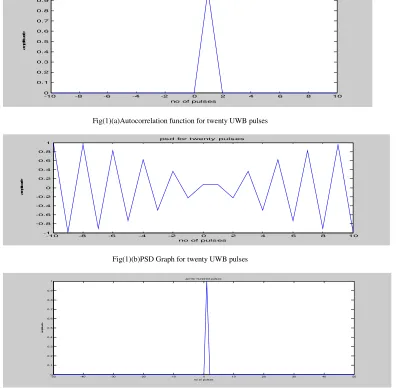
The autocorrelation and power spectral density (PSD) plots are simulated and results have been given from Figs: 1 to 4. The plots explain their characteristics in time and frequency domain.
Fig(1)(a)Autocorrelation function for twenty UWB pulses
Fig(1)(b)PSD Graph for twenty UWB pulses
Fig (2)(a)Autocorrelation function for hundred UWB pulses
Fig(2)(b)PSD Graph for hundred UWB pulses
-10 -8 -6 -4 -2 0 2 4 6 8 10
0 0.1 0.2 0.3 0.4 0.5 0.6 0.7 0.8 0.9 1
ACF for twenty puls es
no of pulses
a
m
p
lit
u
d
e
-10 -8 -6 -4 -2 0 2 4 6 8 10
-1 -0.8 -0.6 -0.4 -0.2 0 0.2 0.4 0.6 0.8 1
ps d for twenty puls es
no of puls es
a
m
p
it
u
d
e
-50 -40 -30 -20 -10 0 10 20 30 40 50 0
0.1 0.2 0.3 0.4 0.5 0.6 0.7 0.8 0.9 1
acf for hundred pulses
no of pulses
a
m
p
li
tu
d
e
-50 -40 -30 -20 -10 0 10 20 30 40 50
-1 -0.8 -0.6 -0.4 -0.2 0 0.2 0.4 0.6 0.8 1
ps d for hundred puls es
no of puls es
a
m
p
lit
u
d
Fig(3)(a)Autocorrelation function for five thousand UWB pulses
Fig(3)(b)PSD function for five thousand UWB pulses
Fig(4)(a)Autocorrelation function for ten thousand UWB pulses
Fig(4)(b)PSD function for ten thousand UWB pulses
-50000 -4000 -3000 -2000 -1000 0 1000 2000 3000 4000 5000
0.1 0.2 0.3 0.4 0.5 0.6 0.7 0.8 0.9
1 ACf for t en t hous and puls es
no of pulses
am
plit
u
de
-2500-1 -2000 -1500 -1000 -500 0 500 1000 1500 2000 2500
-0.8 -0.6 -0.4 -0.2 0 0.2 0.4 0.6 0.8
1 ps d for five thous and puls es
no of pulses
am
pli
tu
d
e
-25000 -2000 -1500 -1000 -500 0 500 1000 1500 2000 2500 0.1
0.2 0.3 0.4 0.5 0.6 0.7 0.8 0.9 1
ACF for five thousand pulses
no of pulses
a
m
p
lit
u
d
e
-500 -400 -300 -200 -100 0 100 200 300 400 500 -1
-0.8 -0.6 -0.4 -0.2 0 0.2 0.4 0.6 0.8 1
ps d for one thousand puls es
no of puls es
a
m
plit
u
de
i
n
v
o
4. Conclusions
As number of UWB pulses increase the peak value of Autocorrelation Function (ACF) increases. Hence range resolution can be improved because of high peak autocorrelation values, which is useful for the detection of targets in the radar applications.
Because of high auto correlation peak values and power spectral densities probability of detection can be improved. Hence constant False Alarm Rate (CFAR) decreases. At zero frequency it shows no energy, which is the advantage of these pulses over sinusoidal signals. So, dc component will not be transmitted through the antenna. The PSD curves are also observed and as number of pulses are more the energy spectral density increases, which is useful for high threshold detection of targets in the presence of noise.
References
[1] Taylor J.D. (Editor) introduction to ultrawideband radar systems-florida,CRC press-1995 [2] Harmuth H.F. nonsinusoidal waves for radio and coomunications.
[3] Ville j.Theory and applications of the notion of the complex signal.
[4] Woodward P.M.Probability and information Theory with applications radar-Newyork Mc.Graw Hill [5] Harmuth H.f.’Synthetic Aperure Based RadarOn Nonsinusoidal Functions”.
[6] Hussain M.G.M.”Principle of high resolution radar based on nonsinusoidal waves part-ll Generalized ambiguity Function”.
[7] Ultra wideband radar using Fourier Synthesized waveform by Gurnam Singh Gill IEEE Transactions on electromagnetic compatibility, vol139, N0.2, May2001.
About Authors
Mr.Ch.Srinivasu obtained his B.Tech. Degree from Jawaharlal Nehru Technological
University , Hyderabad, India in Electronics and Communication Engineering in the year of 1996 with distinction. Obtained M.Tech. in Radar and microwave engineering from Andhra university ,Visakhapatnam, India in the year of 2003.Presently he is pursuing Ph.D. from Andhra University in the area of Ultra Wideband Signal Processing science .He has total of 13 years teaching experience. He is the life member of IETE. He has published total of 9 national and international papers, which includes two international journals. His research areas includes wireless communications ,microwave and radar communications .
Prof.K. Raja Rajeswari obtained her B.E., M.E. and Ph.D. degrees from Andhra