Positive Change in Feedback
Perceptions and Behavior:
A 10-Year Follow-up Study
Dorene F. Balmer, PhD, a, b Rebecca Tenney-Soeiro, MD, MSEd, a, b Erika Mejia, MD, b Beth Rezet, MDa, b
BACKGROUND: Providing and learning from feedback are essential components of medical
education, and typically described as resistant to change. But given a decade of change in the clinical context in which feedback occurs, the authors asked if, and how, perceptions of feedback and feedback behaviors might have changed in response to contextual affordances.
METHODS: In 2017, the authors conducted a follow-up, ethnographic study on 2 general
pediatric floors at the same children’s hospital where another ethnographic study on a general pediatric floor was conducted in 2007. Data sources included (1) 21 and 34 hours of observation in 2007 and 2017, respectively, (2) 35 and 25 interviews with general pediatric attending physicians and residents in 2007 and 2017, respectively, and (3) a review of 120 program documents spanning 2007 to 2017. Data were coded and organized around 3 recommendations for feedback that were derived from 2007 data and served as standards for assessing change in 2017.
RESULTS: Data revealed progress in achieving each recommendation. Compared with 2007,
participants in 2017 more clearly distinguished between feedback and evaluation; residents were more aware of in-the-moment feedback, and they had shifted their orientation from evaluation and grades to feedback and learning. Explanations for progress in achieving recommendations, which were derived from the data, pointed to institutional and national influences, namely, the pediatric milestones.
CONCLUSIONS: On the basis of follow-up, ethnographic data, changes in the clinical context of
pediatric education may afford positive change in perceptions of feedback and feedback behavior and point to influences within and beyond the institution.
abstract
aPerelman School of Medicine, University of Pennsylvania, Philadelphia, Pennsylvania; and bDepartment of
Pediatrics, The Children’s Hospital of Philadelphia, Philadelphia, Pennsylvania
Dr Balmer conceptualized and designed the study, collected data, conducted the initial analyses, drafted the initial manuscript, and reviewed and revised the manuscript; Dr Mejia assisted in data collection and initial analysis and reviewed the manuscript; Drs Tenney-Soeiro and Rezet assisted in study conception and design, participated in the final analysis, and reviewed and revised the manuscript; and all authors approved the final manuscript as submitted and agree to be accountable for all aspects of the work.
DOI: https:// doi. org/ 10. 1542/ peds. 2017- 2950 Accepted for publication Oct 20, 2017
Address correspondence to Dorene F. Balmer, PhD, Department of Pediatrics, The Children’s Hospital of Philadelphia, 34th St and Civic Center Blvd, 9NW72 Main Building, Philadelphia, PA 19104. E-mail: [email protected]
PEDIATRICS (ISSN Numbers: Print, 0031-4005; Online, 1098-4275).
What’s KnOWn On thIs subject: Feedback, which is an essential component of medical education, is typically described as resistant to change. Clinical contexts in which feedback plays out may constrain feedback behavior and the perceptions that underlie that behavior.
What thIs stuDy aDDs: The authors used ethnographic data from 2007 to 2017 to show that changes in the context of pediatric education afforded positive change in the perceptions of feedback and feedback behavior. Data-derived explanations for change point to institutional and national influences.
Providing and learning from feedback, which are essential components of medical education, are emblematic of the resistance to change delineated in Bloom’s1
description of the structure and ideology of medical education. This intransigence is evidenced by the substantial increase in the number of articles that seek to improve feedback.2 Researchers in 4 recent
articles review efforts to improve feedback by employing curricular approaches to change feedback behaviors.2–5 Others suggest that
targeting feedback behaviors is short sighted because context constrains feedback behavior.6–8 They imply
that medical education must adapt to context to reduce its constraints on feedback. But if context constrains feedback behavior, can it not also afford or facilitate change? The veracity of Bloom’s1 claim, as
it is applied to the structure and ideology of pediatric education, seems debatable. Pediatrics is an area that leads change in graduate medical education. Pediatric program directors and the American Board of Pediatrics were among the first to develop and implement milestones assessment in a competency-based framework.9, 10 Pediatric educators
have spearheaded educational innovations at a national level11 and
built infrastructure for educational scholarship.12 The scope of these
changes points to the possibility that the context in which pediatric education unfolds has afforded change in feedback behavior and in the perceptions that drive that change.
In 2007, members of the research team conducted an ethnographic study on a general pediatric inpatient floor in a free-standing children’s hospital to understand learning as it played out in a real-life clinical context. Among other findings, 13–15
they reported on feedback at a national meeting and made 3 data-driven recommendations:
(1) distinguish between evaluation and feedback, (2) increase awareness of in-the-moment feedback embedded in clinical context, and (3) shift the emphasis from performance-oriented evaluation to learning-oriented feedback.16 In 2017, we (the authors)
sought to describe and analyze if and how changes in the pediatric context afforded changes in the perceptions of feedback and feedback behavior over time. To that end, we repeated an ethnographic study by using the 2007 data as a baseline and the 2007 recommendations as standards for assessing change over the course of 10 years. We recognize that assessment is typically associated with individual learners and evaluation with programs. However, participants used these terms interchangeably; we chose to use their words.
MethODs
Ethnography is a tradition in qualitative research that is well positioned to study learning contexts by virtue of its close, prolonged observation in natural settings, interviews with individual actors in the setting, and review of documents.17 With its
anthropological roots, ethnography is the study of social interactions, behaviors, and perceptions that occur in groups and communities, making it an ideal methodology for studying change in learning contexts.18
context
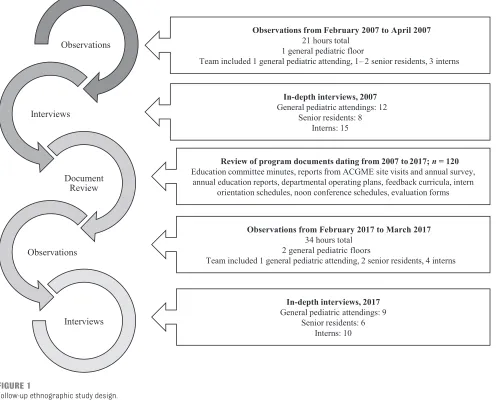
Members of the research team conducted ethnographic studies in 2007 and 2017 at The Children’s Hospital of Philadelphia and targeted general pediatrics because of that division’s leadership in pediatric education (Fig 1). The first study focused on how education plays out in the authentic clinical learning environment on the general pediatric floors, whereas the follow-up study took place on 2 general pediatric
inpatient floors with a focus on feedback.
The first ethnographic study was approved by The Children’s Hospital of Philadelphia Institutional Review Board in 2007; the follow-up was approved in 2017. In 2007, written, informed consent was obtained for the interviews, and verbal consent was obtained for the observation. In 2017, verbal consent was obtained for both the interviews and observation. Confidentiality was ensured by the removal of personal identifiers from observational notes and interview transcripts.
Data collection Interviews
For the interviews, D. B. purposefully sampled interns, senior residents, and attending physicians in general pediatrics who had completed rotations on the general pediatric floors targeted for observation (Fig 1). In 2007, 35 participants were interviewed; all were part of the observation phase. In 2017, 25 participants were interviewed; of these, 9 participants were also observed. Three of the attending physicians interviewed in 2017 had held positions as program directors, and 4 had also participated as attendings in 2007.
The interview guides for 2007 and 2017 consisted of parallel versions of interview questions. In 2007, interns were asked to reflect on their learning, attending physicians were asked to reflect on their teaching, and senior residents were asked to reflect on both teaching and learning.14, 15
evaluation and describe experiences with feedback in nonmedical contexts. Interview questions were derived from the literature and reviewed by the research team.
Observation
From February 2007 to April 2007, D. B. observed on a general pediatrics floor (n = 21 hours). In February 2017 and March 2017, D. B. observed on 2 general pediatrics floors (n = 34 hours). In both 2007 and 2017, she observed the team (defined in Fig 1) during morning rounds. D. B. followed standard ethnographic technique, in which the observer interacts with participants closely enough to gain an insider’s
FIGuRe 1
Follow-up ethnographic study design.
FIGuRe 2
perspective but does not engage in the activities under study. She took notes during rounds and at the end of rounds, and she routinely checked her understanding of observed feedback with residents to whom feedback was directed. She transcribed notes from her observations into an electronic document.
Document Review
D. B. collected and reviewed a total of 120 documents for evidence of contextual changes. Documents included official departmental reports, faculty development curricula, residency lecture schedules, and evaluation forms.
Data analysis
Data collection and analysis were overlapping processes. Data in the form of interview transcripts and observation notes from 2007 and 2017 (a total of 102 documents) were managed with ATLAS.ti; program documents were summarized in a spreadsheet. D. B. inductively coded interview transcripts and notes from her observations by applying codes (ie, words or phrases describing important concepts) to segments of data. Coding occurred in an iterative fashion; codes were revised as patterns in incoming data became more apparent. Although informed by codes applied to the 2007 data set, which focused on learning, the 2017 investigation focused on feedback, and its data yielded more feedback-specific codes.
The research team met periodically to review the codes; as the codes stabilized, D. B. created a final code list and applied those codes to the data. In the later stages of analysis, she clustered coded data to create cohesive categories and used the recommendations for feedback from 2007 as a lens to describe and analyze changes in perceptions of feedback and feedback behavior. We reviewed clusters of coded
data and looked for evidence to confirm or refute the achievement of recommendations and to discuss potential interpretations.
To illuminate qualitative data, we tallied the frequency of application of codes that were central to the study (eg, in-the-moment feedback and summative evaluation) and the number of observed patient presentations on morning rounds. To shed light on change over time, we calculated the percent application in 2007 and 2017.
We attended to data quality by using the following criteria: credibility, dependability, and confirmability.19–21 To enhance
credibility, we triangulated data sources (intern, senior resident, attending physician, and program director perspectives) and data collection methods (interviews, observations, and document
review). We enhanced dependability through iterative data collection and with a single interviewer and observer. Finally, our team approach and peer examination enhanced confirmability, as did D. B.’s routine member checks with residents whom she observed. E. M., B. R., and R. T. S. brought a chief resident, program director, and medical educator perspective, respectively.
Results
Taken together, data from interviews, observations, and document review indicated progress in achieving the 2007 recommendations. We divided our results into 2 parts: (1) evidence of progress in achieving each of the 3 recommendations, and (2) explanations for this progress as derived from the data.
Progress in achieving Recommendations
Recommendation 1: Distinguish Between Feedback and Evaluation In 2007, residents and attending physicians often conflated feedback
and evaluation. For example, 1 intern described evaluation when asked about feedback. “You give feedback for the specific rotation. It’s sort of fill out the questionnaire, which is okay. But I think after filling out so many of these forms, I think toward the end, they just sort of check boxes.”
In contrast, residents and attending physicians in 2017 did not even use the word “evaluation” when responding to questions about feedback. When asked to distinguish feedback from evaluation, they reported (in order of frequency) that feedback was actionable or helpful, conversational, constructive, and timely. In contrast, evaluation was broad strokes, grade oriented, formal, and documented. A 2017 intern made this distinction, “I find that evaluations hit the main points of competency that are required, but I always found feedback to be a lot more engaging, rewarding, and helpful than evaluation.”
Although not intended to be
evaluation, formal feedback was also understood as “what administration wants us to do.” Formal feedback typically occurred in the form of Feedback Friday, a time set aside on Fridays for attending physicians and senior residents to give feedback to interns. Despite its established place in the residency curriculum, the actual occurrence of Feedback Friday was routinely described as hit or miss.
Recommendation 2: Increase
Awareness of in-the-Moment Feedback Compared with Feedback Friday, in-the-moment feedback was more nuanced. A 2017 intern distinguished between formal feedback and in-the-moment feedback:
In-the-moment feedback was also called real-time feedback, just-in-time feedback, or informal feedback. Regardless of what it was called, in-the-moment feedback, as observed and confirmed by residents, typically played out like this:
The intern presents an infant admitted with dehydration and a rule-out of sepsis. She describes physical examination findings, lists laboratory results, and current medications, and then adds, [Intern] “Mom has a difficult time breastfeeding. ... I want mom to see lactation, but if she is not able to breastfeed, then we can do [intravenous (IV)] fluid or use formula.”
[Attending] “So what do you see as her #1 problem?”
[Intern] “Dehydration.”
[Attending] “Is she rehydrated? Before you talk about maintaining hydration, you need to rehydrate. ... I’d much rather use formula than IV fluids.”
[Intern] “But this mom is all natural; she took a lot of supplements and doesn’t want to use formula.”
[Attending] “I see where you are going. Not to be disrespectful, but the [infant] got dehydrated naturally. You could push back and say you want to start formula. Remember, IV fluids are totally not natural either.”
Residents recognized in-the-moment feedback as overlapping with teaching; either way, it was information they could use to improve. One 2017 senior resident talked about in-the-moment feedback this way, “By having someone agree or disagree or fine tune your plan, that is a way of giving that person some feedback. It’s not just teaching about management, it’s a form of feedback.” Interns also recognized in-the-moment feedback, albeit sometimes hidden. One shared her process of recognizing feedback. “If, at the end of the week, I feel like I didn't get feedback, I’m like, ‘Wait, no... that day on rounds, somebody made a comment about how I interacted with nursing and kept them updated.’ I can get feedback from anyone. I think you just have to be a little more cognizant of organic feedback to recognize it.”
In-the-moment feedback was more frequently spoken of in 2017 compared with 2007. In 2007, it was mentioned in interviews by 33%, 13%, and 33% of interns, senior residents, and attendings, respectively. But in 2017, in-the-moment feedback was mentioned by 90%, 100%, and 67% of interns, senior residents, and attending physicians, respectively. This increased awareness was supported by observational data. There was substantially more in-the-moment feedback observed in 2017: 83% (126 of 156) vs 44% (33 of 75) of observed patient presentations in 2017 and 2007, respectively Although residents talked about in-the-moment feedback more frequently, and observational data pointed to its increased occurrence in 2017, attending physicians voiced a different perspective. They routinely said, in 2017, that residents did not recognize in-the-moment feedback.
“I don’t think residents notice it until someone says, ‘How did you feel about that feedback?’”
Recommendation 3: Shift Emphasis From Performance-Oriented Evaluation to Learning-Oriented Feedback
In 2007, residents and attending physicians recognized evaluation and formal feedback as what were supposed to happen, but no one said that either was useful for learning. A 2007 intern conflated evaluation and feedback and questioned the utility of the latter. “I’d say maybe 40% of the attendings give us the written evaluation of feedback. Less actually tell us the feedback before it comes up on the computer. ... Sometimes, you don’t get to know the attending, and it’s not that meaningful.”
In 2017, residents, particularly interns, consistently reported little regard for evaluation and grading but positive regard for in-the-moment feedback as implicit education. Interns associated evaluation with being a medical student. One said,
“Evaluation is more of a grade, and at this point in my career, it is much further back in my mind. I care much less about an evaluation compared to when I was a medical student.”
For interns, in-the-moment feedback was useful because “it’s timely, it’s based on observation, it’s based on that day’s occurrences, and it’s regular.” Senior residents highlighted that in-the-moment feedback is embedded in clinical work. “I try to give feedback along the way. If an intern does something good, I’ll say,
‘good pick up.’” Attending physicians highlighted the timeliness of in-the-moment feedback. “I do think some things need to be addressed just in time. And if someone does something excellently on rounds, I will say right there, “Now that was a fantastic presentation. Everyone, please take note.’”
Only in 2017, when residents were more aware of in-the-moment feedback, did they mention an unintended consequence of Feedback Friday: it could blur the recognition of in-the-moment feedback. “We really emphasize Feedback Friday as a thing we should be doing, and for good reason. But maybe it is to the detriment of recognizing how much feedback we are getting throughout the week.”
Data-Derived explanations for Progress in achieving Recommendations Institutional Influence
In 2017, residents and attending physicians offered clues that helped explain the progress made in achieving the 2007 feedback recommendations. In 2007, the only reference to feedback training was that it did not occur. By 2017, training was offered to attending physicians across the institution, and there were focused efforts within the division of general pediatrics to improve feedback. One attending recalled, “There was a lot of
year. ... There was an intentional effort to rally faculty so that feedback was a more active part of our time on service.”
Efforts to train attending physicians about feedback were matched with efforts in the residency program to teach residents how to recognize and give feedback. One 2017 senior resident said, “The big thing we talk about a lot is what counts as feedback.” As early as 2009, residents-as-teachers sessions were introduced into intern orientation. A 2017 intern remarked, “Feedback in the moment is something we are taught to do better. I try to do it with my [medical] students when they present a patient.” And from June 2016 to January 2017, chief residents led an initiative to encourage
attending physicians to give goal-directed feedback to interns. Feedback training was accompanied by the leadership’s recognition of feedback. Feedback was named as a departmental priority in 2016 and included in the 2017 annual operating plan, and thus reinforcing its importance within the institution.
National Influence
In 2010, the Accreditation Council for Graduate Medical Education changed its annual resident survey to ask about the quality of feedback and not merely the presence or absence of it, and thus indicating an evolved understanding of feedback at a national level. In 2014, the Accreditation Council for Graduate Medical Education mandated the reporting of pediatric milestone data, representing a shift to understanding learning as a developmental
progression. The documents that were reviewed reflected that shift. For example, attending physicians in 2007 were asked to rate resident performance by using a normative scale (at, above, or below residents at the same level), whereas attending physicians in 2017 were asked to rate resident performance by using
a criterion scale with behavioral anchors ranging from preintern to postresidency.
No participant explicitly identified these influences in the 2017 interviews, suggesting that national influence on feedback was subtle and did not rise to the level of awareness. However, attending physicians who served as program directors routinely used a development framework to give feedback. “I always try to phrase it in the developmental sense: ‘This is where you are at now, and this is where you want to be.’”
DIscussIOn
Changes in a pediatric context over the course of 10 years afforded positive change in the perceptions of feedback and feedback behaviors and progress in achieving data-driven recommendations. Compared with their 2007 counterparts, residents and attending physicians in 2017 more clearly distinguished between feedback and evaluation; residents were more aware of in-the-moment feedback and had shifted their orientation from evaluation and grades to learning and feedback. These findings challenge the notion of medical education being resistant to change and offer hope that pediatrics is cultivating a learning context in which feedback is differentiated from evaluation and is perceived as useful for learning.22, 23
The findings also call for a broader understanding of feedback that aligns with residents’ perceptions of feedback as information they can use for improvement.3
Although feedback training and departmental leadership seemed to influence positive change, they did so synergistically with subtle, national changes, namely, the pediatric milestones (Fig 2). In contrast to a norm-referenced assessment framework, the milestones are a developmental
assessment framework that describe a continuum of development toward mastery. Change to a developmental framework may help residents use feedback as a roadmap for their learning trajectory.10, 24, 25
Other disciplines can learn from our experience in pediatrics and dovetail milestone implementation with teaching to give feedback by using a developmental framework. Helping attending physicians across disciplines recognize the subtleties of feedback is an essential part of these efforts to change the context in which feedback plays out.
Despite the positive changes we report, there is room for
improvement. Well-intended efforts, such as Feedback Friday, may have unintended consequences.26 It may
be worthwhile to emphasize in-the-moment feedback as part of teaching in clinical contexts because this type of implicit learning is particularly powerful and pervasive.14, 27–30
but did not observe formal feedback. In the 2017 interviews, we asked participants to distinguish between feedback and evaluation and in so doing may have biased their responses. Finally, we limited our discussion of contextual change to those identified by residents and attending physicians; future researchers might explore evolving social norms or other accreditation mandates, which could also influence change.
Copyright © 2018 by the American Academy of Pediatrics
FInancIal DIsclOsuRe: The authors have indicated they have no financial relationships relevant to this article to disclose. FunDInG: No external funding.
POtentIal cOnFlIct OF InteRest: The authors have indicated they have no potential conflicts of interest to disclose.
abbRevIatIOn IV: intravenous cOnclusIOns
By using follow-up ethnography to study contextual change, we report progress in achieving the data-driven recommendations made in 2007. Changes in the contexts in which pediatric education plays out may afford positive change in the perceptions of feedback and feedback behavior.
acKnOWleDGMents
We thank Gail Slap, MD, MS, and Dan Schumacher MD, MEd, for their insightful comments on the article. We especially appreciate the residents and general pediatric attending physicians who contributed to this study.
ReFeRences
1. Bloom SW. Structure and ideology in medical education: an analysis of resistance to change. J Health Soc
Behav. 1988;29(4):294–306
2. Bing-You R, Hayes V, Varaklis K, Trowbridge R, Kemp H, McKelvy D. Feedback for learners in medical education: what is known? A scoping review. Acad Med. 2017;92(9):1346–1354
3. Johnson CE, Keating Jl, Boud DJ, et al. Identifying educator behaviours for high quality verbal feedback in health professions education: literature review and expert refinement. BMC
Med Educ. 2016;16:96
4. Kornegay J, Kraut A, Manthey D, et al. Feedback in medical education: a critical appraisal. Acad Emerg
Med Education and Training.
2017;1(2):98–109
5. van de Ridder JM, McGaghie WC, Stokking KM, ten Cate OT. Variables that affect the process and outcome of feedback, relevant for medical training: a meta-review. Med Educ. 2015;49(7):658–673
6. Ramani S, Post SE, Könings K, Mann K, Katz JT, van der Vleuten C. “It’s just not the culture”: a qualitative study exploring residents’ perceptions of the impact of institutional culture on feedback. Teach Learn Med. 2017;29(2):153–161
7. lefroy J, Watling C, Teunissen PW, Brand P. Guidelines: the do’s, don’ts and don’t knows of feedback for clinical education. Perspect Med Educ. 2015;4(6):284–299
8. Watling C, Driessen E, van der Vleuten CP, lingard l. learning culture and feedback: an international study of medical athletes and musicians. Med Educ. 2014;48(7):713–723
9. Carraccio C, Benson B, Burke A, et al. Pediatrics milestones. J Grad Med Educ. 2013;5(1, suppl 1):59–73 10. Hicks PJ, Margolis M, Poynter SE,
et al; Association of Pediatric Program Directors longitudinal Educational Assessment Research Network–NBME Pediatrics Milestones Assessment Group. The pediatrics milestones assessment pilot: development of workplace-based assessment content, instruments, and processes. Acad Med. 2016;91(5):701–709
11. Andrews JS, Bale JF Jr, Soep JB, et al; Education in Pediatrics Across the Continuum Study Group. First steps toward realizing the dream of competency-based education [published online ahead of print October 11, 2017]. Acad Med. doi: 10. 1097/ ACM. 0000000000002020 12. Schwartz A, Young R, Hicks PJ;
Association of Pediatric Program Directors longitudinal Educational
Assessment Research Network. Medical education practice-based research networks: facilitating collaborative research. Med Teach. 2016;38(1):64–74
13. Balmer DF, Giardino AP, Richards BF. The dance between attending physicians and senior residents as teachers and supervisors. Pediatrics. 2012;129(5):910–915
14. Balmer DF, Master Cl, Richards B, Giardino AP. Implicit versus explicit curricula in general pediatrics education: is there a convergence?
Pediatrics. 2009;124(2). Available at:
www. pediatrics. org/ cgi/ content/ full/ 124/ 2/ e347
15. Balmer DF, Master Cl, Richards BF, Serwint JR, Giardino AP. An ethnographic study of attending rounds in general paediatrics: understanding the ritual. Med Educ. 2010;44(11):1105–1116
16. Balmer D, Master C, Giardino A. Feedback and evaluation: a case of mistaken identity. In: Pediatric
Academic Society; May 4, 2008;
Honolulu, HI
17. Hammersley M, Atkinson P. Ethnography:
Principles in Practice. london, United
Kingdom: Routledge; 1995
research: AMEE guide no. 80. Med
Teach. 2013;35(8):e1365–e1379
19. Frambach JM, van der Vleuten CP, Durning SJ. AM last page. Quality criteria in qualitative and quantitative research. Acad Med. 2013;88(4):552 20. Hanson Jl, Balmer DF, Giardino AP.
Qualitative research methods for medical educators. Acad Pediatr. 2011;11(5):375–386
21. Patton MQ. Qualitative Research and
Evaluation Methods. 4th ed. Thousand
Oaks, CA: Sage Publications; 2015 22. Kraut A, Yarris lM, Sargeant J.
Feedback: cultivating a positive culture.
J Grad Med Educ. 2015;7(2):262–264
23. Watling CJ. Unfulfilled promise, untapped potential: feedback
at the crossroads. Med Teach. 2014;36(8):692–697
24. Carraccio C, Englander R, Gilhooly J, et al. Building a framework of entrustable professional activities, supported by competencies and milestones, to bridge the educational continuum.
Acad Med. 2017;92(3):324–330
25. Schumacher DJ, lewis KO, Burke AE, et al. The pediatrics milestones: initial evidence for their use as learning road maps for residents. Acad Pediatr. 2013;13(1):40–47
26. Eisner E. The Educational Imagination. New York, NY: Macmillan Publishing; 1985
27. Stern DT. In search of the informal curriculum: when and where
professional values are taught. Acad Med. 1998;73(suppl 10):S28–S30 28. Balmer DF, Quiah S, DiPace J, Paik
S, Ward MA, Richards BF. learning across the explicit, implicit, and extra-curricula: an exploratory study of the relative proportions of residents’ perceived learning in clinical areas at three pediatric residency programs.
Acad Med. 2015;90(11):1547–1552
29. Hafferty FW. Beyond curriculum reform: confronting medicine’s hidden curriculum. Acad Med. 1998;73(4):403–407
DOI: 10.1542/peds.2017-2950 originally published online December 7, 2017;
2018;141;
Pediatrics
Dorene F. Balmer, Rebecca Tenney-Soeiro, Erika Mejia and Beth Rezet
Study
Positive Change in Feedback Perceptions and Behavior: A 10-Year Follow-up
Services
Updated Information &
http://pediatrics.aappublications.org/content/141/1/e20172950
including high resolution figures, can be found at:
References
http://pediatrics.aappublications.org/content/141/1/e20172950#BIBL
This article cites 26 articles, 2 of which you can access for free at:
Subspecialty Collections
atistics_sub
http://www.aappublications.org/cgi/collection/research_methods_-_st
Research Methods & Statistics
dev_sub
http://www.aappublications.org/cgi/collection/teaching_curriculum_
Teaching/Curriculum Development
b
http://www.aappublications.org/cgi/collection/medical_education_su
Medical Education
following collection(s):
This article, along with others on similar topics, appears in the
Permissions & Licensing
http://www.aappublications.org/site/misc/Permissions.xhtml
in its entirety can be found online at:
Information about reproducing this article in parts (figures, tables) or
Reprints
http://www.aappublications.org/site/misc/reprints.xhtml
DOI: 10.1542/peds.2017-2950 originally published online December 7, 2017;
2018;141;
Pediatrics
Dorene F. Balmer, Rebecca Tenney-Soeiro, Erika Mejia and Beth Rezet
Study
Positive Change in Feedback Perceptions and Behavior: A 10-Year Follow-up
http://pediatrics.aappublications.org/content/141/1/e20172950
located on the World Wide Web at:
The online version of this article, along with updated information and services, is
by the American Academy of Pediatrics. All rights reserved. Print ISSN: 1073-0397.